Is Exact Markovianity Fundamental Once Time Is Relational?
Pith reviewed 2026-06-27 18:38 UTC · model grok-4.3
The pith
Relational time via finite-resolution quantum clocks makes open quantum dynamics generically non-Markovian even for local interactions.
A machine-rendered reading of the paper's core claim, the machinery that carries it, and where it could break.
Core claim
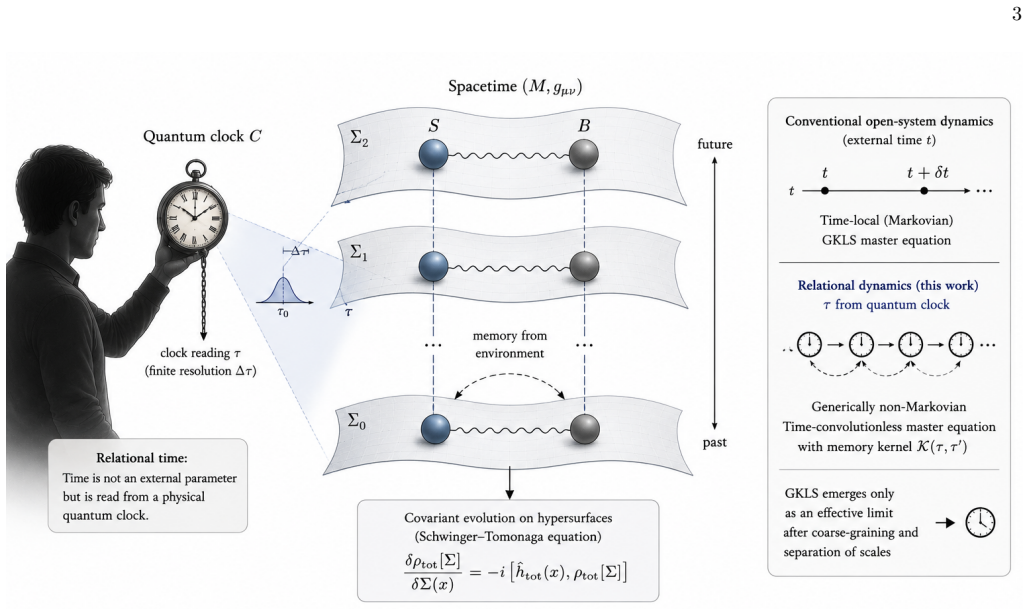
By incorporating finite-resolution quantum clocks into the Schwinger-Tomonaga formalism, the authors derive a covariant master equation on spacetime hypersurfaces whose reduced dynamics is generically non-Markovian for local interactions, with the memory kernel generated jointly by environmental correlations and clock fluctuations; the Gorini-Kossakowski-Lindblad-Sudarshan structure emerges only after relational coarse-graining, so that exact Markovian evolution is effective rather than fundamental.
What carries the argument
The covariant master equation on spacetime hypersurfaces obtained from the Schwinger-Tomonaga formalism with finite-resolution quantum clocks, whose reduced dynamics encodes non-Markovianity from clock fluctuations.
If this is right
- Reduced dynamics remains non-Markovian due to clock fluctuations even when interactions are strictly local.
- The standard Gorini-Kossakowski-Lindblad-Sudarshan Markovian form requires an additional relational coarse-graining step beyond the covariant master equation.
- In the sharp-clock limit the derived equation reduces exactly to the Anastopoulos-Hu gravitational decoherence equation.
- Exact Markovian evolution appears only as an effective limit rather than a fundamental feature once time is treated relationally.
Where Pith is reading between the lines
- The result suggests that any quantum treatment of time at finite resolution will generically introduce memory effects into open-system evolution, independent of the details of the environment.
- This approach could be extended to other relational time frameworks, such as those based on matter degrees of freedom, to check whether non-Markovianity persists.
- Laboratory tests using high-precision atomic clocks in controlled relativistic settings might detect the predicted memory kernel arising from clock fluctuations.
Load-bearing premise
Finite-resolution quantum clocks can be consistently incorporated into the Schwinger-Tomonaga formalism to produce a covariant master equation whose reduced dynamics directly encodes non-Markovianity from clock fluctuations without additional modeling assumptions about the environment or interaction locality.
What would settle it
A concrete demonstration that the reduced dynamics of a relativistic open quantum system with a finite-resolution clock remains exactly Markovian for local interactions, without any relational coarse-graining step, would falsify the generic non-Markovianity claim.
Figures
read the original abstract
Markovian open quantum theory assumes evolution with respect to an external classical time parameter, yet no preferred notion of time exists fundamentally in relativistic physics. We resolve this tension by formulating relativistic open quantum dynamics relationally through finite-resolution quantum clocks. Using the Schwinger-Tomonaga formalism, we derive a covariant master equation directly on spacetime hypersurfaces and show that the resulting reduced dynamics is generically non-Markovian even for local interactions. Environmental correlations and clock fluctuations jointly generate the memory kernel, while the Gorini-Kossakowski-Lindblad-Sudarshan (GKLS) structure emerges only after relational coarse-graining, implying that exact Markovian evolution is effective rather than fundamental. In the sharp-clock limit, the formalism reduces to the Anastopoulos-Hu gravitational decoherence equation.
Editorial analysis
A structured set of objections, weighed in public.
Referee Report
Summary. The paper claims to resolve the tension between Markovian open quantum theory (which assumes an external classical time) and the absence of a preferred time in relativistic physics by formulating open quantum dynamics relationally via finite-resolution quantum clocks. Using the Schwinger-Tomonaga formalism, it derives a covariant master equation on spacetime hypersurfaces whose reduced dynamics is generically non-Markovian even for local interactions; environmental correlations and clock fluctuations generate the memory kernel, the GKLS structure appears only after relational coarse-graining, and the formalism reduces to the Anastopoulos-Hu gravitational decoherence equation in the sharp-clock limit.
Significance. If the derivation holds, the result would indicate that exact Markovian evolution is an effective rather than fundamental feature of open quantum systems once time is treated relationally, with potential implications for decoherence models in relativistic and quantum-gravitational settings. The claimed reduction to a known equation supplies a useful consistency check.
major comments (1)
- [Abstract] Abstract: the central claim rests on a derivation of a covariant master equation from the Schwinger-Tomonaga formalism with finite-resolution clocks, yet the manuscript supplies no equations, intermediate steps, or explicit form of the memory kernel; without these the non-Markovianity assertion and the statement that GKLS emerges only after coarse-graining cannot be verified.
minor comments (1)
- The manuscript would benefit from an explicit statement of the derived master equation and the conditions under which the memory kernel vanishes.
Simulated Author's Rebuttal
We thank the referee for their report. The single major comment concerns the absence of explicit equations and derivation steps. We address it directly below.
read point-by-point responses
-
Referee: [Abstract] Abstract: the central claim rests on a derivation of a covariant master equation from the Schwinger-Tomonaga formalism with finite-resolution clocks, yet the manuscript supplies no equations, intermediate steps, or explicit form of the memory kernel; without these the non-Markovianity assertion and the statement that GKLS emerges only after coarse-graining cannot be verified.
Authors: The abstract is intentionally concise and contains no equations, as is conventional. The full manuscript, however, derives the covariant master equation on spacetime hypersurfaces from the Schwinger-Tomonaga formalism with finite-resolution clocks. Sections detailing the reduced dynamics explicitly construct the memory kernel arising from environmental correlations and clock fluctuations, demonstrate its generic non-Markovian character even for local interactions, and show that the GKLS form appears only after relational coarse-graining. The reduction to the Anastopoulos-Hu equation in the sharp-clock limit is also derived. If these sections were not located, we can add explicit cross-references or an appendix summarizing the key steps. revision: partial
Circularity Check
No significant circularity detected
full rationale
The paper derives the covariant master equation from the standard Schwinger-Tomonaga formalism by incorporating finite-resolution quantum clocks on spacetime hypersurfaces. The resulting non-Markovian reduced dynamics and the emergence of GKLS structure only after coarse-graining follow directly from this construction, with the sharp-clock limit recovering the external Anastopoulos-Hu equation. No self-definitional steps, fitted inputs renamed as predictions, or load-bearing self-citations are present in the abstract or described derivation chain. The central claim that exact Markovianity is effective is a direct consequence of the relational time incorporation and does not reduce to its own inputs by construction.
Axiom & Free-Parameter Ledger
Forward citations
Cited by 1 Pith paper
-
Spin-Induced Fractal Time-Crystal-Like Dynamics and Non-Markovian Memory in the Bateman Dual Oscillator
Spin-induced noncommutativity in the Bateman oscillator yields discrete scaling covariance in amplified and damped modes, producing self-similar evolution and history-dependent non-Markovian reduced dynamics.
Reference graph
Works this paper leans on
-
[1]
Gorini, A
V. Gorini, A. Kossakowski, and E. C. G. Sudarshan, Journal of Mathematical Physics17, 821 (1976)
1976
-
[2]
Lindblad, Communications in Mathematical Physics 48, 119 (1976)
G. Lindblad, Communications in Mathematical Physics 48, 119 (1976)
1976
-
[3]
Gorini, A
V. Gorini, A. Frigerio, M. Verri, A. Kossakowski, and E. C. G. Sudarshan, Rept. Math. Phys.13, 149 (1978)
1978
-
[4]
Trushechkin, Phys
A. Trushechkin, Phys. Rev. A103, 062226 (2021)
2021
-
[5]
Non-Markovian dynamics in open quantum systems
H.-P. Breuer, E.-M. Laine, J. Piilo, and B. Vacchini, Rev. Mod. Phys.88, 021002 (2016), arXiv:1505.01385 [quant- ph]
work page internal anchor Pith review Pith/arXiv arXiv 2016
-
[6]
Tomonaga, Progress of Theoretical Physics1, 27 (1946)
S.-I. Tomonaga, Progress of Theoretical Physics1, 27 (1946)
1946
-
[7]
Schwinger, Physical Review74, 1439 (1948)
J. Schwinger, Physical Review74, 1439 (1948)
1948
-
[8]
Breuer and F
H.-P. Breuer and F. Petruccione, eds.,Relativistic Quan- tum Measurement and Decoherence, Lecture Notes in Physics, Vol. 526 (Springer, Berlin, Heidelberg, 2000)
2000
-
[9]
B.-L. B. Hu and E. Verdaguer,Semiclassical and Stochas- tic Gravity: Quantum Field Effects on Curved Spacetime, Cambridge Monographs on Mathematical Physics (Cam- bridge University Press, Cambridge, 2020)
2020
-
[10]
Jana,Aspects of open quantum field theory, Ph.D
C. Jana,Aspects of open quantum field theory, Ph.D. the- sis, Tata Inst. (2021)
2021
-
[11]
P. Nandi and F. G. Scholtz, Annals Phys.464, 169643 (2024), arXiv:2312.15750 [hep-th]
-
[12]
Giulini, E
D. Giulini, E. Joos, C. Kiefer, J. Kupsch, I.-O. Sta- matescu, and H. D. Zeh,Decoherence and the Appear- ance of a Classical World in Quantum Theory(Springer- Verlag, Berlin, 1996)
1996
-
[13]
D. N. Page and W. K. Wootters, Phys. Rev. D27, 2885 (1983)
1983
-
[14]
Rovelli, Phys
C. Rovelli, Phys. Rev. D43, 442 (1991)
1991
-
[15]
Gambini, R
R. Gambini, R. A. Porto, and J. Pullin, Phys. Rev. Lett. 93, 240401 (2004)
2004
-
[16]
Breuer and F
H.-P. Breuer and F. Petruccione, Journal of Physics A: Mathematical and General31, 33 (1998)
1998
-
[17]
Di´ osi, Physical Review D106, L051901 (2022)
L. Di´ osi, Physical Review D106, L051901 (2022)
2022
-
[18]
Breuer and F
H.-P. Breuer and F. Petruccione, Journal of Physics A: Mathematical and General31, 9605 (1998)
1998
-
[19]
Haag,Local quantum physics: Fields, particles, alge- bras(1992)
R. Haag,Local quantum physics: Fields, particles, alge- bras(1992)
1992
-
[20]
Kashiwagi and A
K. Kashiwagi and A. Matsumura, Phys. Rev. D111, 045014 (2025)
2025
-
[21]
S. D. H. Hsu, Physics Letters B872, 140053 (2026)
2026
-
[22]
Di´ osi, arXiv preprint arXiv:2602.06845 (2026), arXiv:2602.06845 [quant-ph]
L. Di´ osi, arXiv preprint arXiv:2602.06845 (2026), arXiv:2602.06845 [quant-ph]
-
[23]
Anastopoulos and B
C. Anastopoulos and B. L. Hu, Classical and Quantum Gravity30, 165007 (2013). 7 SUPPLEMENT AL MA TERIAL This supplemental material derives the relational memory kernel appearing in Eq. (11) of the main text from a microscopic system—a clock-bath model—and shows explicitly how the Anastopoulos-Hu gravitational decoherence equation emerges in the sharp-cloc...
2013
discussion (0)
Sign in with ORCID, Apple, or X to comment. Anyone can read and Pith papers without signing in.