Hawking Radiation from the Dymnikova Regular Black Hole
Pith reviewed 2026-06-27 18:01 UTC · model grok-4.3
The pith
The Dymnikova regular black hole's Hawking temperature falls rapidly near its cold remnant, suppressing luminosity and leaving fermion-dominated residual flux.
A machine-rendered reading of the paper's core claim, the machinery that carries it, and where it could break.
Core claim
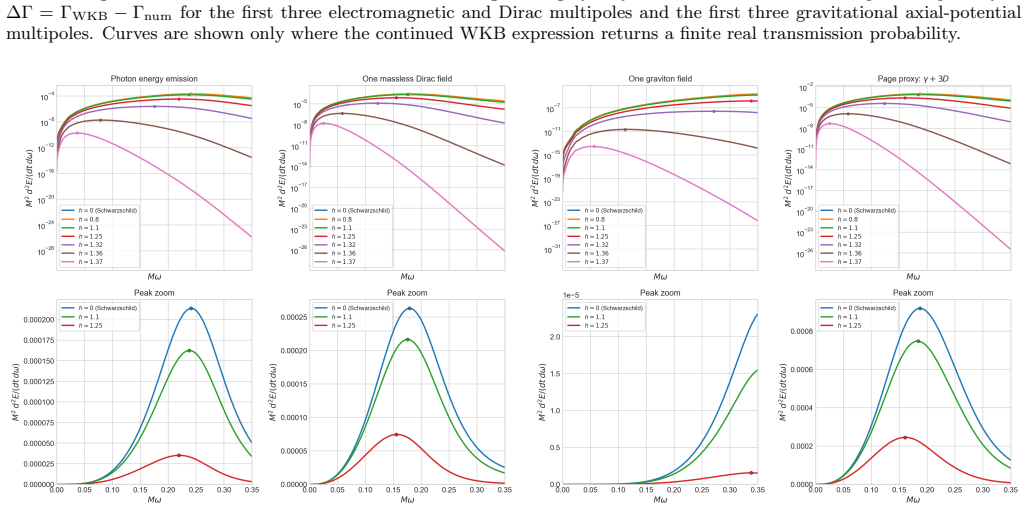
In the Dymnikova regular black hole the greybody factors of Standard Model fields and gravitons change only modestly as the geometry approaches the remnant, yet the rapid decrease of the Hawking temperature strongly suppresses the total luminosity; the photon, light-fermion and graviton channels all fade near the endpoint, the gravitational contribution remains subdominant, and the residual massless flux becomes increasingly fermion dominated because the photon channel is suppressed more efficiently.
What carries the argument
The Dymnikova metric with its de Sitter core and cold extremal remnant, together with the numerically computed greybody factors that determine the emission spectra at each stage of the adiabatic evaporation.
If this is right
- Lifetime estimates are cutoff times to near-extremal configurations rather than complete evaporation times.
- The gravitational channel stays subdominant throughout the evaporation.
- The photon channel is suppressed more efficiently than the fermion channels near the endpoint.
- The residual massless flux is increasingly fermion dominated as the black hole cools.
Where Pith is reading between the lines
- Similar temperature-driven suppression may appear in other regular black-hole models that end at cold remnants.
- Late-time Hawking spectra from any such objects would show a relative excess of fermions over photons.
- If primordial black holes of this type exist, their final stages could leave a detectable fermion excess in cosmic backgrounds.
- The test-field treatment leaves open whether back-reaction can prevent the geometry from reaching the zero-temperature limit.
Load-bearing premise
The background geometry is held fixed in the test-field approximation and the metric is assumed to terminate in a cold extremal remnant whose temperature approaches zero asymptotically.
What would settle it
A calculation that includes back-reaction and shows the temperature stabilizing at a finite nonzero value instead of continuing to zero would falsify the suppression picture.
Figures

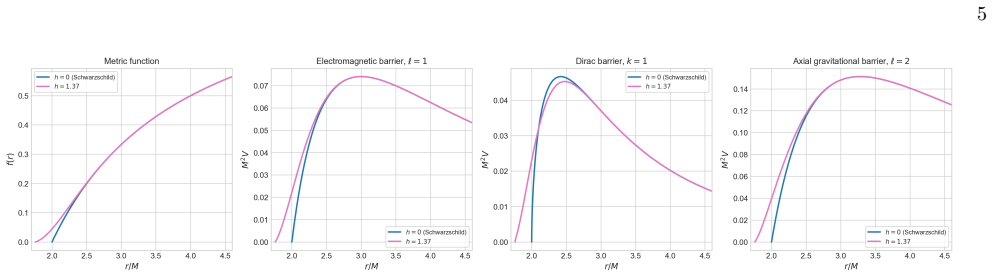
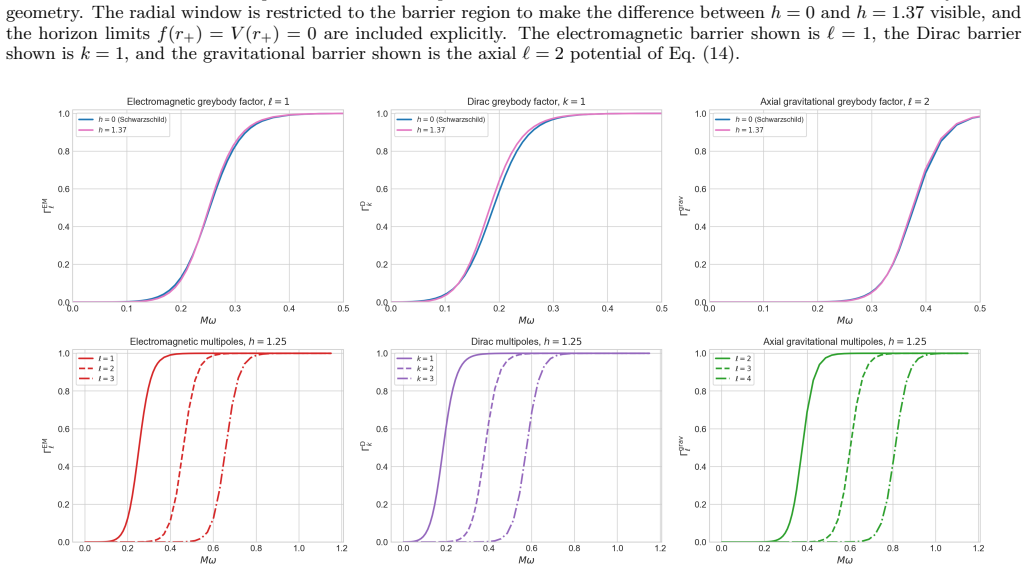
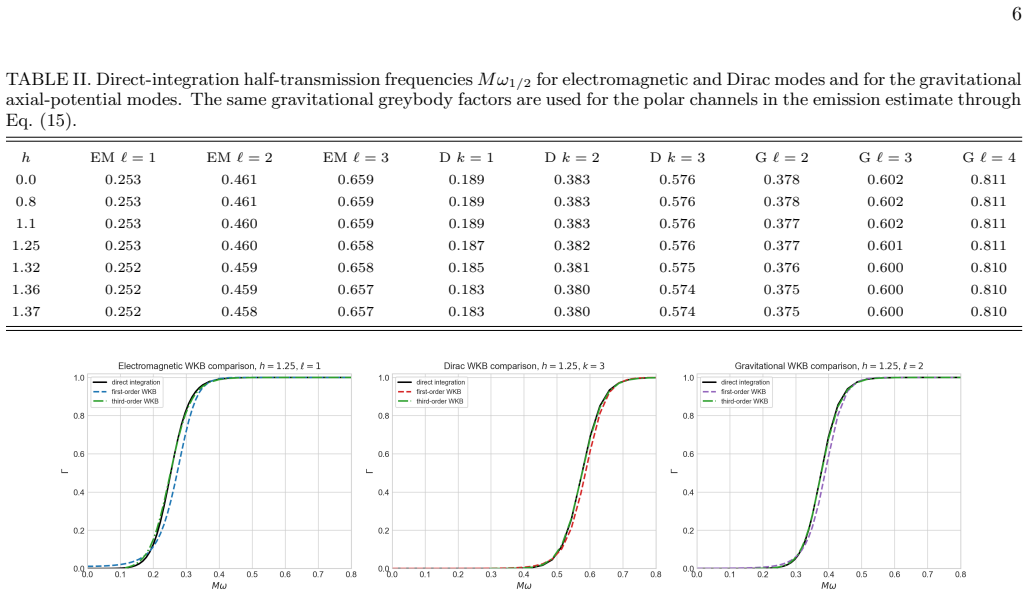
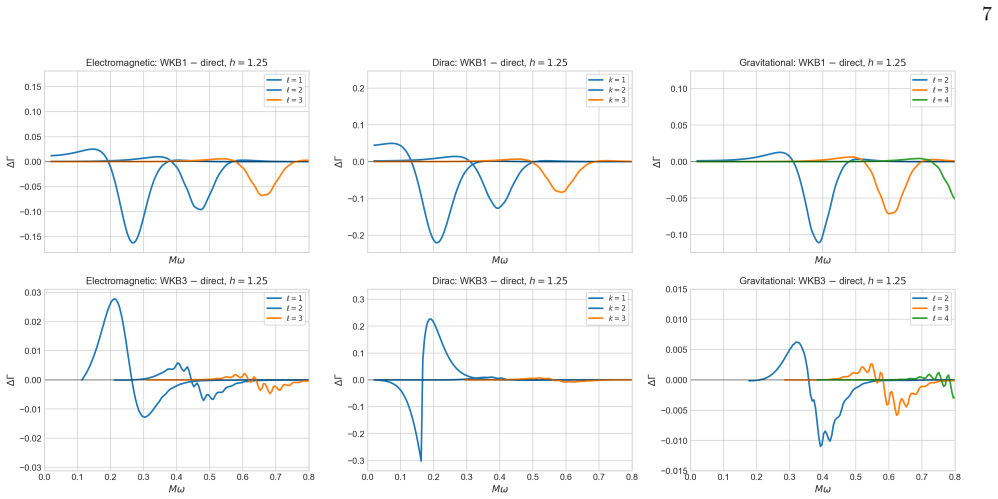
read the original abstract
We study Hawking radiation of the Dymnikova regular black hole. This model replaces the central singularity by a smooth de Sitter core while remaining Schwarzschild-like far from the hole, and its black-hole branch ends in a cold extremal remnant. We compute the greybody factors of the Standard Model test fields and gravitons, compare the precise numerical scattering results with WKB estimates, and use the resulting spectra to estimate an adiabatic evaporation history. The main effect is not a dramatic change in the transmission probabilities: the greybody thresholds move only slightly as the geometry approaches the remnant. Instead, the rapid decrease of the Hawking temperature strongly suppresses the total luminosity. The photon, light-fermion and graviton channels all fade near the endpoint, with the gravitational contribution remaining subdominant. The residual massless flux becomes increasingly fermion dominated because the photon channel is suppressed more efficiently. The black hole approaches the cold remnant only asymptotically, so the quoted lifetime estimates should be interpreted as cutoff times to near-extremal configurations rather than as complete evaporation times.
Editorial analysis
A structured set of objections, weighed in public.
Referee Report
Summary. The paper computes greybody factors for photons, light fermions, and gravitons on the Dymnikova regular black hole using direct numerical scattering and WKB approximation. These are then used to construct an adiabatic evaporation history, showing that the dominant effect is strong suppression of total luminosity by the rapidly falling Hawking temperature as the geometry approaches a cold extremal remnant; the residual massless flux becomes increasingly fermion-dominated while the graviton channel remains subdominant. Lifetime estimates are presented as cutoff times to near-extremal states rather than complete evaporation.
Significance. If the numerical results hold, the work supplies concrete, field-by-field spectra for a regular black-hole model that terminates in a zero-temperature remnant, demonstrating that transmission probabilities change only modestly while temperature suppression dominates the late-time behavior. The direct numerical versus WKB comparison and the explicit caveat on cutoff times are strengths that make the channel-dominance claim falsifiable within the test-field framework.
minor comments (2)
- [Abstract] The abstract states that greybody thresholds move only slightly, but without a quantitative measure (e.g., shift in peak frequency or integrated transmission) it is difficult to judge how 'slight' the change is relative to the temperature effect.
- The manuscript should state the numerical convergence criteria, grid resolution, and error estimates for the scattering solutions, as these directly affect the reliability of the reported luminosity suppression.
Simulated Author's Rebuttal
We thank the referee for the positive and accurate summary of our manuscript on Hawking radiation from the Dymnikova regular black hole. The assessment correctly identifies the central result that temperature suppression dominates over changes in greybody factors, with the residual flux becoming fermion-dominated. We appreciate the recognition of the numerical-WKB comparison and the explicit treatment of cutoff times as a strength. The recommendation for minor revision is noted and will be followed.
Circularity Check
No significant circularity
full rationale
The derivation consists of solving the wave equations for test fields and gravitons on the fixed Dymnikova background to obtain greybody factors (numerically and via WKB), then integrating the resulting spectra against the Hawking temperature to obtain luminosity and evaporation estimates. These steps are direct computations from the metric and the standard Hawking formula; no parameter is fitted to a subset of the output and re-labeled as a prediction, no self-citation supplies a load-bearing uniqueness theorem, and the geometry is prescribed rather than derived from the radiation calculation itself. The manuscript explicitly notes that the lifetime figures are cutoff times to near-extremal states, confirming that the reported channel suppression follows from the input metric and temperature without circular reduction.
Axiom & Free-Parameter Ledger
axioms (2)
- domain assumption The Dymnikova metric is a valid regular black-hole geometry that is Schwarzschild-like at large distances and ends in a cold extremal remnant.
- domain assumption Test fields propagate on a fixed background without significant back-reaction until near the remnant.
Reference graph
Works this paper leans on
-
[1]
S. W. Hawking, Communications in Mathematical Physics43, 199 (1975)
1975
-
[2]
D. N. Page, Physical Review D13, 198 (1976). 10
1976
-
[3]
W. G. Unruh, Physical Review D14, 3251 (1976)
1976
-
[4]
S. R. Das, G. W. Gibbons, and S. D. Mathur, Physical Review Letters78, 417 (1997), arXiv:hep-th/9609052
Pith/arXiv arXiv 1997
-
[5]
R. A. Konoplya and A. Zhidenko, Phys. Rev. D113, 043011 (2026), arXiv:2511.03066 [gr-qc]
arXiv 2026
- [6]
-
[7]
J. Li, K. Lin, and N. Yang, Eur. Phys. J. C75, 131 (2015), arXiv:1409.5988 [gr-qc]
Pith/arXiv arXiv 2015
-
[8]
A. Dubinsky, Int. J. Grav. Theor. Phys.2, 6 (2026), arXiv:2603.17644 [gr-qc]
arXiv 2026
-
[9]
Y. Yang, D. Liu, Z. Xu, Y. Xing, S. Wu, and Z.-W. Long, Phys. Rev. D104, 104021 (2021), arXiv:2107.06554 [gr-qc]
arXiv 2021
-
[10]
A. Held, R. Gold, and A. Eichhorn, JCAP06, 029 (2019), arXiv:1904.07133 [gr-qc]
Pith/arXiv arXiv 2019
-
[11]
S. V. Bolokhov, Annals Phys.488, 170416 (2026), arXiv:2511.12859 [gr-qc]
arXiv 2026
-
[12]
O. Pedraza, L. A. L´ opez, R. Arceo, and I. Cabrera- Munguia, Mod. Phys. Lett. A37, 2250057 (2022), arXiv:2111.06488 [gr-qc]
arXiv 2022
-
[13]
S. Mukohyama, K. Takahashi, K. Tomikawa, and V. Yingcharoenrat, JCAP07, 050 (2023), arXiv:2304.14304 [gr-qc]
arXiv 2023
-
[14]
Skvortsova, arXiv e-prints (2025), arXiv:2509.18061 [gr-qc]
M. Skvortsova, arXiv e-prints (2025), arXiv:2509.18061 [gr-qc]
arXiv 2025
-
[15]
R. A. Konoplya, JCAP07, 001 (2023), arXiv:2305.09187 [gr-qc]
arXiv 2023
-
[16]
D. Mahdavian Yekta, M. Karimabadi, and S. A. Alavi, Annals Phys.434, 168603 (2021), arXiv:1912.12017 [hep-th]
arXiv 2021
-
[17]
X.-C. Cai and Y.-G. Miao, Phys. Rev. D103, 124050 (2021), arXiv:2104.09725 [gr-qc]
arXiv 2021
-
[18]
Y. Guo, H. Xie, and Y.-G. Miao, Phys. Lett. B855, 138801 (2024), arXiv:2402.10406 [gr-qc]
arXiv 2024
-
[19]
S. V. Bolokhov, (2026), arXiv:2603.22310 [gr-qc]
arXiv 2026
-
[20]
L. A. L´ opez and V. Ram´ ırez, Eur. Phys. J. Plus138, 120 (2023), arXiv:2205.10166 [gr-qc]
arXiv 2023
-
[21]
B.-H. Huang, H.-W. Hu, and L. Zhao, JCAP03, 053 (2024), arXiv:2311.12286 [gr-qc]
arXiv 2024
-
[22]
S. Fernando and J. Correa, Phys. Rev. D86, 064039 (2012), arXiv:1208.5442 [gr-qc]
Pith/arXiv arXiv 2012
-
[23]
R. A. Konoplya, A. F. Zinhailo, J. Kunz, Z. Stuch- lik, and A. Zhidenko, JCAP10, 091 (2022), arXiv:2206.14714 [gr-qc]
arXiv 2022
-
[24]
K. Lin, J. Li, and S. Yang, Int. J. Theor. Phys.52, 3771 (2013)
2013
- [25]
-
[26]
P. Dutta Roy and S. Kar, Phys. Rev. D106, 044028 (2022), arXiv:2206.04505 [gr-qc]
arXiv 2022
-
[27]
Saleh, B
M. Saleh, B. B. Thomas, and T. C. Kofane, The Euro- pean Physical Journal C78, 325 (2018)
2018
-
[28]
R. A. Konoplya, Phys. Lett. B876, 140386 (2026), arXiv:2603.03189 [gr-qc]
arXiv 2026
-
[29]
Al-Badawi and A
A. Al-Badawi and A. Kraishan, Chin. J. Phys.87, 59 (2024)
2024
-
[30]
´A. Rinc´ on and V. Santos, The European Physical Jour- nal C80, 910 (2020), arXiv:2009.04386
arXiv 2020
-
[31]
Jawad, M
A. Jawad, M. Yasir, and S. Rani, Mod. Phys. Lett. A 35, 2050298 (2020)
2020
-
[32]
D. M. Gingrich, Phys. Rev. D110, 084045 (2024), arXiv:2404.04447 [gr-qc]
arXiv 2024
-
[33]
Skvortsova, arXiv e-prints (2026), arXiv:2603.28415 [gr-qc]
M. Skvortsova, arXiv e-prints (2026), arXiv:2603.28415 [gr-qc]
arXiv 2026
-
[34]
R. A. Konoplya, D. Ovchinnikov, and B. Ahmedov, Phys. Rev. D108, 104054 (2023), arXiv:2307.10801 [gr- qc]
arXiv 2023
- [35]
-
[36]
S. V. Bolokhov, Phys. Rev. D109, 064017 (2024)
2024
-
[37]
A. Flachi and J. P. S. Lemos, Phys. Rev. D87, 024034 (2013), arXiv:1211.6212 [gr-qc]
Pith/arXiv arXiv 2013
-
[38]
R. A. Konoplya, Z. Stuchlik, A. Zhidenko, and A. F. Zinhailo, Phys. Rev. D107, 104050 (2023), arXiv:2303.01987 [gr-qc]
arXiv 2023
-
[39]
Dymnikova, Gen
I. Dymnikova, Gen. Rel. Grav.24, 235 (1992)
1992
-
[40]
A. Bonanno and M. Reuter, Phys. Rev. D62, 043008 (2000), arXiv:hep-th/0002196
Pith/arXiv arXiv 2000
-
[41]
B. C. Lutfuoglu, Eur. Phys. J. C86, 39 (2026), arXiv:2505.06966 [gr-qc]
arXiv 2026
-
[42]
I. Dymnikova and E. Galaktionov, Class. Quant. Grav. 22, 2331 (2005), arXiv:gr-qc/0409049
Pith/arXiv arXiv 2005
-
[43]
A. Platania, Eur. Phys. J. C79, 470 (2019), arXiv:1903.10411 [gr-qc]
Pith/arXiv arXiv 2019
-
[44]
R. A. Konoplya and A. Zhidenko, Rev. Mod. Phys.83, 793 (2011), arXiv:1102.4014 [gr-qc]
Pith/arXiv arXiv 2011
-
[45]
R. A. Konoplya and A. Zhidenko, Phys. Rev. D97, 084034 (2018), arXiv:1712.06667 [gr-qc]
Pith/arXiv arXiv 2018
-
[46]
H. T. Cho and Y. C. Lin, Class. Quant. Grav.22, 775 (2005), arXiv:gr-qc/0411090
Pith/arXiv arXiv 2005
-
[47]
H. T. Cho, Phys. Rev. D68, 024003 (2003), arXiv:gr- qc/0303078
arXiv 2003
-
[48]
R. A. Konoplya and A. Zhidenko, Phys. Rev. D 76, 084018 (2007), [Erratum: Phys.Rev.D 90, 029901 (2014)], arXiv:0707.1890 [hep-th]
Pith/arXiv arXiv 2007
-
[49]
P. Kanti, R. A. Konoplya, and A. Zhidenko, Phys. Rev. D74, 064008 (2006), arXiv:gr-qc/0607048
Pith/arXiv arXiv 2006
-
[50]
Dubinsky, arXiv (2025), arXiv:2509.11017 [gr-qc]
A. Dubinsky, arXiv (2025), arXiv:2509.11017 [gr-qc]
arXiv 2025
-
[51]
A. Ashtekar, J. Olmedo, and P. Singh, Phys. Rev. D 98, 126003 (2018), arXiv:1806.02406 [gr-qc]
Pith/arXiv arXiv 2018
-
[52]
M. Bouhmadi-L´ opez, S. Brahma, C.-Y. Chen, P. Chen, and D.-h. Yeom, JCAP07, 066 (2020), arXiv:2004.13061 [gr-qc]
arXiv 2020
-
[53]
R. A. Konoplya and O. S. Stashko, Phys. Rev. D111, 084031 (2025), arXiv:2502.05689 [gr-qc]
arXiv 2025
-
[54]
R. A. Konoplya and O. S. Stashko, Phys. Rev. D111, 104055 (2025), arXiv:2408.02578 [gr-qc]
arXiv 2025
-
[55]
S. V. Bolokhov and M. Skvortsova, Eur. Phys. J. C86, 374 (2026), arXiv:2508.19989 [gr-qc]
arXiv 2026
-
[56]
B. C. L¨ utf¨ uo˘ glu, J. Rayimbaev, S. Murodov, J. Kur- banov, and M. Matyoqubov, (2026), arXiv:2605.11364 [gr-qc]
Pith/arXiv arXiv 2026
-
[57]
B. C. L¨ utf¨ uo˘ glu, E. U. Saka, A. Shermatov, J. Rayim- baev, I. Ibragimov, and S. Muminov, Annals Phys.487, 170360 (2026), arXiv:2509.24633 [gr-qc]
arXiv 2026
-
[58]
Tan, (2026), arXiv:2606.03842 [gr-qc]
J. Tan, (2026), arXiv:2606.03842 [gr-qc]
Pith/arXiv arXiv 2026
-
[59]
Tan, (2026), arXiv:2605.09756 [gr-qc]
J. Tan, (2026), arXiv:2605.09756 [gr-qc]
Pith/arXiv arXiv 2026
-
[60]
B. F. Schutz and C. M. Will, The Astrophysical Journal Letters291, L33 (1985)
1985
-
[61]
Iyer and C
S. Iyer and C. M. Will, Physical Review D35, 3621 (1987)
1987
-
[62]
R. A. Konoplya, Physical Review D68, 024018 (2003), arXiv:gr-qc/0303052
Pith/arXiv arXiv 2003
-
[63]
R. A. Konoplya, A. Zhidenko, and A. F. Zinhailo, Classical and Quantum Gravity36, 155002 (2019), 11 arXiv:1904.10333
Pith/arXiv arXiv 2019
-
[64]
R. A. Konoplya, J. Matyjasek, and A. Zhidenko, arXiv e-prints (2026), arXiv:2605.25705 [gr-qc]
Pith/arXiv arXiv 2026
-
[65]
S. V. Bolokhov, (2026), arXiv:2605.11013 [gr-qc]
Pith/arXiv arXiv 2026
-
[66]
M. Momennia, S. Hossein Hendi, and F. Soltani Bidgoli, Phys. Lett. B813, 136028 (2021), arXiv:1807.01792 [hep-th]
arXiv 2021
-
[67]
B. C. L¨ utf¨ uo˘ glu, Eur. Phys. J. C85, 486 (2025), arXiv:2503.16087 [gr-qc]
arXiv 2025
-
[68]
R. A. Konoplya and A. Zhidenko, Phys. Rev. D82, 084003 (2010), arXiv:1004.3772 [hep-th]
Pith/arXiv arXiv 2010
-
[69]
Bolokhov, Eur
S. Bolokhov, Eur. Phys. J. C85, 1166 (2025)
2025
-
[70]
S. Fernando, Gen. Rel. Grav.48, 24 (2016), arXiv:1601.06407 [gr-qc]
Pith/arXiv arXiv 2016
-
[71]
Skvortsova, (2026), arXiv:2604.25471 [gr-qc]
M. Skvortsova, (2026), arXiv:2604.25471 [gr-qc]
Pith/arXiv arXiv 2026
-
[72]
S. V. Bolokhov, Phys. Lett. B856, 138879 (2024), arXiv:2310.12326 [gr-qc]
arXiv 2024
-
[73]
R. A. Konoplya and A. Zhidenko, Phys. Lett. B856, 138945 (2024), arXiv:2404.09063 [gr-qc]
arXiv 2024
-
[74]
Y. Guo and Y.-G. Miao, Phys. Rev. D102, 064049 (2020), arXiv:2005.07524 [hep-th]
arXiv 2020
-
[75]
B. C. L¨ utf¨ uo˘ glu, J. Rayimbaev, N. Kurbonov, S. Murodov, and F. Javed, (2026), arXiv:2605.25076 [gr-qc]
Pith/arXiv arXiv 2026
-
[76]
R. A. Konoplya and A. Zhidenko, Phys. Lett. B686, 199 (2010), arXiv:0909.2138 [hep-th]
Pith/arXiv arXiv 2010
-
[77]
S. V. Bolokhov, (2026), arXiv:2604.11845 [gr-qc]
Pith/arXiv arXiv 2026
-
[78]
H. Kodama, R. A. Konoplya, and A. Zhidenko, Phys. Rev. D81, 044007 (2010), arXiv:0904.2154 [gr-qc]
Pith/arXiv arXiv 2010
-
[79]
D. S. Eniceicu and M. Reece, Phys. Rev. D102, 044015 (2020), arXiv:1912.05553 [gr-qc]
arXiv 2020
- [80]
discussion (0)
Sign in with ORCID, Apple, or X to comment. Anyone can read and Pith papers without signing in.