Beyond Convolution: Advancing Hypergraph Neural Networks with Hypergraph U-Nets
Pith reviewed 2026-06-27 17:19 UTC · model grok-4.3
The pith
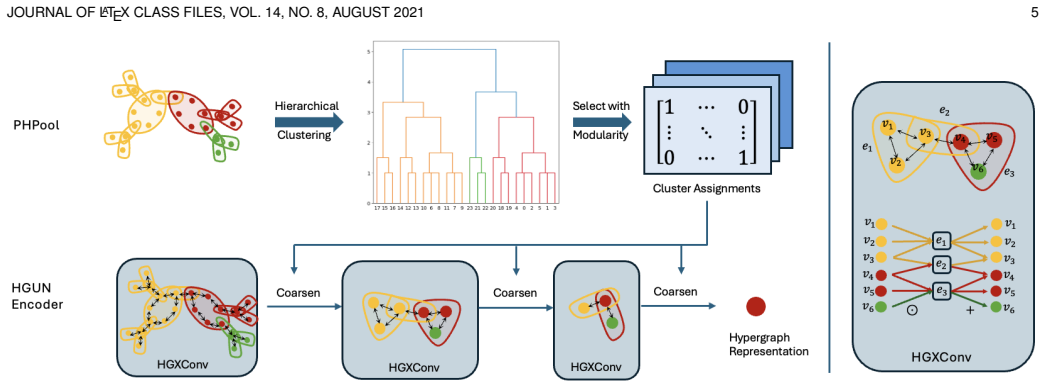
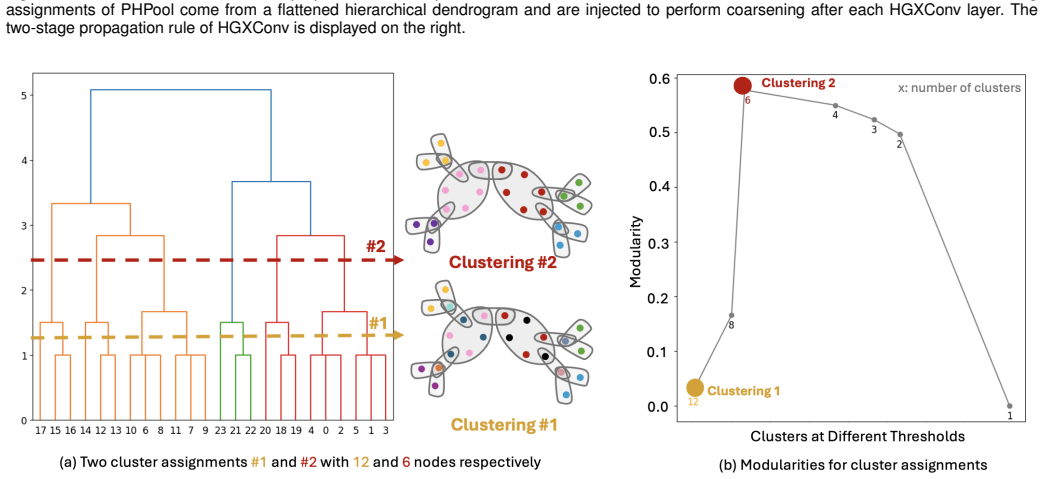
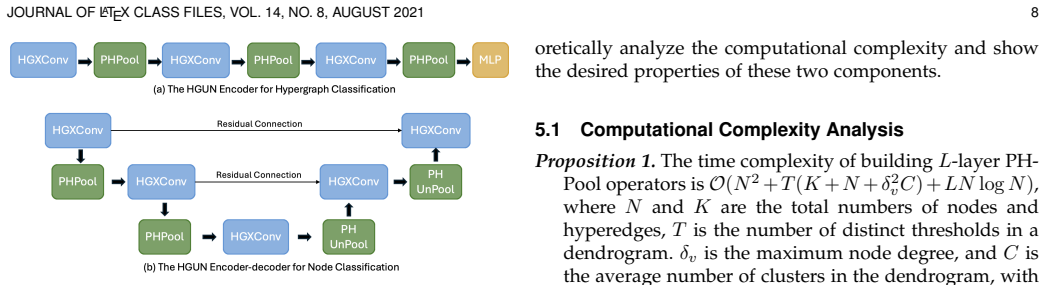
Hypergraph U-Nets perform pooling and unpooling by cutting a hierarchical clustering dendrogram at multiple levels in parallel to preserve original structure.
A machine-rendered reading of the paper's core claim, the machinery that carries it, and where it could break.
Core claim
The central claim is that Parallel Hierarchical Pooling (PHPool) and Parallel Hierarchical Unpooling (PHUnpool) operators, obtained by cutting the clustering dendrogram at different granularities all at once, retain maximal structural information from the input hypergraph while enabling efficient computation and exact inverse reconstruction.
What carries the argument
PHPool and PHUnpool operators that construct pooling and unpooling globally and in parallel by slicing a hierarchical clustering dendrogram at multiple levels.
If this is right
- Hypergraph reconstruction becomes more accurate because unpooling exactly reverses the parallel pooling steps.
- Node and hyperedge classification accuracy improves over existing graph and hypergraph networks on benchmark datasets.
- Node-level anomaly detection benefits from the multi-scale features produced by the hierarchical cuts.
- Computation stays efficient because all pooling levels are generated from one dendrogram rather than learned sequentially.
Where Pith is reading between the lines
- The same parallel dendrogram approach could be tested on simplicial complexes or other higher-order structures beyond hypergraphs.
- If the method scales, it supplies a template for building U-Net-style encoders for any relational data that admits hierarchical clustering.
- One could measure whether the retained structural fidelity correlates with downstream task gains across varying hypergraph densities.
Load-bearing premise
Cutting the dendrogram at several levels in parallel captures the most important hypergraph structure without the local damage introduced by sequential pooling steps.
What would settle it
An experiment in which a sequential pooling baseline preserves more hyperedge connectivity or achieves higher accuracy on the same classification and anomaly tasks than the parallel dendrogram method.
Figures


read the original abstract
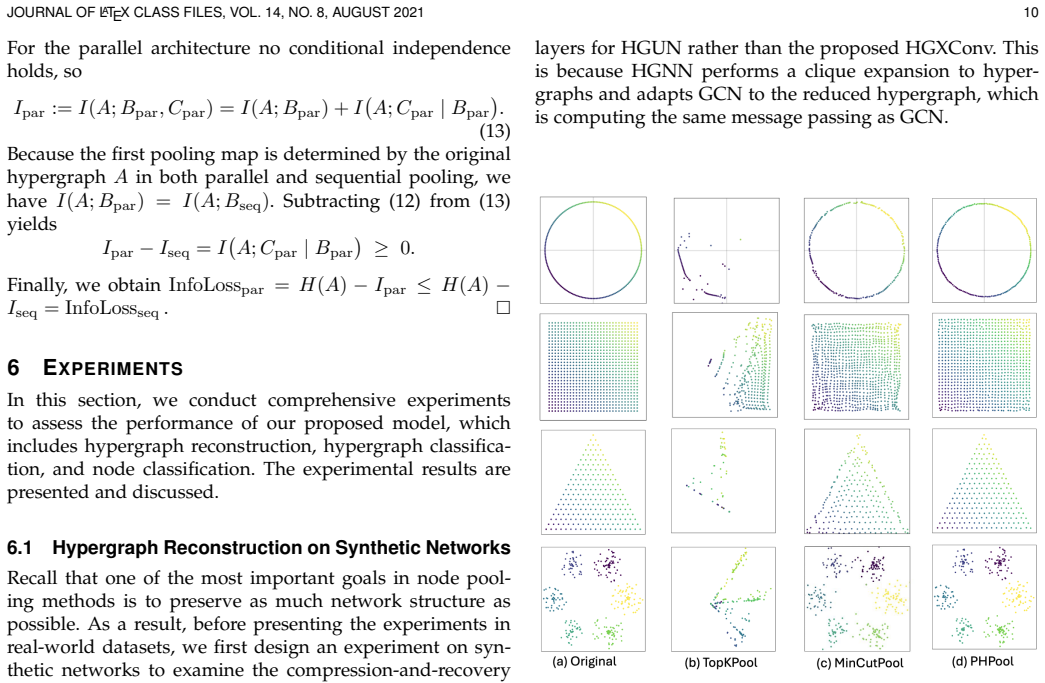
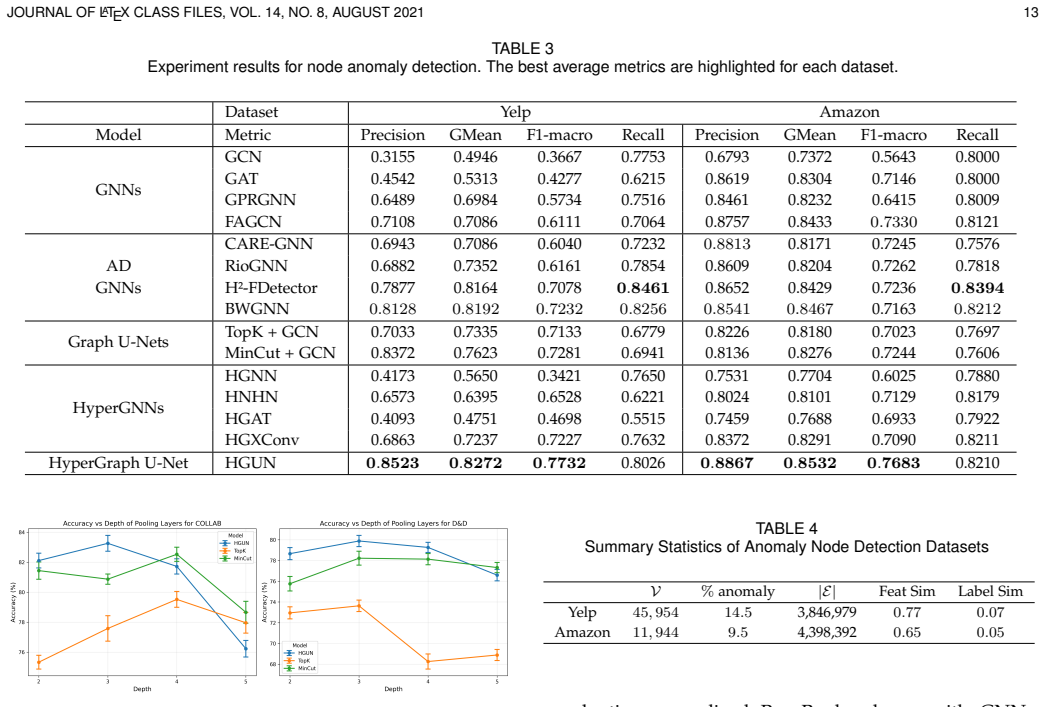
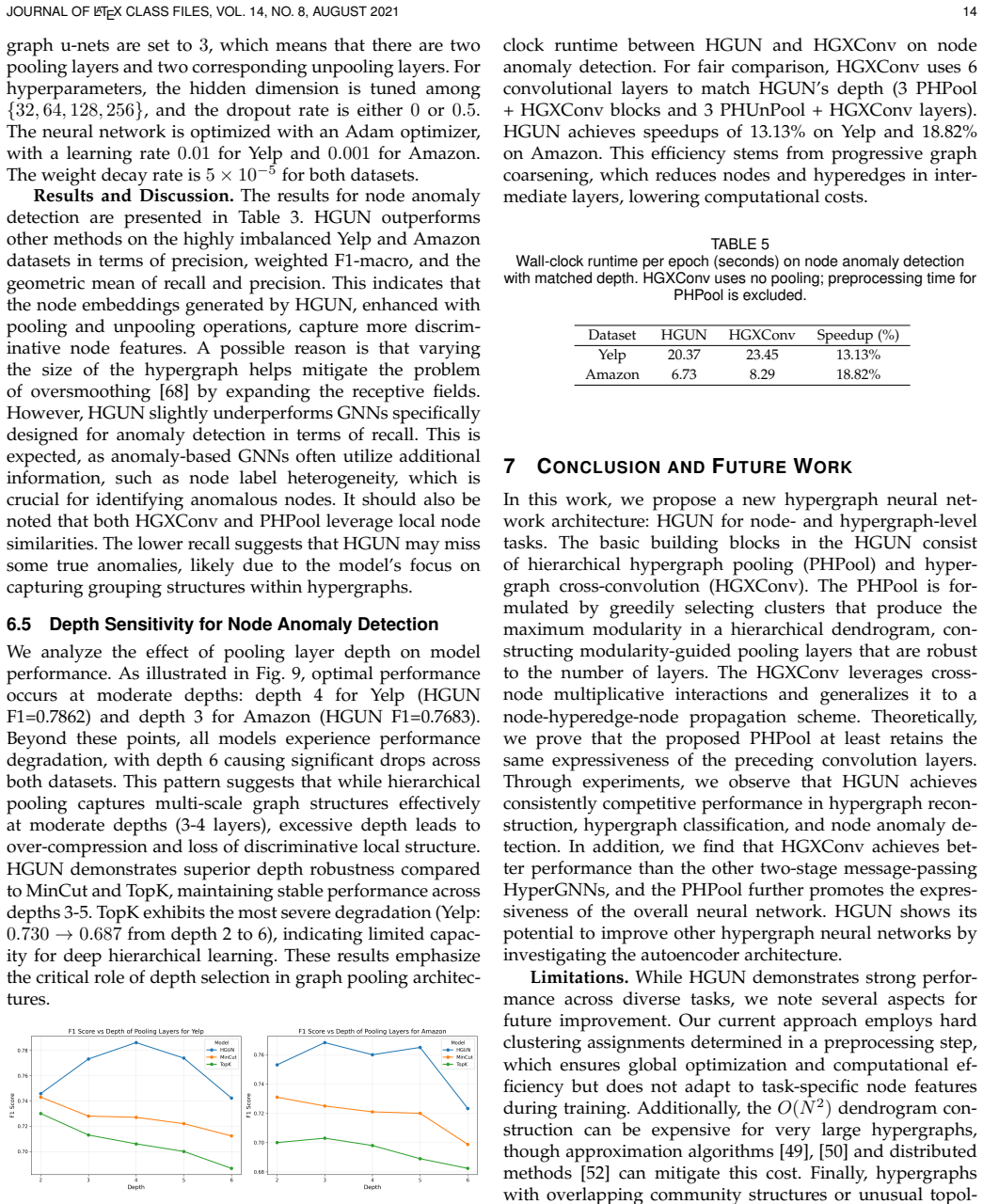
Convolutions have successfully transitioned from image processing to the complex realm of non-Euclidean higher-order domains, particularly in hypergraphs. Despite the success in convolution, the exploration of a popular architecture named U-Net remains largely unexplored for hypergraph data due to the lack of well-defined pooling and unpooling operations. This work pioneers the study of U-Net architectures for hypergraph data, addressing the critical challenge of designing effective pooling and unpooling operations that retain maximal structural information from the input hypergraph. Motivated by hierarchical clustering, we propose to construct the pooling and unpooling operators all at once by cutting the clustering dendrogram at different granularities, named the Parallel Hierarchical Pooling (PHPool) and Unpooling (PHUnpool) operators. Unlike existing pooling methods that risk local structural damage through a sequential learning procedure, our PHPool operators are designed in a global and parallel manner to ensure fidelity to the original hypergraph structure with efficient computation while the PHUnpool operators are tailored to perform inverse operations of the PHPools for hypergraph reconstruction. We validate our model through hypergraph reconstruction simulation, hypergraph classification, and node-level anomaly detection, where it demonstrates superior performance over existing state-of-the-art graph and hypergraph deep learning methods.
Editorial analysis
A structured set of objections, weighed in public.
Referee Report
Summary. The paper introduces Hypergraph U-Nets by proposing Parallel Hierarchical Pooling (PHPool) and Unpooling (PHUnpool) operators constructed by cutting a hierarchical clustering dendrogram at multiple granularities simultaneously. It claims these global, parallel operators preserve the original hypergraph structure with higher fidelity than sequential pooling methods and reports superior performance over state-of-the-art graph and hypergraph methods on hypergraph reconstruction, classification, and node-level anomaly detection.
Significance. If the structural-preservation claim holds, the work would provide the first U-Net architecture for hypergraphs and a novel parallel pooling mechanism that could improve modeling of higher-order relations in non-Euclidean data. The emphasis on global dendrogram cuts rather than learned sequential pooling is a potentially useful design principle.
major comments (2)
- [Abstract / PHPool description] The central claim that parallel dendrogram cuts at different granularities retain maximal structural information (abstract) rests on an unstated hyperedge contraction rule and lacks any information-theoretic argument or explicit mapping showing that the pooled hypergraphs are lossless coarsenings of both vertices and hyperedges. No section defines how hyperedges are aggregated or contracted under simultaneous cuts.
- [Experimental validation] The validation through three tasks asserts superior performance, yet the provided text supplies no dataset descriptions, experimental protocols, error bars, ablation studies isolating the parallel design from the underlying clustering, or quantitative fidelity metrics (e.g., hyperedge preservation ratios) that would allow verification of the fidelity claim.
minor comments (1)
- The operators are introduced without accompanying pseudocode, formal equations, or complexity analysis, making the 'efficient computation' claim difficult to assess.
Simulated Author's Rebuttal
We thank the referee for the constructive feedback. We address each major comment below and indicate planned revisions.
read point-by-point responses
-
Referee: [Abstract / PHPool description] The central claim that parallel dendrogram cuts at different granularities retain maximal structural information (abstract) rests on an unstated hyperedge contraction rule and lacks any information-theoretic argument or explicit mapping showing that the pooled hypergraphs are lossless coarsenings of both vertices and hyperedges. No section defines how hyperedges are aggregated or contracted under simultaneous cuts.
Authors: We agree that the manuscript does not currently provide an explicit definition of the hyperedge aggregation rule under parallel dendrogram cuts, nor an information-theoretic argument or formal mapping for lossless coarsening. We will revise Section 3 to include these details, adding a precise description of hyperedge contraction and a discussion of structural preservation. revision: yes
-
Referee: [Experimental validation] The validation through three tasks asserts superior performance, yet the provided text supplies no dataset descriptions, experimental protocols, error bars, ablation studies isolating the parallel design from the underlying clustering, or quantitative fidelity metrics (e.g., hyperedge preservation ratios) that would allow verification of the fidelity claim.
Authors: We agree that the current manuscript lacks these experimental details. We will expand the experimental section in the revision to include dataset descriptions, protocols, error bars, ablation studies isolating the parallel design, and quantitative fidelity metrics such as hyperedge preservation ratios. revision: yes
Circularity Check
No circularity: operators are independent constructions
full rationale
The paper defines PHPool and PHUnpool via parallel cuts of a hierarchical clustering dendrogram, presented as a direct construction to preserve hypergraph structure. No equations, self-citations, or steps reduce the claimed fidelity or reconstruction to fitted parameters, prior author results, or self-definitional loops. The design is motivated externally by standard clustering and stands as an independent ansatz without load-bearing self-references or renaming of known patterns. The derivation chain is self-contained.
Axiom & Free-Parameter Ledger
invented entities (1)
-
PHPool and PHUnpool operators
no independent evidence
Reference graph
Works this paper leans on
-
[1]
Hgnn+: General hypergraph neural networks,
Y. Gao, Y. Feng, S. Ji, and R. Ji, “Hgnn+: General hypergraph neural networks,”IEEE Transactions on Pattern Analysis and Machine Intelligence, vol. 45, no. 3, pp. 3181–3199, 2022
2022
-
[2]
Signal processing on higher-order networks: Livin’on the edge... and beyond,
M. T. Schaub, Y. Zhu, J.-B. Seby, T. M. Roddenberry, and S. Segarra, “Signal processing on higher-order networks: Livin’on the edge... and beyond,”Signal Processing, vol. 187, p. 108 149, 2021
2021
-
[3]
Hyper- graph neural network for skeleton-based action recog- nition,
X. Hao, J. Li, Y. Guo, T. Jiang, and M. Yu, “Hyper- graph neural network for skeleton-based action recog- nition,”IEEE Transactions on Image Processing, vol. 30, pp. 2263–2275, 2021
2021
-
[4]
Semi-dynamic hypergraph neural net- work for 3d pose estimation.,
S. Liu et al., “Semi-dynamic hypergraph neural net- work for 3d pose estimation.,”IJCAI, pp. 782–788, 2020
2020
-
[5]
Music recommendation via hyper- graph embedding,
V . La Gatta, V . Moscato, M. Pennone, M. Postiglione, and G. Sperlí, “Music recommendation via hyper- graph embedding,”IEEE Transactions on Neural Net- works and Learning systems, 2022
2022
-
[6]
Self-supervised hypergraph convolutional networks for session-based recommendation,
X. Xia, H. Yin, J. Yu, Q. Wang, L. Cui, and X. Zhang, “Self-supervised hypergraph convolutional networks for session-based recommendation,”Proceedings of the AAAI conference on artificial intelligence, vol. 35, no. 5, pp. 4503–4511, 2021
2021
-
[7]
Hypergraph factorization for multi- tissue gene expression imputation,
R. Viñas et al., “Hypergraph factorization for multi- tissue gene expression imputation,”Nature machine intelligence, vol. 5, no. 7, pp. 739–753, 2023
2023
-
[8]
Hy- pergraph neural networks,
Y. Feng, H. You, Z. Zhang, R. Ji, and Y. Gao, “Hy- pergraph neural networks,”Proceedings of the AAAI Conference on Artificial Intelligence, vol. 33, no. 01, pp. 3558–3565, 2019
2019
-
[10]
Hnhn: Hy- pergraph networks with hyperedge neurons,
Y. Dong, W. Sawin, and Y. Bengio, “Hnhn: Hy- pergraph networks with hyperedge neurons,”arXiv preprint arXiv:2006.12278, 2020
-
[11]
Unignn: A unified framework for graph and hypergraph neural networks,
J. Huang and J. Yang, “Unignn: A unified framework for graph and hypergraph neural networks,”arXiv preprint arXiv:2105.00956, 2021
-
[12]
You are allset: A multiset function framework for hypergraph neural networks,
E. Chien, C. Pan, J. Peng, and O. Milenkovic, “You are allset: A multiset function framework for hypergraph neural networks,”arXiv preprint arXiv:2106.13264, 2021
-
[13]
T- hypergnns: Hypergraph neural networks via tensor representations,
F. Wang, K. Pena-Pena, W. Qian, and G. R. Arce, “T- hypergnns: Hypergraph neural networks via tensor representations,”IEEE Transactions on Neural Networks and Learning Systems, pp. 1–15, 2024.DOI: 10 . 1109 / TNNLS.2024.3371382
-
[14]
Hierarchical graph representation learn- ing with differentiable pooling,
Z. Ying, J. You, C. Morris, X. Ren, W. Hamilton, and J. Leskovec, “Hierarchical graph representation learn- ing with differentiable pooling,”Advances in neural information processing systems, vol. 31, 2018
2018
-
[15]
Hypergraph iso- morphism computation,
Y. Feng, J. Han, S. Ying, and Y. Gao, “Hypergraph iso- morphism computation,”IEEE Transactions on Pattern Analysis and Machine Intelligence, 2024
2024
-
[16]
Improving the effective receptive field of message-passing neural networks,
S. E. Finder, R. S. Weber, M. Eliasof, O. Freifeld, and E. Treister, “Improving the effective receptive field of message-passing neural networks,”arXiv preprint arXiv:2505.23185, 2025
-
[17]
Graph u-nets,
H. Gao and S. Ji, “Graph u-nets,”international confer- ence on machine learning, pp. 2083–2092, 2019
2083
-
[18]
Next level message-passing with hierarchical sup- port graphs,
C. Vonessen, F. Grötschla, and R. Wattenhofer, “Next level message-passing with hierarchical sup- port graphs,”arXiv preprint arXiv:2406.15852, 2024
-
[19]
Hierarchical message- passing graph neural networks,
Z. Zhong, C.-T. Li, and J. Pang, “Hierarchical message- passing graph neural networks,”Data Mining and Knowledge Discovery, vol. 37, no. 1, pp. 381–408, 2023
2023
-
[20]
U-net: Con- volutional networks for biomedical image segmen- tation,
O. Ronneberger, P . Fischer, and T. Brox, “U-net: Con- volutional networks for biomedical image segmen- tation,”Medical image computing and computer-assisted intervention, pp. 234–241, 2015
2015
-
[21]
Deep residual learning for image recognition,
K. He, X. Zhang, S. Ren, and J. Sun, “Deep residual learning for image recognition,”Proceedings of the IEEE conference on computer vision and pattern recognition, pp. 770–778, 2016
2016
-
[22]
Asap: Adap- tive structure aware pooling for learning hierarchical graph representations,
E. Ranjan, S. Sanyal, and P . Talukdar, “Asap: Adap- tive structure aware pooling for learning hierarchical graph representations,”Proceedings of the AAAI confer- ence on artificial intelligence, vol. 34, no. 04, pp. 5470– 5477, 2020
2020
-
[23]
Structural entropy guided graph hierarchical pooling,
J. Wu, X. Chen, K. Xu, and S. Li, “Structural entropy guided graph hierarchical pooling,”International con- ference on machine learning, pp. 24 017–24 030, 2022
2022
-
[24]
A comprehensive survey on graph neural networks,
Z. Wu, S. Pan, F. Chen, G. Long, C. Zhang, and S. Y. Philip, “A comprehensive survey on graph neural networks,”IEEE Transactions on Neural Networks and Learning Systems, vol. 32, no. 1, pp. 4–24, 2020
2020
-
[25]
A unified view between tensor hypergraph neural net- works and signal denoising,
F. Wang, K. Pena-Pena, W. Qian, and G. R. Arce, “A unified view between tensor hypergraph neural net- works and signal denoising,”2023 31st European Sig- nal Processing Conference (EUSIPCO), pp. 1968–1972, 2023
2023
-
[26]
Modeling relational data with graph convolutional networks,
M. Schlichtkrull, T. N. Kipf, P . Bloem, R. Van Den Berg, I. Titov, and M. Welling, “Modeling relational data with graph convolutional networks,”European seman- tic web conference, pp. 593–607, 2018
2018
-
[27]
Neural message passing for quantum chemistry,
J. Gilmer, S. S. Schoenholz, P . F. Riley, O. Vinyals, and G. E. Dahl, “Neural message passing for quantum chemistry,”International conference on machine learning, pp. 1263–1272, 2017
2017
-
[28]
Community detection in networks: A user guide,
S. Fortunato and D. Hric, “Community detection in networks: A user guide,”Physics reports, vol. 659, pp. 1–44, 2016
2016
-
[29]
Self-attention graph pooling,
J. Lee, I. Lee, and J. Kang, “Self-attention graph pooling,”International conference on machine learning, pp. 3734–3743, 2019
2019
-
[30]
Second-order pooling for graph neural networks,
Z. Wang and S. Ji, “Second-order pooling for graph neural networks,”IEEE Transactions on Pattern Anal- ysis and Machine Intelligence, vol. 45, no. 6, pp. 6870– 6880, 2020
2020
-
[31]
Spec- tral clustering with graph neural networks for graph pooling,
F. M. Bianchi, D. Grattarola, and C. Alippi, “Spec- tral clustering with graph neural networks for graph pooling,”International conference on machine learning, pp. 874–883, 2020
2020
-
[32]
Higher-order clustering and pooling for graph neural networks,
A. Duval and F. Malliaros, “Higher-order clustering and pooling for graph neural networks,”Proceedings JOURNAL OF LATEX CLASS FILES, VOL. 14, NO. 8, AUGUST 2021 16 of the 31st ACM international conference on information & knowledge management, pp. 426–435, 2022
2021
-
[33]
Haar graph pooling,
Y. G. Wang, M. Li, Z. Ma, G. Montufar, X. Zhuang, and Y. Fan, “Haar graph pooling,”International conference on machine learning, pp. 9952–9962, 2020
2020
-
[34]
Haar wavelet feature compression for quantized graph convolu- tional networks,
M. Eliasof, B. J. Bodner, and E. Treister, “Haar wavelet feature compression for quantized graph convolu- tional networks,”IEEE Transactions on Neural Networks and Learning Systems, vol. 35, no. 4, pp. 4542–4553, 2023
2023
-
[35]
Hierarchical agglomerative graph clustering in nearly-linear time,
L. Dhulipala, D. Eisenstat, J. Ł ˛ acki, V . Mirrokni, and J. Shi, “Hierarchical agglomerative graph clustering in nearly-linear time,”International conference on machine learning, pp. 2676–2686, 2021
2021
-
[36]
Tera- hac: Hierarchical agglomerative clustering of trillion- edge graphs,
L. Dhulipala, J. Ł ˛ acki, J. Lee, and V . Mirrokni, “Tera- hac: Hierarchical agglomerative clustering of trillion- edge graphs,”Proceedings of the ACM on Management of Data, vol. 1, no. 3, pp. 1–27, 2023
2023
-
[37]
A regularization frame- work for learning from graph data,
D. Zhou and B. Schölkopf, “A regularization frame- work for learning from graph data,”ICML 2004 Work- shop on Statistical Relational Learning and Its Connections to Other Fields (SRL 2004), pp. 132–137, 2004
2004
-
[38]
Learning with hypergraphs: Clustering, classification, and embed- ding,
D. Zhou, J. Huang, and B. Schölkopf, “Learning with hypergraphs: Clustering, classification, and embed- ding,”Advances in neural information processing systems, pp. 1601–1608, 2007
2007
-
[39]
Inhomogeneous hypergraph clustering with applications,
P . Li and O. Milenkovic, “Inhomogeneous hypergraph clustering with applications,”Advances in neural infor- mation processing systems, vol. 30, 2017
2017
-
[40]
A new measure of modularity in hypergraphs: Theoretical insights and implications for effective clustering,
T. Kumar, S. Vaidyanathan, H. Ananthapadmanab- han, S. Parthasarathy, and B. Ravindran, “A new measure of modularity in hypergraphs: Theoretical insights and implications for effective clustering,”Pro- ceedings of the Eighth International Conference on Com- plex Networks and Their Applications, pp. 286–297, 2020
2020
-
[41]
Gen- erative hypergraph clustering: From blockmodels to modularity,
P . S. Chodrow, N. Veldt, and A. R. Benson, “Gen- erative hypergraph clustering: From blockmodels to modularity,”Science Advances, vol. 7, no. 28, eabh1303, 2021
2021
-
[42]
Modularity-based hypergraph clustering: Random hypergraph model, hyperedge-cluster relation, and computation,
Z. Feng, M. Qiao, and H. Cheng, “Modularity-based hypergraph clustering: Random hypergraph model, hyperedge-cluster relation, and computation,”Pro- ceedings of the ACM on Management of Data, vol. 1, no. 3, pp. 1–25, 2023
2023
-
[43]
Hypergraph structure learning for hypergraph neural networks.,
D. Cai, M. Song, C. Sun, B. Zhang, S. Hong, and H. Li, “Hypergraph structure learning for hypergraph neural networks.,”IJCAI, pp. 1923–1929, 2022
1923
-
[44]
Modern hierarchical, agglomerative clustering algorithms
D. Müllner, “Modern hierarchical, agglomerative clus- tering algorithms,”arXiv preprint arXiv:1109.2378, 2011
work page internal anchor Pith review Pith/arXiv arXiv 2011
-
[45]
Fast optimal leaf ordering for hierarchical clustering,
Z. Bar-Joseph, D. K. Gifford, and T. S. Jaakkola, “Fast optimal leaf ordering for hierarchical clustering,” Bioinformatics, vol. 17, no. suppl_1, S22–S29, 2001
2001
-
[46]
A note on two problems in connexion with graphs,
E. W. Dijkstra, “A note on two problems in connexion with graphs,”Edsger Wybe Dijkstra: his life, work, and legacy, pp. 287–290, 2022
2022
-
[47]
Algorithm 457: Finding all cliques of an undirected graph,
C. Bron and J. Kerbosch, “Algorithm 457: Finding all cliques of an undirected graph,”Communications of the ACM, vol. 16, no. 9, pp. 575–577, 1973
1973
-
[48]
Inductive representation learning on large graphs,
W. Hamilton, Z. Ying, and J. Leskovec, “Inductive representation learning on large graphs,”Advances in neural information processing systems, vol. 30, 2017
2017
-
[49]
Approximation bounds for hierarchical clustering: Average linkage, bisecting k-means, and local search,
B. Moseley and J. R. Wang, “Approximation bounds for hierarchical clustering: Average linkage, bisecting k-means, and local search,”Journal of Machine Learning Research, vol. 24, no. 1, pp. 1–36, 2023
2023
-
[50]
Approximate hier- archical clustering via sparsest cut and spreading met- rics,
M. Charikar and V . Chatziafratis, “Approximate hier- archical clustering via sparsest cut and spreading met- rics,”Proceedings of the Twenty-Eighth Annual ACM- SIAM Symposium on Discrete Algorithms, pp. 841–854, 2017
2017
-
[51]
Hierarchical clustering: O(1)-approximation for well-clustered graphs,
B.-A. Manghiuc and H. Sun, “Hierarchical clustering: O(1)-approximation for well-clustered graphs,”ad- vances in neural information processing systems, vol. 34, pp. 9278–9289, 2021
2021
-
[52]
Affinity clustering: Hierarchical clustering at scale,
M. Bateni et al., “Affinity clustering: Hierarchical clustering at scale,”Advances in Neural Information Processing Systems, vol. 30, 2017
2017
-
[53]
The expressive power of pooling in graph neural networks,
F. M. Bianchi and V . Lachi, “The expressive power of pooling in graph neural networks,”Advances in Neural Information Processing Systems, vol. 36, 2024
2024
-
[54]
TUDataset: A collection of benchmark datasets for learning with graphs
C. Morris, N. M. Kriege, F. Bause, K. Kersting, P . Mutzel, and M. Neumann, “Tudataset: A collection of benchmark datasets for learning with graphs,”arXiv preprint arXiv:2007.08663, 2020
work page internal anchor Pith review Pith/arXiv arXiv 2007
-
[55]
Learning hypergraphs tensor representations from data via t-hgsp,
K. Pena-Pena, L. Taipe, F. Wang, D. L. Lau, and G. R. Arce, “Learning hypergraphs tensor representations from data via t-hgsp,”IEEE Transactions on Signal and Information Processing over Networks, 2023
2023
-
[56]
Learning hypergraphs from signals with dual smoothness prior,
B. Tang, S. Chen, and X. Dong, “Learning hypergraphs from signals with dual smoothness prior,”ICASSP 2023-2023 IEEE International Conference on Acoustics, Speech and Signal Processing (ICASSP), pp. 1–5, 2023
2023
-
[57]
Structure-activity relationship of mutagenic aromatic and heteroaro- matic nitro compounds. correlation with molecular or- bital energies and hydrophobicity,
A. K. Debnath, R. L. Lopez de Compadre, G. Debnath, A. J. Shusterman, and C. Hansch, “Structure-activity relationship of mutagenic aromatic and heteroaro- matic nitro compounds. correlation with molecular or- bital energies and hydrophobicity,”Journal of medicinal chemistry, vol. 34, no. 2, pp. 786–797, 1991
1991
-
[58]
Graph and hypergraph models of molecular structure: A com- parative analysis of indices,
E. Konstantinova and V . Skoroboratov, “Graph and hypergraph models of molecular structure: A com- parative analysis of indices,”Journal of structural chem- istry, vol. 39, no. 6, pp. 958–966, 1998
1998
-
[59]
Hypergraph convo- lution and hypergraph attention,
S. Bai, F. Zhang, and P . H. Torr, “Hypergraph convo- lution and hypergraph attention,”Pattern Recognition, vol. 110, p. 107 637, 2021
2021
-
[60]
A fair comparison of graph neural networks for graph classification,
F. Errica, M. Podda, D. Bacciu, and A. Micheli, “A fair comparison of graph neural networks for graph classification,”arXiv preprint arXiv:1912.09893, 2019
-
[61]
Enhancing graph neural network-based fraud detectors against camouflaged fraudsters,
Y. Dou, Z. Liu, L. Sun, Y. Deng, H. Peng, and P . S. Yu, “Enhancing graph neural network-based fraud detectors against camouflaged fraudsters,”Proceedings of the 29th ACM international conference on information & knowledge management, pp. 315–324, 2020
2020
-
[62]
P . Veliˇ ckovi´ c, G. Cucurull, A. Casanova, A. Romero, P . Lio, and Y. Bengio, “Graph attention networks,”arXiv preprint arXiv:1710.10903, 2017
work page internal anchor Pith review Pith/arXiv arXiv 2017
-
[63]
Adap- tive universal generalized pagerank graph neural net- work,
E. Chien, J. Peng, P . Li, and O. Milenkovic, “Adap- tive universal generalized pagerank graph neural net- work,”arXiv preprint:2006.07988, 2020. JOURNAL OF LATEX CLASS FILES, VOL. 14, NO. 8, AUGUST 2021 17
-
[64]
Beyond low- frequency information in graph convolutional net- works,
D. Bo, X. Wang, C. Shi, and H. Shen, “Beyond low- frequency information in graph convolutional net- works,”Proceedings of the AAAI conference on artificial intelligence, vol. 35, no. 5, pp. 3950–3957, 2021
2021
-
[65]
Reinforced neighborhood selection guided multi- relational graph neural networks,
H. Peng, R. Zhang, Y. Dou, R. Yang, J. Zhang, and P . S. Yu, “Reinforced neighborhood selection guided multi- relational graph neural networks,”ACM Transactions on Information Systems (TOIS), vol. 40, no. 4, pp. 1–46, 2021
2021
-
[66]
H2-fdetector: A gnn-based fraud detector with homophilic and heterophilic connections,
F. Shi, Y. Cao, Y. Shang, Y. Zhou, C. Zhou, and J. Wu, “H2-fdetector: A gnn-based fraud detector with homophilic and heterophilic connections,”Proceedings of the ACM Web Conference 2022, pp. 1486–1494, 2022
2022
-
[67]
Rethinking graph neural networks for anomaly detection,
J. Tang, J. Li, Z. Gao, and J. Li, “Rethinking graph neural networks for anomaly detection,”International Conference on Machine Learning, pp. 21 076–21 089, 2022
2022
-
[68]
Pre- dict then propagate: Graph neural networks meet per- sonalized pagerank,
J. Gasteiger, A. Bojchevski, and S. Günnemann, “Pre- dict then propagate: Graph neural networks meet per- sonalized pagerank,”arXiv preprint arXiv:1810.05997, 2018. Fuli Wangreceived her M.Sc. degree in Statis- tics from the University of Minnesota in 2020, and her Ph.D degree in Financial Services Ana- lytics from Institute of Financial Services at the U...
discussion (0)
Sign in with ORCID, Apple, or X to comment. Anyone can read and Pith papers without signing in.