Constraining DVCS Compton Form Factors Using Lattice QCD informed Neural Network
Pith reviewed 2026-06-27 16:27 UTC · model grok-4.3
The pith
Lattice QCD form factors constrain DVCS Compton form factors via all-order dispersion relations
A machine-rendered reading of the paper's core claim, the machinery that carries it, and where it could break.
Core claim
Dispersion relations of DVCS applied to all orders determine subtraction constants from lattice QCD generalized form factors; when these constants are fed into a neural network global fit to proton DVCS data the leading-order relation constrains the real part of the CFFs while the higher-order relation reduces both real and imaginary parts considerably.
What carries the argument
All-order dispersion relations that convert lattice QCD generalized form factors into subtraction constants for the DVCS amplitude, embedded inside a neural network trained for kinematic extrapolation.
If this is right
- Higher moments of GPDs calculated on the lattice can be added to the extraction of CFFs from DVCS data.
- The leading-order relation already tightens the real part of the CFFs.
- The higher-order relation reduces both real and imaginary parts of the CFFs in a global proton-data fit.
- The neural network permits controlled extrapolation of the CFFs into unmeasured kinematic regions.
Where Pith is reading between the lines
- The same lattice-informed subtraction constants could be tested against DVCS data on other targets once lattice calculations exist.
- Tensions between different GPD parametrizations might be reduced by enforcing the all-order dispersion constraints.
- Future lattice runs that compute additional moments would directly tighten the CFF uncertainties further.
Load-bearing premise
The dispersion relations remain valid at all orders and can be used to extract subtraction constants directly from lattice QCD generalized form factors.
What would settle it
A global fit that includes the higher-order dispersion relations and lattice inputs produces CFF bands that fail to overlap with independent extractions performed without those relations or that violate known dispersion sum rules.
Figures


read the original abstract
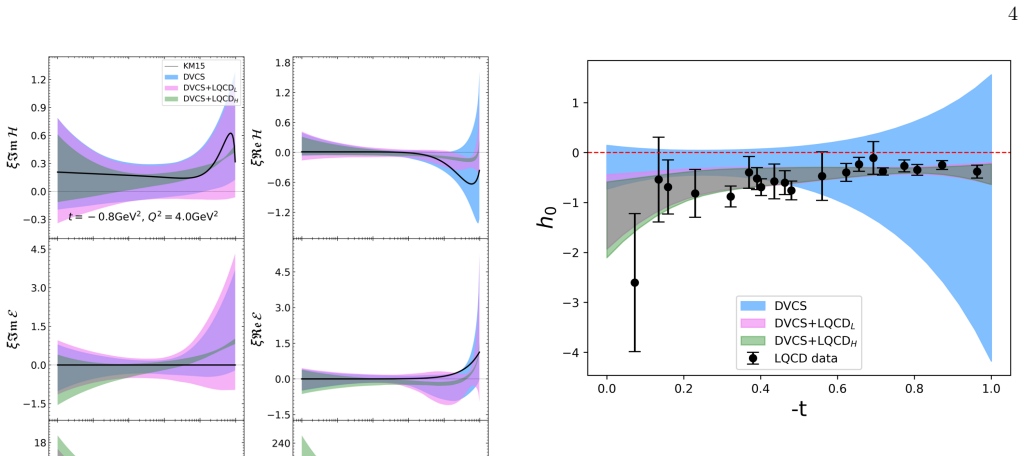
The lattice QCD calculation of generalized form factors are exploited to determine the subtraction constants through all order dispersion relations of Deeply Virtual Compton Scattering (DVCS). The leading order relation is found to constrain significantly the real part of the Compton Form Factors (CFFs), and the higher order one reduces considerably both the real and imaginary part of CFFs in a global analysis of proton data. This is realized by a synthesis of the DVCS data and LQCD calculations within a neural network framework, whose architecture is specifically designed for a reliable extrapolation to unmeasured kinematic regime. By leveraging dispersion relations beyond leading order, our framework allows for adding higher moments of generalized parton distributions (GPDs) from LQCD into the extraction of CFFs from DVCS data.
Editorial analysis
A structured set of objections, weighed in public.
Referee Report
Summary. The manuscript introduces a neural-network framework that uses lattice QCD generalized form factors to fix subtraction constants in dispersion relations for DVCS. It asserts that the leading-order dispersion relation already constrains the real part of the CFFs while the all-order version further reduces both real and imaginary parts in a global fit to proton DVCS data, thereby allowing higher GPD moments from LQCD to be incorporated into the CFF extraction.
Significance. If the mapping from LQCD GFFs to DVCS subtraction constants via all-order dispersion relations is valid, the approach would supply an independent, non-perturbative constraint that reduces model dependence in global CFF analyses and improves extrapolation to unmeasured kinematics. The explicit use of higher moments from lattice calculations is a concrete strength.
major comments (3)
- [Dispersion relations and framework description] The central claim that dispersion relations can be applied to all orders to map arbitrary higher moments of LQCD GFFs directly onto DVCS subtraction constants (Abstract) rests on an unproven assumption that the analytic continuation and moment expansion commute with the dispersion integral at finite ξ and t; standard derivations are performed at leading twist, and no explicit check for additional subtraction terms or branch cuts is provided.
- [Results and global fit] The abstract states that the higher-order relation 'reduces considerably both the real and imaginary part of CFFs' in the global analysis, yet no quantitative values, error budgets, or direct comparison to the leading-order case are supplied; without these numbers the magnitude and statistical significance of the improvement cannot be assessed.
- [Neural network architecture] The neural-network architecture is asserted to enable reliable extrapolation without uncontrolled biases, but the manuscript provides no cross-validation metrics, hold-out tests on measured kinematics, or bias diagnostics that would substantiate this claim for the unmeasured regime.
minor comments (2)
- [Theoretical framework] Define the precise form of the all-order dispersion relation (including the subtraction term) with an explicit equation number so that the mapping from LQCD GFFs is unambiguous.
- [Methodology] Clarify whether the neural-network training and the LQCD constraint steps are performed sequentially or jointly, and state the separation (if any) between training and validation datasets.
Simulated Author's Rebuttal
We thank the referee for the careful reading of the manuscript and the constructive comments. We address each major point below and indicate where revisions will be made to strengthen the presentation.
read point-by-point responses
-
Referee: [Dispersion relations and framework description] The central claim that dispersion relations can be applied to all orders to map arbitrary higher moments of LQCD GFFs directly onto DVCS subtraction constants (Abstract) rests on an unproven assumption that the analytic continuation and moment expansion commute with the dispersion integral at finite ξ and t; standard derivations are performed at leading twist, and no explicit check for additional subtraction terms or branch cuts is provided.
Authors: We acknowledge that the standard literature derivations of dispersion relations for DVCS are performed at leading twist and that an explicit demonstration of commutation between the moment expansion and the dispersion integral at finite ξ and t is not provided in the current text. The all-order relations used here follow from the Cauchy integral representation of the Compton amplitude, with the subtraction constants identified as the appropriate moments; the lattice GFFs are evaluated inside the kinematic domain where the series is expected to converge. Nevertheless, we agree that a dedicated discussion of possible additional subtraction terms or branch-cut contributions would remove ambiguity. In the revised manuscript we will add a short subsection deriving the commutation step and stating the domain of validity. revision: yes
-
Referee: [Results and global fit] The abstract states that the higher-order relation 'reduces considerably both the real and imaginary part of CFFs' in the global analysis, yet no quantitative values, error budgets, or direct comparison to the leading-order case are supplied; without these numbers the magnitude and statistical significance of the improvement cannot be assessed.
Authors: The body of the manuscript contains figures and tables that compare the leading-order and all-order extractions, including uncertainty bands obtained from the neural-network ensemble. However, the abstract itself contains no numerical measures of the reduction. We will revise the abstract to report the quantitative improvement (percentage reduction in the real and imaginary CFF uncertainties) together with a brief statement of the error budget, and we will add a short table in the results section that tabulates the leading-order versus all-order values at representative kinematics. revision: yes
-
Referee: [Neural network architecture] The neural-network architecture is asserted to enable reliable extrapolation without uncontrolled biases, but the manuscript provides no cross-validation metrics, hold-out tests on measured kinematics, or bias diagnostics that would substantiate this claim for the unmeasured regime.
Authors: The architecture incorporates dispersion-relation constraints at every layer precisely to suppress unphysical extrapolations. The current text describes the network but does not report quantitative validation. We will add a new subsection presenting k-fold cross-validation scores on the measured DVCS data points, results of hold-out tests in which a subset of measured kinematics is withheld, and a bias diagnostic based on the variance across the ensemble of trained networks. These additions will be included in the revised manuscript. revision: yes
Circularity Check
No significant circularity; LQCD supplies independent input via dispersion relations.
full rationale
The abstract describes using lattice QCD generalized form factors as external input to fix subtraction constants through dispersion relations, then incorporating those into a neural network fit to DVCS data. No equations or steps are shown that reduce a claimed prediction to a fitted parameter by construction, nor any self-citation load-bearing the central result. The LQCD calculations and dispersion relations function as an independent bridge rather than a self-referential loop, leaving the global fit with genuine data-driven content.
Axiom & Free-Parameter Ledger
axioms (1)
- domain assumption Dispersion relations hold to all orders for DVCS and relate subtraction constants directly to generalized form factors computed in lattice QCD.
Reference graph
Works this paper leans on
-
[1]
3.h 0(t= 0) =−1.07±0.72, orD u+d =−0.77±0.55 is consistent with that in LO dispersion relation
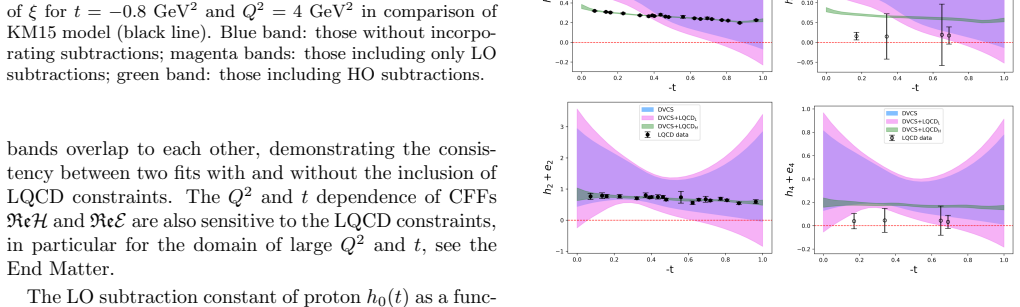
As a result of above mentioned deviation the cen- tral values ofImHfor−t <0.4 GeV 2 shift downward relative to previous fits as shown in Fig 5 in End Mat- ter.All the included subtractions are well described in the global fit, and theh 0 remains stable whether the LO or NLO dispersion relation is enabled as shown in Fig. 3.h 0(t= 0) =−1.07±0.72, orD u+d =...
- [3]
-
[4]
A. Accardiet al., Eur. Phys. J. A52, 268 (2016), arXiv:1212.1701 [nucl-ex]
Pith/arXiv arXiv 2016
-
[5]
R. Abdul Khaleket al., Nucl. Phys. A1026, 122447 (2022), arXiv:2103.05419 [physics.ins-det]
Pith/arXiv arXiv 2022
-
[6]
D. P. Anderleet al., Front. Phys. (Beijing)16, 64701 (2021), arXiv:2102.09222 [nucl-ex]
arXiv 2021
-
[7]
D. M¨ uller, D. Robaschik, B. Geyer, F. M. Dittes, and J. Hoˇ rejˇ si, Fortsch. Phys.42, 101 (1994), arXiv:hep- ph/9812448
arXiv 1994
- [8]
-
[9]
A. V. Radyushkin, Phys. Rev. D56, 5524 (1997), arXiv:hep-ph/9704207
Pith/arXiv arXiv 1997
- [10]
-
[11]
A. V. Belitsky and A. V. Radyushkin, Phys. Rept.418, 1 (2005), arXiv:hep-ph/0504030
Pith/arXiv arXiv 2005
-
[12]
M. Guidal, H. Moutarde, and M. Vanderhaeghen, Rept. Prog. Phys.76, 066202 (2013), arXiv:1303.6600 [hep-ph]
Pith/arXiv arXiv 2013
-
[13]
Diehl, Prog
S. Diehl, Prog. Part. Nucl. Phys.133, 104069 (2023)
2023
-
[14]
Bo¨ eret al., (2025), arXiv:2512.15064 [hep-ph]
M. Bo¨ eret al., (2025), arXiv:2512.15064 [hep-ph]. [14]Precision QCD with the Electron-Ion Collider(2026) arXiv:2604.04765 [hep-ph]
arXiv 2025
-
[15]
V. Bertone, H. Dutrieux, C. Mezrag, H. Moutarde, and P. Sznajder, Phys. Rev. D103, 114019 (2021), arXiv:2104.03836 [hep-ph]. 6
arXiv 2021
- [16]
-
[17]
K. Kumericki, D. Mueller, and A. Schafer, JHEP07, 073 (2011), arXiv:1106.2808 [hep-ph]
Pith/arXiv arXiv 2011
-
[18]
H. Moutarde, P. Sznajder, and J. Wagner, Eur. Phys. J. C79, 614 (2019), arXiv:1905.02089 [hep-ph]
Pith/arXiv arXiv 2019
-
[19]
M. ˇCui´ c, K. Kumeriˇ cki, and A. Sch¨ afer, Phys. Rev. Lett. 125, 232005 (2020), arXiv:2007.00029 [hep-ph]
arXiv 2020
-
[20]
L. Calero Diaz and D. Keller, Phys. Rev. D112, 096001 (2025), arXiv:2509.18331 [nucl-ex]
arXiv 2025
-
[21]
J. Grigsby, B. Kriesten, J. Hoskins, S. Liuti, P. Alonzi, and M. Burkardt, Phys. Rev. D104, 016001 (2021), arXiv:2012.04801 [hep-ph]
arXiv 2021
-
[22]
M. Almaeen, T. Alghamdi, B. Kriesten, D. Adams, Y. Li, H.-W. Lin, and S. Liuti, Eur. Phys. J. C85, 499 (2025), arXiv:2405.05826 [hep-ph]
arXiv 2025
-
[23]
M. Almaeen, J. Grigsby, J. Hoskins, B. Kriesten, Y. Li, H.-W. Lin, and S. Liuti, (2022), arXiv:2207.10766 [hep- ph]
arXiv 2022
-
[24]
D. Q. Adamset al., (2024), arXiv:2410.23469 [hep-ph]
arXiv 2024
-
[25]
Hossenet al., (2024), arXiv:2408.11681 [hep-ph]
F. Hossenet al., (2024), arXiv:2408.11681 [hep-ph]
arXiv 2024
-
[26]
M. V. Polyakov, Phys. Lett. B555, 57 (2003), arXiv:hep- ph/0210165
arXiv 2003
-
[27]
O. V. Teryaev, in11th International Conference on Elas- tic and Diffractive Scattering: Towards High Energy Frontiers: The 20th Anniversary of the Blois Workshops, 17th Rencontre de Blois(2005) arXiv:hep-ph/0510031
Pith/arXiv arXiv 2005
-
[28]
I. V. Anikin and O. V. Teryaev, Phys. Rev. D76, 056007 (2007), arXiv:0704.2185 [hep-ph]
Pith/arXiv arXiv 2007
-
[29]
M. V. Polyakov and P. Schweitzer, Int. J. Mod. Phys. A 33, 1830025 (2018), arXiv:1805.06596 [hep-ph]
Pith/arXiv arXiv 2018
-
[30]
G. S. Bali, S. Collins, M. G¨ ockeler, R. R¨ odl, A. Sch¨ afer, and A. Sternbeck, Phys. Rev. D100, 014507 (2019), arXiv:1812.08256 [hep-lat]
Pith/arXiv arXiv 2019
-
[31]
C. Alexandrouet al., Phys. Rev. D101, 034519 (2020), arXiv:1908.10706 [hep-lat]
arXiv 2020
-
[32]
D. C. Hackett, D. A. Pefkou, and P. E. Shanahan, Phys. Rev. Lett.132, 251904 (2024), arXiv:2310.08484 [hep- lat]
arXiv 2024
-
[33]
P. Hagleret al.(LHPC), Phys. Rev. D77, 094502 (2008), arXiv:0705.4295 [hep-lat]
Pith/arXiv arXiv 2008
-
[34]
M. Constantinouet al., Prog. Part. Nucl. Phys.121, 103908 (2021), arXiv:2006.08636 [hep-ph]
arXiv 2021
-
[35]
H. Dutrieux, R. G. Edwards, C. Egerer, J. Karpie, C. Monahan, K. Orginos, A. Radyushkin, D. Richards, E. Romero, and S. Zafeiropoulos (HadStruc), JHEP08, 162 (2024), arXiv:2405.10304 [hep-lat]
arXiv 2024
- [36]
- [37]
- [38]
-
[39]
C. Alexandrou, K. Cichy, M. Constantinou, K. Had- jiyiannakou, K. Jansen, A. Scapellato, and F. Steffens, Phys. Rev. Lett.125, 262001 (2020), arXiv:2008.10573 [hep-lat]
arXiv 2020
-
[40]
S. Bhattacharya, K. Cichy, M. Constantinou, X. Gao, A. Metz, J. Miller, S. Mukherjee, P. Petreczky, F. Stef- fens, and Y. Zhao, Phys. Rev. D108, 014507 (2023), arXiv:2305.11117 [hep-lat]
arXiv 2023
-
[41]
H. Dutrieux, R. G. Edwards, J. Karpie, C. Mezrag, C. Monahan, K. Orginos, A. Radyushkin, D. Richards, E. Romero, and S. Zafeiropoulos, (2026), arXiv:2604.21476 [hep-lat]
Pith/arXiv arXiv 2026
-
[42]
D. Watkins, I. Fernando, and D. Keller, (2025), arXiv:2512.21761 [hep-ph]
Pith/arXiv arXiv 2025
-
[43]
Xuet al., (2026), arXiv:2605.06994 [hep-ph]
J. Xuet al., (2026), arXiv:2605.06994 [hep-ph]
Pith/arXiv arXiv 2026
-
[44]
M. J. Riberdy, H. Dutrieux, C. Mezrag, and P. Sznajder, Eur. Phys. J. C84, 201 (2024), arXiv:2306.01647 [hep- ph]
arXiv 2024
-
[45]
H. Dutrieux, H. Dutrieux, O. Grocholski, O. Grochol- ski, H. Moutarde, H. Moutarde, P. Sznajder, and P. Sznajder, Eur. Phys. J. C82, 252 (2022), [Erratum: Eur.Phys.J.C 82, 389 (2022)], arXiv:2112.10528 [hep-ph]
arXiv 2022
-
[46]
K. A. Mamo and I. Zahed, Phys. Rev. Lett.133, 241901 (2024), arXiv:2411.04162 [hep-ph]
arXiv 2024
-
[47]
Dotsonet al., (2025), arXiv:2504.13289 [hep-ph]
A. Dotsonet al., (2025), arXiv:2504.13289 [hep-ph]
arXiv 2025
-
[48]
Z. Panjsheeri, D. Q. Adams, A. Khawaja, S. Pandey, K. Tezgin, and S. Liuti, (2025), arXiv:2511.03065 [hep- ph]
arXiv 2025
-
[49]
K. Kumericki, D. Mueller, and K. Passek-Kumericki, Nucl. Phys. B794, 244 (2008), arXiv:hep-ph/0703179
Pith/arXiv arXiv 2008
-
[50]
K. Kumeriˇ cki and D. Mueller, Nucl. Phys. B841, 1 (2010), arXiv:0904.0458 [hep-ph]
Pith/arXiv arXiv 2010
-
[51]
H. Moutarde, P. Sznajder, and J. Wagner, Eur. Phys. J. C78, 890 (2018), arXiv:1807.07620 [hep-ph]
Pith/arXiv arXiv 2018
-
[52]
M. ˇCui´ c, G. Duplanˇ ci´ c, K. Kumeriˇ cki, and K. Passek-K., JHEP12, 192 (2023), [Erratum: JHEP 02, 225 (2024)], arXiv:2310.13837 [hep-ph]
arXiv 2023
-
[53]
Y. Guo, X. Ji, M. G. Santiago, K. Shiells, and J. Yang, JHEP05, 150 (2023), arXiv:2302.07279 [hep-ph]
arXiv 2023
-
[54]
Y. Guo, F. P. Aslan, X. Ji, and M. G. Santiago, Phys. Rev. Lett.135, 261903 (2025), arXiv:2509.08037 [hep- ph]
arXiv 2025
-
[55]
V. D. Burkert, L. Elouadrhiri, and F. X. Girod, Nature 557, 396 (2018)
2018
-
[56]
V. D. Burkert, L. Elouadrhiri, F. X. Girod, C. Lorc´ e, P. Schweitzer, and P. E. Shanahan, Rev. Mod. Phys. 95, 041002 (2023), arXiv:2303.08347 [hep-ph]
arXiv 2023
-
[57]
Kumeriˇ cki, Nature570, E1 (2019)
K. Kumeriˇ cki, Nature570, E1 (2019)
2019
-
[58]
Duranet al., Nature615, 813 (2023), arXiv:2207.05212 [nucl-ex]
B. Duranet al., Nature615, 813 (2023), arXiv:2207.05212 [nucl-ex]
arXiv 2023
-
[59]
Y. Guo, F. Yuan, and W. Zhao, Phys. Rev. Lett.135, 111902 (2025), arXiv:2501.10532 [hep-ph]
arXiv 2025
-
[60]
M. V. Polyakov and C. Weiss, Phys. Rev. D60, 114017 (1999), arXiv:hep-ph/9902451
Pith/arXiv arXiv 1999
- [61]
-
[62]
H. Dutrieux, C. Lorc´ e, H. Moutarde, P. Sznajder, A. Trawi´ nski, and J. Wagner, Eur. Phys. J. C81, 300 (2021), arXiv:2101.03855 [hep-ph]
arXiv 2021
-
[63]
H. Dutrieux, T. Meisgny, C. Mezrag, and H. Moutarde, Eur. Phys. J. C85, 105 (2025), arXiv:2410.13518 [hep- ph]
arXiv 2025
-
[64]
M. Diehl and D. Y. Ivanov, Eur. Phys. J. C52, 919 (2007), arXiv:0707.0351 [hep-ph]
Pith/arXiv arXiv 2007
-
[65]
V. Mart´ ınez-Fern´ andez, D. Binosi, C. Mezrag, and Z.-Q. Yao, Phys. Rev. D113, 094003 (2026), arXiv:2509.06669 [hep-ph]
arXiv 2026
-
[66]
V. Mart´ ınez-Fern´ andez and C. Mezrag, Phys. Rev. D 113, 094004 (2026), arXiv:2509.05059 [hep-ph]
arXiv 2026
-
[67]
V. M. Braun, A. N. Manashov, D. M¨ uller, and B. M. Pirnay, Phys. Rev. D89, 074022 (2014), arXiv:1401.7621 [hep-ph]. 7
Pith/arXiv arXiv 2014
-
[68]
V. M. Braun, Y. Ji, and A. N. Manashov, JHEP01, 078 (2023), arXiv:2211.04902 [hep-ph]
arXiv 2023
-
[69]
V. M. Braun, Y. Ji, and A. N. Manashov, Phys. Rev. D 111, 076011 (2025), arXiv:2501.08185 [hep-ph]
arXiv 2025
-
[70]
B. B. Le and D. Keller, Phys. Rev. C113, 045214 (2026), arXiv:2504.15458 [cs.LG]
Pith/arXiv arXiv 2026
- [71]
-
[72]
Y.-Y. Huang, X. Cao, T. Feng, K. Kumeriˇ cki, and Y. Lu, Chin. Phys. C50, 053110 (2026), arXiv:2512.19145 [hep- ph]
Pith/arXiv arXiv 2026
-
[73]
B. Pasquini, M. V. Polyakov, and M. Vanderhaeghen, Phys. Lett. B739, 133 (2014), arXiv:1407.5960 [hep-ph]
Pith/arXiv arXiv 2014
- [74]
-
[75]
X.-H. Cao, F.-K. Guo, Q.-Z. Li, B.-W. Wu, and D.-L. Yao, (2025), 10.1140/epjs/s11734-025-02025-9, arXiv:2507.05375 [hep-ph]
-
[76]
J. Gegelia and M. V. Polyakov, Phys. Lett. B820, 136572 (2021), arXiv:2104.13954 [hep-ph]
arXiv 2021
-
[77]
A. Franciset al., Phys. Rev. Lett.136, 171903 (2026), arXiv:2509.02472 [hep-lat]
arXiv 2026
-
[78]
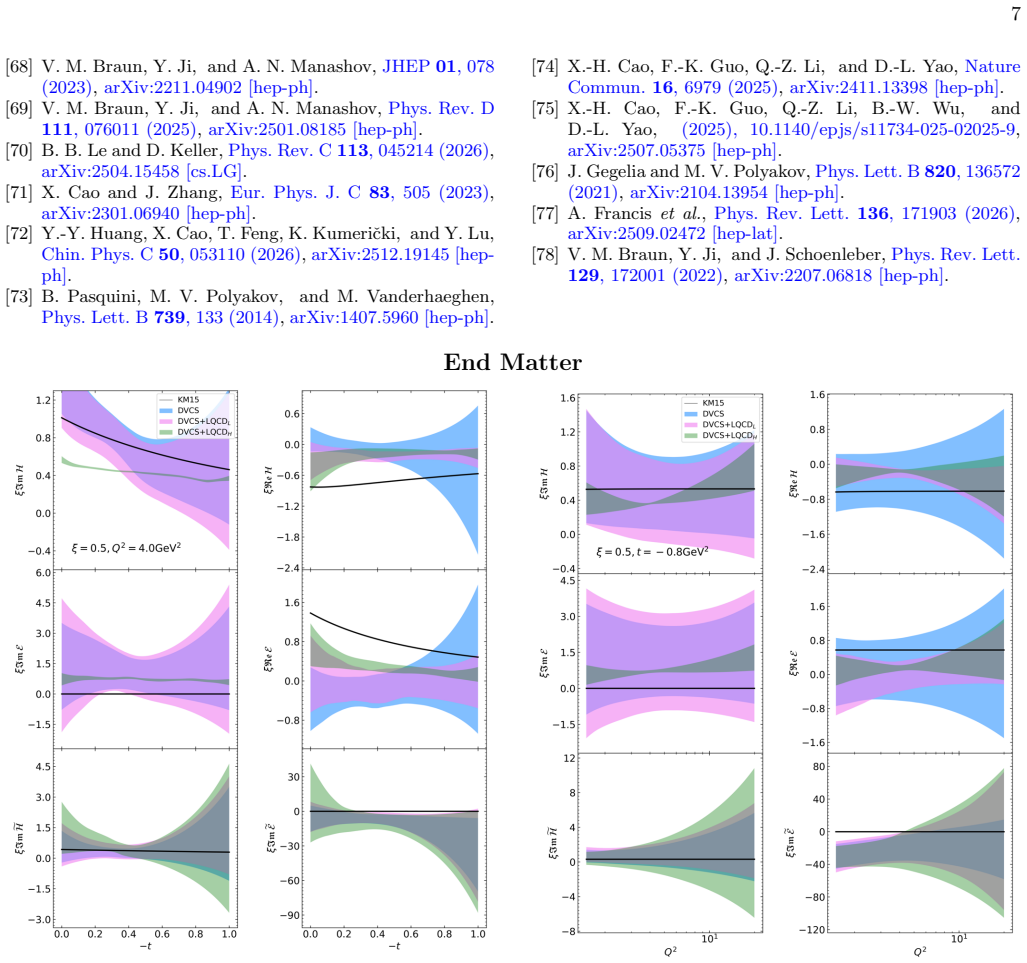
V. M. Braun, Y. Ji, and J. Schoenleber, Phys. Rev. Lett. 129, 172001 (2022), arXiv:2207.06818 [hep-ph]. End Matter FIG. 5. Imaginary and real parts of the CFFs as a function of−tforξ= 0.5 andQ 2 = 4 GeV2 FIG. 6. Imaginary and real parts of the CFFs as a function ofQ 2 forξ= 0.5 andt=−0.8 GeV 2 ThetandQ 2 dependence of CFFs are shown in Figs. 5 and 6, respectively
arXiv 2022
discussion (0)
Sign in with ORCID, Apple, or X to comment. Anyone can read and Pith papers without signing in.