Satellite-Based Quantum Communication: Performance Evaluation of Discrete-Variable Quantum Key Distribution Protocols
Pith reviewed 2026-06-27 16:29 UTC · model grok-4.3
The pith
HD-BB84 achieves higher key rates and better noise tolerance than HD-Extended B92 in satellite QKD simulations.
A machine-rendered reading of the paper's core claim, the machinery that carries it, and where it could break.
Core claim
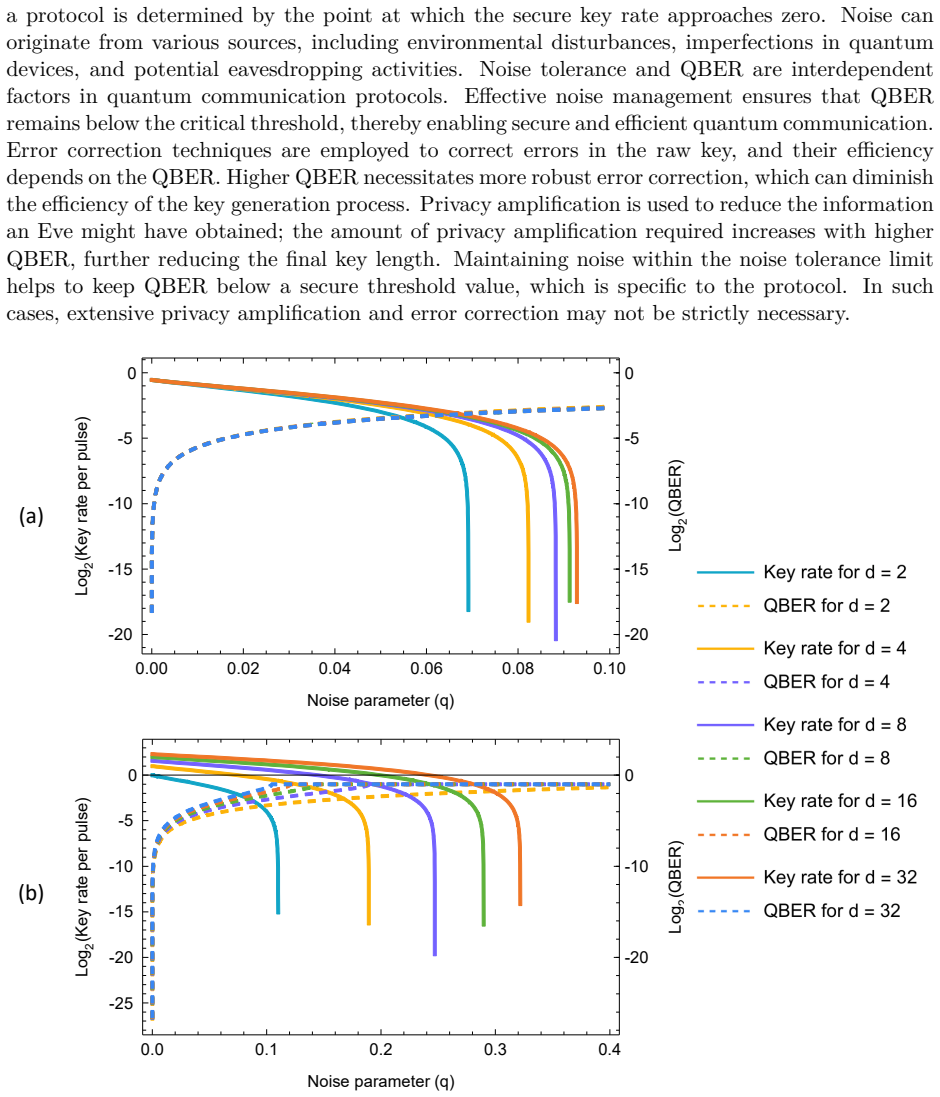
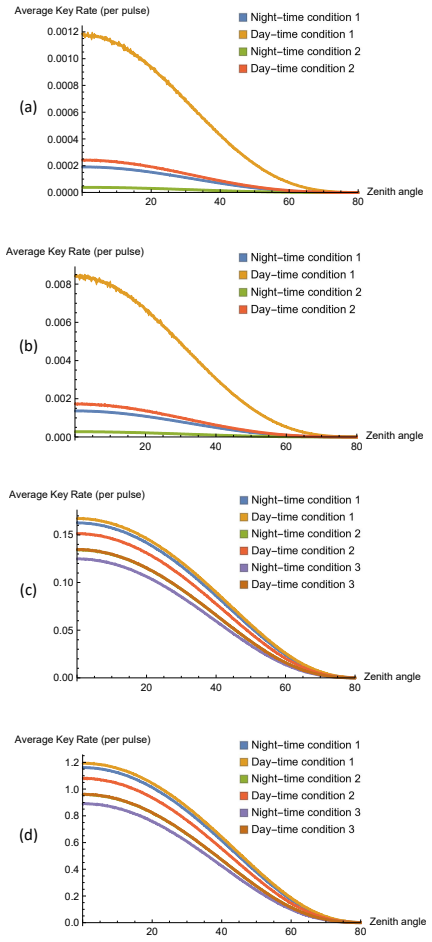
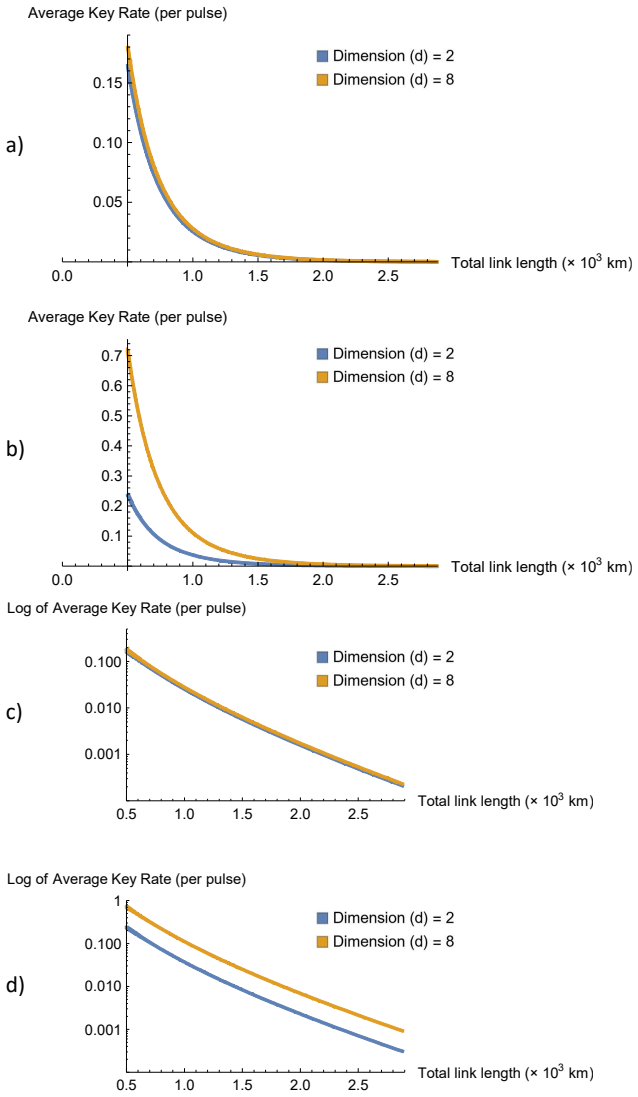
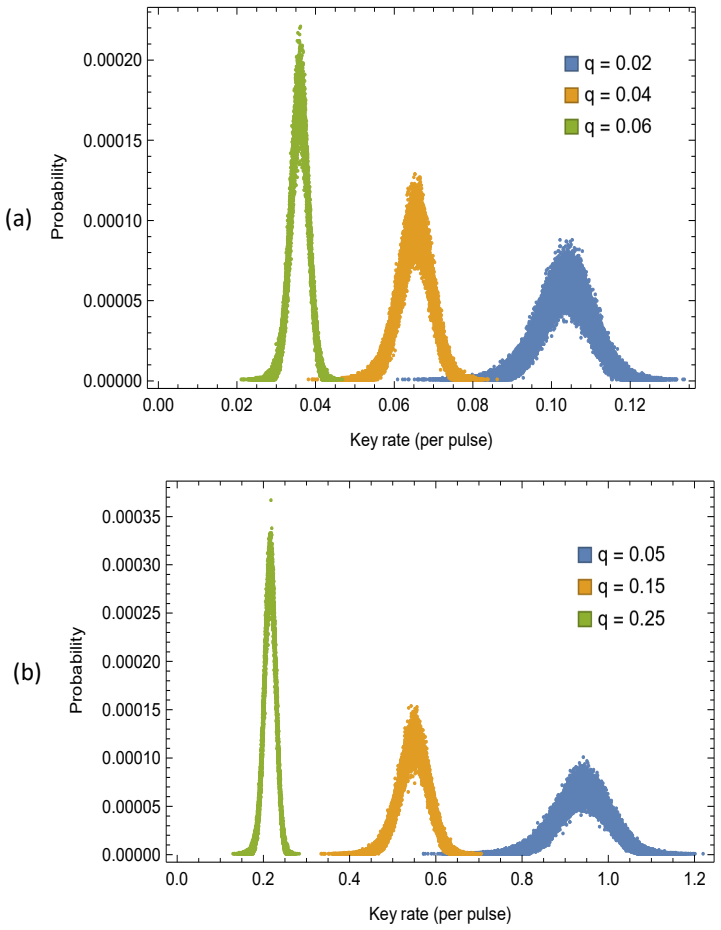
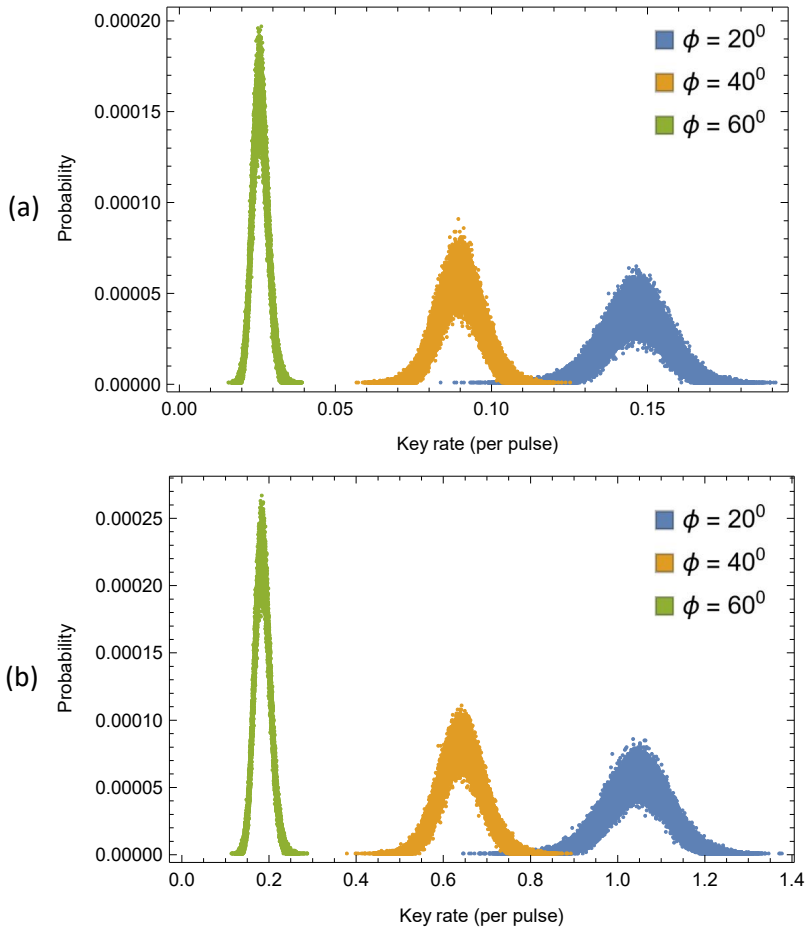
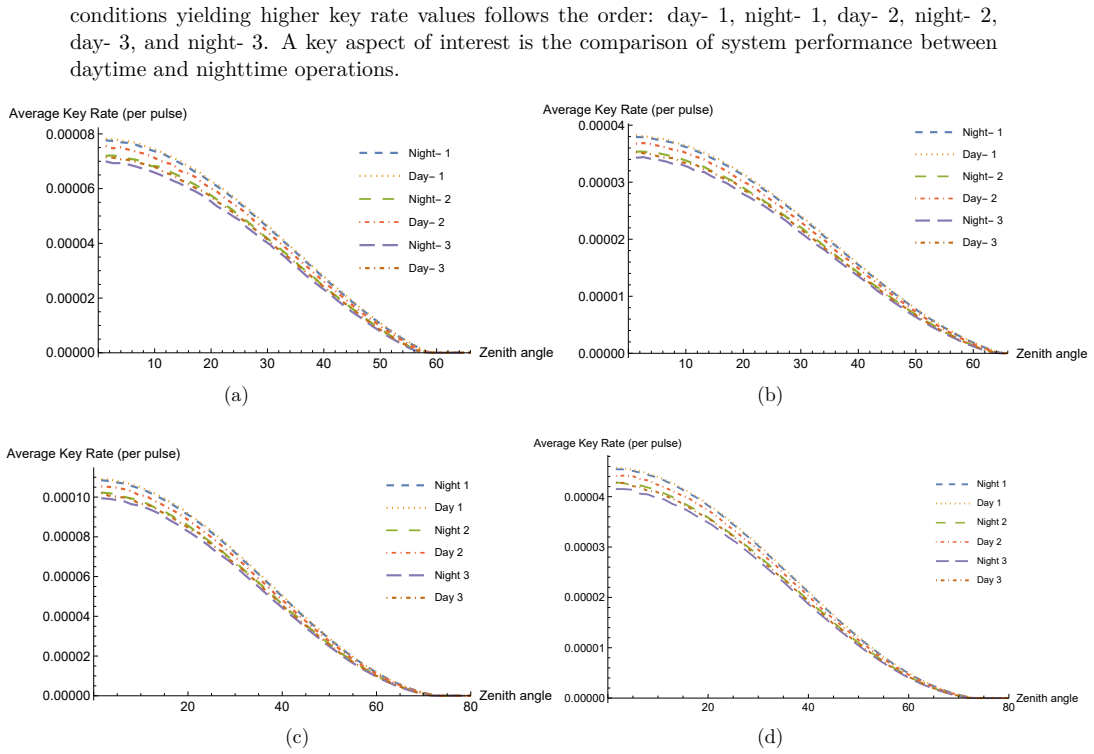
Simulations with circular beam models for standard protocols and elliptic-beam approximations for high-dimensional ones demonstrate that HD-BB84 achieves higher key rates, superior noise tolerance, and more favorable probability distributions of the key rate compared to HD-Extended B92 under varying system dimensions, weather conditions, and zenith angles for LEO satellite links.
What carries the argument
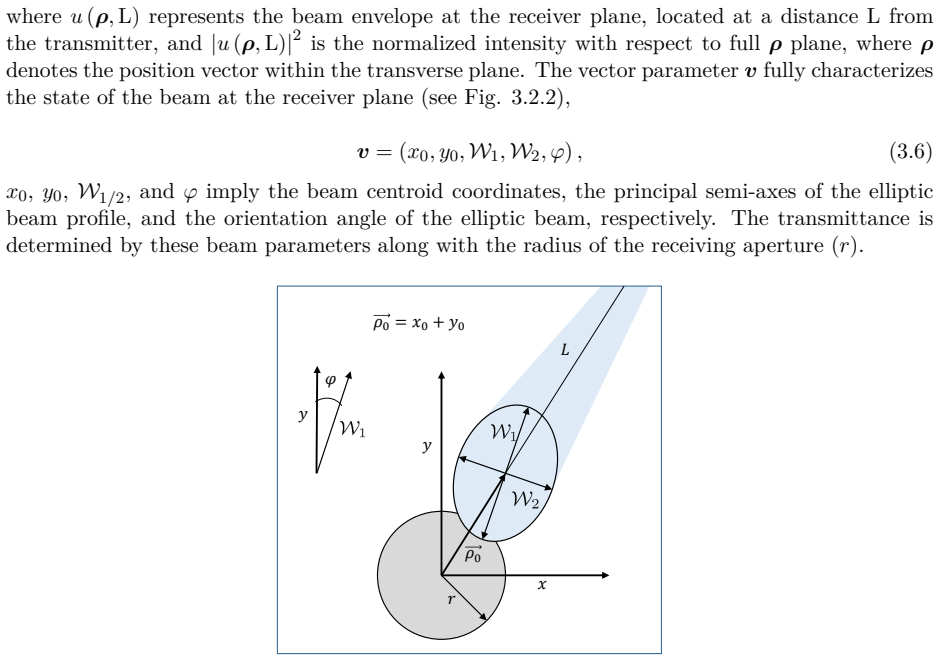
Elliptic-beam approximation used to model turbulence-induced distortions in high-dimensional QKD protocols for uplink and downlink.
If this is right
- Protocol performance depends strongly on channel asymmetries, beam characteristics, and environmental noise.
- High-dimensional encoding can improve robustness for satellite-based QKD.
- The results provide guidance for selecting protocols suited to LEO links.
Where Pith is reading between the lines
- The relative advantage of HD-BB84 could inform choices in designing future satellite quantum networks that combine multiple protocols.
- Extending the same simulation framework to entanglement-based protocols might reveal similar dimensional scaling trends.
- Validation against actual satellite data would clarify how much the models must be adjusted for real atmospheric variability.
Load-bearing premise
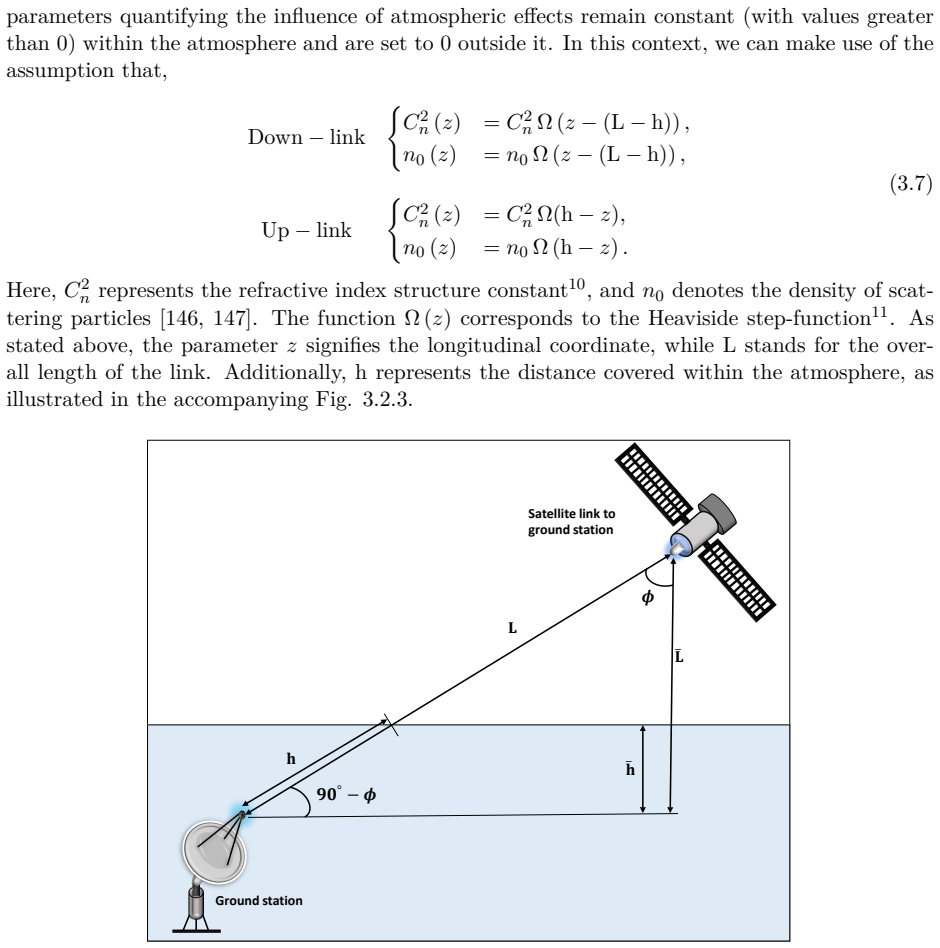
The circular and elliptic beam propagation models plus the selected atmospheric parameters adequately represent real LEO satellite uplink and downlink conditions.
What would settle it
An experimental satellite QKD test that measures lower or equal key rates and worse noise tolerance for HD-BB84 relative to HD-Extended B92 under comparable conditions.
Figures


read the original abstract
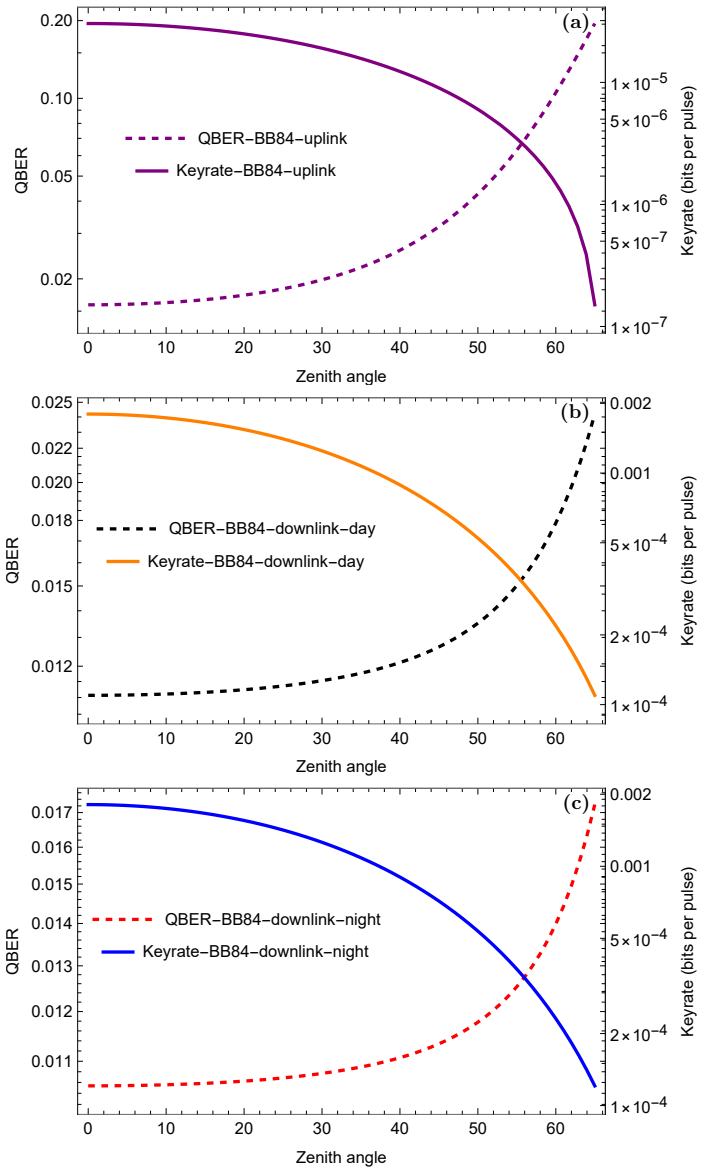
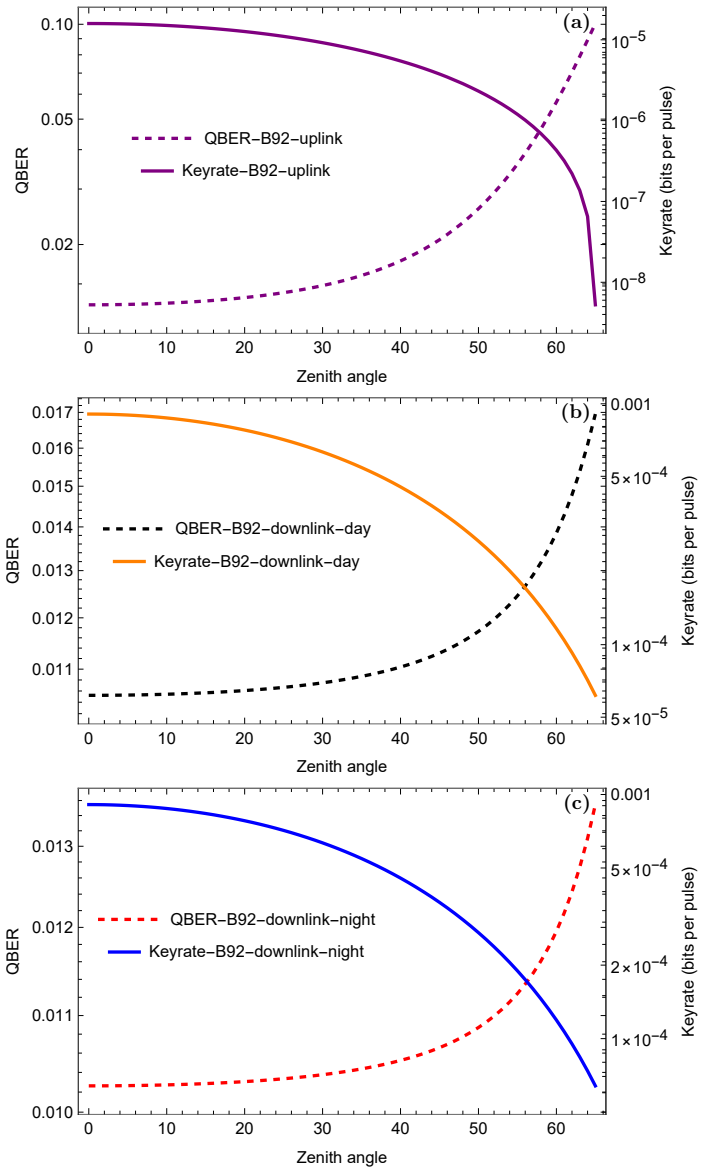
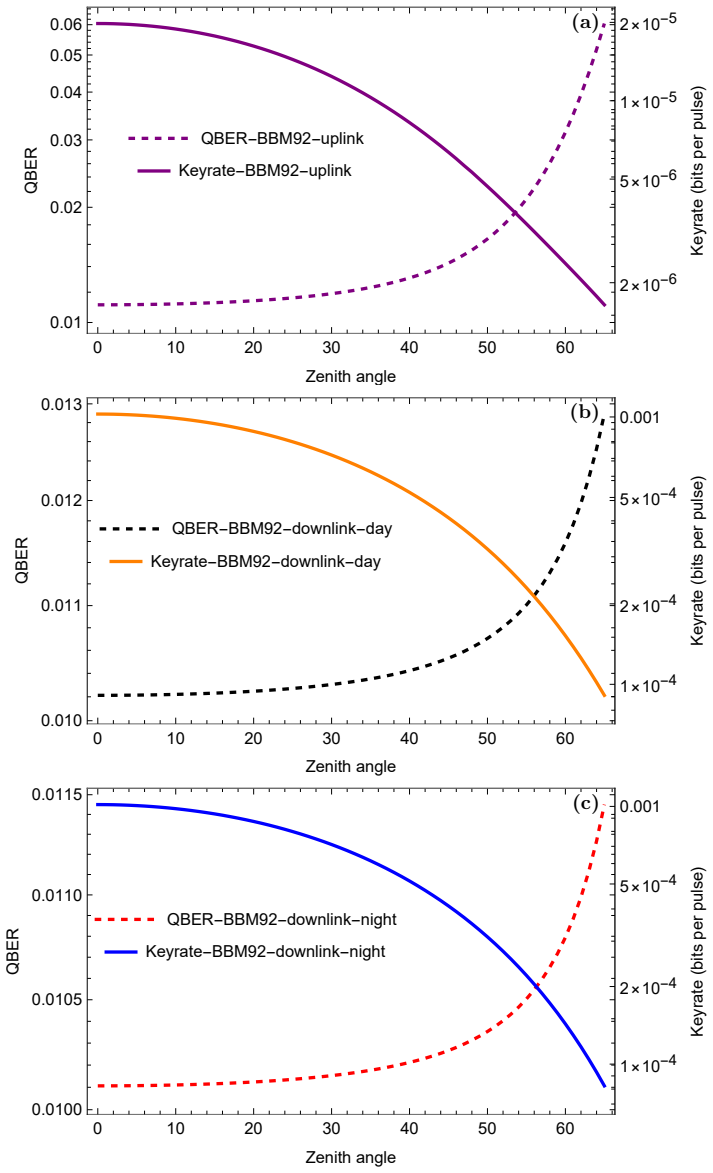
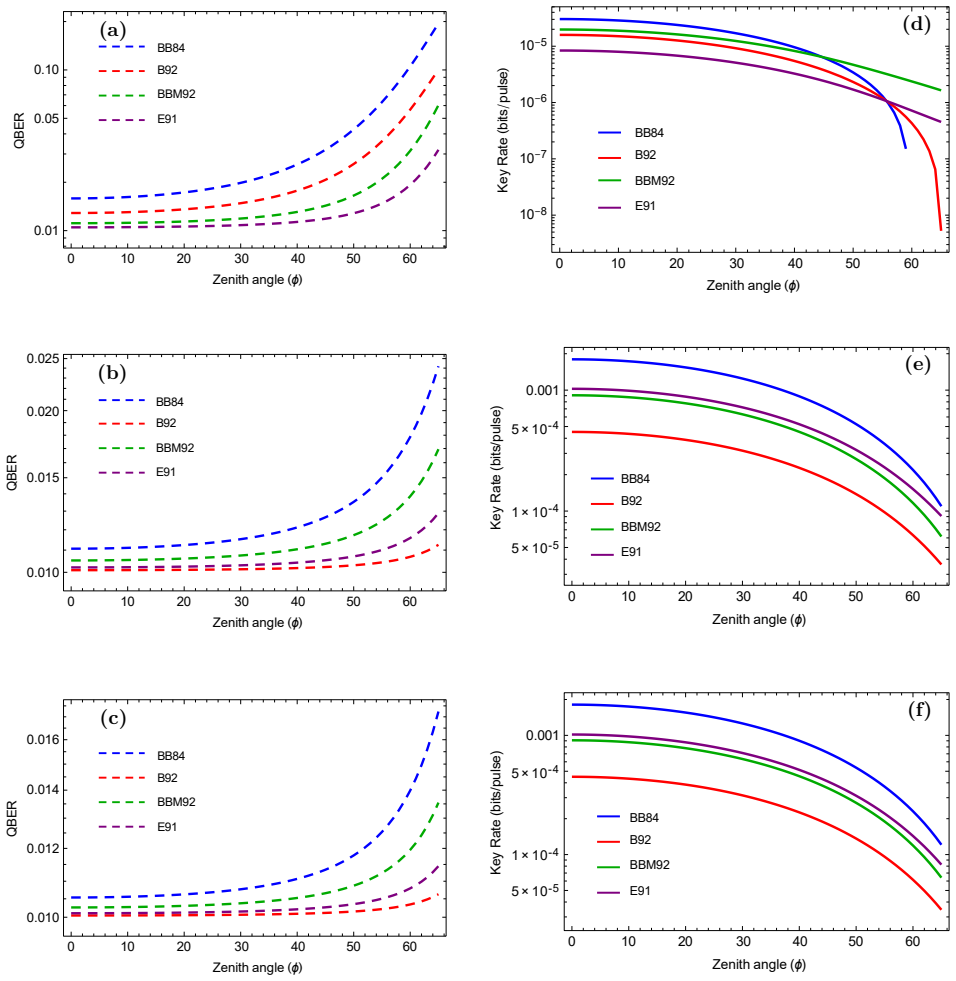
Quantum Key Distribution (QKD) has emerged as a fundamentally secure approach to communication in the era of quantum computing, offering protection against threats posed to classical cryptographic schemes such as RSA and Diffie-Hellman. This thesis presents a comprehensive performance analysis of satellite-based QKD protocols, focusing on both prepare-and-measure and entanglement-based schemes under realistic atmospheric and operational conditions. The study begins by introducing the theoretical foundations of quantum communication, including qubits, entanglement, and quantum entropy, and motivates the need for satellite-based QKD to overcome the distance limitations of fiber-based systems. Subsequently, the thesis evaluates four prominent QKD protocols-BB84, B92, BBM92, and E91-using a circular beam propagation model that incorporates atmospheric effects such as diffraction, turbulence, attenuation, and pointing errors, along with environmental noise contributions for uplink and downlink. Comparative numerical simulations reveal that protocol performance is strongly influenced by channel asymmetries, beam propagation characteristics, and noise, providing guidance on optimal protocol selection for low Earth orbit (LEO) satellite links. The research further investigates high-dimensional (HD) QKD protocols, specifically HD-BB84 and HD-Extended B92, using the elliptic-beam approximation to account for turbulence-induced distortions for both uplink and downlink. Simulations under vary ing system dimensions, weather conditions, and zenith angles demonstrate that HD-BB84 achieves higher key rates, superior noise tolerance, and more favorable probability distributions of the key rate compared to HD-Extended B92, highlighting the advantages of high-dimensional encoding for robust satellite-based QKD.
Editorial analysis
A structured set of objections, weighed in public.
Referee Report
Summary. The manuscript evaluates discrete-variable QKD protocols for satellite links, applying a circular-beam propagation model (including diffraction, turbulence, attenuation, and pointing errors) to BB84, B92, BBM92, and E91, and an elliptic-beam approximation to HD-BB84 and HD-Extended B92. Numerical simulations under varying dimensions, weather, and zenith angles conclude that HD-BB84 yields higher key rates, better noise tolerance, and more favorable key-rate distributions than HD-Extended B92 for LEO uplink/downlink.
Significance. If the beam-propagation models and atmospheric-parameter choices accurately capture real LEO conditions, the work supplies comparative guidance on protocol selection for satellite QKD and illustrates potential advantages of high-dimensional encoding. The lack of any reported validation against flight data or alternative solvers, however, confines the results to the specific modeling framework employed.
major comments (3)
- [Abstract] Abstract: the central claim that HD-BB84 outperforms HD-Extended B92 in key rate, noise tolerance, and rate distributions is obtained exclusively from simulations that switch from a circular-beam model (standard protocols) to an elliptic-beam approximation (HD protocols) without any reported justification, derivation, or accuracy assessment of the switch for LEO uplink/downlink statistics.
- [Abstract] Abstract: no information is supplied on the numerical methods, Monte-Carlo sampling details, error bars, or convergence checks used to generate the key-rate curves and probability distributions, rendering the quantitative comparisons unverifiable and the sensitivity to the listed free parameters (turbulence strength, attenuation coefficients, pointing-error variances) unquantified.
- [Abstract] Abstract: the reported performance ordering rests on a fixed set of atmospheric and pointing-error parameters with no sensitivity study or comparison to measured satellite-link statistics; if the elliptic-beam approximation or chosen parameter values deviate from actual conditions, the superiority conclusion becomes an artifact of the model rather than a robust prediction.
minor comments (1)
- [Abstract] Abstract: typographical error 'vary ing' should read 'varying'.
Simulated Author's Rebuttal
We thank the referee for the constructive comments, which highlight areas where the presentation of our modeling choices and numerical procedures can be strengthened. We address each major comment below and will revise the manuscript to incorporate the requested clarifications and additional analyses.
read point-by-point responses
-
Referee: [Abstract] Abstract: the central claim that HD-BB84 outperforms HD-Extended B92 in key rate, noise tolerance, and rate distributions is obtained exclusively from simulations that switch from a circular-beam model (standard protocols) to an elliptic-beam approximation (HD protocols) without any reported justification, derivation, or accuracy assessment of the switch for LEO uplink/downlink statistics.
Authors: We acknowledge that the manuscript does not explicitly justify or derive the switch to the elliptic-beam approximation for the high-dimensional protocols. This modeling choice is motivated by the fact that higher-dimensional encoding is more sensitive to the elliptical beam distortions caused by atmospheric turbulence, which the circular model does not capture. In the revised manuscript we will add a dedicated paragraph in the methods section that derives the elliptic approximation from the turbulence-induced beam wander statistics for LEO links and cites supporting literature on its accuracy for uplink/downlink scenarios. revision: yes
-
Referee: [Abstract] Abstract: no information is supplied on the numerical methods, Monte-Carlo sampling details, error bars, or convergence checks used to generate the key-rate curves and probability distributions, rendering the quantitative comparisons unverifiable and the sensitivity to the listed free parameters (turbulence strength, attenuation coefficients, pointing-error variances) unquantified.
Authors: The numerical implementation details were omitted from the abstract and condensed in the main text. We will expand the numerical methods section to specify the Monte-Carlo sampling procedure (number of realizations, sampling method), the computation of error bars (e.g., via standard deviation across realizations or bootstrap), and the convergence criteria applied to the key-rate curves and probability distributions. This will make the quantitative comparisons verifiable and allow assessment of parameter sensitivity. revision: yes
-
Referee: [Abstract] Abstract: the reported performance ordering rests on a fixed set of atmospheric and pointing-error parameters with no sensitivity study or comparison to measured satellite-link statistics; if the elliptic-beam approximation or chosen parameter values deviate from actual conditions, the superiority conclusion becomes an artifact of the model rather than a robust prediction.
Authors: The atmospheric and pointing-error parameters were selected from standard LEO models in the literature. We agree that the absence of an explicit sensitivity study limits the robustness claim. In the revision we will add a sensitivity analysis that varies turbulence strength, attenuation coefficients, and pointing-error variances over realistic ranges and reports how the performance ordering between HD-BB84 and HD-Extended B92 is affected. Direct comparison to flight data lies outside the scope of this simulation study but will be discussed with reference to available experimental benchmarks. revision: partial
Circularity Check
No significant circularity; results from independent physical models
full rationale
The paper evaluates QKD protocols via numerical simulations of beam propagation (circular model for standard protocols, elliptic approximation for HD protocols) incorporating diffraction, turbulence, attenuation, pointing errors, and atmospheric parameters. These inputs are external physical models, not derived from or fitted to the target performance metrics (key rates, noise tolerance, probability distributions). No self-definitional equations, fitted inputs renamed as predictions, or load-bearing self-citations are present. The central claim (HD-BB84 superiority) follows directly from the simulation outputs under varying dimensions, weather, and zenith angles, without reduction to its own inputs by construction. This is the expected non-circular outcome for model-driven performance analysis.
Axiom & Free-Parameter Ledger
free parameters (1)
- atmospheric turbulence strength, attenuation coefficients, pointing error variances
axioms (1)
- domain assumption The chosen circular and elliptic beam models plus environmental noise terms accurately capture real LEO uplink/downlink physics
Reference graph
Works this paper leans on
-
[1]
A method for obtaining digital signatures and public-key cryptosystems
Ronald L Rivest, Adi Shamir, and Leonard Adleman. “A method for obtaining digital signatures and public-key cryptosystems” . In: Communications of the ACM 21.2 (1978), pp. 120–126
1978
-
[2]
New directions in cryptography
Whitfield Diffie and Martin E Hellman. “New directions in cryptography” . In: Democratizing cryptography: the work of Whitfield Diffie and Martin Hellman . 2022, pp. 365–390
2022
-
[3]
Algorithms for quantum computation: discrete logarithms and factoring
Peter W Shor. “Algorithms for quantum computation: discrete logarithms and factoring” . In: Proceedings 35th annual symposium on foundations of computer science . Ieee. 1994, pp. 124–134
1994
-
[4]
Moore’s law: past, present and future
Robert R Schaller. “Moore’s law: past, present and future” . In: IEEE spectrum 34.6 (2002), pp. 52–59
2002
-
[5]
Quantum communication
Nicolas Gisin and Rob Thew. “Quantum communication” . In: Nature photonics 1.3 (2007), pp. 165–171
2007
-
[6]
Quantum computation and quantum information
Michael A Nielsen and Isaac L Chuang. Quantum computation and quantum information . Cambridge university press, 2010
2010
-
[7]
Quantum key distribution
Ramona Wolf. Quantum key distribution . Vol. 988. Springer, 2021
2021
-
[8]
Elements of quantum computation and quantum communication
Anirban Pathak. Elements of quantum computation and quantum communication . CRC Press Boca Raton, 2013
2013
-
[9]
Quantum computing explained
David McMahon. Quantum computing explained . John Wiley & Sons, 2008
2008
-
[10]
On quantum Rényi entropies: A new generalization and some properties
Martin Müller-Lennert, Frédéric Dupuis, Oleg Szehr, Serge Fehr, and Marco Tomamichel. “On quantum Rényi entropies: A new generalization and some properties” . In: Journal of Mathematical Physics 54.12 (2013)
2013
-
[11]
Quantum cryptog- raphy
Nicolas Gisin, Grégoire Ribordy, Wolfgang Tittel, and Hugo Zbinden. “Quantum cryptog- raphy” . In:Reviews of Modern Physics 74.1 (2002), p. 145
2002
-
[13]
A single quantum cannot be cloned
William K Wootters and Wojciech H Zurek. “A single quantum cannot be cloned” . In: Nature 299.5886 (1982), pp. 802–803
1982
-
[14]
Quantum cloning
Valerio Scarani, Sofyan Iblisdir, Nicolas Gisin, and Antonio Acín. “Quantum cloning” . In: Reviews of Modern Physics 77.4 (2005), pp. 1225–1256
2005
-
[15]
A Tutorial on Quantum Key Distribution Protocols With Interactive Simulation of QBER and SKR Per- formance Metrics
Ushnik Nath, Ramniwas Meena, Shahnoor Ali, and Neel Kanth Kundu. “A Tutorial on Quantum Key Distribution Protocols With Interactive Simulation of QBER and SKR Per- formance Metrics” . In: IET Quantum Communication 7.1 (2026), e70033. 79
2026
-
[16]
Heisenberg uncertainty principle
Werner Heisenberg. “Heisenberg uncertainty principle” . In: Zeitschrift für Physik 43 (1927), p. 172
1927
-
[17]
Conjugate coding
Stephen Wiesner. “Conjugate coding” . In: ACM Sigact News 15.1 (1983), pp. 78–88
1983
-
[18]
Quantum key distribution and coin tossing
CH Bennett and G Brassard. “Quantum key distribution and coin tossing” . In: Proc. of IEEE Int. Conf. on Computers, Systems, and Signal Processing (Bangalore, India, 1984) . 1984, pp. 175–179
1984
-
[19]
Quantum cryptography using any two nonorthogonal states
Charles H. Bennett. “Quantum cryptography using any two nonorthogonal states” . In:Phys. Rev. Lett. 68 (1992)
1992
-
[20]
Quantum cryptography pro- tocols robust against photon number splitting attacks
Valerio Scarani, A Acin, Grégoire Ribordy, and Nicolas Gisin. “Quantum cryptography pro- tocols robust against photon number splitting attacks” . In:ERATO Conference on Quantum Information Science . 2003, pp. 4–6
2003
-
[21]
Quantum key distribution (QKD) protocols: A survey
Ali Ibnun Nurhadi and Nana Rachmana Syambas. “Quantum key distribution (QKD) protocols: A survey” . In: 2018 4th International Conference on Wireless and Telematics (ICWT). IEEE. 2018, pp. 1–5
2018
-
[22]
Ad- vances in quantum cryptography
Stefano Pirandola, Ulrik L Andersen, Leonardo Banchi, Mario Berta, Darius Bunandar, Roger Colbeck, Dirk Englund, Tobias Gehring, Cosmo Lupo, Carlo Ottaviani, et al. “Ad- vances in quantum cryptography” . In:Advances in optics and photonics 12.4 (2020), pp. 1012– 1236
2020
-
[24]
Quantum cryptography without Bell’s theorem
Charles H Bennett, Gilles Brassard, and N David Mermin. “Quantum cryptography without Bell’s theorem” . In: Physical Review Letters 68.5 (1992), p. 557
1992
-
[25]
Dynamics of quantum coher- ence and non-classical correlations in open quantum system coupled to a squeezed thermal bath
Neha Pathania, Ramniwas Meena, and Subhashish Banerjee. “Dynamics of quantum coher- ence and non-classical correlations in open quantum system coupled to a squeezed thermal bath” . In: Physica A: Statistical Mechanics and its Applications (2026), p. 131405
2026
-
[26]
Continuous variable quantum cryptography
Timothy C Ralph. “Continuous variable quantum cryptography” . In: Physical Review A 61.1 (1999), p. 010303
1999
-
[27]
Continuous variable quantum cryptography using coherent states
Frédéric Grosshans and Philippe Grangier. “Continuous variable quantum cryptography using coherent states” . In: Physical review letters 88.5 (2002), p. 057902
2002
-
[28]
Quantum cryptography without switching
Christian Weedbrook, Andrew M Lance, Warwick P Bowen, Thomas Symul, <? format?> Timothy C Ralph, and Ping Koy Lam. “Quantum cryptography without switching” . In: Physical review letters 93.17 (2004), p. 170504
2004
-
[29]
Unconditional security proof of long-distance continuous-variable quantum key distribution with discrete modulation
Anthony Leverrier and Philippe Grangier. “Unconditional security proof of long-distance continuous-variable quantum key distribution with discrete modulation” . In:Physical review letters 102.18 (2009), p. 180504
2009
-
[30]
Continuous variable-based quantum commu- nication in the ocean: R. Meena, S. Banerjee
Ramniwas Meena and Subhashish Banerjee. “Continuous variable-based quantum commu- nication in the ocean: R. Meena, S. Banerjee” . In: Quantum Information Processing 24.2 (2025), p. 46
2025
-
[31]
Unidimensional continuous-variable quantum key distribution
Vladyslav C Usenko and Frédéric Grosshans. “Unidimensional continuous-variable quantum key distribution” . In: Physical Review A 92.6 (2015), p. 062337
2015
-
[32]
Husimi phase distribution in non-Gaussian operations
Ramniwas Meena, Chandan Kumar, and Subhashish Banerjee. “Husimi phase distribution in non-Gaussian operations” . In: Physical Review A 112.2 (2025), p. 023702. 80
2025
-
[33]
The rationale for the optimal continuous-variable quantum key distribution protocol
Roman Goncharov, Irina Vorontsova, Daniil Kirichenko, Ilya Filipov, Iurii Adam, Vladimir Chistiakov, Semyon Smirnov, Boris Nasedkin, Boris Pervushin, Daria Kargina, et al. “The rationale for the optimal continuous-variable quantum key distribution protocol” . In: Optics 3.4 (2022), pp. 338–351
2022
-
[34]
Differential phase shift quantum key distribution
Kyo Inoue, Edo Waks, and Yoshihisa Yamamoto. “Differential phase shift quantum key distribution” . In: Physical review letters 89.3 (2002), p. 037902
2002
-
[35]
Fast and simple one-way quantum key distribution
Damien Stucki, Nicolas Brunner, Nicolas Gisin, Valerio Scarani, and Hugo Zbinden. “Fast and simple one-way quantum key distribution” . In: Applied Physics Letters 87.19 (2005)
2005
-
[36]
Deterministic secure direct communication using en- tanglement
Kim Boström and Timo Felbinger. “Deterministic secure direct communication using en- tanglement” . In:Physical Review Letters 89.18 (2002), p. 187902
2002
-
[37]
Measurement-device-independent quantum key distribution
Hoi-Kwong Lo, Marcos Curty, and Bing Qi. “Measurement-device-independent quantum key distribution” . In: Physical review letters 108.13 (2012), p. 130503
2012
-
[38]
Overcoming the rate–distance limit of quantum key distribution without quantum repeaters
Marco Lucamarini, Zhiliang L Yuan, James F Dynes, and Andrew J Shields. “Overcoming the rate–distance limit of quantum key distribution without quantum repeaters” . In: Nature 557.7705 (2018), pp. 400–403
2018
-
[39]
Security against individual attacks for realistic quantum key distri- bution
Norbert Lütkenhaus. “Security against individual attacks for realistic quantum key distri- bution” . In: Physical Review A 61.5 (2000), p. 052304
2000
-
[40]
Quantum key distribution with high loss: toward global secure com- munication
Won-Young Hwang. “Quantum key distribution with high loss: toward global secure com- munication” . In:Physical Review Letters 91.5 (2003), p. 057901
2003
-
[41]
Practical decoy state for quantum key distribution
Xiongfeng Ma, Bing Qi, Yi Zhao, and Hoi-Kwong Lo. “Practical decoy state for quantum key distribution” . In: Physical Review A—Atomic, Molecular, and Optical Physics 72.1 (2005), p. 012326
2005
-
[42]
Experimental quantum key distribution beyond the repeaterless secret key capacity
Mariella Minder, Mirko Pittaluga, George Lloyd Roberts, Marco Lucamarini, James F Dynes, ZL Yuan, and Andrew J Shields. “Experimental quantum key distribution beyond the repeaterless secret key capacity” . In: Nature Photonics 13.5 (2019), pp. 334–338
2019
-
[43]
Secure quantum key distribution over 421 km of optical fiber
Alberto Boaron, Gianluca Boso, Davide Rusca, Cédric Vulliez, Claire Autebert, Misael Caloz, Matthieu Perrenoud, Gaëtan Gras, Félix Bussières, Ming-Jun Li, et al. “Secure quantum key distribution over 421 km of optical fiber” . In: Physical Review Letters 121.19 (2018), p. 190502
2018
-
[44]
Inside quantum re- peaters
William J Munro, Koji Azuma, Kiyoshi Tamaki, and Kae Nemoto. “Inside quantum re- peaters” . In: IEEE Journal of Selected topics in quantum electronics 21.3 (2015), pp. 78– 90
2015
-
[45]
All-photonic quantum repeaters
Koji Azuma, Kiyoshi Tamaki, and Hoi-Kwong Lo. “All-photonic quantum repeaters” . In: Nature Communications 6.1 (2015), pp. 1–7
2015
-
[46]
Long-range big quantum-data transmission
Michael Zwerger, Alexander Pirker, Vedran Dunjko, Hans J Briegel, and Wolfgang Dür. “Long-range big quantum-data transmission” . In: Physical Review Letters 120.3 (2018), p. 030503
2018
-
[47]
Efficient quantum repeater with respect to both entanglement-concentration rate and complexity of local operations and classical commu- nication
Zhaofeng Su, Ji Guan, and Lvzhou Li. “Efficient quantum repeater with respect to both entanglement-concentration rate and complexity of local operations and classical commu- nication” . In: Physical Review A 97.1 (2018), p. 012325
2018
-
[48]
Quantum repeaters based on atomic ensembles and linear optics
Nicolas Sangouard, Christoph Simon, Hugues De Riedmatten, and Nicolas Gisin. “Quantum repeaters based on atomic ensembles and linear optics” . In: Reviews of Modern Physics 83.1 (2011), pp. 33–80. 81
2011
-
[49]
En- tanglement over global distances via quantum repeaters with satellite links
K Boone, J-P Bourgoin, E Meyer-Scott, K Heshami, T Jennewein, and C Simon. “En- tanglement over global distances via quantum repeaters with satellite links” . In: Physical Review A 91.5 (2015), p. 052325
2015
-
[50]
Progress in satellite quan- tum key distribution
Robert Bedington, Juan Miguel Arrazola, and Alexander Ling. “Progress in satellite quan- tum key distribution” . In: npj Quantum Information 3.1 (2017), p. 30
2017
-
[51]
A comprehensive design and performance analysis of low Earth orbit satellite quantum communication
Jean-Philippe Bourgoin, Evan Meyer-Scott, Brendon L Higgins, B Helou, Chris Erven, Hannes Huebel, B Kumar, D Hudson, Ian D’Souza, Ralph Girard, et al. “A comprehensive design and performance analysis of low Earth orbit satellite quantum communication” . In: New Journal of Physics 15.2 (2013), p. 023006
2013
-
[52]
Feasibility of satellite quantum key distribution
Cristian Bonato, Andrea Tomaello, Vania Da Deppo, Giampiero Naletto, and Paolo Vil- loresi. “Feasibility of satellite quantum key distribution” . In: New Journal of Physics 11.4 (2009), p. 045017
2009
-
[53]
Satellite-to-ground quantum key distribution
Sheng-Kai Liao, Wen-Qi Cai, Wei-Yue Liu, Liang Zhang, Yang Li, Ji-Gang Ren, Juan Yin, Qi Shen, Yuan Cao, Zheng-Ping Li, et al. “Satellite-to-ground quantum key distribution” . In: Nature 549.7670 (2017), pp. 43–47
2017
-
[54]
Satellite-to-ground entanglement-based quantum key distribution
Juan Yin, Yuan Cao, Yu-Huai Li, Ji-Gang Ren, Sheng-Kai Liao, Liang Zhang, Wen-Qi Cai, Wei-Yue Liu, Bo Li, Hui Dai, et al. “Satellite-to-ground entanglement-based quantum key distribution” . In: Physical review letters 119.20 (2017), p. 200501
2017
-
[55]
Ground-to-satellite quantum teleportation
Ji-Gang Ren, Ping Xu, Hai-Lin Yong, Liang Zhang, Sheng-Kai Liao, Juan Yin, Wei-Yue Liu, Wen-Qi Cai, Meng Yang, Li Li, et al. “Ground-to-satellite quantum teleportation” . In: Nature 549.7670 (2017), pp. 70–73
2017
-
[56]
Quantum cryp- tography: Key distribution and beyond
Akshata Shenoy-Hejamadi, Anirban Pathak, and Srikanth Radhakrishna. “Quantum cryp- tography: Key distribution and beyond” . In: Quanta 6.1 (2017), pp. 1–47
2017
-
[57]
MODTRAN® 6: A major upgrade of the MODTRAN® radia- tive transfer code
Alexander Berk, Patrick Conforti, Rosemary Kennett, Timothy Perkins, Fred Hawes, and Jeannette Van Den Bosch. “MODTRAN® 6: A major upgrade of the MODTRAN® radia- tive transfer code” . In: 2014 6th Workshop on Hyperspectral Image and Signal Processing: Evolution in Remote Sensing (WHISPERS) . IEEE. 2014, pp. 1–4
2014
-
[58]
Isoplanatic degradation of tilt correction and short-term imaging sys- tems
George C Valley. “Isoplanatic degradation of tilt correction and short-term imaging sys- tems” . In: Applied Optics 19.4 (1980), pp. 574–577
1980
-
[59]
Modulation transfer function associated with image trans- mission through turbulent media
RE Hufnagel and NR Stanley. “Modulation transfer function associated with image trans- mission through turbulent media” . In:Journal of the Optical Society of America 54.1 (1964), pp. 52–61
1964
-
[60]
Performance Analysis of Satellite- Based QKD Protocols
Muskan, Ramniwas Meena, and Subhashish Banerjee. “Performance Analysis of Satellite- Based QKD Protocols” . In: Modern Physics Letters A (2026)
2026
-
[61]
Quantum cryptography using larger alphabets
Helle Bechmann-Pasquinucci and Wolfgang Tittel. “Quantum cryptography using larger alphabets” . In: Physical Review A 61.6 (2000), p. 062308
2000
-
[62]
Security of quantum key distribution using d-level systems
Nicolas J Cerf, Mohamed Bourennane, Anders Karlsson, and Nicolas Gisin. “Security of quantum key distribution using d-level systems” . In: Physical review letters 88.12 (2002), p. 127902
2002
-
[63]
High- dimensional quantum communication: benefits, progress, and future challenges
Daniele Cozzolino, Beatrice Da Lio, Davide Bacco, and Leif Katsuo Oxenløwe. “High- dimensional quantum communication: benefits, progress, and future challenges” . In: Ad- vanced Quantum Technologies 2.12 (2019), p. 1900038. 82
2019
-
[64]
High-dimensional coherent one-way quantum key distri- bution
Kfir Sulimany, Guy Pelc, Rom Dudkiewicz, Simcha Korenblit, Hagai S Eisenberg, Yaron Bromberg, and Michael Ben-Or. “High-dimensional coherent one-way quantum key distri- bution” . In: NPJ Quantum Information 11.1 (2025), p. 16
2025
-
[65]
High-dimensional quantum key distribution using orbital angular momentum of single photons<? pag \break?> from a colloidal quantum dot at room temperature
Dotan Halevi, Boaz Lubotzky, Kfir Sulimany, Eric G Bowes, Jennifer A Hollingsworth, Yaron Bromberg, and Ronen Rapaport. “High-dimensional quantum key distribution using orbital angular momentum of single photons<? pag \break?> from a colloidal quantum dot at room temperature” . In: Optica Quantum 2.5 (2024), pp. 351–357
2024
-
[66]
High dimensional quantum key distribution with temporal and polarization hybrid encoding
Dong-Dong Li, Mei-Sheng Zhao, Zhi Li, Yan-Lin Tang, Yun-Qi Dai, Shi-Biao Tang, and Yong Zhao. “High dimensional quantum key distribution with temporal and polarization hybrid encoding” . In: Optical Fiber Technology 68 (2022), p. 102828
2022
-
[67]
Decoy State Quantum Key Distribution
X. Ma H.-K. Lo and K. Chen. “Decoy State Quantum Key Distribution” . In: Physical Review Letters 94 (2005), p. 230504
2005
-
[68]
Practical Decoy State for Quantum Key Distribution
X. Ma et al. “Practical Decoy State for Quantum Key Distribution” . In: Physical Review A 72 (2005), p. 012326
2005
-
[69]
Atmospheric Quantum Channels with Weak and Strong Turbulence
A. Semenov D. Vasylyev and W. Vogel. “Atmospheric Quantum Channels with Weak and Strong Turbulence” . In: Physical Review Letters 117 (2017), p. 090501
2017
-
[70]
Analysis of a high-dimensional extended B92 protocol
Hasan Iqbal and Walter O Krawec. “Analysis of a high-dimensional extended B92 protocol” . In: Quantum Information Processing 20.10 (2021), p. 344
2021
-
[71]
Free-space quantum links under diverse weather conditions
D Vasylyev, AA Semenov, W Vogel, K Günthner, A Thurn, Ö Bayraktar, and Ch Mar- quardt. “Free-space quantum links under diverse weather conditions” . In: Physical Review A 96.4 (2017), p. 043856
2017
-
[72]
Satellite-based links for quantum key distribution: beam effects and weather dependence
Carlo Liorni, Hermann Kampermann, and Dagmar Bruß. “Satellite-based links for quantum key distribution: beam effects and weather dependence” . In: New Journal of Physics 21.9 (2019), p. 093055
2019
-
[73]
Analysis for Satellite- Based High-Dimensional Extended B92 and High-Dimensional BB84 Quantum Key Distri- bution
Arindam Dutta, Muskan, Subhashish Banerjee, and Anirban Pathak. “Analysis for Satellite- Based High-Dimensional Extended B92 and High-Dimensional BB84 Quantum Key Distri- bution” . In: Advanced Quantum Technologies 7.11 (2024), p. 2400149
2024
-
[74]
Optimizing the decoy-state BB84 QKD protocol parameters
Thomas Attema, Joost W Bosman, and Niels MP Neumann. “Optimizing the decoy-state BB84 QKD protocol parameters” . In: Quantum Information Processing 20.4 (2021), p. 154
2021
-
[75]
Satellite-based quantum key distribution in the presence of bypass channels
Masoud Ghalaii, Sima Bahrani, Carlo Liorni, Federico Grasselli, Hermann Kampermann, Lewis Wooltorton, Rupesh Kumar, Stefano Pirandola, Timothy P Spiller, Alexander Ling, et al. “Satellite-based quantum key distribution in the presence of bypass channels” . In: PRX Quantum 4.4 (2023), p. 040320
2023
-
[76]
Statistical fluctuation analysis for decoy-state quantum secure direct communication
Jooyoun Park, Bumil Kim, and Jun Heo. “Statistical fluctuation analysis for decoy-state quantum secure direct communication” . In: Quantum Information Processing 22.2 (2023), p. 112
2023
-
[77]
Numerical finite-key analysis of quantum key distribution
Darius Bunandar, Luke CG Govia, Hari Krovi, and Dirk Englund. “Numerical finite-key analysis of quantum key distribution” . In: npj Quantum Information 6.1 (2020), p. 104
2020
-
[78]
Numerical calculations of the finite key rate for general quantum key distribution protocols
Ian George, Jie Lin, and Norbert Lütkenhaus. “Numerical calculations of the finite key rate for general quantum key distribution protocols” . In: Physical Review Research 3.1 (2021), p. 013274
2021
-
[79]
Characterization of quantumness of non- Gaussian states under the influence of Gaussian channel: R. Meena, S. Banerjee
Ramniwas Meena and Subhashish Banerjee. “Characterization of quantumness of non- Gaussian states under the influence of Gaussian channel: R. Meena, S. Banerjee” . In: Quan- tum Information Processing 22.8 (2023), p. 298. 83
2023
-
[80]
Finite key effects in satellite quantum key distribution
Jasminder S Sidhu, Thomas Brougham, Duncan McArthur, Roberto G Pousa, and Daniel KL Oi. “Finite key effects in satellite quantum key distribution” . In: npj Quantum Infor- mation 8.1 (2022), p. 18
2022
-
[81]
Strategies for achieving high key rates in satellite-based QKD
Sebastian Ecker, Bo Liu, Johannes Handsteiner, Matthias Fink, Dominik Rauch, Fabian Steinlechner, Thomas Scheidl, Anton Zeilinger, and Rupert Ursin. “Strategies for achieving high key rates in satellite-based QKD” . In: npj Quantum Information 7.1 (2021), p. 5
2021
-
[82]
Feasibility of satellite-to-ground continuous- variable quantum key distribution
Daniele Dequal, Luis Trigo Vidarte, Victor Roman Rodriguez, Giuseppe Vallone, Paolo Vil- loresi, Anthony Leverrier, and Eleni Diamanti. “Feasibility of satellite-to-ground continuous- variable quantum key distribution” . In: npj Quantum Information 7.1 (2021), p. 3
2021
discussion (0)
Sign in with ORCID, Apple, or X to comment. Anyone can read and Pith papers without signing in.