Meson-Nucleus Bound States with Neural-Network Quantum States
Pith reviewed 2026-06-27 16:18 UTC · model grok-4.3
The pith
Neural-network variational Monte Carlo solves the (A+1)-body Schrödinger equation with HAL QCD meson-nucleon potentials and finds bound states for φ at A≥2, J/ψ at A≥4, and η_c at A≥6.
A machine-rendered reading of the paper's core claim, the machinery that carries it, and where it could break.
Core claim
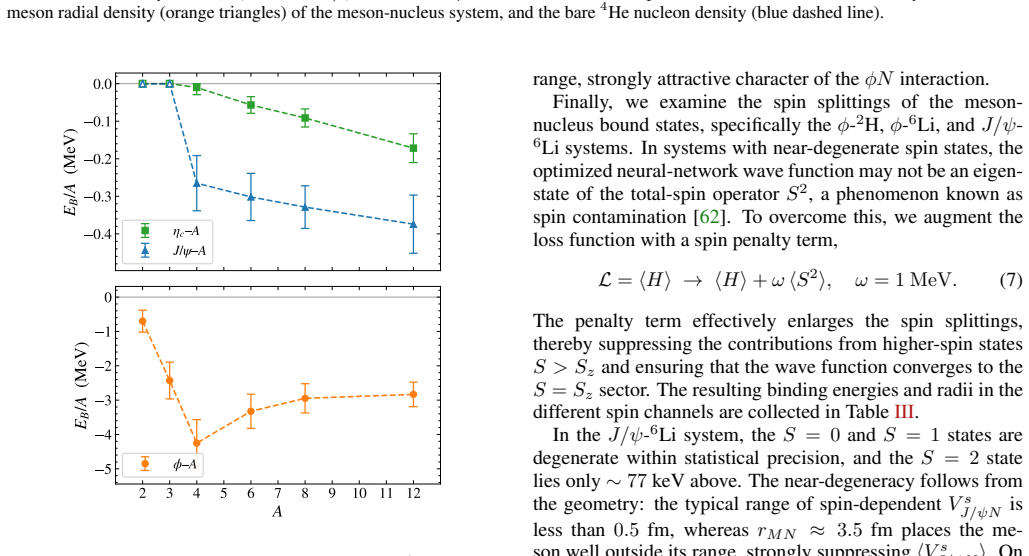
Meson-nucleus bound states emerge at A≥2 for φ, A≥4 for J/ψ, and A≥6 for η_c. The φ-nucleus systems exhibit the strongest binding, with binding energies reaching tens of MeV. The J/ψ-nucleus and η_c-nucleus systems are weakly bound at the few-MeV and sub-MeV scale, respectively. The binding energy per nucleon deepens nearly linearly with A for charmonium systems, whereas the φ-nucleus system exhibits a non-monotonic behavior peaking at ^4He. The meson compresses the nucleon distribution relative to the parent nucleus and evolves from a halo configuration to one embedded inside the nucleus with increasing A.
What carries the argument
Neural-network variational Monte Carlo framework generalized to mesonic degrees of freedom, solving the (A+1)-body Schrödinger equation with input HAL QCD meson-nucleon potentials.
If this is right
- φ-nucleus systems bind at tens of MeV while J/ψ-nucleus systems bind at a few MeV and η_c-nucleus systems bind at sub-MeV energies.
- Binding energy per nucleon for charmonium-nucleus systems increases nearly linearly with A.
- Binding energy per nucleon for φ-nucleus systems is non-monotonic and reaches a maximum at ^4He.
- The embedded meson compresses the nucleon distribution relative to the bare nucleus and shifts from halo-like to interior placement as A grows.
- The method supplies quantitative predictions that can be tested in future experiments.
Where Pith is reading between the lines
- Similar calculations could be performed for other mesons such as the ω or K to map how binding thresholds depend on the underlying meson-nucleon potential range and strength.
- If the non-monotonic binding peak at ^4He for φ is confirmed, it would indicate that short-range attraction dominates over volume effects in light systems.
- Extending the mass range beyond A=12 would test whether the linear deepening of binding per nucleon for charmonium saturates at larger A.
- Direct comparison of the computed nucleon density profiles with electron-scattering or pion-production data on the same nuclei could constrain the compression effect.
Load-bearing premise
The HAL QCD meson-nucleon potentials computed at the near-physical point remain accurate when embedded in the full (A+1)-body Schrödinger equation without additional many-body force corrections or significant lattice artifacts.
What would settle it
Experimental observation that φ-nucleus systems do not bind at A=2 or that their binding energies fall well below the predicted tens of MeV scale would falsify the central predictions.
Figures

read the original abstract
We present the first systematic calculations of $\phi$-, $\eta_c$-, and $J/\psi$-nucleus ground states up to mass number $A{=}12$ based on the HAL QCD meson-nucleon potentials at near-physical point. The $(A{+}1)$-body Schr\"odinger equation is solved with a neural-network variational Monte Carlo framework, generalized to incorporate mesonic degrees of freedom. Benchmarking on light nuclei from $^2$H to $^{12}$C yields ground-state energies consistent with experiment. Meson-nucleus bound states emerge at $A\ge2$ for $\phi$, $A\ge4$ for $J/\psi$, and $A\ge6$ for $\eta_c$. The $\phi$-nucleus systems exhibit the strongest binding, with binding energies reaching tens of MeV. The $J/\psi$-nucleus and $\eta_c$-nucleus systems are weakly bound at the few-MeV and sub-MeV scale, respectively. The binding energy per nucleon deepens nearly linearly with $A$ for charmonium systems, whereas the $\phi$-nucleus system exhibits a non-monotonic behavior peaking at $^4$He -- a distinctive hallmark of the short-range and strongly attractive $\phi N$ interaction. The meson compresses the nucleon distribution relative to the parent nucleus, and evolves from a halo configuration to one embedded inside the nucleus with increasing $A$. Our results provide predictions for future experimental searches, and establish a quantitative bridge between lattice QCD meson-nucleon interactions and the emergent many-body phenomena in meson-nucleus bound states.
Editorial analysis
A structured set of objections, weighed in public.
Referee Report
Summary. The paper claims the first systematic variational Monte Carlo calculations of φ-, J/ψ-, and η_c-nucleus ground states up to A=12, using HAL QCD meson-nucleon potentials at near-physical point inside a neural-network ansatz for the (A+1)-body Schrödinger equation. Benchmarking on ²H to ¹²C recovers experimental energies. Bound states appear for A≥2 (φ), A≥4 (J/ψ), A≥6 (η_c), with φ bindings reaching tens of MeV, J/ψ at few MeV, and η_c at sub-MeV; binding per nucleon and nucleon-distribution compression are also reported.
Significance. If the numerical accuracy and two-body approximation hold, the work supplies concrete predictions for meson-nucleus bindings that can be tested experimentally and provides a quantitative link from lattice QCD potentials to emergent many-body structure. The generalization of neural-network quantum states to include mesonic degrees of freedom and the successful benchmarking on ordinary nuclei are explicit strengths.
major comments (2)
- [Abstract] Abstract (results paragraph): the binding energies for the J/ψ-nucleus (few-MeV) and η_c-nucleus (sub-MeV) systems are stated without reported statistical or systematic uncertainties, without convergence tests versus neural-network width or Monte Carlo sampling for the meson cases, and without validation of the ansatz accuracy in the presence of the meson. The nucleonic benchmarking alone does not establish numerical reliability at the claimed weak-binding scales.
- [Abstract] Abstract (paragraph describing the input potentials and the solved equation): the central binding claims rest on direct insertion of the HAL QCD two-body meson-nucleon potentials into the (A+1)-body Schrödinger equation. No estimate or test is supplied of possible many-body force corrections or lattice artifacts (finite volume, unphysical pion mass, discretization) that could shift near-threshold bindings by amounts comparable to the reported few-MeV or sub-MeV values.
Simulated Author's Rebuttal
We thank the referee for the careful reading and constructive feedback on our manuscript. We address each major comment below and indicate the planned revisions.
read point-by-point responses
-
Referee: [Abstract] Abstract (results paragraph): the binding energies for the J/ψ-nucleus (few-MeV) and η_c-nucleus (sub-MeV) systems are stated without reported statistical or systematic uncertainties, without convergence tests versus neural-network width or Monte Carlo sampling for the meson cases, and without validation of the ansatz accuracy in the presence of the meson. The nucleonic benchmarking alone does not establish numerical reliability at the claimed weak-binding scales.
Authors: We agree that the abstract should explicitly report uncertainties and reference convergence/validation for the meson cases to establish reliability at weak-binding scales. The full manuscript already presents statistical uncertainties from VMC sampling for all systems (including mesons) in the results tables and figures, and the nucleonic benchmarks serve as a baseline validation of the ansatz. However, we acknowledge that dedicated convergence tests versus network width and sampling specifically for the meson-nucleus systems are not highlighted in the abstract. We will revise the abstract to include the reported uncertainties and add a sentence on ansatz validation. We will also expand the methods/results sections with additional convergence data for the J/ψ and η_c cases. revision: yes
-
Referee: [Abstract] Abstract (paragraph describing the input potentials and the solved equation): the central binding claims rest on direct insertion of the HAL QCD two-body meson-nucleon potentials into the (A+1)-body Schrödinger equation. No estimate or test is supplied of possible many-body force corrections or lattice artifacts (finite volume, unphysical pion mass, discretization) that could shift near-threshold bindings by amounts comparable to the reported few-MeV or sub-MeV values.
Authors: The calculations are performed within the two-body approximation using the available HAL QCD potentials, as is standard when many-body forces are not yet computed on the lattice for these channels. We will add a paragraph in the discussion section that explicitly addresses this limitation, noting that many-body corrections and lattice artifacts (finite-volume effects, pion-mass extrapolation, discretization) could affect near-threshold bindings at the scale of the reported values and that future lattice work is needed to quantify them. revision: partial
- Quantitative estimates or tests of many-body force corrections and lattice artifacts on the reported few-MeV and sub-MeV bindings (no such data exist in the current HAL QCD results)
Circularity Check
No significant circularity; external lattice QCD inputs drive the predictions
full rationale
The paper computes meson-nucleus bound states by directly inserting external HAL QCD meson-nucleon potentials into a neural-network variational Monte Carlo solution of the (A+1)-body Schrödinger equation. Benchmarking on pure nuclei (²H to ¹²C) validates the nucleonic sector against experiment but does not fit or redefine the meson-nucleus quantities. No self-definitional steps, fitted inputs renamed as predictions, or load-bearing self-citations appear in the derivation; the reported binding energies (tens of MeV down to sub-MeV) are computed outputs from the external two-body inputs rather than reductions to quantities internal to this work.
Axiom & Free-Parameter Ledger
axioms (2)
- domain assumption The HAL QCD meson-nucleon potentials at near-physical point accurately capture the relevant interactions when used in the (A+1)-body Schrödinger equation.
- domain assumption The neural-network variational Monte Carlo framework, after generalization to mesonic degrees of freedom, converges to the ground-state energy of the full many-body system.
Reference graph
Works this paper leans on
-
[1]
S. J. Brodsky, I. A. Schmidt, and G. F. de Teramond, NU- CLEAR BOUND QUARKONIUM, Phys. Rev. Lett.64, 1011 (1990)
1990
-
[2]
R. Aaijet al.(LHCb), Observation ofJ/ψpResonances Con- sistent with Pentaquark States inΛ 0 b →J/ψK −pDecays, Phys. Rev. Lett.115, 072001 (2015), arXiv:1507.03414 [hep- ex]
Pith/arXiv arXiv 2015
-
[3]
R. Aaijet al.(LHCb), Observation of a narrow pentaquark state, Pc(4312)+, and of two-peak structure of thePc(4450)+, Phys. Rev. Lett.122, 222001 (2019), arXiv:1904.03947 [hep-ex]
Pith/arXiv arXiv 2019
-
[4]
S.-M. Wu, F. Wang, and B.-S. Zou, Strange molecular partners ofP c states in theγp→ϕpreaction, Phys. Rev. C108, 045201 (2023), arXiv:2306.15385 [hep-ph]
arXiv 2023
-
[5]
W.-Y . Tian, N.-C. Wei, Y .-F. Wang, F. Huang, and B.-S. Zou, Effects of the hadronic moleculeN(2080)3/2 − on K ∗+Λphotoproduction, Phys. Rev. C112, 055203 (2025), arXiv:2510.03673 [hep-ph]
arXiv 2080
-
[6]
Appelquist and W
T. Appelquist and W. Fischler, Some Remarks on Van Der Waals Forces in QCD, Phys. Lett. B77, 405 (1978)
1978
-
[7]
D. A. Wasson, Comment on ‘Nuclear bound quarkonium.’, Phys. Rev. Lett.67, 2237 (1991)
1991
-
[8]
M. E. Luke, A. V . Manohar, and M. J. Savage, A QCD Calcu- lation of the interaction of quarkonium with nuclei, Phys. Lett. B288, 355 (1992), arXiv:hep-ph/9204219. 6
Pith/arXiv arXiv 1992
-
[9]
A. B. Kaidalov and P. E. V olkovitsky, Heavy quarkonia inter- actions with nucleons and nuclei, Phys. Rev. Lett.69, 3155 (1992)
1992
-
[10]
G. F. de Teramond, R. Espinoza, and M. Ortega-Rodriguez, Proton proton spin correlations at charm threshold and quarko- nium bound to nuclei, Phys. Rev. D58, 034012 (1998), arXiv:hep-ph/9708202
Pith/arXiv arXiv 1998
-
[11]
H. Gao, T. S. H. Lee, and V . Marinov, Phi0 - N bound state, Phys. Rev. C63, 022201 (2001), arXiv:nucl-th/0010042
Pith/arXiv arXiv 2001
-
[12]
A. Sibirtsev and M. B. V oloshin, The Interaction of slow J/psi and psi’ with nucleons, Phys. Rev. D71, 076005 (2005), arXiv:hep-ph/0502068
Pith/arXiv arXiv 2005
- [13]
-
[14]
V . B. Belyaev, N. V . Shevchenko, A. I. Fix, and W. Sandhas, Binding of charmonium with two- and three-body nuclei, Nucl. Phys. A780, 100 (2006), arXiv:nucl-th/0601058
Pith/arXiv arXiv 2006
-
[15]
K. Tsushima, D. H. Lu, G. Krein, and A. W. Thomas, J/Ψ-nuclear bound states, Phys. Rev. C83, 065208 (2011), arXiv:1103.5516 [nucl-th]
Pith/arXiv arXiv 2011
-
[16]
J.-J. Wu and T. S. H. Lee, Photo-production of Bound States with Hidden Charms, Phys. Rev. C86, 065203 (2012), arXiv:1210.6009 [nucl-th]
Pith/arXiv arXiv 2012
-
[17]
A. Yokota, E. Hiyama, and M. Oka, Possible existence of char- monium–nucleus bound states, PTEP2013, 113D01 (2013), arXiv:1308.6102 [nucl-th]
Pith/arXiv arXiv 2013
-
[18]
S. R. Beane, E. Chang, S. D. Cohen, W. Detmold, H. W. Lin, K. Orginos, A. Parre ˜no, and M. J. Savage, Quarkonium- Nucleus Bound States from Lattice QCD, Phys. Rev. D91, 114503 (2015), arXiv:1410.7069 [hep-lat]
Pith/arXiv arXiv 2015
-
[19]
J. J. Cobos-Mart ´ınez, K. Tsushima, G. Krein, and A. W. Thomas,Φ-meson–nucleus bound states, Phys. Rev. C96, 035201 (2017), arXiv:1705.06653 [nucl-th]
Pith/arXiv arXiv 2017
-
[20]
Mibeet al.(LEPS), Diffractive phi-meson photoproduction on proton near threshold, Phys
T. Mibeet al.(LEPS), Diffractive phi-meson photoproduction on proton near threshold, Phys. Rev. Lett.95, 182001 (2005), arXiv:nucl-ex/0506015
Pith/arXiv arXiv 2005
-
[21]
B. Dey, C. A. Meyer, M. Bellis, and M. Williams (CLAS), Data analysis techniques, differential cross sections, and spin density matrix elements for the reactionγp→ϕp, Phys. Rev. C89, 055208 (2014), [Addendum: Phys.Rev.C 90, 019901 (2014)], arXiv:1403.2110 [nucl-ex]
Pith/arXiv arXiv 2014
-
[22]
A. Aliet al.(GlueX), First Measurement of Near-Threshold J/ψ Exclusive Photoproduction off the Proton, Phys. Rev. Lett.123, 072001 (2019), arXiv:1905.10811 [nucl-ex]
arXiv 2019
-
[23]
S. Adhikariet al.(GlueX), Measurement of the J/ψphoto- production cross section over the full near-threshold kinematic region, Phys. Rev. C108, 025201 (2023), arXiv:2304.03845 [nucl-ex]
arXiv 2023
-
[24]
B. Duranet al., Determining the gluonic gravitational form fac- tors of the proton, Nature615, 813 (2023), arXiv:2207.05212 [nucl-ex]
arXiv 2023
-
[25]
J. R. Pybuset al., First Measurement of Near-Threshold and Subthreshold J/ψPhotoproduction off Nuclei, Phys. Rev. Lett. 134, 201903 (2025), arXiv:2409.18463 [nucl-ex]
arXiv 2025
-
[26]
Acharyaet al.(ALICE), Experimental Evidence for an At- tractive p-ϕInteraction, Phys
S. Acharyaet al.(ALICE), Experimental Evidence for an At- tractive p-ϕInteraction, Phys. Rev. Lett.127, 172301 (2021), arXiv:2105.05578 [nucl-ex]
arXiv 2021
-
[27]
I. I. Strakovsky, L. Pentchev, and A. Titov, Comparative anal- ysis ofωp,ϕp, andJ/ψpscattering lengths from A2, CLAS, and GlueX threshold measurements, Phys. Rev. C101, 045201 (2020), arXiv:2001.08851 [hep-ph]
arXiv 2020
-
[28]
O. Gryniuk and M. Vanderhaeghen, Accessing the real part of the forwardJ/ψ-p scattering amplitude fromJ/ψphotopro- duction on protons around threshold, Phys. Rev. D94, 074001 (2016), arXiv:1608.08205 [hep-ph]
Pith/arXiv arXiv 2016
-
[29]
I. Strakovsky, D. Epifanov, and L. Pentchev, J/ψp scattering length from GlueX threshold measurements, Phys. Rev. C101, 042201 (2020), arXiv:1911.12686 [hep-ph]
arXiv 2020
-
[30]
Winneyet al.(Joint Physics Analysis Center), Dynamics in near-threshold J/ψphotoproduction, Phys
D. Winneyet al.(Joint Physics Analysis Center), Dynamics in near-threshold J/ψphotoproduction, Phys. Rev. D108, 054018 (2023), arXiv:2305.01449 [hep-ph]
arXiv 2023
-
[31]
E. Chizzali, Y . Kamiya, R. Del Grande, T. Doi, L. Fabbietti, T. Hatsuda, and Y . Lyu, Indication of a p–ϕbound state from a correlation function analysis, Phys. Lett. B848, 138358 (2024), arXiv:2212.12690 [nucl-ex]
arXiv 2024
- [32]
-
[33]
I. I. Strakovsky, W. J. Briscoe, P. Gubler, J. R. Pybus, A. Schmidt, and A. Somov,J/ψ-Meson Nucleon Scatter- ing Length from Threshold Photoproduction on Light Nuclei, (2025), arXiv:2512.08701 [hep-ph]
arXiv 2025
-
[34]
Y . Lyu, T. Doi, T. Hatsuda, Y . Ikeda, J. Meng, K. Sasaki, and T. Sugiura, Attractive N-ϕinteraction and two-pion tail from lattice QCD near physical point, Phys. Rev. D106, 074507 (2022), arXiv:2205.10544 [hep-lat]
arXiv 2022
-
[35]
Y . Lyu, T. Doi, T. Hatsuda, and T. Sugiura, Nucleon- charmonium interactions from lattice QCD, Phys. Lett. B860, 139178 (2025), arXiv:2410.22755 [hep-lat]
arXiv 2025
-
[36]
I. Filikhin, R. Y . Kezerashvili, and B. Vlahovic, Possible Hϕ3 hypernucleus with the HAL QCD interaction, Phys. Rev. D110, L031502 (2024), arXiv:2407.12190 [nucl-th]
arXiv 2024
-
[37]
L.-Z. Wen, Y . Ma, L. Meng, and S.-L. Zhu,ϕNN, J/ψNN,ηcNN systems based on HAL QCD interactions, Phys. Rev. D111, 114004 (2025), [Erratum: Phys.Rev.D 112, 039901 (2025)], arXiv:2503.11938 [hep-ph]
arXiv 2025
-
[38]
F. Etminan, Bound states of Becc¯9 within cc¯+α+αcluster models based on state-of-the-art QCD charmonium-nucleon in- teractions, Phys. Rev. C112, 064001 (2025), arXiv:2508.02653 [nucl-th]
arXiv 2025
-
[39]
H. Zhou and X. Liu, Three-body resonances ofααM clusters (M=ϕ, J/ψ,ηc) in BeM8 nuclei, Phys. Rev. D113, 014031 (2026), arXiv:2512.10695 [hep-ph]
arXiv 2026
-
[40]
G. Carleo and M. Troyer, Solving the quantum many-body problem with artificial neural networks, Science355, 602 (2017), arXiv:1606.02318 [cond-mat.dis-nn]
Pith/arXiv arXiv 2017
-
[41]
D. Pfau, J. S. Spencer, A. G. d. G. Matthews, and W. M. C. Foulkes, Ab-Initio Solution of the Many-Electron Schr ¨odinger Equation with Deep Neural Networks, Phys. Rev. Res.2, 033429 (2020), arXiv:1909.02487 [physics.chem-ph]
arXiv 2020
-
[42]
Hermann, Z
J. Hermann, Z. Sch ¨atzle, and F. No´e, Deep-neural-network so- lution of the electronic Schr¨odinger equation, Nature Chem.12, 891 (2020)
2020
- [43]
- [44]
-
[45]
Y . Yang and P. Zhao, Deep-neural-network approach to solv- ing the ab initio nuclear structure problem, Phys. Rev. C107, 034320 (2023), arXiv:2211.13998 [nucl-th]
arXiv 2023
- [46]
-
[47]
A. Di Donna, L. Contessi, A. Lovato, and F. Pederiva, Hyper- nuclei with neural network quantum states, Phys. Rev. Res.8, 013160 (2026), arXiv:2507.16994 [nucl-th]
arXiv 2026
-
[48]
Z.-X. Zhang, Y .-L. Yang, W.-B. He, P.-W. Zhao, B.-N. Lu, and Y .-G. Ma, Machine learning the single-Λhypernuclei with neural-network quantum states, Phys. Lett. B874, 140285 (2026), arXiv:2508.03575 [nucl-th]
Pith/arXiv arXiv 2026
-
[49]
W.-L. Wu, L. Meng, and S.-L. Zhu, DeepQuark: A Deep- Neural-Network Approach to Multiquark Bound States, Phys. Rev. Lett.136, 071901 (2026), arXiv:2506.20555 [hep-ph]
arXiv 2026
-
[50]
H. W. Hammer, S. K ¨onig, and U. van Kolck, Nuclear effec- tive field theory: status and perspectives, Rev. Mod. Phys.92, 025004 (2020), arXiv:1906.12122 [nucl-th]
arXiv 2020
-
[51]
R. Schiavilla, L. Girlanda, A. Gnech, A. Kievsky, A. Lovato, L. E. Marcucci, M. Piarulli, and M. Viviani, Two- and three- nucleon contact interactions and ground-state energies of light- and medium-mass nuclei, Phys. Rev. C103, 054003 (2021), arXiv:2102.02327 [nucl-th]
arXiv 2021
-
[52]
R. B. Wiringa, V . G. J. Stoks, and R. Schiavilla, An Accurate nucleon-nucleon potential with charge independence breaking, Phys. Rev. C51, 38 (1995), arXiv:nucl-th/9408016
Pith/arXiv arXiv 1995
-
[53]
[34, 35, 37, 48, 51, 52, 68–71]
See Supplemental Material for additional details on the nuclear and meson-nucleon potentials, neural-network quantum state architecture, estimation of binding energy uncertainties, and meson-nucleus density distributions, which include Refs. [34, 35, 37, 48, 51, 52, 68–71]
-
[54]
M. Zaheer, S. Kottur, S. Ravanbakhsh, B. Poczos, R. Salakhut- dinov, and A. Smola, Deep Sets, inAdvances in Neural In- formation Processing Systems, V ol. 30 (2017) pp. 3391–3401, arXiv:1703.06114 [cs.LG]
Pith/arXiv arXiv 2017
-
[55]
E. Wagstaff, F. B. Fuchs, M. Engelcke, I. Posner, and M. Os- borne, On the Limitations of Representing Functions on Sets, in Proceedings of the 36th International Conference on Machine Learning (ICML)(2019) pp. 6487–6494, arXiv:1901.09006 [cs.LG]
arXiv 2019
-
[56]
J. Gilmer, S. S. Schoenholz, P. F. Riley, O. Vinyals, and G. E. Dahl, Neural Message Passing for Quantum Chemistry, inPro- ceedings of the 34th International Conference on Machine Learning (ICML)(2017) pp. 1263–1272, arXiv:1704.01212 [cs.LG]
Pith/arXiv arXiv 2017
- [57]
-
[58]
K. He, X. Zhang, S. Ren, and J. Sun, Deep Residual Learning for Image Recognition, in2016 IEEE Conference on Computer Vision and Pattern Recognition (CVPR)(2016) pp. 770–778, arXiv:1512.03385 [cs.CV]
Pith/arXiv arXiv 2016
-
[59]
Luo and B
D. Luo and B. K. Clark, Backflow Transformations via Neu- ral Networks for Quantum Many-Body Wave Functions, Phys. Rev. Lett.122, 226401 (2019)
2019
-
[60]
Sorella, Wave function optimization in the variational Monte Carlo method, Phys
S. Sorella, Wave function optimization in the variational Monte Carlo method, Phys. Rev. B71, 241103 (2005), arXiv:cond- mat/0502553
arXiv 2005
-
[61]
M. Wang, W. J. Huang, F. G. Kondev, G. Audi, and S. Naimi, The AME 2020 atomic mass evaluation (II). Tables, graphs and references, Chin. Phys. C45, 030003 (2021)
2020
-
[62]
J. S. Andrews, D. Jayatilaka, R. G. Bone, N. C. Handy, and R. D. Amos, Spin contamination in single-determinant wave- functions, Chemical physics letters183, 423 (1991)
1991
-
[63]
H. Ohnishi, F. Sakuma, and T. Takahashi, Hadron Physics at J-PARC, Prog. Part. Nucl. Phys.113, 103773 (2020), arXiv:1912.02380 [nucl-ex]
arXiv 2020
-
[64]
JLab PAC42,PAC42 Final Report, Tech. Rep. (Jefferson Lab, 2014)
2014
-
[65]
Wiedner, Future Prospects for Hadron Physics at PANDA, Prog
U. Wiedner, Future Prospects for Hadron Physics at PANDA, Prog. Part. Nucl. Phys.66, 477 (2011), arXiv:1104.3961 [hep- ex]
Pith/arXiv arXiv 2011
-
[66]
G. Krein, A. W. Thomas, and K. Tsushima, Nuclear-bound quarkonia and heavy-flavor hadrons, Prog. Part. Nucl. Phys. 100, 161 (2018), arXiv:1706.02688 [hep-ph]
Pith/arXiv arXiv 2018
-
[67]
V . Metag, M. Nanova, and E. Y . Paryev, Meson–nucleus poten- tials and the search for meson–nucleus bound states, Prog. Part. Nucl. Phys.97, 199 (2017), arXiv:1706.09654 [nucl-ex]
Pith/arXiv arXiv 2017
-
[68]
Navaset al.(Particle Data Group), Review of particle physics, Phys
S. Navaset al.(Particle Data Group), Review of particle physics, Phys. Rev. D110, 030001 (2024)
2024
-
[69]
Carleo, K
G. Carleo, K. Choo, D. Hofmann, J. E. Smith, T. Wester- hout, F. Alet, E. J. Davis, S. Efthymiou, I. Glasser, S.-H. Lin, M. Mauri, G. Mazzola, C. B. Pereira, and F. Vicentini, Netket: A machine learning toolkit for many-body quantum systems, SoftwareX10, 100311 (2019)
2019
-
[70]
Vicentini, D
F. Vicentini, D. Hofmann, A. Szab ´o, D. Wu, C. Roth, C. Giu- liani, G. Pescia, J. Nys, V . Vargas-Calder´on, N. Astrakhantsev, and G. Carleo, Netket 3: Machine learning toolbox for many- body quantum systems, SciPost Phys. Codebases , 7 (2022)
2022
-
[71]
J. W. T. Keeble and A. Rios, Machine learning the deuteron, Phys. Lett. B809, 135743 (2020), arXiv:1911.13092 [nucl-th]. 1 Supplemental Material This Supplemental Material provides additional details on the nuclear and meson-nucleon potentials, con- struction of backflow-transformed orbitals in the neural-network quantum state, estimation of binding en- e...
arXiv 2020
discussion (0)
Sign in with ORCID, Apple, or X to comment. Anyone can read and Pith papers without signing in.