Fluctuations and correlations of conserved charges in the Polyakov chiral SU(3) quark mean field model
Pith reviewed 2026-06-27 16:15 UTC · model grok-4.3
The pith
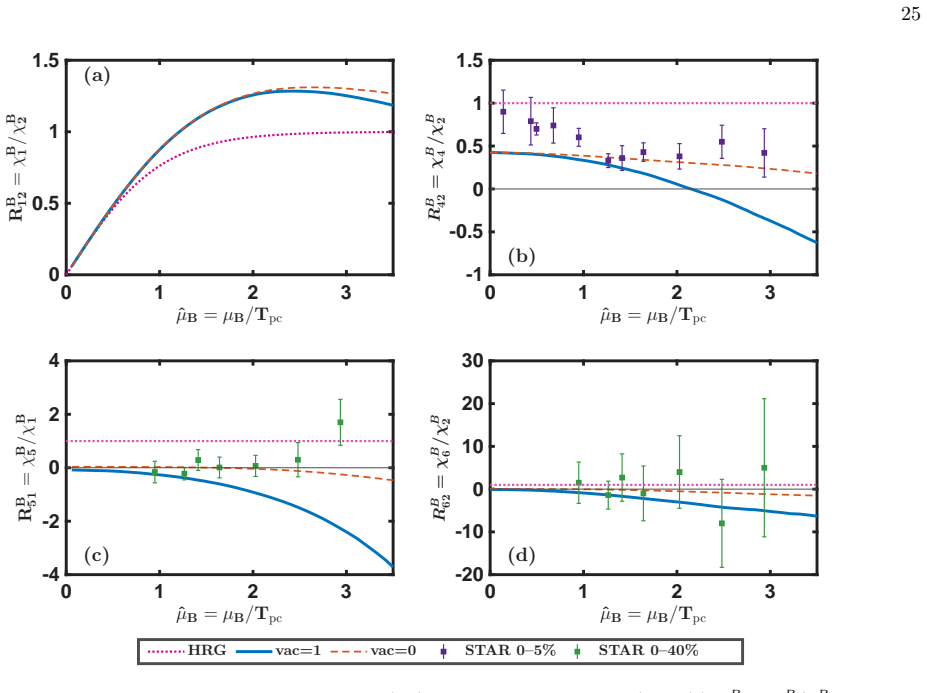
Including the vacuum term in the PCQMF model makes the baryon kurtosis ratio cross zero at μ_B/T_pc ≈ 2.15 while the no-sea version stays positive.
A machine-rendered reading of the paper's core claim, the machinery that carries it, and where it could break.
Core claim
In the vac=1 variant the kurtosis ratio R_42^B crosses zero at μ_B/T_pc ≈ 2.15 while the no-sea variant remains positive; the higher-order ratios R_51^B and R_62^B start negative and become more negative with increasing μ_B. The calculation includes diagonal susceptibilities through eighth order, all twelve independent fourth-order off-diagonal correlators, and selected odd-order baryon susceptibilities, with the vacuum term producing larger BQ amplitudes and multiple zero crossings in χ_6^B.
What carries the argument
The Polyakov chiral SU(3) quark mean field model with the fermion vacuum term (vac=1 variant), whose thermodynamic potential is differentiated repeatedly to obtain the generalized susceptibilities of baryon number, electric charge and strangeness.
If this is right
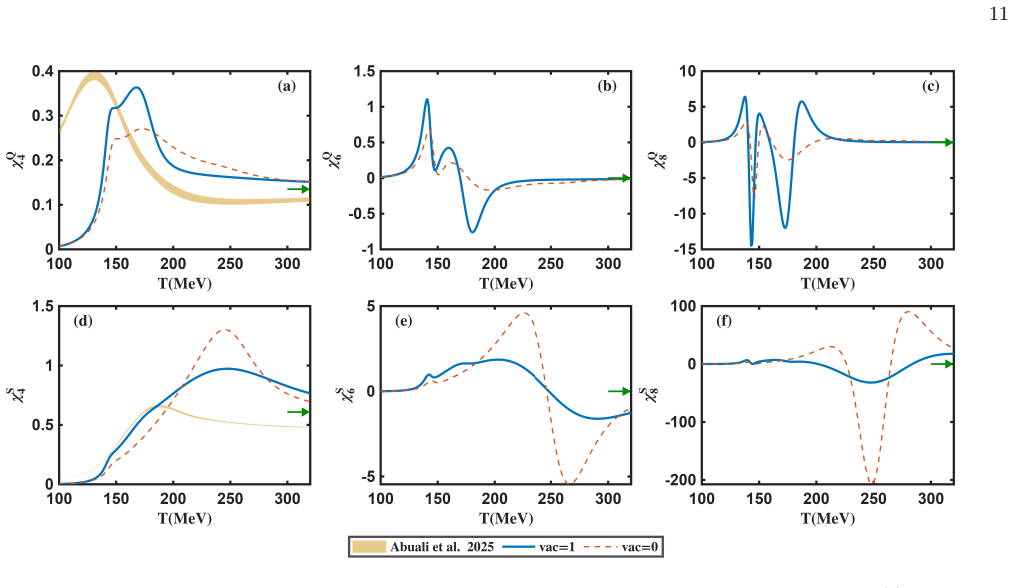
- Twin maxima develop in χ_4^B and χ_6^Q and twin minima in χ_8^B and χ_8^Q when the chiral-deconfinement splitting is resolved by higher derivatives.
- The BQ off-diagonal correlators maintain larger amplitudes in the vac=1 variant across the chiral crossover.
- The BS, QS and mixed BQS fourth-order correlators peak near the strange-melting temperature, where the no-sea variant dominates.
- Multiple zero crossings appear in χ_6^B only when the vacuum term is retained.
Where Pith is reading between the lines
- The zero crossing in R_42^B supplies a concrete, density-dependent signature that lattice groups could target to test the necessity of vacuum contributions in effective models.
- Because the sign change occurs at μ_B/T values already accessible in the RHIC beam-energy scan, the result directly informs which model variant better matches fluctuation data.
- Repeating the calculation at small nonzero μ_Q and μ_S would map how the reported patterns extend into the three-dimensional chemical-potential space relevant to real collisions.
Load-bearing premise
The model parameters fitted to vacuum meson masses or lattice results remain valid when extrapolated to finite baryon density and when higher-order derivatives of the thermodynamic potential are taken.
What would settle it
A lattice QCD or experimental determination of the baryon kurtosis ratio R_42^B at μ_B/T_pc ≈ 2.15 that remains positive rather than crossing zero would falsify the reported distinction between the vac=1 and vac=0 variants.
Figures
read the original abstract
We compute generalized susceptibilities of conserved charges in the Polyakov chiral SU(3) quark mean field (PCQMF) model with the fermion vacuum term. At $\mu_B = 0$ MeV, the calculation covers the diagonal $\chi_n^{B,Q,S}$ through eighth order and all twelve independent fourth-order off-diagonal correlators. Extending to finite $\mu_B$ at $\mu_Q = \mu_S = 0$, we compute $\chi_n^B$ through eighth order, $\chi_n^{Q,S}$ through fourth order, the second-order off-diagonals, all twelve fourth-order off-diagonal correlators, and the odd-order baryon susceptibilities $\chi_1^B$, $\chi_3^B$, $\chi_5^B$. The calculation includes the vacuum term (vac=1) and is repeated for an independently refitted no-sea variant (vac=0). At $\mu_B = 0$ MeV, the chiral pseudocritical temperature is $T_{\mathrm{pc}} = 170.5$ MeV (vac=1) and $166.4$ MeV (vac=0), while the Polyakov-loop deconfinement temperature is $T_{\mathrm{dec}} = 144.4$ MeV (vac=1) and $146.6$ MeV (vac=0). In vac=1, the derivative $-d\Delta_{l,s}/dT$ of the subtracted chiral condensate develops an inflection near $T_{\mathrm{dec}}$. Higher derivative orders resolve the chiral-deconfinement splitting as twin maxima in $\chi_4^B$ and $\chi_6^Q$, twin minima in $\chi_8^B$ and $\chi_8^Q$, and multiple zero crossings in $\chi_6^B$. Among the fourth-order off-diagonal correlators, vac=1 amplitudes exceed vac=0 in the BQ channel across the chiral crossover. The BS, QS, and mixed BQS components peak near the strange-melting temperature, where vac=0 dominates. Along $T_{\mathrm{pc}}(\mu_B)$, the kurtosis ratio $R_{42}^B \equiv \chi_4^B/\chi_2^B$ of vac=1 crosses zero at $\mu_B/T_{\mathrm{pc}} \approx 2.15$, while vac=0 stays positive across the full range. The higher-order ratios $R_{51}^B \equiv \chi_5^B/\chi_1^B$ and $R_{62}^B \equiv \chi_6^B/\chi_2^B$ start negative in vac=1 and grow more negative as $\mu_B$ increases.
Editorial analysis
A structured set of objections, weighed in public.
Referee Report
Summary. The manuscript computes generalized susceptibilities of conserved charges (B, Q, S) and their correlations in the Polyakov chiral SU(3) quark mean field model, both with the fermion vacuum term (vac=1) and an independently refitted no-sea variant (vac=0). At μ_B=0 it reports diagonal χ_n^{B,Q,S} through order 8 and all 12 independent fourth-order off-diagonal correlators; along the T_pc(μ_B) line at μ_Q=μ_S=0 it reports χ_n^B through order 8, χ_n^{Q,S} through order 4, second-order off-diagonals, all fourth-order off-diagonals, and the odd-order baryon susceptibilities, together with the ratios R_42^B, R_51^B and R_62^B. Key reported features include T_pc=170.5 MeV (vac=1) versus 166.4 MeV (vac=0), a zero crossing of R_42^B at μ_B/T_pc≈2.15 only in vac=1, and R_51^B, R_62^B starting negative and becoming more negative with increasing μ_B in vac=1.
Significance. If robust, the work supplies concrete higher-order fluctuation predictions from an effective model that can be confronted with lattice QCD and heavy-ion data, with the explicit vac=1 versus vac=0 comparison and the full set of fourth-order off-diagonal correlators constituting a useful addition to the literature on conserved-charge fluctuations.
major comments (1)
- [finite-μ_B results (abstract and corresponding numerical sections)] The zero crossing of R_42^B at μ_B/T_pc≈2.15 (vac=1) and the negative, increasingly negative behavior of R_51^B and R_62^B are obtained from up to eighth-order derivatives of the thermodynamic potential whose parameters (constituent quark masses, scalar/pseudoscalar couplings, Polyakov-loop parameters) were fixed exclusively at μ_B=0. No variation of these free parameters or propagation of their uncertainties is reported for the finite-density line, so the location of the crossing and the sign pattern are not shown to be stable; this directly affects the central claim of qualitatively different behavior between the two variants.
Simulated Author's Rebuttal
We thank the referee for the careful reading of our manuscript and for recognizing the potential utility of the higher-order susceptibilities and the vac=1 versus vac=0 comparison. We address the single major comment below.
read point-by-point responses
-
Referee: [finite-μ_B results (abstract and corresponding numerical sections)] The zero crossing of R_42^B at μ_B/T_pc≈2.15 (vac=1) and the negative, increasingly negative behavior of R_51^B and R_62^B are obtained from up to eighth-order derivatives of the thermodynamic potential whose parameters (constituent quark masses, scalar/pseudoscalar couplings, Polyakov-loop parameters) were fixed exclusively at μ_B=0. No variation of these free parameters or propagation of their uncertainties is reported for the finite-density line, so the location of the crossing and the sign pattern are not shown to be stable; this directly affects the central claim of qualitatively different behavior between the two variants.
Authors: The PCQMF parameters are fixed by fitting to vacuum hadron properties and lattice QCD thermodynamics at μ_B=0, which is the conventional procedure for effective QCD models. The finite-μ_B results are therefore genuine predictions of each variant. The vac=1 and vac=0 cases are independently refitted at μ_B=0, so the reported qualitative difference in the sign pattern and zero-crossing of the ratios directly reflects the presence or absence of the vacuum term within the same modeling framework. While an explicit variation of parameters or uncertainty propagation along the finite-density line would be a useful extension, it lies outside the scope of the present work; the central claim concerns the model-level distinction between the two variants rather than a claim of parameter-independent robustness. revision: no
Circularity Check
No significant circularity; standard parameter fit followed by extrapolation
full rationale
The paper constructs the PCQMF thermodynamic potential, fits its parameters (constituent masses, couplings, Polyakov parameters) to vacuum meson masses or μ_B=0 lattice quantities, then evaluates up to eighth-order derivatives to obtain susceptibilities and ratios R_42^B, R_51^B, R_62^B along T_pc(μ_B). This is ordinary model extrapolation; the finite-μ_B sign changes and zero crossing are outputs of the functional form and are not equivalent by construction to the μ_B=0 fit data. The vac=0 variant is independently refitted, and no load-bearing self-citation or self-definitional step is present. The derivation chain remains self-contained against external benchmarks.
Axiom & Free-Parameter Ledger
free parameters (1)
- PCQMF coupling constants and Polyakov potential parameters
axioms (1)
- domain assumption The mean-field approximation captures the thermodynamics of the model at the temperatures and densities considered.
Reference graph
Works this paper leans on
-
[1]
To account for the back- reaction of dynamical quarks on the gluonic sector, the temperature argument of a andb is replaced by an effec- tive Yang-Mills temperature TYM
The parameters a0,a1,a2,b3 are fitted to pure-gauge lattice thermodynamics [72]. To account for the back- reaction of dynamical quarks on the gluonic sector, the temperature argument of a andb is replaced by an effec- tive Yang-Mills temperature TYM. The glue temperature of the full theory Tglue is identified with the matter tem- perature T , and TYM follows...
-
[2]
A change in Λ is absorbed by refitting the scalar-sector parameters to the same vacuum observables
yields [40, 59] Ω vac ¯qq = − Nc 8π 2 ∑ i=u,d,s m∗4 i lnm∗ i Λ , (19) where Λ = 600 MeV is the regularization scale. A change in Λ is absorbed by refitting the scalar-sector parameters to the same vacuum observables. Because m∗ i depends on the scalar fields through Eq. ( 8), Ω vac ¯qq modifies the curvature of the effective potential in field space and contri...
-
[3]
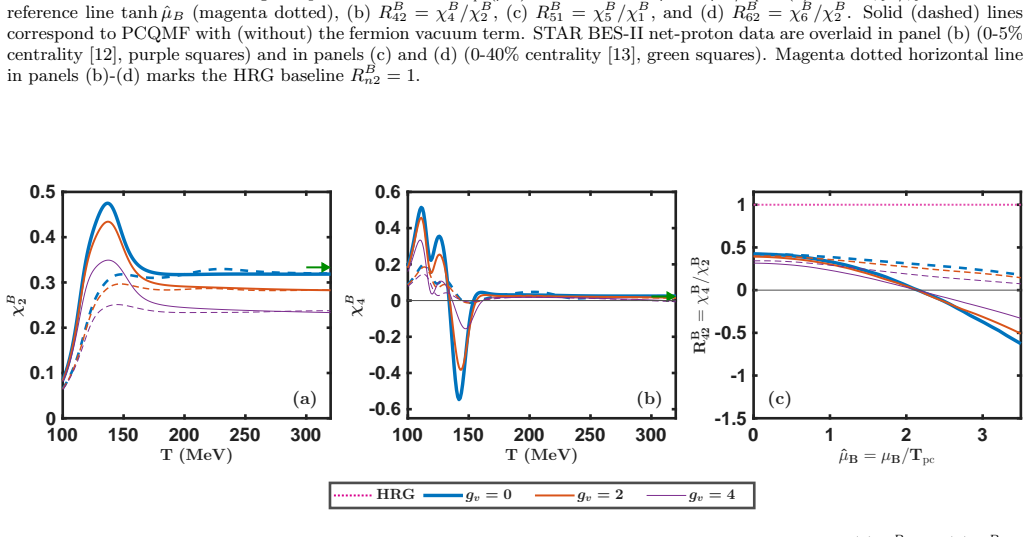
The effect of nonzero gv on the finite-µ B results is examined in Sec
then reduce to the bare quark chemical potentials, µ ∗ i =µ i. The effect of nonzero gv on the finite-µ B results is examined in Sec. IV F. E. Conserved-charge susceptibilities The generalized susceptibilities of conserved charges are defined as derivatives of the scaled pressure with re- spect to the reduced chemical potentials ˆ µ X ≡ µ X/T [24, 25], χ BQS...
2010
-
[4]
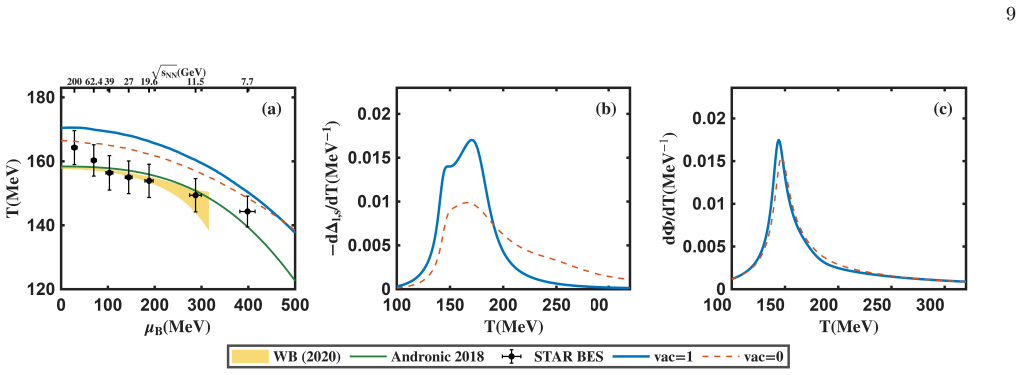
4 MeV (vac=1) and
4 MeV (vac=0), and Tdec = 144. 4 MeV (vac=1) and
-
[5]
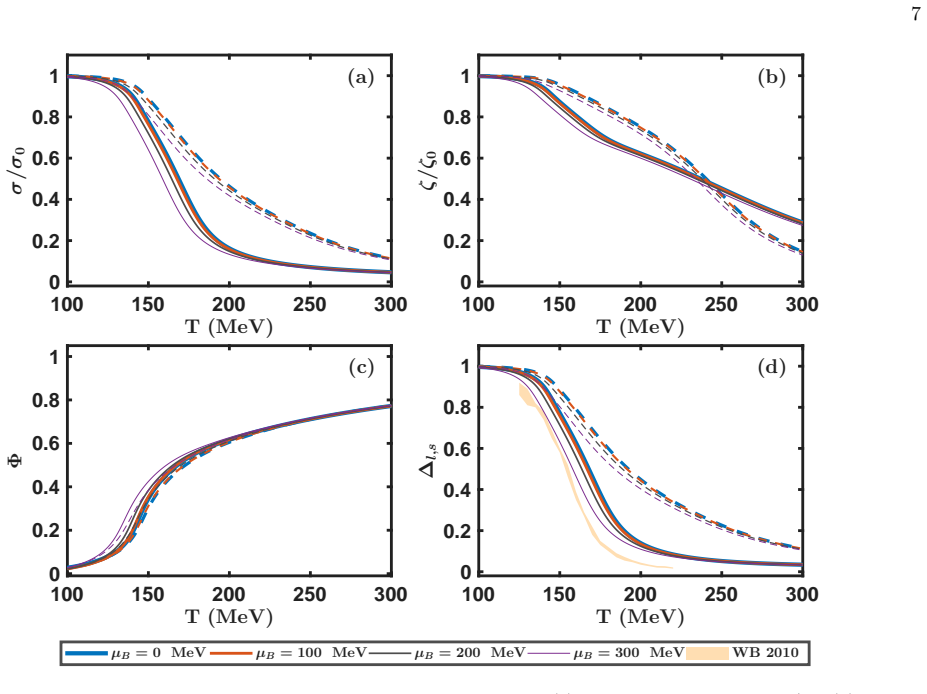
The chiral-deconfinement splitting is 26
6 MeV (vac=0). The chiral-deconfinement splitting is 26. 1 MeV for vac=1 and 19 . 8 MeV for vac=0. The same glue-to-Yang-Mills mapping of Eq. ( 17) [73] gener- ates the splitting in both variants. Earlier PCQMF works without this mapping [65, 66] placed both crossovers near 165 MeV. The model Tpc(µ B) lies above the continuum- extrapolated chiral crossover...
2010
-
[6]
Figure 5 shows second-order off-diagonal correlators at µ B = 0 MeV
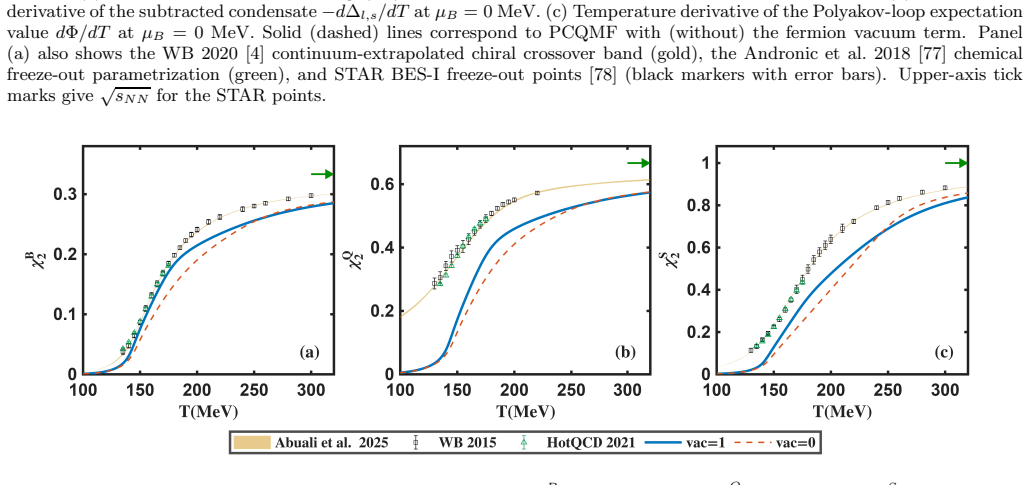
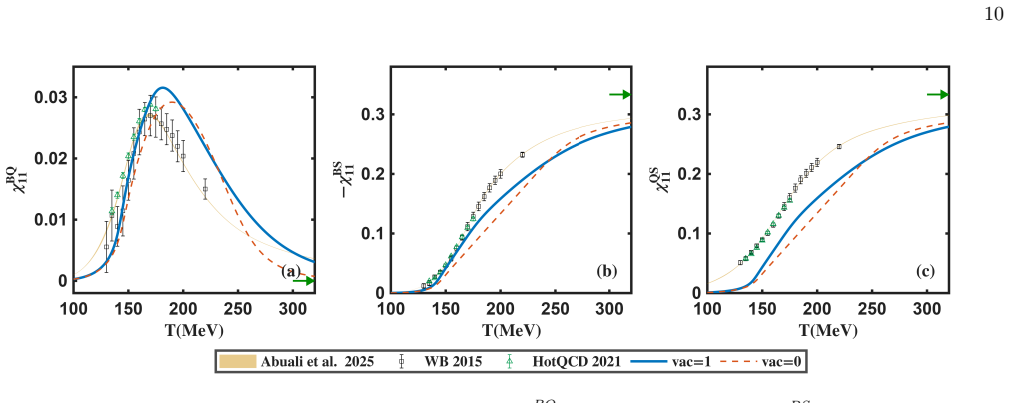
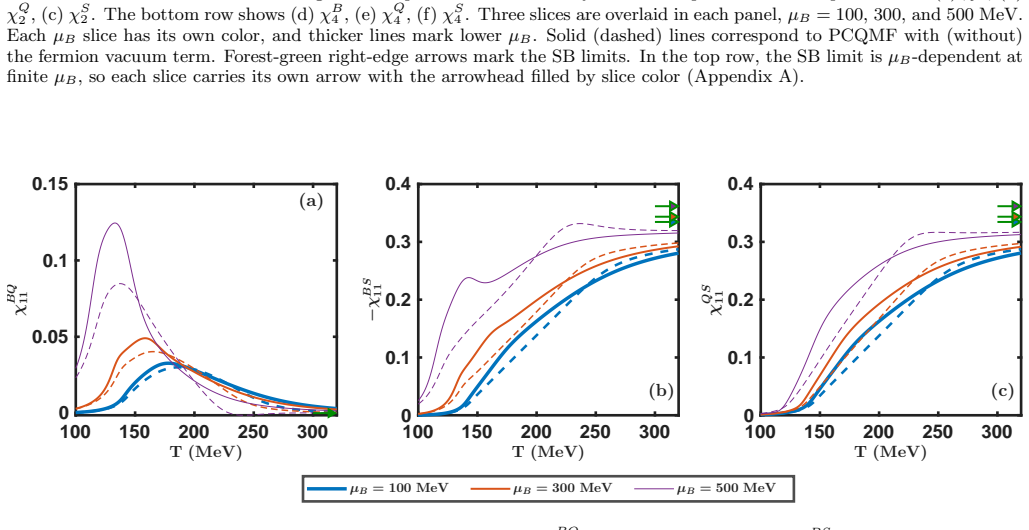
and NJL [51] mean-field calculations. Figure 5 shows second-order off-diagonal correlators at µ B = 0 MeV. Panel (b) plots −χ BS 11 because χ BS 11 is neg- ative across the full T range. In the hadronic phase, hy- perons carry B = +1 and S <0. In the partonic phase, the strange quark carries B = +1/ 3 and S = − 1. Hence, χ BS 11 remains negative in both reg...
2014
-
[7]
Lattice bands are Borsanyi et al
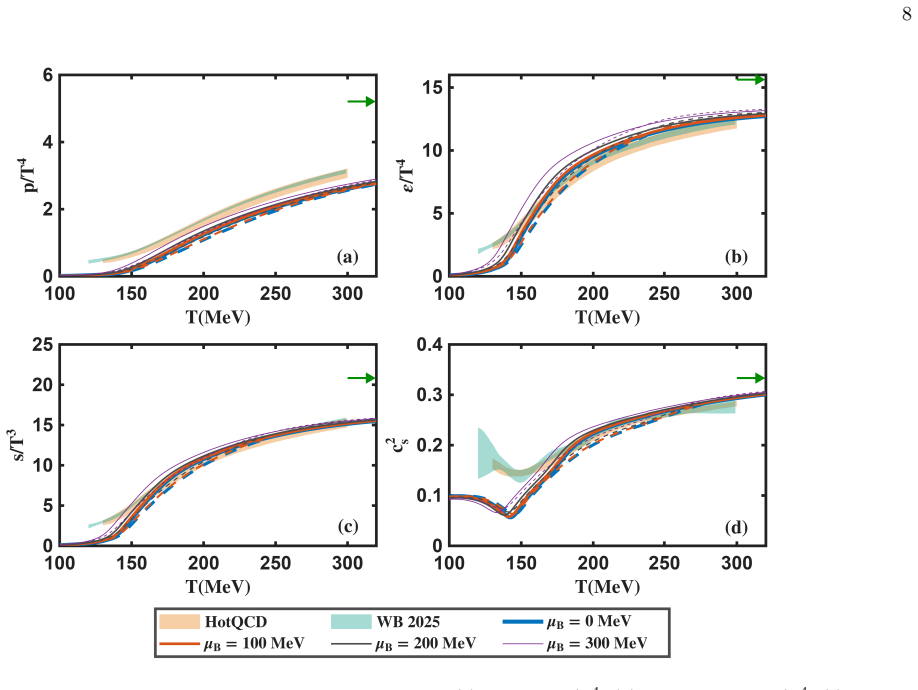
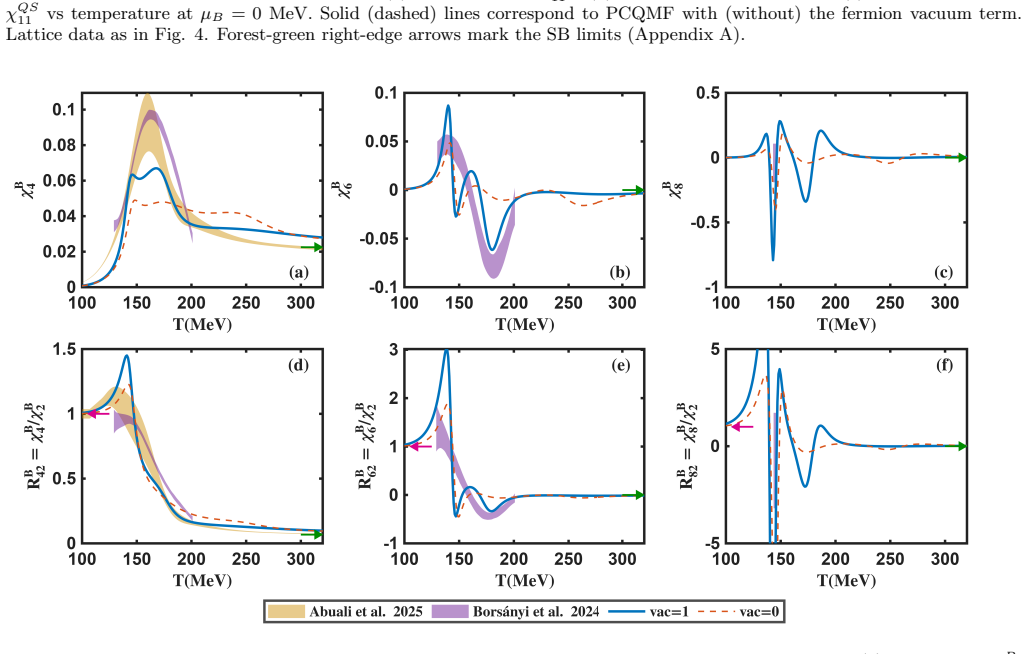
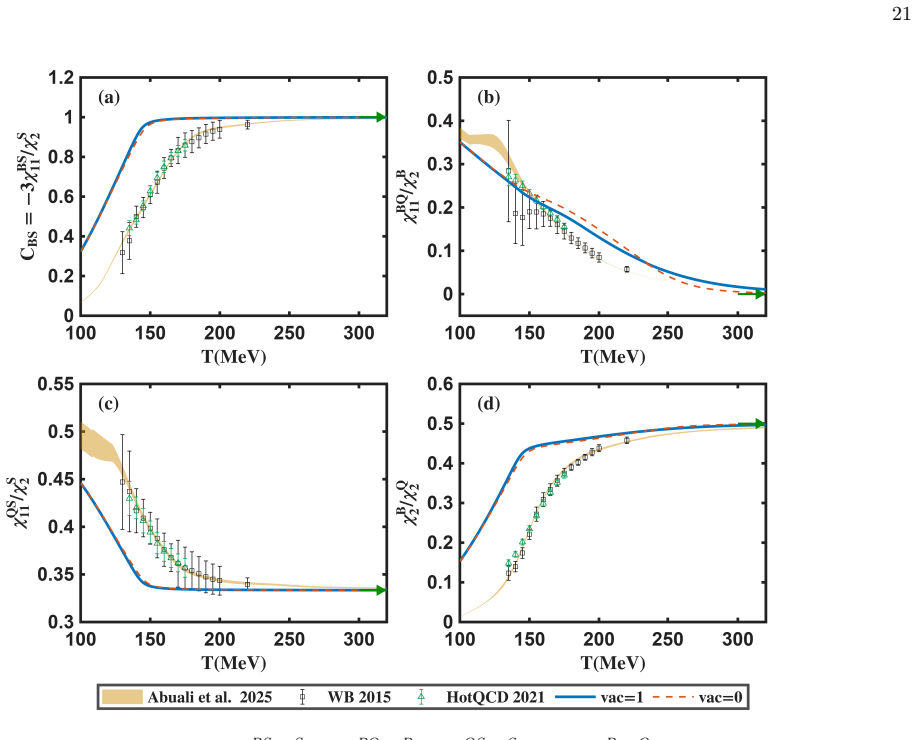
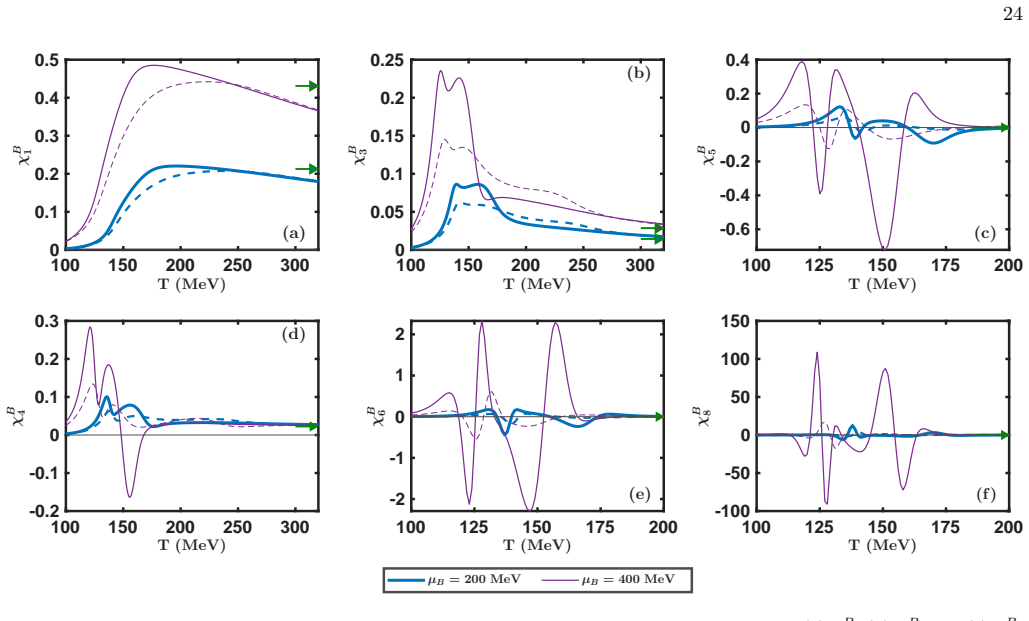
Solid (dashed) lines correspond to PCQMF with (without) the fermi on vacuum term. Lattice bands are Borsanyi et al. 2024 [49] (deep purple) and Abuali et al. 2025 [8] (amber). Forest-gre en right-edge arrows mark the SB limits (Appendix A). Magent a left-edge arrows in the bottom row mark the HRG baseline RB n2 = 1. region. The free massless quark pressur...
2024
-
[8]
Panels (d), (e), (k), (l) carry an over- all minus sign to match the convention of [8], so that all twelve plotted quantities have positive SB limits
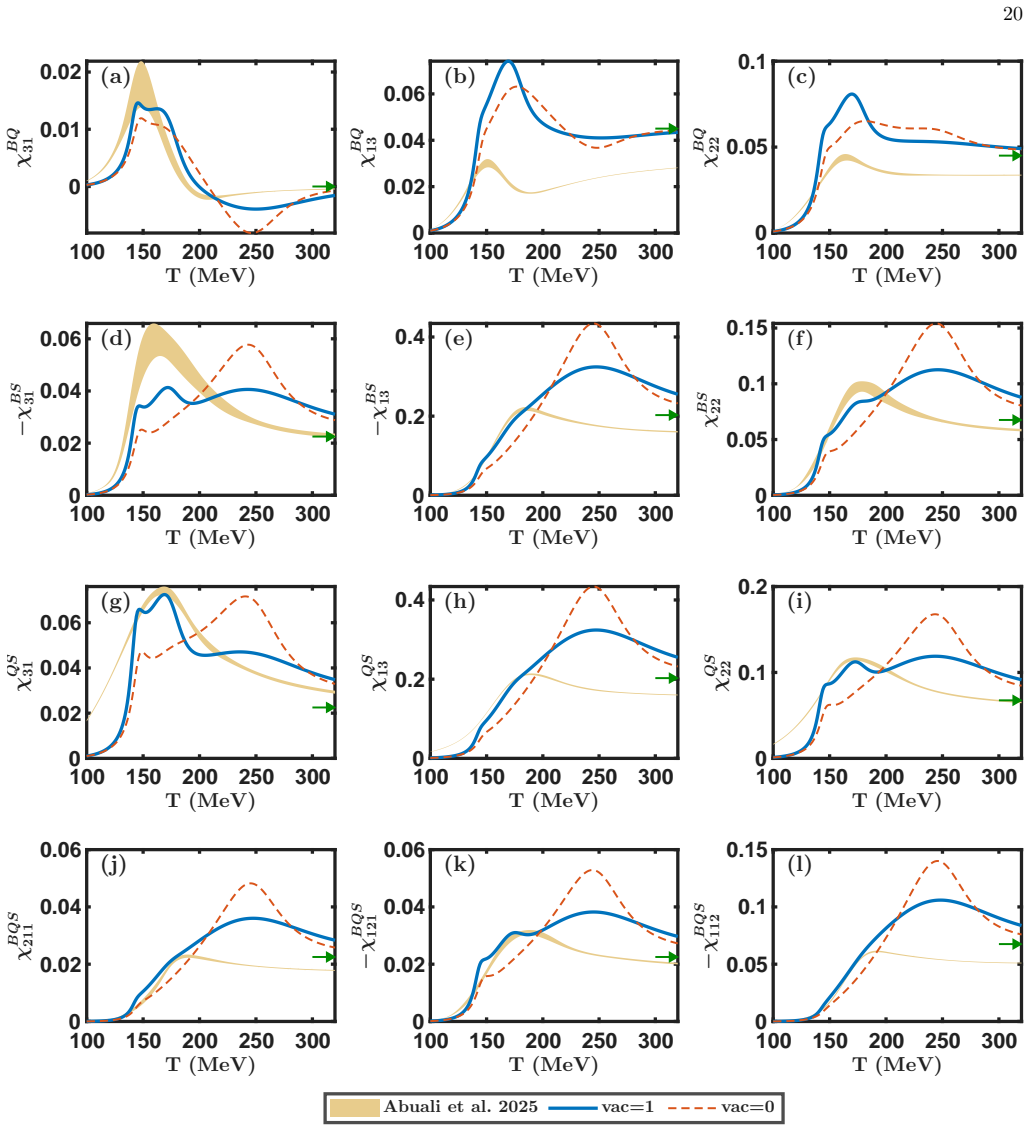
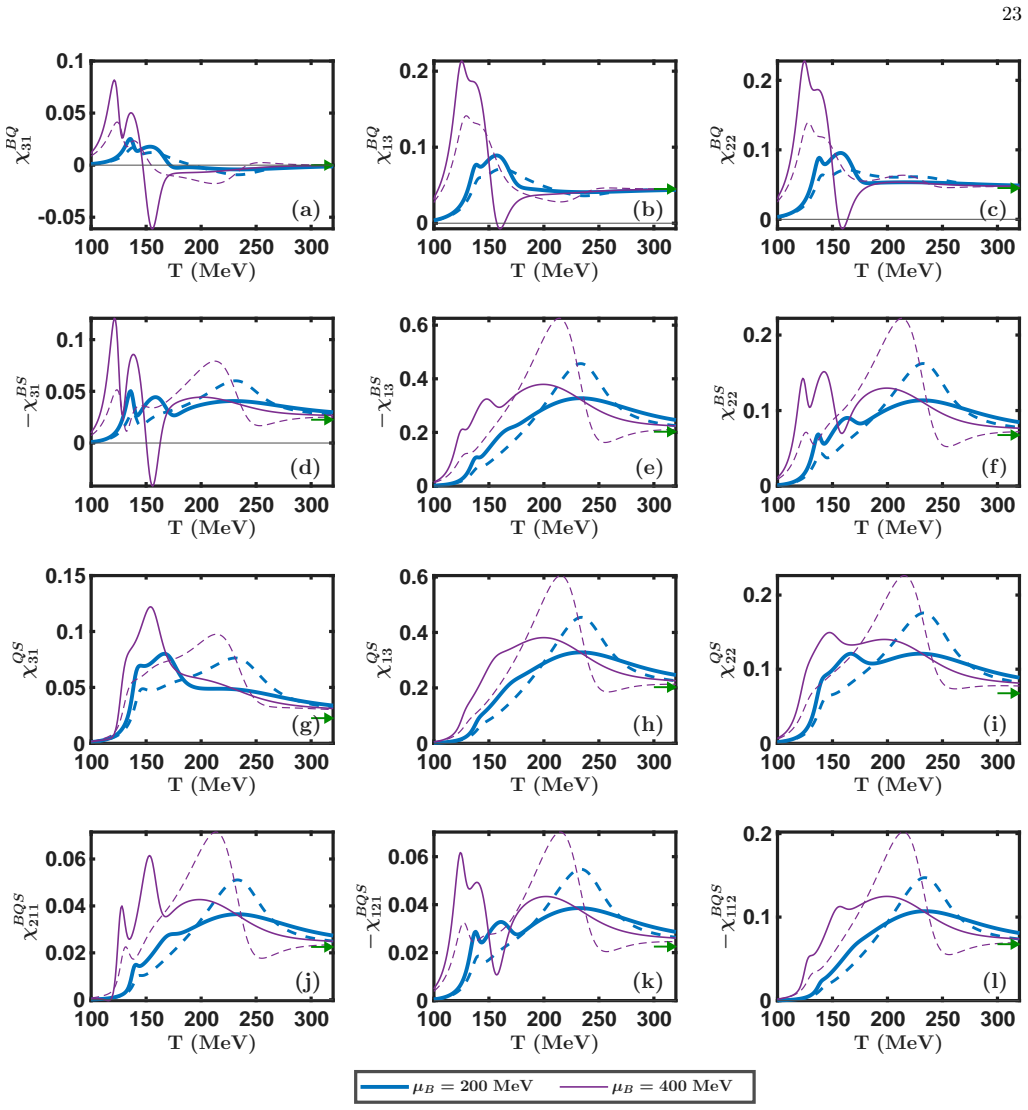
Row 4 holds the three mixed components χ BQS ijk with i +j +k = 4. Panels (d), (e), (k), (l) carry an over- all minus sign to match the convention of [8], so that all twelve plotted quantities have positive SB limits. The same twelve correlators have been computed in (2+1)- flavor PQM with the vacuum term at µ B = 0 MeV [41]. The complete fourth-order off-d...
-
[9]
Peaks in panels (b) and (c) track the light chiral crossover at T ≈ 170 MeV
015. Peaks in panels (b) and (c) track the light chiral crossover at T ≈ 170 MeV. The peak in panel (a) shifts to T ≈ 145 MeV, near Tdec. The vac=1 peaks exceed vac=0 by about 20% across the BQ row. In panels (b) and (c), the lattice central values sit well below the model peaks. Panel (a) shows the closest lattice-model agree- ment in the BQ row. The ban...
-
[10]
The vac=0 curve follows the same pattern with smaller amplitudes
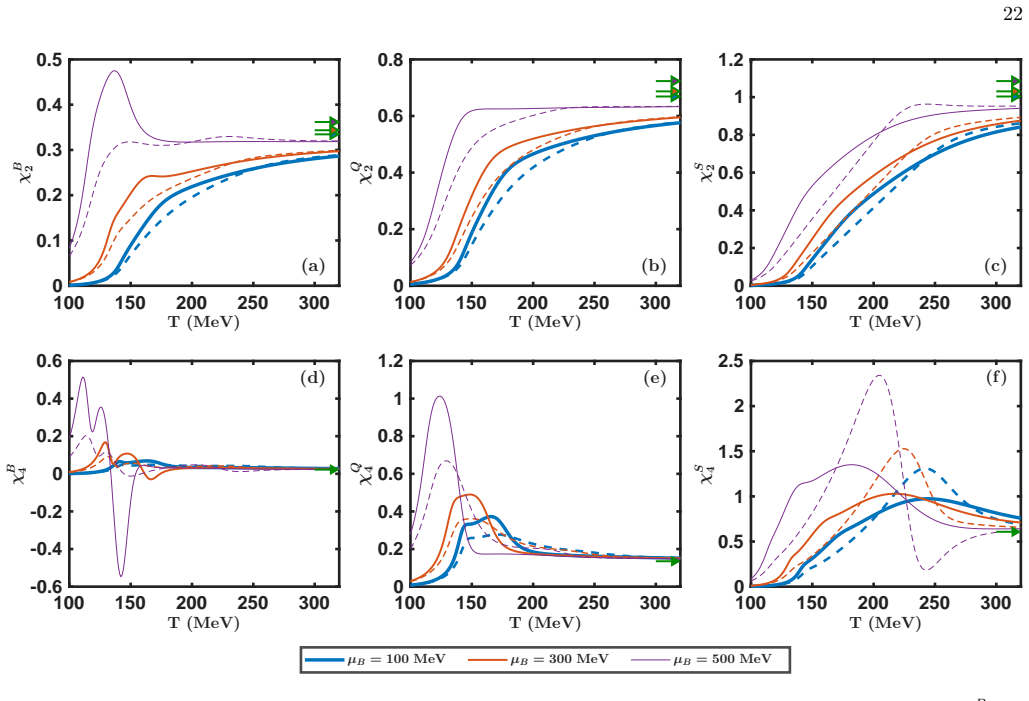
125 atT ≈ 133 MeV. The vac=0 curve follows the same pattern with smaller amplitudes. Light quarks carry both B andQ, so the correlator couples directly to µ B and the peak sharpens as the crossover strengthens. The vac=1 peak grows by a factor of 3 . 8 between µ B = 100 and 500 MeV, more than double the χ B 2 growth of 1. 7 (Fig. 10). In panels (b) and (c...
-
[11]
PQM with and without the vacuum term re- ports the corresponding RB n2 ratios through twelfth order at finiteµ B [40] but does not isolate individual high-order χ B n
reports a similar growth of chiral-region oscillations with µ B. PQM with and without the vacuum term re- ports the corresponding RB n2 ratios through twelfth order at finiteµ B [40] but does not isolate individual high-order χ B n . E. Cumulant ratios along the pseudocritical line Figure 14 presents the cumulant ratios RB 12 ≡ χ B 1/χ B 2 , RB 42 ≡ χ B 4/...
-
[12]
In vac=1, Fig
enters the PC- QMF effective potential and modifies the gap-equation solutions. In vac=1, Fig. 1(a) shows that the scalar field σ drops more steeply with temperature through the chi- ral crossover than in vac=0. This sharpening is opposite to the (2+1)-flavor PQM result, where the vacuum term smooths the crossover [40, 41]. The light constituent quark masses ...
-
[13]
At higher derivative orders, Fig
[73] and is present in both variants. At higher derivative orders, Fig. 6 shows the chiral-deconfinement splitting resolved as a double-peak structure in χ B 4 and as multiple zero crossings in χ B 6 and χ B 8 in both variants. The vac=1 peak-to-trough contrast exceeds that of vac=0. The vac=1/vac=0 difference in the fourth-order off- diagonal tensor (Fig
-
[14]
Chiral-crossover peaks are larger in vac=1, while strange-melting peaks are larger in vac=0
depends on the temperature region of each peak. Chiral-crossover peaks are larger in vac=1, while strange-melting peaks are larger in vac=0. The BQ row sits in the first category, since light quarks dominate its correlators at the chiral crossover. The steeper σ (T ) drop in vac=1 drives the vac=1 dominance throughout the chiral region of the tensor, where...
2023
-
[15]
Y. Aoki, G. Endr˝ odi, Z. Fodor, S. D. Katz, and K. K. Szab´ o, The order of the quantum chromodynam- ics transition predicted by the standard model of particle physics, Nature 443, 675 (2006)
2006
-
[16]
Bazavov et al
A. Bazavov et al. (HotQCD), Chiral crossover in QCD at zero and non-zero chemical potentials, Phys. Lett. B 795, 15 (2019)
2019
-
[17]
Borsanyi et al
S. Borsanyi et al. (Wuppertal-Budapest), Is there still any Tc mystery in lattice QCD? Results with physical masses in the continuum limit III, JHEP 09, 073
-
[18]
Borsanyi, Z
S. Borsanyi, Z. Fodor, J. N. Guenther, R. Kara, S. D. Katz, P. Parotto, A. Pasztor, C. Ratti, and K. K. Szab´ o, Qcd crossover at finite chemical potential from lattice simulations, Phys. Rev. Lett. 125, 052001 (2020)
2020
-
[19]
A. M. Halasz, A. D. Jackson, R. E. Shrock, M. A. Stephanov, and J. J. M. Verbaarschot, Phase diagram of QCD, Phys. Rev. D 58, 096007 (1998)
1998
-
[20]
M. A. Stephanov, K. Rajagopal, and E. V. Shuryak, Sig- natures of the tricritical point in QCD, Phys. Rev. Lett. 81, 4816 (1998)
1998
-
[21]
M. A. Stephanov, QCD phase diagram: An overview, PoS LAT2006, 024 (2006)
2006
-
[22]
Abuali, S
A. Abuali, S. Borsanyi, Z. Fodor, J. N. Guenther, R. Kara, A. Pasztor, C. Ratti, and K. K. Szab´ o, New four-dimensional lattice QCD equation of state: ex- tended density coverage from a generalized T ′-expansion, Phys. Rev. D 112, 054502 (2025)
2025
-
[23]
D. A. Clarke, F. Karsch, A. Lahiri, M. Neu- mann, and C. Schmidt, Searching for the QCD crit- ical endpoint using multipoint Pad´ e approximants, Phys. Rev. D 112, L091504 (2025)
2025
-
[24]
Ba¸ sar, QCD critical point, Lee–Yang edge singularities, and Pad´ e resummations, Phys
G. Ba¸ sar, QCD critical point, Lee–Yang edge singularities, and Pad´ e resummations, Phys. Rev. C 110, 015203 (2024)
2024
-
[25]
Adam et al
J. Adam et al. (STAR), Nonmonotonic energy depen- dence of net-proton number fluctuations in Au+Au col- lisions at √ sN N = 7 . 7–200 GeV, Phys. Rev. Lett. 126, 092301 (2021)
2021
-
[26]
B. E. Aboona et al. (STAR), Precision measurement of net-proton number fluctuations in Au+Au collisions at RHIC, Phys. Rev. Lett. 135, 142301 (2025)
2025
-
[27]
B. E. Aboona et al. (STAR), Measurements of fifth- and sixth-order net-proton cumulants in Au+Au collisions at RHIC, (2025), arXiv:2512.19352 [nucl-ex]
arXiv 2025
-
[28]
B. E. Aboona et al. (STAR), Measurements of proton high order cumulants in √ sN N = 3 GeV Au+Au colli- sions and implications for the QCD critical point, Phys. Rev. Lett. 130, 082301 (2023)
2023
-
[29]
Bzdak, S
A. Bzdak, S. Esumi, V. Koch, J. Liao, M. Stephanov, and N. Xu, Mapping the phases of quantum chromodynamics 18 with beam energy scan, Phys. Rept. 853, 1 (2020)
2020
-
[30]
Pandav, D
A. Pandav, D. Mallick, and B. Mohanty, Search for the QCD critical point in high energy nuclear collisions, Prog. Part. Nucl. Phys. 125, 103960 (2022)
2022
-
[31]
Luo and N
X. Luo and N. Xu, Search for the QCD critical point with fluctuations of conserved quantities in relativistic heavy - ion collisions at RHIC: An overview, Nucl. Sci. Tech. 28, 112 (2017)
2017
-
[32]
V. Koch and V. Vovchenko, Exploring the QCD phase diagram through correlations and fluctuations, (2025), arXiv:2512.04288 [hep-ph]
Pith/arXiv arXiv 2025
-
[33]
Koch, Hadronic fluctuations and correlations, (2008), arXiv:0810.2520 [hep-ph]
V. Koch, Hadronic fluctuations and correlations, (2008), arXiv:0810.2520 [hep-ph]
Pith/arXiv arXiv 2008
-
[34]
Kitazawa and M
M. Kitazawa and M. Asakawa, Relation between baryon number fluctuations and experimentally observed proton number fluctuations in relativistic heavy ion collisions, Phys. Rev. C 86, 024904 (2012)
2012
-
[35]
V. Koch, A. Majumder, and J. Randrup, Baryon- strangeness correlations: A diagnostic of strongly inter- acting matter, Phys. Rev. Lett. 95, 182301 (2005)
2005
-
[36]
Ejiri, F
S. Ejiri, F. Karsch, and K. Redlich, Hadronic fluctuations at the QCD phase transition, Phys. Lett. B 633, 275 (2006)
2006
-
[37]
Hatta and T
Y. Hatta and T. Ikeda, Universality, the QCD critical and tricritical point, and the quark number susceptibility , Phys. Rev. D 67, 014028 (2003)
2003
-
[38]
Bazavov et al
A. Bazavov et al. (HotQCD), Fluctuations and cor- relations of net baryon number, electric charge, and strangeness: A comparison of lattice QCD results with the hadron resonance gas model, Phys. Rev. D 86, 034509 (2012)
2012
-
[39]
Borsanyi, Z
S. Borsanyi, Z. Fodor, S. D. Katz, S. Krieg, C. Ratti, and K. K. Szab´ o, Fluctuations of conserved charges at finite temperature from lattice QCD, JHEP 01, 138
-
[40]
Bellwied, S
R. Bellwied, S. Borsanyi, Z. Fodor, S. D. Katz, A. Pasztor, C. Ratti, and K. K. Szab´ o, Fluctu- ations and correlations in high temperature QCD, Phys. Rev. D 92, 114505 (2015)
2015
-
[41]
Bollweg et al
D. Bollweg et al. (HotQCD), Second order cumulants of conserved charge fluctuations revisited: I. Vanishing chemical potentials, Phys. Rev. D 104, 074512 (2021)
2021
-
[42]
Karsch, B.-J
F. Karsch, B.-J. Schaefer, M. Wagner, and J. Wambach, Towards finite density QCD with Taylor expansions, Phys. Lett. B 698, 256 (2011)
2011
-
[43]
Bazavov et al
A. Bazavov et al. (HotQCD), Skewness, kurtosis, and the fifth and sixth order cumulants of net baryon-number distributions from lattice QCD confront high-statistics STAR data, Phys. Rev. D 101, 074502 (2020)
2020
-
[44]
Fukushima, Chiral effective model with the Polyakov loop, Phys
K. Fukushima, Chiral effective model with the Polyakov loop, Phys. Lett. B 591, 277 (2004)
2004
-
[45]
Ratti, M
C. Ratti, M. H. Thoma, and W. Weise, Phases of QCD: Lattice thermodynamics and a conceptual model, Phys. Rev. D 73, 014019 (2006)
2006
-
[46]
S. K. Ghosh, T. K. Mukherjee, M. G. Mustafa, and R. Ray, Susceptibilities and speed of sound from the Polyakov–Nambu–Jona-Lasinio model, Phys. Rev. D 73, 014007 (2006)
2006
-
[47]
Bhattacharyya, P
A. Bhattacharyya, P. Deb, A. Lahiri, and R. Ray, Sus- ceptibilities with multiquark interactions in the PNJL model, Phys. Rev. D 82, 114028 (2010)
2010
-
[48]
A. Sarkar and P. Deb, Study of net-baryon higher moments in the PNJL model, (2024), arXiv:2406.13873 [hep-ph]
arXiv 2024
-
[49]
A. Sarkar and P. Deb, Net-strangeness fluctuations and their experimental implications in SU(3) PNJL model, (2026), arXiv:2601.05891 [hep-ph]
arXiv 2026
-
[50]
Shao, Z.-d
G.-y. Shao, Z.-d. Tang, X.-y. Gao, and W.-b. He, Baryon number fluctuations and the phase structure in the PNJL model, Eur. Phys. J. C 78, 138 (2018)
2018
-
[51]
Ferreira and P
M. Ferreira and P. Costa, Presence of a critical endpoint in the QCD phase diagram from net-baryon number fluc- tuations, Phys. Rev. D 99, 036006 (2018)
2018
-
[52]
Schaefer, J
B.-J. Schaefer, J. M. Pawlowski, and J. Wambach, Phase structure of the Polyakov-quark-meson model, Phys. Rev. D 76, 074023 (2007)
2007
-
[53]
Schaefer, M
B.-J. Schaefer, M. Wagner, and J. Wambach, Thermody- namics of (2 + 1)-flavor QCD: Confronting models with lattice studies, Phys. Rev. D 81, 074013 (2010)
2010
-
[54]
Schaefer and M
B.-J. Schaefer and M. Wagner, QCD critical re- gion and higher moments for three-flavor models, Phys. Rev. D 85, 034027 (2012)
2012
-
[55]
Chatterjee and K
S. Chatterjee and K. A. Mohan, Fluctuations and correla- tions of conserved charges in the Polyakov–quark-meson model, Phys. Rev. D 86, 114021 (2012)
2012
-
[56]
S. Pal, G. Kadam, H. Mishra, and A. Bhat- tacharyya, Effects of hadronic repulsive interac- tions on the fluctuations of conserved charges, Phys. Rev. D 103, 054015 (2021)
2021
-
[57]
Bollweg et al
D. Bollweg et al. , Strangeness correlations on the pseudocritical line in (2 + 1)-flavor QCD, Phys. Rev. D 110, 054519 (2024)
2024
-
[58]
J. Goswami and F. Karsch, Higher-order net-baryon number cumulants and baryon–strangeness correlations, (2025), arXiv:2512.01126 [hep-lat]
arXiv 2025
-
[59]
Yang, G.-Y
X.-R. Yang, G.-Y. Shao, C.-L. Xie, and Z.-P. Li, Corre- lations of the net baryon number and electric charge in nuclear matter, Nucl. Sci. Tech. 36, 138 (2025)
2025
-
[60]
M. A. Stephanov, Non-Gaussian fluctuations near the QCD critical point, Phys. Rev. Lett. 102, 032301 (2009)
2009
-
[61]
M. A. Stephanov, Sign of kurtosis near the QCD critical point, Phys. Rev. Lett. 107, 052301 (2011)
2011
-
[62]
Friman, F
B. Friman, F. Karsch, K. Redlich, and V. Skokov, Fluctu- ations as probe of the QCD phase transition and freeze- out in heavy ion collisions at LHC and RHIC energies, Eur. Phys. J. C 71, 1694 (2011)
2011
-
[63]
Borsanyi, Z
S. Borsanyi, Z. Fodor, J. N. Guenther, S. D. Katz, A. Pasztor, and K. K. Szab´ o, Continuum- extrapolated higher-order baryon fluctuations, Phys. Rev. D 110, L011501 (2024)
2024
-
[64]
A. Adam, S. Borsanyi, Z. Fodor, J. N. Guenther, et al. , High-precision baryon number cumulants from lattice QCD in a finite box, (2025), arXiv:2507.13254 [hep-lat]
arXiv 2025
-
[65]
W. Fan, X. Luo, and H.-S. Zong, Mapping the QCD phase diagram with susceptibilities of con- served charges within Nambu–Jona-Lasinio model, Phys. Rev. D 95, 014017 (2017)
2017
-
[66]
W. Fan, X. Luo, and H.-S. Zong, Probing the QCD phase structure with higher-order baryon number susceptibilities within the NJL model, Phys. Rev. D 100, 074008 (2019)
2019
-
[67]
W.-j. Fu, J. M. Pawlowski, and F. Rennecke, Hyper-order baryon number fluctuations at finite temperature and density, Phys. Rev. D 104, 034025 (2021)
2021
-
[68]
W.-j. Fu, J. M. Pawlowski, and F. Rennecke, Strangeness neutrality and QCD thermodynamics, SciPost Phys. Core 2, 002 (2020)
2020
-
[69]
W.-j. Fu, X. Luo, J. M. Pawlowski, F. Rennecke, and S. Yin, Ripples of the QCD critical point, 19 Phys. Rev. D 111, L031502 (2025)
2025
-
[70]
W.-j. Fu, J. M. Pawlowski, and F. Rennecke, Strangeness neutrality and the QCD phase diagram, Phys. Rev. D 101, 054032 (2020)
2020
- [71]
-
[72]
Li and S
Z. Li and S. He, Holographic study of higher-order baryon number susceptibilities at finite temperature and density, Phys. Rev. D 107, 066009 (2023)
2023
-
[73]
Skokov, B
V. Skokov, B. Friman, E. Nakano, K. Redlich, and B.-J. Schaefer, Vacuum fluctuations and the thermodynamics of chiral models, Phys. Rev. D 82, 034029 (2010)
2010
-
[74]
Chatterjee and K
S. Chatterjee and K. A. Mohan, Including the fermion vacuum fluctuations in the (2 + 1) flavor Polyakov quark- meson model, Phys. Rev. D 85, 074018 (2012)
2012
-
[75]
U. S. Gupta and V. K. Tiwari, Revisiting the phase structure of the Polyakov-quark-meson model in the presence of vacuum fermion fluctuation, Phys. Rev. D 85, 014010 (2012)
2012
-
[76]
S. K. Rai and V. K. Tiwari, On-shell vs curvature-mass renormalized Polyakov quark-meson model: Thermody- namics and the critical endpoint for (2 + 1) quark flavors, Phys. Rev. D 109, 034025 (2024)
2024
-
[77]
Singh and A
D. Singh and A. Kumar, Finite-size effects on the trans- port coefficients of strongly interacting QCD matter, Phys. Rev. D 111, 074017 (2025)
2025
-
[78]
Singh and A
D. Singh and A. Kumar, Transport coefficients of anisotropic quark matter in the PCQMF model with the fermion vacuum term, Phys. Rev. D 113, 054005 (2026)
2026
-
[79]
Kumari and A
N. Kumari and A. Kumar, Phase transition and ther- modynamics of asymmetric strange quark matter in the PCQMF model, Eur. Phys. J. Plus 136, 19 (2021)
2021
-
[80]
Chahal, S
N. Chahal, S. Dutt, and A. Kumar, Quark matter prop- erties and fluctuations of conserved charges in a (2 + 1)- flavored quark model, Chin. Phys. C 46, 063104 (2022)
2022
discussion (0)
Sign in with ORCID, Apple, or X to comment. Anyone can read and Pith papers without signing in.