REVIEW 2 major objections 2 minor 67 references
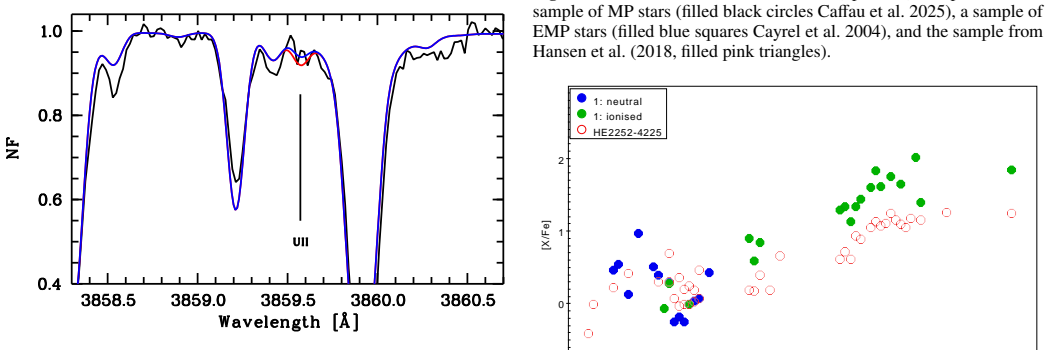
TYC 170-1218-1 is an r-II extremely metal-poor star with [Eu/Fe] = +1.84 and [Th/Fe] = +1.85 at [Fe/H] = -3.52 that joined the Milky Way in the Sequoia accretion event.
Reviewed by Pith at T0; open to challenge. T0 means a machine referee read the full paper against a public rubric. the ladder, T0–T4 →
T0 review · grok-4.3
2026-06-27 16:11 UTC pith:UTC7CM6H
load-bearing objection This is a standard discovery paper adding one r-II EMP star with high Th to the catalog, but the headline abundances rest on uncorrected 1D LTE. the 2 major comments →
TYC 170-1218-1: A new r-process-enhanced extremely metal-poor star, rich in Th
The pith
A machine-rendered reading of the paper's core claim, the machinery that carries it, and where it could break.
Core claim
The star TYC 170-1218-1 has [Fe/H] = -3.52 and is enhanced in alpha elements. It is an r-II star with [Eu/Fe] = +1.84 and [Th/Fe] = +1.85. The star is carbon-poor relative to iron. Kinematically it belongs to the Galactic halo but originated in the Sequoia accretion event. Abundances for 33 elements were derived from UVES and MIKE spectra using the MyGIsFOS code and an ATLAS9 model atmosphere; uranium was not detected.
What carries the argument
Abundance analysis of 33 elements from high-resolution spectra using the MyGIsFOS code with an ATLAS9 model atmosphere, together with kinematic classification for Galactic origin.
Load-bearing premise
The reported abundance ratios accurately reflect the star's composition, which depends on the assumption that the ATLAS9 model atmosphere and MyGIsFOS analysis code correctly capture line formation without major unaccounted non-LTE or 3D effects.
What would settle it
An independent analysis of the same spectra with 3D non-LTE models that yields [Eu/Fe] below +1.0 would falsify the r-II classification.
If this is right
- The star supplies a new data point for r-process element ratios at the lowest metallicities.
- The measured thorium abundance provides an additional anchor point for radioactive dating of early enrichment events.
- Its carbon deficiency distinguishes its formation channel from the more common carbon-enhanced metal-poor population.
- Kinematic membership in Sequoia demonstrates that at least one accreted dwarf galaxy delivered r-II stars to the Milky Way halo.
Where Pith is reading between the lines
- Similar stars found in other halo substructures could map which accreted systems contributed r-process material.
- The high Th/Eu ratio may eventually help time the delay between r-process events and the formation of the next generation of stars.
- The non-detection of uranium sets a practical limit on the precision of cosmochronology for this particular object.
Editorial analysis
A structured set of objections, weighed in public.
Referee Report
Summary. The paper reports the serendipitous discovery of TYC 170-1218-1 as an extremely metal-poor star ([Fe/H] = -3.52) that is strongly enhanced in r-process elements, with [Eu/Fe] = +1.84 and [Th/Fe] = +1.85, classifying it as an r-II star. It is also carbon-poor relative to iron. Abundances for 33 elements were derived from high-resolution UVES and MIKE spectra using the MyGIsFOS code with 1D ATLAS9 LTE model atmospheres. Kinematically, the star is associated with the Sequoia accretion event.
Significance. If the abundance ratios hold after verification, the star provides an additional well-measured r-II EMP object with notable Th enhancement, expanding the sample available for constraining the sites and timing of r-process nucleosynthesis in the early universe. The carbon deficiency and Sequoia kinematic link offer context for chemical evolution in accreted systems, though these are secondary to the abundance claims.
major comments (2)
- [Results] Results section (abundance values for Eu and Th): The headline ratios [Eu/Fe] = +1.84 and [Th/Fe] = +1.85 are presented without any description of the specific lines employed, whether equivalent-width or spectrum-synthesis fitting was used in MyGIsFOS, or the line-by-line scatter and total error budget. These values are load-bearing for the r-II classification and Th-rich designation.
- [Methods] Methods section (model atmosphere and analysis assumptions): The analysis employs 1D LTE ATLAS9 models and MyGIsFOS with no mention of non-LTE corrections or 3D hydrodynamical adjustments for the Eu II and Th II lines. In the EMP giant regime such effects are known to alter abundances by 0.2–0.6 dex; a downward revision of ~0.3 dex would still leave the star enhanced but would alter the precise classification thresholds and implied production ratios.
minor comments (2)
- [Results] The statement that uranium was not detected lacks a quantitative upper limit or S/N estimate at the relevant wavelength.
- No comparison table or figure is provided against other known r-II EMP stars to place the new abundances in context.
Simulated Author's Rebuttal
We thank the referee for the careful and constructive review of our manuscript. We address each major comment below and will revise the paper to improve transparency on the abundance determinations while maintaining the core scientific claims.
read point-by-point responses
-
Referee: [Results] Results section (abundance values for Eu and Th): The headline ratios [Eu/Fe] = +1.84 and [Th/Fe] = +1.85 are presented without any description of the specific lines employed, whether equivalent-width or spectrum-synthesis fitting was used in MyGIsFOS, or the line-by-line scatter and total error budget. These values are load-bearing for the r-II classification and Th-rich designation.
Authors: We agree that the presentation of the Eu and Th abundances can be strengthened with additional detail. In the revised manuscript we will specify the exact Eu II and Th II lines employed, note that spectrum synthesis was used within MyGIsFOS to account for blending, report the line-by-line abundances together with their scatter, and provide the full error budget (statistical plus systematic contributions from stellar parameters). These additions will directly support the reported ratios and the r-II classification. revision: yes
-
Referee: [Methods] Methods section (model atmosphere and analysis assumptions): The analysis employs 1D LTE ATLAS9 models and MyGIsFOS with no mention of non-LTE corrections or 3D hydrodynamical adjustments for the Eu II and Th II lines. In the EMP giant regime such effects are known to alter abundances by 0.2–0.6 dex; a downward revision of ~0.3 dex would still leave the star enhanced but would alter the precise classification thresholds and implied production ratios.
Authors: The referee is correct that the analysis is performed under 1D LTE assumptions without explicit NLTE or 3D corrections. We will revise the methods and discussion sections to state this limitation explicitly and to include a short paragraph on the possible magnitude of NLTE effects for Eu II and Th II in EMP giants, citing relevant literature. Even allowing for a ~0.3 dex downward adjustment the star remains strongly r-process enhanced, so the r-II classification is robust; however, we do not perform a full NLTE re-analysis here as it lies outside the scope of this discovery paper. revision: partial
Circularity Check
No circularity: abundances derived from standard spectroscopic pipeline with no self-referential reduction
full rationale
The paper reports direct abundance measurements for 33 elements in TYC 170-1218-1 using the MyGIsFOS code on an ATLAS9 model atmosphere applied to UVES and MIKE spectra. The key ratios [Eu/Fe]=+1.84, [Th/Fe]=+1.85 and [Fe/H]=-3.52 are outputs of this standard 1D LTE equivalent-width/synthesis analysis; no equation in the paper defines these quantities in terms of themselves or renames a fitted input as a prediction. No self-citation chain, uniqueness theorem, or ansatz smuggling is invoked to justify the central chemical classification or kinematic assignment. The derivation chain is therefore self-contained against external benchmarks (observed spectra and published model atmospheres/codes) and receives the default non-circularity finding.
Axiom & Free-Parameter Ledger
axioms (1)
- domain assumption Stellar abundances can be derived accurately from high-resolution spectra using 1D LTE model atmospheres (ATLAS9) and the MyGIsFOS code.
read the original abstract
Context . Extremely metal-poor (EMP) stars are formed from gas clouds enriched by one or a few supernova explosions belonging to the first stellar generation and this very limited number of sources of metal enrichment is suitable to produce peculiar chemical patterns that give birth to stars with anomalous chemical composition. Among the EMP stars, r-II stars are characterised by an over-abundance of the heavy elements with respect to iron. Aims . In the search for apparently young, metal-poor stars, we serendipitously selected TYC 170-1218-1, which turned out to be an EMP star, enhanced in neutron capture elements over iron. Our aim is to obtain a detailed chemical inventory for this exceptional object. Methods . We investigated high-resolution spectra observed with UVES at the VLT telescope and Mike at the Magellan Clay telescope. We derived the abundance of 33 elements using the MyGIsFOS code and an ATLAS 9 model atmosphere. Results . The star is an EMP with [Fe/H] = -3.52. It is enhanced in the $\alpha$ elements, as EMP stars usually are. It is an r-II star with [Eu/Fe] = +1.84 and [Th/Fe] = +1.85. The star is also poor in carbon with respect to iron. The quality of the spectra was insufficient for us to detect uranium. Kinematically the star belongs now to the Galactic halo, but it joined the Milky Way during the Sequoia accretion event.
Figures




Reference graph
Works this paper leans on
-
[1]
A., Pakhomov , Y
Alexeeva , S. A., Pakhomov , Y. V., & Mashonkina , L. I. 2014, Astronomy Letters, 40, 406
2014
-
[2]
& Plez , B
Alvarez , R. & Plez , B. 1998, , 330, 1109
1998
-
[3]
M., Spite , M., Korotin , S
Andrievsky , S. M., Spite , M., Korotin , S. A., et al. 2010, , 509, A88
2010
-
[4]
M., Spite , M., Korotin , S
Andrievsky , S. M., Spite , M., Korotin , S. A., et al. 2008, , 481, 481
2008
-
[5]
& Thielemann , F.-K
Arcones , A. & Thielemann , F.-K. 2023, , 31, 1
2023
-
[6]
2024, , 274, 39
Bandyopadhyay , A., Ezzeddine , R., Allende Prieto , C., et al. 2024, , 274, 39
2024
-
[7]
H., Minniti , D., Geisler , D., et al
Barb \'a , R. H., Minniti , D., Geisler , D., et al. 2019, , 870, L24
2019
-
[8]
Bensby , T., Feltzing , S., & Oey , M. S. 2014, , 562, A71
2014
-
[9]
& Cescutti , G
Bergemann , M. & Cescutti , G. 2010, , 522, A9
2010
-
[10]
M., et al
Bergemann , M., Collet , R., Amarsi , A. M., et al. 2017, , 847, 15
2017
-
[11]
& Gehren , T
Bergemann , M. & Gehren , T. 2008, , 492, 823
2008
-
[12]
2013, , 764, 115
Bergemann , M., Kudritzki , R.-P., W \"u rl , M., et al. 2013, , 764, 115
2013
-
[13]
C., & Gehren , T
Bergemann , M., Pickering , J. C., & Gehren , T. 2010, , 401, 1334
2010
-
[14]
2025, , 33, 2
Bonifacio , P., Caffau , E., Fran c ois , P., & Spite , M. 2025, , 33, 2
2025
-
[15]
2024, , 684, A91
Bonifacio , P., Caffau , E., Monaco , L., et al. 2024, , 684, A91
2024
-
[16]
2021, , 651, A79
Bonifacio , P., Monaco , L., Salvadori , S., et al. 2021, , 651, A79
2021
-
[17]
2015, , 216, 29
Bovy , J. 2015, , 216, 29
2015
-
[18]
2024, , 691, A245
Caffau , E., Bonifacio , P., Monaco , L., et al. 2024, , 691, A245
2024
-
[19]
2025, Astronomische Nachrichten, 346, e70025
Caffau , E., Katz , D., Bonifacio , P., et al. 2025, Astronomische Nachrichten, 346, e70025
2025
-
[20]
2004, , 416, 1117
Cayrel , R., Depagne , E., Spite , M., et al. 2004, , 416, 1117
2004
-
[21]
C., et al
Cayrel , R., Hill , V., Beers , T. C., et al. 2001, , 409, 691
2001
-
[22]
C., Barklem , P
Christlieb , N., Beers , T. C., Barklem , P. S., et al. 2004, , 428, 1027
2004
-
[23]
Cowan , J. J. & Rose , W. K. 1977, , 212, 149
1977
-
[24]
da Silva , A. R. & Smiljanic , R. 2025, , 696, A122
2025
-
[25]
2000, in Society of Photo-Optical Instrumentation Engineers (SPIE) Conference Series, Vol
Dekker , H., D'Odorico , S., Kaufer , A., Delabre , B., & Kotzlowski , H. 2000, in Society of Photo-Optical Instrumentation Engineers (SPIE) Conference Series, Vol. 4008, Optical and IR Telescope Instrumentation and Detectors, ed. M. Iye & A. F. Moorwood , 534--545
2000
-
[26]
K., Sahlholdt , C
Feuillet , D. K., Sahlholdt , C. L., Feltzing , S., & Casagrande , L. 2021, , 508, 1489
2021
-
[27]
Gaia Collaboration , Vallenari , A., Brown , A. G. A., et al. 2023, , 674, A1
2023
-
[28]
T., Holmbeck , E
Hansen , T. T., Holmbeck , E. M., Beers , T. C., et al. 2018, , 858, 92
2018
-
[29]
2002, , 387, 560
Hill , V., Plez , B., Cayrel , R., et al. 2002, , 387, 560
2002
-
[30]
M., Hansen , T
Holmbeck , E. M., Hansen , T. T., Beers , T. C., et al. 2020, , 249, 30
2020
-
[31]
Kurucz , R. L. 2005, MSAIS, 8, 14
2005
-
[32]
L., Ferron , S., et al
Lallement , R., Bertaux , J. L., Ferron , S., et al. 2025, , 701, A200
2025
-
[33]
& Reese , D
Lebreton , Y. & Reese , D. R. 2020, , 642, A88
2020
-
[34]
2021, , 649, A4
Lindegren , L., Bastian , U., Biermann , M., et al. 2021, , 649, A4
2021
-
[35]
2021, , 656, A155
Lombardo , L., Fran c ois , P., Bonifacio , P., et al. 2021, , 656, A155
2021
-
[36]
2010, , 509, A84
Ludwig , H.-G., Caffau , E., Steffen , M., Bonifacio , P., & Sbordone , L. 2010, , 509, A84
2010
-
[37]
& Andes Consortium
Marconi , A. & Andes Consortium . 2025, Rendiconti Lincei. Scienze Fisiche e Naturali, 36, 749
2025
-
[38]
2014, , 569, A43
Mashonkina , L., Christlieb , N., & Eriksson , K. 2014, , 569, A43
2014
-
[39]
J., & Grupp , F
Mashonkina , L., Gehren , T., Shi , J.-R., Korn , A. J., & Grupp , F. 2011, , 528, A87
2011
-
[40]
2012, , 540, A98
Mashonkina , L., Ryabtsev , A., & Frebel , A. 2012, , 540, A98
2012
-
[41]
Mashonkina , L., Sitnova , T., & Belyaev , A. K. 2017, , 605, A53
2017
-
[42]
2022, Astronomy Letters, 48, 303
Mashonkina , L., Sitnova , T., & Korotin , S. 2022, Astronomy Letters, 48, 303
2022
-
[43]
Mashonkina , L. I. 2000, Astronomy Reports, 44, 558
2000
-
[44]
Mashonkina , L. I. & Belyaev , A. K. 2019, Astronomy Letters, 45, 341
2019
-
[45]
2021, , 653, A90
Mucciarelli , A., Bellazzini , M., & Massari , D. 2021, , 653, A90
2021
-
[46]
2026, , 705, A134
Mucciarelli , A., Bonifacio , P., & Lardo , C. 2026, , 705, A134
2026
-
[47]
2021, , 908, 102
Pietrinferni , A., Hidalgo , S., Cassisi , S., et al. 2021, , 908, 102
2021
-
[48]
M., Almeida-Fernandes , F., Holmbeck , E
Placco , V. M., Almeida-Fernandes , F., Holmbeck , E. M., et al. 2023, , 959, 60
2023
-
[49]
M., Frebel , A., Beers , T
Placco , V. M., Frebel , A., Beers , T. C., & Stancliffe , R. J. 2014, , 797, 21
2014
-
[50]
M., Holmbeck , E
Placco , V. M., Holmbeck , E. M., Frebel , A., et al. 2017, , 844, 18
2017
-
[51]
2025, Turbospectrum\_NLTE: Turbospectrum 2020 with NLTE capability , Astrophysics Source Code Library, record ascl:2504.012
Plez , B., Gerber , J., Magg , E., & Bergemann , M. 2025, Turbospectrum\_NLTE: Turbospectrum 2020 with NLTE capability , Astrophysics Source Code Library, record ascl:2504.012
2025
-
[52]
Reese , D. R. & Lebreton , Y. 2020, SPInS: Stellar Parameters INferred Systematically , Astrophysics Source Code Library, record ascl:2009.006
2020
-
[53]
U., Kratz , K.-L., Frebel , A., et al
Roederer , I. U., Kratz , K.-L., Frebel , A., et al. 2009, , 698, 1963
2009
-
[54]
2014, , 564, A109
Sbordone , L., Caffau , E., Bonifacio , P., & Duffau , S. 2014, , 564, A109
2014
-
[55]
2014, , 565, A93
Siqueira Mello , C., Hill , V., Barbuy , B., et al. 2014, , 565, A93
2014
-
[56]
2013, , 550, A122
Siqueira Mello , C., Spite , M., Barbuy , B., et al. 2013, , 550, A122
2013
-
[57]
M., Mashonkina , L
Sitnova , T. M., Mashonkina , L. I., & Ryabchikova , T. A. 2016, , 461, 1000
2016
-
[58]
M., Yakovleva , S
Sitnova , T. M., Yakovleva , S. A., Belyaev , A. K., & Mashonkina , L. I. 2022, , 515, 1510
2022
-
[59]
J., & Gallino , R
Sneden , C., Cowan , J. J., & Gallino , R. 2008, , 46, 241
2008
-
[60]
2005, , 430, 655
Spite , M., Cayrel , R., Plez , B., et al. 2005, , 430, 655
2005
-
[61]
2008, , 60, 1159
Suda , T., Katsuta , Y., Yamada , S., et al. 2008, , 60, 1159
2008
-
[62]
2005, , 57, 751
Takeda , Y., Hashimoto , O., Taguchi , H., et al. 2005, , 57, 751
2005
-
[63]
The r-Process: History, Required Conditions, Astrophysical Sites, and Observations
Thielemann , F.-K. & Cowan , J. J. 2026, arXiv e-prints, arXiv:2601.17246
work page internal anchor Pith review Pith/arXiv arXiv 2026
-
[64]
L., Lallement , R., & Cox , N
Vergely , J. L., Lallement , R., & Cox , N. L. J. 2022, , 664, A174
2022
-
[65]
2007, , 666, L77
Wanajo , S. 2007, , 666, L77
2007
-
[66]
2024, , 133, 241201
Wanajo , S., Fujibayashi , S., Hayashi , K., et al. 2024, , 133, 241201
2024
-
[67]
S., et al
Yong , D., Kobayashi , C., Da Costa , G. S., et al. 2021, , 595, 223
2021
discussion (0)
Sign in with ORCID, Apple, or X to comment. Anyone can read and Pith papers without signing in.