Core-edge integrated modeling of ARC: on the effect of impurity transport and detachment conditions
Pith reviewed 2026-06-27 14:43 UTC · model grok-4.3
The pith
Integrated core-edge modeling shows ARC can reach near-GW fusion power with detached divertor using argon seeding.
A machine-rendered reading of the paper's core claim, the machinery that carries it, and where it could break.
Core claim
Integrated modeling of ARC H-modes incorporating self-consistent impurity radiation and density profiles shows that fusion power levels approaching a GW can be achieved while maintaining divertor temperatures below 2 eV with Ar seeding. Sensitivity studies reveal a strong dependence of fusion power on the separatrix density, with performance spanning 750-1000 MW, and a weaker dependence on enrichment factor and pedestal density. Argon seeding allows consistent H-mode access with the highest fusion power and detached divertor operation, whereas neon seeding leads to lower performance (600-850 MW) and less robust H-mode access due to excessive core impurity accumulation. A small W impurity pea
What carries the argument
Self-consistent evolution of impurity radiation and density profiles within an integrated core-edge modeling code
Load-bearing premise
The impurity transport, radiation, and detachment models in the integrated core-edge code accurately capture real plasma behavior under the simulated ARC conditions.
What would settle it
Measurements on an ARC-relevant plasma showing that argon seeding cannot sustain divertor temperatures below 2 eV once fusion power approaches 1 GW, or that neon seeding achieves comparable power without core impurity accumulation preventing H-mode.
Figures




read the original abstract
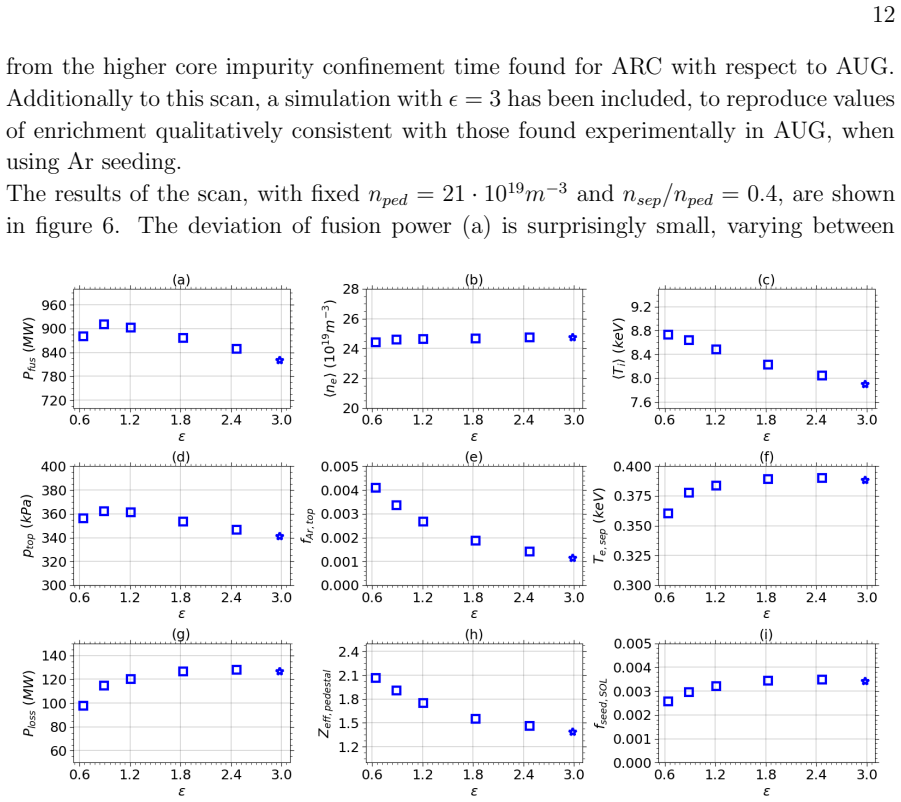
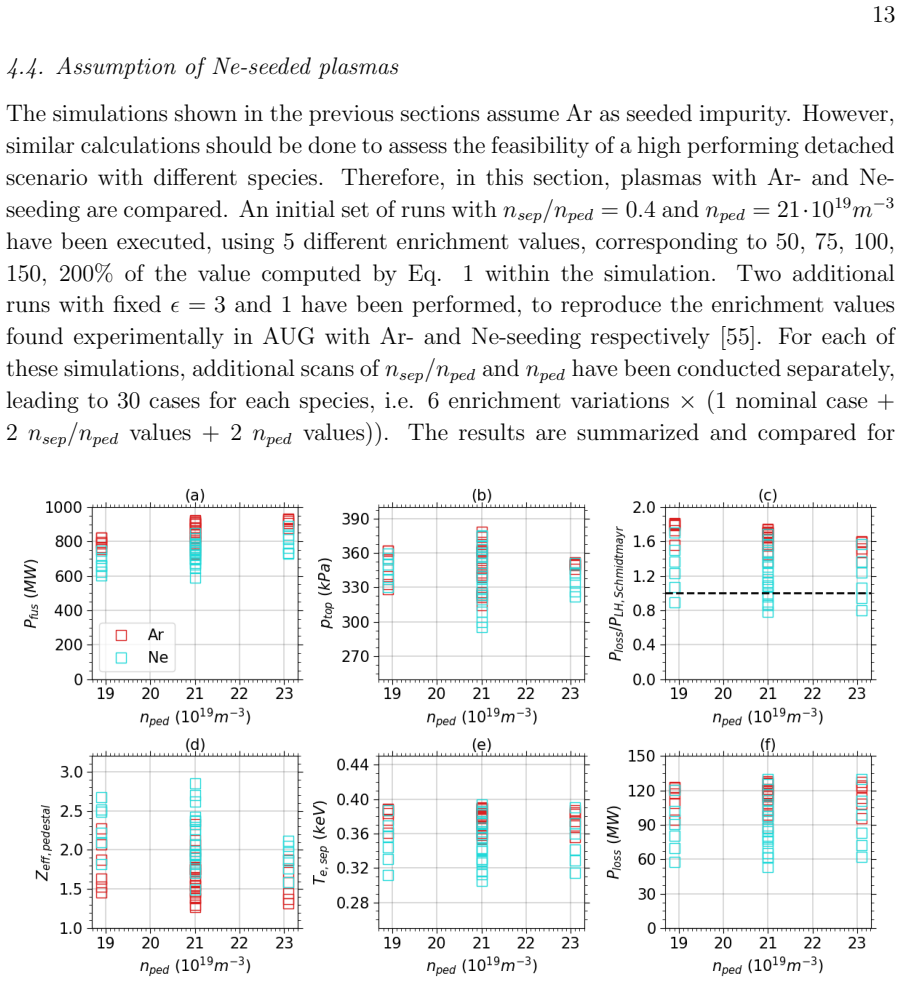
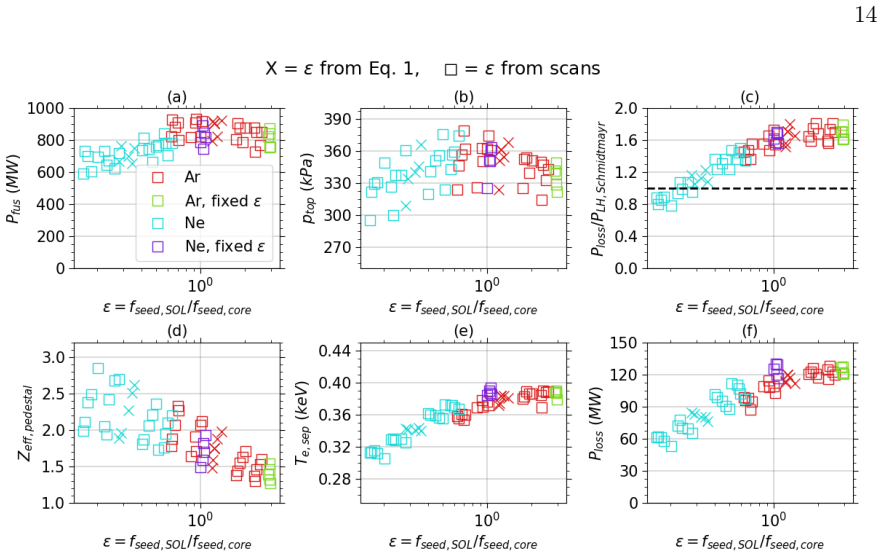
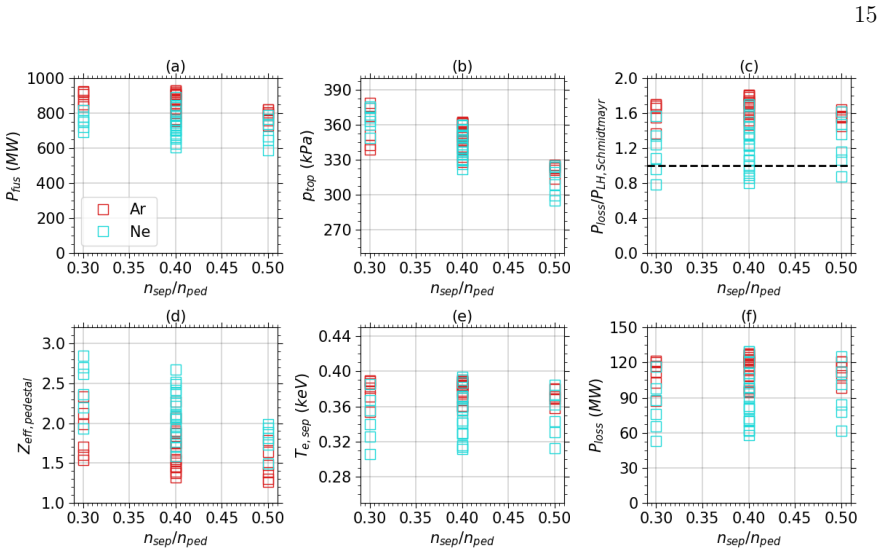
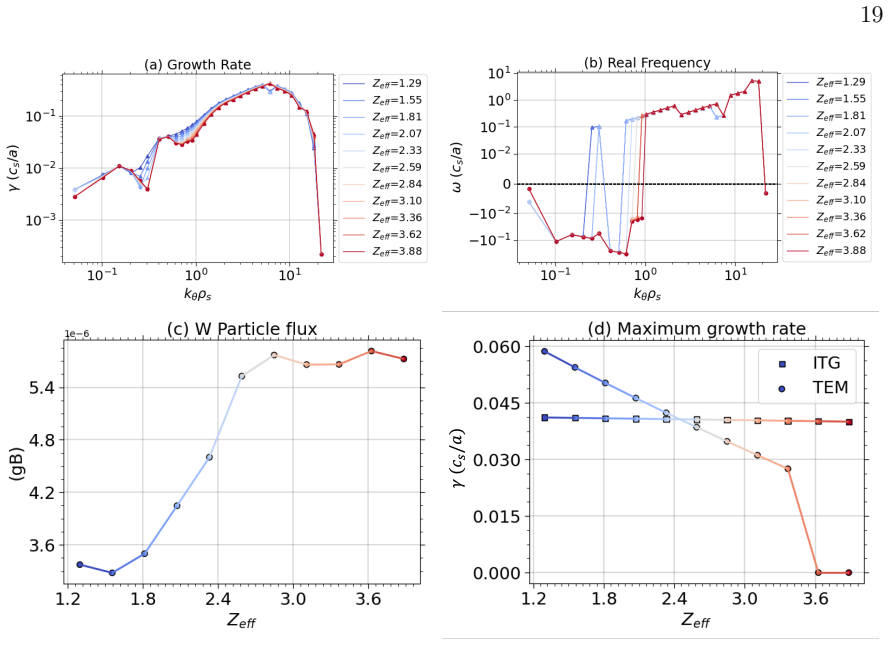
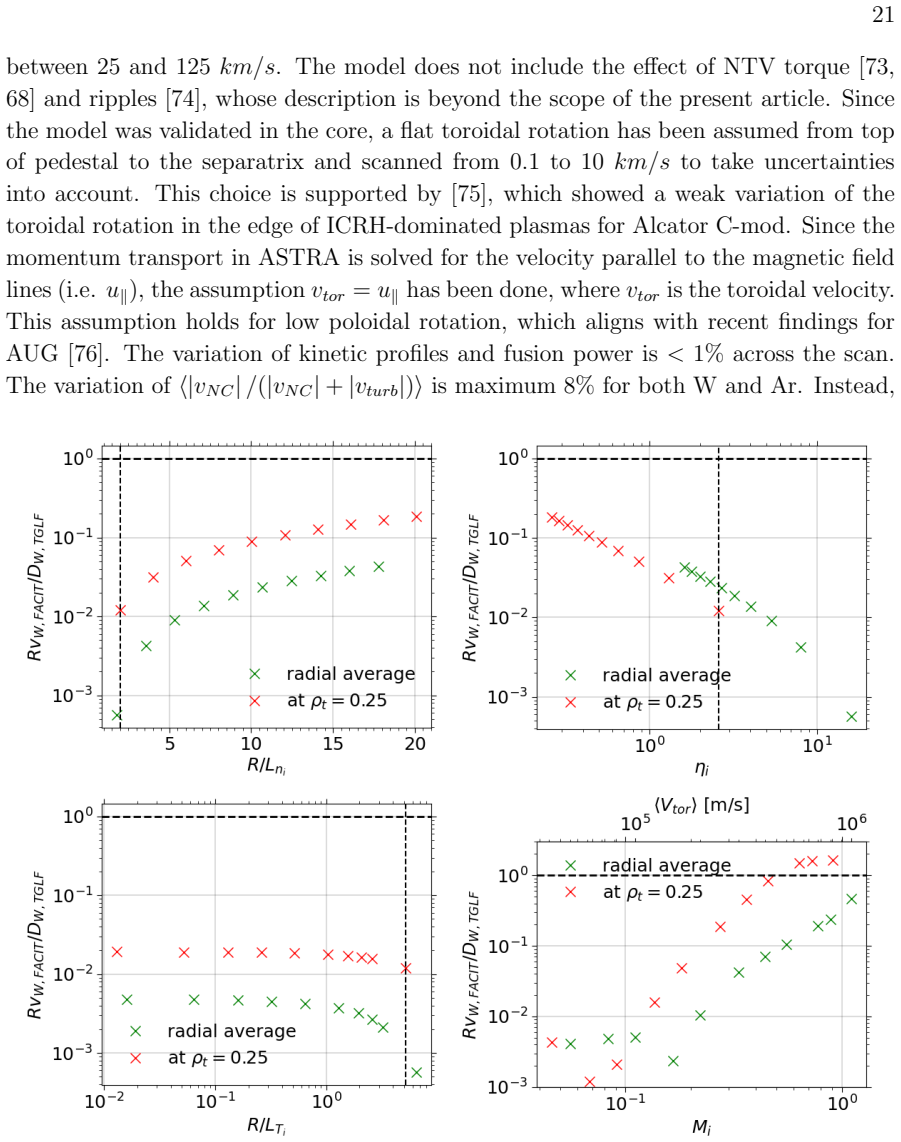
Integrated modeling of ARC H-modes has been conducted to assess the feasibility of high-performance scenarios compatible with divertor detachment. The analysis incorporates self-consistent evolution of impurity radiation and density profiles, demonstrating that fusion power levels approaching a GW can be achieved while maintaining divertor temperatures below 2 eV with Ar seeding. Sensitivity studies reveal a strong dependence of fusion power on the separatrix density, with performance spanning 750-1000 MW, and a weaker dependence on enrichment factor and pedestal density. Alternative seeding strategies using Neon have also been explored. Plasmas with Argon seeding consistently access H-mode, providing the highest fusion power and detached divertor operation, whereas Neon seeding leads to lower performance (600-850 MW) and less robust H-mode access, due to excessive core impurity accumulation. A small W impurity peaking has been found, with decreasing values at higher Zeff. Further analyses incorporate reduced momentum transport modeling, and sensitivity studies of neoclassical impurity transport, confirming the robustness of the results. Overall, these findings support the viability of high-performing H-mode operation in ARC, ensuring divertor protection, enabled through Argon and Neon impurity seeding.
Editorial analysis
A structured set of objections, weighed in public.
Referee Report
Summary. The paper conducts core-edge integrated modeling of ARC H-modes incorporating self-consistent impurity radiation and density profile evolution. It claims that fusion powers approaching 1 GW are achievable while maintaining divertor temperatures below 2 eV using argon seeding, with sensitivity studies showing strong dependence on separatrix density (750-1000 MW range) and weaker dependence on enrichment factor and pedestal density. Neon seeding yields lower performance (600-850 MW) and less robust H-mode access due to core impurity accumulation. Additional analyses cover reduced momentum transport, neoclassical impurity transport sensitivities, and small tungsten peaking that decreases with higher Zeff, supporting overall viability of high-performance detached operation.
Significance. If the underlying transport and radiation models hold under ARC conditions, the work is significant for compact high-field tokamak design by identifying viable impurity seeding strategies that simultaneously enable high fusion power and divertor detachment. The self-consistent impurity evolution, parameter sensitivity scans, and Ar versus Ne comparison provide concrete guidance on operational windows, while the robustness checks against variations in separatrix density and neoclassical transport add credibility within the modeling framework.
minor comments (3)
- Abstract: the phrase 'fusion power levels approaching a GW' would be clearer if the maximum achieved value and the specific separatrix density at which it occurs were stated explicitly rather than giving only the 750-1000 MW span.
- Abstract: the description of 'reduced momentum transport modeling' lacks any quantitative detail on the reduction factor or its effect on the reported fusion powers and detachment conditions.
- Abstract: a brief statement on the integrated code framework employed and any benchmark or validation steps performed against existing experiments or other codes would help readers assess the reliability of the self-consistent impurity profiles.
Simulated Author's Rebuttal
We thank the referee for the positive and accurate summary of our core-edge integrated modeling study on ARC H-modes, as well as for recommending minor revision. No major comments were provided in the report.
Circularity Check
No significant circularity identified
full rationale
The paper presents results from an integrated core-edge modeling framework with self-consistent impurity evolution, radiation, and density profiles. Sensitivity studies on separatrix density, enrichment factor, pedestal density, neoclassical transport, and seeding species (Ar vs Ne) are described as exploring the model's behavior rather than deriving predictions that reduce to fitted inputs by construction. No load-bearing self-citations, uniqueness theorems, or ansatzes smuggled via prior work are referenced in the abstract or description. The central feasibility claim for GW-level power with detachment is framed as an outcome of the modeling under stated assumptions, with no quoted equations or steps showing tautological reduction to inputs.
Axiom & Free-Parameter Ledger
Reference graph
Works this paper leans on
-
[1]
ARC: A compact, high-field, fusion nuclear science facility and demonstration power plant with demountable magnets
B.N. Sorbom et al. “ARC: A compact, high-field, fusion nuclear science facility and demonstration power plant with demountable magnets”. In:Fusion Engineering and Design100 (Nov. 2015), pp. 378–405.issn: 09203796.doi:10 . 1016 / j . fusengdes.2015.07.008.url:https://linkinghub.elsevier.com/retrieve/ pii/S0920379615302337(visited on 12/02/2025)
2015
-
[2]
The updated ITPA global H-mode confinement database: description and analysis
G. Verdoolaege et al. “The updated ITPA global H-mode confinement database: description and analysis”. In:Nuclear Fusion61.7 (May 2021), p. 076006.issn: 0029-5515.doi:10.1088/1741-4326/abdb91.url:https://dx.doi.org/10. 1088/1741-4326/abdb91(visited on 06/12/2023)
work page doi:10.1088/1741-4326/abdb91.url:https://dx.doi.org/10 2021
-
[5]
Power requirement for accessing the H-mode in ITER
Y R Martin, T Takizuka, and the ITPA CDBM H-mode Threshold Data Group. “Power requirement for accessing the H-mode in ITER”. In:Journal of Physics: Conference Series123 (July 1, 2008), p. 012033.issn: 1742-6596.doi:10.1088/ 1742-6596/123/1/012033.url:https://iopscience.iop.org/article/10. 1088/1742-6596/123/1/012033(visited on 08/13/2020)
2008
-
[7]
Empirical scaling of the L–H threshold power for metal wall tokamaks using a multi-device database
E. Delabie et al. “Empirical scaling of the L–H threshold power for metal wall tokamaks using a multi-device database”. In:Nuclear Fusion66.3 (Mar. 1, 2026), p. 036016.issn: 0029-5515, 1741-4326.doi:10.1088/1741-4326/ae39f2.url: https://iopscience.iop.org/article/10.1088/1741-4326/ae39f2(visited on 04/28/2026)
-
[8]
Dependence of H-mode pedestal parameters on plasma magnetic geometry
L D Horton et al. “Dependence of H-mode pedestal parameters on plasma magnetic geometry”. In:Plasma Physics and Controlled Fusion44.5 (May 1, 2002), A273–A278.issn: 07413335.doi:10.1088/0741-3335/44/5A/327.url: https : / / iopscience . iop . org / article / 10 . 1088 / 0741 - 3335 / 44 / 5A / 327 (visited on 01/26/2026)
-
[9]
High fusion performance in Super H-mode experiments on Alcator C-Mod and DIII-D
P.B. Snyder et al. “High fusion performance in Super H-mode experiments on Alcator C-Mod and DIII-D”. In:Nuclear Fusion59.8 (Aug. 1, 2019), p. 086017. issn: 0029-5515, 1741-4326.doi:10 . 1088 / 1741 - 4326 / ab235b.url:https : / / iopscience . iop . org / article / 10 . 1088 / 1741 - 4326 / ab235b(visited on 01/26/2026)
2019
-
[10]
Theory-based integrated modelling of tungsten transport in ITER plasmas
D Fajardo et al. “Theory-based integrated modelling of tungsten transport in ITER plasmas”. In:Plasma Physics and Controlled Fusion67.1 (Jan. 31, 2025), p. 015020.issn: 0741-3335, 1361-6587.doi:10.1088/1361-6587/ad9aca.url: https://iopscience.iop.org/article/10.1088/1361-6587/ad9aca(visited on 10/24/2025)
-
[11]
Integrated modeling of SPARC H-mode scenarios: exploration of the impact of modeling assumptions on predicted performance
M. Muraca et al. “Integrated modeling of SPARC H-mode scenarios: exploration of the impact of modeling assumptions on predicted performance”. In:Nuclear Fusion65.9 (Sept. 1, 2025), p. 096010.issn: 0029-5515, 1741-4326.doi:10.1088/ 1741- 4326/adf656.url:https://iopscience.iop.org/article/10.1088/ 1741-4326/adf656(visited on 12/02/2025)
2025
-
[12]
Integrated core–SOL simulations for SPARC tokamak with the COREDIV code
I. Ivanova-Stanik, P. Chmielewski, and R. Zag´ orski. “Integrated core–SOL simulations for SPARC tokamak with the COREDIV code”. In:Fusion Engineering and Design193 (Aug. 2023), p. 113698.issn: 09203796.doi:10 . 1016/j.fusengdes.2023.113698.url:https://linkinghub.elsevier.com/ retrieve/pii/S0920379623002818(visited on 05/27/2025). REFERENCES26
arXiv 2023
-
[13]
Impurity peaking of SPARC H-modes: a sensitivity study on physics and engineering assumptions
Marco Muraca et al. “Impurity peaking of SPARC H-modes: a sensitivity study on physics and engineering assumptions”. In:Plasma Physics and Controlled Fusion (Apr. 16, 2026).issn: 0741-3335, 1361-6587.doi:10.1088/1361-6587/ae60a4. url:https://iopscience.iop.org/article/10.1088/1361- 6587/ae60a4 (visited on 04/17/2026)
-
[14]
The European Integrated Tokamak Modelling (ITM) effort: achievements and first physics results
G.L. Falchetto et al. “The European Integrated Tokamak Modelling (ITM) effort: achievements and first physics results”. In:Nuclear Fusion54.4 (Apr. 1, 2014), p. 043018.issn: 0029-5515, 1741-4326.doi:10.1088/0029-5515/54/4/043018. url:https : / / iopscience . iop . org / article / 10 . 1088 / 0029 - 5515 / 54 / 4 / 043018(visited on 02/20/2026)
-
[15]
Progress in pedestal and edge physics: Chapter 3 of the special issue: on the path to tokamak burning plasma operation
M.E. Fenstermacher et al. “Progress in pedestal and edge physics: Chapter 3 of the special issue: on the path to tokamak burning plasma operation”. In:Nuclear Fusion65.5 (May 1, 2025), p. 053001.issn: 0029-5515, 1741-4326.doi:10.1088/ 1741- 4326/adb1f3.url:https://iopscience.iop.org/article/10.1088/ 1741-4326/adb1f3(visited on 01/26/2026)
2025
-
[16]
Elements of H-mode pedestal structure
R J Groebner and S Saarelma. “Elements of H-mode pedestal structure”. In: Plasma Physics and Controlled Fusion65.7 (July 1, 2023), p. 073001.issn: 0741- 3335, 1361-6587.doi:10.1088/1361-6587/acd478.url:https://iopscience. iop.org/article/10.1088/1361-6587/acd478(visited on 02/17/2026)
work page doi:10.1088/1361-6587/acd478.url:https://iopscience 2023
-
[17]
N. Aiba. “Modeling for ELMs and H-mode pedestal transport: MHD, gyrokinetic, neoclassical and integrated simulations”. In:Nuclear Fusion65.8 (Aug. 1, 2025), p. 082003.issn: 0029-5515, 1741-4326.doi:10.1088/1741-4326/aded24.url: https://iopscience.iop.org/article/10.1088/1741-4326/aded24(visited on 02/17/2026)
-
[18]
Impurity seeding for tokamak power exhaust: from present devices via ITER to DEMO
A Kallenbach et al. “Impurity seeding for tokamak power exhaust: from present devices via ITER to DEMO”. In:Plasma Physics and Controlled Fusion55.12 (Dec. 1, 2013), p. 124041.issn: 0741-3335, 1361-6587.doi:10.1088/0741-3335/ 55/12/124041.url:https://iopscience.iop.org/article/10.1088/0741- 3335/55/12/124041(visited on 10/24/2025)
-
[19]
Physics of ultimate detachment of a tokamak divertor plasma
S. I. Krasheninnikov and A. S. Kukushkin. “Physics of ultimate detachment of a tokamak divertor plasma”. In:Journal of Plasma Physics83.5 (Oct. 2017), p. 155830501.issn: 0022-3778, 1469-7807.doi:10 . 1017 / S0022377817000654. url:https : / / www . cambridge . org / core / product / identifier / S0022377817000654/type/journal_article(visited on 10/24/2025)
2017
-
[20]
A review of radiative detachment studies in tokamak advanced magnetic divertor configurations
V A Soukhanovskii. “A review of radiative detachment studies in tokamak advanced magnetic divertor configurations”. In:Plasma Physics and Controlled Fusion59.6 (June 1, 2017), p. 064005.issn: 0741-3335, 1361-6587.doi:10.1088/ 1361- 6587/aa6959.url:https://iopscience.iop.org/article/10.1088/ 1361-6587/aa6959(visited on 10/24/2025). REFERENCES27
2017
-
[21]
Experimental study of H–L transitions in JET
C. F. Maggi et al. “Experimental study of H–L transitions in JET”. In:Proceedings of the 40th EPS Conference on Plasma Physics. Espoo, Finland: European Physical Society, 2013.url:https://scipub.euro-fusion.org/wp-content/ uploads/2014/11/EFDC130320.pdf
2013
-
[22]
Pereverzev et al.ASTRA - an automatic system for transport analysis in a tokamak
G.V. Pereverzev et al.ASTRA - an automatic system for transport analysis in a tokamak. IPP–5/42 INIS Reference Number: 23024293. Germany, 1991, p. 64
1991
-
[23]
New adaptive grid plasma evolution code SPIDER
AA Ivanov. “New adaptive grid plasma evolution code SPIDER”. 32nd EPS Conference on Plasma Physics. Tarragona, 2005. [24]freegs-plasma/freegs. original-date: 2016-11-15T11:28:29Z. Nov. 28, 2024.url: https://github.com/freegs-plasma/freegs(visited on 12/06/2024)
2005
-
[24]
HYDROMAGNETIC EQUILIBRIA AND FORCE-FREE FIELDS
Harold Grad and Hanan Rubin. “HYDROMAGNETIC EQUILIBRIA AND FORCE-FREE FIELDS”. In:Journal of Nuclear Energy7 (1958), pp. 284–285. url:https://api.semanticscholar.org/CorpusID:121009637
1958
-
[25]
Plasma Equilibrium in a Magnetic Field
V. D. Shafranov. “Plasma Equilibrium in a Magnetic Field”. In:Reviews of Plasma Physics2 (Jan. 1966), p. 103
1966
-
[26]
Introduction to magnetic helicity,
F. Porcelli, D. Boucher, and M. N. Rosenbluth. “Model for the sawtooth period and amplitude”. In:Plasma Physics and Controlled Fusion38.12 (Dec. 1996), p. 2163.issn: 0741-3335.doi:10.1088/0741- 3335/38/12/010.url:https: //dx.doi.org/10.1088/0741-3335/38/12/010(visited on 06/27/2023)
-
[27]
Predictions of core plasma performance for the SPARC tokamak
P. Rodriguez-Fernandez et al. “Predictions of core plasma performance for the SPARC tokamak”. In:Journal of Plasma Physics86.5 (Oct. 2020), p. 865860503. issn: 0022-3778, 1469-7807.doi:10 . 1017 / S0022377820001075.url:https : //www.cambridge.org/core/product/identifier/S0022377820001075/type/ journal%5C_article(visited on 12/06/2024)
2020
-
[28]
Verification of a quasi-linear model for gyrokinetic turbulent transport
G.M. Staebler et al. “Verification of a quasi-linear model for gyrokinetic turbulent transport”. In:Nuclear Fusion61.11 (Nov. 1, 2021), p. 116007.issn: 0029-5515, 1741-4326.doi:10.1088/1741-4326/ac243a.url:https://iopscience.iop. org/article/10.1088/1741-4326/ac243a(visited on 02/15/2022)
work page doi:10.1088/1741-4326/ac243a.url:https://iopscience.iop 2021
-
[29]
Plasma physics series
Jan Weiland.Collective modes in inhomogeneous plasma: kinetic and advanced fluid theory. Plasma physics series. Bristol: Inst. of Physics Publ, 2000. 189 pp. isbn: 978-0-7503-0589-1
2000
-
[30]
Comparisons and physics basis of tokamak transport models and turbulence simulations
A. M. Dimits et al. “Comparisons and physics basis of tokamak transport models and turbulence simulations”. In:Physics of Plasmas7.3 (Mar. 1, 2000), pp. 969– 983.issn: 1070-664X, 1089-7674.doi:10.1063/1.873896.url:https://pubs. aip.org/pop/article/7/3/969/1029781/Comparisons-and-physics-basis- of-tokamak-transport(visited on 12/06/2024). REFERENCES28
-
[31]
Introduction to turbulent transport in fusion plasmas
Xavier Garbet. “Introduction to turbulent transport in fusion plasmas”. In: Comptes Rendus. Physique7.6 (July 1, 2006), pp. 573–583.issn: 1878-1535.doi: 10.1016/j.crhy.2006.06.002.url:https://comptes- rendus.academie- sciences.fr/physique/articles/10.1016/j.crhy.2006.06.002/(visited on 12/06/2024)
work page doi:10.1016/j.crhy.2006.06.002.url:https://comptes- 2006
-
[32]
Predict-first experiments and modeling of perturbative cold pulses in the DIII-D tokamak
P. Rodriguez-Fernandez et al. “Predict-first experiments and modeling of perturbative cold pulses in the DIII-D tokamak”. In:Physics of Plasmas26.6 (June 1, 2019), p. 062503.issn: 1070-664X, 1089-7674.doi:10.1063/1.5096800. url:https://pubs.aip.org/pop/article/26/6/062503/1061751/Predict- first-experiments-and-modeling-of(visited on 12/02/2024)
-
[33]
Perturbative transport modeling of cold-pulse dynamics in Alcator C-Mod Ohmic plasmas
P. Rodriguez-Fernandez et al. “Perturbative transport modeling of cold-pulse dynamics in Alcator C-Mod Ohmic plasmas”. In:Nuclear Fusion59.6 (June 1, 2019), p. 066017.issn: 0029-5515, 1741-4326.doi:10.1088/1741-4326/ab1575. url:https://iopscience.iop.org/article/10.1088/1741- 4326/ab1575 (visited on 12/02/2024)
-
[35]
B Baiocchi et al. “Turbulent transport analysis of JET H-mode and hybrid plasmas using QuaLiKiz and Trapped Gyro Landau Fluid”. In:Plasma Physics and Controlled Fusion57.3 (Mar. 1, 2015), p. 035003.issn: 0741-3335, 1361-6587. doi:10.1088/0741-3335/57/3/035003.url:https://iopscience.iop.org/ article/10.1088/0741-3335/57/3/035003(visited on 12/02/2024)
work page doi:10.1088/0741-3335/57/3/035003.url:https://iopscience.iop.org/ 2015
-
[36]
Validation of nonlinear gyrokinetic simulations of L- and I- mode plasmas on Alcator C-Mod
A. J. Creely et al. “Validation of nonlinear gyrokinetic simulations of L- and I- mode plasmas on Alcator C-Mod”. In:Physics of Plasmas24.5 (May 1, 2017), p. 056104.issn: 1070-664X, 1089-7674.doi:10.1063/1.4977466.url:https: / / pubs . aip . org / pop / article / 24 / 5 / 056104 / 991885 / Validation - of - nonlinear-gyrokinetic-simulations-of(visited on ...
-
[37]
Quasilinear theory and modelling of gyrokinetic turbulent transport in tokamaks
G. Staebler et al. “Quasilinear theory and modelling of gyrokinetic turbulent transport in tokamaks”. In:Nuclear Fusion64.10 (Oct. 1, 2024), p. 103001. issn: 0029-5515, 1741-4326.doi:10 . 1088 / 1741 - 4326 / ad6ba5.url:https : / / iopscience . iop . org / article / 10 . 1088 / 1741 - 4326 / ad6ba5(visited on 05/12/2025)
2024
-
[38]
Representation of the plasma fluid equations in “Miller equilibrium
W. M. Stacey and Cheonho Bae. “Representation of the plasma fluid equations in “Miller equilibrium” analytical flux surface geometry”. In:Physics of Plasmas 16.8 (Aug. 1, 2009), p. 082501.issn: 1070-664X, 1089-7674.doi:10 . 1063 / 1 . 3177613.url:https : / / pubs . aip . org / pop / article / 16 / 8 / 082501 / 316133 / Representation - of - the - plasma -...
2009
-
[39]
Full-radius integrated modelling of ASDEX Upgrade L-modes including impurity transport and radiation
D. Fajardo et al. “Full-radius integrated modelling of ASDEX Upgrade L-modes including impurity transport and radiation”. In:Nuclear Fusion64.4 (Apr. 1, 2024), p. 046021.issn: 0029-5515, 1741-4326.doi:10.1088/1741-4326/ad29bd. url:https://iopscience.iop.org/article/10.1088/1741- 4326/ad29bd (visited on 10/24/2025)
-
[40]
Analytical model for collisional impurity transport in tokamaks at arbitrary collisionality
D Fajardo et al. “Analytical model for collisional impurity transport in tokamaks at arbitrary collisionality”. In:Plasma Physics and Controlled Fusion64.5 (May 1, 2022), p. 055017.issn: 0741-3335, 1361-6587.doi:10.1088/1361-6587/ac5b4d. url:https://iopscience.iop.org/article/10.1088/1361- 6587/ac5b4d (visited on 10/24/2025)
-
[42]
Ralph Dux.STRAHL User Manual. 10/30. IPP–10/30. Germany, 2006
2006
-
[44]
ELM divertor peak energy fluence scaling to ITER with data from JET, MAST and ASDEX upgrade
T. Eich et al. “ELM divertor peak energy fluence scaling to ITER with data from JET, MAST and ASDEX upgrade”. In:Nuclear Materials and Energy12 (Aug. 2017), pp. 84–90.issn: 23521791.doi:10 . 1016 / j . nme . 2017 . 04 . 014. url:https://linkinghub.elsevier.com/retrieve/pii/S2352179116302927 (visited on 01/30/2026)
2017
-
[45]
Physics basis for the ICRF system of the SPARC tokamak
Y. Lin, J. C. Wright, and S. J. Wukitch. “Physics basis for the ICRF system of the SPARC tokamak”. In:Journal of Plasma Physics86.5 (Oct. 2020), p. 865860506. issn: 0022-3778, 1469-7807.doi:10 . 1017 / S0022377820001269.url:https : //www.cambridge.org/core/product/identifier/S0022377820001269/type/ journal%5C_article(visited on 12/06/2024)
2020
-
[46]
A. Y Pankin et al.TRANSP integrated modeling code for interpretive and predictive analysis of tokamak plasmas. 2024.doi:10.48550/ARXIV.2406.07781. url:https://arxiv.org/abs/2406.07781(visited on 11/19/2024)
-
[47]
Numerical simulation of ion cyclotron waves in tokamak plasmas
M. Brambilla. “Numerical simulation of ion cyclotron waves in tokamak plasmas”. In:Plasma Physics and Controlled Fusion41.1 (Jan. 1999), p. 1.issn: 0741-3335. doi:10.1088/0741-3335/41/1/002.url:https://dx.doi.org/10.1088/0741- 3335/41/1/002(visited on 11/19/2024)
work page doi:10.1088/0741-3335/41/1/002.url:https://dx.doi.org/10.1088/0741- 1999
-
[48]
Fast ion studies of ion cyclotron heating in the PLT tokamak
G W Hammett. “Fast ion studies of ion cyclotron heating in the PLT tokamak”. PhD thesis. United States: Princeton Univ.,Princeton, NJ, Jan. 1, 1986.url: https://www.osti.gov/biblio/5079411. REFERENCES30
arXiv 1986
-
[49]
A simple, accurate model for detachment access
Thomas Body, Arne Kallenbach, and Thomas Eich. “A simple, accurate model for detachment access”. In:Nuclear Fusion65.8 (Aug. 1, 2025), p. 086002.issn: 0029- 5515, 1741-4326.doi:10.1088/1741-4326/ade4d9.url:https://iopscience. iop.org/article/10.1088/1741-4326/ade4d9(visited on 01/27/2026)
work page doi:10.1088/1741-4326/ade4d9.url:https://iopscience 2025
-
[50]
How turbulence sets boundaries for tokamak operation
Peter Manz, Thomas Eich, and Ondrej Grover. “How turbulence sets boundaries for tokamak operation”. In:Reviews of Modern Plasma Physics9.1 (Jan. 27, 2025), p. 5.issn: 2367-3192.doi:10.1007/s41614-024-00178-z.url:https: //link.springer.com/10.1007/s41614-024-00178-z(visited on 02/18/2026)
-
[51]
The separatrix electron density in JET, ASDEX upgrade and alcator C-Mod H-mode plasmas: A common evaluation procedure and correlation with engineering parameters
D. Silvagni et al. “The separatrix electron density in JET, ASDEX upgrade and alcator C-Mod H-mode plasmas: A common evaluation procedure and correlation with engineering parameters”. In:Nuclear Materials and Energy42 (Mar. 2025), p. 101867.issn: 23521791.doi:10 . 1016 / j . nme . 2025 . 101867.url:https : //linkinghub.elsevier.com/retrieve/pii/S235217912...
2025
-
[52]
SOLPS-ITER modeling of deuterium throughput impact on the ITER SOL plasma
E. Kaveeva et al. “SOLPS-ITER modeling of deuterium throughput impact on the ITER SOL plasma”. In:Nuclear Materials and Energy35 (June 2023), p. 101424. issn: 23521791.doi:10.1016/j.nme.2023.101424.url:https://linkinghub. elsevier.com/retrieve/pii/S2352179123000637(visited on 02/18/2026)
work page doi:10.1016/j.nme.2023.101424.url:https://linkinghub 2023
-
[53]
Characterisation of divertor detachment onset in JET-ILW hydrogen, deuterium, tritium and deuterium–tritium low-confinement mode plasmas
M. Groth et al. “Characterisation of divertor detachment onset in JET-ILW hydrogen, deuterium, tritium and deuterium–tritium low-confinement mode plasmas”. In:Nuclear Materials and Energy34 (Mar. 2023), p. 101345.issn: 23521791.doi:10 . 1016 / j . nme . 2022 . 101345.url:https : / / linkinghub . elsevier.com/retrieve/pii/S2352179122002265(visited on 01/30/2026)
2023
-
[54]
Divertor enrichment of recycling impurity species (He, N 2 , Ne, Ar, Kr) in ASDEX Upgrade H-modes
A. Kallenbach et al. “Divertor enrichment of recycling impurity species (He, N 2 , Ne, Ar, Kr) in ASDEX Upgrade H-modes”. In:Nuclear Fusion64.5 (May 1, 2024), p. 056003.issn: 0029-5515, 1741-4326.doi:10.1088/1741-4326/ad3139. url:https://iopscience.iop.org/article/10.1088/1741- 4326/ad3139 (visited on 01/27/2026)
-
[55]
Minority and mode conversion heating in ( 3 He)–H JET plasmas
D Van Eester et al. “Minority and mode conversion heating in ( 3 He)–H JET plasmas”. In:Plasma Physics and Controlled Fusion54.7 (July 1, 2012), p. 074009. issn: 0741-3335, 1361-6587.doi:10.1088/0741-3335/54/7/074009.url:https: //iopscience.iop.org/article/10.1088/0741-3335/54/7/074009(visited on 11/19/2024)
-
[56]
Operation above the Greenwald density limit in high performance DIII-D negative triangularity discharges
O Sauter et al. “Operation above the Greenwald density limit in high performance DIII-D negative triangularity discharges”. In:Plasma Physics and Controlled Fusion67.7 (July 31, 2025), p. 075009.issn: 0741-3335, 1361-6587.doi:10 . 1088/1361- 6587/ade185.url:https://iopscience.iop.org/article/10. 1088/1361-6587/ade185(visited on 02/18/2026). REFERENCES31
2025
-
[57]
Real-time avoidance of the L-mode and H-mode density limit via machine-learned stability metrics
Andrew David Maris et al. “Real-time avoidance of the L-mode and H-mode density limit via machine-learned stability metrics”. In:Nuclear Fusion(Mar. 9, 2026).issn: 0029-5515, 1741-4326.doi:10 . 1088 / 1741 - 4326 / ae4efe.url: https://iopscience.iop.org/article/10.1088/1741-4326/ae4efe(visited on 03/28/2026)
-
[59]
Neutral pressure and separatrix density related models for seed impurity divertor radiation in ASDEX Upgrade
A. Kallenbach et al. “Neutral pressure and separatrix density related models for seed impurity divertor radiation in ASDEX Upgrade”. In:Nuclear Materials and Energy18 (Jan. 2019), pp. 166–174.issn: 23521791.doi:10 . 1016 / j . nme . 2018 . 12 . 021.url:https : / / linkinghub . elsevier . com / retrieve / pii / S2352179118301480(visited on 04/09/2026)
2019
-
[60]
D. Silvagni et al.A predictive formula for the H-mode electron separatrix density: Bridging regression and physics-based models across C-Mod, AUG and JET tokamaks. 2026.doi:10 . 48550 / ARXIV . 2601 . 23140.url:https : / / arxiv . org/abs/2601.23140(visited on 02/02/2026)
arXiv 2026
-
[61]
Core impurity transport in Alcator C-Mod L-, I- and H-mode plasmas
J.E. Rice et al. “Core impurity transport in Alcator C-Mod L-, I- and H-mode plasmas”. In:Nuclear Fusion55.3 (Mar. 1, 2015), p. 033014.issn: 0029-5515, 1741-4326.doi:10.1088/0029-5515/55/3/033014.url:https://iopscience. iop.org/article/10.1088/0029-5515/55/3/033014(visited on 03/23/2026)
work page doi:10.1088/0029-5515/55/3/033014.url:https://iopscience 2015
-
[62]
Critical gradient formula for toroidal electron temperature gradient modes
F. Jenko, W. Dorland, and G. W. Hammett. “Critical gradient formula for toroidal electron temperature gradient modes”. In:Physics of Plasmas8.9 (Sept. 1, 2001), pp. 4096–4104.issn: 1070-664X, 1089-7674.doi:10 . 1063 / 1 . 1391261.url: https://pubs.aip.org/pop/article/8/9/4096/265245/Critical-gradient- formula-for-toroidal-electron(visited on 11/19/2024)
2001
-
[63]
E Fable, C Angioni, and O Sauter. “The role of ion and electron electrostatic turbulence in characterizing stationary particle transport in the core of tokamak plasmas”. In:Plasma Physics and Controlled Fusion52.1 (Jan. 1, 2010), p. 015007. issn: 0741-3335, 1361-6587.doi:10.1088/0741-3335/52/1/015007.url:https: //iopscience.iop.org/article/10.1088/0741-33...
-
[64]
The effects of dilution on turbulence and transport in C- Mod ohmic plasmas and comparisons with gyrokinetic simulations
P. Ennever et al. “The effects of dilution on turbulence and transport in C- Mod ohmic plasmas and comparisons with gyrokinetic simulations”. In:Physics of Plasmas22.7 (July 1, 2015), p. 072507.issn: 1070-664X, 1089-7674.doi: 10 . 1063 / 1 . 4926518.url:https : / / pubs . aip . org / pop / article / 22 / 7 / 072507/264325/The- effects- of- dilution- on- t...
2015
-
[65]
Full-f XGC1 gyrokinetic study of improved ion energy confinement from impurity stabilization of ITG turbulence
Kyuho Kim et al. “Full-f XGC1 gyrokinetic study of improved ion energy confinement from impurity stabilization of ITG turbulence”. In:Physics of Plasmas24.6 (June 1, 2017), p. 062302.issn: 1070-664X, 1089-7674.doi:10 . 1063/1.4984991.url:https://pubs.aip.org/pop/article/24/6/062302/ 108560 / Full - f - XGC1 - gyrokinetic - study - of - improved - ion(visi...
2017
-
[66]
P. Rodriguez-Fernandez et al.Core performance predictions in projected SPARC first-campaign plasmas with nonlinear CGYRO. May 8, 2024.doi:10 . 48550 / arXiv.2403.15633. arXiv:2403.15633[physics].url:http://arxiv.org/ abs/2403.15633(visited on 05/29/2024)
arXiv 2024
-
[67]
Self-consistent perturbed equilibrium with neoclassical toroidal torque in tokamaks
Jong-Kyu Park and Nikolas C. Logan. “Self-consistent perturbed equilibrium with neoclassical toroidal torque in tokamaks”. In:Physics of Plasmas24.3 (Mar. 1, 2017), p. 032505.issn: 1070-664X, 1089-7674.doi:10.1063/1.4977898.url: https : / / pubs . aip . org / pop / article / 24 / 3 / 032505 / 319136 / Self - consistent-perturbed-equilibrium-with(visited o...
-
[68]
Comparing N versus Ne as divertor radiators in ASDEX- upgrade and ITER
Elizaveta Sytova et al. “Comparing N versus Ne as divertor radiators in ASDEX- upgrade and ITER”. In:Nuclear Materials and Energy19 (May 2019), pp. 72–78. issn: 23521791.doi:10.1016/j.nme.2019.02.019.url:https://linkinghub. elsevier.com/retrieve/pii/S2352179118303120(visited on 02/12/2026)
work page doi:10.1016/j.nme.2019.02.019.url:https://linkinghub 2019
-
[69]
C Angioni and P Helander. “Neoclassical transport of heavy impurities with poloidally asymmetric density distribution in tokamaks”. In:Plasma Physics and Controlled Fusion56.12 (Dec. 1, 2014), p. 124001.issn: 0741-3335, 1361-6587. doi:10.1088/0741-3335/56/12/124001.url:https://iopscience.iop.org/ article/10.1088/0741-3335/56/12/124001(visited on 10/24/2025)
work page doi:10.1088/0741-3335/56/12/124001.url:https://iopscience.iop.org/ 2014
-
[70]
C. F. B. Zimmermann et al. “Experimental validation of momentum transport theory in the core of H-mode plasmas in the ASDEX Upgrade tokamak”. In: Physics of Plasmas31.4 (Apr. 1, 2024), p. 042306.issn: 1070-664X, 1089-7674. doi:10.1063/5.0203092.url:https://pubs.aip.org/pop/article/31/4/ 042306/3284584/Experimental-validation-of-momentum-transport(visited ...
work page doi:10.1063/5.0203092.url:https://pubs.aip.org/pop/article/31/4/ 2024
-
[71]
C F B Zimmermann et al. “Analysis and modelling of momentum transport based on NBI modulation experiments at ASDEX Upgrade”. In:Plasma Physics and Controlled Fusion64.5 (May 1, 2022), p. 055020.issn: 0741-3335, 1361-6587.doi: 10.1088/1361- 6587/ac5ae8.url:https://iopscience.iop.org/article/ 10.1088/1361-6587/ac5ae8(visited on 10/28/2025)
-
[72]
Neoclassical toroidal viscosity torque prediction via deep learning
M.D. Clement, N.C. Logan, and M.D. Boyer. “Neoclassical toroidal viscosity torque prediction via deep learning”. In:Nuclear Fusion62.2 (Feb. 1, 2022), p. 026022.issn: 0029-5515, 1741-4326.doi:10.1088/1741-4326/ac3e83.url: https://iopscience.iop.org/article/10.1088/1741-4326/ac3e83(visited on 11/04/2025). REFERENCES33
-
[73]
On plasma rotation with toroidal magnetic field ripple and no external momentum input
C. Fenzi et al. “On plasma rotation with toroidal magnetic field ripple and no external momentum input”. In:Nuclear Fusion51.10 (Oct. 1, 2011), p. 103038. issn: 0029-5515, 1741-4326.doi:10 . 1088 / 0029 - 5515 / 51 / 10 / 103038.url: https://iopscience.iop.org/article/10.1088/0029-5515/51/10/103038 (visited on 11/04/2025)
-
[74]
Edge radial electric field studies via charge exchange recombi- nation spectroscopy on the Alcator C-Mod Tokamak
R. M. McDermott. “Edge radial electric field studies via charge exchange recombi- nation spectroscopy on the Alcator C-Mod Tokamak”. Thesis. Massachusetts Insti- tute of Technology, 2009.url:https://dspace.mit.edu/handle/1721.1/54462 (visited on 11/04/2025)
2009
-
[75]
Measurement of the complete core plasma flow across the LOC–SOC transition at ASDEX Upgrade
A. Lebschy et al. “Measurement of the complete core plasma flow across the LOC–SOC transition at ASDEX Upgrade”. In:Nuclear Fusion58.2 (Feb. 1, 2018), p. 026013.issn: 0029-5515, 1741-4326.doi:10.1088/1741-4326/aa9c54.url: https://iopscience.iop.org/article/10.1088/1741-4326/aa9c54(visited on 02/06/2026)
-
[76]
Scaling of Spontaneous Rotation with Temperature and Plasma Current in Tokamaks
F. I. Parra et al. “Scaling of Spontaneous Rotation with Temperature and Plasma Current in Tokamaks”. In:Physical Review Letters108.9 (Feb. 29, 2012), p. 095001.issn: 0031-9007, 1079-7114.doi:10.1103/PhysRevLett.108.095001. url:https://link.aps.org/doi/10.1103/PhysRevLett.108.095001(visited on 04/28/2026)
-
[77]
Impurity toroidal rotation and transport in Alcator C-Mod ohmic high confinement mode plasmas
J. E. Rice et al. “Impurity toroidal rotation and transport in Alcator C-Mod ohmic high confinement mode plasmas”. In:Physics of Plasmas7.5 (May 1, 2000), pp. 1825–1830.issn: 1070-664X, 1089-7674.doi:10 . 1063 / 1 . 874004. url:https://pubs.aip.org/pop/article/7/5/1825/1069448/Impurity- toroidal-rotation-and-transport-in(visited on 04/28/2026)
2000
-
[78]
J.E Rice et al. “Observations of impurity toroidal rotation suppression with ITB formation in ICRF and ohmic H mode Alcator C-Mod plasmas”. In:Nuclear Fusion41.3 (Mar. 2001), pp. 277–284.issn: 0029-5515.doi:10 . 1088 / 0029 - 5515/41/3/304.url:https://iopscience.iop.org/article/10.1088/0029- 5515/41/3/304(visited on 04/28/2026)
-
[79]
A.R. Field et al. “Peripheral temperature gradient screening of high-Z impurities in optimised ‘hybrid’ scenario H-mode plasmas in JET-ILW”. In:Nuclear Fusion 63.1 (Jan. 1, 2023), p. 016028.issn: 0029-5515, 1741-4326.doi:10.1088/1741- 4326/aca54e.url:https://iopscience.iop.org/article/10.1088/1741- 4326/aca54e(visited on 01/30/2026)
-
[80]
Nonlinear neoclassical transport in a rotating impure plasma with large gradients
T. F¨ ul¨ op and P. Helander. “Nonlinear neoclassical transport in a rotating impure plasma with large gradients”. In:Physics of Plasmas6.8 (Aug. 1, 1999), pp. 3066– 3075.issn: 1070-664X, 1089-7674.doi:10 . 1063 / 1 . 873593.url:https : / / pubs.aip.org/pop/article/6/8/3066/1016115/Nonlinear- neoclassical- transport-in-a-rotating(visited on 01/30/2026)
1999
discussion (0)
Sign in with ORCID, Apple, or X to comment. Anyone can read and Pith papers without signing in.