Strong-field control of the Z-boson resonance in e^+e^- collisions
Pith reviewed 2026-06-27 16:07 UTC · model grok-4.3
The pith
A strong laser field alters the Z-boson resonance profile in electron-positron collisions by dressing fermions and enabling multiphoton processes.
A machine-rendered reading of the paper's core claim, the machinery that carries it, and where it could break.
Core claim
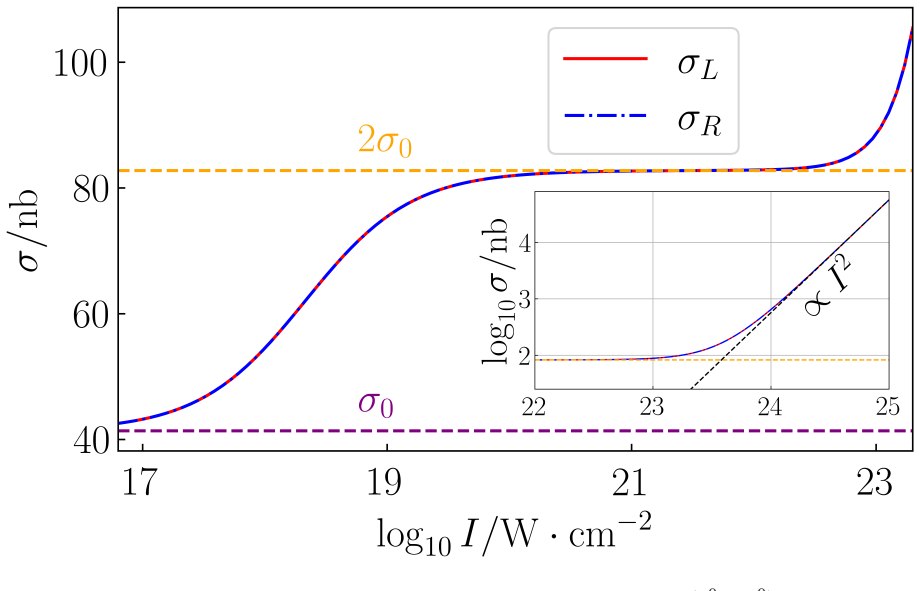
Resonant Z-boson production has a vacuum line shape fixed by the Z mass, width, and collision kinematics. When a strong laser field is treated nonperturbatively, laser dressing of the incoming fermions alters the effective collision kinematics and opens laser-photon exchange channels, including multiphoton processes. The Z-resonance profile then develops distinct intensity-dependent regimes, evolving from the vacuum limit to saturation at intermediate field strengths and to an approximately quadratic enhancement at higher intensities. The polarization composition of the produced Z bosons is redistributed, and at high intensities the laser-induced contribution can compensate the intrinsic chi
What carries the argument
Nonperturbative laser dressing of incoming fermions that alters effective kinematics and opens multiphoton laser-photon exchange channels.
If this is right
- The Z-resonance profile develops intensity-dependent regimes from vacuum-like behavior to saturation to quadratic enhancement.
- The polarization composition of produced Z bosons is redistributed by the laser field.
- At high intensities the laser-induced contribution compensates the electroweak chiral asymmetry, yielding nearly parity-balanced Z production.
- Strong classical fields can dynamically control electroweak resonance phenomena.
Where Pith is reading between the lines
- Similar laser-induced modifications could appear in other electroweak resonances such as W-boson production if the same dressing mechanism applies.
- Future collider designs might incorporate auxiliary laser fields to tune effective resonance parameters without altering beam energies.
- Verification would require synchronized high-intensity laser systems with precision e+e- collision detectors at appropriate field strengths.
Load-bearing premise
The nonperturbative treatment of the laser field accurately captures fermion dressing and multiphoton channels for the intensities considered, without breakdown from higher-order QED corrections or invalidation of the effective kinematics.
What would settle it
An experiment observing no intensity-dependent change in the Z resonance line shape or polarization under strong laser illumination in e+e- collisions would falsify the predicted effects.
Figures



read the original abstract
Resonant $Z$-boson production is a cornerstone of precision electroweak physics, with its vacuum line shape set by the $Z$ mass, width, and collision kinematics. We show that a strong laser field can significantly alter this picture. By treating the field nonperturbatively, we find that laser dressing of the incoming fermions alters the effective collision kinematics and opens laser-photon exchange channels, including multiphoton processes, in $e^{+}e^{-}$ collisions. As a result, the $Z$-resonance profile develops distinct intensity-dependent regimes, evolving from the vacuum limit to saturation at intermediate field strengths and to an approximately quadratic enhancement at higher intensities. Additionally, the polarization composition of the produced $Z$ bosons is redistributed. In particular, at high intensities the laser-induced contribution can compensate the intrinsic chiral asymmetry of the electroweak interaction, leading to nearly parity-balanced $Z$-boson production. Our results identify that strong classical fields can dynamically control electroweak resonance phenomena, opening a bridge between strong-field QED and high-energy collider physics.
Editorial analysis
A structured set of objections, weighed in public.
Referee Report
Summary. The manuscript claims that treating a strong laser field nonperturbatively in e⁺e⁻ collisions dresses the incoming fermions via Volkov states, modifying effective collision kinematics and opening multiphoton laser-photon exchange channels. This produces intensity-dependent regimes in the Z-resonance profile (vacuum limit, intermediate saturation, and quadratic enhancement at high intensities) together with a redistribution of Z-boson polarization that can compensate the intrinsic chiral asymmetry of the electroweak interaction, yielding nearly parity-balanced production.
Significance. If the central results hold, the work establishes a concrete link between strong-field QED and electroweak collider physics by demonstrating dynamical control of a resonance line shape and its polarization content with classical fields. The identification of distinct intensity regimes and the parity-compensation mechanism is a novel conceptual step; however, its broader significance depends on quantitative validation that the nonperturbative dressing remains valid in the quoted intensity windows.
major comments (2)
- [Abstract] The abstract asserts that the quadratic-enhancement regime appears at higher intensities while higher-order QED processes remain negligible, yet no explicit intensity thresholds, values of the strong-field parameter, or comparison to nonlinear Compton or Breit-Wheeler rates are supplied to substantiate this separation of scales.
- [Abstract] The claim that laser-induced sidebands and effective kinematics after dressing accurately determine the modified resonance line shape rests on the assumption that the resonance width does not overlap significantly with real pair-production thresholds; this assumption is not tested against the intensities where the quadratic regime is reported.
minor comments (1)
- Notation for the laser-dressed four-momenta and the multiphoton channels should be defined explicitly at first use rather than left implicit from the Volkov solution.
Simulated Author's Rebuttal
We thank the referee for the careful reading and constructive comments on our manuscript. We address the two major comments point by point below. We agree that the abstract can be strengthened by the addition of explicit thresholds and a brief discussion of the relevant assumptions, and we will revise accordingly.
read point-by-point responses
-
Referee: [Abstract] The abstract asserts that the quadratic-enhancement regime appears at higher intensities while higher-order QED processes remain negligible, yet no explicit intensity thresholds, values of the strong-field parameter, or comparison to nonlinear Compton or Breit-Wheeler rates are supplied to substantiate this separation of scales.
Authors: We acknowledge the referee's observation. While the main text (Sections III and IV) defines the intensity regimes via the strong-field parameter ξ and shows that the quadratic enhancement sets in for ξ ≳ 5–10 (with higher-order nonlinear QED processes remaining subdominant due to the high center-of-mass energy relative to the laser frequency), these details are not quantified in the abstract. We will revise the abstract to include approximate thresholds for the quadratic regime together with a short statement on the separation of scales from nonlinear Compton and Breit-Wheeler processes. revision: yes
-
Referee: [Abstract] The claim that laser-induced sidebands and effective kinematics after dressing accurately determine the modified resonance line shape rests on the assumption that the resonance width does not overlap significantly with real pair-production thresholds; this assumption is not tested against the intensities where the quadratic regime is reported.
Authors: This is a valid concern. The assumption follows from the fact that the laser photon energy is orders of magnitude below the Z width and that the Volkov dressing induces only small effective-mass shifts at the intensities considered; pair-production thresholds therefore lie well outside the resonance window. Nevertheless, to make this explicit, we will add a short discussion or footnote in the revised manuscript that confirms the separation for the reported intensity range of the quadratic regime. revision: yes
Circularity Check
No circularity: derivation uses standard nonperturbative QED methods without self-referential reduction
full rationale
The paper's central claim rests on applying Volkov dressing to incoming fermions and incorporating multiphoton channels into the Z-resonance calculation. No quoted equations or self-citations reduce the intensity-dependent regimes, quadratic enhancement, or parity compensation to fitted inputs or prior author results by construction. The abstract and described approach treat the laser field nonperturbatively via established strong-field QED techniques, with outcomes emerging from the kinematics and interaction vertices rather than tautological redefinition. External benchmarks (vacuum Z line shape) are referenced as limits, not fitted parameters. This is a standard theoretical computation without load-bearing self-citation chains or ansatz smuggling.
Axiom & Free-Parameter Ledger
Reference graph
Works this paper leans on
-
[1]
Consequently, selecting a circularly polarized laser is crucial, as the polarization vector satisfiesϵ 2 = 0, resulting inβ= 0
At high laser intensities, the factorβinduces nonlinear effects that are more pronounced than those from α, leading to a significant deviation of the generatedZ-bosons from the on-shell state. Consequently, selecting a circularly polarized laser is crucial, as the polarization vector satisfiesϵ 2 = 0, resulting inβ= 0. Furthermore, the circular polarizati...
-
[2]
Schael, R
S. Schael, R. Barate, R. Bruneliere, D. Buskulic, B. De, D. Decamp, P. Ghez, C. Goy, S. Jeze- quel, J. Lees,et al., Precision electroweak measurements on the Z resonance, Physics Reports 427, 257 (2006)
2006
-
[3]
Martinez, R
M. Martinez, R. Miquel, L. Rolandi, and R. Tenchini, Precision tests of the electroweak interaction at the z pole, Rev. Mod. Phys.71, 575 (1999)
1999
-
[4]
K. Abe, K. Abe, T. Abe, I. Adam, H. Akimoto, D. Aston, K. Baird, C. Baltay, H. Band, T. Barklow,et al., High-precision measurement of the left-right z boson cross-section asym- metry, Physical review letters84, 5945 (2000)
2000
-
[5]
Kawamoto and R
T. Kawamoto and R. G. Kellogg, Character of z-pole data constraints on standard model parameters, Phys. Rev. D69, 113008 (2004)
2004
-
[6]
Allwicher, M
L. Allwicher, M. McCullough, and S. Renner, New physics at Tera-Z: precision renormalised, Journal of High Energy Physics2025, 164 (2025)
2025
-
[7]
Falkowski and F
A. Falkowski and F. Riva, Model-independent precision constraints on dimension-6 operators, 30 Journal of High Energy Physics2015, 1 (2015)
2015
-
[8]
A. Bohm, H. Kaldass, and S. Wickramasekara, Time asymmetric quantum theory – II. Rela- tivistic resonances from S-matrix poles, Fortschritte der Physik51, 569 (2003)
2003
-
[9]
Assmann, A
working group on LEP energy, R. Assmann, A. Beuret, A. Blondel, J. Billan, R. Billen, G. Bobbink, F. Bordry, H. Burkhardt, B. Dehning,et al., The energy calibration of lep in the 1993 scan, Zeitschrift f¨ ur Physik C Particles and Fields66, 567 (1995)
1993
-
[10]
Panico, Precision measurements at future colliders, PoSCORFU2024, 049 (2025)
G. Panico, Precision measurements at future colliders, PoSCORFU2024, 049 (2025)
2025
-
[11]
M. Benedikt, F. Zimmermann, B. Auchmann, W. Bartmann,et al.(FCC), Future Circu- lar Collider Feasibility Study Report Volume 2, Eur. Phys. J. Spec. Top. , 5713 (2025), arXiv:2505.00274
- [12]
-
[13]
Fedotov, A
A. Fedotov, A. Ilderton, F. Karbstein, B. King, D. Seipt, H. Taya, and G. Torgrimsson, Advances in QED with intense background fields, Physics Reports1010, 1 (2023), advances in QED with intense background fields
2023
-
[14]
Gonoskov, T
A. Gonoskov, T. G. Blackburn, M. Marklund, and S. S. Bulanov, Charged particle motion and radiation in strong electromagnetic fields, Rev. Mod. Phys.94, 045001 (2022)
2022
-
[15]
Di Piazza, C
A. Di Piazza, C. M¨ uller, K. Z. Hatsagortsyan, and C. H. Keitel, Extremely high-intensity laser interactions with fundamental quantum systems, Reviews of Modern Physics84, 1177 (2012)
2012
-
[16]
V. I. Ritus, Quantum effects of the interaction of elementary particles with an intense elec- tromagnetic field, Journal of Soviet Laser Research6, 497 (1985)
1985
-
[17]
D. M. Wolkow, ¨Uber eine Klasse von L¨ osungen der Diracschen Gleichung, Z. Angew. Phys. 94, 250 (1935)
1935
-
[18]
Di Piazza, Ultrarelativistic electron states in a general background electromagnetic field, Physical review letters113, 040402 (2014)
A. Di Piazza, Ultrarelativistic electron states in a general background electromagnetic field, Physical review letters113, 040402 (2014)
2014
-
[19]
Di Piazza, Completeness and orthonormality of the volkov states and the volkov propagator in configuration space, Physical Review D97, 056028 (2018)
A. Di Piazza, Completeness and orthonormality of the volkov states and the volkov propagator in configuration space, Physical Review D97, 056028 (2018)
2018
-
[20]
C. F. Nielsen, R. Holtzapple, M. M. Lund, J. H. Surrow, A. H. Sørensen, M. B. Sørensen, U. I. Uggerhøj, and C. NA63), Precision measurement of trident production in strong electro- magnetic fields, Physical Review Letters130, 071601 (2023)
2023
-
[21]
Kohlf¨ urst, N
C. Kohlf¨ urst, N. Ahmadiniaz, J. Oertel, and R. Sch¨ utzhold, Sauter-schwinger effect for collid- 31 ing laser pulses, Physical Review Letters129, 241801 (2022)
2022
-
[22]
Li, Y.-Y
Y.-F. Li, Y.-Y. Chen, K. Z. Hatsagortsyan, and C. H. Keitel, Helicity transfer in strong laser fields via the electron anomalous magnetic moment, Physical Review Letters128, 174801 (2022)
2022
-
[23]
K. Xue, T. Sun, K.-J. Wei, Z.-P. Li, Q. Zhao, F. Wan, C. Lv, Y.-T. Zhao, Z.-F. Xu, and J.- X. Li, Generation of high-density high-polarization positrons via single-shot strong laser-foil interaction, Physical Review Letters131, 175101 (2023)
2023
-
[24]
Tang, Fully polarized nonlinear breit-wheeler pair production in pulsed plane waves, Phys- ical Review D105, 056018 (2022)
S. Tang, Fully polarized nonlinear breit-wheeler pair production in pulsed plane waves, Phys- ical Review D105, 056018 (2022)
2022
-
[25]
Seipt, C
D. Seipt, C. P. Ridgers, D. Del Sorbo, and A. G. Thomas, Polarized qed cascades, New Journal of Physics23, 053025 (2021)
2021
-
[26]
See the Supplemental Materials for the detailed derivation and analysis
-
[27]
Di Piazza, C
A. Di Piazza, C. M¨ uller, K. Z. Hatsagortsyan, and C. H. Keitel, Extremely high-intensity laser interactions with fundamental quantum systems, Rev. Mod. Phys.84, 1177 (2012)
2012
-
[28]
Tanabashi, K
M. Tanabashi, K. Hagiwara, K. Hikasa,et al.(Particle Data Group), Review of Particle Physics, Phys. Rev. D98, 030001 (2018)
2018
-
[29]
H. Shi, B. Wang, H. Shi, C. Yu, M. Dong, and H. Peng, Beam background simulation and experiment at BEPCII, Nuclear Instruments and Methods in Physics Research Section A: Accelerators, Spectrometers, Detectors and Associated Equipment1050, 168174 (2023)
2023
-
[30]
Branchini, The Belle II Experiment: Status and Prospects, Universe4, 101 (2018)
P. Branchini, The Belle II Experiment: Status and Prospects, Universe4, 101 (2018)
2018
-
[31]
Ai, L.-P
X.-C. Ai, L.-P. An, S.-Z. An,et al., Conceptual design report of the Super Tau-Charm Facility: the accelerator, Nuclear Science and Techniques36, 242 (2025)
2025
-
[32]
Y. Zhao, F. Wu, C. Wang, J. Hu,et al., Spatiotemporal aberrations due to the groove density mismatching of compression gratings in ultra-intense femtosecond lasers, Scientific Reports 14, 18231 (2024)
2024
-
[33]
Major, U
Z. Major, U. Eisenbarth, B. Zielbauer, C. Brabetz, J. B. Ohland, Y. Zobus, S. Roeder, D. Reemts, S. Kunzer, S. G¨ otte, and et al., High-energy laser facility PHELIX at GSI: latest advances and extended capabilities, High Power Laser Science and Engineering12, e39 (2024)
2024
-
[34]
Y. Han, Z. Li, Y. Zhang, F. Kong, H. Cao, Y. Jin, Y. Leng, R. Li, and J. Shao, 400nm ultra-broadband gratings for near-single-cycle 100 Petawatt lasers, Nature Communications 14, 3632 (2023). 32
2023
-
[35]
S. Du, X. Shen, W. Liang, P. Wang, J. Liu, and R. Li, A 100-PW compressor based on single-pass single-grating pair, High Power Laser Science and Engineering11, e4 (2023)
2023
-
[36]
Z. Guo, L. Yu, J. Wang, C. Wang, Y. Liu, Z. Gan, W. Li, Y. Leng, X. Liang, and R. Li, Improvement of the focusing ability by double deformable mirrors for 10-PW-level Ti: sapphire chirped pulse amplification laser system, Opt. Express26, 26776 (2018)
2018
-
[37]
Mimura, H
H. Mimura, H. Yumoto, S. Matsuyama, T. Koyama, K. Tono, Y. Inubushi, T. Togashi, T. Sato, J. Kim, R. Fukui, Y. Sano, M. Yabashi, H. Ohashi, T. Ishikawa, and K. Yamauchi, Genera- tion of 10 20Wcm−2 hard X-ray laser pulses with two-stage reflective focusing system, Nature Communications5, 3539 (2014)
2014
-
[38]
W. H. Furry, On Bound States and Scattering in Positron Theory, Phys. Rev.81, 115 (1951)
1951
-
[39]
Hoferichter, J
M. Hoferichter, J. Men´ endez, and A. Schwenk, Coherent elastic neutrino-nucleus scattering: EFT analysis and nuclear responses, Phys. Rev. D102, 074018 (2020)
2020
-
[40]
Breit and E
G. Breit and E. Wigner, Capture of Slow Neutrons, Phys. Rev.49, 519 (1936)
1936
-
[41]
Maggiore,A Modern Introduction to Quantum Field Theory(Oxford University Press, 2004)
M. Maggiore,A Modern Introduction to Quantum Field Theory(Oxford University Press, 2004)
2004
-
[42]
M. E. Peskin,An Introduction to Quantum Field Theory, 1st ed. (CRC Press, Boca Raton, 1995)
1995
-
[43]
Shu-Hong, P
W. Shu-Hong, P. Guo-Xi, C. Yun-Long, C. Yan-Wei, C. Jian-She, K. Xiang-Cheng, Z. Feng- Li, H. Mi, C. Zhi-Bi, L. Wei-Bin, D. Bing-Lin, G. Zhe-Qiao, P. Shi-Lun, S. Li, L. Qi, and Y. Qiang, Bepcii linac beam commissioning and operation, Chinese Physics C32, 215 (2008)
2008
-
[44]
Suwada, M
T. Suwada, M. Satoh, and K. Furukawa, Nondestructive beam energy-spread monitor using multi-strip-line electrodes, Phys. Rev. ST Accel. Beams6, 032801 (2003)
2003
-
[45]
Kononenko and A
O. Kononenko and A. Grudiev, Transient beam-loading model and compensation in compact linear collider main linac, Phys. Rev. ST Accel. Beams14, 111001 (2011)
2011
-
[46]
Shu-hong, G
W. Shu-hong, G. Peng-da, L. Wei-bin, and P. Shi-lun, Error and jitter effects on BEPII-linac (2005)
2005
-
[47]
G. N. Watson,A Treatise on the Theory of Bessel Functions, 2nd ed. (Cambridge University Press, Cambridge, 1944) chap. XI
1944
-
[48]
Eshraqi and J
M. Eshraqi and J. Lagniel, Choice of linac parameters to minimize the space-charge effects, Journal of Instrumentation15(07), P07024
-
[49]
Zimmermann, M
F. Zimmermann, M. Korostelev, D. Schulte, T. Agoh, and K. Yokoya, Collective Effects in 33 the CLIC Damping Rings, inProceedings of the 2005 Particle Accelerator Conference(IEEE) p. 1312–1314
2005
-
[50]
Dastan, D
S. Dastan, D. Zhou, T. Ishibashi, E. Karantzoulis, S. Di Mitri, and R. Lindberg, Coherent synchrotron radiation instability in low-emittance electron storage rings, Phys. Rev. Accel. Beams27, 104401 (2024)
2024
-
[51]
Gao, CEPC Technical Design Report: Accelerator, Radiation Detection Technology and Methods8, 1 (2024)
J. Gao, CEPC Technical Design Report: Accelerator, Radiation Detection Technology and Methods8, 1 (2024)
2024
-
[52]
Liang, Y
H. Liang, Y. Zhu, P.-Z. Lai, and M. Ruan, Optimization of tracker configuration for the cepc, Journal of Instrumentation17(11), P11016
-
[53]
G. Aad, B. Abbott, D. C. Abbott, A. A. Abud, K. Abeling,et al., Search for charged-lepton- flavour violation in Z-boson decays with the ATLAS detector, Nature Physics17, 819 (2021)
2021
-
[54]
A. M. Sirunyan, A. Tumasyan, W. Adam, T. Bergauer, M. Dragicevic, A. Escalante Del Valle, et al., Measurement of the Z boson differential production cross section using its invisible decay mode (Z→ν¯ν) in proton-proton collisions at √s= 13 TeV, Journal of High Energy Physics 2021, 205 (2021)
2021
-
[55]
Dubovyk, A
I. Dubovyk, A. Freitas, J. Gluza, T. Riemann, and J. Usovitsch, Electroweak pseudo- observables and Z-boson form factors at two-loop accuracy, Journal of High Energy Physics 2019, 113 (2019)
2019
-
[56]
Freitas, Higher-order electroweak corrections to the partial widths and branching ratios of the Z boson, Journal of High Energy Physics2014, 70 (2014)
A. Freitas, Higher-order electroweak corrections to the partial widths and branching ratios of the Z boson, Journal of High Energy Physics2014, 70 (2014)
2014
-
[57]
Abbiendi, C
G. Abbiendi, C. Ainsley, P. ˚Akesson, G. Alexander, J. Allison,et al., Charged particle multi- plicities in heavy and light quark initiated events above the Z0 peak, Physics Letters B550, 33 (2002). 34
2002
discussion (0)
Sign in with ORCID, Apple, or X to comment. Anyone can read and Pith papers without signing in.