NNLO QCD predictions for tbar t W production at hadron colliders
Pith reviewed 2026-06-27 16:06 UTC · model grok-4.3
The pith
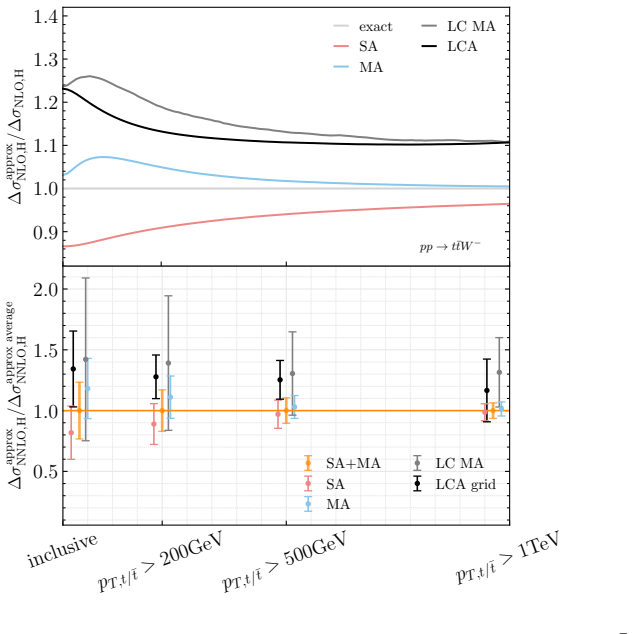
NNLO QCD predictions for ttbar W production at hadron colliders are now based on direct two-loop amplitude computation in the generalised leading-colour limit.
A machine-rendered reading of the paper's core claim, the machinery that carries it, and where it could break.
Core claim
The central claim is that NNLO QCD predictions for ttW production follow from a direct computation of the required two-loop amplitudes in the generalised leading-colour limit, providing the first such results without dynamical approximations for the double-virtual correction.
What carries the argument
Direct computation of the two-loop amplitudes in the generalised leading-colour limit, which supplies the double-virtual contribution to the NNLO cross section and differential distributions.
Load-bearing premise
The generalised leading-colour limit supplies a sufficiently accurate representation of the full two-loop contribution for the NNLO cross section and differential distributions.
What would settle it
A complete-color two-loop amplitude calculation or higher-precision LHC data that deviates substantially from these predictions would show whether the limit is accurate enough.
Figures
read the original abstract
The production of a top-antitop quark pair in association with a $W$ boson constitutes one of the heaviest final states currently studied at the Large Hadron Collider (LHC) at CERN. Measurements of its production rate have consistently exceeded Standard Model predictions. Owing to the complexity of the two-loop amplitudes entering the double-virtual correction, next-to-next-to-leading-order (NNLO) QCD calculations for this process have so far employed dynamical approximations for the two-loop contribution. We present NNLO QCD predictions based, for the first time, on a direct computation of the required two-loop amplitudes in the generalised leading-colour limit.
Editorial analysis
A structured set of objections, weighed in public.
Referee Report
Summary. The manuscript presents NNLO QCD predictions for t t-bar W production at hadron colliders. It claims to be the first work to obtain these from a direct computation of the two-loop amplitudes in the generalised leading-colour limit, rather than relying on dynamical approximations for the double-virtual contribution.
Significance. If the generalised leading-colour approximation holds to sufficient accuracy, the results would supply improved theoretical predictions for a process whose measured rate at the LHC has exceeded Standard Model expectations. The direct two-loop computation in this limit constitutes a clear methodological advance over prior approximations and supplies a concrete step toward fully differential NNLO calculations for heavy final states.
major comments (1)
- [Abstract] Abstract: The central claim is that the work supplies NNLO predictions based on a direct two-loop computation. This claim is load-bearing on the assertion that the generalised leading-colour limit furnishes a sufficiently accurate representation of the full two-loop contribution. No numerical estimate or bound is supplied on the size of the neglected colour-suppressed terms relative to the NNLO correction itself, either for the inclusive cross section or for the differential distributions that are presented. Without such a quantification the reliability of the reported predictions cannot be assessed.
Simulated Author's Rebuttal
We thank the referee for their careful reading of the manuscript and for the constructive comment. We respond to the major comment below.
read point-by-point responses
-
Referee: [Abstract] Abstract: The central claim is that the work supplies NNLO predictions based on a direct two-loop computation. This claim is load-bearing on the assertion that the generalised leading-colour limit furnishes a sufficiently accurate representation of the full two-loop contribution. No numerical estimate or bound is supplied on the size of the neglected colour-suppressed terms relative to the NNLO correction itself, either for the inclusive cross section or for the differential distributions that are presented. Without such a quantification the reliability of the reported predictions cannot be assessed.
Authors: We agree that the manuscript does not supply a numerical estimate of the colour-suppressed terms. The predictions presented are NNLO QCD within the generalised leading-colour approximation; the manuscript does not claim to deliver the complete-colour result. The direct two-loop computation in this limit is the methodological advance relative to earlier dynamical approximations. A quantitative bound on the neglected terms would require the subleading-colour two-loop amplitudes, which are not yet available. In the revised manuscript we will add an explicit statement clarifying the scope of the approximation and will include references to existing assessments of its numerical accuracy in related processes (e.g. ttbar production). revision: partial
- A precise numerical bound on the size of the colour-suppressed terms, which requires the full-colour two-loop amplitudes not computed in this work.
Circularity Check
No circularity; derivation rests on direct two-loop computation
full rationale
The paper presents NNLO QCD predictions obtained via a direct computation of the two-loop amplitudes in the generalised leading-colour limit. This is a methodological choice within standard perturbative QCD, with no evidence of self-definitional steps, fitted inputs renamed as predictions, load-bearing self-citations, or ansatze smuggled via prior work. The central claim does not reduce to its own inputs by construction and remains self-contained against external QCD benchmarks.
Axiom & Free-Parameter Ledger
axioms (1)
- domain assumption Perturbative QCD expansion remains valid at NNLO for ttW production.
Reference graph
Works this paper leans on
-
[1]
S. Badger, J. M. Campbell, and R. K. Ellis,QCD Corrections to the Hadronic Production of a Heavy Quark Pair and a W-Boson Including Decay Correlations, JHEP03(2011) 027, [arXiv:1011.6647]
Pith/arXiv arXiv 2011
-
[2]
J. M. Campbell and R. K. Ellis,t ¯tW +− production and decay at NLO, JHEP07(2012) 052, [arXiv:1204.5678]
Pith/arXiv arXiv 2012
-
[3]
F. Maltoni, D. Pagani, and I. Tsinikos,Associated production of a top-quark pair with vector bosons at NLO in QCD: impact ont tHsearches at the LHC, JHEP02(2016) 113, [arXiv:1507.05640]
Pith/arXiv arXiv 2016
-
[4]
S. Frixione, V. Hirschi, D. Pagani, H. S. Shao, and M. Zaro,Electroweak and QCD corrections to top-pair hadroproduction in association with heavy bosons, JHEP06(2015) 184, [arXiv:1504.03446]
Pith/arXiv arXiv 2015
-
[5]
R. Frederix, D. Pagani, and M. Zaro,Large NLO corrections int ¯tW ± andt ¯tt¯thadroproduction from supposedly subleading EW contributions, JHEP02(2018) 031, [arXiv:1711.02116]
Pith/arXiv arXiv 2018
-
[6]
H. T. Li, C. S. Li, and S. A. Li,Renormalization group improved predictions fort ¯tW ± production at hadron colliders, Phys. Rev. D90(2014), no. 9 094009, [arXiv:1409.1460]
Pith/arXiv arXiv 2014
-
[7]
A. Broggio, A. Ferroglia, G. Ossola, and B. D. Pecjak,Associated production of a top pair and a W boson at next-to-next-to-leading logarithmic accuracy, JHEP09(2016) 089, [arXiv:1607.05303]
Pith/arXiv arXiv 2016
-
[8]
A. Kulesza, L. Motyka, D. Schwartl¨ ander, T. Stebel, and V. Theeuwes,Associated production of a top quark pair with a heavy electroweak gauge boson at NLO+NNLL accuracy, Eur. Phys. J. C79(2019), no. 3 249, [arXiv:1812.08622]
Pith/arXiv arXiv 2019
-
[9]
A. Broggio, A. Ferroglia, R. Frederix, D. Pagani, B. D. Pecjak, and I. Tsinikos,Top-quark pair hadroproduction in association with a heavy boson at NLO+NNLL including EW corrections, JHEP08 (2019) 039, [arXiv:1907.04343]
arXiv 2019
-
[10]
G. Bevilacqua, H.-Y. Bi, H. B. Hartanto, M. Kraus, and M. Worek,The simplest of them all:t ¯tW ± at NLO accuracy in QCD, JHEP08(2020) 043, [arXiv:2005.09427]
arXiv 2020
-
[11]
A. Denner and G. Pelliccioli,NLO QCD corrections to off-shell t ¯tW+ production at the LHC, JHEP11 (2020) 069, [arXiv:2007.12089]
arXiv 2020
-
[12]
G. Bevilacqua, H.-Y. Bi, H. B. Hartanto, M. Kraus, J. Nasufi, and M. Worek,NLO QCD corrections to off-shellt ¯tW ± production at the LHC: correlations and asymmetries, Eur. Phys. J. C81(2021), no. 7 675, [arXiv:2012.01363]
arXiv 2021
-
[13]
A. Denner and G. Pelliccioli,Combined NLO EW and QCD corrections to off-shell t tW production at the LHC, Eur. Phys. J. C81(2021), no. 4 354, [arXiv:2102.03246]
arXiv 2021
-
[14]
R. Frederix and S. Frixione,Merging meets matching in MC@NLO, JHEP12(2012) 061, [arXiv:1209.6215]
Pith/arXiv arXiv 2012
-
[15]
R. Frederix and I. Tsinikos,On improving NLO merging fort tWproduction, JHEP11(2021) 029, [arXiv:2108.07826]
arXiv 2021
-
[16]
L. Buonocore, S. Devoto, M. Grazzini, S. Kallweit, J. Mazzitelli, L. Rottoli, and C. Savoini,Precise Predictions for the Associated Production of a W Boson with a Top-Antitop Quark Pair at the LHC, Phys. Rev. Lett.131(2023), no. 23 231901, [arXiv:2306.16311]
arXiv 2023
-
[17]
M. Grazzini, S. Kallweit, and M. Wiesemann,Fully differential NNLO computations with MATRIX, Eur. Phys. J. C78(2018), no. 7 537, [arXiv:1711.06631]
Pith/arXiv arXiv 2018
-
[18]
S. Catani, S. Devoto, M. Grazzini, S. Kallweit, J. Mazzitelli, and H. Sargsyan,Top-quark pair hadroproduction at next-to-next-to-leading order in QCD, Phys. Rev. D99(2019), no. 5 051501, [arXiv:1901.04005]. 8
Pith/arXiv arXiv 2019
- [19]
- [20]
-
[21]
L. Buonocore, S. Devoto, S. Kallweit, J. Mazzitelli, L. Rottoli, and C. Savoini,Associated production of a W boson and massive bottom quarks at next-to-next-to-leading order in QCD, Phys. Rev. D107(2023), no. 7 074032, [arXiv:2212.04954]
arXiv 2023
- [22]
-
[23]
S. Catani and M. Grazzini,An NNLO subtraction formalism in hadron collisions and its application to Higgs boson production at the LHC, Phys. Rev. Lett.98(2007) 222002, [hep-ph/0703012]
Pith/arXiv arXiv 2007
-
[24]
R. Bonciani, S. Catani, M. Grazzini, H. Sargsyan, and A. Torre,Theq T subtraction method for top quark production at hadron colliders, Eur. Phys. J. C75(2015), no. 12 581, [arXiv:1508.03585]
Pith/arXiv arXiv 2015
-
[25]
S. Catani and M. H. Seymour,The Dipole formalism for the calculation of QCD jet cross-sections at next-to-leading order, Phys. Lett. B378(1996) 287–301, [hep-ph/9602277]
Pith/arXiv arXiv 1996
-
[26]
S. Catani and M. H. Seymour,A General algorithm for calculating jet cross-sections in NLO QCD, Nucl. Phys. B485(1997) 291–419, [hep-ph/9605323]. [Erratum: Nucl.Phys.B 510, 503–504 (1998)]
Pith/arXiv arXiv 1997
-
[27]
S. Catani, S. Dittmaier, M. H. Seymour, and Z. Trocsanyi,The Dipole formalism for next-to-leading order QCD calculations with massive partons, Nucl. Phys. B627(2002) 189–265, [hep-ph/0201036]
Pith/arXiv arXiv 2002
- [28]
-
[29]
S. Devoto and J. Mazzitelli,Soft contributions to heavy quark production in arbitrary kinematics, arXiv:2509.17509
-
[30]
F. Cascioli, P. Maierh¨ ofer, and S. Pozzorini,Scattering Amplitudes with Open Loops, Phys. Rev. Lett. 108(2012) 111601, [arXiv:1111.5206]
Pith/arXiv arXiv 2012
-
[31]
F. Buccioni, S. Pozzorini, and M. Zoller,On-the-fly reduction of open loops, Eur. Phys. J. C78(2018), no. 1 70, [arXiv:1710.11452]
Pith/arXiv arXiv 2018
-
[32]
F. Buccioni, J.-N. Lang, J. M. Lindert, P. Maierh¨ ofer, S. Pozzorini, H. Zhang, and M. F. Zoller, OpenLoops 2, Eur. Phys. J. C79(2019), no. 10 866, [arXiv:1907.13071]
arXiv 2019
-
[33]
A. Ferroglia, M. Neubert, B. D. Pecjak, and L. L. Yang,Two-loop divergences of massive scattering amplitudes in non-abelian gauge theories, JHEP11(2009) 062, [arXiv:0908.3676]
Pith/arXiv arXiv 2009
-
[34]
M. Becchetti, M. Delto, S. Ditsch, P. A. Kreer, M. Pozzoli, and L. Tancredi,One-loop QCD corrections to ¯ ud→ttWatO ε2 , JHEP09(2025) 126, [arXiv:2502.14952]
arXiv 2025
-
[35]
Nogueira,Automatic Feynman Graph Generation, J
P. Nogueira,Automatic Feynman Graph Generation, J. Comput. Phys.105(1993) 279–289
1993
- [36]
- [37]
-
[38]
T. Peraro and L. Tancredi,Physical projectors for multi-leg helicity amplitudes, JHEP07(2019) 114, [arXiv:1906.03298]. 9
arXiv 2019
-
[39]
T. Peraro and L. Tancredi,Tensor decomposition for bosonic and fermionic scattering amplitudes, Phys. Rev. D103(2021), no. 5 054042, [arXiv:2012.00820]
arXiv 2021
-
[40]
’t Hooft and M
G. ’t Hooft and M. J. G. Veltman,Regularization and Renormalization of Gauge Fields, Nucl. Phys. B44 (1972) 189–213
1972
-
[41]
M. Becchetti, D. Canko, V. Chestnov, T. Peraro, M. Pozzoli, and S. Zoia,Two-loop Feynman integrals for leading colourt tWproduction at hadron colliders, JHEP07(2025) 001, [arXiv:2504.13011]
arXiv 2025
- [42]
-
[43]
S. Badger, M. Becchetti, C. Brancaccio, M. Czakon, H. B. Hartanto, R. Poncelet, and S. Zoia,Double virtual QCD corrections tot ¯t+jet production at the LHC,arXiv:2511.11424
-
[44]
X. Liu and Y.-Q. Ma,AMFlow: A Mathematica package for Feynman integrals computation via auxiliary mass flow, Comput. Phys. Commun.283(2023) 108565, [arXiv:2201.11669]
arXiv 2023
-
[45]
X. Liu, Y.-Q. Ma, and C.-Y. Wang,A Systematic and Efficient Method to Compute Multi-loop Master Integrals, Phys. Lett. B779(2018) 353–357, [arXiv:1711.09572]
Pith/arXiv arXiv 2018
-
[46]
A. von Manteuffel and R. M. Schabinger,A novel approach to integration by parts reduction, Phys. Lett. B744(2015) 101–104, [arXiv:1406.4513]
Pith/arXiv arXiv 2015
-
[47]
T. Peraro,Scattering amplitudes over finite fields and multivariate functional reconstruction, JHEP12 (2016) 030, [arXiv:1608.01902]
Pith/arXiv arXiv 2016
-
[48]
T. Peraro,FiniteFlow: multivariate functional reconstruction using finite fields and dataflow graphs, JHEP07(2019) 031, [arXiv:1905.08019]
Pith/arXiv arXiv 2019
-
[49]
F. V. Tkachov,A theorem on analytical calculability of 4-loop renormalization group functions, Phys. Lett. B100(1981) 65–68
1981
-
[50]
K. G. Chetyrkin and F. V. Tkachov,Integration by parts: The algorithm to calculateβ-functions in 4 loops, Nucl. Phys. B192(1981) 159–204
1981
-
[51]
Laporta,High-precision calculation of multiloop Feynman integrals by difference equations, Int
S. Laporta,High-precision calculation of multiloop Feynman integrals by difference equations, Int. J. Mod. Phys. A15(2000) 5087–5159, [hep-ph/0102033]
Pith/arXiv arXiv 2000
-
[52]
Z. Wu, J. Boehm, R. Ma, H. Xu, and Y. Zhang,NeatIBP 1.0, a package generating small-size integration-by-parts relations for Feynman integrals, Comput. Phys. Commun.295(2024) 108999, [arXiv:2305.08783]
arXiv 2024
-
[53]
T. Peraro,Analytic multi-loop results using finite fields and dataflow graphs with FiniteFlow, in 14th International Symposium on Radiative Corrections: Application of Quantum Field Theory to Phenomenology, 12, 2019.arXiv:1912.03142
arXiv 2019
-
[54]
X. Guan, X. Liu, Y.-Q. Ma, and W.-H. Wu,Blade: A package for block-triangular form improved Feynman integrals decomposition, Comput. Phys. Commun.310(2025) 109538, [arXiv:2405.14621]
arXiv 2025
-
[55]
X. Guan, X. Liu, and Y.-Q. Ma,Complete reduction of integrals in two-loop five-light-parton scattering amplitudes, Chin. Phys. C44(2020), no. 9 093106, [arXiv:1912.09294]
arXiv 2020
- [56]
- [57]
-
[58]
H. T. Li, Y.-Q. Ma, C.-T. Tan, J. Wang, and H.-F. Zhang,Compton-Scattering Total Cross Section at Next-to-Next-to-Leading Order and Resummation of Leading Logarithms, Phys. Rev. Lett.136(2026), no. 2 021802, [arXiv:2511.09330]
arXiv 2026
-
[59]
B. Agarwal, G. Heinrich, S. P. Jones, M. Kerner, S. Y. Klein, J. Lang, V. Magerya, and A. Olsson, Two-loop amplitudes fort tHproduction: the quark-initiated N f -part, JHEP05(2024) 013, [arXiv:2402.03301]. [Erratum: JHEP 06, 142 (2024)]
arXiv 2024
-
[60]
Williams,BSPLINE-FORTRAN package,https://github.com/jacobwilliams/bspline-fortran,
J. Williams,BSPLINE-FORTRAN package,https://github.com/jacobwilliams/bspline-fortran,
-
[61]
V. Bres´ o-Pla, G. Heinrich, V. Magerya, and A. Olsson,Interpolating amplitudes, SciPost Phys.19(2025), no. 5 123, [arXiv:2412.09534]. [78]NNPDFCollaboration, V. Bertone, S. Carrazza, N. P. Hartland, and J. Rojo,Illuminating the photon content of the proton within a global PDF analysis, SciPost Phys.5(2018), no. 1 008, [arXiv:1712.07053]
arXiv 2025
-
[62]
A. Buckley, J. Ferrando, S. Lloyd, K. Nordstr¨ om, B. Page, M. R¨ ufenacht, M. Sch¨ onherr, and G. Watt, LHAPDF6: parton density access in the LHC precision era, Eur. Phys. J. C75(2015) 132, [arXiv:1412.7420]
Pith/arXiv arXiv 2015
-
[63]
A. Mitov and S. Moch,The Singular behavior of massive QCD amplitudes, JHEP05(2007) 001, [hep-ph/0612149]
Pith/arXiv arXiv 2007
-
[64]
G. Wang, T. Xia, L. L. Yang, and X. Ye,On the high-energy behavior of massive QCD amplitudes, JHEP 05(2024) 082, [arXiv:2312.12242]
arXiv 2024
- [65]
- [66]
discussion (0)
Sign in with ORCID, Apple, or X to comment. Anyone can read and Pith papers without signing in.