Effective QCD model with consistent quasi-gluon treatment : formulation and application
Pith reviewed 2026-06-27 16:01 UTC · model grok-4.3
The pith
The PNJL model is reformulated with gluon quasi-particles beyond the saddle-point approximation to produce a consistent quasiparticle description of QCD thermodynamics.
A machine-rendered reading of the paper's core claim, the machinery that carries it, and where it could break.
Core claim
Reformulating the PNJL model in terms of both quark and gluon quasi-particles, with the gluon sector treated beyond the saddle-point approximation, yields a physically consistent quasiparticle model for QCD thermodynamics whose advantages appear in calculations of transport coefficients.
What carries the argument
The reformulation of the PNJL Lagrangian and thermodynamic potential that incorporates gluon quasi-particles without restricting to the saddle-point approximation, thereby enforcing consistency between the quasi-particle dispersion relations and the thermodynamic relations.
If this is right
- Thermodynamic quantities and transport coefficients become calculable within a single consistent quasiparticle framework for both quarks and gluons.
- The light-quark transport coefficients obtained from the model satisfy the same consistency requirements as the underlying thermodynamics.
- The approach removes the need for ad-hoc fixes that previous quasiparticle models required to restore thermodynamic consistency.
- The same framework can be applied to other observables that depend on quasi-particle properties at finite temperature.
Where Pith is reading between the lines
- The method may improve agreement with lattice data on the QCD equation of state once the quasi-gluon masses are fixed.
- Similar extensions could be tested in models that include strange quarks or finite baryon density.
- If the consistency holds, the model could serve as input for hydrodynamic simulations of heavy-ion collisions without additional patching.
Load-bearing premise
Extending the PNJL model with gluon quasi-particles beyond the saddle-point approximation removes physical inconsistencies without introducing new uncontrolled approximations or parameter dependencies.
What would settle it
A calculation of a thermodynamic quantity such as pressure or energy density, or a transport coefficient such as shear viscosity, within this model that still violates thermodynamic consistency relations or deviates systematically from lattice QCD results in a way that cannot be fixed by parameter choice would falsify the consistency claim.
Figures


read the original abstract
The Polyakov loop enhanced Nambu-Jona-Lasinio model is reformulated in terms of the gluon quasi-particles in addition to the already existing quark quasi-particles. The formulation goes beyond the saddle point approximation for the gluon sector. The framework provides a physically consistent quasiparticle model for QCD thermodynamics. The ensuing advantages of this formulation is discussed using transport coefficients in the light quark sector.
Editorial analysis
A structured set of objections, weighed in public.
Referee Report
Summary. The paper reformulates the Polyakov-loop enhanced Nambu–Jona-Lasinio (PNJL) model by incorporating gluon quasi-particles in addition to the existing quark quasi-particles, extending the gluon-sector treatment beyond the saddle-point approximation. It claims that this yields a physically consistent quasiparticle framework for QCD thermodynamics and demonstrates advantages through calculations of transport coefficients in the light-quark sector.
Significance. If the beyond-saddle-point gluon treatment indeed preserves exact thermodynamic relations (pressure obtained from the effective potential and entropy from its temperature derivative) without introducing new uncontrolled approximations or parameter dependencies, the resulting model would strengthen the internal consistency of effective QCD descriptions used for the equation of state and transport properties in the quark-gluon plasma regime.
major comments (1)
- [Abstract] Abstract: the central claim that the reformulation 'provides a physically consistent quasiparticle model' requires that the gluon-sector extension beyond the saddle-point approximation maintains thermodynamic consistency and introduces no new inconsistencies or parameter dependencies. The abstract states the reformulation occurs and advantages are shown via transport coefficients but supplies no explicit construction, derivation, or verification that the beyond-saddle-point step preserves the required relations (pressure from effective potential, entropy from derivative) without additional assumptions.
Simulated Author's Rebuttal
We thank the referee for the constructive comments on our manuscript. We address the concern about the abstract's claim of thermodynamic consistency below, providing clarification on where the derivations appear in the main text while agreeing to strengthen the abstract.
read point-by-point responses
-
Referee: [Abstract] Abstract: the central claim that the reformulation 'provides a physically consistent quasiparticle model' requires that the gluon-sector extension beyond the saddle-point approximation maintains thermodynamic consistency and introduces no new inconsistencies or parameter dependencies. The abstract states the reformulation occurs and advantages are shown via transport coefficients but supplies no explicit construction, derivation, or verification that the beyond-saddle-point step preserves the required relations (pressure from effective potential, entropy from derivative) without additional assumptions.
Authors: The explicit construction of the gluon quasi-particle treatment beyond the saddle-point approximation, together with the verification that thermodynamic relations are preserved (pressure obtained directly from the effective potential and entropy from its temperature derivative), is derived in Sections II and III without introducing new parameters or uncontrolled approximations. The same set of PNJL parameters is retained. We agree that the abstract would benefit from a brief reference to this verification and will revise it accordingly in the next version. revision: partial
Circularity Check
No significant circularity detected; derivation presented as independent model reformulation
full rationale
The paper describes a reformulation of the PNJL model by adding gluon quasi-particles treated beyond the saddle-point approximation, claiming this yields a physically consistent quasiparticle description of QCD thermodynamics with advantages illustrated through transport coefficients. No equations or steps are quoted that reduce a claimed prediction or result to a fitted input by construction, nor is there evidence of load-bearing self-citation chains, uniqueness theorems imported from the same authors, or ansatzes smuggled via prior work that would make the central consistency claim equivalent to its inputs. The extension is framed as a new formulation whose consistency follows from the reformulation itself, with transport coefficients serving as an application rather than a re-labeled fit. The derivation chain therefore remains self-contained against external benchmarks.
Axiom & Free-Parameter Ledger
Reference graph
Works this paper leans on
-
[1]
In our numerical analysis to reproduce results for usual PNJL model, we have used ΩPoly with the parameters given in table.I, taken from Ref
Polynomial potential approach In this approach, aZ(3) symmetric polynomial po- tential is constructed in terms of Φ, ¯Φ and the first or- der phase transition is captured through the temperature dependent parameters,α i, following the usual Ginsburg- Landau approach [20].U(Φ, ¯Φ) can be written as [21–28], U(Φ, ¯Φ) T 4 =− α1(T) 2 Φ¯Φ− α2 6 (Φ3+ ¯Φ3)+ α3 4...
-
[2]
The thermodynamic potential, Ωgqp can be written as, Ωgqp = = 2T Z d3p (2π)3 ln det 1− ˆLAe− |⃗ p| T = 2T Z d3p (2π)3 ln 1 + 8X n=1 ane− n|⃗ p| T ! ,(13) where ˆLA is given in Eq
Quasi-particle approach In the quasi-particle model [76–79, 81], the gluon quasi- particles are considered to be swarming in the back- ground of Polyakov field. The thermodynamic potential, Ωgqp can be written as, Ωgqp = = 2T Z d3p (2π)3 ln det 1− ˆLAe− |⃗ p| T = 2T Z d3p (2π)3 ln 1 + 8X n=1 ane− n|⃗ p| T ! ,(13) where ˆLA is given in Eq. (5). The coeffic...
-
[3]
The standard approach Nambu—Jona-Lasinio model [65–70], is a chiral effec- tive model where the gauge field is integrated out and re- placed by the local four-point interaction of quark degrees of freedom. To incorporate the confinement properties in this chiral model, the quarks are considered to be coupled to the static background gauge field and gluon ...
-
[4]
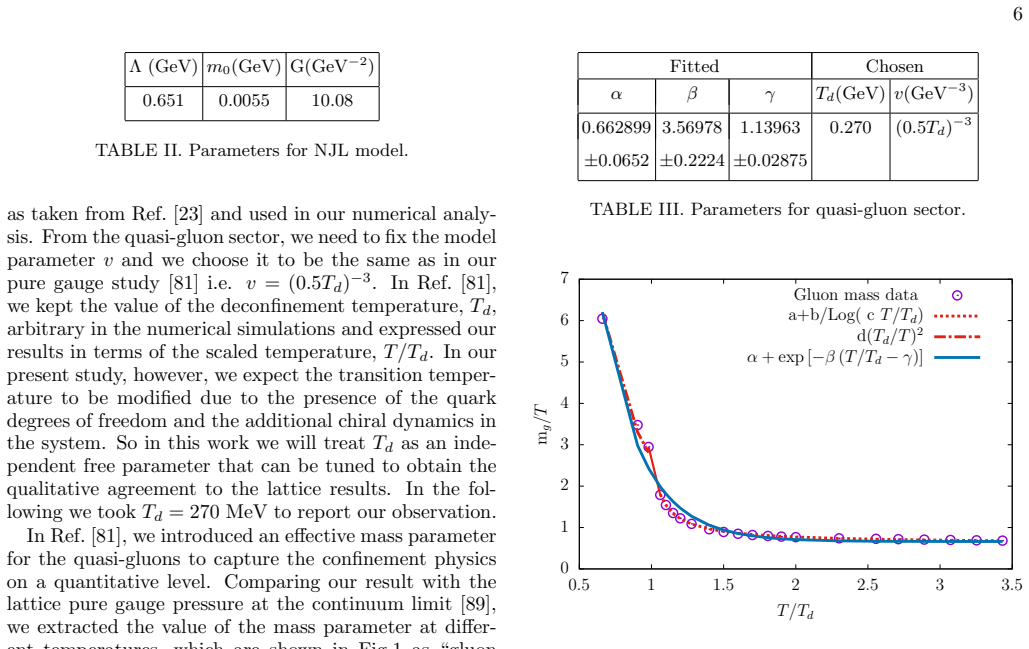
gluon mass data
Quasiparticle approach Our proposal in this work is to couple the gluon quasi- particle model [76–79, 81] to the 2 flavour NJL model. In the usual saddle point approximation the thermodynamic potential is given as, Ωqp PNJL = Ωq + Ωqp ,(22) where, Ω q is given in Eq.(20), and Ω qp is given in Eq. (10), with Ωgqp given in Eq.(13). This model can pro- vide ...
2065
-
[5]
Adamczyket al.(STAR), Nature548, 62 (2017), arXiv:1701.06657 [nucl-ex]
L. Adamczyket al.(STAR), Nature548, 62 (2017), arXiv:1701.06657 [nucl-ex]
Pith/arXiv arXiv 2017
-
[6]
G. Boyd, J. Engels, F. Karsch, E. Laermann, C. Leg- eland, M. Lutgemeier, and B. Petersson, Nucl. Phys. B469, 419 (1996), arXiv:hep-lat/9602007 [hep-lat]
Pith/arXiv arXiv 1996
-
[7]
J. Engels, O. Kaczmarek, F. Karsch, and E. Laermann, Nucl. Phys. B558, 307 (1999), [Erratum: Nucl.Phys.B 576, 657–657 (2000)], arXiv:hep-lat/9903030
Pith/arXiv arXiv 1999
-
[8]
Z. Fodor and S. D. Katz, Phys. Lett. B534, 87 (2002), arXiv:hep-lat/0104001
Pith/arXiv arXiv 2002
-
[9]
C. R. Allton, S. Ejiri, S. J. Hands, O. Kaczmarek, F. Karsch, E. Laermann, C. Schmidt, and L. Scorzato, Phys. Rev. D66, 074507 (2002), arXiv:hep-lat/0204010
Pith/arXiv arXiv 2002
-
[10]
Y. Aoki, G. Endrodi, Z. Fodor, S. D. Katz, and K. K. Szabo, Nature443, 675 (2006), arXiv:hep-lat/0611014
Pith/arXiv arXiv 2006
-
[11]
A. Bazavovet al., Phys. Rev. D85, 054503 (2012), arXiv:1111.1710 [hep-lat]
Pith/arXiv arXiv 2012
-
[12]
P. N. Meisinger and M. C. Ogilvie, Phys. Lett. B379, 163 (1996), arXiv:hep-lat/9512011
Pith/arXiv arXiv 1996
-
[13]
P. Levai and U. W. Heinz, Phys. Rev. C57, 1879 (1998), arXiv:hep-ph/9710463
Pith/arXiv arXiv 1998
-
[14]
Karsch, Adv
F. Karsch, Adv. Ser. Direct. High Energy Phys.6, 61 (1990), [,61(1989)]
1990
-
[15]
A. Ali Khanet al.(CP-PACS), Phys. Rev. D64, 074510 (2001), arXiv:hep-lat/0103028
Pith/arXiv arXiv 2001
-
[16]
S. Borsanyi, G. Endrodi, Z. Fodor, S. D. Katz, and K. K. Szabo, JHEP07, 056 (2012), arXiv:1204.6184 [hep-lat]
Pith/arXiv arXiv 2012
-
[17]
P. Petreczky, Nucl. Phys. B Proc. Suppl.140, 78 (2005), arXiv:hep-lat/0409139
Pith/arXiv arXiv 2005
-
[18]
V. V. Braguta, A. Kotov, A. Roenko, and D. Sychev, PoSLATTICE2022, 190 (2023), arXiv:2212.03224 [hep-lat]
arXiv 2023
-
[19]
V. V. Braguta, M. N. Chernodub, I. E. Kudrov, A. A. Roenko, and D. A. Sychev, Phys. Atom. Nucl.86, 1249 (2023)
2023
-
[20]
V. V. Braguta, M. N. Chernodub, and A. A. Roenko, Phys. Rev. D111, 114508 (2025), arXiv:2503.18636 [hep-lat]
arXiv 2025
-
[21]
R. D. Pisarski, Phys. Rev.D62, 111501 (2000), arXiv:hep-ph/0006205 [hep-ph]
Pith/arXiv arXiv 2000
-
[22]
A. Dumitru and R. D. Pisarski, Phys. Lett.B504, 282 (2001), arXiv:hep-ph/0010083 [hep-ph]
Pith/arXiv arXiv 2001
-
[23]
R. D. Pisarski (2002) pp. 353–384, arXiv:hep- ph/0203271 [hep-ph]
arXiv 2002
-
[24]
Landau, CERN Document Server53(08)(1965)
L. Landau, CERN Document Server53(08)(1965)
1965
-
[25]
Fukushima, Physics Letters B591, 277 (2004)
K. Fukushima, Physics Letters B591, 277 (2004)
2004
-
[26]
E. Megias, E. Ruiz Arriola, and L. L. Salcedo, Phys. Rev. D74, 065005 (2006), arXiv:hep-ph/0412308
Pith/arXiv arXiv 2006
-
[27]
Ratti, M
C. Ratti, M. A. Thaler, and W. Weise, Phys. Rev. D 73, 014019 (2006)
2006
-
[28]
S. K. Ghosh, T. K. Mukherjee, M. G. Mustafa, and R. Ray, Phys. Rev. D73, 114007 (2006), arXiv:hep- ph/0603050
arXiv 2006
-
[29]
E. Megias, E. Ruiz Arriola, and L. L. Salcedo, Phys. Rev. D74, 114014 (2006), arXiv:hep-ph/0607338
Pith/arXiv arXiv 2006
-
[30]
S. Mukherjee, M. G. Mustafa, and R. Ray, Phys. Rev. D75, 094015 (2007), arXiv:hep-ph/0609249
Pith/arXiv arXiv 2007
-
[31]
S. K. Ghosh, T. K. Mukherjee, M. G. Mustafa, and R. Ray, Phys. Rev. D77, 094024 (2008), arXiv:0710.2790 [hep-ph]
Pith/arXiv arXiv 2008
-
[32]
B.-J. Schaefer, J. M. Pawlowski, and J. Wambach, Phys. Rev. D76, 074023 (2007), arXiv:0704.3234 [hep- ph]
Pith/arXiv arXiv 2007
-
[33]
K. Kashiwa, H. Kouno, M. Matsuzaki, and M. Yahiro, Phys. Lett. B662, 26 (2008), arXiv:0710.2180 [hep-ph]
Pith/arXiv arXiv 2008
-
[34]
M. Ciminale, R. Gatto, N. D. Ippolito, G. Nardulli, and M. Ruggieri, Phys. Rev.D77, 054023 (2008), arXiv:0711.3397 [hep-ph]
Pith/arXiv arXiv 2008
-
[35]
K. Fukushima, Phys. Rev.D77, 114028 (2008), [Er- ratum: Phys. Rev.D78,039902(2008)], arXiv:0803.3318 [hep-ph]
Pith/arXiv arXiv 2008
-
[36]
P. Deb, A. Bhattacharyya, S. Datta, and S. K. Ghosh, Phys. Rev.C79, 055208 (2009), arXiv:0901.1992 [nucl- th]
Pith/arXiv arXiv 2009
-
[37]
B.-J. Schaefer, M. Wagner, and J. Wambach, Phys. Rev. D81, 074013 (2010), arXiv:0910.5628 [hep-ph]
Pith/arXiv arXiv 2010
-
[38]
A. Bhattacharyya, P. Deb, S. K. Ghosh, and R. Ray, Phys. Rev. D82, 014021 (2010), arXiv:1003.3337 [hep- ph]
Pith/arXiv arXiv 2010
-
[39]
A. Bhattacharyya, P. Deb, A. Lahiri, and R. Ray, Phys. Rev. D82, 114028 (2010), arXiv:1008.0768 [hep-ph]
Pith/arXiv arXiv 2010
-
[40]
A. Bhattacharyya, P. Deb, A. Lahiri, and R. Ray, Phys. Rev. D83, 014011 (2011), arXiv:1010.2394 [hep-ph]
Pith/arXiv arXiv 2011
-
[41]
A. Bhattacharyya, S. K. Ghosh, S. Majumder, and R. Ray, Phys. Rev. D86, 096006 (2012), arXiv:1107.5941 [hep-ph]
Pith/arXiv arXiv 2012
-
[42]
A. Bhattacharyya, P. Deb, S. K. Ghosh, R. Ray, and S. Sur, Phys. Rev. D87, 054009 (2013), arXiv:1212.5893 [hep-ph]
Pith/arXiv arXiv 2013
-
[43]
A. Bhattacharyya, S. K. Ghosh, A. Lahiri, S. Ma- jumder, S. Raha, and R. Ray, Phys. Rev. C89, 064905 (2014), arXiv:1212.6134 [hep-ph]
Pith/arXiv arXiv 2014
-
[44]
S. K. Ghosh, A. Lahiri, S. Majumder, M. G. Mustafa, S. Raha, and R. Ray, Phys. Rev. D90, 054030 (2014), arXiv:1407.7203 [hep-ph]
Pith/arXiv arXiv 2014
-
[45]
S. K. Ghosh, S. Raha, R. Ray, K. Saha, and S. Upad- haya, Phys. Rev. D91, 054005 (2015), arXiv:1411.2765 [hep-ph]
Pith/arXiv arXiv 2015
-
[46]
A. Bhattacharyya, R. Ray, and S. Sur, Phys. Rev. D 91, 051501 (2015), arXiv:1412.8316 [hep-ph]
Pith/arXiv arXiv 2015
-
[47]
A. Bhattacharyya, S. K. Ghosh, R. Ray, K. Saha, and S. Upadhaya, EPL116, 52001 (2016), arXiv:1507.08795 [hep-ph]
Pith/arXiv arXiv 2016
-
[48]
A. Bhattacharyya, S. K. Ghosh, S. Maity, S. Raha, R. Ray, K. Saha, and S. Upadhaya, Phys. Rev. D95, 054005 (2017), arXiv:1609.07882 [hep-ph]
Pith/arXiv arXiv 2017
-
[49]
Singha, A
P. Singha, A. Abhishek, G. Kadam, S. Ghosh, and H. Mishra, DAE Symp. Nucl. Phys.62, 862 (2017)
2017
-
[50]
A. Bhattacharyya, S. K. Ghosh, S. Maity, S. Raha, R. Ray, K. Saha, S. Samanta, and S. Upadhaya, Phys. Rev. C99, 045207 (2019), arXiv:1708.04549 [hep-ph]
Pith/arXiv arXiv 2019
-
[51]
P. Singha, A. Abhishek, G. Kadam, S. Ghosh, and H. Mishra, J. Phys. G46, 015201 (2019), arXiv:1705.03084 [nucl-th]
Pith/arXiv arXiv 2019
-
[52]
A. Bhattacharyya, P. Deb, S. K. Ghosh, S. Maity, S. Raha, R. Ray, K. Saha, and S. Upadhaya, Phys. Rev. D102, 074006 (2020), arXiv:1912.07019 [hep-ph]
arXiv 2020
-
[53]
W.-j. Fu, Z. Zhang, and Y.-x. Liu, Phys. Rev. D77, 014006 (2008), arXiv:0711.0154 [hep-ph]
Pith/arXiv arXiv 2008
-
[54]
P. Costa, M. C. Ruivo, and C. A. de Sousa, Phys. Rev. D77, 096001 (2008), arXiv:0801.3417 [hep-ph]. 16
Pith/arXiv arXiv 2008
-
[55]
M. Buballa, A. G. Grunfeld, A. E. Radzhabov, and D. Scheffler, Prog. Part. Nucl. Phys.62, 365 (2009), arXiv:0811.4543 [hep-ph]
Pith/arXiv arXiv 2009
-
[56]
P. Costa, H. Hansen, M. C. Ruivo, and C. A. de Sousa, Phys. Rev. D81, 016007 (2010), arXiv:0909.5124 [hep- ph]
Pith/arXiv arXiv 2010
-
[57]
O. Lourenco, M. Dutra, A. Delfino, and M. Malheiro, Phys. Rev. D84, 125034 (2011), arXiv:1201.1239 [nucl- th]
Pith/arXiv arXiv 2011
-
[58]
T. Inagaki, D. Kimura, H. Kohyama, and A. Kvinikhidze, Phys. Rev. D86, 116013 (2012), arXiv:1202.5220 [hep-ph]
Pith/arXiv arXiv 2012
-
[59]
A. V. Friesen, Y. L. Kalinovsky, and V. D. Toneev, Int. J. Mod. Phys. A27, 1250013 (2012), arXiv:1111.3042 [hep-ph]
Pith/arXiv arXiv 2012
-
[60]
H. Davoudiasl, T. G. Rizzo, and A. Soni, Phys. Rev. D 77, 036001 (2008), arXiv:0710.2078 [hep-ph]
Pith/arXiv arXiv 2008
-
[61]
Y. Sakai, H. Kouno, and M. Yahiro, J. Phys. G37, 105007 (2010), arXiv:0908.3088 [hep-ph]
Pith/arXiv arXiv 2010
-
[62]
K. Morita, V. Skokov, B. Friman, and K. Redlich, Phys. Rev. D84, 076009 (2011), arXiv:1107.2273 [hep-ph]
Pith/arXiv arXiv 2011
-
[63]
H.-M. Tsai and B. Muller, J. Phys. G36, 075101 (2009), arXiv:0811.2216 [hep-ph]
Pith/arXiv arXiv 2009
-
[64]
J. Braun, L. M. Haas, F. Marhauser, and J. M. Pawlowski, Phys. Rev. Lett.106, 022002 (2011), arXiv:0908.0008 [hep-ph]
Pith/arXiv arXiv 2011
-
[65]
E. Megias, E. Ruiz Arriola, and L. L. Salcedo, Phys. Rev. D89, 076006 (2014), arXiv:1311.2814 [hep-ph]
Pith/arXiv arXiv 2014
- [66]
-
[67]
P. Singha, S. Busuioc, V. E. Ambrus, and M. N. Chernodub, Phys. Rev. D112, 094031 (2025), arXiv:2503.17291 [nucl-th]
Pith/arXiv arXiv 2025
- [68]
-
[69]
Nambu and G
Y. Nambu and G. Jona-Lasinio, Phys. Rev.122, 345 (1961)
1961
-
[70]
Nambu and G
Y. Nambu and G. Jona-Lasinio, Phys. Rev.124, 246 (1961)
1961
-
[71]
T. Hatsuda and T. Kunihiro, Phys. Rept.247, 221 (1994), arXiv:hep-ph/9401310
Pith/arXiv arXiv 1994
-
[72]
Vogl and W
U. Vogl and W. Weise, Prog. Part. Nucl. Phys.27, 195 (1991)
1991
-
[73]
Klevansky, Rev
S. Klevansky, Rev. Mod. Phys.64, 649 (1992)
1992
- [74]
-
[75]
D. U. Jungnickel and C. Wetterich, Phys. Rev. D53, 5142 (1996), arXiv:hep-ph/9505267
Pith/arXiv arXiv 1996
-
[76]
J. Berges, D. U. Jungnickel, and C. Wetterich, Int. J. Mod. Phys. A18, 3189 (2003), arXiv:hep-ph/9811387
Pith/arXiv arXiv 2003
- [77]
-
[78]
B.-J. Schaefer and J. Wambach, Phys. Rev. D75, 085015 (2007), arXiv:hep-ph/0603256
Pith/arXiv arXiv 2007
-
[79]
B.-J. Schaefer and J. Wambach, Phys. Part. Nucl.39, 1025 (2008), arXiv:hep-ph/0611191
Pith/arXiv arXiv 2008
-
[80]
C. Sasaki and K. Redlich, Phys. Rev.D86, 014007 (2012), arXiv:1204.4330 [hep-ph]
Pith/arXiv arXiv 2012
discussion (0)
Sign in with ORCID, Apple, or X to comment. Anyone can read and Pith papers without signing in.