Finite Massless Pentaboxes
Pith reviewed 2026-06-27 15:57 UTC · model grok-4.3
The pith
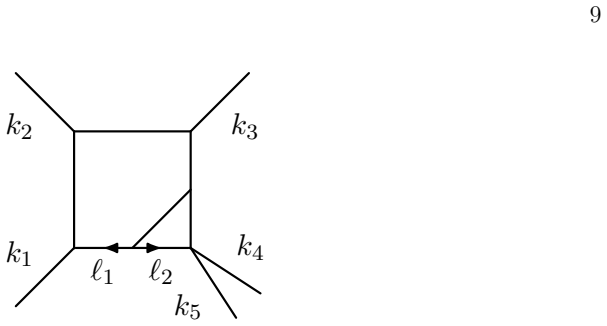
The integrand numerators yielding locally finite or evanescent massless pentabox integrals are characterized by their ideal generators in an adapted momentum basis.
A machine-rendered reading of the paper's core claim, the machinery that carries it, and where it could break.
Core claim
We characterize the integrand numerators that give rise to locally finite or evanescent Feynman integrals for the massless pentabox. We provide compact expressions for the generators of the corresponding ideal in terms of an adapted momentum basis and also in terms of Gram determinants. We also compute the integrals corresponding to the lowest-rank numerators in terms of polylogarithms using the HyperInt package, and in terms of pentagon functions.
What carries the argument
The generators of the numerator ideal in an adapted momentum basis, which classify which integrands produce locally finite or evanescent pentabox integrals.
If this is right
- The ideal generators supply a systematic way to construct finite pentabox representations.
- Lowest-rank numerators evaluate to explicit polylogarithmic expressions and pentagon functions.
- Gram-determinant forms of the generators give a coordinate-independent description of the same ideal.
- The method distinguishes evanescent cases that vanish in specific dimensional limits.
Where Pith is reading between the lines
- The same ideal-based approach could be applied to other two-loop topologies to isolate finite sectors without case-by-case regularization.
- Finite numerators selected this way may reduce the size of the integral basis required for two-loop scattering amplitudes.
- Evanescent members of the ideal might correspond to operators that vanish in four dimensions and could link to effective-theory simplifications.
Load-bearing premise
An adapted momentum basis exists in which the generators of the numerator ideal admit compact closed-form expressions without additional relations that would alter the finite or evanescent classification.
What would settle it
An explicit integration of a numerator the characterization labels finite that instead produces a divergent result would falsify the classification.
Figures

read the original abstract
We characterize the integrand numerators that give rise to locally finite or evanescent Feynman integrals for the massless pentabox. We provide compact expressions for the generators of the corresponding ideal in terms of an adapted momentum basis and also in terms of Gram determinants. We also compute the integrals corresponding to the lowest-rank numerators in terms of polylogarithms using the HyperInt package, and in terms of pentagon functions.
Editorial analysis
A structured set of objections, weighed in public.
Referee Report
Summary. The paper characterizes the integrand numerators that produce locally finite or evanescent massless pentabox Feynman integrals. It supplies compact expressions for the generators of the associated numerator ideal both in an adapted momentum basis and via Gram determinants, and evaluates the integrals for the lowest-rank numerators in terms of polylogarithms (via HyperInt) and pentagon functions.
Significance. If the classification is verified to be complete and consistent between the two presentations, the results would supply a practical tool for isolating finite contributions in two-loop five-point amplitudes, which are of direct phenomenological interest in massless QCD. The explicit HyperInt evaluations of specific cases provide concrete, reproducible benchmarks that strengthen the utility of the classification.
major comments (1)
- [section presenting the numerator ideal generators] The central claim requires that the generators listed in the adapted momentum basis and in the Gram-determinant form generate identical ideals (i.e., that the change-of-basis does not introduce or omit syzygies that would alter the finite/evanescent classification). The manuscript presents both sets of generators but does not exhibit an explicit check—such as computation of the transformation matrix determinant over the polynomial ring or direct comparison of the syzygy modules—that the two presentations are equivalent.
Simulated Author's Rebuttal
We thank the referee for the careful reading of the manuscript and the constructive comment on the equivalence of the two presentations of the numerator ideal generators. We address the point below.
read point-by-point responses
-
Referee: [section presenting the numerator ideal generators] The central claim requires that the generators listed in the adapted momentum basis and in the Gram-determinant form generate identical ideals (i.e., that the change-of-basis does not introduce or omit syzygies that would alter the finite/evanescent classification). The manuscript presents both sets of generators but does not exhibit an explicit check—such as computation of the transformation matrix determinant over the polynomial ring or direct comparison of the syzygy modules—that the two presentations are equivalent.
Authors: We agree that an explicit verification of the equivalence between the two generating sets is needed to rigorously confirm they span the same ideal. In the revised version we will add a short appendix containing the explicit change-of-basis matrix between the adapted-momentum and Gram-determinant generators together with its determinant (computed symbolically over the polynomial ring), which is a non-zero constant. This establishes that the ideals coincide and that no additional syzygies are introduced or omitted. The check will be performed with a computer-algebra system and the result reported. revision: yes
Circularity Check
Derivation chain self-contained with no circular reductions
full rationale
The paper characterizes the integrand numerators giving locally finite or evanescent integrals by constructing generators of the numerator ideal, expressed both in an adapted momentum basis and via Gram determinants, then evaluates lowest-rank cases with HyperInt and pentagon functions. No step equates a claimed result to its own input by definition, renames a fitted quantity as a prediction, or relies on a load-bearing self-citation whose content is unverified outside the present work. The algebraic ideal generators and integral evaluations rest on external computational tools and standard momentum-space identities rather than circular redefinition.
Axiom & Free-Parameter Ledger
axioms (1)
- domain assumption Feynman integrals are defined in dimensional regularization with d = 4 - 2ε
Reference graph
Works this paper leans on
-
[1]
single-collinear
Constraints arising from subintegrations do not change the maximal rank, but do further constrain the loop momentum monomials allowed in the numerator. We call the constraints based solely on superficial degrees of divergencestrongUV constraints. They start to exclude numerators at rank 5. The coefficients of some of the expected UV divergences may turn o...
-
[2]
G. Gambuti, D. A. Kosower, P. P. Novichkov, and L. Tancredi, Phys. Rev. D 110:116026 (2024) [arXiv:2311.16907 [hep-ph]]
arXiv 2024
-
[3]
A. von Manteuffel, E. Panzer, and R. M. Schabinger, JHEP 02:120 (2015) [arXiv:1411.7392 [hep-ph]]
Pith/arXiv arXiv 2015
-
[4]
A. von Manteuffel, E. Panzer, and R. M. Schabinger, Phys. Rev. D 93:125014 (2016) [arXiv:1510.06758 [hep-ph]]
Pith/arXiv arXiv 2016
-
[5]
C. Anastasiou and G. Sterman, JHEP 05:242 (2023) [arXiv:2212.12162 [hep-ph]]
arXiv 2023
-
[6]
C. Anastasiou and G. Sterman, JHEP 07:056 (2019) [arXiv:1812.03753 [hep-ph]]
arXiv 2019
- [7]
-
[8]
L. de la Cruz, D. A. Kosower, and P. P. Novichkov, Phys. Rev. D 111:105013 (2025) [arXiv:2410.18014 [hep-th]]
arXiv 2025
- [9]
-
[10]
P. K. Dhani, K. Pyretzidis, S. Ram´ ırez-Uribe, J. R´ ıos-S´ anchez, G. F. R. Sborlini, S. Tiwari, and G. Rodrigo, arXiv:2603.18691 [hep-ph]
-
[11]
E. Panzer, Comput. Phys. Commun. 188:148 (2015) [arXiv:1403.3385 [hep-th]]
Pith/arXiv arXiv 2015
-
[12]
T. Gehrmann, J. M. Henn, and N. A. Lo Presti, JHEP 10:103 (2018) [arXiv:1807.09812 [hep- ph]]
Pith/arXiv arXiv 2018
-
[13]
D. Chicherin, J. Henn, and V. Mitev, JHEP 05:164 (2018) [arXiv:1712.09610 [hep-th]]
Pith/arXiv arXiv 2018
-
[14]
T. Gehrmann, J. M. Henn, and N. A. Lo Presti, Phys. Rev. Lett. 116:062001 (2016) [Erratum: Phys.Rev.Lett. 116, 189903 (2016)], [arXiv:1511.05409 [hep-ph]]
Pith/arXiv arXiv 2016
-
[15]
D. Chicherin and V. Sotnikov, JHEP 20:167 (2020) [arXiv:2009.07803 [hep-ph]]
arXiv 2020
-
[16]
X. Liu and Y.-Q. Ma, Comput. Phys. Commun. 283:108565 (2023) [arXiv:2201.11669 [hep- ph]]
arXiv 2023
-
[17]
F. Brown, Commun. Math. Phys. 287:925 (2009) [arXiv:0804.1660 [math.AG]]
Pith/arXiv arXiv 2009
- [18]
-
[19]
Panzer,Feynman integrals and hyperlogarithms, Ph.D
E. Panzer,Feynman integrals and hyperlogarithms, Ph.D. thesis, Humboldt U. (2015) arXiv:1506.07243 [math-ph]
Pith/arXiv arXiv 2015
- [20]
-
[21]
Decker, G.-M
W. Decker, G.-M. Greuel, G. Pfister, and H. Sch¨ onemann,Singular4-3-2 — A computer algebra system for polynomial computations,http://www.singular.uni-kl.de(2023)
2023
-
[22]
F. J. Dyson Phys. Rev. 75:1736 (1949)
1949
-
[23]
Weinberg Phys
S. Weinberg Phys. Rev. 118:838 (1960)
1960
- [24]
-
[25]
F. Coro, P. P. Novichkov, B. Page, and Q. Song, arXiv:2512.05869 [hep-th]
-
[26]
J. L. Bourjaily, Y.-H. He, A. J. McLeod, M. Spradlin, C. Vergu, M. Volk, M. von Hippel, and M. Wilhelm, inAntidifferentiation and the Calculation of Feynman Amplitudes(2021) arXiv:2103.15423 [hep-th]
arXiv 2021
-
[27]
J. L. Bourjaily, F. Dulat, and E. Panzer, Nucl. Phys. B 942:251 (2019) [arXiv:1901.02887 [hep-th]]
Pith/arXiv arXiv 2019
-
[28]
J. L. Bourjaily, A. J. McLeod, M. von Hippel, and M. Wilhelm, JHEP 08:184 (2018) [arXiv:1805.10281 [hep-th]]
arXiv 2018
-
[29]
S. Weinzierl,Feynman Integrals. A Comprehensive Treatment for Students and Researchers, UNITEXT for Physics (Springer, 2022) arXiv:2201.03593 [hep-th]
arXiv 2022
-
[30]
G. Heinrich, Int. J. Mod. Phys. A 23:1457 (2008) [arXiv:0803.4177 [hep-ph]]
Pith/arXiv arXiv 2008
-
[31]
L. de la Cruz, P. P. Novichkov, and P. Vanhove, arXiv:2512.10518 [hep-th]
-
[32]
S. Badger, H. Frellesvig, and Y. Zhang, JHEP 12:045 (2013) [arXiv:1310.1051 [hep-ph]]
Pith/arXiv arXiv 2013
- [33]
-
[34]
H. S. Hannesdottir, A. J. McLeod, M. D. Schwartz, and C. Vergu, Phys. Rev. D 111:085003 (2025) [arXiv:2410.02424 [hep-ph]]
arXiv 2025
-
[35]
S. Caron-Huot, L. J. Dixon, J. M. Drummond, F. Dulat, J. Foster, ¨O. G¨ urdo˘ gan, M. von Hippel, A. J. McLeod, and G. Papathanasiou, PoS CORFU2019:003 (2020) [arXiv:2005.06735 [hep-th]]
arXiv 2020
-
[36]
H. S. Hannesdottir, A. J. McLeod, M. D. Schwartz, and C. Vergu, Phys. Rev. D 105:L061701 (2022) [arXiv:2109.09744 [hep-th]]
arXiv 2022
-
[37]
A. V. Smirnov and M. Zeng, arXiv:2510.07150 [hep-ph]
-
[38]
C. W. Bauer, A. Frink, and R. Kreckel, J. Symb. Comput. 33:1 (2002) [arXiv:cs/0004015]
Pith/arXiv arXiv 2002
-
[39]
S. De Angelis, D. A. Kosower, R. Ma, Z. Wu, and Y. Zhang, Phys. Rev. D 113:056013 (2026) [arXiv:2508.04394 [hep-th]]
arXiv 2026
discussion (0)
Sign in with ORCID, Apple, or X to comment. Anyone can read and Pith papers without signing in.