Magic and entanglement in 1+1-dimensional SU(2) lattice gauge theory
Pith reviewed 2026-06-27 16:12 UTC · model grok-4.3
The pith
The ground state of 1+1D SU(2) lattice gauge theory crosses from a magic-rich to a magic-poor regime at coupling g⋆.
A machine-rendered reading of the paper's core claim, the machinery that carries it, and where it could break.
Core claim
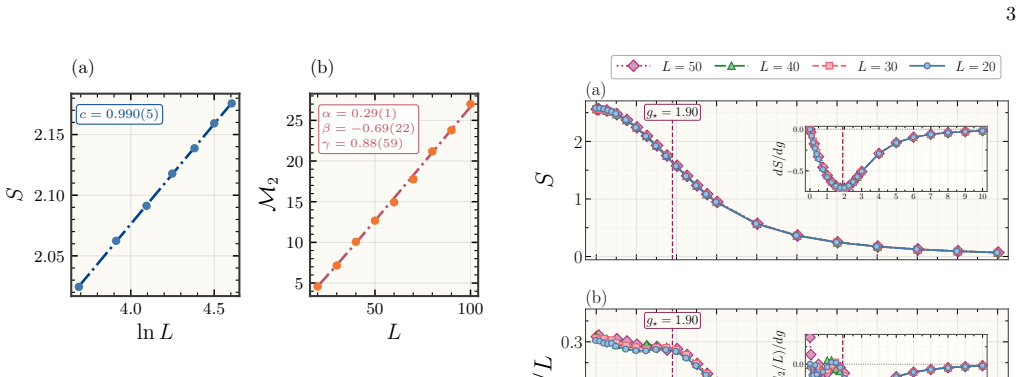
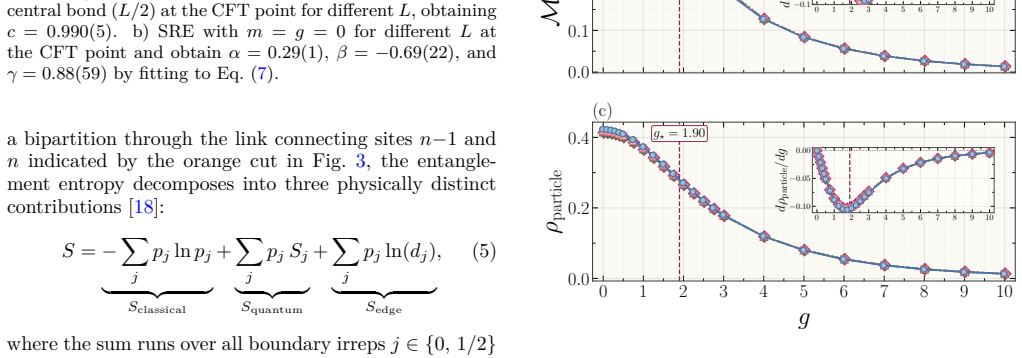
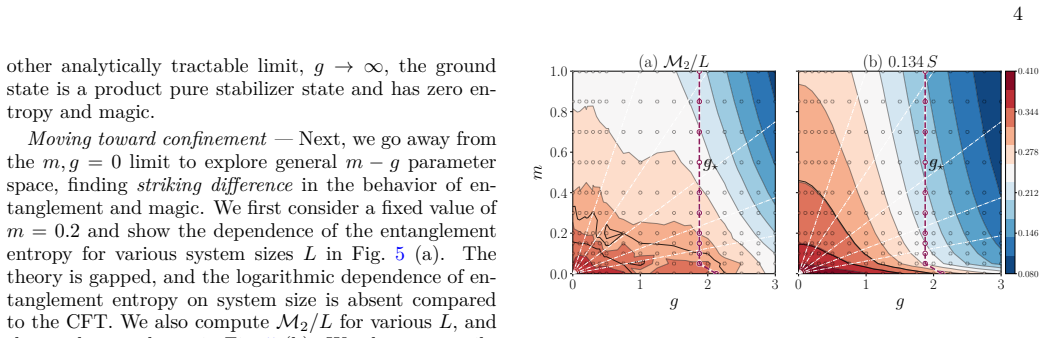
We calculate the gauge-invariant entanglement entropy and stabilizer Rényi entropy of the ground state of the (1+1)-dimensional SU(2) lattice gauge theory. We find a crossover denoted by g⋆ where the ground state passes from a more magic-rich regime into a regime with less magic; this is also tracked by the sharpest change of both the entanglement entropy and lattice particle density.
What carries the argument
Stabilizer Rényi entropy as a measure of magic in the gauge-invariant ground state obtained via tensor networks in the dressed-site basis.
Load-bearing premise
Tensor network approximations in the dressed-site basis accurately capture the ground state properties up to L=100 without significant errors altering the observed crossover.
What would settle it
Exact diagonalization results for small lattices showing the absence of a magic crossover or a substantially different g⋆ value.
Figures


read the original abstract
Entanglement and non-stabilizerness (magic) quantify two distinct departures of quantum systems from classical description: the former measures non-local correlations, while the latter measures the deviation from stabilizer states that can be efficiently simulated classically. Understanding magic in physically relevant quantum field theories is essential for identifying where quantum advantage may be realized in the early fault-tolerant quantum computing era. We calculate the gauge-invariant entanglement entropy and stabilizer R\'{e}nyi entropy of the ground state of the (1+1)-dimensional SU(2) lattice gauge theory formulated in a dressed-site basis that enforces Gauss's law exactly. Using tensor networks, we obtain results for system sizes up to $L=100$ (300 qubits). We find a crossover denoted by $g_{\star}$ where the ground state passes from a more magic-rich regime into a regime with less magic; this is also tracked by the sharpest change of both the entanglement entropy and lattice particle density. Our large-scale study of non-stabilizerness and entanglement entropy in a non-Abelian lattice gauge theory with matter provides new insight into the interplay of magic and entanglement in gauge theories, both of which are relevant for classical and early fault-tolerant quantum simulations.
Editorial analysis
A structured set of objections, weighed in public.
Referee Report
Summary. The manuscript computes gauge-invariant entanglement entropy and stabilizer Rényi entropy for the ground state of (1+1)D SU(2) lattice gauge theory in the dressed-site basis (exact Gauss law) via tensor networks, reaching system sizes L=100 (300 qubits). It reports a crossover g⋆ separating a magic-rich regime from a less-magic regime, with the location of g⋆ also marked by the sharpest changes in entanglement entropy and lattice particle density.
Significance. If the numerical identification of g⋆ is robust, the work supplies concrete data on the interplay of non-stabilizerness and entanglement in a non-Abelian gauge theory with matter, a setting directly relevant to both classical tensor-network simulations and early fault-tolerant quantum simulations of lattice gauge theories.
major comments (2)
- [Numerical methods and results (tensor-network implementation for L up to 100)] The central claim rests on the location and sharpness of the crossover g⋆ extracted from tensor-network ground states. No bond-dimension scaling, truncation-error estimates, or extrapolation near g⋆ is reported for the L=100 data; without these checks it is possible that the observed sharpest changes in stabilizer Rényi entropy, entanglement entropy, and particle density are still affected by finite bond dimension and would move or soften upon convergence.
- [Abstract and § on numerical results] The abstract and main text present numerical results for the crossover without error bars, convergence diagnostics against known limits (e.g., strong- or weak-coupling regimes), or validation that the dressed-site tensor-network ansatz reproduces established benchmarks for smaller L; this absence prevents assessment of whether the reported g⋆ is quantitatively reliable.
minor comments (2)
- [Methods] The precise definition and normalization of the stabilizer Rényi entropy used for the gauge-invariant states should be stated explicitly, including any truncation or approximation applied when evaluating it on the tensor-network wave function.
- [Figures] Figure captions should indicate the bond dimension(s) employed for each data set and whether any extrapolation was performed.
Simulated Author's Rebuttal
We thank the referee for the careful reading of our manuscript and the constructive comments on the numerical robustness of our tensor-network results. We address each major comment below and will incorporate revisions to strengthen the presentation of convergence and validation.
read point-by-point responses
-
Referee: [Numerical methods and results (tensor-network implementation for L up to 100)] The central claim rests on the location and sharpness of the crossover g⋆ extracted from tensor-network ground states. No bond-dimension scaling, truncation-error estimates, or extrapolation near g⋆ is reported for the L=100 data; without these checks it is possible that the observed sharpest changes in stabilizer Rényi entropy, entanglement entropy, and particle density are still affected by finite bond dimension and would move or soften upon convergence.
Authors: We agree that explicit bond-dimension scaling, truncation-error estimates, and extrapolation would strengthen confidence in the location of g⋆. Although our L=100 simulations were performed at bond dimensions where the observables appeared converged, these diagnostics were not reported. In the revised manuscript we will add bond-dimension scaling data and truncation-error estimates for the key observables near g⋆, together with a brief extrapolation analysis, to confirm that the reported crossover is robust against finite bond dimension. revision: yes
-
Referee: [Abstract and § on numerical results] The abstract and main text present numerical results for the crossover without error bars, convergence diagnostics against known limits (e.g., strong- or weak-coupling regimes), or validation that the dressed-site tensor-network ansatz reproduces established benchmarks for smaller L; this absence prevents assessment of whether the reported g⋆ is quantitatively reliable.
Authors: We acknowledge that the absence of error bars, explicit convergence checks against known limits, and small-L benchmarks limits quantitative assessment. In the revised version we will (i) add error bars based on truncation errors to all reported quantities, (ii) include comparisons of entanglement entropy and particle density with the analytically known strong- and weak-coupling regimes, and (iii) validate the dressed-site ansatz against exact results for small L (L≤6) where direct diagonalization is feasible. These additions will be reflected in both the abstract and the numerical-results section. revision: yes
Circularity Check
No circularity: numerical crossover identified from independent tensor-network computations
full rationale
The paper computes gauge-invariant ground states via tensor networks in the dressed-site basis (exact Gauss law enforcement), then evaluates stabilizer Rényi entropy, entanglement entropy, and particle density on those states to locate the crossover g⋆. No equations, fitted parameters, or self-citations are shown reducing the reported crossover to a definition or input by construction. The derivation chain is self-contained against external benchmarks (numerical ground-state data), yielding a normal non-finding.
Axiom & Free-Parameter Ledger
Forward citations
Cited by 1 Pith paper
-
SU(2) gauge theory with fermions on a semi-simple cubic lattice
Introduces the semi-simple cubic (ssc) lattice for 3D SU(2) gauge theory with staggered fermions, reducing qubit count and streamlining Gauss's law for quantum hardware.
Reference graph
Works this paper leans on
-
[1]
At a staggered matter site with one fermion flavor and two colors, the local matter Fock space is HM = span { |0⟩,(ψr n)†|0⟩,(ψg n)†|0⟩,(ψr n)†(ψg n)†|0⟩ } , (2) which decomposes underSU(2)color asHM≃1⊕2⊕1. The vacuum|0⟩ ≡ |j=0, m=0⟩and the doubly occu- pied state|d⟩= (ψr n)†(ψg n)†|0⟩are both color singlets (jM = 0), while the single-quark states|r⟩≡(ψr ...
-
[2]
Simulating physics with computers,
R. P. Feynman, “Simulating physics with computers,” Int. J. Theor. Phys.21(1982) 467–488
1982
-
[3]
Simulating quantum field theory with a quantum computer,
J. Preskill, “Simulating quantum field theory with a quantum computer,”PoSLATTICE2018(2018) 024, arXiv:1811.10085 [hep-lat]
Pith/arXiv arXiv 2018
-
[4]
The Heisenberg representation of quantum computers,
D. Gottesman, “The Heisenberg representation of quantum computers,” in22nd International Colloquium on Group Theoretical Methods in Physics, pp. 32–43. 7, 1998.arXiv:quant-ph/9807006
Pith/arXiv arXiv 1998
-
[5]
Improved simulation of stabilizer circuits,
S. Aaronson and D. Gottesman, “Improved simulation of stabilizer circuits,”Phys. Rev. A70no. 5, (2004) 052328,arXiv:quant-ph/0406196
Pith/arXiv arXiv 2004
-
[6]
Universal quantum computation with ideal Clifford gates and noisy ancillas,
S. Bravyi and A. Kitaev, “Universal quantum computation with ideal Clifford gates and noisy ancillas,”Phys. Rev. A71no. 2, (2005) 022316, arXiv:quant-ph/0403025
arXiv 2005
-
[7]
Quantifying nonstabilizerness of matrix product states,
T. Haug and L. Piroli, “Quantifying nonstabilizerness of matrix product states,”Phys. Rev. B107no. 3, (2023) 035148,arXiv:2207.13076 [quant-ph]
arXiv 2023
-
[9]
Phase transition in magic with random quantum circuits,
P. Niroula, C. D. White, Q. Wang, S. Johri, D. Zhu, C. Monroe, C. Noel, and M. J. Gullans, “Phase transition in magic with random quantum circuits,” Nature Phys.20no. 11, (2024) 1786–1792, arXiv:2304.10481 [quant-ph]
arXiv 2024
-
[10]
Nonstabilizerness via Matrix Product States in the Pauli Basis,
P. S. Tarabunga, E. Tirrito, M. C. Bañuls, and M. Dalmonte, “Nonstabilizerness via Matrix Product States in the Pauli Basis,”Phys. Rev. Lett.133no. 1, (2024) 010601,arXiv:2401.16498 [quant-ph]
arXiv 2024
-
[11]
Nonstabilizerness in U(1) lattice gauge theory,
P. R. N. Falcão, P. S. Tarabunga, M. Frau, E. Tirrito, J. Zakrzewski, and M. Dalmonte, “Nonstabilizerness in U(1) lattice gauge theory,”Phys. Rev. B111no. 8, (2025) L081102,arXiv:2409.01789 [quant-ph]
arXiv 2025
-
[12]
The Quantum Complexity of String Breaking in the Schwinger Model,
S. Grieninger, M. J. Savage, and N. A. Zemlevskiy, “The Quantum Complexity of String Breaking in the Schwinger Model,”arXiv:2601.08825 [hep-ph]
-
[13]
Magic of discrete Lattice Gauge theories,
G. Esposito, S. Cepollaro, L. Cappiello, and A. Hamma, “Magic of discrete Lattice Gauge theories,”Int. J. Geom. Meth. Mod. Phys.22no. 06, (2025) 2550003, arXiv:2601.15842 [hep-lat]
arXiv 2025
-
[14]
G. C. Santra, J. Mildenberger, E. Ballini, A. Bottarelli, M. M. Wauters, and P. Hauke, “Quantum Resources in Non-Abelian Lattice Gauge Theories: Nonstabilizerness, Multipartite Entanglement, and Fermionic Non-Gaussianity,”arXiv:2510.07385 [quant-ph]
-
[15]
Hamiltonian Formulation of Wilson’s Lattice Gauge Theories,
J. B. Kogut and L. Susskind, “Hamiltonian Formulation of Wilson’s Lattice Gauge Theories,”Phys. Rev. D11 (1975) 395–408
1975
-
[16]
Digital Quantum Simulation of a (1+1)D SU(2) Lattice Gauge Theory with Ion Qudits,
G. Calajò, G. Magnifico, C. Edmunds, M. Ringbauer, S. Montangero, and P. Silvi, “Digital Quantum Simulation of a (1+1)D SU(2) Lattice Gauge Theory with Ion Qudits,”PRX Quantum5no. 4, (2024) 040309,arXiv:2402.07987 [quant-ph]
arXiv 2024
-
[17]
Entanglement entropy and conformal field theory,
P. Calabrese and J. Cardy, “Entanglement entropy and conformal field theory,”J. Phys. A42(2009) 504005, arXiv:0905.4013 [cond-mat.stat-mech]
Pith/arXiv arXiv 2009
-
[18]
Estimating the central charge from the Rényi entanglement entropy,
A. Bazavov, Y. Meurice, S. W. Tsai, J. Unmuth-Yockey, L.-P. Yang, and J. Zhang, “Estimating the central charge from the Rényi entanglement entropy,”Phys. Rev. D96no. 3, (2017) 034514,arXiv:1703.10577 [hep-lat]
Pith/arXiv arXiv 2017
-
[19]
Decomposition of entanglement entropy in lattice gauge theory,
W. Donnelly, “Decomposition of entanglement entropy in lattice gauge theory,”Phys. Rev. D85(2012) 085004,arXiv:1109.0036 [hep-th]
Pith/arXiv arXiv 2012
-
[20]
L. Leone, S. F. E. Oliviero, Y. Zhou, and A. Hamma, “Quantum Chaos is Quantum,”Quantum5(2021) 453, arXiv:2102.08406 [quant-ph]
arXiv 2021
-
[21]
Conformal field theories are magical,
C. D. White, C. Cao, and B. Swingle, “Conformal field theories are magical,”Physical Review B103(2021) 075145,arXiv:2007.01303 [cond-mat.str-el]
arXiv 2021
-
[22]
Stabilizer Rényi Entropy Encodes Fusion Rules of Topological Defects and Boundaries,
M. Hoshino and Y. Ashida, “Stabilizer Rényi Entropy Encodes Fusion Rules of Topological Defects and Boundaries,”Phys. Rev. Lett.136no. 8, (2026) 080402, arXiv:2507.10656 [quant-ph]
arXiv 2026
-
[23]
Stabilizer-Shannon Renyi Equivalence: Exact Results for Quantum Critical Chains,
E. A. R. Trino and M. A. Rajabpour, “Stabilizer-Shannon Renyi Equivalence: Exact Results for Quantum Critical Chains,”arXiv:2509.10700 [quant-ph]
-
[24]
Gravitational Backreaction is 6 Magical,
C. Cao, G. Cheng, A. Hamma, L. Leone, W. Munizzi, and S. F. E. Oliviero, “Gravitational Backreaction is 6 Magical,”PRX Quantum6no. 4, (2025) 040375, arXiv:2403.07056 [hep-th]
arXiv 2025
-
[25]
Simulating (2+1)D SU(2) Yang-Mills lattice gauge theory at finite density with tensor networks,
G. Cataldi, G. Magnifico, P. Silvi, and S. Montangero, “Simulating (2+1)D SU(2) Yang-Mills lattice gauge theory at finite density with tensor networks,”Phys. Rev. Res.6no. 3, (2024) 033057,arXiv:2307.09396 [hep-lat]
arXiv 2024
-
[26]
Accurate Ground States of SU(2) Lattice Gauge Theory in 2+1D and 3+1D,
T. Spriggs, E. Greplova, J. Carrasquilla, and J. Nys, “Accurate Ground States of SU(2) Lattice Gauge Theory in 2+1D and 3+1D,”Phys. Rev. Lett.136 no. 10, (2026) 101902,arXiv:2509.12323 [hep-lat]
arXiv 2026
-
[27]
From Random Determinants to the Ground State,
H. Zhang and M. Otten, “From Random Determinants to the Ground State,”arXiv:2511.14734 [quant-ph]
-
[28]
A. R. Edmonds,Angular Momentum in Quantum Mechanics. Princeton University Press, Princeton, New Jersey, 2nd ed., 1957
1957
-
[29]
Edge states in gauge theories: Theory, interpretations and predictions,
A. P. Balachandran, L. Chandar, and E. Ercolessi, “Edge states in gauge theories: Theory, interpretations and predictions,”Int. J. Mod. Phys. A10(1995) 1969–1993,arXiv:hep-th/9411164
Pith/arXiv arXiv 1995
-
[30]
Entanglement entropy in gauge theories and the holographic principle for electric strings,
P. V. Buividovich and M. I. Polikarpov, “Entanglement entropy in gauge theories and the holographic principle for electric strings,”Phys. Lett. B670(2008) 141–145, arXiv:0806.3376 [hep-th]
Pith/arXiv arXiv 2008
-
[31]
Entanglement entropy in loop quantum gravity,
W. Donnelly, “Entanglement entropy in loop quantum gravity,”Phys. Rev. D77(2008) 104006, arXiv:0802.0880 [gr-qc]
Pith/arXiv arXiv 2008
-
[32]
Remarks on entanglement entropy for gauge fields,
H. Casini, M. Huerta, and J. A. Rosabal, “Remarks on entanglement entropy for gauge fields,”Phys. Rev. D89 no. 8, (2014) 085012,arXiv:1312.1183 [hep-th]
Pith/arXiv arXiv 2014
-
[33]
One of us (R.G.J.) would like to thank Will Donnelly for discussions on this during Fall 2019
2019
-
[34]
L. Leone, S. F. E. Oliviero, and A. Hamma, “Stabilizer Rényi Entropy,”Phys. Rev. Lett.128no. 5, (2022) 050402,arXiv:2106.12587 [quant-ph]
arXiv 2022
-
[35]
Many-body magic via pauli-markov chains—from criticality to gauge theories,
P. S. Tarabunga, E. Tirrito, T. Chanda, and M. Dalmonte, “Many-body magic via pauli-markov chains—from criticality to gauge theories,”PRX Quantum4(2023) 040317,arXiv:2305.18541 [quant-ph]
arXiv 2023
-
[36]
Nonstabilizerness via Perfect Pauli Sampling of Matrix Product States,
G. Lami and M. Collura, “Nonstabilizerness via Perfect Pauli Sampling of Matrix Product States,”Phys. Rev. Lett.131no. 18, (2023) 180401,arXiv:2303.05536 [quant-ph]
arXiv 2023
-
[37]
The itensor software library for tensor network calculations,
M. Fishman, S. White, and E. Stoudenmire, “The itensor software library for tensor network calculations,” SciPost Physics Codebases(Aug., 2022) . http://dx.doi.org/10.21468/SciPostPhysCodeb.4
-
[38]
Tensor network python (tenpy) version 1,
J. Hauschild, J. Unfried, S. Anand, B. Andrews, M. Bintz, U. Borla, S. Divic, M. Drescher, J. Geiger, M. Hefel, K. Hémery, W. Kadow, J. Kemp, N. Kirchner, V. S. Liu, G. Moller, D. Parker, M. Rader, A. Romen, S. Scalet, L. Schoonderwoerd, M. Schulz, T. Soejima, P. Thoma, Y. Wu, P. Zechmann, L. Zweng, R. Mong, M. Zaletel, and F. Pollmann, “Tensor network py...
-
[39]
http://dx.doi.org/10.21468/SciPostPhysCodeb.41
-
[40]
A journey through Flatland: What does the antiflatness of a spectrum teach us?,
B. Jasser, D. Iannotti, and A. Hamma, “A journey through Flatland: What does the antiflatness of a spectrum teach us?,”arXiv:2605.21664 [quant-ph]. 7 Appendix A:SU(2)representation theory and gauge singlet condition Let us represent group elements by matrices. Given a groupG, we can associate each elementg∈Gwith adj×dj matrixD(g), with the property thatD(...
-
[41]
In our notation, the electric term is simply written asg2 ∑ nCn [Eq
= 3g2 can 8 ∑ nCn. In our notation, the electric term is simply written asg2 ∑ nCn [Eq. (B32)]. We find that to construct the Hamiltonian, we need hopping matrices in addition to the diagonal matrices defined in Eqs. (B8). The hopping operators are [15]: ˆA(1) = 0 0 0 √ 2 0 0 0 0 1 0 0 0 0 1 0 0 0 1√ 2 0 0 0 √ 2 0 0 0 0 √ 2 0 0 0 0 1 0 0 0 ...
-
[42]
Entanglement entropy In lattice gauge theories, computing the entanglement entropy,SEE across a spatial bipartition (into regionsAand ¯A) is subtle. The standard recipe for the bipartite entanglement entropy of a regionAin a quantum spin chain is: SA =−Tr [ ρA lnρA ] , ρ A = Tr ¯A|ψ⟩⟨ψ|,(C1) 12 0 1 2 3 g 0.0 0.2 0.4 0.6 0.8 1.0 m (a) S g⋆ 0.61 1.10 1.59 2...
-
[43]
One such approach is the replica method [6]; however, it scales exponentially with system size, rendering the computation of magic for large systems intractable
Stabilizer Rényi entropy as a probe of magic Ingeneral, quantifyingmagicisnotastraightforwardtask, butinrecentyearsthestabilizerRényientropy(SRE)[33] hasemergedasoneofthemostwidelyusedmagicmeasures, withseveralapproachesavailableforitscomputation. One such approach is the replica method [6]; however, it scales exponentially with system size, rendering the...
-
[44]
At each site we construct all4nq = 64three-qubit Pauli strings and project each onto the physical subspace by taking its upper-leftd×dblock
and is embedded intonq =⌈log2d⌉= 3 qubits via the trivial isometryV|i⟩=|i⟩fori= 0,...,d−1. At each site we construct all4nq = 64three-qubit Pauli strings and project each onto the physical subspace by taking its upper-leftd×dblock. These 64 projected matrices are precomputed and stored as a contiguous array, then reused across all scan points. The total n...
2000
-
[45]
The single- occupancy contribution is obtained from the local probabilities of the dressed states|3⟩and|4⟩(see Eqs
Total particle density We study vacuum fluctuations through the total particle density:ρparticle =ρsingle +ρdouble, where the two con- tributions separately count single- and double-occupancy excitations in the dressed six-state local basis. The single- occupancy contribution is obtained from the local probabilities of the dressed states|3⟩and|4⟩(see Eqs....
-
[46]
This quantity has been useful for characterizing the complexity of quantum states and for putting bounds on the non-local magic
Anti-flatness An additional observable that we compute for theSU(2)gauge theory with matter is the deviation from flatness of the entanglement spectrum. This quantity has been useful for characterizing the complexity of quantum states and for putting bounds on the non-local magic. Unlike the full SRE that we computed in the main text, it is sensitive to t...
discussion (0)
Sign in with ORCID, Apple, or X to comment. Anyone can read and Pith papers without signing in.