Too Heavy to Hide: Gamma-Ray Constraints on Annihilating Dark Matter beyond Unitarity
Pith reviewed 2026-06-27 15:43 UTC · model grok-4.3
The pith
High-energy gamma-ray data set world-leading limits on dark matter annihilation for masses from 10^5 to 10^12 GeV.
A machine-rendered reading of the paper's core claim, the machinery that carries it, and where it could break.
Core claim
The central claim is that gamma-ray measurements and upper limits from Tibet ASγ, LHAASO, KASCADE-Grande, Pierre Auger Observatory, and Telescope Array enable probing new regions of parameter space and setting world-leading limits on the annihilation cross sections for dark matter with masses between 10^5 and 10^12 GeV, even when the thermal unitarity bound is relaxed for composite dark matter.
What carries the argument
Interpretation of high-energy diffuse gamma-ray upper limits from air shower detectors as constraints on dark matter annihilation cross sections for heavy masses.
If this is right
- The allowed annihilation rates for heavy dark matter are now more tightly bounded by astrophysical data.
- Composite dark matter models must satisfy these new cross section limits to remain viable.
- Indirect detection via gamma rays extends to mass scales previously inaccessible by collider or direct detection methods.
- Multiple independent detector datasets strengthen the robustness of the constraints.
- Future gamma-ray observations could either detect a signal or further exclude parameter space.
Where Pith is reading between the lines
- These limits could be combined with other indirect searches like neutrinos or cosmic rays for multi-messenger constraints.
- If dark matter is not annihilating, these results do not apply, pointing to other production mechanisms for heavy particles.
- The method could be applied to decaying dark matter scenarios with similar datasets.
- Improved background modeling in gamma-ray astronomy would directly tighten these DM limits.
Load-bearing premise
The gamma-ray upper limits can be directly translated into dark matter annihilation constraints without dominant interference from astrophysical sources or large modeling uncertainties.
What would settle it
An independent measurement showing that the gamma-ray fluxes at the relevant energies are explained entirely by known astrophysical processes without room for dark matter contributions, or a detection of an excess exceeding the derived cross section limits.
Figures

read the original abstract
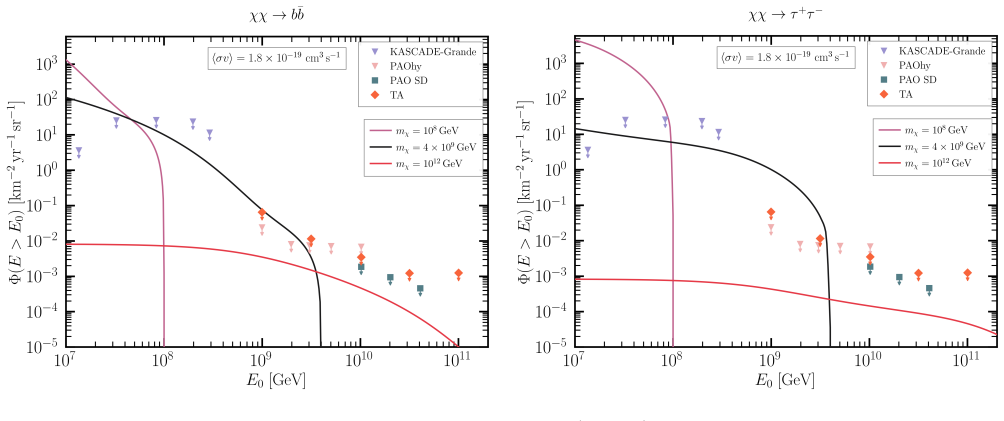
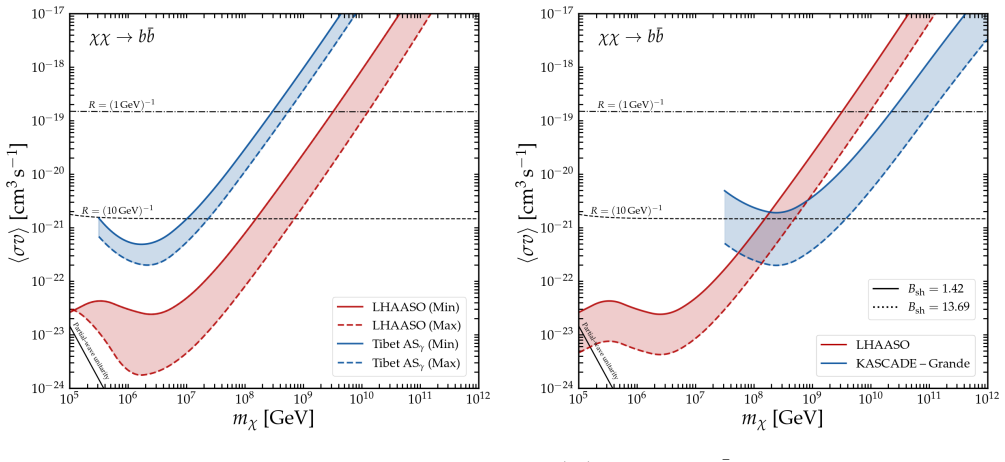
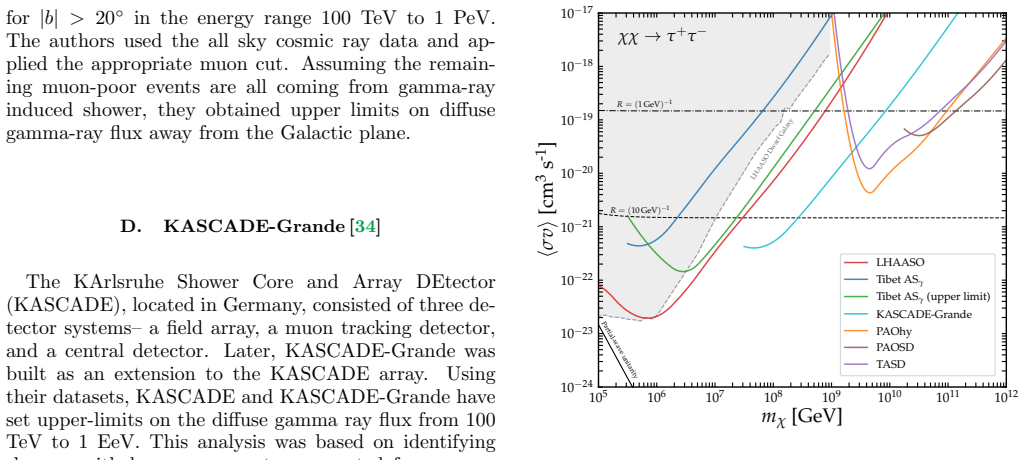
The measurement of high energy diffuse gamma rays by various ground-based air shower detectors have opened a new chapter for high energy particle physics and astrophysics. The broad range of viable dark matter candidates motivates extending indirect searches to heavier dark matter masses, opening new opportunities to uncover the nature of dark matter. If dark matter is composite rather than point-like, then the thermal unitarity bound can be relaxed, opening up the possibility of dark matter masses far beyond the electroweak scale. We perform a model agnostic search for heavy annihilating dark matter using the gamma-ray measurements and upper limits from Tibet AS$_\gamma$, LHAASO, KASCADE-Grande, Pierre Auger Observatory, and Telescope Array. These highest energy datasets enable us to probe new regions of parameter space and set world-leading limits on the annihilation cross sections for dark matter masses $10^5$--$10^{12}$ GeV. Our work highlights the power of high energy gamma-ray datasets in discovering heavy dark matter signatures in the near future.
Editorial analysis
A structured set of objections, weighed in public.
Referee Report
Summary. The manuscript performs a model-agnostic analysis that converts published diffuse gamma-ray upper limits from Tibet ASγ, LHAASO, KASCADE-Grande, Pierre Auger Observatory, and Telescope Array into constraints on the velocity-averaged annihilation cross section ⟨σv⟩ for dark matter masses between 10^5 and 10^12 GeV. It claims these datasets yield world-leading limits in this mass range, relaxing the thermal unitarity bound for composite dark matter candidates.
Significance. If the limits hold after proper background treatment, the result would usefully extend indirect detection reach to ultra-heavy dark matter using existing high-energy observatories and would motivate dedicated analyses with future data from these instruments.
major comments (2)
- [Abstract] Abstract: the central claim that the listed detectors 'set world-leading limits on the annihilation cross sections' rests on treating published gamma-ray flux upper limits as direct DM-only constraints. At EeV energies the diffuse flux includes cosmic-ray-induced cascades, unresolved sources, and hadronic-interaction uncertainties; the manuscript provides no indication that these contributions have been subtracted or propagated as systematics when deriving ⟨σv⟩ bounds.
- [Abstract and introduction] The model-agnostic framing precludes appealing to a specific annihilation channel to suppress astrophysical backgrounds. Without an explicit demonstration (e.g., via sky-region selection or energy-bin analysis) that astrophysical contributions are sub-dominant in the bins used for the limits, the derived bounds on ⟨σv⟩ for m_DM = 10^5–10^12 GeV cannot be regarded as robust.
Simulated Author's Rebuttal
We thank the referee for their detailed review and constructive comments on our manuscript. We address the major concerns point by point below, clarifying our use of published upper limits and the conservative nature of the resulting bounds. We will incorporate revisions to improve clarity on these points.
read point-by-point responses
-
Referee: [Abstract] Abstract: the central claim that the listed detectors 'set world-leading limits on the annihilation cross sections' rests on treating published gamma-ray flux upper limits as direct DM-only constraints. At EeV energies the diffuse flux includes cosmic-ray-induced cascades, unresolved sources, and hadronic-interaction uncertainties; the manuscript provides no indication that these contributions have been subtracted or propagated as systematics when deriving ⟨σv⟩ bounds.
Authors: Our analysis converts the published upper limits on the total diffuse gamma-ray flux directly into conservative upper bounds on the dark matter annihilation cross section. Because any astrophysical contribution would reduce the allowable dark matter flux, this procedure yields valid (though weaker) constraints without requiring background subtraction. We do not propagate additional systematics from hadronic interactions or unresolved sources, as that would necessitate a dedicated reanalysis beyond the scope of this model-agnostic study. We will revise the abstract to explicitly describe the limits as conservative bounds based on total-flux upper limits and add a brief discussion of the implications. revision: yes
-
Referee: [Abstract and introduction] The model-agnostic framing precludes appealing to a specific annihilation channel to suppress astrophysical backgrounds. Without an explicit demonstration (e.g., via sky-region selection or energy-bin analysis) that astrophysical contributions are sub-dominant in the bins used for the limits, the derived bounds on ⟨σv⟩ for m_DM = 10^5–10^12 GeV cannot be regarded as robust.
Authors: We acknowledge that a model-agnostic approach cannot exploit channel-specific features for background rejection. The published limits already incorporate the experiments' best efforts to constrain the total flux; our conversion therefore provides indicative, conservative constraints on ultra-heavy dark matter that can guide future dedicated analyses. We do not perform new sky-region or energy-bin selections ourselves. We will add text in the introduction and a dedicated caveats section to emphasize the conservative character of the bounds and the value of follow-up work with these instruments. revision: partial
Circularity Check
No circularity: limits derived directly from external observatory datasets without self-referential fitting or definitional loops.
full rationale
The paper's central result consists of upper limits on dark matter annihilation cross sections obtained by interpreting published gamma-ray flux measurements and upper limits from independent experiments (Tibet ASγ, LHAASO, KASCADE-Grande, Pierre Auger, Telescope Array). No equations or steps in the provided text reduce a derived quantity to a parameter fitted from the same data, nor does any load-bearing premise rest on a self-citation whose content is itself unverified. The derivation chain is therefore self-contained against external benchmarks and receives the default non-circularity finding.
Axiom & Free-Parameter Ledger
axioms (2)
- domain assumption Gamma rays observed by the listed detectors can be used to set model-agnostic upper limits on dark matter annihilation into standard-model final states.
- domain assumption The thermal unitarity bound on dark matter mass can be relaxed when dark matter is composite rather than elementary.
Reference graph
Works this paper leans on
-
[1]
G. Bertone and D. Hooper,History of dark matter, Rev. Mod. Phys.90(2018) 045002, [1605.04909]
Pith/arXiv arXiv 2018
- [2]
-
[3]
L. E. Strigari,Galactic Searches for Dark Matter, Phys. Rept.531(2013) 1–88, [1211.7090]
Pith/arXiv arXiv 2013
-
[4]
M. Lisanti,Lectures on Dark Matter Physics, in Theoretical Advanced Study Institute in Elementary Particle Physics: New Frontiers in Fields and Strings, pp. 399–446, 2017.1603.03797. DOI
arXiv 2017
-
[5]
Lin,Dark matter models and direct detection,PoS 333(2019) 009, [1904.07915]
T. Lin,Dark matter models and direct detection,PoS 333(2019) 009, [1904.07915]
Pith/arXiv arXiv 2019
-
[6]
V. C. Rubin and W. K. Ford, Jr.,Rotation of the Andromeda Nebula from a Spectroscopic Survey of Emission Regions,Astrophys. J.159(1970) 379–403
1970
-
[7]
D. Clowe, M. Bradac, A. H. Gonzalez, M. Markevitch, S. W. Randall, C. Jones et al.,A direct empirical proof of the existence of dark matter,Astrophys. J. Lett.648 (2006) L109–L113, [astro-ph/0608407]. [8]Planckcollaboration, N. Aghanim et al.,Planck 2018 results. VI. Cosmological parameters,Astron. Astrophys.641(2020) A6, [1807.06209]
Pith/arXiv arXiv 2006
-
[8]
Carney et al.,Snowmass2021 cosmic frontier white paper: Ultraheavy particle dark matter,SciPost Phys
D. Carney et al.,Snowmass2021 cosmic frontier white paper: Ultraheavy particle dark matter,SciPost Phys. Core6(2023) 075, [2203.06508]. [10]LHAASOcollaboration, Z. Cao et al.,Constraints on Ultraheavy Dark Matter Properties from Dwarf Spheroidal Galaxies with LHAASO Observations, Phys. Rev. Lett.133(2024) 061001, [2406.08698]
arXiv 2023
-
[9]
I. V. Moskalenko, A. W. Strong and O. Reimer, Diffuse gamma-rays: Galactic and extragalactic diffuse emission,Astrophys. Space Sci. Libr.304(2004) 279, [astro-ph/0402243]
Pith/arXiv arXiv 2004
-
[10]
S. R. Kelner, F. A. Aharonian and V. V. Bugayov, Energy spectra of gamma-rays, electrons and neutrinos produced at proton-proton interactions in the very high energy regime,Phys. Rev. D74(2006) 034018, [astro-ph/0606058]
Pith/arXiv arXiv 2006
-
[11]
A. Kappes, J. Hinton, C. Stegmann and F. A. Aharonian,Potential Neutrino Signals from Galactic Gamma-Ray Sources,Astrophys. J.656(2007) 870–896, [astro-ph/0607286]
Pith/arXiv arXiv 2007
-
[12]
A. A. Abdo et al.,TeV Gamma-Ray Sources from a Survey of the Galactic Plane with Milagro,Astrophys. J. Lett.664(2007) L91–L94, [0705.0707]
Pith/arXiv arXiv 2007
-
[13]
C. D. Dermer and G. Menon,High Energy Radiation from Black Holes: Gamma Rays, Cosmic Rays, and Neutrinos. 2009
2009
-
[14]
N. Gupta,PeV gamma rays from interactions of ultra high energy cosmic rays in the Milky Way, Astroparticle Physics35(Mar., 2012) 503–507, [1110.5257]
Pith/arXiv arXiv 2012
-
[15]
P. Lipari and S. Vernetto,Diffuse Galactic gamma ray flux at very high energy,Phys. Rev. D98(2018) 043003, [1804.10116]
Pith/arXiv arXiv 2018
-
[16]
I. V. Moskalenko, T. A. Porter and A. W. Strong, Attenuation of vhe gamma rays by the milky way interstellar radiation field,Astrophys. J. Lett.640 (2006) L155–L158, [astro-ph/0511149]
Pith/arXiv arXiv 2006
-
[17]
T. C. Weekes, M. F. Cawley, D. J. Fegan, K. G. Gibbs, A. M. Hillas, P. W. Kowk et al.,Observation of TeV Gamma Rays from the Crab Nebula Using the Atmospheric Cerenkov Imaging Technique, ApJ342 (July, 1989) 379
1989
-
[18]
A. Capanema, A. Esmaili and P. D. Serpico,Where do IceCube neutrinos come from? Hints from the diffuse gamma-ray flux,JCAP02(2021) 037, [2007.07911]
arXiv 2021
-
[19]
T. M. Venters,Contribution to the Extragalactic Gamma-Ray Background from the Cascades of very High Energy Gamma Rays from Blazars, ApJ710 (Feb., 2010) 1530–1540, [1001.1363]
Pith/arXiv arXiv 2010
-
[20]
S. Vernetto and P. Lipari,Absorption of very high energy gamma rays in the Milky Way,Phys. Rev. D 94(2016) 063009, [1608.01587]
Pith/arXiv arXiv 2016
-
[21]
A. De Angelis, G. Galanti and M. Roncadelli, Transparency of the Universe to gamma rays,Mon. Not. Roy. Astron. Soc.432(2013) 3245–3249, [1302.6460]
Pith/arXiv arXiv 2013
-
[22]
R. Ruffini, G. V. Vereshchagin and S. S. Xue,Cosmic absorption of ultra high energy particles,Astrophys. Space Sci.361(2016) 82, [1503.07749]
Pith/arXiv arXiv 2016
-
[23]
T. Sudoh and J. F. Beacom,Where are Milky Way’s hadronic PeVatrons?,Phys. Rev. D107(2023) 043002, [2209.03970]
arXiv 2023
-
[24]
F. W. Stecker,Cosmic gamma rays, vol. 249. 1971
1971
-
[25]
D. Bose, V. R. Chitnis, P. Majumdar and A. Shukla, Galactic and extragalactic sources of very high energy gamma rays,Eur. Phys. J. ST231(2022) 27–66, [2201.06789]
arXiv 2022
-
[26]
M. Cardillo and A. Giuliani,The LHAASO PeVatron Bright Sky: What We Learned,Appl. Sciences13 (2023) 6433, [2305.10526]
arXiv 2023
-
[27]
P. Lipari and S. Vernetto,Resolved and unresolved Galactic gamma-ray sources,Phys. Rev. D111(2025) 063035, [2412.08861]
arXiv 2025
-
[28]
D. Ehlert, A. van Vliet, F. Oikonomou and W. Winter, Constraints on the proton fraction of cosmic rays at the highest energies and the consequences for cosmogenic neutrinos and photons,JCAP02(2024) 022, [2304.07321]. [31]Tibet ASgammacollaboration, M. Amenomori et al., First Detection of sub-PeV Diffuse Gamma Rays from 9 the Galactic Disk: Evidence for Ub...
arXiv 2024
-
[29]
W. D. Apel, J. C. Arteaga-Vel´ azquez, K. Bekk, M. Bertaina, J. Bl¨ umer, H. Bozdog et al., KASCADE-Grande Limits on the Isotropic Diffuse Gamma-Ray Flux between 100 TeV and 1 EeV, ApJ 848(Oct., 2017) 1, [1710.02889]. [35]Telescope Arraycollaboration, R. U. Abbasi et al., Constraints on the diffuse photon flux with energies above10 18 eV using the surface...
Pith/arXiv arXiv 2017
-
[30]
K. Ishiwata, S. Matsumoto and T. Moroi,High Energy Cosmic Rays from the Decay of Gravitino Dark Matter,Phys. Rev. D78(2008) 063505, [0805.1133]
Pith/arXiv arXiv 2008
-
[31]
K. Murase and J. F. Beacom,Constraining Very Heavy Dark Matter Using Diffuse Backgrounds of Neutrinos and Cascaded Gamma Rays,JCAP10 (2012) 043, [1206.2595]
Pith/arXiv arXiv 2012
-
[32]
K. Murase, R. Laha, S. Ando and M. Ahlers,Testing the Dark Matter Scenario for PeV Neutrinos Observed in IceCube,Phys. Rev. Lett.115(2015) 071301, [1503.04663]
Pith/arXiv arXiv 2015
-
[33]
A. Esmaili and P. D. Serpico,Gamma-ray bounds from EAS detectors and heavy decaying dark matter constraints,JCAP10(2015) 014, [1505.06486]
Pith/arXiv arXiv 2015
-
[34]
A. Esmaili, S. K. Kang and P. D. Serpico,IceCube events and decaying dark matter: hints and constraints,JCAP12(2014) 054, [1410.5979]
Pith/arXiv arXiv 2014
-
[35]
O. K. Kalashev and M. Y. Kuznetsov,Constraining heavy decaying dark matter with the high energy gamma-ray limits,Phys. Rev. D94(2016) 063535, [1606.07354]
Pith/arXiv arXiv 2016
-
[36]
O. E. Kalashev and M. Y. Kuznetsov,Heavy decaying dark matter and large-scale anisotropy of high-energy cosmic rays,JETP Lett.106(2017) 73–80, [1704.05300]
Pith/arXiv arXiv 2017
-
[37]
M. Kachelriess, O. E. Kalashev and M. Y. Kuznetsov, Heavy decaying dark matter and IceCube high energy neutrinos,Phys. Rev. D98(2018) 083016, [1805.04500]
Pith/arXiv arXiv 2018
-
[38]
C. Blanco and D. Hooper,Constraints on Decaying Dark Matter from the Isotropic Gamma-Ray Background,JCAP03(2019) 019, [1811.05988]
Pith/arXiv arXiv 2019
-
[39]
K. Ishiwata, O. Macias, S. Ando and M. Arimoto, Probing heavy dark matter decays with multi-messenger astrophysical data,JCAP01(2020) 003, [1907.11671]
arXiv 2020
-
[40]
E. Alcantara, L. A. Anchordoqui and J. F. Soriano, Hunting for superheavy dark matter with the highest-energy cosmic rays,Phys. Rev. D99(2019) 103016, [1903.05429]
Pith/arXiv arXiv 2019
-
[41]
T. Cohen, K. Murase, N. L. Rodd, B. R. Safdi and Y. Soreq,γ-ray Constraints on Decaying Dark Matter and Implications for IceCube,Phys. Rev. Lett.119 (2017) 021102, [1612.05638]
Pith/arXiv arXiv 2017
-
[42]
A. Bhattacharya, A. Esmaili, S. Palomares-Ruiz and I. Sarcevic,Update on decaying and annihilating heavy dark matter with the 6-year IceCube HESE data, JCAP05(2019) 051, [1903.12623]
arXiv 2019
-
[43]
O. E. Kalashev, M. Y. Kuznetsov and Y. V. Zhezher, Dark matter component decaying after recombination: constraints from diffuse gamma-ray and neutrino flux measurements,JCAP10(2019) 039, [1905.05170]
arXiv 2019
-
[44]
M. Y. Kuznetsov,Hadronically decaying heavy dark matter and high-energy neutrino limits,JETP Lett. 105(2017) 561–567, [1611.08684]
Pith/arXiv arXiv 2017
-
[45]
Y. Sui and P. S. Bhupal Dev,A Combined Astrophysical and Dark Matter Interpretation of the IceCube HESE and Throughgoing Muon Events,JCAP 07(2018) 020, [1804.04919]
Pith/arXiv arXiv 2018
-
[46]
M. Chianese, D. F. G. Fiorillo, G. Miele, S. Morisi and O. Pisanti,Decaying dark matter at IceCube and its signature on High Energy gamma experiments,JCAP 11(2019) 046, [1907.11222]
arXiv 2019
-
[47]
T. N. Maity, A. K. Saha, A. Dubey and R. Laha, Search for dark matter using sub-PeVγ-rays observed by Tibet ASγ,2105.05680
-
[48]
L. A. Anchordoqui et al.,Hunting super-heavy dark matter with ultra-high energy photons,Astropart. Phys. 132(2021) 102614, [2105.12895]
arXiv 2021
-
[49]
A. Esmaili and P. D. Serpico,First implications of Tibet ASγdata for heavy dark matter,Phys. Rev. D 104(2021) L021301, [2105.01826]
arXiv 2021
-
[50]
M. Chianese, D. F. G. Fiorillo, R. Hajjar, G. Miele and N. Saviano,Constraints on heavy decaying dark matter with current gamma-ray measurements,JCAP 11(2021) 035, [2108.01678]. [59]IceCubecollaboration, R. Abbasi et al.,Searches for connections between dark matter and high-energy neutrinos with IceCube,JCAP10(2023) 003, [2205.12950]. [60]LHAASOcollaborat...
arXiv 2021
-
[51]
C. A. Arg¨ uelles, D. Delgado, A. Friedlander, A. Kheirandish, I. Safa, A. C. Vincent et al.,Dark matter decay to neutrinos,Phys. Rev. D108(2023) 123021, [2210.01303]
arXiv 2023
-
[52]
T. Aramaki et al.,Snowmass2021 Cosmic Frontier: The landscape of cosmic-ray and high-energy photon probes of particle dark matter,2203.06894
-
[53]
B. Skrzypek, M. Chianese, C. A. Arg¨ uelles and C. Delgado Arg¨ uelles,Multi-messenger high-energy signatures of decaying dark matter and the effect of background light,JCAP01(2023) 037, [2205.03416]
arXiv 2023
- [54]
-
[55]
R. Allahverdi, C. Arina, M. Chianese, M. Cicoli, F. Maltoni, D. Massaro et al.,Phenomenology of 10 superheavy decaying dark matter from string theory, JHEP02(2024) 192, [2312.00136]. [66]IceCubecollaboration, R. Abbasi et al.,Search for Dark Matter Decay in Nearby Galaxy Clusters and Galaxies with IceCube,PoSICRC2023(2023) 1378, [2308.04833]. [67]Pierre A...
arXiv 2024
- [56]
-
[57]
S. Das, J. A. Carpio and K. Murase,Probing superheavy dark matter through lunar radio observations of ultrahigh-energy neutrinos and the impacts of neutrino cascades,Phys. Rev. D111(2025) 083007, [2405.06382]
arXiv 2025
- [58]
-
[59]
K. C. Y. Ng et al.,Sensitivities of KM3NeT on decaying dark matter,2007.03692
arXiv 2007
-
[60]
M. Deliyergiyev, A. Del Popolo and M. Le Delliou, Bounds from multimessenger astronomy on the superheavy dark matter,Phys. Rev. D106(2022) 063002, [2209.14061]
arXiv 2022
-
[61]
D. M. H. Leung and K. C. Y. Ng,Improving HAWC dark matter constraints with inverse-Compton emission,Phys. Rev. D110(2024) 103021, [2312.08989]
arXiv 2024
-
[62]
S. Das, K. Murase and T. Fujii,Revisiting ultrahigh-energy constraints on decaying superheavy dark matter,Phys. Rev. D107(2023) 103013, [2302.02993]
arXiv 2023
-
[63]
P. Munbodh and S. Profumo,Astrophysical constraints from synchrotron emission on very massive decaying dark matter,Phys. Rev. D110(2024) 043014, [2405.00798]
arXiv 2024
-
[64]
D. Song, N. Hiroshima and K. Murase,Search for heavy dark matter from dwarf spheroidal galaxies: leveraging cascades and subhalo models,JCAP05 (2024) 087, [2401.15606]
arXiv 2024
- [65]
- [66]
-
[67]
K. V. Berghaus, D. Hooper and E. R. Simon, Searching for superheavy decaying particles with ultra-high-energy neutrino observatories,JCAP07 (2025) 067, [2502.12238]. [81]LAT, HA WCcollaboration, A. Acharyya et al., Combined dark matter search towards dwarf spheroidal galaxies with Fermi-LAT, HAWC, H.E.S.S., MAGIC, and VERITAS,2508.20229
arXiv 2025
-
[68]
B. Feldstein, A. Kusenko, S. Matsumoto and T. T. Yanagida,Neutrinos at IceCube from Heavy Decaying Dark Matter,Phys. Rev. D88(2013) 015004, [1303.7320]
Pith/arXiv arXiv 2013
-
[69]
C. A. Arg¨ uelles, A. Diaz, A. Kheirandish, A. Olivares-Del-Campo, I. Safa and A. C. Vincent, Dark matter annihilation to neutrinos,Rev. Mod. Phys.93(2021) 035007, [1912.09486]
arXiv 2021
-
[70]
M. Chianese, D. F. G. Fiorillo, R. Hajjar, G. Miele, S. Morisi and N. Saviano,Heavy decaying dark matter at future neutrino radio telescopes,JCAP05(2021) 074, [2103.03254]
arXiv 2021
- [71]
-
[72]
R. Aloisio, A. Ambrosone and C. Evoli,Constraining superheavy dark matter with the KM3-230213A neutrino event,Phys. Rev. D113(2026) 043024, [2508.08779]
arXiv 2026
-
[73]
D. Mukherjee, A. Halder, D. Majumdar and A. Bandyopadhyay,IceCube PeV neutrinos from heavy dark matter decay with 12 years HESE data, 2505.22204
- [74]
-
[75]
M. Chianese, N. Saviano, S. Cesare, V. M. Grieco, V. Nasti, F. Spinnato et al.,Probing super-heavy dark matter with ultra-high-energy gamma rays, 2601.11703
-
[76]
M. Rocamora, P. De La Torre Luque and M. A. S´ anchez-Conde,Constraints on Ultra-heavy DM from TeV-PeV gamma-ray diffuse measurements, 2509.09609
-
[77]
Griest and M
K. Griest and M. Kamionkowski,Unitarity Limits on the Mass and Radius of Dark Matter Particles,Phys. Rev. Lett.64(1990) 615
1990
-
[78]
J. Smirnov and J. F. Beacom,TeV-Scale Thermal WIMPs: Unitarity and its Consequences,Phys. Rev. D 100(2019) 043029, [1904.11503]
arXiv 2019
-
[79]
N. Dalal and A. Kravtsov,Excluding fuzzy dark matter with sizes and stellar kinematics of ultrafaint dwarf galaxies,Phys. Rev. D106(2022) 063517, [2203.05750]
arXiv 2022
-
[80]
A. K. Saha, S. Bouri, A. Das, A. Dubey and R. Laha, Shedding Infrared Light on QCD Axion and ALP Dark Matter with JWST,2503.14582
discussion (0)
Sign in with ORCID, Apple, or X to comment. Anyone can read and Pith papers without signing in.