Anomaly-driven evaporation endpoints of a two-dimensional regular black hole
Pith reviewed 2026-06-27 15:18 UTC · model grok-4.3
The pith
Dilaton-coupled anomaly in two-dimensional regular black hole evaporation forces endpoints to fixed radius √2 ℓ or one constrained null branch.
A machine-rendered reading of the paper's core claim, the machinery that carries it, and where it could break.
Core claim
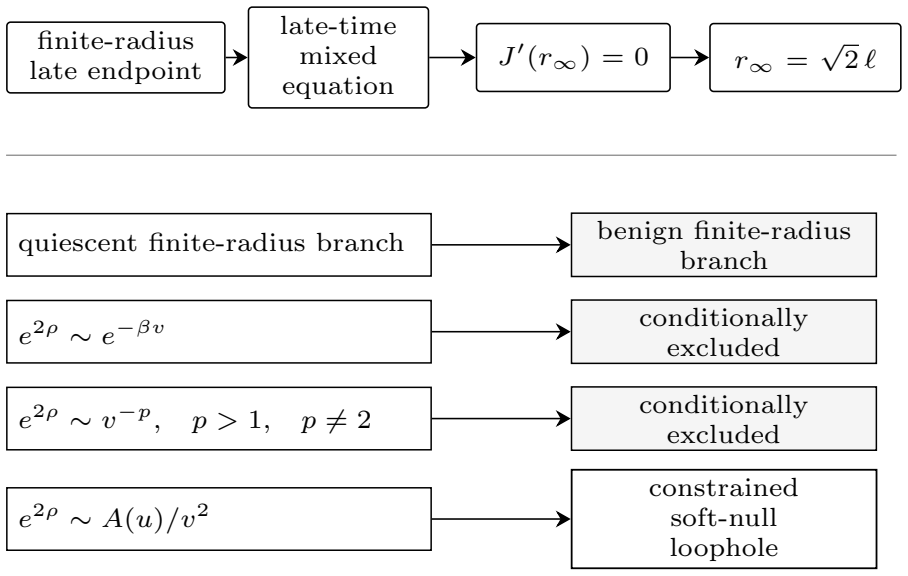
Replacing the Polyakov quantum sector by the dilaton-coupled anomaly model of Fabbri, Farese, and Navarro-Salas yields semiclassical equations whose late-time mixed equation enforces J prime of r infinity equals zero and hence r infinity equals √2 ℓ for any quiescent finite-radius branch with finite nonzero conformal factor. Finite-radius null branches satisfying the state-tail assumptions exclude the ordinary strong-cosmic-censorship-restoring exponential null boundary, and generic power-law branches e to the 2 rho proportional to v to the minus p with p greater than 1 are likewise excluded except for the borderline p equals 2 case, which in the FFN model requires the stronger state-tail de
What carries the argument
The FFN dilaton-coupled anomaly model from spherical reduction of four-dimensional minimally coupled matter, which replaces the Polyakov sector and supplies the semiclassical field equations whose late-time mixed equation classifies the allowed asymptotic branches.
If this is right
- Quiescent finite-radius branches are fixed at r infinity equals √2 ℓ independently of the local dilaton-anomaly convention.
- Ordinary strong-cosmic-censorship-restoring exponential null boundaries are excluded for finite-radius null branches.
- Generic power-law branches with p greater than 1 are excluded under the state-tail assumptions.
- The sole surviving null loophole is the p equals 2 case, which requires s phi of order v to the minus 2 and carries finite affine flux in the FFN model.
Where Pith is reading between the lines
- The fixed finite-radius endpoint suggests that remnants can form and persist in these reduced models rather than evaporating completely.
- The requirement of stronger state-tail decay for the null loophole may be checked by examining the late-time falloff of the dilaton flux in numerical integrations of the FFN equations.
- Because the anomaly originates from four-dimensional spherical reduction, the same branch restrictions could appear in higher-dimensional regular black hole models that retain the dilaton coupling after reduction.
Load-bearing premise
The classification of allowed branches rests on the state-tail assumptions for the quantum fields together with modeling the quantum sector via the FFN dilaton-coupled anomaly from spherical reduction.
What would settle it
A late-time solution of the FFN semiclassical equations that reaches a quiescent finite-radius endpoint with r infinity not equal to √2 ℓ while keeping the conformal factor finite and nonzero, or that realizes an exponential null boundary or a power-law branch with p not equal to 2.
Figures
read the original abstract
Spherical reduction of four-dimensional minimally coupled matter yields a two-dimensional theory with dilaton-coupled matter rather than minimally coupled conformal matter. We use this distinction to revisit the backreacted late-time endpoint problem for the regular two-dimensional Bardeen-like black hole considered by Barenboim, Frolov, and Kunstatter. Replacing the Polyakov quantum sector by the dilaton-coupled anomaly model of Fabbri, Farese, and Navarro-Salas (FFN), we derive the corresponding semiclassical field equations and classify the asymptotically allowed late branches at finite radius. For any quiescent finite-radius branch with finite nonzero conformal factor, the late-time mixed equation enforces $J'(r_\infty)=0$, and hence $r_\infty=\sqrt{2}\,\ell$, independently of the local dilaton-anomaly convention. For finite-radius null branches satisfying the stated state-tail assumptions, the ordinary strong-cosmic-censorship-restoring exponential null boundary is excluded. Generic power-law branches $e^{2\rho}\sim v^{-p}$ with $p>1$ are likewise excluded, except for the borderline case $p=2$, which is the only remaining null loophole of this type. In the FFN model, the settled realization of this loophole carries finite affine flux and requires the stronger state-tail decay $s_\phi=O(v^{-2})$. The natural finite-radius outcome is remnant-like, while the surviving null branch is a highly constrained soft-null alternative.
Editorial analysis
A structured set of objections, weighed in public.
Referee Report
Summary. The manuscript derives the semiclassical equations for a two-dimensional regular Bardeen-like black hole using the Fabbri-Farese-Navarro-Salas (FFN) dilaton-coupled anomaly model obtained from spherical reduction of four-dimensional minimally coupled matter. It classifies the asymptotically allowed late-time branches at finite radius, showing that any quiescent finite-radius branch with finite nonzero conformal factor satisfies J'(r_∞)=0 and thus r_∞=√2 ℓ independently of the local dilaton-anomaly convention; ordinary exponential null boundaries and generic power-law branches e^{2ρ}∼v^{-p} (p>1) are excluded under the stated state-tail assumptions, leaving only the borderline p=2 null branch (which in the FFN model requires s_φ=O(v^{-2}) and carries finite affine flux). The natural outcome is described as remnant-like or a highly constrained soft-null alternative.
Significance. If the central classification holds, the work supplies a concrete, model-specific prediction for evaporation endpoints that distinguishes the FFN anomaly from the Polyakov case and isolates the role of quantum state tails. The reported independence of r_∞=√2 ℓ from the anomaly convention, together with the explicit exclusion of standard strong-cosmic-censorship-restoring null boundaries, constitutes a falsifiable claim within the semiclassical 2D framework. The analysis also underscores that the correct anomaly model arising from dimensional reduction is essential for endpoint statements.
major comments (2)
- [Abstract / late-time branch classification] Abstract and late-time analysis section: the exclusions of the ordinary exponential null boundary and of generic p>1 power-law branches rest entirely on the imposed state-tail assumptions (in particular s_φ=O(v^{-2}) for the surviving null case). These tails are not shown to be attractors of the coupled FFN system; without an independent consistency check or derivation from the semiclassical equations, the force of the mixed-equation analysis is limited. This assumption is load-bearing for the central classification.
- [Abstract] Abstract: the claim that the late-time mixed equation enforces J'(r_∞)=0 and hence r_∞=√2 ℓ 'independently of the local dilaton-anomaly convention' requires the explicit form of that equation (and of any normalizations entering J) to be displayed and verified; without it, it remains unclear whether the independence survives all choices of local counterterms or self-consistent normalizations.
minor comments (1)
- [Notation and definitions] The notation for the conformal factor ρ, the flux functions, and the state-tail parameters s_φ could be introduced with a single consolidated table or equation block to improve readability of the branch classification.
Simulated Author's Rebuttal
We thank the referee for the careful reading and for highlighting the model-specific aspects of the FFN analysis. We respond point-by-point to the major comments below.
read point-by-point responses
-
Referee: [Abstract / late-time branch classification] Abstract and late-time analysis section: the exclusions of the ordinary exponential null boundary and of generic p>1 power-law branches rest entirely on the imposed state-tail assumptions (in particular s_φ=O(v^{-2}) for the surviving null case). These tails are not shown to be attractors of the coupled FFN system; without an independent consistency check or derivation from the semiclassical equations, the force of the mixed-equation analysis is limited. This assumption is load-bearing for the central classification.
Authors: We agree that the state-tail assumptions are load-bearing for the exclusions. The manuscript classifies branches under these explicitly stated assumptions rather than claiming they are dynamical attractors. A full consistency check deriving the tails from the coupled equations would require a separate dynamical study, which is beyond the present scope of asymptotic classification. We will revise the abstract and discussion to stress the assumption-dependence and flag attractor verification as future work. revision: partial
-
Referee: [Abstract] Abstract: the claim that the late-time mixed equation enforces J'(r_∞)=0 and hence r_∞=√2 ℓ 'independently of the local dilaton-anomaly convention' requires the explicit form of that equation (and of any normalizations entering J) to be displayed and verified; without it, it remains unclear whether the independence survives all choices of local counterterms or self-consistent normalizations.
Authors: We will add the explicit late-time mixed equation together with the definition of J(r) (including normalizations) to the revised manuscript. This will make transparent that the condition J'(r_∞)=0 and the resulting r_∞=√2 ℓ follow from the structure of the FFN anomaly and hold independently of local counterterm choices. revision: yes
- Demonstrating that the imposed state-tail assumptions are dynamical attractors of the full coupled FFN system
Circularity Check
No circularity; derivation follows from explicit model and assumptions
full rationale
The paper replaces the Polyakov sector with the FFN dilaton-coupled anomaly, derives semiclassical equations, and classifies late branches under explicit state-tail hypotheses on the quantum stress tensor. The central claim that the mixed equation enforces J'(r_∞)=0 hence r_∞=√2 ℓ is presented as independent of the local anomaly convention and follows directly from the late-time equation rather than any fitted parameter or self-citation. No load-bearing step reduces by construction to its inputs; the exclusions of exponential null boundaries and p>1 power laws are logical consequences of the stated assumptions, not tautologies. The derivation is therefore self-contained against the external FFN model.
Axiom & Free-Parameter Ledger
free parameters (1)
- ℓ
axioms (1)
- domain assumption Spherical reduction of four-dimensional minimally coupled matter yields a two-dimensional theory with dilaton-coupled matter rather than minimally coupled conformal matter.
Reference graph
Works this paper leans on
-
[1]
If e2ρ∼e−βv, β >0,(36) and the ingoing state tail satisfiestv =o(1), this branch is excluded
-
[2]
If e2ρ∼v−p, p>1,(37) and the ingoing state tail satisfiestv =o(v−2), this branch is excluded for allp̸= 2. Within this finite-radius exponential/power-law class, the only surviving null-boundary loop- hole is the specialp= 2branch, e2ρ∼A(u) v2 .(38) Proof.For the exponential case, e2ρ∼e−βv=⇒ρv→−β 2, ρ vv→0.(39) By the regularity and state-tail hypotheses,...
-
[3]
J. M. Bardeen, Non-singular general-relativistic gravitational collapse, inProceedings of the International Conference GR5(Tbilisi, USSR, 1968)
1968
-
[4]
E. Ayón-Beato and A. García, The Bardeen Model as a Nonlinear Magnetic Monopole, Phys. Lett. B493, 149 (2000), arXiv:gr-qc/0009077
Pith/arXiv arXiv 2000
-
[5]
S. A. Hayward, Formation and Evaporation of Non-Singular Black Holes, Phys. Rev. Lett. 96, 031103 (2006), arXiv:gr-qc/0506126
Pith/arXiv arXiv 2006
-
[6]
C. G. Callan, S. B. Giddings, J. A. Harvey, and A. Strominger, Evanescent Black Holes, Phys. Rev. D45, R1005 (1992), arXiv:hep-th/9111056
Pith/arXiv arXiv 1992
-
[7]
J. G. Russo, L. Susskind, and L. Thorlacius, The endpoint of hawking evaporation, Phys. Rev. D46, 3444 (1992), arXiv:hep-th/9206070 [hep-th]
Pith/arXiv arXiv 1992
-
[8]
J. Barenboim, A. V. Frolov, and G. Kunstatter, Evaporation of Regular Black Holes in 2D Dilaton Gravity, arXiv e-prints , arXiv:2503.03191 (2025), arXiv:2503.03191 [gr-qc]
arXiv 2025
-
[9]
A. M. Polyakov, Quantum Geometry of Bosonic Strings, Phys. Lett. B103, 207 (1981). 17
1981
-
[10]
V. Mukhanov, A. Wipf, and A. Zelnikov, On 4D Hawking Radiation from Effective Action, Phys. Lett. B332, 283 (1994), arXiv:hep-th/9403018
Pith/arXiv arXiv 1994
-
[11]
W. Kummer, H. Liebl, and D. V. Vassilevich, Hawking Radiation for Non-Minimally Cou- pled Matter from Generalized 2D Black Hole Models, Mod. Phys. Lett. A12, 2683 (1997), arXiv:hep-th/9707041
Pith/arXiv arXiv 1997
-
[12]
D. Grumiller, W. Kummer, and D. V. Vassilevich, Dilaton Gravity in Two Dimensions, Phys. Rept.369, 327 (2002), arXiv:hep-th/0204253
Pith/arXiv arXiv 2002
-
[13]
D.A.LoweandL.Thorlacius,Dynamicalblackholeemission,JHEP05,258,arXiv:2512.16480 [hep-th]
-
[14]
D. A. Lowe and L. Thorlacius, Breakdown of Semiclassical Gravity in Four-Dimensional Black Hole Evaporation (2026), arXiv:2605.00780 [hep-th]
Pith/arXiv arXiv 2026
-
[15]
D. A. Easson, Fate of Schwarzschild–de Sitter black holes: Nonequilibrium evaporation, Phys. Rev. D113, 084014 (2026), arXiv:2511.11873 [hep-th]
Pith/arXiv arXiv 2026
-
[16]
D. A. Easson, The fate of Reissner–Nordström–de Sitter black holes: nonequilibrium discharge and evaporation (2026), arXiv:2605.20349 [hep-th]
Pith/arXiv arXiv 2026
-
[17]
A. Fabbri, S. Farese, and J. Navarro-Salas, Generalized Virasoro Anomaly and Stress Tensor for Dilaton Coupled Theories, Phys. Lett. B574, 309 (2003), arXiv:hep-th/0309160
Pith/arXiv arXiv 2003
-
[18]
N. D. Birrell and P. C. W. Davies,Quantum Fields in Curved Space, Cambridge Monographs on Mathematical Physics (Cambridge University Press, Cambridge, UK, 1982)
1982
-
[19]
S. M. Christensen and S. A. Fulling, Trace anomalies and the hawking effect, Phys. Rev. D 15, 2088 (1977)
2088
-
[20]
R. Bousso and S. W. Hawking, Trace Anomaly of Dilaton Coupled Scalars in Two Dimensions, Phys. Rev. D56, 7788 (1997), arXiv:hep-th/9705236
Pith/arXiv arXiv 1997
-
[21]
W. Kummer, H. Liebl, and D. V. Vassilevich, Comment on: ‘Trace anomaly of dilaton coupled scalars in two-dimensions’, Phys. Rev. D58, 108501 (1998), arXiv:hep-th/9801122
Pith/arXiv arXiv 1998
-
[22]
S. Nojiri and S. D. Odintsov, Trace Anomaly and Non-Local Effective Action for 2D Con- formally Invariant Scalar Interacting with Dilaton, Mod. Phys. Lett. A12, 2083 (1997), arXiv:hep-th/9706009
Pith/arXiv arXiv 2083
-
[23]
S. Nojiri and S. D. Odintsov, Trace Anomaly Induced Effective Action for 2D and 4D Dilaton Coupled Scalars, Phys. Rev. D57, 2363 (1998), arXiv:hep-th/9706143
Pith/arXiv arXiv 1998
- [24]
-
[25]
Poisson and W
E. Poisson and W. Israel, Internal structure of black holes, Phys. Rev. D41, 1796 (1990)
1990
-
[26]
Ori, Inner structure of a charged black hole: An exact mass-inflation solution, Phys
A. Ori, Inner structure of a charged black hole: An exact mass-inflation solution, Phys. Rev. Lett.67, 789 (1991)
1991
-
[27]
M. Dafermos, The interior of charged black holes and the problem of uniqueness in general relativity, Commun. Pure Appl. Math.58, 0445 (2005), arXiv:gr-qc/0307013
Pith/arXiv arXiv 2005
-
[28]
D. A. Easson, Cauchy-horizon flux coefficients in the reduced Polyakov model (2025), arXiv:2511.05656 [gr-qc]
Pith/arXiv arXiv 2025
- [29]
-
[30]
D. A. Easson, Hawking radiation of nonsingular black holes in two-dimensions, JHEP02, 037, arXiv:hep-th/0210016
-
[31]
P. C. W. Davies, D. A. Easson, and P. B. Levin, Nonsingular Black Holes as Dark Matter, arXiv e-prints , arXiv:2410.21577 (2024), arXiv:2410.21577 [hep-th]
arXiv 2024
- [32]
- [33]
- [34]
-
[35]
B. Carr and F. Kühnel, Primordial Black Holes as Dark Matter Candidates, SciPost Phys. Lect. Notes48, 1 (2022), arXiv:2110.02821 [astro-ph.CO]. 19
arXiv 2022
discussion (0)
Sign in with ORCID, Apple, or X to comment. Anyone can read and Pith papers without signing in.