Testing Heavy Dark Matter Decay as the Origin of KM3-230213A
Pith reviewed 2026-06-27 14:26 UTC · model grok-4.3
The pith
If the KM3-230213A neutrino came from heavy dark matter decay, the particle mass would need to exceed 100 PeV with a lifetime of 10^26 to 10^27 seconds, but these values conflict with other observations.
A machine-rendered reading of the paper's core claim, the machinery that carries it, and where it could break.
Core claim
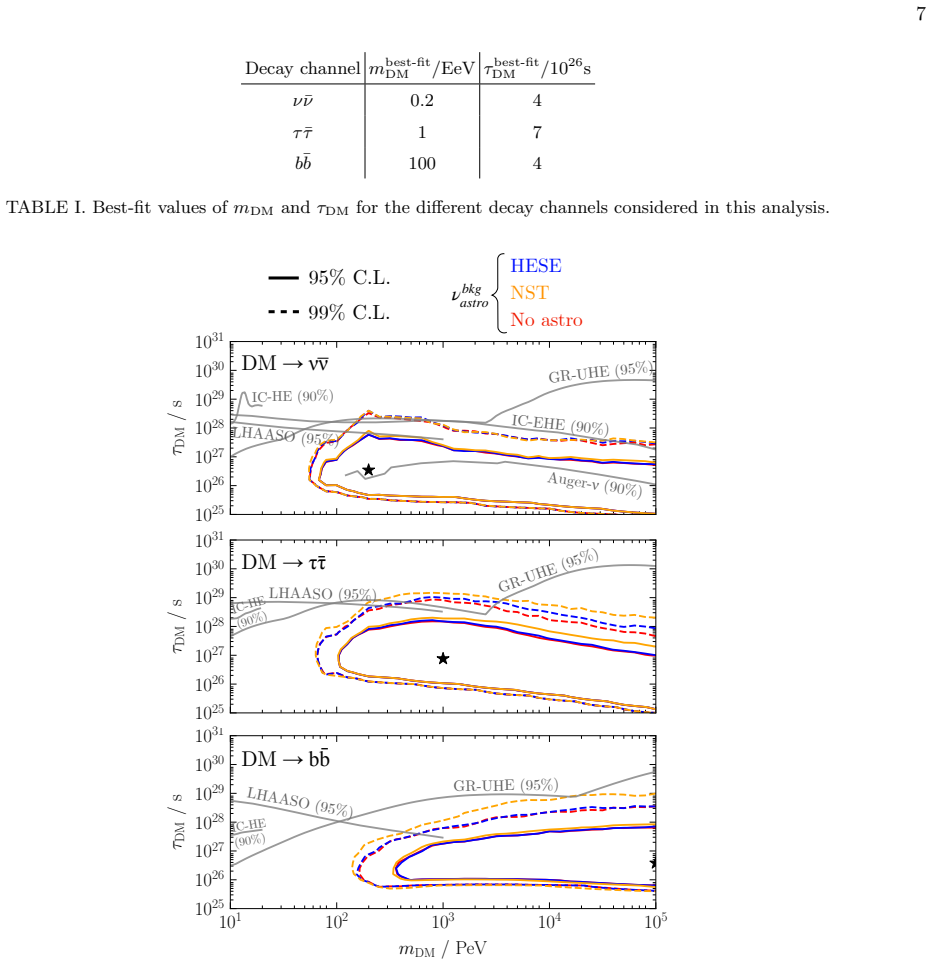
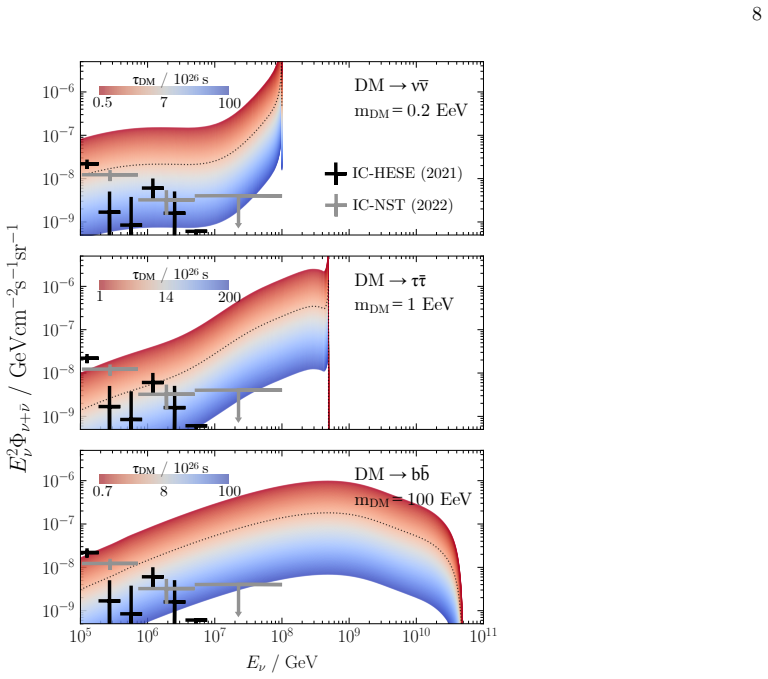
Assuming a dark matter origin of the event, we find that the preferred mass at 95% C.L. is larger than about 100 PeV in all scenarios considered, with best-fit lifetimes in the range 10^{26}-10^{27} s. These preferred regions are in tension with existing bounds from other neutrino telescopes and gamma-ray observations.
What carries the argument
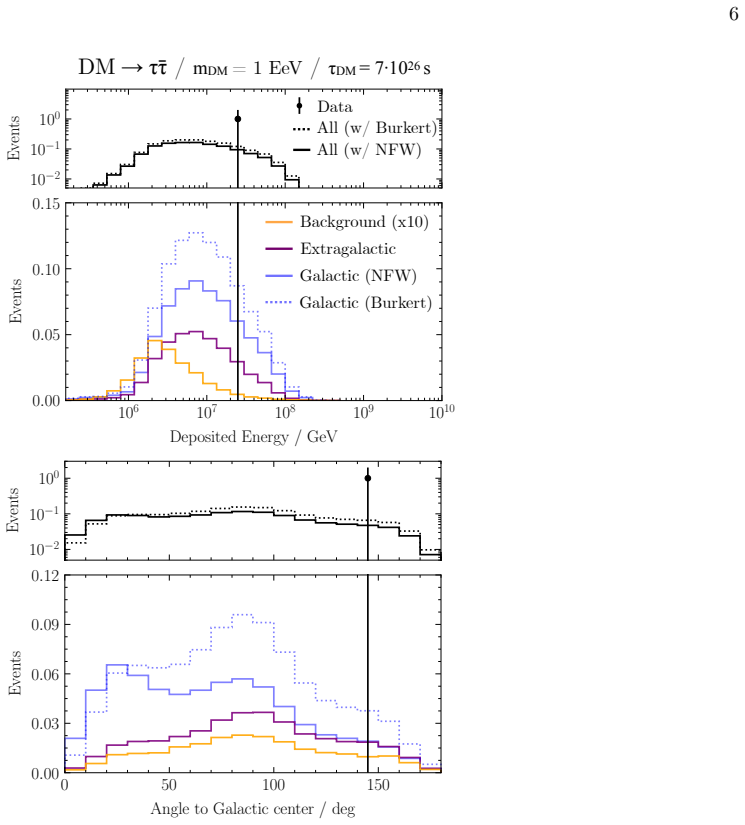
Detector Monte Carlo simulation that maps the event's deposited energy and arrival direction onto expected signal distributions for different decay channels while separating Galactic and extragalactic dark matter contributions.
If this is right
- Dark matter masses above 100 PeV are required at 95 percent confidence level for every decay channel examined.
- Lifetimes between 10^{26} and 10^{27} seconds provide the best match to the event properties.
- The same parameter region is already excluded by gamma-ray flux limits.
- Constraints from other neutrino telescopes independently rule out the preferred lifetimes and masses.
- Inclusion of both Galactic and extragalactic dark matter does not remove the tension with existing bounds.
Where Pith is reading between the lines
- The tension favors an astrophysical explanation for this particular neutrino event over a dark matter origin.
- Repeating the same energy-direction analysis on any future ultra-high-energy neutrino detections could tighten limits on heavy decaying dark matter.
- Multi-messenger follow-up observations that search for accompanying gamma rays at the predicted level could directly test the decay hypothesis.
- The method can be extended to other high-energy events to place model-independent bounds on dark matter lifetime at extreme masses.
Load-bearing premise
The observed event originates from dark matter decay rather than an astrophysical source or background.
What would settle it
An independent analysis that attributes KM3-230213A to a known astrophysical source such as a blazar or cosmic-ray interaction would remove the premise needed to derive the mass and lifetime constraints.
Figures
read the original abstract
This work explores the hypothesis that the ultra-high-energy neutrino event KM3-230213A originates from the decay of a heavy dark matter particle with a mass above PeV scale. The analysis exploits the deposited energy and arrival direction of the event as well as a complete detector Monte Carlo simulation to compute the expected signal distributions for different decay channels and assesses the relative contributions from Galactic and extragalactic dark matter. Assuming a dark matter origin of the event, we find that the preferred mass at 95% C.L. is larger than about 100 PeV in all scenarios considered, with best-fit lifetimes in the range $10^{26}$-$10^{27}$ s. These preferred regions are in tension with existing bounds from other neutrino telescopes and gamma-ray observations.
Editorial analysis
A structured set of objections, weighed in public.
Referee Report
Summary. The manuscript tests whether the ultra-high-energy neutrino event KM3-230213A originates from heavy dark matter decay above the PeV scale. It employs the event's deposited energy and arrival direction together with a complete detector Monte Carlo simulation to derive expected signal distributions across decay channels, while separating Galactic and extragalactic dark matter contributions. Assuming a dark matter origin for the event, the analysis reports a preferred mass larger than about 100 PeV at 95% C.L. with best-fit lifetimes in the range 10^{26}–10^{27} s; these regions are stated to be in tension with existing neutrino telescope and gamma-ray bounds.
Significance. If the result holds, the work supplies a concrete conditional constraint on heavy dark matter by mapping a single observed event onto mass and lifetime parameter space via full detector Monte Carlo. Credit is due for the explicit separation of Galactic and extragalactic contributions and the use of complete detector Monte Carlo, both of which strengthen the signal modeling. The analysis adds a falsifiable test of the dark matter hypothesis for this ultra-high-energy neutrino within a multi-messenger framework.
minor comments (2)
- [Abstract] Abstract: the phrase 'in all scenarios considered' is left unspecified; listing the decay channels or models examined would improve immediate clarity for readers.
- [Section on statistical analysis] The likelihood construction and treatment of systematic uncertainties on the single-event fit are referenced but would benefit from an expanded description to confirm how the 95% C.L. mass lower limit is obtained.
Simulated Author's Rebuttal
We thank the referee for the positive assessment of our work, the recognition of the value of the full detector Monte Carlo and the Galactic/extragalactic separation, and the recommendation for minor revision. No specific major comments were raised in the report.
Circularity Check
No significant circularity
full rationale
The paper conditions explicitly on the hypothesis that the single observed event originates from heavy DM decay, then uses deposited energy, direction, and full detector MC to derive conditional best-fit mass (>~100 PeV at 95% C.L.) and lifetime ranges (10^26-10^27 s) across channels, plus Galactic/extragalactic decomposition. These are standard likelihood fits to data under the premise; the tension statement references independent external neutrino and gamma-ray bounds. No step reduces by construction to its own inputs, no self-citation chain is load-bearing for the central claim, and no ansatz or uniqueness theorem is smuggled in. The derivation is self-contained against external benchmarks.
Axiom & Free-Parameter Ledger
free parameters (2)
- dark matter mass =
>100 PeV
- dark matter lifetime =
10^{26}-10^{27} s
axioms (2)
- domain assumption The neutrino event originates from dark matter decay
- domain assumption Monte Carlo simulation correctly reproduces detector response and signal distributions for decay channels
Reference graph
Works this paper leans on
-
[1]
R. H. Wechsler and J. L. Tinker, Ann. Rev. Astron. Astrophys.56, 435 (2018), arXiv:1804.03097
Pith/arXiv arXiv 2018
-
[2]
G. Bertone, D. Hooper, and J. Silk, Phys. Rept.405, 279 (2005), arXiv:hep-ph/0404175
Pith/arXiv arXiv 2005
-
[3]
F. Kahlhoefer, Int. J. Mod. Phys. A32, 1730006 (2017), arXiv:1702.02430
Pith/arXiv arXiv 2017
-
[4]
N. Aghanimet al.(Planck), Astron. Astrophys.641, A6 (2020), [Erratum: Astron.Astrophys. 652, C4 (2021)], arXiv:1807.06209
Pith/arXiv arXiv 2020
-
[5]
P´ erez de los Heros, Symmetry12, 1648 (2020), arXiv:2008.11561
C. P´ erez de los Heros, Symmetry12, 1648 (2020), arXiv:2008.11561
arXiv 2020
-
[6]
J. Billardet al., Rept. Prog. Phys.85, 056201 (2022), arXiv:2104.07634
arXiv 2022
-
[7]
Alves Batistaet al., (2021), arXiv:2110.10074
R. Alves Batistaet al., (2021), arXiv:2110.10074
arXiv 2021
-
[8]
A. Albertet al., Phys. Lett. B769, 249 (2017), [Erratum: Phys.Lett.B 796, 253–255 (2019)], arXiv:1612.04595
Pith/arXiv arXiv 2017
-
[9]
Adrian-Martinezet al.(ANTARES), Phys
S. Adrian-Martinezet al.(ANTARES), Phys. Lett. B759, 69 (2016), arXiv:1603.02228
Pith/arXiv arXiv 2016
-
[10]
M. G. Aartsenet al.(IceCube), Eur. Phys. J. C76, 531 (2016), arXiv:1606.00209
Pith/arXiv arXiv 2016
-
[11]
M. G. Aartsenet al.(IceCube), Eur. Phys. J. C77, 146 (2017), [Erratum: Eur.Phys.J.C 79, 214 (2019)], arXiv:1612.05949
Pith/arXiv arXiv 2017
-
[12]
R. Abbasiet al.(IceCube), Phys. Rev. D105, 062004 (2022), arXiv:2111.09970
arXiv 2022
-
[13]
Albertet al.(ANTARES), JCAP06, 028 (2022), arXiv:2203.06029
A. Albertet al.(ANTARES), JCAP06, 028 (2022), arXiv:2203.06029
arXiv 2022
-
[14]
Abbasiet al.(IceCube), JCAP10, 003 (2023), arXiv:2205.12950
R. Abbasiet al.(IceCube), JCAP10, 003 (2023), arXiv:2205.12950
arXiv 2023
-
[15]
S. R. Gozzini and J. De Dios Zornoza (ANTARES), PoSICRC2023, 1375 (2023)
2023
-
[16]
R. Abbasiet al.(IceCube), Phys. Rev. D108, 102004 (2023), arXiv:2303.13663
arXiv 2023
-
[17]
Aielloet al.(KM3NeT), JCAP03, 058 (2025), arXiv:2411.10092
S. Aielloet al.(KM3NeT), JCAP03, 058 (2025), arXiv:2411.10092
arXiv 2025
-
[18]
Aielloet al.(KM3NeT), Nature638, 376 (2025), [Erratum: Nature 640, E3 (2025)]
S. Aielloet al.(KM3NeT), Nature638, 376 (2025), [Erratum: Nature 640, E3 (2025)]
2025
-
[19]
R. Abbasiet al.(IceCube), Phys. Rev. Lett.135, 031001 (2025), arXiv:2502.01963
arXiv 2025
-
[20]
V. A. Allakhverdyanet al.(Baikal-GVD), Phys. Rev. D112, 083025 (2025), arXiv:2507.05769
arXiv 2025
-
[21]
Abdul Halimet al.(Pierre Auger), PoSICRC2023, 1488 (2023)
A. Abdul Halimet al.(Pierre Auger), PoSICRC2023, 1488 (2023)
2023
-
[22]
O. Adrianiet al.(KM3NeT), Phys. Rev. X15, 031016 (2025), arXiv:2502.08173
arXiv 2025
-
[23]
Adrianiet al.(KM3NeT) 10.1051/0004-6361/202557320 (2025), arXiv:2509.14895
O. Adrianiet al.(KM3NeT) 10.1051/0004-6361/202557320 (2025), arXiv:2509.14895
-
[24]
Adrianiet al.(KM3NeT), JCAP03, 033 (2026), arXiv:2511.13886
O. Adrianiet al.(KM3NeT), JCAP03, 033 (2026), arXiv:2511.13886
arXiv 2026
-
[25]
K. Fang, F. Halzen, and D. Hooper, Astrophys. J. Lett.982, L16 (2025), arXiv:2502.09545
arXiv 2025
-
[26]
M. D. Filipovi´ cet al., Astrophys. J. Lett.984, L52 (2025), arXiv:2503.09108
arXiv 2025
-
[27]
M. Crnogorˇ cevi´ c, C. Blanco, and T. Linden, JCAP10, 009 (2025), arXiv:2503.16606
arXiv 2025
-
[28]
C. Yuan, L. Pfeiffer, W. Winter, J. M. S. Zaballa, S. Buson, F. Testagrossa, and A. Azzollini, Astrophys. J. Lett.998, L1 (2026), arXiv:2506.21111
arXiv 2026
-
[29]
Adrianiet al.(KM3NeT), Astrophys
O. Adrianiet al.(KM3NeT), Astrophys. J. Lett.984, L41 (2025), arXiv:2502.08508
arXiv 2025
-
[30]
Q. Zhang, T.-Q. Huang, and Z. Li, Astrophys. J.990, 78 (2025), arXiv:2504.10378
arXiv 2025
-
[31]
S. Boxi, S. Das, and N. Gupta, Astrophys. J. Lett.997, L3 (2026), arXiv:2511.18144
arXiv 2026
-
[32]
S. Das, B. Zhang, S. Razzaque, and S. Xu, Astrophys. J.991, 96 (2025), arXiv:2504.10847
arXiv 2025
-
[33]
O. Adrianiet al.(KM3NeT), Commun. Phys.8, 457 (2025), arXiv:2502.12070
arXiv 2025
- [34]
-
[35]
A. P. Klipfel and D. I. Kaiser, Phys. Rev. Lett.135, 121003 (2025), arXiv:2503.19227
arXiv 2025
- [36]
-
[37]
G. F. S. Alves, M. Hostert, and M. Pospelov, Phys. Rev. D113, 075035 (2026), arXiv:2503.14419
arXiv 2026
- [38]
-
[39]
V. Brdar and D. S. Chattopadhyay, Phys. Rev. Lett.136, 081001 (2026), arXiv:2502.21299
arXiv 2026
- [40]
-
[41]
G. Amelino-Camelia, G. D’Amico, G. Fabiano, D. Frattulillo, G. Gubitosi, A. Moia, and G. Rosati, Phys. Lett. B868, 139764 (2025), arXiv:2502.13093
arXiv 2025
-
[42]
T. Bert´ olez-Mart´ ınez, G. Herrera, P. Mart´ ınez-Mirav´ e, and J. Terol Calvo, (2025), arXiv:2506.08993
Pith/arXiv arXiv 2025
-
[43]
L. F. T. Airoldi, G. F. S. Alves, Y. F. Perez-Gonzalez, G. M. Salla, and R. Z. Funchal, Phys. Rev. Lett.136, 041002 (2026), arXiv:2505.24666
arXiv 2026
-
[44]
L. A. Anchordoqui, F. Halzen, and D. Lust, Phys. Rev. D112, 083034 (2025), arXiv:2505.23414
arXiv 2025
-
[45]
P. S. B. Dev, B. Dutta, A. Karthikeyan, W. Maitra, L. E. Strigari, and A. Verma, (2025), arXiv:2505.22754
arXiv 2025
- [46]
-
[47]
M. J. Baker, J. Iguaz Juan, A. Symons, and A. Thamm, Phys. Rev. Lett.136, 061002 (2026), arXiv:2505.22722
arXiv 2026
-
[48]
K.-Y. Choi, E. Lkhagvadorj, and S. Mahapatra, JCAP10, 079 (2025), arXiv:2503.22465
arXiv 2025
-
[49]
A. S. Sakharov, R. Konoplich, and M. Gogberashvili, Phys. Rev. D112, 083061 (2025), arXiv:2506.23387
arXiv 2025
- [50]
-
[51]
Y. Jho, S. C. Park, and C. S. Shin, Phys. Rev. D112, 115004 (2025), arXiv:2503.18737
arXiv 2025
-
[52]
R. Aloisio, A. Ambrosone, and C. Evoli, Phys. Rev. D113, 043024 (2026), arXiv:2508.08779
arXiv 2026
- [53]
- [54]
-
[55]
S. Khan, J. Kim, and P. Ko, JCAP11, 033 (2025), arXiv:2504.16040
arXiv 2025
- [56]
-
[57]
S. Chang, C. Coriano, and A. E. Faraggi, Nucl. Phys. B477, 65 (1996), arXiv:hep-ph/9605325
Pith/arXiv arXiv 1996
-
[58]
B. R. Greene, T. Prokopec, and T. G. Roos, Phys. Rev. D56, 6484 (1997), arXiv:hep-ph/9705357
Pith/arXiv arXiv 1997
-
[59]
D. J. H. Chung, E. W. Kolb, and A. Riotto, Phys. Rev. D59, 023501 (1998), arXiv:hep-ph/9802238
Pith/arXiv arXiv 1998
-
[60]
K. Benakli, J. R. Ellis, and D. V. Nanopoulos, Phys. Rev. D59, 047301 (1999), arXiv:hep-ph/9803333
Pith/arXiv arXiv 1999
-
[61]
E. W. Kolb, D. J. H. Chung, and A. Riotto, AIP Conf. Proc.484, 91 (1999), arXiv:hep-ph/9810361
Pith/arXiv arXiv 1999
-
[62]
C. Coriano, A. E. Faraggi, and M. Plumacher, Nucl. Phys. B614, 233 (2001), arXiv:hep-ph/0107053
Pith/arXiv arXiv 2001
-
[63]
M. Garny, M. Sandora, and M. S. Sloth, Phys. Rev. Lett.116, 101302 (2016), arXiv:1511.03278
Pith/arXiv arXiv 2016
-
[64]
K. Kannike, A. Racioppi, and M. Raidal, Nucl. Phys. B918, 162 (2017), arXiv:1605.09378
Pith/arXiv arXiv 2017
-
[65]
E. W. Kolb and A. J. Long, Phys. Rev. D96, 103540 (2017), arXiv:1708.04293
arXiv 2017
- [66]
- [67]
- [68]
- [69]
-
[70]
R. Allahverdi, C. Arina, M. Chianese, M. Cicoli, F. Maltoni, D. Massaro, and J. K. Osi´ nski, JHEP02, 192, arXiv:2312.00136
-
[71]
Adri´ an-Mart´ ınezet al., Journal of Physics G Nuclear Physics43, 084001 (2016), arXiv:1601.07459
S. Adri´ an-Mart´ ınezet al., Journal of Physics G Nuclear Physics43, 084001 (2016), arXiv:1601.07459
Pith/arXiv arXiv 2016
-
[72]
Aielloet al., Journal of Instrumentation17(07), P07038
S. Aielloet al., Journal of Instrumentation17(07), P07038
-
[73]
S. Aielloet al.(KM3NeT), Eur. Phys. J. C84, 885 (2024), arXiv:2402.08363
arXiv 2024
-
[74]
R. Abuteret al.(Gravity), Astron. Astrophys.625, 10.1051/0004-6361/201935656 (2019), arXiv:1904.05721
-
[75]
C. W. Bauer, N. L. Rodd, and B. R. Webber, JHEP06, 121, arXiv:2007.15001
arXiv 2007
-
[76]
J. F. Navarro, C. S. Frenk, and S. D. M. White, Astrophys. J.462, 563 (1996), arXiv:astro-ph/9508025
Pith/arXiv arXiv 1996
-
[77]
A. Burkert, Astrophys. J. Lett.447, L25 (1995), arXiv:astro-ph/9504041
Pith/arXiv arXiv 1995
-
[78]
W. J. G. de Blok, Adv. Astron.2010, 789293 (2010), arXiv:0910.3538
Pith/arXiv arXiv 2010
-
[79]
M. Benito, A. Cuoco, and F. Iocco, JCAP03, 033 (2019), arXiv:1901.02460
Pith/arXiv arXiv 2019
- [80]
discussion (0)
Sign in with ORCID, Apple, or X to comment. Anyone can read and Pith papers without signing in.