On BPS Branes
Pith reviewed 2026-06-27 15:11 UTC · model grok-4.3
The pith
In supersymmetric quantum gravity every integral charge in the BPS black-brane cone is realized by a BPS state.
A machine-rendered reading of the paper's core claim, the machinery that carries it, and where it could break.
Core claim
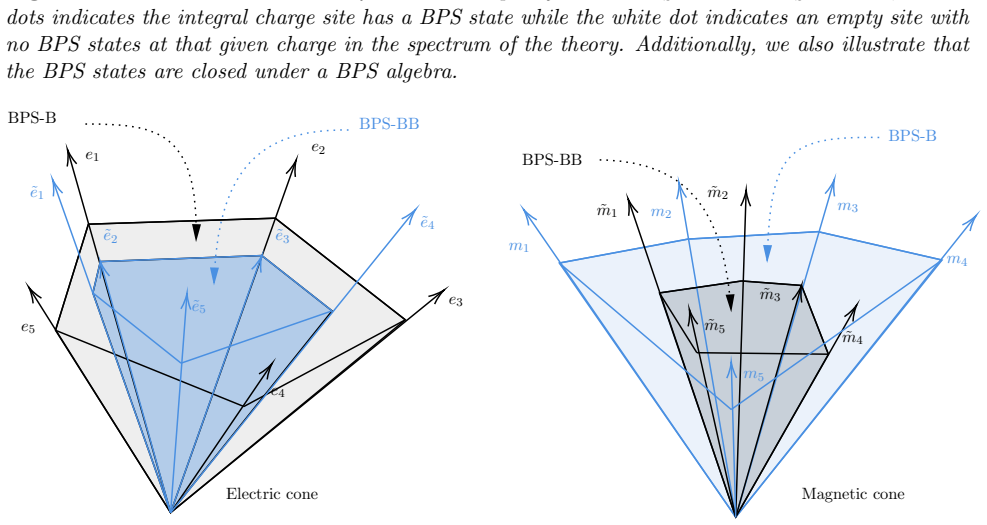
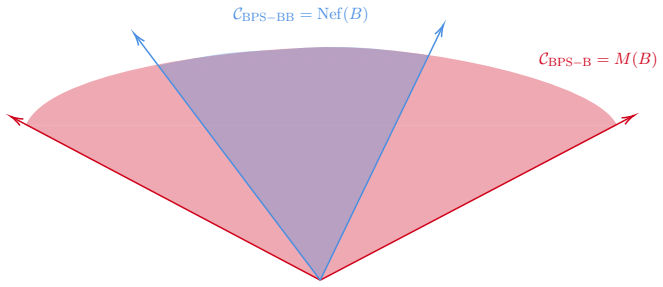
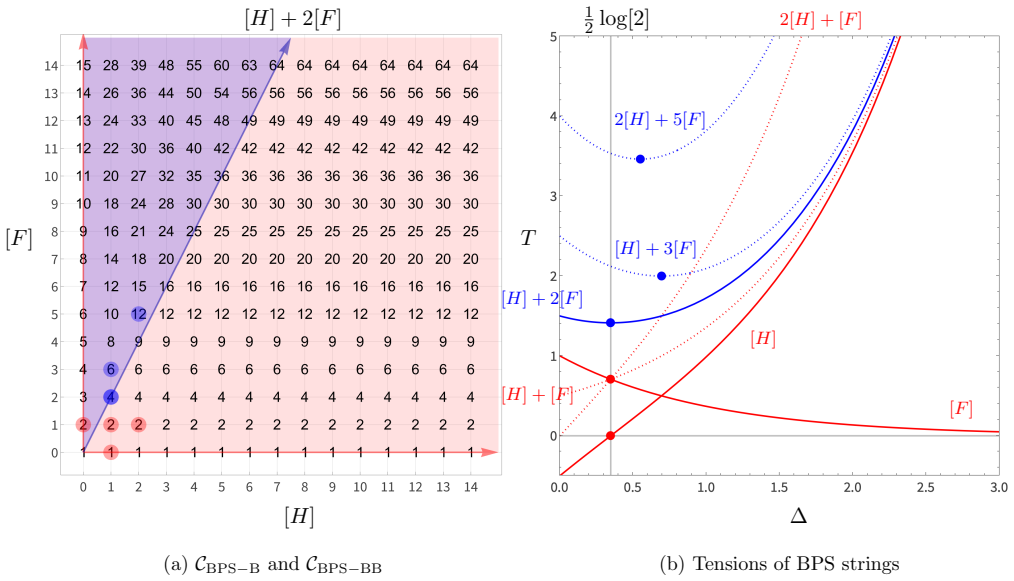
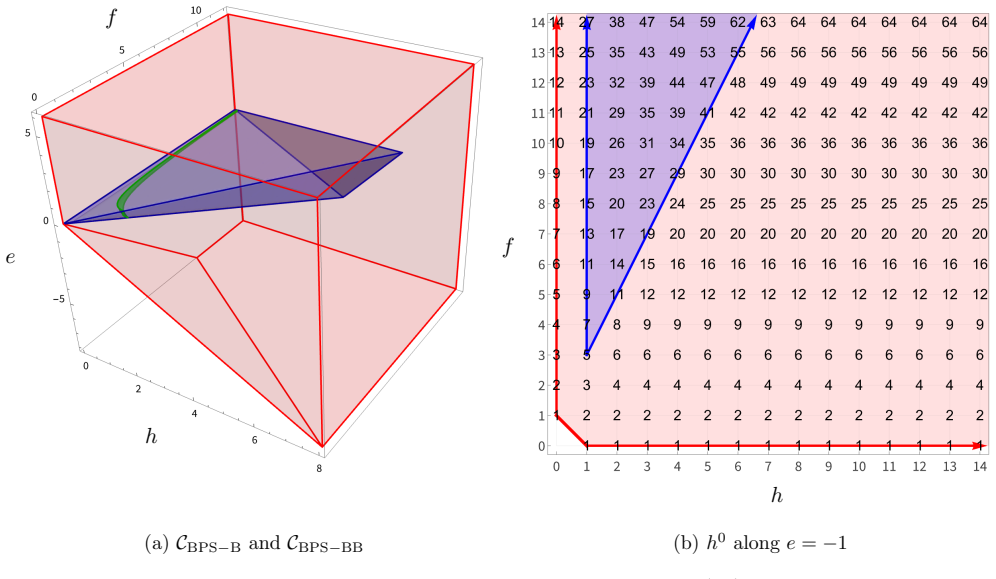
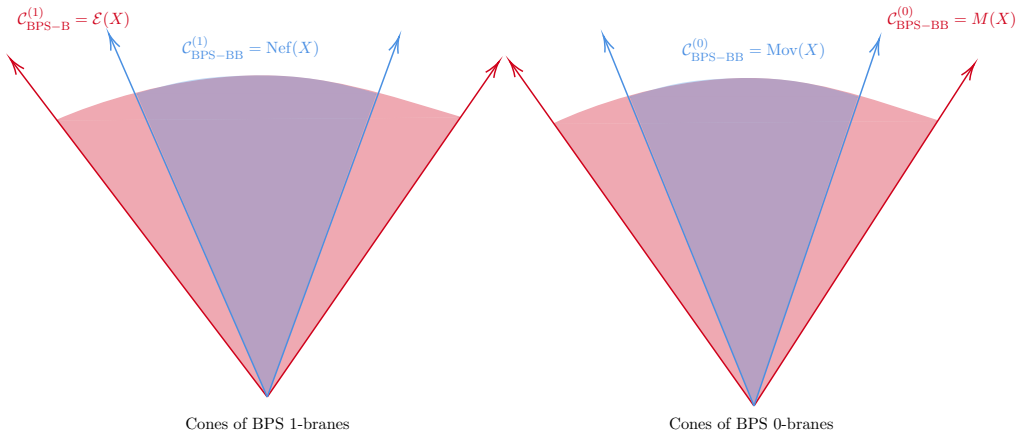
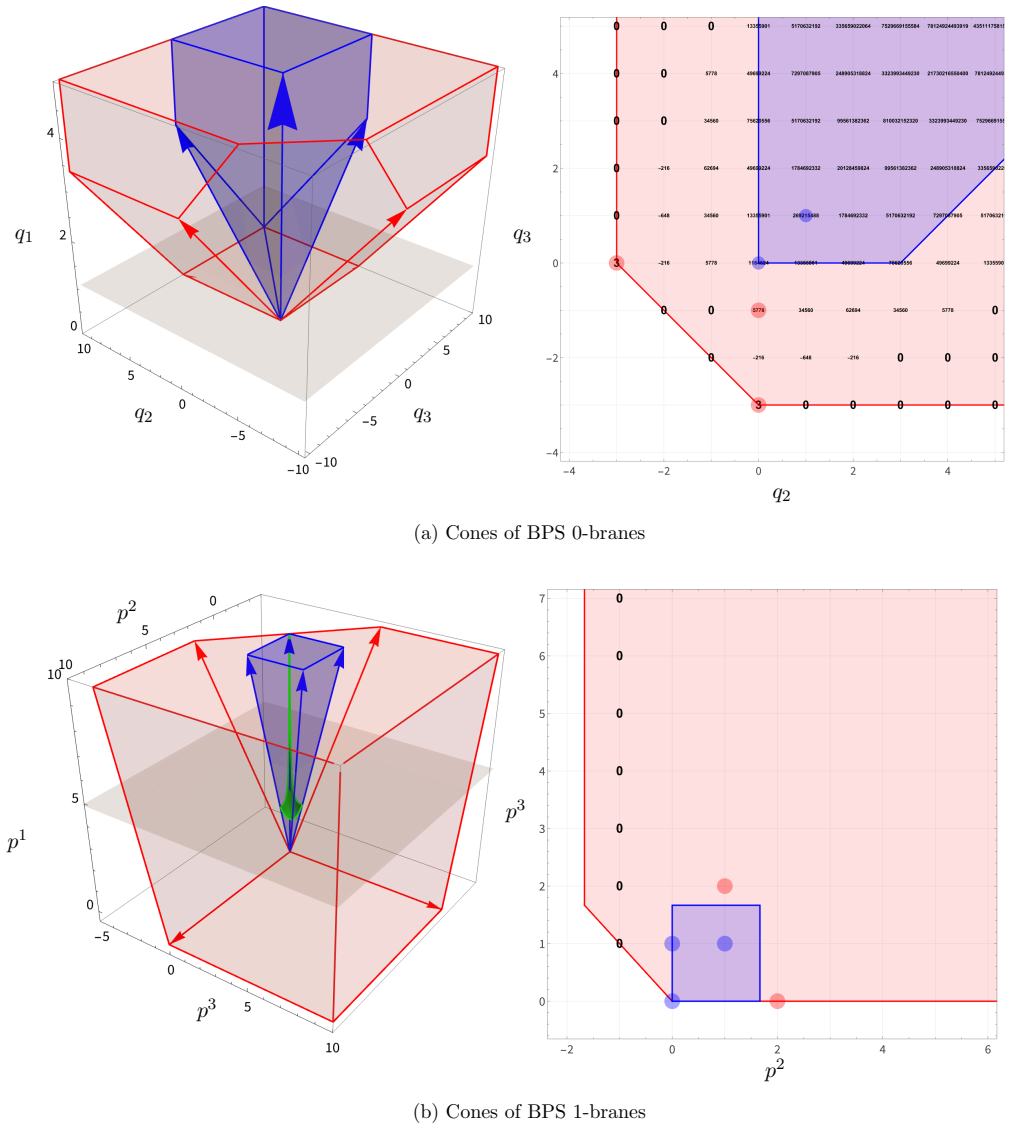
The authors distinguish C_BPS-B, the cone generated by BPS branes, from C_BPS-BB, the subcone of charges that admit BPS black-brane attractor solutions. They conjecture that every integrally charged state lying in C_BPS-BB is realized by a BPS state in the spectrum. They further conjecture that when C_BPS-B is moduli independent, it can be determined as the dual to C_BPS-BB under the electric-magnetic pairing.
What carries the argument
The cones C_BPS-B and C_BPS-BB in the space of charges, with their relation via electric-magnetic pairing.
If this is right
- All integral charges in C_BPS-BB correspond to BPS states.
- C_BPS-B is the electric-magnetic dual of C_BPS-BB when moduli independent.
- The conjecture applies universally to supersymmetric theories of quantum gravity.
- The infrared limit of the effective theory determines the BPS spectrum inside the cone.
Where Pith is reading between the lines
- The result would allow determining BPS spectra solely from supergravity data in many cases.
- It suggests a general mechanism linking black brane solutions to the full brane spectrum.
- Extensions could apply to non-supersymmetric cases or other duality pairs.
Load-bearing premise
The cone generated by BPS branes does not depend on the choice of moduli.
What would settle it
Discovery of a supersymmetric quantum gravity model with an integral charge in C_BPS-BB lacking a corresponding BPS state.
Figures





read the original abstract
We study supersymmetric BPS branes (BPS-B) in supergravity theories. Some of these states are anticipated by BPS black-brane (BPS-BB) solutions of supergravity. In particular, we define and distinguish the cone generated by BPS branes from the subcone of charges that admit BPS black-brane attractor solutions in the infrared limit of the supergravity effective field theory. We denote these cones by $C_{\rm BPS-B}$ and $C_{\rm BPS-BB}$, respectively. We conjecture that, in any supersymmetric theory of quantum gravity, every integrally charged state lying in $C_{\rm BPS-BB}$ is realized by a BPS state in the spectrum. Furthermore, we conjecture and present evidence that when $C_{\rm BPS-B}$ is moduli independent, it can be determined as the cone dual to the $C_{\rm BPS-BB}$ under the electric-magnetic pairing.
Editorial analysis
A structured set of objections, weighed in public.
Referee Report
Summary. The manuscript defines two cones in the charge space of supersymmetric supergravity theories: C_BPS-B, generated by BPS branes, and C_BPS-BB, the subcone of charges admitting BPS black-brane attractor solutions. It conjectures that every integrally charged state in C_BPS-BB is realized by a BPS state in any supersymmetric quantum gravity theory, and further conjectures (with evidence) that when C_BPS-B is moduli-independent it coincides with the electric-magnetic dual of C_BPS-BB.
Significance. If the conjectures are correct they would furnish a concrete link between infrared attractor solutions of supergravity and the full BPS spectrum of the ultraviolet theory, supplying a new tool for constraining the allowed charges in quantum gravity and for testing swampland-type statements about BPS states.
minor comments (2)
- [Abstract] The abstract states that evidence is presented for the duality conjecture under moduli independence, but the manuscript should include a brief summary of the specific examples or calculations used to support this evidence (e.g., in a dedicated subsection).
- The definitions of the cones C_BPS-B and C_BPS-BB are introduced without an explicit comparison to existing cones in the BPS literature (e.g., the BPS cone in the context of wall-crossing or attractor flows); adding one or two sentences of context would improve readability.
Simulated Author's Rebuttal
We thank the referee for their positive assessment of the manuscript, the clear summary of our conjectures, and the recommendation for minor revision. No major comments appear in the report, so we have nothing further to address point by point.
Circularity Check
No significant circularity; claims are explicit conjectures
full rationale
The paper frames its central results as conjectures (every state in C_BPS-BB realized by BPS state; C_BPS-B dual to C_BPS-BB when moduli-independent) rather than derivations. No equations or steps reduce by construction to fitted inputs, self-definitions, or self-citation chains. Definitions of the cones are introduced as distinct objects, and duality is conjectured with evidence, not derived tautologically. This matches the default expectation of non-circularity for conjecture-based work.
Axiom & Free-Parameter Ledger
axioms (2)
- domain assumption The theory under consideration is a supersymmetric theory of quantum gravity.
- domain assumption An electric-magnetic pairing exists on the charge lattice.
invented entities (2)
-
C_BPS-B cone
no independent evidence
-
C_BPS-BB cone
no independent evidence
Reference graph
Works this paper leans on
-
[1]
Polchinski,Monopoles, duality, and string theory,Int
J. Polchinski,Monopoles, duality, and string theory,Int. J. Mod. Phys. A19S1(2004) 145–156, [hep-th/0304042]
Pith/arXiv arXiv 2004
-
[2]
T. Banks and N. Seiberg,Symmetries and Strings in Field Theory and Gravity,Phys. Rev. D 83(2011) 084019, [arXiv:1011.5120]
Pith/arXiv arXiv 2011
-
[3]
J. McNamara and C. Vafa,Cobordism Classes and the Swampland,arXiv:1909.10355
arXiv 1909
-
[4]
N. Arkani-Hamed, L. Motl, A. Nicolis, and C. Vafa,The String landscape, black holes and gravity as the weakest force,JHEP06(2007) 060, [hep-th/0601001]
Pith/arXiv arXiv 2007
-
[5]
B. Heidenreich, M. Reece, and T. Rudelius,Evidence for a sublattice weak gravity conjecture, JHEP08(2017) 025, [arXiv:1606.08437]. 66
Pith/arXiv arXiv 2017
-
[6]
R. Gopakumar and C. Vafa,M theory and topological strings. 2.,hep-th/9812127
-
[7]
H. Ooguri and C. Vafa,Non-supersymmetric AdS and the Swampland,Adv. Theor. Math. Phys. 21(2017) 1787–1801, [arXiv:1610.01533]
Pith/arXiv arXiv 2017
-
[8]
M. Alim, B. Heidenreich, and T. Rudelius,The Weak Gravity Conjecture and BPS Particles, Fortsch. Phys.69(2021), no. 11-12 2100125, [arXiv:2108.08309]
arXiv 2021
-
[9]
C. Long, A. Sheshmani, C. Vafa, and S.-T. Yau,Non-Holomorphic Cycles and Non-BPS Black Branes,Commun. Math. Phys.399(2023), no. 3 1991–2043, [arXiv:2104.06420]
arXiv 2023
- [10]
-
[11]
D. Harlow and H. Ooguri,Symmetries in quantum field theory and quantum gravity,Commun. Math. Phys.383(2021), no. 3 1669–1804, [arXiv:1810.05338]
Pith/arXiv arXiv 2021
-
[12]
N. Gendler, E. Sheridan, M. Stillman, and D. H. Wu,Holes in Calabi-Yau Effective Cones, arXiv:2603.11173
-
[13]
H.-C. Kim, C. Vafa, and K. Xu,Finite landscape of 6d N=(1,0) supergravity,SciPost Phys.20 (2026), no. 1 016, [arXiv:2411.19155]
arXiv 2026
-
[14]
H. Ooguri and C. Vafa,On the Geometry of the String Landscape and the Swampland,Nucl. Phys. B766(2007) 21–33, [hep-th/0605264]
Pith/arXiv arXiv 2007
-
[15]
Witten,Phase transitions in M theory and F theory,Nucl
E. Witten,Phase transitions in M theory and F theory,Nucl. Phys. B471(1996) 195–216, [hep-th/9603150]
Pith/arXiv arXiv 1996
-
[16]
N. Gendler, B. Heidenreich, L. McAllister, J. Moritz, and T. Rudelius,Moduli space reconstruction and Weak Gravity,JHEP12(2023) 134, [arXiv:2212.10573]
arXiv 2023
-
[17]
J. M. Maldacena, A. Strominger, and E. Witten,Black hole entropy in M theory,JHEP12 (1997) 002, [hep-th/9711053]
Pith/arXiv arXiv 1997
-
[18]
Hirzebruch,The Riemann-Roch theorem for algebraic manifolds, pp
F. Hirzebruch,The Riemann-Roch theorem for algebraic manifolds, pp. 114–158. Springer Berlin Heidelberg, Berlin, Heidelberg, 1966
1966
-
[19]
S. Katz, H.-C. Kim, H.-C. Tarazi, and C. Vafa,Swampland Constraints on 5dN= 1 Supergravity,JHEP07(2020) 080, [arXiv:2004.14401]
arXiv 2020
-
[20]
Seiberg,Five-dimensional SUSY field theories, nontrivial fixed points and string dynamics, Phys
N. Seiberg,Five-dimensional SUSY field theories, nontrivial fixed points and string dynamics, Phys. Lett. B388(1996) 753–760, [hep-th/9608111]
Pith/arXiv arXiv 1996
-
[21]
Cossec, I
F. Cossec, I. Dolgachev, and C. Liedtke,Enriques Surfaces I. Springer Singapore, 2025
2025
-
[22]
D. R. Morrison and C. Vafa,Compactifications of F theory on Calabi-Yau threefolds. 2.,Nucl. Phys. B476(1996) 437–469, [hep-th/9603161]
Pith/arXiv arXiv 1996
-
[23]
Hartshorne,Algebraic Geometry, vol
R. Hartshorne,Algebraic Geometry, vol. 52 ofGraduate Texts in Mathematics. Springer, New York, 1977. 67
1977
-
[24]
M. Demirtas, C. Long, L. McAllister, and M. Stillman,The Kreuzer-Skarke Axiverse,JHEP04 (2020) 138, [arXiv:1808.01282]
Pith/arXiv arXiv 2020
-
[25]
S.-J. Lee, W. Lerche, and T. Weigand,Emergent strings from infinite distance limits,JHEP02 (2022) 190, [arXiv:1910.01135]
arXiv 2022
-
[26]
R. K. Lazarsfeld,Positivity in Algebraic Geometry II: Positivity for Vector Bundles, and Multiplier Ideals, vol. 49. Springer-Verlag Berlin Heidelberg, 2004
2004
-
[27]
B. Skauli,Curve classes on calabi–yau complete intersections in toric varieties,Bulletin of the London Mathematical Society55(2023), no. 2 811–825, [arXiv:1911.03146]
arXiv 2023
-
[28]
Lazarsfeld,Positivity in Algebraic Geometry I: Classical Setting: Line Bundles and Linear Series, vol
R. Lazarsfeld,Positivity in Algebraic Geometry I: Classical Setting: Line Bundles and Linear Series, vol. 48 ofErgebnisse der Mathematik und ihrer Grenzgebiete. 3. Folge / A Series of Modern Surveys in Mathematics. Springer, Berlin, Heidelberg, 2004
2004
-
[29]
Miyaoka,The chern classes and kodaira dimension of a minimal variety, inAlgebraic geometry, Sendai, 1985, vol
Y. Miyaoka,The chern classes and kodaira dimension of a minimal variety, inAlgebraic geometry, Sendai, 1985, vol. 10, pp. 449–477. Mathematical Society of Japan, 1987
1985
-
[30]
Kawamata,A generalization of kodaira-ramanujam’s vanishing theorem,Mathematische Annalen261(1982), no
Y. Kawamata,A generalization of kodaira-ramanujam’s vanishing theorem,Mathematische Annalen261(1982), no. 1 43–46
1982
-
[31]
Viehweg,Vanishing theorems.,Journal f¨ ur die reine und angewandte Mathematik335(1982) 1–8
E. Viehweg,Vanishing theorems.,Journal f¨ ur die reine und angewandte Mathematik335(1982) 1–8
1982
-
[32]
Lazi´ c and T
V. Lazi´ c and T. Peternell,On generalised abundance, i,Publications of the Research Institute for Mathematical Sciences56(2020), no. 2 353–389
2020
-
[33]
J. C. Ottem,Birational geometry of hypersurfaces in products of projective spaces, Mathematische Zeitschrift280(2015), no. 1 135–148, [arXiv:1305.0537]
Pith/arXiv arXiv 2015
-
[34]
S. Hosono, A. Klemm, S. Theisen, and S.-T. Yau,Mirror symmetry, mirror map and applications to complete intersection Calabi-Yau spaces,Nucl. Phys. B433(1995) 501–554, [hep-th/9406055]
Pith/arXiv arXiv 1995
-
[35]
cygv: Compute gv and gw invariants of calabi–yau manifolds
A. Rios Tascon, “cygv: Compute gv and gw invariants of calabi–yau manifolds.” https://github.com/ariostas/cygv, 2026. Version 0.2.2
2026
-
[36]
B. R. Greene, D. R. Morrison, and A. Strominger,Black hole condensation and the unification of string vacua,Nucl. Phys. B451(1995) 109–120, [hep-th/9504145]
Pith/arXiv arXiv 1995
-
[37]
B. R. Greene, D. R. Morrison, and C. Vafa,A Geometric realization of confinement,Nucl. Phys. B481(1996) 513–538, [hep-th/9608039]
Pith/arXiv arXiv 1996
-
[38]
Reece, T
M. Reece, T. Rudelius, and C. Tudball,Co-scaling and alignment of electric and magnetic towers,Journal of High Energy Physics2025(2025), no. 9 1–69
2025
-
[39]
Huybrechts,Complex Geometry: An Introduction
D. Huybrechts,Complex Geometry: An Introduction. Universitext. Springer, Berlin, Heidelberg, 2005. 68
2005
-
[40]
D. van de Heisteeg, C. Vafa, M. Wiesner, and D. H. Wu,Species scale in diverse dimensions, JHEP05(2024) 112, [arXiv:2310.07213]
arXiv 2024
-
[41]
M. Larfors and R. Schneider,Line bundle cohomologies on CICYs with Picard number two, Fortsch. Phys.67(2019), no. 12 1900083, [arXiv:1906.00392]
arXiv 2019
-
[42]
M. Kreuzer and H. Skarke,Complete classification of reflexive polyhedra in four-dimensions, Adv. Theor. Math. Phys.4(2000) 1209–1230, [hep-th/0002240]
Pith/arXiv arXiv 2000
-
[43]
M. Demirtas, A. Rios-Tascon, and L. McAllister,CYTools: A Software Package for Analyzing Calabi-Yau Manifolds,arXiv:2211.03823
-
[44]
A. D. Shapere and C. Vafa,BPS structure of Argyres-Douglas superconformal theories, hep-th/9910182
-
[45]
Witten,Bound states of strings and p-branes,Nucl
E. Witten,Bound states of strings and p-branes,Nucl. Phys. B460(1996) 335–350, [hep-th/9510135]
Pith/arXiv arXiv 1996
-
[46]
S. Sethi and M. Stern,D-brane bound states redux,Commun. Math. Phys.194(1998) 675–705, [hep-th/9705046]. 69
Pith/arXiv arXiv 1998
discussion (0)
Sign in with ORCID, Apple, or X to comment. Anyone can read and Pith papers without signing in.