Microscopic Investigation of the Superconducting State in CuCo₂S₄: Evidence for an Intermediate-Coupling Fully Gapped Superconductor
Pith reviewed 2026-06-27 14:26 UTC · model grok-4.3
The pith
Transverse-field μSR measurements establish that CuCo2S4 is a fully gapped superconductor in the intermediate electron-phonon coupling regime.
A machine-rendered reading of the paper's core claim, the machinery that carries it, and where it could break.
Core claim
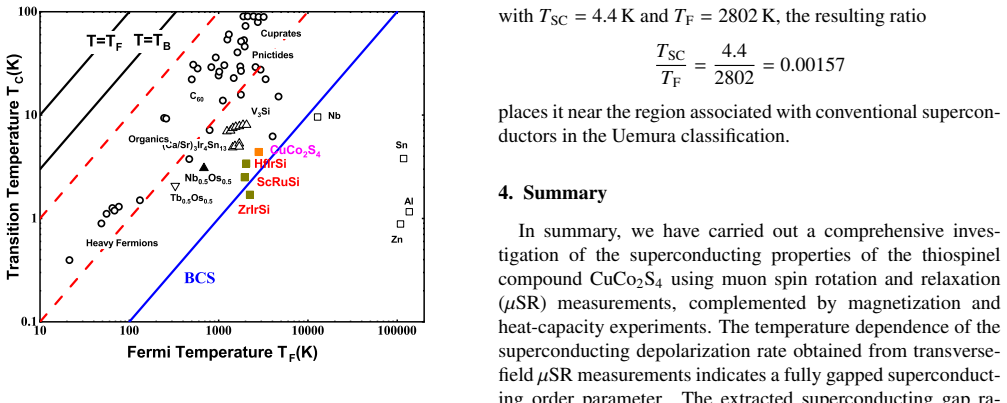
The temperature dependence of the superconducting depolarization rate obtained from transverse-field μSR measurements indicates a fully gapped superconducting order parameter with 2Δ(0)/(k_B T_SC) = 3.95(2), placing CuCo2S4 in the intermediate electron-phonon coupling regime and consistent with conventional s-wave superconductivity.
What carries the argument
The temperature dependence of the muon depolarization rate in the superconducting state, analyzed within the London limit for a fully gapped s-wave superfluid density.
Load-bearing premise
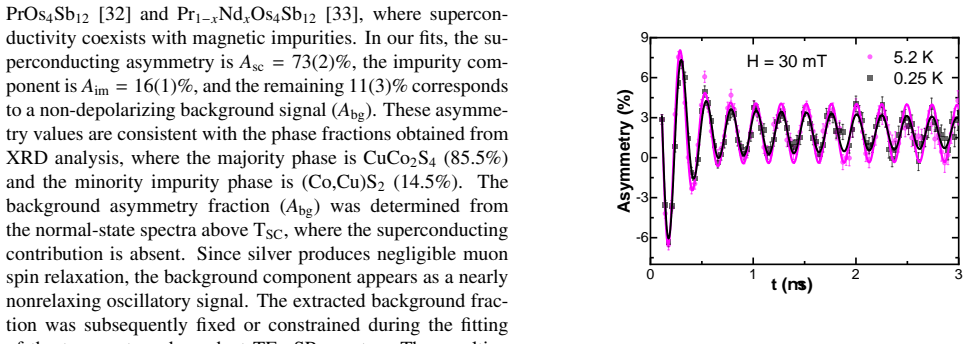
The ferromagnetic impurity phase does not distort the extracted temperature dependence of the depolarization rate in a way that mimics a fully gapped behavior.
What would settle it
Observation of a temperature dependence of the depolarization rate that fits a nodal gap model or yields a gap ratio of exactly 3.53 would falsify the fully gapped intermediate-coupling claim.
Figures




read the original abstract
The thiospinel compound CuCo$_2$S$_4$ provides an attractive platform for exploring superconductivity in transition-metal chalcogenide spinels. Here, we report the first microscopic investigation of the superconducting state in CuCo$_2$S$_4$ using muon spin rotation and relaxation ($\mu$SR) measurements, complemented by magnetization and heat-capacity experiments. The temperature dependence of the superconducting depolarization rate obtained from transverse-field $\mu$SR measurements indicates a fully gapped superconducting order parameter. The extracted gap ratio $2\Delta(0)/(k_{\mathrm{B}}T_\mathrm{SC}) = 3.95(2)$ exceeds the BCS weak-coupling value of 3.53, placing CuCo$_2$S$_4$ in the intermediate electron-phonon coupling regime. Zero-field $\mu$SR measurements were performed to probe possible time-reversal symmetry breaking (TRSB) in the superconducting state. Within the experimental resolution, no additional spontaneous internal magnetic fields are observed below $T_c$. However, due to the presence of a ferromagnetic impurity phase and the associated fast-relaxing signal component, the sensitivity of the present measurements to weak spontaneous fields is reduced. Consequently, while no evidence for TRSB is detected, its existence cannot be definitively ruled out. Overall, our combined thermodynamic and $\mu$SR results demonstrate that CuCo$_2$S$_4$ exhibits a fully gapped superconducting state with intermediate coupling strength, consistent with conventional $s$-wave superconductivity in this cobalt-based thiospinel system.
Editorial analysis
A structured set of objections, weighed in public.
Referee Report
Summary. The manuscript reports the first microscopic investigation of superconductivity in the thiospinel CuCo₂S₄ via transverse-field and zero-field μSR, supported by magnetization and heat-capacity data. The central claim is that the temperature dependence of the TF-μSR depolarization rate indicates a fully gapped s-wave order parameter, with extracted ratio 2Δ(0)/(k_B T_SC) = 3.95(2) placing the material in the intermediate electron-phonon coupling regime. ZF-μSR detects no spontaneous fields, though sensitivity is reduced by a ferromagnetic impurity phase.
Significance. If the TF-μSR analysis holds, the work supplies the first microscopic evidence for conventional intermediate-coupling superconductivity in this cobalt-based thiospinel, consistent with the thermodynamic data. The gap ratio is reported with uncertainty and follows directly from the stated temperature dependence of the depolarization rate.
major comments (1)
- [TF-μSR analysis and abstract discussion of impurity phase] The ferromagnetic impurity is addressed only for ZF-μSR (reducing sensitivity to spontaneous fields via its fast-relaxing component). No corresponding statement or analysis confirms that this component was isolated, subtracted, or shown to be temperature-independent in the TF-μSR data used to extract σ_sc(T) and the gap ratio. This assumption is load-bearing for the fully gapped claim, as any T-dependent impurity relaxation would alter the inferred order-parameter symmetry and magnitude.
minor comments (1)
- [Abstract] The abstract states the gap ratio but omits the explicit fitting functions, background subtraction procedure, and impurity modeling details for the TF-μSR depolarization rate; these should be summarized even in the abstract for a microscopic claim.
Simulated Author's Rebuttal
We thank the referee for their careful reading of the manuscript and for identifying this important point regarding the TF-μSR analysis. We respond to the major comment below.
read point-by-point responses
-
Referee: [TF-μSR analysis and abstract discussion of impurity phase] The ferromagnetic impurity is addressed only for ZF-μSR (reducing sensitivity to spontaneous fields via its fast-relaxing component). No corresponding statement or analysis confirms that this component was isolated, subtracted, or shown to be temperature-independent in the TF-μSR data used to extract σ_sc(T) and the gap ratio. This assumption is load-bearing for the fully gapped claim, as any T-dependent impurity relaxation would alter the inferred order-parameter symmetry and magnitude.
Authors: We agree that the manuscript does not explicitly describe the treatment of the ferromagnetic impurity contribution in the TF-μSR data analysis. The TF-μSR spectra were in fact fitted with a two-component model separating the Gaussian relaxation arising from the vortex lattice (used to extract σ_sc(T)) from the fast-relaxing impurity component. The impurity relaxation rate was verified to be temperature-independent below T_c through consistency with measurements above T_c and by direct inspection of the raw spectra. Nevertheless, because this procedure is not stated in the current text, we will add a dedicated paragraph in the Methods and Results sections of the revised manuscript, together with supporting details on the fitting model and evidence for temperature independence of the impurity term. This will make the analysis fully transparent and address the referee's concern. revision: yes
Circularity Check
No significant circularity; experimental fit to standard model
full rationale
The paper reports TF-μSR depolarization rates measured on CuCo2S4 and fits their temperature dependence to the standard London-limit expression for the superfluid density of a fully gapped s-wave superconductor. The extracted gap ratio 2Δ(0)/kBTSC = 3.95(2) is a direct output of that fit to the observed data points. No equation in the reported chain defines a quantity in terms of itself, renames a fitted parameter as a prediction, or reduces the central claim to a self-citation whose validity is presupposed. The abstract explicitly flags the ferromagnetic impurity and the consequent reduction in ZF-μSR sensitivity; the TF-μSR analysis is presented as using the conventional model with that caveat noted. The derivation is therefore self-contained data analysis against an externally validated functional form and does not meet any of the enumerated circularity patterns.
Axiom & Free-Parameter Ledger
free parameters (1)
- gap ratio 2Δ(0)/k_B T_SC =
3.95(2)
axioms (2)
- domain assumption Muon depolarization rate in the vortex state is proportional to the superfluid density via the London penetration depth in the London limit.
- ad hoc to paper Ferromagnetic impurity contributes only a fast-relaxing component that does not alter the slow component used for gap extraction.
Reference graph
Works this paper leans on
-
[1]
R. J. Naumann, Introduction to the Physics and Chemistry of Materials, CRC Press, 2008. doi:10.1201/9781420061345. URLhttp://dx.doi.org/10.1201/9781420061345
-
[2]
F. Bosi, C. Biagioni, M. Pasero, Nomenclature and classification of the spinel supergroup, Euro- pean Journal of Mineralogy 31 (1) (2019) 183–192. doi:10.1127/ejm/2019/0031-2788. URLhttp://dx.doi.org/10.1127/ejm/2019/0031-2788
-
[3]
D. C. Johnston, Superconducting and normal state prop- erties of Li 1+xTi2−xO4 spinel compounds. I. Preparation, 9 crystallography, superconducting properties, electrical re- sistivity, dielectric behavior, and magnetic susceptibil- ity, Journal of Low Temperature Physics 25 (1–2) (1976) 145–175. doi:10.1007/bf00654827. URLhttp://dx.doi.org/10.1007/BF00654827
-
[4]
R. W. McCallum, D. C. Johnston, C. A. Luengo, M. B. Maple, Superconducting and normal state properties of Li1+xTi2−xO4 spinel compounds. II. Low-temperature heat capacity, Journal of Low Temperature Physics 25 (1–2) (1976) 177–193. doi:10.1007/bf00654828. URLhttp://dx.doi.org/10.1007/BF00654828
-
[5]
N. Van Maaren, G. Schaeffer, F. Lotgering, Super- conductivity in sulpho- and selenospinels, Physics Letters A 25 (3) (1967) 238–239. doi:10.1016/0375- 9601(67)90878-x. URLhttp://dx.doi.org/10.1016/0375-9601(67)90878-X
-
[6]
M. Robbins, R. Willens, R. Miller, Superconductivity in the spinels CuRh 2S4 and CuRh 2Se4, Solid State Com- munications 5 (12) (1967) 933–934. doi:10.1016/0038- 1098(67)90469-3. URLhttp://dx.doi.org/10.1016/0038-1098(67)90469-3
-
[7]
T. Hagino, Y . Seki, N. Wada, S. Tsuji, T. Shirane, K.-i. Kumagai, S. Nagata, Superconductivity in spinel-type compounds CuRh 2S4 and CuRh 2Se4, Physical Review B 51 (18) (1995) 12673–12684. doi:10.1103/physrevb.51.12673. URLhttp://dx.doi.org/10.1103/PhysRevB.51.12673
-
[8]
Kumagai, S
K. Kumagai, S. Tsuji, T. Hagino, S. Nagata, NMR Stud- ies of Superconductivity and Metal-Insulator Transition in Cu Spinel CuM2X4 (M=Rh, Ir and X=S, Se), in: Spec- troscopy of Mott Insulators and Correlated Metals, V ol. 119 of Springer Series in Solid-State Sciences, Springer, Berlin, Heidelberg, 1995, pp. 255–264
1995
-
[9]
G. Cao, T. Furubayashi, H. Suzuki, H. Kitazawa, T. Matsumoto, Y . Uwatoko, Suppression of metal-to- insulator transition and appearance of superconductivity in Cu 1−xZnxIr2S4, Physical Review B 64 (21) (2001) 214514. doi:10.1103/physrevb.64.214514. URLhttp://dx.doi.org/10.1103/PhysRevB.64.214514
-
[10]
H. Suzuki, T. Furubayashi, G. Cao, H. Kitazawa, A. Kamimura, K. Hirata, T. Matsumoto, Metal-Insulator Transition and Superconductivity in Spinel-Type System Cu1−xZnxIr2S4, Journal of the Physical Society of Japan 68 (8) (1999) 2495–2497. doi:10.1143/jpsj.68.2495. URLhttp://dx.doi.org/10.1143/JPSJ.68.2495
-
[11]
N. Aito, M. Sato, Superconducting Transition Tem- peratures of Cu(Co 1−xMx)2S4, Journal of the Phys- ical Society of Japan 73 (7) (2004) 1938–1943. doi:10.1143/jpsj.73.1938. URLhttp://dx.doi.org/10.1143/JPSJ.73.1938
-
[12]
Y .-Y . Jin, S.-H. Sun, Y .-W. Cui, Q.-Q. Zhu, L.-W. Ji, Z. Ren, G.-H. Cao, Bulk superconductivity and Pauli paramagnetism in nearly stoichiometric CuCo 2S4, Physical Review Materials 5 (7) (2021) 074804. doi:10.1103/physrevmaterials.5.074804. URLhttp://dx.doi.org/10.1103/PhysRevMaterials.5.074804
-
[13]
A. Gibson, K. Lilova, T. Subramani, B. von der Heyden, D. A. Gilbert, A. Navrotsky, B. F. Woodfield, Thermody- namic properties and superconductivity of natural carrol- lite CuCo2S4, The Journal of Chemical Thermodynamics 185 (2023) 107096. doi:10.1016/j.jct.2023.107096. URLhttp://dx.doi.org/10.1016/j.jct.2023.107096
-
[14]
T. Oda, M. Shirai, N. Suzuki, K. Motizuki, Electronic band structure of sulphide spinels CuM 2S4 (M=Co, Rh, Ir), Journal of Physics: Condensed Matter 7 (23) (1995) 4433–4445. doi:10.1088/0953-8984/7/23/012. URLhttp://dx.doi.org/10.1088/0953-8984/7/23/012
-
[15]
Z. Yue, Z. Hou, F. Yun, P. Liu, G. Yang, A. Bake, W. Zhao, D. Cortie, C. Shu, S. Hu, J. Cheng, X. Wang, Observation of itinerant ferromagnetism and coupled magnetoresis- tance in a spinel CuCo2S4, Journal of Materials Chemistry C 9 (28) (2021) 8874–8881. doi:10.1039/d1tc02065j. URLhttp://dx.doi.org/10.1039/d1tc02065j
-
[16]
S. L. Skornyakov, I. O. Trifonov, V . I. Anisimov, Coulomb Correlations and Electronic Structure of CuCo2S4: a DFT +DMFT Study, JETP Letters 117 (8) (2023) 588–592. doi:10.1134/s0021364023600647. URLhttp://dx.doi.org/10.1134/S0021364023600647
-
[17]
P. Hemmati-Eslamlu, A. Habibi-Yangjeh, Y . Ak- inay, T. Cetin, Novel g-C 3N4 nanorods/Cu3BiS3 nanocomposites: Outstanding photocatalysts with p-n heterojunction for impressively detoxification of water under visible light, Journal of Photochemistry and Photobiology A: Chemistry 443 (2023) 114862. doi:10.1016/j.jphotochem.2023.114862. URLhttp://dx.doi.org/...
-
[18]
M. Habibi, A. Habibi-Yangjeh, Y . Akinay, A. Khataee, Oxygen vacancy-rich CeO 2 decorated with Cu 3BiS3 nanoparticles: Outstanding visible- light photocatalytic performance towards tetracy- cline degradation, Chemosphere 340 (2023) 139828. doi:10.1016/j.chemosphere.2023.139828. URLhttp://dx.doi.org/10.1016/j.chemosphere.2023.139828
-
[19]
A. Bhattacharyya, D. T. Adroja, K. Panda, S. Saha, T. Das, A. J. S. Machado, O. V . Cigarroa, T. W. Grant, Z. Fisk, A. D. Hillier, P. Manfrinetti, Evidence of a Nodal Line in the Superconducting Gap Symmetry of Noncentrosymmetric ThCoC 2, Phys. Rev. Lett. 122 (2019) 147001. doi:10.1103/PhysRevLett.122.147001. URLhttps://link.aps.org/doi/10.1103/PhysRevLet...
-
[20]
A. Bhattacharyya, M. R. Lees, K. Panda, P. P. Ferreira, T. T. Dorini, E. Gaudry, L. T. F. Eleno, V . K. Anand, 10 J. Sannigrahi, P. K. Biswas, R. Tripathi, D. T. Adroja, Nodeless time-reversal symmetry breaking in the cen- trosymmetric superconductor Sc 5Co4Si10 probed by muon-spin spectroscopy, Physical Review Materials 6 (6) (2022) 064802. doi:10.1103/p...
-
[21]
Y . Furukawa, S. Wada, K. Miyatani, T. Tanaka, M. Fuku- gauchi, M. Ishikawa, Nuclear spin-lattice relaxation and antiferromagnetic spin correlations in superconducting thiospinel Cu1.5Co1.5S4, Physical Review B 51 (9) (1995) 6159–6162. doi:10.1103/physrevb.51.6159. URLhttp://dx.doi.org/10.1103/PhysRevB.51.6159
-
[22]
S. Sugita, H. Takikawa, H. Nishihara, M. Ishikawa, E. Saito, An evidence for the s-wave superconductivity in the spinel superconductor Cd 2Re2O7: a study of low-temperature specific heat, Physica C: Superconduc- tivity 469–470 (2000) 233–234. doi:10.1016/s0921- 4534(99)00894-8. URLhttp://dx.doi.org/10.1016/s0921-4534(99)00894-8
-
[23]
S. Wada, H. Sugita, K. Miyatani, T. Tanaka, T. Nishikawa, Weak antiferromagnetism and superconductivity in pseudo-binary spinel compounds (Cu, Co)Co 2S4 inves- tigated by 59Co and 63Cu magnetic resonance, Journal of Physics: Condensed Matter 14 (2) (2001) 219–230. doi:10.1088/0953-8984/14/2/309. URLhttp://dx.doi.org/10.1088/0953-8984/14/2/309
-
[24]
G. Baskaran, Electronic Model for CoO 2 Layer Based Systems: Chiral Resonating Valence Bond Metal and Superconductivity, Physical Review Letters 91 (9) (2003) 097003. doi:10.1103/physrevlett.91.097003. URLhttp://dx.doi.org/10.1103/PhysRevLett.91.097003
-
[25]
T. Fujimoto, G.-q. Zheng, Y . Kitaoka, R. L. Meng, J. Cmaidalka, C. W. Chu, Unconventional Superconduc- tivity and Electron Correlations in the Cobalt Oxyhydrate Na0.35CoO2.yH2O from Nuclear Quadrupole Reso- nance, Physical Review Letters 92 (4) (2004) 047004. doi:10.1103/physrevlett.92.047004. URLhttp://dx.doi.org/10.1103/PhysRevLett.92.047004
-
[26]
Q.-H. Wang, P. A. Lee, Dopedtext−Jmodel on a triangular lattice: Possible application to Na xCoO2·yH2O and Na1−xTiO2, Physical Review B 69 (9) (2004) 092504. doi:10.1103/physrevb.69.092504. URLhttp://dx.doi.org/10.1103/PhysRevB.69.092504
-
[27]
A. D. Hillier, S. J. Blundell, I. McKenzie, I. Umegaki, L. Shu, J. A. Wright, T. Prokscha, F. Bert, K. Shimomura, A. Berlie, H. Alberto, I. Watanabe, Muon spin spec- troscopy, Nature Reviews Methods Primers 2 (1) (2022)
2022
-
[28]
URLhttp://dx.doi.org/10.1038/s43586-021-00089-0
doi:10.1038/s43586-021-00089-0. URLhttp://dx.doi.org/10.1038/s43586-021-00089-0
-
[29]
F. L. Pratt, Wimda: a muon data analysis program for the windows pc, Physica B 289–290 (2000) 710–714. doi:10.1016/S0921-4526(00)00328-8. URLhttps://doi.org/10.1016/S0921-4526(00)00328-8
-
[30]
A. Aharoni, Demagnetizing factors for rectangular ferro- magnetic prisms, Journal of Applied Physics 83 (6) (1998) 3432–3434. doi:10.1063/1.367113. URLhttp://dx.doi.org/10.1063/1.367113
-
[31]
J. Bardeen, L. N. Cooper, J. R. Schrieffer, Theory of superconductivity, Phys. Rev. 108 (1957) 1175–1204. doi:10.1103/PhysRev.108.1175. URLhttps://link.aps.org/doi/10.1103/PhysRev.108.1175
-
[32]
A. Teruya, F. Suzuki, D. Aoki, F. Honda, A. Nakamura, M. Nakashima, Y . Amako, H. Harima, K. Uchima, M. Hedo, T. Nakama, Y .¯Onuki, Fermi Surface and Mag- netic Properties in Ferromagnet CoS 2 and Paramagnet CoSe2 with the Pyrite-type Cubic Structure, Journal of Physics: Conference Series 807 (2017) 012001. doi:10.1088/1742-6596/807/1/012001. URLhttp://dx...
-
[33]
D. E. MacLaughlin, J. E. Sonier, R. H. Heffner, O. O. Bernal, B.-L. Young, M. S. Rose, G. D. Morris, E. D. Bauer, T. D. Do, M. B. Maple, Muon Spin Relaxation and Isotropic Pairing in Superconducting PrOs 4Sb12, Physical Review Letters 89 (15) (2002) 157001. doi:10.1103/physrevlett.89.157001. URLhttp://dx.doi.org/10.1103/PhysRevLett.89.157001
-
[34]
D. E. MacLaughlin, P.-C. Ho, L. Shu, O. O. Bernal, S. Zhao, A. A. Dooraghi, T. Yanagisawa, M. B. Maple, R. H. Fukuda, Muon spin rotation and relaxation in Pr1−xNdxOs4Sb12: Magnetic and superconducting ground states, Physical Review B 89 (14) (2014) 144419. doi:10.1103/physrevb.89.144419. URLhttp://dx.doi.org/10.1103/PhysRevB.89.144419
-
[35]
R. Prozorov, R. W. Giannetta, Magnetic penetration depth in unconventional superconductors, Supercond. Sci. Tech. 19 (8) (2006) R41–R67. doi:10.1088/0953-2048/19/8/r01. URLhttps://doi.org/10.1088/0953-2048/19/8/r01
-
[36]
V . K. Anand, A. Bhattacharyya, D. T. Adroja, K. Panda, P. K. Biswas, A. D. Hillier, B. Lake, Time-reversal symmetry breaking ands-wave superconductivity in CaPd2Ge2: AµSR study, Physical Review B 108 (22) (2023) 224519. doi:10.1103/physrevb.108.224519. URLhttp://dx.doi.org/10.1103/PhysRevB.108.224519
-
[37]
A. Bhattacharyya, D. Adroja, A. Jana, K. Panda, P. Fer- reira, Y . Zhao, T. Ying, H. Hosono, T. Dorini, L. Eleno, P. Biswas, G. Stenning, R. Tripathi, Y . Qi, Exploring superconductivity in Ba 3Ir4Ge16: Experimental and theoretical insights, Journal of Alloys and Compounds 978 (2024) 173374. doi:10.1016/j.jallcom.2023.173374. URLhttp://dx.doi.org/10.1016/...
-
[38]
A. Bhattacharyya, P. P. Ferreira, K. Panda, S. H. Ma- sunaga, L. R. de Faria, L. E. Correa, F. B. Santos, D. T. 11 Adroja, K. Yokoyama, T. T. Dorini, R. F. Jardim, L. T. F. Eleno, A. J. S. Machado, Electron–phonon supercon- ductivity in C-doped topological nodal-line semimetal Zr5Pt3: a muon spin rotation and relaxation (µSR) study, Journal of Physics: Co...
-
[39]
G. M. Pang, M. Smidman, W. B. Jiang, J. K. Bao, Z. F. Weng, Y . F. Wang, L. Jiao, J. L. Zhang, G. H. Cao, H. Q. Yuan, Evidence for nodal superconductivity in quasi-one-dimensional K2Cr3As3, Phys. Rev. B 91 (2015) 220502. doi:10.1103/PhysRevB.91.220502. URLhttps://link.aps.org/doi/10.1103/PhysRevB.91.220502
-
[40]
J. F. Annett, Symmetry of the order parameter for high- temperature superconductivity, Adv. Phys. 39 (1990) 83–126. doi:10.1080/00018739000101481. URLhttps://doi.org/10.1080/00018739000101481
-
[41]
D. T. Adroja, A. Bhattacharyya, Y . J. Sato, M. R. Lees, P. K. Biswas, K. Panda, V . K. Anand, G. B. G. Stenning, A. D. Hillier, D. Aoki, Pairing symmetry of an interme- diate valence superconductor CeIr 3 investigated using µSR measurements, Phys. Rev. B 103 (2021) 104514. doi:10.1103/PhysRevB.103.104514. URLhttps://link.aps.org/doi/10.1103/PhysRevB.103.104514
-
[42]
E. H. Brandt, Properties of the ideal Ginzburg-Landau vortex lattice, Physical Review B 68 (5) (2003) 054506. doi:10.1103/physrevb.68.054506. URLhttp://dx.doi.org/10.1103/PhysRevB.68.054506
-
[43]
W. L. McMillan, Transition Temperature of Strong- Coupled Superconductors, Phys. Rev. 167 (1968) 331–344. doi:10.1103/PhysRev.167.331. URLhttps://link.aps.org/doi/10.1103/PhysRev.167.331
-
[44]
E. E. M. Chia, M. B. Salamon, H. Sugawara, H. Sato, Probing the superconducting gap symmetry of PrRu4Sb12: A comparison with PrOs 4Sb12, Phys. Rev. B 69 (2004) 180509. doi:10.1103/PhysRevB.69.180509. URLhttps://link.aps.org/doi/10.1103/PhysRevB.69.180509
-
[45]
Amato, Heavy-fermion systems studied byµSR technique, Rev
A. Amato, Heavy-fermion systems studied byµSR technique, Rev. Mod. Phys. 69 (1997) 1119–1180. doi:10.1103/RevModPhys.69.1119. URLhttps://link.aps.org/doi/10.1103/RevModPhys.69.1119
-
[46]
R. S. Hayano, Y . J. Uemura, J. Imazato, N. Nishida, T. Yamazaki, R. Kubo, Zero-and low-field spin relaxation studied by positive muons, Physical Review B 20 (3) (1979) 850–859. doi:10.1103/physrevb.20.850. URLhttp://dx.doi.org/10.1103/PhysRevB.20.850
-
[47]
A. Bhattacharyya, D. T. Adroja, J. S. Lord, L. Wang, Y . Shi, K. Panda, H. Luo, A. M. Strydom, Quantum fluc- tuations in the quasi-one-dimensional non-Fermi liquid system CeCo 2Ga8 investigated usingµSR, Phys. Rev. B 101 (2020) 214437. doi:10.1103/PhysRevB.101.214437. URLhttps://link.aps.org/doi/10.1103/PhysRevB.101.214437
-
[48]
Aarti, K. Panda, D. T. Adroja, A. Bhattacharyya, P. K. Biswas, A. D. Hillier, B. Lake, S. Layek, V . K. Anand, Time-reversal symmetry breaking in thes-wave super- conductor CaPd 2As2 probed byµSR, Phys. Rev. B 110 (2024) 144506. doi:10.1103/PhysRevB.110.144506. URLhttps://link.aps.org/doi/10.1103/PhysRevB.110.144506
-
[49]
A. D. Hillier, J. Quintanilla, R. Cywinski, Evi- dence for Time-Reversal Symmetry Breaking in the Noncentrosymmetric Superconductor LaNiC 2, Physical Review Letters 102 (11) (2009) 117007. doi:10.1103/physrevlett.102.117007. URLhttp://dx.doi.org/10.1103/PhysRevLett.102.117007
-
[50]
G. M. Luke, Y . Fudamoto, K. M. Kojima, M. I. Larkin, J. Merrin, B. Nachumi, Y . J. Uemura, Y . Maeno, Z. Q. Mao, Y . Mori, H. Nakamura, M. Sigrist, Time-reversal symmetry-breaking superconductivity in Sr 2RuO4, Na- ture 394 (6693) (1998) 558–561. doi:10.1038/29038. URLhttp://dx.doi.org/10.1038/29038
-
[51]
A. de Visser, N. T. Huy, A. Gasparini, D. E. de Nijs, D. Andreica, C. Baines, A. Amato, Muon Spin Rota- tion and Relaxation in the Superconducting Ferromagnet UCoGe, Physical Review Letters 102 (16) (2009) 117007. doi:10.1103/physrevlett.102.167003. URLhttp://dx.doi.org/10.1103/PhysRevLett.102.167003
-
[52]
R. Khasanov, K. Conder, E. Pomjakushina, A. Amato, C. Baines, Z. Bukowski, J. Karpinski, S. Katrych, H.-H. Klauss, H. Luetkens, A. Shengelaya, N. D. Zhigadlo, Evidence of nodeless superconductivity in FeSe 0.85 from a muon-spin-rotation study of the in-plane magnetic penetration depth, Physical Review B 78 (22) (2008) 220510. doi:10.1103/PhysRevB.78.22051...
-
[53]
D. Das, A. Bhattacharyya, V . K. Anand, A. D. Hillier, J. W. Taylor, T. Gruner, C. Geibel, D. T. Adroja, Z. Hos- sain, Muon spin relaxation study on itinerant ferromagnet CeCrGe3 and the effect of Ti substitution on magnetism of CeCrGe3, Journal of Physics: Condensed Matter 27 (1) (2014) 016004. doi:10.1088/0953-8984/27/1/016004. URLhttp://dx.doi.org/10.1...
-
[54]
J. van Lierop, H. S. Isaacs, D. H. Ryan, A. Beath, E. Mc- Calla, Muon spin relaxation study of exchange biased Co/CoO, Physical Review B 67 (13) (2003) 134430. doi:10.1103/physrevb.67.134430. URLhttp://dx.doi.org/10.1103/PhysRevB.67.134430
-
[55]
K. Panda, A. Bhattacharyya, P. N. Ferreira, R. Mon- dal, A. Thamizhavel, D. T. Adroja, C. Heil, L. T. F. Eleno, A. D. Hillier, Probing the superconducting gap structure of ScRuSi viaµSR and first-principles calculations, Phys. Rev. B 109 (2024) 224517. doi:10.1103/PhysRevB.109.224517. URLhttps://link.aps.org/doi/10.1103/PhysRevB.109.224517 12
-
[56]
A. Bhattacharyya, K. Panda, D. T. Adroja, N. Kase, P. K. Biswas, S. Saha, T. Das, M. R. Lees, A. D. Hillier, Investigation of superconducting gap structure in HfIrSi using muon spin relaxation/rotation, Journal of Physics: Condensed Matter 32 (8) (2019) 085601. doi:10.1088/1361-648x/ab549e. URLhttps://doi.org/10.1088/1361-648x/ab549e
-
[57]
K. Panda, A. Bhattacharyya, D. T. Adroja, N. Kase, P. K. Biswas, S. Saha, T. Das, M. R. Lees, A. D. Hillier, Prob- ing the superconducting ground state of ZrIrSi: A muon spin rotation and relaxation study, Physical Review B 99 (17) (2019) 174513. doi:10.1103/physrevb.99.174513. URLhttps://doi.org/10.1103/physrevb.99.174513
-
[58]
Y . J. Uemura, G. M. Luke, B. J. Sternlieb, J. H. Brewer, J. F. Carolan, W. N. Hardy, R. Kadono, J. R. Kempton, R. F. Kiefl, S. R. Kreitzman, P. Mulhern, T. M. Riseman, D. L. Williams, B. X. Yang, S. Uchida, H. Takagi, J. Gopalakrishnan, A. W. Sleight, M. A. Subramanian, C. L. Chien, M. Z. Cieplak, G. Xiao, V . Y . Lee, B. W. Statt, C. E. Stronach, W. J. ...
-
[59]
A. D. Hillier, R. Cywinski, The classification of supercon- ductors using muon spin rotation, Applied Magnetic Res- onance 13 (1-2) (1997) 95–109. doi:10.1007/bf03161973. URLhttps://doi.org/10.1007/bf03161973 13
discussion (0)
Sign in with ORCID, Apple, or X to comment. Anyone can read and Pith papers without signing in.