Neural-network solution of subtracted three-body Faddeev integral equations near the Efimov limit
Pith reviewed 2026-06-27 11:43 UTC · model grok-4.3
The pith
A deep neural network solves the subtracted three-body Faddeev integral equations near the Efimov limit by minimizing the equation residual while treating the binding scale as a trainable parameter.
A machine-rendered reading of the paper's core claim, the machinery that carries it, and where it could break.
Core claim
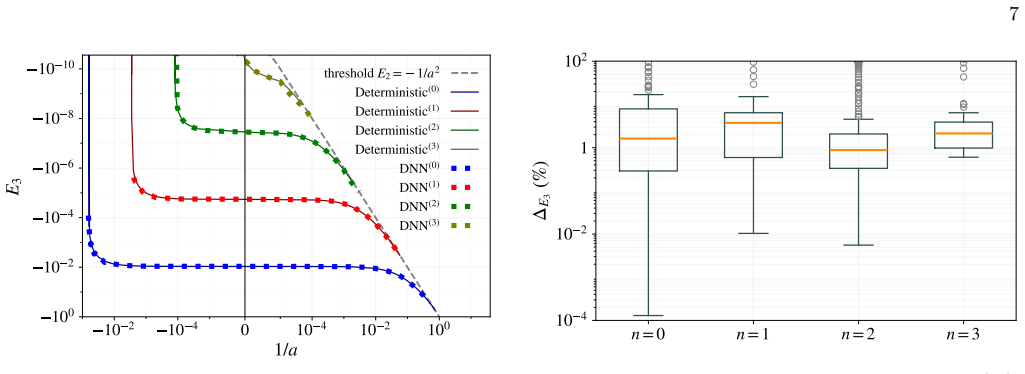
A DNN ansatz trained solely by residual minimization on the discretized, subtracted three-body Faddeev kernel reproduces the Efimov ground-state binding scale to 0.022 percent and the first excited state to 0.002 percent of the deterministic diagonalization result at unitarity; the same network traces the bound-state trajectories as a continuous function of 1/a by continuation from the unitary point.
What carries the argument
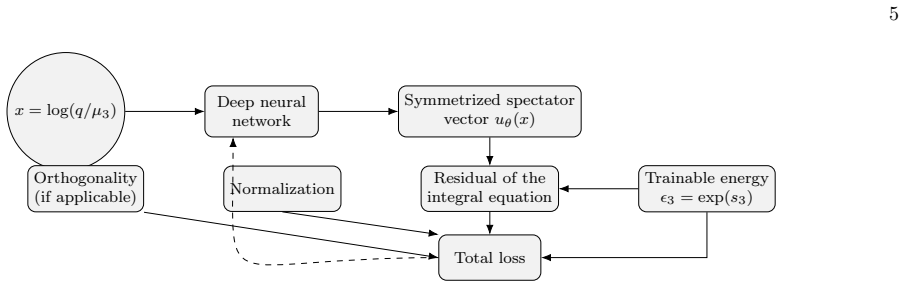
Deep neural network ansatz for the symmetrized spectator vector, trained by residual minimization of the discretized integral equation with the three-body binding scale treated as a trainable parameter.
If this is right
- The neural solution reproduces the universal Efimov scaling ratio to the same precision as the deterministic solver.
- Bound-state branches can be followed continuously from the unitary limit by varying the inverse scattering length.
- The trained network supplies a differentiable map from scattering length to binding energy that can be differentiated for further calculations.
Where Pith is reading between the lines
- The same residual-minimization strategy could be applied to other renormalized few-body integral equations that lack closed-form solutions.
- Because the network is differentiable, gradients with respect to the scattering length could be used to optimize three-body observables without repeated full solves.
- Extension to systems with finite-range potentials or to four-body problems would test whether the method remains stable when the discrete scale invariance is broken.
Load-bearing premise
Minimizing the residual of the discretized integral equation with the positive three-body binding scale as a trainable parameter converges to the physically correct solution of the original subtracted Faddeev equation rather than to a spurious stationary point.
What would settle it
A direct comparison in which the neural-network binding energies deviate by more than a few percent from the known universal Efimov ratio e^{2π/s₀} or from independent deterministic diagonalization at the same cutoff would falsify the claim that residual minimization recovers the correct physical solution.
Figures

read the original abstract
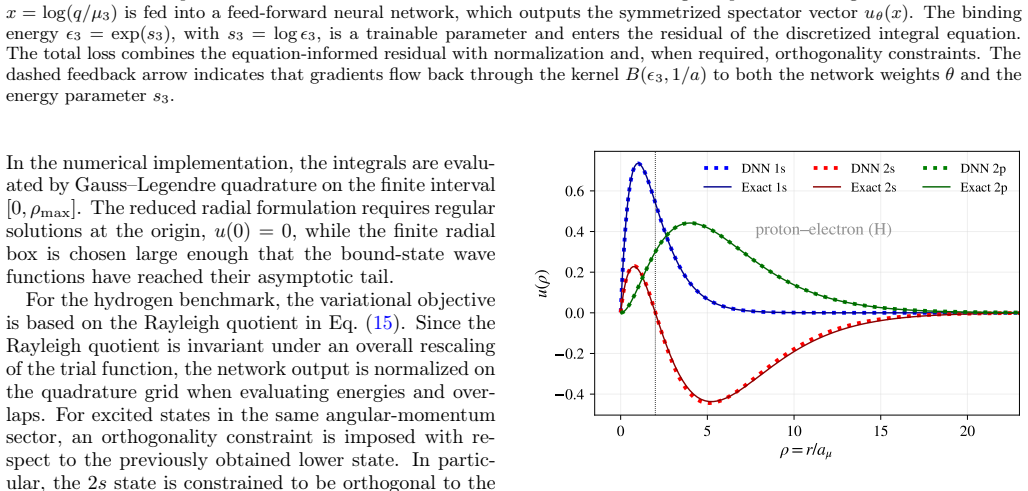
We apply a deep-neural-network (DNN) ansatz to the symmetrized spectator vector of the subtracted three-body Faddeev integral equation for identical bosons near the Efimov limit. The network is trained by minimizing the residual of the discretized integral equation, while the positive binding scale associated with the three-body energy is treated as a trainable parameter. Deterministic diagonalization of the same discretized kernel is used only as an a posteriori numerical benchmark. As preliminary validation, the neural-solver strategy is tested on the analytically solvable hydrogen radial problem. At unitarity, the DNN reproduces the Efimov ground-state binding scale with a DNN--deterministic deviation of $0.022\%$, while the first excited state is recovered to $0.002\%$. The deterministic solver recovers the universal Efimov scaling ratio $e^{2\pi/s_0}\simeq 515.03$, and the neural method traces the bound-state branches as a function of the inverse scattering length $1/a$ by continuation from the unitary solution. These results indicate that DNN-based residual minimization can provide a compact and differentiable representation of a renormalized few-body integral-equation solution in a regime governed by discrete scale invariance.
Editorial analysis
A structured set of objections, weighed in public.
Referee Report
Summary. The paper applies a deep neural network ansatz to the symmetrized spectator vector of the subtracted three-body Faddeev integral equation for identical bosons near the Efimov limit. The network is trained by residual minimization on the discretized equation, with the positive three-body binding scale treated as a trainable parameter. A deterministic diagonalization of the same kernel serves as a posteriori benchmark. At unitarity the DNN recovers the ground-state binding scale to 0.022% and the first excited state to 0.002% of the deterministic result; the method is then continued in 1/a to trace bound-state branches. Preliminary validation is shown on the hydrogen radial problem.
Significance. If the joint optimization of network weights and binding scale is shown to converge reliably to physical roots of the subtracted kernel (rather than spurious residual minima), the approach would supply a compact, differentiable representation of renormalized few-body solutions in a discrete-scale-invariant regime. The reported numerical agreement with the deterministic benchmark is promising, but the method's central novelty rests on the trainable-scale construction whose correctness is not yet demonstrated.
major comments (2)
- [Abstract] Abstract: treating the three-body binding scale as a trainable parameter that is adjusted inside the loss function makes the reported binding energies fitted outputs of the same optimization that defines the residual, rather than independent solutions of the subtracted Faddeev equation. This circularity is load-bearing for the central claim of having solved the integral equation.
- [Abstract] Abstract and validation section: no loss-landscape diagnostics, no sweep over initial values of the trainable scale, and no demonstration that other candidate scales produce distinctly higher residuals are provided. The hydrogen test case does not address the three-body discrete-scale-invariance structure, leaving open the possibility that low-residual stationary points reached by gradient descent are artifacts rather than true zeros of the kernel.
Simulated Author's Rebuttal
We thank the referee for the careful reading of the manuscript and the constructive comments. We address each major comment below.
read point-by-point responses
-
Referee: [Abstract] Abstract: treating the three-body binding scale as a trainable parameter that is adjusted inside the loss function makes the reported binding energies fitted outputs of the same optimization that defines the residual, rather than independent solutions of the subtracted Faddeev equation. This circularity is load-bearing for the central claim of having solved the integral equation.
Authors: The subtracted Faddeev equation is homogeneous; non-trivial solutions exist only for discrete values of the three-body binding scale. Jointly optimizing the network weights and the scale to drive the residual to zero is a direct numerical realization of the eigenvalue condition. The deterministic diagonalization of the identical discretized kernel provides an independent verification that the scale recovered by the neural procedure coincides with the physical root to 0.022 % (ground state) and 0.002 % (first excited state). This external benchmark demonstrates that the reported scales are solutions of the integral equation rather than artifacts of the optimization. revision: no
-
Referee: [Abstract] Abstract and validation section: no loss-landscape diagnostics, no sweep over initial values of the trainable scale, and no demonstration that other candidate scales produce distinctly higher residuals are provided. The hydrogen test case does not address the three-body discrete-scale-invariance structure, leaving open the possibility that low-residual stationary points reached by gradient descent are artifacts rather than true zeros of the kernel.
Authors: We agree that additional diagnostics would strengthen the presentation. In the revised manuscript we will include (i) optimizations initialized from several widely separated trial values of the binding scale, all converging to the same physical root, and (ii) a direct comparison of the final residual achieved at the physical scale versus nearby non-physical trial scales. The hydrogen radial problem validates the residual-minimization procedure on a known eigenproblem; the three-body results are further corroborated by the deterministic eigensolver applied to the same kernel, which encodes the discrete scale invariance by construction. revision: yes
Circularity Check
No significant circularity; numerical solver validated against independent benchmark
full rationale
The paper describes a DNN residual-minimization method for the subtracted Faddeev equation in which the three-body binding scale κ is treated as a trainable parameter. This is a direct numerical approach to locating the eigenvalue of the integral kernel rather than a self-referential definition or renaming. Accuracy is quantified solely by post-hoc comparison to deterministic diagonalization of the identical discretized operator, which functions as an external numerical check. The hydrogen test case is analytically independent. No load-bearing self-citations, imported uniqueness theorems, or ansatzes appear in the provided text. The central claim therefore reduces to a standard collocation-style solver whose output is not forced by construction from its own fitted inputs.
Axiom & Free-Parameter Ledger
free parameters (1)
- three-body binding scale
axioms (2)
- domain assumption The residual of the discretized subtracted Faddeev integral equation can be driven to zero by a neural-network ansatz whose parameters include the binding scale.
- domain assumption The deterministic diagonalization of the same discretized kernel provides an independent numerical benchmark.
Reference graph
Works this paper leans on
-
[1]
In this way, the ultraviolet dependence is traded for the finite three-body scaleµ 3, which fixes the absolute position of the Efimov spectrum
The physical kernel at energy−ϵ 3 is re- placed by the difference between this kernel and the same kernel evaluated at the subtraction scale. In this way, the ultraviolet dependence is traded for the finite three-body scaleµ 3, which fixes the absolute position of the Efimov spectrum. Throughout this work we setµ3 = 1and ex- press all momenta and energies...
2000
-
[2]
LeCun, Y
Y. LeCun, Y. Bengio, and G. Hinton, Nature521, 436 (2015)
2015
-
[3]
I. E. Lagaris, A. Likas, and D. I. Fotiadis, IEEE Transactions on Neural Networks9, 987 (1998), arXiv:physics/9705023
Pith/arXiv arXiv 1998
-
[4]
Raissi, P
M. Raissi, P. Perdikaris, and G. E. Karniadakis, Journal of Computational Physics378, 686 (2019)
2019
-
[5]
G. E. Karniadakis, I. G. Kevrekidis, L. Lu, P. Perdikaris, S. Wang, and L. Yang, Nature Reviews Physics3, 422 (2021)
2021
-
[6]
Carleo and M
G. Carleo and M. Troyer, Science355, 602 (2017)
2017
-
[7]
J. Hermann, Z. Schätzle, and F. Noé, Nature Chemistry 12, 891 (2020), arXiv:1909.08423
arXiv 2020
-
[8]
S. Sarkar, Physics-informed neural networks for one-dimensional quantum well problems (2025), arXiv:2504.05367 [quant-ph]
arXiv 2025
-
[9]
Brevi, A
L. Brevi, A. Mandarino, and E. Prati, New Journal of Physics26, 103015 (2024)
2024
-
[10]
J. W. T. Keeble and A. Rios, Physics Letters B809, 135743 (2020), arXiv:1911.13092 [nucl-th]
arXiv 2020
-
[11]
Rozalén Sarmiento, J
J. Rozalén Sarmiento, J. W. T. Keeble, and A. Rios, European Physical Journal Plus139, 189 (2024)
2024
- [12]
-
[13]
R. Li, X. Luo, H. Sun, and P. G. Ortega, European Phys- ical Journal C86, 503 (2026), arXiv:2507.17559 [hep-ph]
arXiv 2026
-
[14]
J. Lei, Exterior complex scaling enables physics- informed neural networks for quantum scattering (2026), arXiv:2602.04553 [nucl-th]
Pith/arXiv arXiv 2026
-
[15]
A. Boehnlein, M. Diefenthaler, C. Fanelli, M. Hjorth- Jensen, T. Horn, M. P. Kuchera, D. Lee, W. Nazarewicz, K. Orginos, P. Ostroumov, L.-G. Pang, A. Poon, N. Sato, M. Schram, A. Scheinker, M. S. Smith, X.-N. Wang, and V.Ziegler,ReviewsofModernPhysics94,031003(2022), arXiv:2112.02309 [nucl-th]
arXiv 2022
-
[16]
E. V. Chimanski, R. V. Lobato, A. R. Goncalves, and C. A. Bertulani, Particles6, 198 (2023)
2023
-
[17]
J. D. Baker, C. A. Bertulani, and R. V. Lobato, A physics informed bayesian neural network for the neutron star equation of state (2026), arXiv:2604.24949 [astro-ph.HE]
Pith/arXiv arXiv 2026
-
[18]
Efimov, Phys
V. Efimov, Phys. Lett. B33, 563 (1970)
1970
-
[19]
Efimov, Nucl
V. Efimov, Nucl. Phys. A210, 157 (1973)
1973
-
[20]
Braaten and H.-W
E. Braaten and H.-W. Hammer, Phys. Rep.428, 259 (2006)
2006
-
[21]
Naidon and S
P. Naidon and S. Endo, Rep. Prog. Phys.80, 056001 (2017)
2017
-
[22]
E. Braaten and H.-W. Hammer, Annals of Physics322, 120 (2007), arXiv:cond-mat/0612123 [cond-mat]
Pith/arXiv arXiv 2007
-
[23]
H.-W.HammerandL.Platter,AnnualReviewofNuclear and Particle Science60, 207 (2010), arXiv:1001.1981 [nucl-th]
Pith/arXiv arXiv 2010
-
[24]
A. Kievsky, M. Gattobigio, L. Girlanda, and M. Viviani, Annual Review of Nuclear and Particle Science71, 465 (2021), arXiv:2102.13504 [nucl-th]
arXiv 2021
-
[25]
H.-W. Hammer and R. Higa, European Physical Journal A37, 193 (2008), arXiv:0804.4643 [nucl-th]
Pith/arXiv arXiv 2008
-
[26]
A. E. A. Amorim, T. Frederico, and L. Tomio, Physi- cal Review C56, R2378 (1997), arXiv:nucl-th/9708023 [nucl-th]
Pith/arXiv arXiv 1997
-
[27]
M. T. Yamashita, T. Frederico, and L. Tomio, Physics Letters B670, 49 (2008), arXiv:0808.3113 [nucl-th]
Pith/arXiv arXiv 2008
-
[28]
Ji, Chinese Science Bulletin70, 3358 (2025)
C. Ji, Chinese Science Bulletin70, 3358 (2025)
2025
-
[29]
L. A. Souza, E. Garrido, and T. Frederico, Phys. Rev. C 94, 064002 (2016)
2016
-
[30]
S. K. Adhikari, A. Delfino, T. Frederico, I. D. Goldman, and L. Tomio, Physical Review A37, 3666 (1988)
1988
-
[31]
Frederico, L
T. Frederico, L. Tomio, A. Delfino, and A. E. A. Amorim, Physical Review A60, R9 (1999)
1999
-
[32]
Saito, Journal of the Physical Society of Japan87, 074002 (2018), arXiv:1804.06521
H. Saito, Journal of the Physical Society of Japan87, 074002 (2018), arXiv:1804.06521
Pith/arXiv arXiv 2018
-
[33]
S.Yokoi, S.Endo,andH.Saito,Neural-networkquantum states for solving few-body problems: application to efi- mov physics (2026), arXiv:2604.04435 [cond-mat.quant- gas]
Pith/arXiv arXiv 2026
-
[34]
J. Ziqi, P. Recchia, and M. Gattobigio, Advancing ma- chine learning applications in quantum few-body systems (2026), arXiv:2603.12668 [physics.comp-ph]
arXiv 2026
-
[35]
G. V. Skorniakov and K. A. Ter-Martirosian, Sov. Phys. JETP4, 648 (1957)
1957
-
[36]
L. H. Thomas, Phys. Rev.47, 903 (1935)
1935
-
[37]
Frederico, A
T. Frederico, A. Delfino, L. Tomio, and M. Yamashita, Progress in Particle and Nuclear Physics67, 939 (2012)
2012
-
[38]
D. P. Kingma and J. Ba, inProceedings of the 3rd International Conference on Learning Representations (ICLR)(2015) arXiv:1412.6980 [cs.LG]
Pith/arXiv arXiv 2015
discussion (0)
Sign in with ORCID, Apple, or X to comment. Anyone can read and Pith papers without signing in.