Light and Strange Baryons in Medium
Pith reviewed 2026-06-27 12:55 UTC · model grok-4.3
The pith
Baryon masses decrease as constituent quark masses are lowered in a Goldstone-boson-exchange model, with the strongest response to changes in the quark-meson coupling constant.
A machine-rendered reading of the paper's core claim, the machinery that carries it, and where it could break.
Core claim
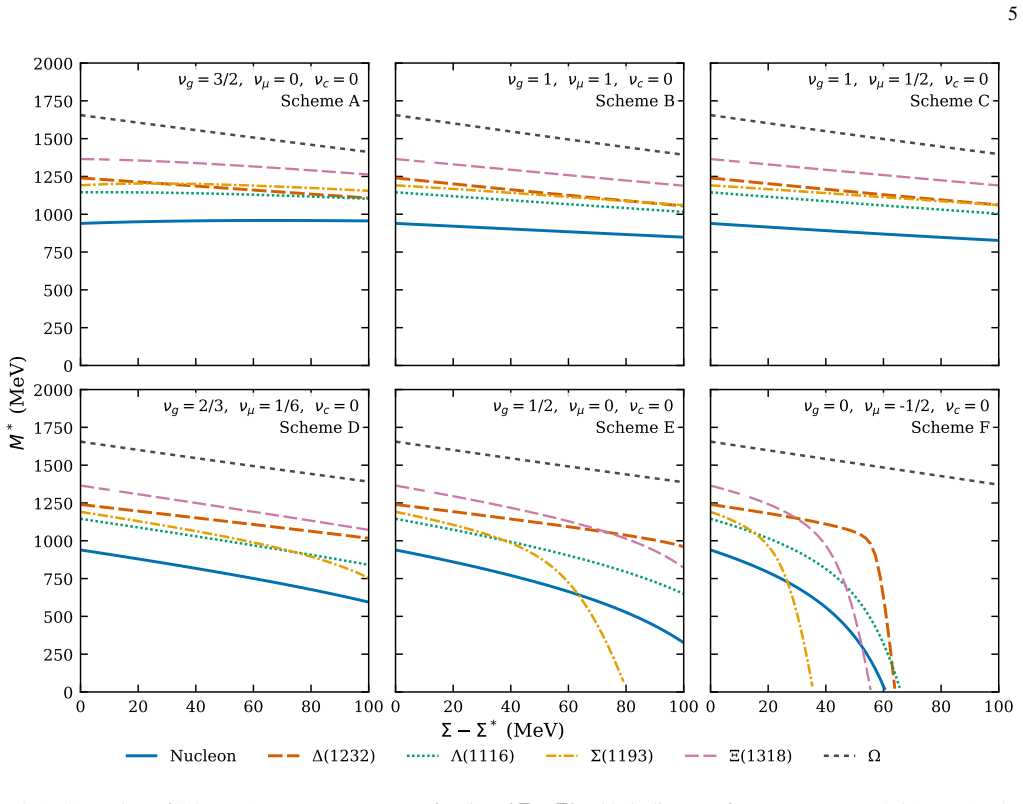
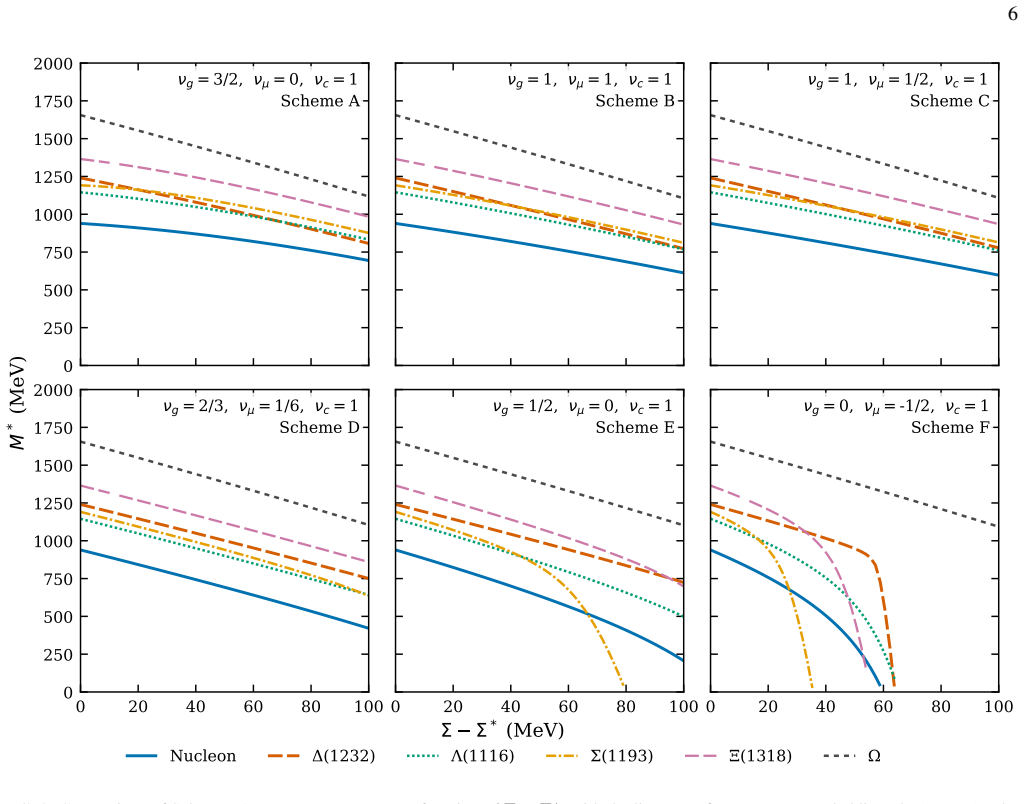
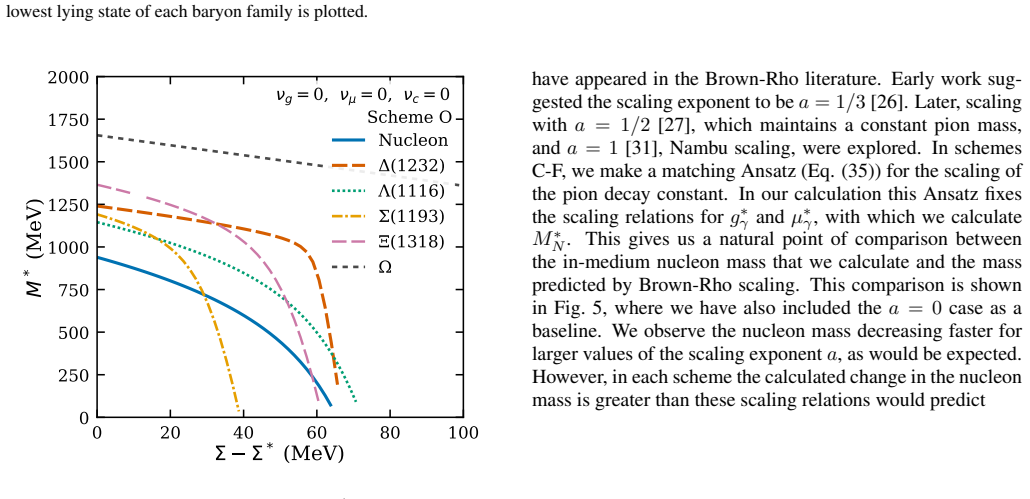
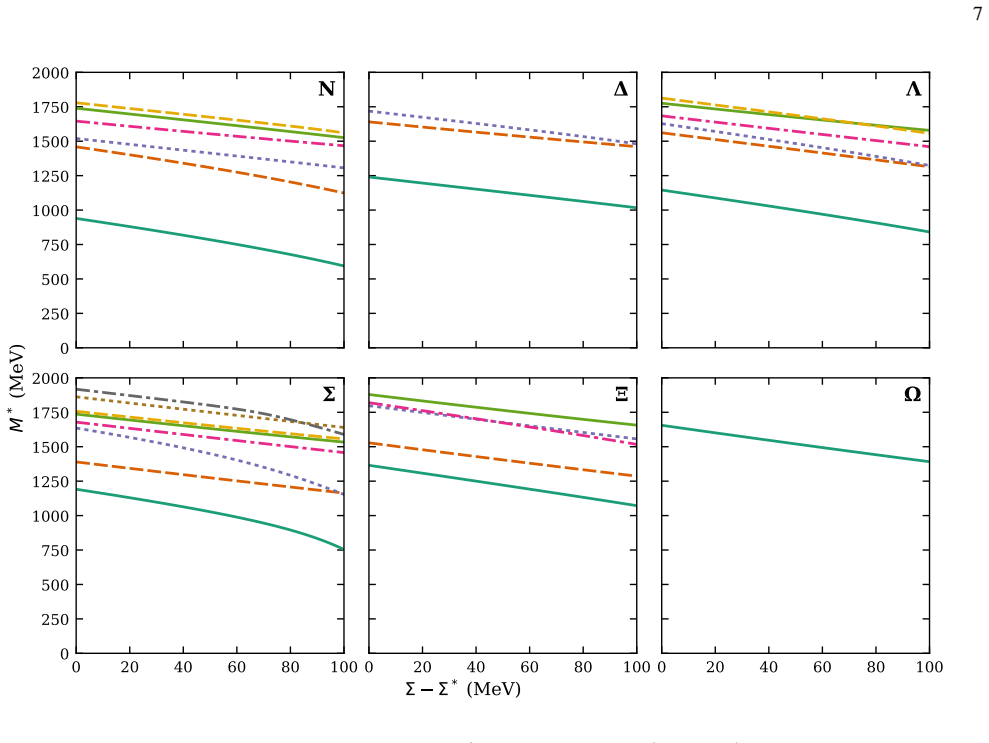
Solving the Goldstone-boson-exchange relativistic constituent quark model via the Faddeev approach reproduces the vacuum baryon spectrum below 2 GeV. Parametric variation of the model parameters through power-law scaling relations, some drawn from constituent-quark current algebra, shows that the spectrum is most sensitive to the quark-meson coupling constant. Baryon masses decrease with decreasing constituent quark mass, and these shifts produce sizable changes in ideal-gas baryon yields while yield ratios are affected only when the compared baryons carry different constituent-quark-mass dependence.
What carries the argument
The Goldstone-boson-exchange relativistic constituent quark model solved in the Faddeev approach, with parameters linked by power-law scaling relations.
If this is right
- Baryon masses fall when constituent quark masses decrease under the chosen scaling.
- The quark-meson coupling constant produces the largest shifts in the spectrum.
- Absolute baryon yields in an ideal gas change significantly for mass shifts of a few tens of MeV.
- Yield ratios between different baryons change strongly only when those baryons have unequal dependence on the constituent quark mass.
Where Pith is reading between the lines
- The parametric results supply a reference point for comparing with explicit finite-density or finite-temperature calculations of the same model.
- If the scaling relations hold, medium-modified baryon masses could alter the interpretation of measured particle ratios in heavy-ion data.
- Alternative scaling choices that preserve current-algebra relations at the quark level might produce different patterns of mass shifts and yield changes.
- The same framework could be used to track how the relative ordering of baryon states evolves with density.
Load-bearing premise
Power-law scaling relations can faithfully represent the simultaneous medium-induced changes in quark masses, boson masses, confinement strength, and coupling constant.
What would settle it
A lattice QCD calculation or direct medium simulation in which baryon masses do not decrease when constituent quark masses are reduced, or in which the quark-meson coupling does not control the mass shifts.
Figures


read the original abstract
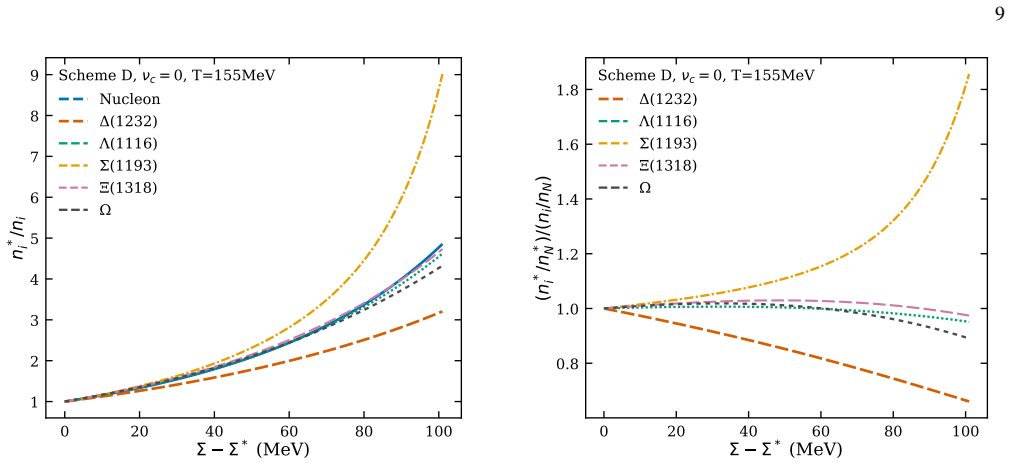
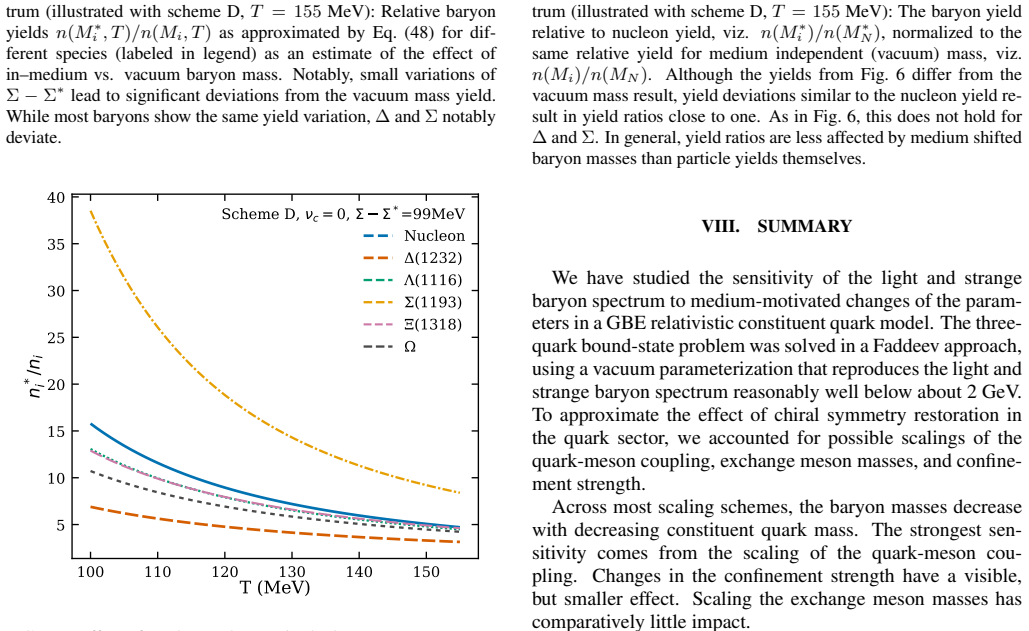
We solve the Goldstone-boson-exchange (GBE) relativistic constituent quark model of light and strange baryons by using the Faddeev approach. The model reproduces the vacuum mass spectrum of light and strange baryons below $2$ GeV reasonably well. To test the sensitivity of the model to possible medium-induced effects, we vary the masses of the constituent quarks and the exchange bosons, the confinement strength, and the quark-meson coupling constant. In a parametric study, we consider a set of power law scaling relations for these parameters, including some motivated by constituent quark level current algebra relations. We find that the baryon spectrum is most sensitive to the quark-meson coupling constant, and generally observe a decrease in baryon mass with decreasing constituent quark mass. We qualitatively estimate the impact of these mass shifts on ideal-gas baryon yields and yield ratios. Absolute yields can change significantly already for mass shifts of a few $10$~MeV, whereas yield ratios are strongly modified only when the compared baryons have different constituent-quark-mass dependence.
Editorial analysis
A structured set of objections, weighed in public.
Referee Report
Summary. The paper solves the Goldstone-boson-exchange (GBE) relativistic constituent quark model of light and strange baryons via the Faddeev approach. It reproduces the vacuum mass spectrum below 2 GeV reasonably well. A parametric study then varies the constituent quark masses, exchange boson masses, confinement strength, and quark-meson coupling constant using a set of power-law scaling relations (some motivated by constituent-quark current-algebra identities). The central findings are that the spectrum is most sensitive to the quark-meson coupling constant, baryon masses generally decrease with decreasing constituent quark mass, and these shifts can affect ideal-gas baryon yields and yield ratios, with absolute yields changing for mass shifts of a few 10 MeV while ratios are modified only for baryons with differing quark-mass dependence.
Significance. If the adopted power-law scalings prove representative of medium effects, the work offers an exploratory mapping of parameter sensitivities in a established quark model and a first qualitative link to observable yields. The Faddeev treatment of the three-body problem is a technical strength that ensures consistent relativistic kinematics. The absence of tabulated numerical spectra, error estimates, or direct comparison to data after the parameter changes, however, keeps the result at the level of a sensitivity survey rather than a quantitative prediction.
major comments (2)
- [parametric study section] The section describing the parametric study: the power-law scaling relations imposed simultaneously on the four free parameters (constituent quark masses, boson masses, confinement strength, quark-meson coupling) are introduced without derivation from the GBE Lagrangian, from chiral restoration, or from lattice QCD; only partial motivation from vacuum current-algebra identities is supplied. Because the reported sensitivity ordering and the mass-decrease trend are obtained by direct numerical solution under these specific relations, any change in the functional form or relative scaling would alter both the ranking and the yield estimates.
- [Abstract and results] Abstract and results section: no numerical values for the modified baryon masses, no error estimates on the Faddeev solutions, and no explicit comparison of the shifted spectra to vacuum data or to experiment are provided after the parameter changes. This omission is load-bearing for the claim that absolute yields change significantly for shifts of a few 10 MeV, as the magnitude cannot be assessed from the qualitative statement alone.
minor comments (2)
- [Abstract] The phrase 'reasonably well' for the vacuum spectrum reproduction is not quantified (e.g., by rms deviation or table of calculated vs. experimental masses), which would help readers gauge the baseline accuracy before medium modifications.
- [parametric study section] Notation for the scaling exponents and the precise functional forms of the power laws should be collected in a single equation or table for clarity.
Simulated Author's Rebuttal
We thank the referee for the careful reading of the manuscript and the constructive comments. We address each major comment below.
read point-by-point responses
-
Referee: [parametric study section] The section describing the parametric study: the power-law scaling relations imposed simultaneously on the four free parameters (constituent quark masses, boson masses, confinement strength, quark-meson coupling) are introduced without derivation from the GBE Lagrangian, from chiral restoration, or from lattice QCD; only partial motivation from vacuum current-algebra identities is supplied. Because the reported sensitivity ordering and the mass-decrease trend are obtained by direct numerical solution under these specific relations, any change in the functional form or relative scaling would alter both the ranking and the yield estimates.
Authors: We agree that the adopted power-law scalings are not derived from the GBE Lagrangian, chiral restoration scenarios, or lattice QCD. They are introduced as a parametric ansatz to explore sensitivities to possible medium effects, with partial motivation from vacuum constituent-quark current-algebra relations as stated in the text. The study is exploratory by design; the reported ordering and trends are specific to these choices, and different functional forms would indeed produce different results. We will revise the manuscript to state this limitation more explicitly in the parametric study section. revision: partial
-
Referee: [Abstract and results] Abstract and results section: no numerical values for the modified baryon masses, no error estimates on the Faddeev solutions, and no explicit comparison of the shifted spectra to vacuum data or to experiment are provided after the parameter changes. This omission is load-bearing for the claim that absolute yields change significantly for shifts of a few 10 MeV, as the magnitude cannot be assessed from the qualitative statement alone.
Authors: We agree that the absence of explicit numerical values for the shifted masses limits the quantitative assessment of the yield claims. The vacuum spectrum is compared to experiment in the manuscript, but the medium-modified cases are discussed only qualitatively. In the revised version we will add a table with selected numerical baryon masses (vacuum and shifted) for representative parameter sets, note the numerical convergence of the Faddeev solutions (typically to better than 1 MeV), and provide concrete examples of the mass shifts and their effect on ideal-gas yields. revision: yes
Circularity Check
No circularity: parametric variations are explicit inputs; sensitivity results from numerical Faddeev solutions
full rationale
The paper first reproduces the vacuum baryon spectrum by solving the GBE Faddeev equations with fixed parameters. It then performs an explicit parametric study by imposing a chosen set of power-law scalings on four parameters (quark masses, boson masses, confinement strength, coupling constant), with some scalings motivated by external current-algebra relations. The reported sensitivity ordering and mass-shift trends are obtained by repeated numerical solution under these imposed variations, not by any algebraic identity or self-referential definition that reduces the output to the input scalings. No self-citations, uniqueness theorems, or fitted-input-called-prediction steps appear in the provided text. The derivation chain is therefore self-contained against the model's own vacuum benchmark and the stated parametric assumptions.
Axiom & Free-Parameter Ledger
free parameters (4)
- constituent quark masses
- exchange boson masses
- confinement strength
- quark-meson coupling constant
axioms (2)
- domain assumption Goldstone-boson-exchange relativistic constituent quark model
- standard math Faddeev approach for three-quark bound states
Reference graph
Works this paper leans on
-
[1]
In analogy to a Nambu–Jona-Lasino (NJL) model [23–25], we associate the mass gap directly with the light quark mean-field condensateΣ ∗ ∝ ⟨¯qq⟩∗
We assume that all model parameters vary as a function of temperatureTand chemical potentialµonly through their dependence on the light quark mass gapΣ ∗ m∗ q =m 0 q + Σ∗,(28) whereΣ ∗ tends from its vacuum valueΣ =m q −m 0 q to zero. In analogy to a Nambu–Jona-Lasino (NJL) model [23–25], we associate the mass gap directly with the light quark mean-field ...
-
[2]
This is a deliberate oversimplification that, while masking underlying dynamics, makes simple scaling relations tractable
We take the strange quarks to vary as m∗ s =m 0 s +αΣ ∗,(29) whereα≈1.2is set to match vacuum constituent mass and the current mass of the strange quark. This is a deliberate oversimplification that, while masking underlying dynamics, makes simple scaling relations tractable. 4 TABLE I. Scaling schemes used in this study. The table shows the scaling of th...
-
[3]
Section VI discusses the effect of lifting these assumptions
We hold constant as a function ofΣ ∗ several model param- eters:g 0/g8, the ratio between the singlet and octet couplings; Λ0 andκ, which control the meson-mass dependent smearing of the delta function; andV 0, the offset energy. Section VI discusses the effect of lifting these assumptions. The meson-quark-quark couplingsg ∗ γ, exchange boson massesµ ∗ γ,...
2000
-
[4]
HoldingΛ ∗ γ constant, achieved by scaling the parameterκ ∗ ∝ (Σ∗)−νµ. 4. Holdingµ ∗ η′ constant, instead of scaling it with the octet meson masses. 5. Holdingg ∗ 0 constant, instead of scaling it with the octet couplings. In each case the modification is applied to scheme F (νc = 1), except for the final case, in which it is applied to scheme E (νc = 1)....
2000
-
[5]
B. D. Serot and J. D. Walecka, International Journal of Modern Physics E06, 515 (1997), https://doi.org/10.1142/S0218301397000299
-
[6]
M. Dutra, O. Lourenc ¸o, S. S. Avancini, B. V . Carlson, A. Delfino, D. P. Menezes, C. Provid ˆencia, S. Typel, and J. R. Stone, Phys. Rev. C90, 055203 (2014), arXiv:1405.3633 [nucl- th]
Pith/arXiv arXiv 2014
-
[7]
T. Niksic, D. Vretenar, and P. Ring, Prog. Part. Nucl. Phys.66, 519 (2011), arXiv:1102.4193 [nucl-th]
Pith/arXiv arXiv 2011
-
[8]
M. Oertel, M. Hempel, T. Kl¨ahn, and S. Typel, Rev. Mod. Phys. 89, 015007 (2017), arXiv:1610.03361 [astro-ph.HE]
Pith/arXiv arXiv 2017
-
[9]
C. D. Roberts, Few Body Syst.58, 5 (2017), arXiv:1606.03909 [nucl-th]
Pith/arXiv arXiv 2017
-
[10]
R. D. Pisarski and F. Wilczek, Phys. Rev. D29, 338 (1984)
1984
-
[11]
K. Fukushima and T. Hatsuda, Rept. Prog. Phys.74, 014001 (2011), arXiv:1005.4814 [hep-ph]
Pith/arXiv arXiv 2011
-
[12]
A. Bazavovet al.(HotQCD), Phys. Lett. B795, 15 (2019), arXiv:1812.08235 [hep-lat]
arXiv 2019
-
[13]
A. Bazavovet al., Phys. Rev. D85, 054503 (2012), arXiv:1111.1710 [hep-lat]
Pith/arXiv arXiv 2012
-
[14]
C. S. Fischer, Prog. Part. Nucl. Phys.105, 1 (2019), arXiv:1810.12938 [hep-ph]
Pith/arXiv arXiv 2019
-
[15]
C. D. Roberts and S. M. Schmidt, Prog. Part. Nucl. Phys.45, S1 (2000), arXiv:nucl-th/0005064
Pith/arXiv arXiv 2000
-
[16]
A. Andronic, P. Braun-Munzinger, K. Redlich, and J. Stachel, Nature561, 321 (2018), arXiv:1710.09425 [nucl-th]
Pith/arXiv arXiv 2018
-
[17]
K. Morita, C. Sasaki, P. M. Lo, and K. Redlich, EPJ Web Conf. 171, 05001 (2018), arXiv:1711.10779 [hep-ph]
Pith/arXiv arXiv 2018
-
[18]
F. Karsch, K. Redlich, and A. Tawfik, Eur. Phys. J. C29, 549 (2003), arXiv:hep-ph/0303108
Pith/arXiv arXiv 2003
-
[19]
A. Andronic, P. Braun-Munzinger, B. Friman, P. M. Lo, K. Redlich, and J. Stachel, Phys. Lett. B792, 304 (2019), arXiv:1808.03102 [hep-ph]
Pith/arXiv arXiv 2019
-
[20]
Papp, Few-Body Systems26, 99 (1999)
Z. Papp, Few-Body Systems26, 99 (1999)
1999
-
[21]
J. P. Day and Z. Papp, Physical Review D85, 114042 (2012)
2012
-
[22]
Z. Papp, A. Krassnigg, and W. Plessas, Phys. Rev. C62, 044004 (2000)
2000
-
[23]
L. Y . Glozman and D. O. Riska, Physics Reports268, 263 (1996)
1996
-
[24]
L. Y . Glozman, Z. Papp, and W. Plessas, Physics Letters B381, 311 (1996)
1996
-
[25]
L. Y . Glozman, Z. Papp, W. Plessas, K. Varga, and R. Wagen- brunn, Physical Review C57, 3406 (1998)
1998
-
[26]
L. Y . Glozman, W. Plessas, K. Varga, and R. Wagenbrunn, Physical Review D58, 094030 (1998)
1998
-
[27]
Nambu and G
Y . Nambu and G. Jona-Lasinio, Physical review122, 345 (1961)
1961
-
[28]
Nambu and G
Y . Nambu and G. Jona-Lasinio, Physical review124, 246 (1961)
1961
-
[29]
S. P. Klevansky, Rev. Mod. Phys.64, 649 (1992)
1992
-
[30]
Brown and M
G. Brown and M. Rho, Phys. Rev. Lett.66, 2720 (1991)
1991
-
[31]
G. E. Brown and M. Rho, Physics Reports269, 333 (1996)
1996
-
[32]
G. E. Brown and M. Rho, Physics Reports363, 85 (2002)
2002
-
[33]
Gell-Mann, R
M. Gell-Mann, R. J. Oakes, and B. Renner, Physical Review 175, 2195 (1968)
1968
-
[34]
Hatsuda and T
T. Hatsuda and T. Kunihiro, Physics Reports247, 221 (1994)
1994
-
[35]
Koch and G
V . Koch and G. Brown, Nuclear Physics A560, 345 (1993)
1993
discussion (0)
Sign in with ORCID, Apple, or X to comment. Anyone can read and Pith papers without signing in.