Sequential Clusterization of Light Nuclei and Hypernuclei in Heavy-Ion Collisions within a Wigner Function Coalescence Framework
Pith reviewed 2026-06-27 11:35 UTC · model grok-4.3
The pith
Realistic wave functions show non-universal formation times for different nuclear clusters in collisions.
A machine-rendered reading of the paper's core claim, the machinery that carries it, and where it could break.
Core claim
The formation of light nuclei and hypernuclei proceeds via coalescence whose timing depends on the specific cluster species, as extracted by matching rapidity distributions calculated from parameter-free Wigner functions to experimental data.
What carries the argument
Wigner phase-space distributions constructed from realistic N-body wave functions obtained by solving the Schrödinger equation in the hyperspherical harmonics formalism.
Load-bearing premise
The coalescence times fitted to rapidity distributions of some clusters are physically meaningful, species-dependent, and transferable to other clusters and hypernuclei.
What would settle it
A future measurement of the yield or rapidity distribution of 5ΛHe or 5ΛΛHe that deviates substantially from the prediction obtained with the extracted coalescence times.
Figures


read the original abstract
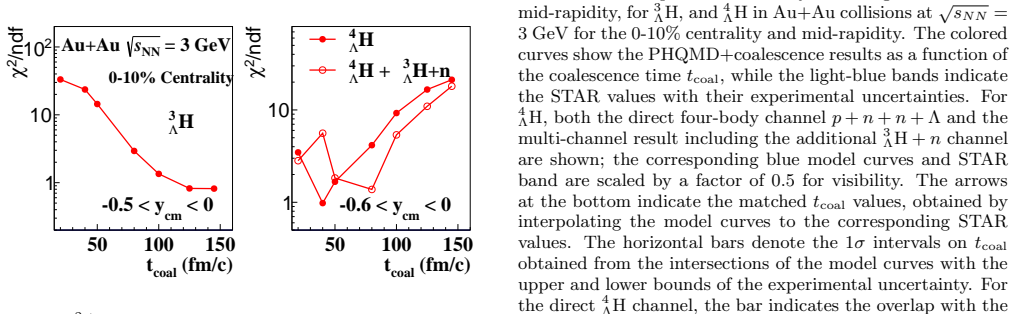
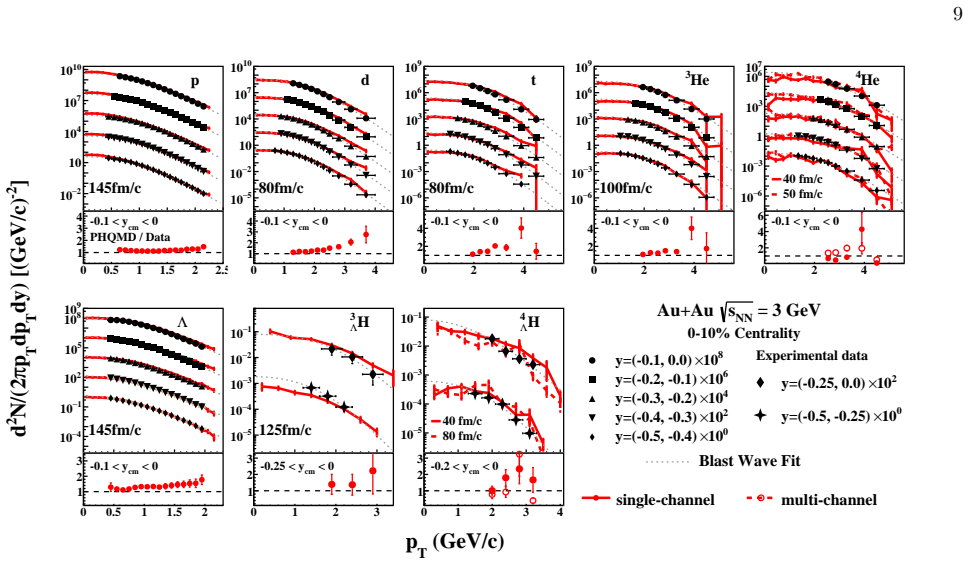
We investigate the formation of light nuclei and hypernuclei in Au+Au collisions at $\sqrt{s_{NN}}=3~\mathrm{GeV}$ within a coalescence framework embedded in the microscopic N-body Parton-Hadron-Quantum-Molecular Dynamics (PHQMD) transport model. The Wigner phase-space distributions employed in the coalescence calculation are constructed from realistic $N$-body wave functions obtained by solving the Schr\"odinger equation in the hyperspherical harmonics formalism, providing a solid and parameter-free description of nuclear clusters and hypernuclei. By comparing calculated rapidity distributions with STAR data, we extract species-dependent coalescence times, revealing a non-universal formation pattern among different clusters. The resulting yields and kinematic distributions of light nuclei and hypernuclei are systematically analyzed and shown to be sensitive to the underlying wave-function structure and formation time. In addition, we explore cluster-nucleon formation channels for $A=4$ systems. These additional channels improve the description of ${}^{4}\mathrm{He}$ and ${}^{4}_{\Lambda}\mathrm{H}$ yields and help address the underestimation of $A=4$ cluster production in theoretical approaches. Finally, we provide predictions for heavier hypernuclei, including ${}^{5}_{\Lambda}\mathrm{He}$ and ${}^{5}_{\Lambda\Lambda}\mathrm{He}$, which are of interest for future experimental measurements.
Editorial analysis
A structured set of objections, weighed in public.
Referee Report
Summary. The manuscript develops a coalescence framework embedded in the PHQMD transport model for light nuclei and hypernuclei in √s_NN=3 GeV Au+Au collisions. Wigner phase-space distributions are constructed from realistic N-body wave functions obtained by solving the Schrödinger equation in the hyperspherical harmonics formalism, providing a parameter-free description of cluster structure. Species-dependent coalescence times are extracted by comparing calculated rapidity distributions to STAR data, revealing a non-universal formation pattern. Additional cluster-nucleon channels are explored for A=4 systems to improve yields of 4He and 4_ΛH, and predictions are provided for 5_ΛHe and 5_ΛΛHe.
Significance. The parameter-free construction of Wigner distributions from hyperspherical-harmonics solutions of the Schrödinger equation is a clear methodological strength that reduces phenomenological inputs for cluster wave functions. If the extracted coalescence times can be shown to have physical content beyond improving fits to the calibration data, the non-universal formation pattern and the A=5 predictions would constitute a useful advance for interpreting hypernuclear yields in heavy-ion collisions.
major comments (2)
- [Abstract and coalescence-times extraction section] Abstract and the section describing extraction of coalescence times: the non-universal formation pattern and all predictions for 5_ΛHe and 5_ΛΛHe rest on species-dependent coalescence times that are determined by fitting rapidity distributions to STAR data for lighter clusters; the manuscript does not demonstrate independent validation or sensitivity analysis showing that these times are transferable rather than compensating for deficiencies in the PHQMD background or the coalescence implementation itself.
- [A=4 channels section] Section on A=4 formation channels: the claim that the additional cluster-nucleon channels improve the description of 4He and 4_ΛH yields is load-bearing for the assertion that extra channels address underestimation in theoretical approaches, yet no quantitative table or figure directly compares the baseline versus extended-channel yields against the same STAR data set.
minor comments (2)
- [Notation throughout] Ensure consistent notation for hypernuclear species (e.g., 5_ΛHe) across text, equations, and figures.
- [Wave-function construction paragraph] The abstract mentions systematic analysis of yields and kinematic distributions; a brief statement on the numerical convergence of the hyperspherical-harmonics wave functions would strengthen the parameter-free claim.
Simulated Author's Rebuttal
We thank the referee for the careful and constructive review of our manuscript. We address the two major comments point by point below.
read point-by-point responses
-
Referee: [Abstract and coalescence-times extraction section] Abstract and the section describing extraction of coalescence times: the non-universal formation pattern and all predictions for 5_ΛHe and 5_ΛΛHe rest on species-dependent coalescence times that are determined by fitting rapidity distributions to STAR data for lighter clusters; the manuscript does not demonstrate independent validation or sensitivity analysis showing that these times are transferable rather than compensating for deficiencies in the PHQMD background or the coalescence implementation itself.
Authors: The coalescence times are extracted by fitting the model rapidity distributions to the STAR data available for the lighter species (A ≤ 4). This procedure is the explicit method used to determine the formation times within the PHQMD + Wigner coalescence framework, and the resulting non-universality is a direct outcome of those fits. The A = 5 predictions are obtained by applying the same extracted times to the corresponding hypernuclear channels. We acknowledge that the manuscript does not contain an independent cross-validation (e.g., on additional observables or different collision energies) that would demonstrate transferability beyond the calibration data. A brief discussion of this assumption and its implications can be added in the revised manuscript, but a full sensitivity study would require substantial additional calculations. revision: partial
-
Referee: [A=4 channels section] Section on A=4 formation channels: the claim that the additional cluster-nucleon channels improve the description of 4He and 4_ΛH yields is load-bearing for the assertion that extra channels address underestimation in theoretical approaches, yet no quantitative table or figure directly compares the baseline versus extended-channel yields against the same STAR data set.
Authors: We agree that a direct side-by-side comparison is needed to substantiate the improvement. In the revised manuscript we will include a table (or supplementary figure) that reports the yields of 4He and 4_ΛH obtained with the baseline coalescence channels versus the extended set of cluster-nucleon channels, both compared to the same STAR data points. revision: yes
Circularity Check
Coalescence times fitted to data for lighter species then applied to A=5 predictions
specific steps
-
fitted input called prediction
[Abstract]
"By comparing calculated rapidity distributions with STAR data, we extract species-dependent coalescence times, revealing a non-universal formation pattern among different clusters. [...] Finally, we provide predictions for heavier hypernuclei, including 5_ΛHe and 5_ΛΛHe"
Coalescence times are adjusted to match data for lighter species; the same times then determine the calculated yields for unmeasured heavier hypernuclei, so those predictions incorporate the fitted parameters rather than being independent first-principles outputs.
full rationale
The Wigner distributions are constructed parameter-free from hyperspherical-harmonics solutions of the Schrödinger equation, which is independent content. However, species-dependent coalescence times are extracted by fitting rapidity distributions to STAR data for lighter clusters and then used to generate yields and distributions for A=4 and A=5 hypernuclei. This constitutes a fitted-input-called-prediction pattern for the extrapolated results, though the central wave-function claim remains non-circular and the times are not self-defined by the target observables.
Axiom & Free-Parameter Ledger
free parameters (1)
- species-dependent coalescence times
axioms (2)
- domain assumption Coalescence model accurately describes cluster formation in heavy-ion collisions
- domain assumption Hyperspherical harmonics solutions provide accurate N-body wave functions for light nuclei and hypernuclei
Reference graph
Works this paper leans on
-
[1]
D. Oliinychenko, L.-G. Pang, H. Elfner, and V. Koch, Deuterons at LHC: “snowballs in hell” via hydrodynam- ics and hadronic afterburner, Phys. Rev. C99, 044907 (2019), arXiv:1809.03071 [hep-ph]
Pith/arXiv arXiv 2019
-
[2]
D. Oliinychenko, C. Shen, and V. Koch, Deuteron pro- duction in Au+Au collisions at √sN N = 7–200 GeV via pion catalysis, Phys. Rev. C103, 034913 (2021), arXiv:2009.14681 [hep-ph]
arXiv 2021
-
[3]
J. Aichelin, “Quantum” molecular dynamics — A dy- namical microscopicn-body approach to investigate frag- ment formation and the nuclear equation of state in heavy ion collisions, Phys. Rep.202, 233 (1991)
1991
-
[5]
Gl¨ aßel, V
S. Gl¨ aßel, V. Kireyeu, V. Voronyuk, J. Aichelin, 11 C. Blume, E. Bratkovskaya, G. Coci, V. Kolesnikov, and M. Winn, Cluster and hypercluster production in rela- tivistic heavy-ion collisions within the parton–hadron– quantum–molecular-dynamics approach, Phys. Rev. C 105, 014908 (2022)
2022
-
[6]
G. Coci, S. Gl¨ asel, V. Kireyeu, J. Aichelin, C. Blume, E. Bratkovskaya, V. Kolesnikov, and V. Voronyuk, Dy- namical mechanisms for deuteron production at mid- rapidity in relativistic heavy-ion collisions from energies available at the GSI schwerionensynchrotron to those at the BNL relativistic heavy ion collider, Phys. Rev. C108, 014902 (2023)
2023
-
[7]
V. Kireyeu, V. Voronyuk, M. Winn, S. Gl¨ asel, J. Aiche- lin, C. Blume, E. Bratkovskaya, G. Coci, and J. Zhao, Constraints on the equation of state from low-energy heavy-ion collisions within the PHQMD microscopic approach with momentum-dependent potential, arXiv preprint (2024), arXiv:2411.04969 [nucl-th]
Pith/arXiv arXiv 2024
- [8]
-
[9]
M. I. Abdulhamid, B. E. Aboona, J. Adam, L. Adam- czyk, J. R. Adams, I. Aggarwal, M. M. Aggarwal, Z. Ahammed, E. C. Aschenauer, et al. (STAR), Produc- tion of protons and light nuclei in au+au collisions at√sN N = 3 gev with the star detector, Phys. Rev. C110, 054911 (2024)
2024
-
[10]
M. S. A. et al. (STAR Collaboration), Measurements of 3 ΛH and 4 ΛH lifetimes and yields in au+au collisions in the high baryon density region, Phys. Rev. Lett.128, 202301 (2022)
2022
-
[11]
S. A. et al. (ALICE Collaboration), First measurement of a= 4 hypernuclei and antihypernuclei at the lhc, Physi- cal Review Letters134, 162301 (2025)
2025
-
[12]
Collaboration, Measurement of 3 ΛH production in pb– pb collisions at √sNN = 5.02 tev, Physics Letters B860, 139066 (2025)
A. Collaboration, Measurement of 3 ΛH production in pb– pb collisions at √sNN = 5.02 tev, Physics Letters B860, 139066 (2025)
2025
-
[13]
T. A. Armstrong et al. (E864), Production of H- 3(Lambda) and H-4(Lambda) in central 11.5-GeV/c Au + Pt heavy ion collisions, Phys. Rev. C70, 024902 (2004), arXiv:nucl-ex/0211010
Pith/arXiv arXiv 2004
-
[14]
T. A. Armstrong et al. (E864), Measurements of light nuclei production in 11.5-A-GeV/c Au + Pb heavy ion collisions, Phys. Rev. C61, 064908 (2000), arXiv:nucl- ex/0003009
arXiv 2000
-
[15]
S. S. Adler et al. (PHENIX), Deuteron and antideuteron production in Au + Au collisions at √sN N = 200- GeV, Phys. Rev. Lett.94, 122302 (2005), arXiv:nucl- ex/0406004
arXiv 2005
-
[16]
R. Abou Yassine et al. (HADES), Formation and lifetime measurements of light hypernuclei in Ag+Ag collisions at√sNN = 2.55 GeV (2025), arXiv:2512.12454 [nucl-ex]
arXiv 2025
-
[17]
STAR Collaboration, Light nuclei collectivity from√sN N = 3 gev au+au collisions at rhic, Phys. Lett. B 827, 136941 (2022)
2022
-
[18]
B. E. A. et al. (STAR Collaboration), Observation of directed flow of hypernuclei 3 ΛH and 4 ΛH in √sN N = 3 gev au+au collisions at rhic, Phys. Rev. Lett.130, 212301 (2023)
2023
-
[19]
S. Acharya et al. (ALICE), Measurement of the produc- tion and elliptic flow of (anti)nuclei in Xe-Xe collisions at sNN=5.44 TeV, Phys. Rev. C110, 064901 (2024), arXiv:2405.19826 [nucl-ex]
arXiv 2024
-
[20]
J. Adamczewski-Musch et al. (HADES), Directed, El- liptic, and Higher Order Flow Harmonics of Pro- tons, Deuterons, and Tritons in Au + Au Collisions at√sN N = 2.4 GeV, Phys. Rev. Lett.125, 262301 (2020), arXiv:2005.12217 [nucl-ex]
arXiv 2020
-
[21]
S. Acharya et al. (ALICE), Measurement of (anti)alpha production in central Pb–Pb collisions at sNN=5.02 TeV, Phys. Lett. B858, 138943 (2024), arXiv:2311.11758 [nucl-ex]
arXiv 2024
-
[22]
L. K. Liu, C. L. Hu, X. H. He, S. S. Shi, and G. N. Xie, Light and hyper nuclei formation at sNN= 3 GeV Au+Au collisions using Wigner coalescence approach, Phys. Lett. B855, 138853 (2024), arXiv:2404.13582 [nucl-th]
arXiv 2024
-
[23]
R. Scheibl and U. W. Heinz, Coalescence and flow in ultrarelativistic heavy ion collisions, Phys. Rev. C59, 1585 (1999), arXiv:nucl-th/9809092
Pith/arXiv arXiv 1999
-
[24]
Sato and K
H. Sato and K. Yazaki, On the coalescence model for high energy nuclear reactions, Physics Letters B98, 153 (1981)
1981
-
[25]
Scheibl and U
R. Scheibl and U. Heinz, Coalescence and flow in ultra- relativistic heavy ion collisions, Phys. Rev. C59, 1585 (1999)
1999
-
[26]
F. Bellini, K. Blum, A. P. Kalweit, and M. Puccio, Examination of coalescence as the origin of nuclei in hadronic collisions, Phys. Rev. C103, 014907 (2021), arXiv:2007.01750 [nucl-th]
arXiv 2021
-
[27]
M. Mahlein, B. Singh, M. Viviani, F. Bellini, L. Fabbietti, A. Kievsky, and L. E. Marcucci, ToMCCA-3: A realistic 3-body coalescence model (2025), arXiv:2504.02491 [hep- ph]
arXiv 2025
-
[28]
Y. H. Leung, Y. Zhou, and N. Herrmann, Data- guided coalescence model for production of light nu- clei and hypernuclei in relativistic heavy-ion collisions at√sN N = 3–200 GeV, Phys. Rev. C113, 034912 (2026), arXiv:2510.06758 [nucl-th]
arXiv 2026
-
[29]
K.-J. Sun, R. Wang, C. M. Ko, Y.-G. Ma, and C. Shen, Unveiling the dynamics of little-bang nucleosynthesis, Nature Commun.15, 1074 (2024), arXiv:2207.12532 [nucl-th]
arXiv 2024
-
[30]
E. Shuryak and J. M. Torres-Rincon, Light-nuclei pro- duction and search for the QCD critical point, Eur. Phys. J. A56, 241 (2020), arXiv:2005.14216 [nucl-th]
arXiv 2020
- [31]
-
[32]
J. Aichelin, E. Bratkovskaya, A. Le F` evre, V. Kireyeu, V. Kolesnikov, Y. Leifels, V. Voronyuk, and G. Coci, Parton-hadron-quantum-molecular dynamics: A novel microscopicn-body transport approach for heavy-ion collisions, dynamical cluster formation, and hypernu- clei production, Phys. Rev. C101, 044905 (2020), arXiv:1907.03860 [nucl-th]
arXiv 2020
-
[33]
S. Gl¨ aßel, V. Kireyeu, V. Voronyuk, J. Aichelin, C. Blume, E. Bratkovskaya, G. Coci, V. Kolesnikov, and M. Winn, Cluster and hypercluster production in rel- ativistic heavy-ion collisions within the parton-hadron- quantum-molecular-dynamics approach, Phys. Rev. C 105, 014908 (2022), arXiv:2106.14839 [nucl-th]
arXiv 2022
-
[34]
V. Kireyeu, J. Steinheimer, J. Aichelin, M. Bleicher, and E. Bratkovskaya, Deuteron production in ultrarelativistic heavy-ion collisions: A comparison of the coalescence and the minimum spanning tree procedure, Phys. Rev. C105, 12 044909 (2022), arXiv:2201.13374 [nucl-th]
arXiv 2022
-
[35]
G. Coci, S. Gl¨ aßel, V. Kireyeu, J. Aichelin, C. Blume, E. Bratkovskaya, V. Kolesnikov, and V. Voronyuk, Dy- namical mechanisms for deuteron production at mid- rapidity in relativistic heavy-ion collisions from energies available at the GSI Schwerionensynchrotron to those at the BNL Relativistic Heavy Ion Collider, Phys. Rev. C 108, 014902 (2023), arXiv:...
arXiv 2023
-
[36]
Y. Zhou, S. Gl¨ aßel, Y.-H. Leung, V. Kireyeu, J. Zhao, H. Liu, C. Blume, I. Vassiliev, V. Voronyuk, et al., Prob- ing the nuclear equation of state with clusters and hy- pernuclei, Phys. Rev. C113, 014909 (2026)
2026
-
[37]
W. Cassing and E. L. Bratkovskaya, Parton-Hadron- String Dynamics: an off-shell transport approach for relativistic energies, Nucl. Phys. A831, 215 (2009), arXiv:0907.5331 [nucl-th]
Pith/arXiv arXiv 2009
-
[38]
STAR Collaboration, Disappearance of partonic collec- tivity in √sN N = 3 gev au+au collisions at rhic, Phys. Lett. B827, 137003 (2022)
2022
-
[39]
J. Zhao, J. Aichelin, and E. Bratkovskaya, Wigner phase- space densities of nuclear clusters and hypernuclei, Phys. Rev. C112, 064902 (2025)
2025
- [40]
-
[41]
L. E. Marcucci, J. Dohet-Eraly, L. Girlanda, A. Gnech, A. Kievsky, and M. Viviani, The Hyperspherical Har- monics method: a tool for testing and improving nu- clear interaction models, Front. in Phys.8, 69 (2020), arXiv:1912.09751 [nucl-th]
arXiv 2020
-
[42]
J. Zhao, S. Shi, and P. Zhuang, Fully-heavy tetraquarks in a strongly interacting medium, Phys. Rev. D102, 114001 (2020), arXiv:2009.10319 [hep-ph]
arXiv 2020
-
[43]
Bedjidian, A
M. Bedjidian, A. Filipkowski, J. Grossiord, A. Guichard, M. Gusakow, S. Majewski, H. Piekarz, J. Piekarz, and J. Pizzi, Observation of aγtransition in the 4 ΛH hyper- nucleus, Physics Letters B62, 467 (1976)
1976
-
[44]
A. Deltuva and A. C. Fonseca, Four-nucleon scattering: Ab initio calculations in momentum space, Phys. Rev. C 75, 014005 (2007), arXiv:nucl-th/0611029
Pith/arXiv arXiv 2007
-
[45]
R.-Q. Wang, J. Song, M.-Y. Wu, H.-T. Xue, and F.-L. Shao, Production of HΛ3, HΛ4, and HeΛ4 in different coalescence channels in Au-Au collisions at sNN=3 GeV, Phys. Rev. C112, 034908 (2025), arXiv:2504.13640 [nucl-th]
arXiv 2025
-
[46]
M. I. Abdulhamid et al. (STAR), Strangeness production in √sNN = 3 GeV Au+Au collisions at RHIC, JHEP10, 139, arXiv:2407.10110 [nucl-ex]
-
[47]
Adamczyk, J
L. Adamczyk, J. R. Adams, J. K. Adkins, G. Agakishiev, M. M. Aggarwal, Z. Ahammed, N. N. Ajitanand, I. Alek- seev, J. Alford, et al. (STAR Collaboration), Measure- ment of the 3 ΛH lifetime in au+au collisions at the bnl rel- ativistic heavy ion collider, Physical Review C97, 054909 (2018)
2018
-
[48]
Juri´ c, G
M. Juri´ c, G. Bohm, J. Klabuhn, U. Krecker, F. Wysotzki, G. Coremans-Bertrand, J. Sacton, G. Wil- quet, T. Cantwell, F. Esmael, A. Montwill, D. H. Davis, D. Kie lczewska, T. Pniewski, T. Tymieniecka, and J. Za- krzewski, A new determination of the binding-energy val- ues of the light hypernuclei (a≤15), Nuclear Physics B 52, 1 (1973)
1973
-
[49]
J. G. Congleton, A simple model of the hypertriton, Jour- nal of Physics G: Nuclear and Particle Physics18, 339 (1992)
1992
-
[50]
Kamada, J
H. Kamada, J. Golak, K. Miyagawa, H. Wita la, and W. Gl¨ ockle,π-mesonic decay of the hypertriton, Phys- ical Review C57, 1595 (1998)
1998
-
[51]
H. Outa, M. Aoki, R. S. Hayano, T. Ishikawa, M. Iwasaki, A. Sakaguchi, E. Takada, H. Tamura, and T. Yamazaki, Mesonic and non-mesonic decay widths of 4 ΛH and 4 ΛHe, Nuclear Physics A639, 251c (1998)
1998
discussion (0)
Sign in with ORCID, Apple, or X to comment. Anyone can read and Pith papers without signing in.