Multi-epoch scattered-light analysis of HD 135344B: new evidence for a spiral-driving protoplanet
Pith reviewed 2026-06-27 12:01 UTC · model grok-4.3
The pith
The scattered-light twist in the HD 135344B disk moves at the orbital speed expected for a planet at 69 au.
A machine-rendered reading of the paper's core claim, the machinery that carries it, and where it could break.
Core claim
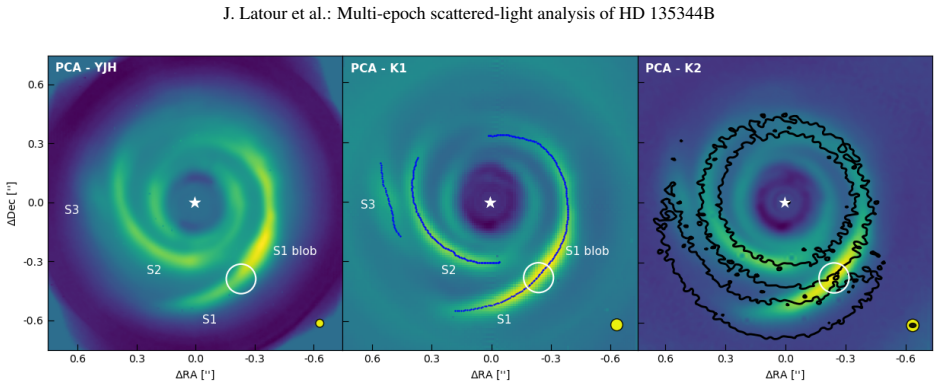
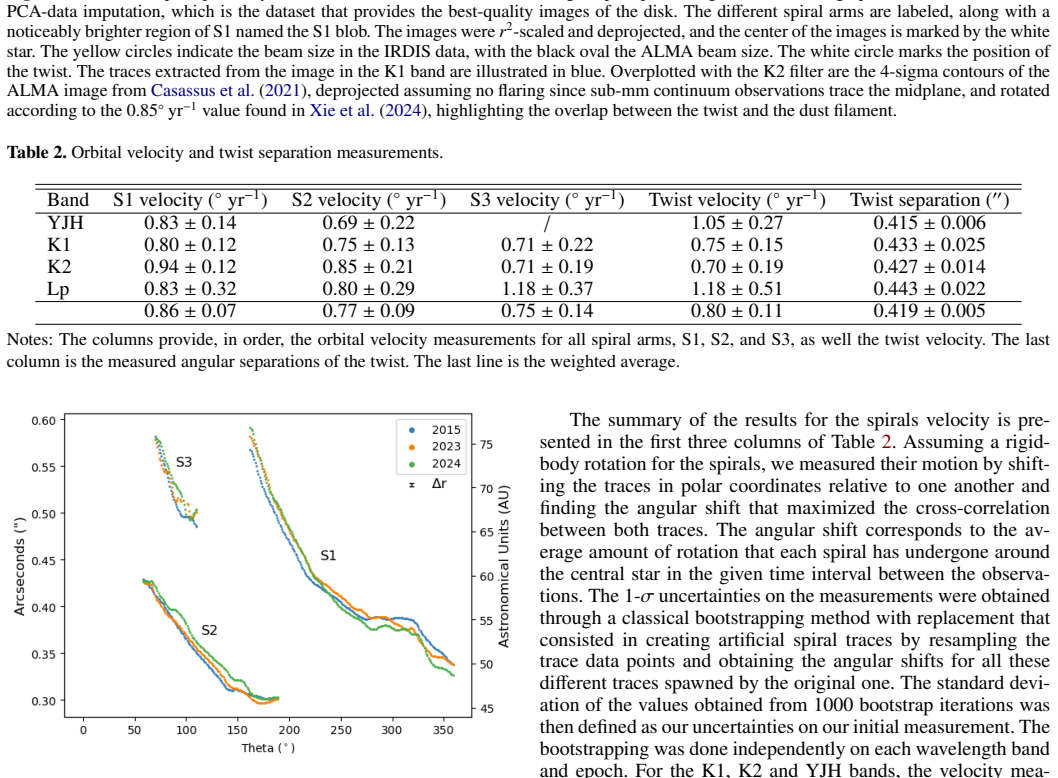
Tracking the spiral traces and the twist they contain across VLT/NACO, SPHERE, ERIS, and JWST/NIRCam datasets shows an average orbital motion of 0.81 ± 0.05 deg/yr that is consistent with a body at 69 ± 4 au. Simple modeling confirms the twist moves together with the spiral in which it sits, and its position angle aligns with the ALMA dust filament, while its smaller separation at shorter wavelengths is attributed to the spiral itself moving outward with wavelength.
What carries the argument
Multi-epoch measurement of the position angle and radial location of the scattered-light twist after applying post-processing to reduce biases on extended emission.
If this is right
- The spirals, gap, dust filament, and twist share a common origin in one protoplanet embedded within the spiral at about 69 au.
- A recently claimed protoplanet candidate is a post-processing artifact and does not correspond to a real body.
- The twist remains co-moving with the spiral over the full ten-year baseline at all observed wavelengths.
- The angular separation of the spiral trace from the star increases with wavelength, producing the observed shift in the twist location.
Where Pith is reading between the lines
- If the single-protoplanet picture holds, similar twists in other disks could serve as indirect tracers of embedded planets when direct detection remains difficult.
- The unexplained wavelength dependence of spiral radius may require models that include the vertical structure or temperature gradient of the disk surface.
- Repeated imaging campaigns on other spiral-hosting disks could test whether the same orbital-motion signature appears at comparable separations.
Load-bearing premise
The smaller angular separation of the twist at shorter wavelengths occurs because the spiral trace itself moves outward with increasing wavelength rather than marking a separate physical structure or projection effect.
What would settle it
A new observation epoch in which the twist has not advanced by roughly 0.81 degrees per year from its prior positions would show that the motion is not orbital at 69 au.
Figures




read the original abstract
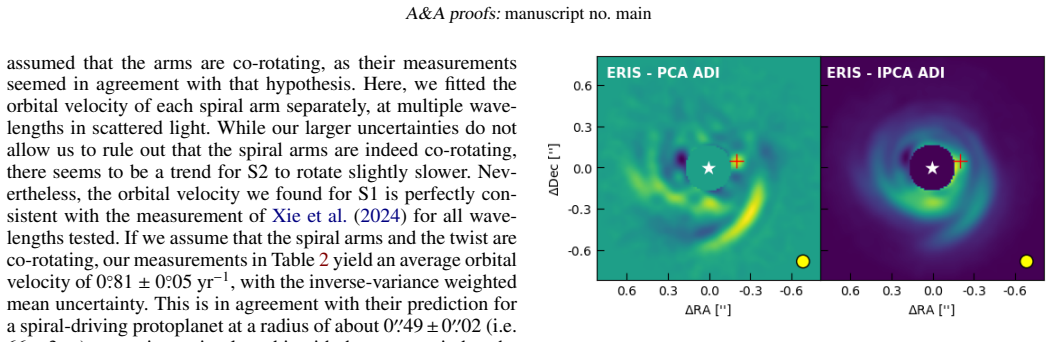
The HD 135344B (SAO 206462) disk exhibits strong signposts of planet formation. ALMA images in the sub-mm revealed a gap-crossing dust filament whose position coincides with a twist detected in the scattered-light spiral structure. Analysis of the spirals in polarized light also hints at a spiral-driving protoplanet in the sub-mm gap. We aim to study the spirals dynamics, as well as the twist, over a 10-year baseline, in different bands. We also seek to assess the authenticity of a recently claimed candidate protoplanet. We use high-fidelity post-processing algorithms such as IPCA to minimize the biases induced by ADI on extended sources and analyze archival VLT/NACO, VLT/SPHERE, VLT/ERIS and JWST/NIRCam datasets to obtain the spiral traces and measure their orbital motion in multiple scattered light bands. We measure an average spiral orbital motion of 0.81$\pm$0.05 deg/yr, in agreement with the literature value of about 0.85$\pm$0.05 deg/yr at all wavelengths. With simple modeling of the twist morphology, we confirm that it is co-moving with the spiral in which it is embedded. While the position angle of the twist coincides with the dust filament, it is located at a smaller angular separation from the star, which we attribute to the fact that the spiral trace moves away from the central star with increasing wavelength. We find that a recently claimed protoplanet candidate can be explained as a post-processing artifact. Our confirmation that the motion of the scattered light twist is consistent with the orbital velocity of a planet at 69$\pm$4 au over a 10-year baseline suggests that the spirals, the gap, the dust filament, and the twist, could indeed be attributed to the same hypothetical protoplanet embedded within the spiral. A perplexing trend for a wavelength-dependence of the angular distance of the spiral traces to the central star remains to be explained.
Editorial analysis
A structured set of objections, weighed in public.
Referee Report
Summary. The paper analyzes multi-epoch scattered-light data (VLT/NACO, SPHERE, ERIS, JWST/NIRCam) of the HD 135344B disk over a ~10-year baseline. It reports an average spiral orbital motion of 0.81±0.05 deg/yr consistent with prior measurements, uses simple modeling to confirm that the twist feature co-moves with the embedded spiral, dismisses a recently claimed protoplanet candidate as a post-processing artifact, and concludes that the spirals, gap, dust filament, and twist are consistent with a single hypothetical protoplanet at 69±4 au. The abstract notes a perplexing wavelength-dependent trend in the angular separation of the spiral traces.
Significance. If the attribution to a single protoplanet holds, the work supplies dynamical evidence connecting multiple disk signposts over a decade-long baseline and across wavelengths, bolstering interpretations of planet-driven spirals in transition disks. Strengths include the use of IPCA to reduce ADI biases on extended emission, the direct measurement of consistent angular motion (0.81±0.05 deg/yr) matching literature, and the explicit dismissal of an artifact candidate. The low circularity of the 69 au radius (derived from observed angular speed via standard Keplerian conversion) is a positive feature.
major comments (1)
- [Abstract] Abstract (final paragraph) and discussion of twist morphology: The central claim that the spirals, gap, dust filament, and twist can be attributed to the same protoplanet at 69±4 au rests on positional coincidence. This requires interpreting the smaller angular separation of the twist at shorter wavelengths as the spiral trace moving outward with increasing wavelength. No quantitative model of scattering-surface height, pitch-angle variation, or projection effects is supplied to justify the shift, and the text itself labels the trend 'perplexing' and 'remain[ing] to be explained.' If the wavelength dependence instead indicates a distinct structure, the unification argument is weakened.
minor comments (2)
- [Methods/Results] The modeling of the twist is described as 'simple'; adding a brief sensitivity test to assumed spiral geometry or inclination would strengthen the co-motion result without altering the main analysis.
- Notation for angular separations and position angles should be defined consistently in a single table or section to aid comparison across bands and epochs.
Simulated Author's Rebuttal
We thank the referee for their careful reading and constructive feedback on our manuscript. We respond to the single major comment below.
read point-by-point responses
-
Referee: [Abstract] Abstract (final paragraph) and discussion of twist morphology: The central claim that the spirals, gap, dust filament, and twist can be attributed to the same protoplanet at 69±4 au rests on positional coincidence. This requires interpreting the smaller angular separation of the twist at shorter wavelengths as the spiral trace moving outward with increasing wavelength. No quantitative model of scattering-surface height, pitch-angle variation, or projection effects is supplied to justify the shift, and the text itself labels the trend 'perplexing' and 'remain[ing] to be explained.' If the wavelength dependence instead indicates a distinct structure, the unification argument is weakened.
Authors: We acknowledge that the manuscript provides no quantitative model of scattering-surface height, pitch-angle variation, or projection effects to explain the wavelength-dependent radial shift, which we explicitly describe as 'perplexing' and remaining to be explained. However, the central unification argument is not based solely on positional coincidence. It rests primarily on the dynamical evidence: the measured angular motion of 0.81±0.05 deg/yr is identical across all wavelengths and consistent with Keplerian motion at 69±4 au, while our simple modeling confirms the twist co-moves with the spiral over the 10-year baseline. The wavelength-independent angular speed supports the features being physically connected even if their apparent radial locations vary. We will revise the abstract and discussion to better distinguish the dynamical constraints from the morphological interpretation and to explicitly note the absence of a quantitative scattering model as a limitation requiring future work. revision: partial
Circularity Check
No significant circularity: purely observational measurement converted via standard Keplerian law
full rationale
The paper measures angular orbital motion (0.81±0.05 deg/yr) directly from multi-epoch imaging across bands and converts it to a semi-major axis of 69±4 au using the standard Keplerian relation between angular speed and orbital radius. This conversion relies on external constants (stellar mass, distance) and contains no internal fitting, self-citation chain, or redefinition of inputs as outputs. The wavelength-dependent radial shift is explicitly flagged as a 'perplexing trend' that 'remains to be explained' with no quantitative model supplied, so the unification claim rests on positional coincidence and motion consistency rather than any self-referential derivation. No load-bearing step reduces to a fitted parameter or prior self-citation.
Axiom & Free-Parameter Ledger
free parameters (1)
- planet orbital radius =
69 au
axioms (2)
- domain assumption Observed angular motion of spirals and twist corresponds to Keplerian orbital motion of a planet at fixed radius
- domain assumption Wavelength-dependent change in apparent spiral separation is a projection or scattering effect rather than a distinct physical feature
invented entities (1)
-
hypothetical protoplanet
no independent evidence
Reference graph
Works this paper leans on
-
[1]
Müller, A. and van den Ancker, M. E. and Launhardt, R. and Pott, J. U. and Fedele, D. and Henning, Th. , year=. HD135344B: a young star has reached its rotational limit , volume=. doi:10.1051/0004-6361/201116732 , journal=
-
[2]
Astrometric and photometric accuracies in high contrast imaging: The SPHERE speckle calibration tool (SpeCal). , keywords =. doi:10.1051/0004-6361/201832973 , archivePrefix =. 1805.04854 , primaryClass =
-
[3]
and Ruffio, Jean-Baptiste and Calvin, Benjamin A
Ren , Bin and Dong , Ruobing and van Holstein, Rob G. and Ruffio, Jean-Baptiste and Calvin, Benjamin A. and Girard, Julien H. and Benisty, Myriam and Boccaletti, Anthony and Esposito, Thomas M. and Choquet, Élodie and Mawet, Dimitri and Pueyo, Laurent and Stolker, Tomas and Chiang, Eugene and Boer, Jozua de and Debes, John H. and Garufi, Antonio and Grady...
-
[4]
Juillard, S. and Christiaens, V. and Absil, O. and Stasevic, S. and Milli, J. , year=. Combining reference-star and angular differential imaging for high-contrast imaging of extended sources , volume=. doi:10.1051/0004-6361/202449747 , journal=
-
[5]
Keppler, M. and Benisty, M. and Müller, A. and Henning, Th. and van Boekel, R. and Cantalloube, F. and Ginski, C. and van Holstein, R. G. and Maire, A.-L. and Pohl, A. and Samland, M. and Avenhaus, H. and Baudino, J.-L. and Boccaletti, A. and de Boer, J. and Bonnefoy, M. and Chauvin, G. and Desidera, S. and Langlois, M. and Lazzoni, C. and Marleau, G.-D. ...
-
[6]
Haffert, S. Y. and Bohn, A. J. and de Boer, J. and Snellen, I. A. G. and Brinchmann, J. and Girard, J. H. and Keller, C. U. and Bacon, R. , year=. Two accreting protoplanets around the young star PDS 70 , volume=. Nature Astronomy , publisher=. doi:10.1038/s41550-019-0780-5 , number=
-
[7]
Disk Evolution Study Through Imaging of Nearby Young Stars (DESTINYS): Dynamical Evidence of a Spiral-Arm-Driving and Gap-Opening Protoplanet from SAO 206462 Spiral Motion. Universe , keywords =. doi:10.3390/universe10120465 , archivePrefix =. 2412.14402 , primaryClass =
-
[8]
doi:10.1111/j.1365-2966.2004.07955.x , eprint =
Lodato, G. and Rice, W. K. M. , year=. Testing the locality of transport in self-gravitating accretion discs , volume=. Monthly Notices of the Royal Astronomical Society , publisher=. doi:10.1111/j.1365-2966.2004.07811.x , number=
-
[9]
A dusty filament and turbulent CO spirals in HD135344B - SAO206462 , volume=
Casassus, Simon and Christiaens, Valentin and Cárcamo, Miguel and Pérez, Sebastián and Weber, Philipp and Ercolano, Barbara and vanderMarel, Nienke and Pinte, Christophe and Dong, Ruobing and Baruteau, Clément and Cieza, Lucas and vanDishoeck, Ewine F and Jordan, Andrés and Price, Daniel J and Absil, Olivier and Arce-Tord, Carla and Faramaz, Virginie and ...
-
[10]
JWST/NIRCam Imaging of Young Stellar Objects. II. Deep Constraints on Giant Planets and a Planet Candidate Outside of the Spiral Disk Around SAO 206462. , keywords =. doi:10.3847/1538-3881/ad1ffc , archivePrefix =. 2401.02834 , primaryClass =
-
[11]
Bohn, A. J. and Benisty, M. and Perraut, K. and van der Marel, N. and Wölfer, L. and van Dishoeck, E. F. and Facchini, S. and Manara, C. F. and Teague, R. and Francis, L. and Berger, J.-P. and Garcia-Lopez, R. and Ginski, C. and Henning, T. and Kenworthy, M. and Kraus, S. and Ménard, F. and Mérand, A. and Pérez, L. M. , year=. Probing inner and outer disk...
-
[12]
Maire, A.-L. and Stolker, T. and Messina, S. and Müller, A. and Biller, B. A. and Currie, T. and Dominik, C. and Grady, C. A. and Boccaletti, A. and Bonnefoy, M. and Chauvin, G. and Galicher, R. and Millward, M. and Pohl, A. and Brandner, W. and Henning, T. and Lagrange, A.-M. and Langlois, M. and Meyer, M. R. and Quanz, S. P. and Vigan, A. and Zurlo, A. ...
-
[13]
Unveiling a protoplanet candidate embedded in the HD 135344B disk with VLT/ERIS. , keywords =. doi:10.1051/0004-6361/202554472 , adsurl =
-
[14]
Wahhaj, Z. and Milli, J. and Romero, C. and Cieza, L. and Zurlo, A. and Vigan, A. and Peña, E. and Valdes, G. and Cantalloube, F. and Girard, J. and Pantoja, B. , year=. A search for a fifth planet around HR 8799 using the star-hopping RDI technique at VLT/SPHERE , volume=. doi:10.1051/0004-6361/202038794 , journal=
-
[15]
Karhunen--Lo
Ren, Bin B , journal=. Karhunen--Lo. 2023 , publisher=
2023
-
[16]
Stolker, Tomas and Sitko, Mike and Lazareff, Bernard and Benisty, Myriam and Dominik, Carsten and Waters, Rens and Min, Michiel and Perez, Sebastian and Milli, Julien and Garufi, Antonio and Boer, Jozua de and Ginski, Christian and Kraus, Stefan and Berger, Jean-Philippe and Avenhaus, Henning , year=. Variable Dynamics in the Inner Disk of HD 135344B Reve...
-
[17]
Stolker, T. and Dominik, C. and Avenhaus, H. and Min, M. and de Boer, J. and Ginski, C. and Schmid, H. M. and Juhasz, A. and Bazzon, A. and Waters, L. B. F. M. and Garufi, A. and Augereau, J.-C. and Benisty, M. and Boccaletti, A. and Henning, Th. and Langlois, M. and Maire, A.-L. and Ménard, F. and Meyer, M. R. and Pinte, C. and Quanz, S. P. and Thalmann,...
-
[18]
Zhu, Zhaohuan and Dong, Ruobing and Stone, James M. and Rafikov, Roman R. , year=. THE STRUCTURE OF SPIRAL SHOCKS EXCITED BY PLANETARY-MASS COMPANIONS , volume=. The Astrophysical Journal , publisher=. doi:10.1088/0004-637x/813/2/88 , number=
-
[19]
Gaia Data Release 3. The extragalactic content. , keywords =. doi:10.1051/0004-6361/202243232 , archivePrefix =. 2206.05681 , primaryClass =
-
[20]
Flybys in protoplanetary discs: I. Gas and dust dynamics
Flybys in protoplanetary discs: I. Gas and dust dynamics. , keywords =. doi:10.1093/mnras/sty3325 , archivePrefix =. 1812.00961 , primaryClass =
work page internal anchor Pith review Pith/arXiv arXiv doi:10.1093/mnras/sty3325
-
[21]
Discovery of Small-scale Spiral Structures in the Disk of SAO 206462 (HD 135344B): Implications for the Physical State of the Disk from Spiral Density Wave Theory. , keywords =. doi:10.1088/2041-8205/748/2/L22 , archivePrefix =. 1202.6139 , primaryClass =
work page internal anchor Pith review Pith/arXiv arXiv doi:10.1088/2041-8205/748/2/l22 2041
-
[22]
Small vs large dust grains in transitional disks: do different cavity sizes indicate a planet?
Small vs. large dust grains in transitional disks: do different cavity sizes indicate a planet?. SAO 206462 (HD 135344B) in polarized light with VLT/NACO. , keywords =. doi:10.1051/0004-6361/201322429 , archivePrefix =. 1311.4195 , primaryClass =
work page internal anchor Pith review Pith/arXiv arXiv doi:10.1051/0004-6361/201322429
-
[23]
Angular Differential Imaging: a Powerful High-Contrast Imaging Technique
Angular Differential Imaging: A Powerful High-Contrast Imaging Technique. , keywords =. doi:10.1086/500401 , archivePrefix =. astro-ph/0512335 , primaryClass =
work page internal anchor Pith review Pith/arXiv arXiv doi:10.1086/500401
-
[24]
Spiral Arm Pattern Motion in the SAO 206462 Protoplanetary Disk. , keywords =. doi:10.3847/2041-8213/abd241 , archivePrefix =. 2012.05242 , primaryClass =
-
[25]
A companion in V1247 Ori supported by motion in the pattern of the spiral arm. , keywords =. doi:10.1051/0004-6361/202348114 , archivePrefix =. 2310.15430 , primaryClass =
-
[26]
VIP: Vortex Image Processing package for high-contrast direct imaging
VIP: Vortex Image Processing Package for High-contrast Direct Imaging. , keywords =. doi:10.3847/1538-3881/aa73d7 , archivePrefix =. 1705.06184 , primaryClass =
work page internal anchor Pith review Pith/arXiv arXiv doi:10.3847/1538-3881/aa73d7
-
[27]
The Journal of Open Source Software , keywords =
VIP: A Python package for high-contrast imaging. The Journal of Open Source Software , keywords =. doi:10.21105/joss.04774 , adsurl =
-
[28]
Discovery of H Emission from a Protoplanet Candidate around the Young Star 2MASS J16120668 3010270 with MagAO-X. , keywords =. doi:10.3847/2041-8213/adfcbd , archivePrefix =. 2508.11155 , primaryClass =
-
[29]
Wide Separation Planets in Time (WISPIT): Discovery of a Gap H Protoplanet WISPIT 2b with MagAO-X. , keywords =. doi:10.3847/2041-8213/adf7a5 , archivePrefix =. 2508.19046 , primaryClass =
-
[30]
Confirmation and Keplerian motion of the gap-carving protoplanet HD 169142 b. , keywords =. doi:10.1093/mnrasl/slad027 , archivePrefix =. 2302.11302 , primaryClass =
-
[31]
VLT/MUSE Detection of the AB Aurigae b Protoplanet with H _ Spectroscopy. , keywords =. doi:10.3847/2041-8213/adf7a0 , archivePrefix =. 2508.18351 , primaryClass =
-
[32]
Disks around T Tauri Stars with SPHERE (DARTTS-S). I. SPHERE/IRDIS Polarimetric Imaging of Eight Prominent T Tauri Disks. , keywords =. doi:10.3847/1538-4357/aab846 , archivePrefix =. 1803.10882 , primaryClass =
work page internal anchor Pith review Pith/arXiv arXiv doi:10.3847/1538-4357/aab846
-
[33]
Multiband reflectance and shadowing of the protoplanetary disk RX J1604.3-2130 in scattered light. , keywords =. doi:10.1051/0004-6361/202348874 , archivePrefix =. 2402.16698 , primaryClass =
-
[34]
Disk Evolution Study Through Imaging of Nearby Young Stars (DESTINYS): Evidence of planet disk interaction in the 2MASSJ16120668-3010270 system. , keywords =. doi:10.1051/0004-6361/202451647 , archivePrefix =. 2506.05892 , primaryClass =
-
[35]
Stellar Flyby Analysis for Spiral Arm Hosts with Gaia DR3. , keywords =. doi:10.3847/1538-4365/ac98fd , archivePrefix =. 2210.03725 , primaryClass =
-
[36]
Impact of angular differential imaging on circumstellar disk images
Impact of angular differential imaging on circumstellar disk images. , keywords =. doi:10.1051/0004-6361/201219687 , archivePrefix =. 1207.5909 , primaryClass =
work page internal anchor Pith review Pith/arXiv arXiv doi:10.1051/0004-6361/201219687
-
[37]
Spiral density wave or vortex?
Analysis of the arm-like structure in the outer disk of PDS 70. Spiral density wave or vortex?. , keywords =. doi:10.1051/0004-6361/202244402 , archivePrefix =. 2211.03361 , primaryClass =
-
[38]
Observational Signatures of Planets in Protoplanetary Disks: Spiral Arms Observed in Scattered Light Imaging Can be Induced by Planets. , keywords =. doi:10.1088/2041-8205/809/1/L5 , archivePrefix =. 1507.03596 , primaryClass =
work page internal anchor Pith review Pith/arXiv arXiv doi:10.1088/2041-8205/809/1/l5 2041
-
[39]
Circumbinary, not transitional: on the spiral arms, cavity, shadows, fast radial flows, streamers, and horseshoe in the HD 142527 disc. , keywords =. doi:10.1093/mnras/sty647 , archivePrefix =. 1803.02484 , primaryClass =
work page internal anchor Pith review Pith/arXiv arXiv doi:10.1093/mnras/sty647
-
[40]
PynPoint: a modular pipeline architecture for processing and analysis of high-contrast imaging data
PynPoint: a modular pipeline architecture for processing and analysis of high-contrast imaging data. , keywords =. doi:10.1051/0004-6361/201834136 , archivePrefix =. 1811.03336 , primaryClass =
work page internal anchor Pith review Pith/arXiv arXiv doi:10.1051/0004-6361/201834136
-
[41]
A faint companion around CrA-9: protoplanet or obscured binary?. , keywords =. doi:10.1093/mnras/stab480 , archivePrefix =. 2102.10288 , primaryClass =
-
[42]
VCAL-SPHERE: Hybrid pipeline for reduction of VLT/SPHERE data
-
[43]
Theoretical Model of Hydrogen Line Emission from Accreting Gas Giants. , keywords =. doi:10.3847/1538-4357/aadc11 , archivePrefix =. 1808.06776 , primaryClass =
-
[44]
Ground-based and Airborne Instrumentation for Astronomy II , year = 2008, editor =
SPHERE: a 'Planet Finder' instrument for the VLT. Ground-based and Airborne Instrumentation for Astronomy II , year = 2008, editor =. doi:10.1117/12.790120 , adsurl =
-
[45]
SPHERE: the exoplanet imager for the Very Large Telescope. , keywords =. doi:10.1051/0004-6361/201935251 , archivePrefix =. 1902.04080 , primaryClass =
-
[46]
Annular Groove Phase Mask Coronagraph. , keywords =. doi:10.1086/462409 , adsurl =
-
[47]
WIde Separation Planets In Time (WISPIT): A Gap-clearing Planet in a Multi-ringed Disk around the Young Solar-type Star WISPIT 2. , keywords =. doi:10.3847/2041-8213/adf721 , archivePrefix =. 2508.19053 , primaryClass =
-
[48]
Iterative angular differential imaging (IADI): An exploration of recovering disk structures in scattered light with an iterative ADI approach. , keywords =. doi:10.1051/0004-6361/202142820 , archivePrefix =. 2210.02454 , primaryClass =
-
[49]
Evolution of protoplanetary disks from their taxonomy in scattered light: spirals, rings, cavities, and shadows. , keywords =. doi:10.1051/0004-6361/201833872 , archivePrefix =. 1810.04564 , primaryClass =
work page internal anchor Pith review Pith/arXiv arXiv doi:10.1051/0004-6361/201833872
-
[50]
Spiral Arms in Disks: Planets or Gravitational Instability?. , keywords =. doi:10.3847/1538-4357/aaccfc , archivePrefix =. 1806.05183 , primaryClass =
-
[51]
Reference-star differential imaging on SPHERE/IRDIS. , keywords =. doi:10.1051/0004-6361/202243379 , archivePrefix =. 2208.07915 , primaryClass =
-
[52]
The SPHERE data center: a reference for high contrast imaging processing
The SPHERE Data Center: a reference for high contrast imaging processing. SF2A-2017: Proceedings of the Annual meeting of the French Society of Astronomy and Astrophysics , year = 2017, editor =. doi:10.48550/arXiv.1712.06948 , archivePrefix =. 1712.06948 , primaryClass =
work page internal anchor Pith review Pith/arXiv arXiv doi:10.48550/arxiv.1712.06948 2017
-
[53]
Protoplanetary disks in K _ s -band total intensity and polarized light. , keywords =. doi:10.1051/0004-6361/202347353 , archivePrefix =. 2310.08589 , primaryClass =
-
[54]
Spiral waves triggered by shadows in transition disks
Spiral Waves Triggered by Shadows in Transition Disks. , keywords =. doi:10.3847/2041-8205/823/1/L8 , archivePrefix =. 1601.07912 , primaryClass =
work page internal anchor Pith review Pith/arXiv arXiv doi:10.3847/2041-8205/823/1/l8 2041
-
[55]
Planetary-like spirals caused by moving shadows in transition discs
Planetary-like spirals caused by moving shadows in transition discs. , keywords =. doi:10.1093/mnrasl/sly001 , archivePrefix =. 1712.09157 , primaryClass =
work page internal anchor Pith review Pith/arXiv arXiv doi:10.1093/mnrasl/sly001
-
[56]
Vortices and spirals in the HD135344B transition disk
Vortices and Spirals in the HD135344B Transition Disk. , keywords =. doi:10.3847/0004-637X/832/2/178 , archivePrefix =. 1607.05775 , primaryClass =
work page internal anchor Pith review Pith/arXiv arXiv doi:10.3847/0004-637x/832/2/178
-
[57]
Evidence for a massive dust-trapping vortex connected to spirals. Multi-wavelength analysis of the HD 135344B protoplanetary disk. , keywords =. doi:10.1051/0004-6361/201834006 , archivePrefix =. 1809.04160 , primaryClass =
work page internal anchor Pith review Pith/arXiv arXiv doi:10.1051/0004-6361/201834006
-
[58]
SPHERE IRDIS and IFS astrometric strategy and calibration
SPHERE IRDIS and IFS astrometric strategy and calibration. Ground-based and Airborne Instrumentation for Astronomy VI , year = 2016, editor =. doi:10.1117/12.2233013 , archivePrefix =. 1609.06681 , primaryClass =
work page internal anchor Pith review Pith/arXiv arXiv doi:10.1117/12.2233013 2016
-
[59]
2024 , url =
ESO , title =. 2024 , url =
2024
-
[60]
Survey description and results from the first 2.5 years of observations
ISPY-NACO Imaging Survey for Planets around Young stars. Survey description and results from the first 2.5 years of observations. , keywords =. doi:10.1051/0004-6361/201937000 , archivePrefix =. 2002.01807 , primaryClass =
-
[61]
CenteR: The impact of centering and frame selection
ISPY - NaCo Imaging Survey for Planets around Young stars. CenteR: The impact of centering and frame selection. , keywords =. doi:10.1051/0004-6361/202040024 , archivePrefix =. 2111.14888 , primaryClass =
-
[62]
Adaptive Optics Systems IX , year = 2024, editor =
The VLT/ERIS vortex coronagraph: design, pointing control, and on-sky performance. Adaptive Optics Systems IX , year = 2024, editor =. doi:10.1117/12.3018265 , archivePrefix =. 2407.14406 , primaryClass =
-
[63]
Journal of Astronomical Telescopes, Instruments, and Systems , keywords =
Lessons learned from SPHERE for the astrometric strategy of the next generation of exoplanet imaging instruments. Journal of Astronomical Telescopes, Instruments, and Systems , keywords =. doi:10.1117/1.JATIS.7.3.035004 , archivePrefix =. 2107.14341 , primaryClass =
discussion (0)
Sign in with ORCID, Apple, or X to comment. Anyone can read and Pith papers without signing in.