REVIEW 3 major objections 2 minor 35 references
Optical-morphology-based assessment of astrometric quality in Gaia-CRF3 quasars
T0 review · 3 major / 2 minor · reviewed 2026-06-27 · grok-4.3
Pith's one-line read AGNs with non-point-like morphology in Gaia-CRF3 produce a -43.7 μas parallax zero-point shift that standard corrections fail to remove.
desk verdict The paper quantifies a -43.7 μas parallax offset and 15.8% spin reduction in Gaia-CRF3 by applying an external XGBoost morphology score, but the abstract leaves the validation details thin. read the letter →
The pith
A machine-rendered reading of the paper's core claim, the machinery that carries it, and where it could break.
The reading
What carries the argument
The composite point-source score, a 0-to-1 Gaia-independent indicator of departure from ideal point-source morphology obtained by fusing XGBoost predictions trained on external survey morphological parameters.
What would settle it
Repeating the parallax zero-point measurement for the same strongly non-point-like AGN subsample using an independent astrometric catalog or high-resolution imaging would test whether the -43.7 μas offset persists.
Extended reading notes
Core claim
Using a multi-survey fusion of morphological scores derived via XGBoost, the authors demonstrate that AGNs with strongly non-point-like morphology induce a parallax zero-point shift of about -43.7 μas in Gaia-CRF3, which cannot be effectively removed by the current correction model. Reference-source subsamples selected in different score ranges exhibit significantly different all-sky proper motion fields; the high-purity point-source subsample with point_score > 0.95 reduces the total frame spin amplitude by 15.8 percent relative to the full Gaia-CRF3 sample.
Load-bearing premise
The XGBoost model trained on morphological parameters from other surveys produces scores that accurately measure true optical extent without inheriting or masking Gaia-specific systematics.
Editorial extensions
If this is right
- Morphology-aware selection can reduce systematic errors in the Gaia celestial reference frame.
- The current parallax zero-point model requires additional terms that depend on source extent.
- Proper-motion fields derived from reference sources vary with the morphological purity of the sample.
- High-purity point-source subsamples improve the rotational stability of the reference frame by 15.8 percent.
Reading between the lines
- Future reference-frame constructions may benefit from routine morphological filtering before spin or zero-point fitting.
- The same external-score approach could be applied to other large astrometric catalogs to diagnose similar biases.
- If extended morphology correlates with host-galaxy properties, the effect may also appear in studies of AGN proper motions over longer baselines.
Signed reviews
Editorial analysis
A structured set of objections, weighed in public.
Referee Report
Summary. The paper develops a Gaia-independent morphological indicator for sources in the Gaia-CRF3 catalogue using an XGBoost model trained on parameters from DESI, SDSS, SkyMapper, and the PS1-PSC point-source score. A composite point-source score is constructed via multi-survey fusion, achieving 99.59% completeness. The authors report that AGNs with non-point-like morphology induce a parallax zero-point shift of approximately -43.7 μas that persists after standard corrections, and that selecting sources with point_score > 0.95 reduces the all-sky proper motion frame spin amplitude by 15.8% compared to the full sample.
Significance. If the composite morphology score is shown to be a clean, independent proxy for optical extent, the work would offer a practical external tool for vetting Gaia-CRF3 reference sources and mitigating morphology-driven systematics in the celestial reference frame. The reported 99.59% completeness and the quantitative impact on parallax zero-point and frame spin are potentially useful for future Gaia data releases and reference-frame construction.
major comments (3)
- [Abstract] Abstract: the reported parallax zero-point shift of -43.7 μas and the 15.8% spin-amplitude reduction are stated as point values with no accompanying uncertainties, error bars, or statistical significance tests, which is load-bearing for the claim that morphology induces uncorrectable systematics.
- [Methods (XGBoost training and multi-survey fusion)] Methods (XGBoost training and multi-survey fusion): no description is given of training/validation splits, cross-validation procedure, performance metrics, or feature-importance analysis for the XGBoost model that produces the point-source scores; this directly affects the reliability of the composite score used for all subsample selections and bias measurements.
- [Results (parallax and proper-motion analysis)] Results (parallax and proper-motion analysis): the assertion that the -43.7 μas shift cannot be removed by the current zero-point correction model, and that the spin reduction is morphology-driven, lacks explicit tests for independence from the morphology-model training itself or for selection biases correlated with magnitude, color, or redshift across the input surveys.
minor comments (2)
- [Abstract] Abstract: the G < 20.85 mag reliability limit is stated without indicating how this threshold was determined or whether it was validated against an external morphology catalog.
- The notation 'point_score' is introduced without a clear definition of its exact construction from the four survey scores in the abstract, which would aid readability.
Simulated Author's Rebuttal
We thank the referee for the constructive comments on our manuscript. We address each major comment point-by-point below, indicating where revisions will be made to strengthen the paper.
read point-by-point responses
-
Referee: [Abstract] Abstract: the reported parallax zero-point shift of -43.7 μas and the 15.8% spin-amplitude reduction are stated as point values with no accompanying uncertainties, error bars, or statistical significance tests, which is load-bearing for the claim that morphology induces uncorrectable systematics.
Authors: We agree that uncertainties and significance tests are important for these key results. In the revised manuscript we will report bootstrap-derived 1σ uncertainties on both the -43.7 μas shift and the 15.8% spin reduction, together with p-values from two-sample tests comparing the relevant subsamples. These additions will appear in the abstract and the corresponding results section. revision: yes
-
Referee: [Methods (XGBoost training and multi-survey fusion)] Methods (XGBoost training and multi-survey fusion): no description is given of training/validation splits, cross-validation procedure, performance metrics, or feature-importance analysis for the XGBoost model that produces the point-source scores; this directly affects the reliability of the composite score used for all subsample selections and bias measurements.
Authors: The current Methods section provides only a high-level description of the XGBoost model. We will expand it to include the 80/20 training/validation split, 5-fold cross-validation details, performance metrics (AUC-ROC, precision-recall, accuracy), and SHAP-based feature-importance rankings. This will directly address the reliability of the composite point-source score. revision: yes
-
Referee: [Results (parallax and proper-motion analysis)] Results (parallax and proper-motion analysis): the assertion that the -43.7 μas shift cannot be removed by the current zero-point correction model, and that the spin reduction is morphology-driven, lacks explicit tests for independence from the morphology-model training itself or for selection biases correlated with magnitude, color, or redshift across the input surveys.
Authors: We will add explicit checks in the revised Results section: (i) magnitude-, color-, and redshift-matched subsample comparisons to demonstrate that the observed differences are not driven by selection biases, and (ii) verification that the morphology score shows no significant correlation with Gaia astrometric parameters outside the external-survey training data. These tests will support the claim that the shift persists after the standard correction and that the spin reduction is morphology-driven. revision: partial
Circularity Check
No circularity: morphology scores derived from independent external surveys and applied to Gaia data
full rationale
The paper trains an XGBoost model on morphological parameters and point-source scores from DESI, SDSS, SkyMapper and PS1-PSC (all external to Gaia), then applies the resulting composite point_score to matched Gaia-CRF3 sources. The reported parallax offset (-43.7 μas) and spin reduction (15.8%) are obtained by splitting the Gaia sample on this external score and measuring differences in Gaia astrometry; neither quantity is defined by or forced to equal any fitted parameter or equation inside the paper. No self-citations, self-definitional loops, or fitted-input-as-prediction patterns appear in the derivation chain. The central results remain independent of the paper's own inputs.
Assumptions & free parameters
assumptions (1)
- domain assumption The PS1-PSC point-source score provides a reliable common reference scale across the four surveys for training the morphology model.
invented entities (1)
-
composite point-source score
Cite this review
Pith. "Pith review of Optical-morphology-based assessment of astrometric quality in Gaia-CRF3 quasars." pith.science (2026). https://pith.science/paper/FM3G573D
@misc{pith2026260610655,
  author       = {Pith},
  title        = {Pith review of: Optical-morphology-based assessment of astrometric quality in Gaia-CRF3 quasars},
  year         = {2026},
  howpublished = {\url{https://pith.science/paper/FM3G573D}},
  note         = {Machine review of arXiv:2606.10655}
}
abstract
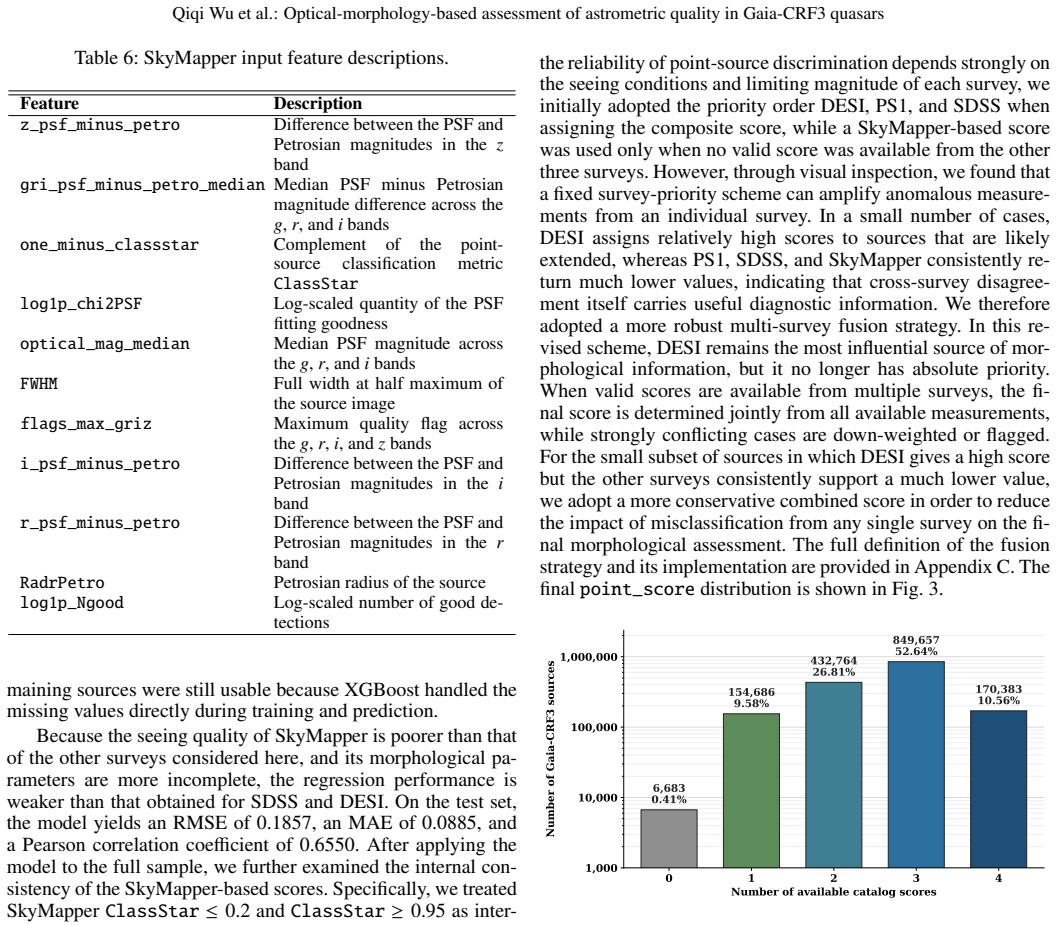
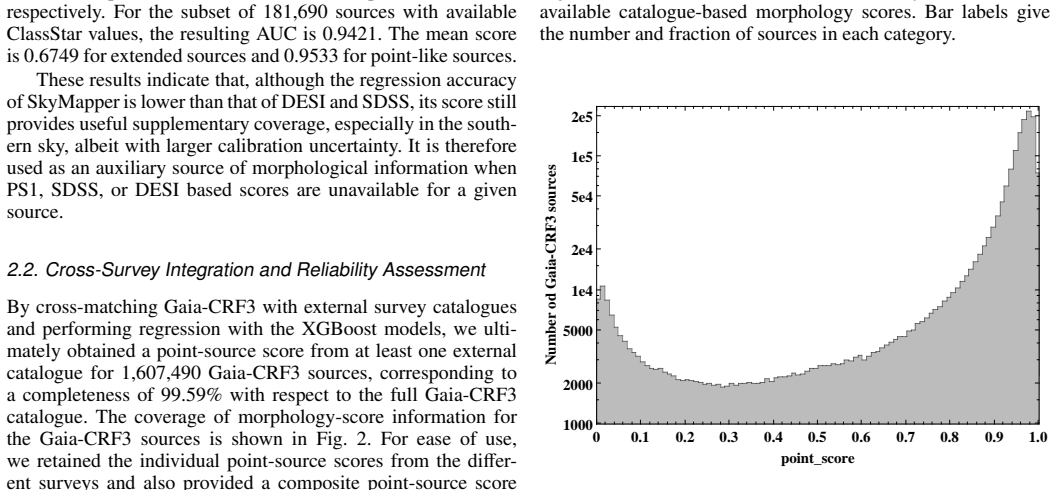
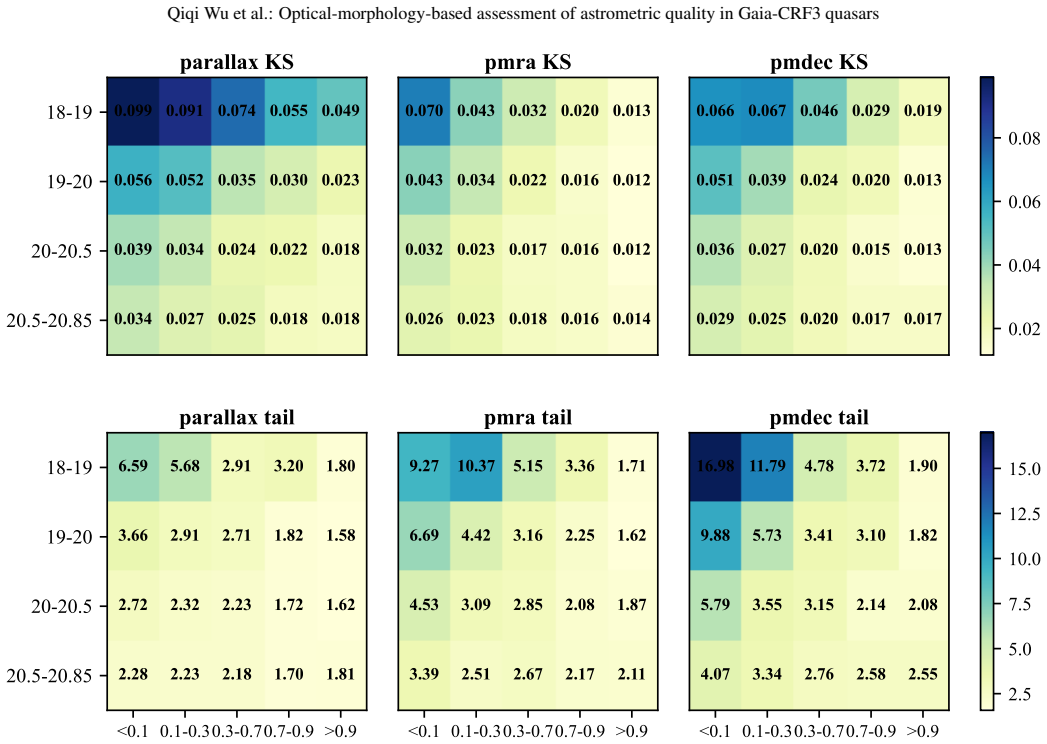
Context. Several studies have shown that host-galaxy structure or extended optical morphology in AGNs can induce spurious parallaxes and proper motions in Gaia DR3. However, it remains unclear whether source morphology also introduces systematic errors into the celestial reference frame constructed from Gaia data. Aims. We aim to provide a Gaia-independent external morphological indicator for Gaia-CRF3 sources and to use it to quantify the astrometric systematics associated with source morphology. Methods. Using morphological parameters derived from DESI, SDSS, and SkyMapper, together with the PS1-PSC point-source score as a common reference scale, we used XGBoost to infer external morphological scores for Gaia-CRF3 sources. We then developed a multi-survey fusion scheme to combine the four survey-based point-source scores into a single composite score that measures the degree to which each source departs from the morphology of an ideal point source. Results. We obtained morphological scores for 1,607,490 Gaia-CRF3 sources, corresponding to a completeness of 99.59\% with respect to the full Gaia-CRF3 catalogue. The score ranges from 0 to 1 and remains reliable for sources with $G<20.85$ mag. Based on this indicator, we find that AGNs with strongly non-point-like morphology induce a parallax zero-point shift of about $-43.7\,\mu$as, which cannot be effectively removed by the current parallax zero-point correction model. We also find that reference-source subsamples selected in different score ranges exhibit significantly different all-sky proper motion fields. For the high-purity point-source subsample with \texttt{point\_score} > 0.95, the total frame spin amplitude is reduced by 15.8\% relative to that of the full Gaia-CRF3 sample.
Figures

Figures from the paper (8 more)




Reference graph
Works this paper leans on
-
[1]
S., Gordon, D., et al
Charlot, P., Jacobs, C. S., Gordon, D., et al. 2020, A&A, 644, A159
2020
-
[2]
XGBoost: A Scalable Tree Boosting System
Chen, T. & Guestrin, C. 2016, arXiv e-prints, arXiv:1603.02754
work page Pith review arXiv 2016
-
[3]
M., Gerke, B
Comerford, J. M., Gerke, B. F., Stern, D., et al. 2012, ApJ, 753, 42
2012
-
[4]
J., Lang, D., et al
Dey, A., Schlegel, D. J., Lang, D., et al. 2019, AJ, 157, 168
2019
-
[5]
2024, A&A, 691, A81
Ding, Y ., Liao, S., Wu, Q., Qi, Z., & Tang, Z. 2024, A&A, 691, A81
2024
-
[6]
2023, A&A, 674, A11
Ducourant, C., Krone-Martins, A., Galluccio, L., et al. 2023, A&A, 674, A11
2023
-
[7]
2018, A&A, 618, A56
Ducourant, C., Wertz, O., Krone-Martins, A., et al. 2018, A&A, 618, A56
2018
-
[8]
2016, A&A, 595, A3
Fabricius, C., Bastian, U., Portell, J., et al. 2016, A&A, 595, A3
2016
Show all 35 references
-
[9]
2021, A&A, 649, A5
Fabricius, C., Luri, X., Arenou, F., et al. 2021, A&A, 649, A5
2021
-
[10]
Fey, A. L. & Charlot, P. 1997, ApJS, 111, 95
1997
-
[11]
L., Gordon, D., Jacobs, C
Fey, A. L., Gordon, D., Jacobs, C. S., et al. 2015, AJ, 150, 58
2015
-
[12]
J., et al
Fu, Y ., Wu, X.-B., Bouwens, R. J., et al. 2025, ApJS, 279, 54 Gaia Collaboration, Bailer-Jones, C. A. L., Teyssier, D., et al. 2023, A&A, 674, A41 Gaia Collaboration, Brown, A. G. A., Vallenari, A., et al. 2021, A&A, 649, A1 Gaia Collaboration, Klioner, S. A., Lindegren, L., ...
2025
-
[13]
2020, ApJ, 888, 73
Hwang, H.-C., Shen, Y ., Zakamska, N., & Liu, X. 2020, ApJ, 888, 73
2020
-
[14]
2023, MNRAS, 524, 1909
Ji, X., Zheng, Z.-Y ., Wu, Q., et al. 2023, MNRAS, 524, 1909
2023
-
[15]
E., et al
Kaiser, N., Aussel, H., Burke, B. E., et al. 2002, in Society of Photo-Optical Instrumentation Engineers (SPIE) Conference Series, V ol. 4836, Survey and Other Telescope Technologies and Discoveries, ed. J. A. Tyson & S. Wolff, 154–164
2002
-
[16]
A., Auger, M
Lemon, C. A., Auger, M. W., & McMahon, R. G. 2019, MNRAS, 483, 4242
2019
-
[17]
2025, arXiv e-prints, arXiv:2511.02204
Liao, S., Wu, Q., Ding, Y ., Xu, Q., & Qi, Z. 2025, arXiv e-prints, arXiv:2511.02204
2025
-
[18]
2021, PASP, 133, 094501
Liao, S., Wu, Q., Qi, Z., et al. 2021, PASP, 133, 094501
2021
-
[19]
F., Eubanks, T
Ma, C., Arias, E. F., Eubanks, T. M., et al. 1998, AJ, 116, 516
1998
-
[20]
2025, Nature Astronomy, 9, 1396
Makarov, V . 2025, Nature Astronomy, 9, 1396
2025
-
[21]
Makarov, V . V . & Secrest, N. J. 2022, ApJ, 933, 28
2022
-
[22]
Makarov, V . V . & Secrest, N. J. 2023, ApJS, 264, 4
2023
-
[23]
2022, Nature Astronomy, 6, 1185 Massey Jr, F
Mannucci, F., Pancino, E., Belfiore, F., et al. 2022, Nature Astronomy, 6, 1185 Massey Jr, F. J. 1951, Journal of the American statistical Association, 46, 68
2022
-
[24]
& Klioner, S
Mignard, F. & Klioner, S. 2012, A&A, 547, A59
2012
-
[25]
Miller, A. A. & Hall, X. J. 2021, PASP, 133, 054502
2021
-
[26]
& Kovalev, Y
Petrov, L. & Kovalev, Y . Y . 2017, MNRAS, 471, 3775
2017
-
[27]
W., Weaver, K
Pfeifle, R. W., Weaver, K. A., Secrest, N. J., Rothberg, B., & Patton, D. R. 2025, ApJS, 281, 25 Popovi´c, L. ˇC., Jovanovi´c, P., Stalevski, M., et al. 2012, A&A, 538, A107
2025
-
[28]
E., Berghea, C
Rusu, C. E., Berghea, C. T., Fassnacht, C. D., et al. 2019, MNRAS, 486, 4987
2019
-
[29]
& Miller, A
Tachibana, Y . & Miller, A. A. 2018, PASP, 130, 128001
2018
-
[30]
Taylor, M. B. 2005, in Astronomical Society of the Pacific Conference Se- ries, V ol. 347, Astronomical Data Analysis Software and Systems XIV , ed. P. Shopbell, M. Britton, & R. Ebert, 29
2005
-
[31]
A., Luvaul, L
Wolf, C., Onken, C. A., Luvaul, L. C., et al. 2018, PASA, 35, e010
2018
-
[32]
2023, Research in Astronomy and Astrophysics, 23, 025006
Wu, Q., Liao, S., Qi, Z., et al. 2023, Research in Astronomy and Astrophysics, 23, 025006
2023
-
[33]
2024, A&A, 692, A154
Wu, Q., Scialpi, M., Liao, S., Mannucci, F., & Qi, Z. 2024, A&A, 692, A154
2024
-
[34]
2022, Frontiers in Astronomy and Space Sciences, 9, 822768
Wu, Q.-Q., Liao, S.-L., Ji, X., et al. 2022, Frontiers in Astronomy and Space Sciences, 9, 822768
2022
-
[35]
G., Adelman, J., Anderson, Jr., J
York, D. G., Adelman, J., Anderson, Jr., J. E., et al. 2000, AJ, 120, 1579 Article number, page 13 A&A proofs:manuscript no. quality_qso Appendix A: normalised astrometric distributions in Morphological Score and magnitude bins Fig. A.1 shows the distributions of the normalise...
2000
Reviewed June 27, 2026 · model on record in the stance chip above.
Discussion (0). Continue with ORCID to comment.