The Two Dimensional Dynamical Bulk Boundary Correspondence: Beyond Two Band Models
Pith reviewed 2026-06-27 11:48 UTC · model grok-4.3
The pith
In a multi-band two-dimensional topological superconductor, dynamical bulk-boundary correspondence after quenches fails to match equilibrium phases and varies with edge orientation.
A machine-rendered reading of the paper's core claim, the machinery that carries it, and where it could break.
Core claim
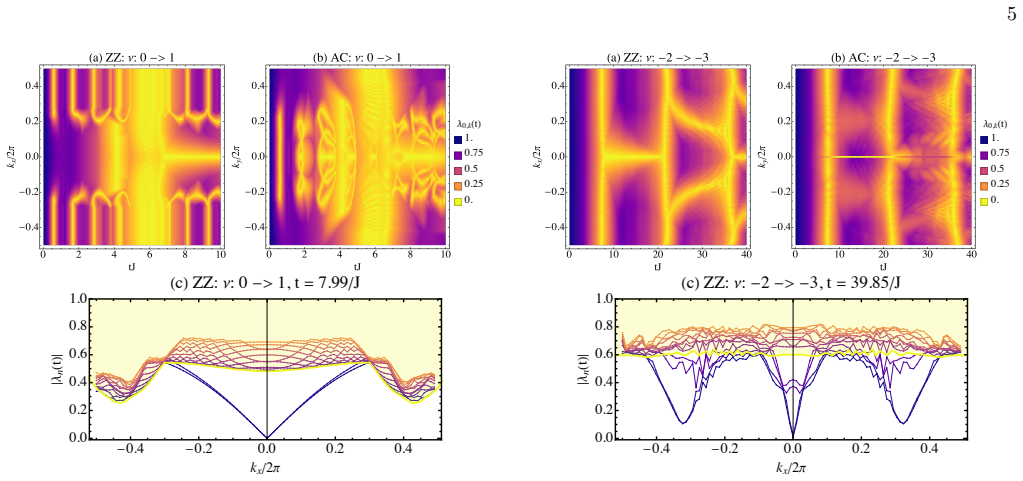
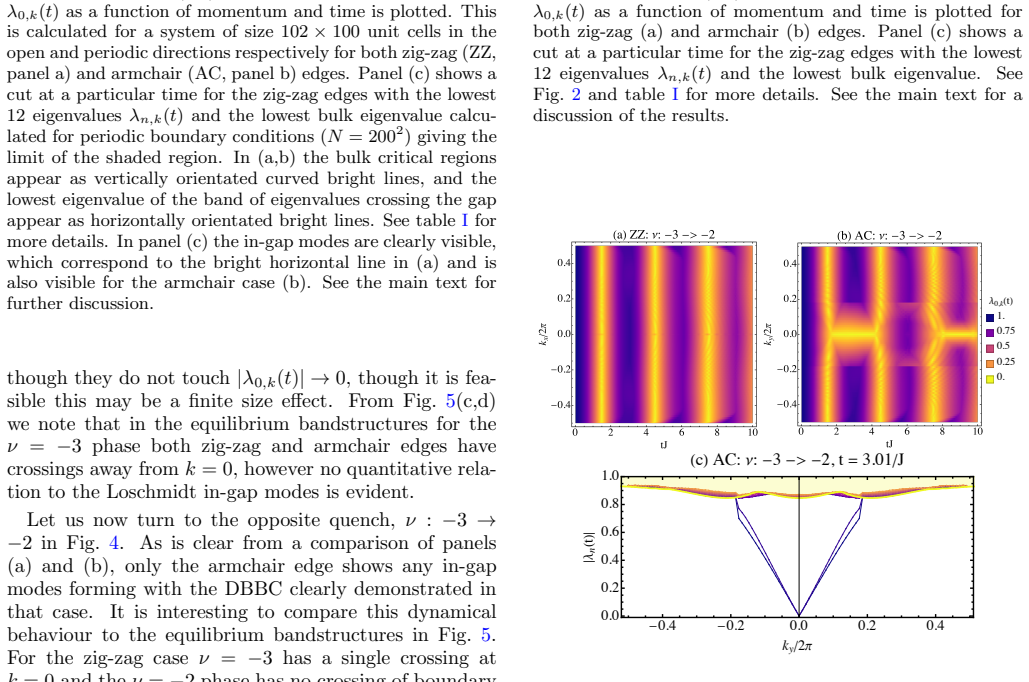
In a two-dimensional topological superconductor with a complex phase diagram, quenches between phases of varying Chern numbers produce large boundary contributions to the dynamical free energy that occur periodically between critical times of non-analyticity. These contributions arise from zero modes or in-gap bands of the Loschmidt matrix, yet their presence does not correspond in a straightforward manner to the topological invariants of the quenched phases. The effect further depends on the specific orientation of the system edges.
What carries the argument
The Loschmidt matrix whose gap closings mark dynamical quantum phase transitions and whose zero modes produce boundary contributions to the dynamical free energy.
If this is right
- Quenches between phases with different Chern numbers do not produce dynamical boundary modes in a manner predictable from the equilibrium bulk-boundary correspondence.
- The dynamical correspondence does not hold in a simple way once models exceed two bands.
- Boundary contributions can appear or vanish depending on whether an edge runs along one lattice direction or the orthogonal direction.
- A weak topological variant of the dynamical correspondence may exist that is sensitive to edge orientation.
Where Pith is reading between the lines
- Orientation dependence could arise in other lattice models whenever hopping amplitudes differ along the two principal directions.
- Experimental protocols in cold-atom or superconducting-qubit arrays could measure edge-specific Loschmidt echoes after quenches to test for the reported directional selectivity.
- If the weak variant is confirmed, it would imply that dynamical topology in two dimensions requires additional invariants beyond a single Chern number.
Load-bearing premise
The Loschmidt-matrix gap-closing and zero-mode analysis used to identify boundary contributions remains valid and directly comparable across the different equilibrium phases and edge orientations in this multi-band model.
What would settle it
A numerical computation of the Loschmidt matrix for one specific quench in this model that shows boundary contributions appearing without corresponding zero modes, or that the contributions match the equilibrium Chern numbers exactly for both edge orientations.
Figures



read the original abstract
A dynamical equivalent of the bulk-boundary correspondence has been suggested to occur in one and two dimensional topological models following sudden quenches. Depending on the topological invariant of the time evolving and initial phases involved large boundary contributions to a dynamical free energy occur. Moreover they occur periodically between the critical times at which this dynamical free energy becomes non-analytic, \emph{i.e.}~at dynamical quantum phase transitions. At these critical times the eigenvalue spectrum of the Loschmidt matrix which underlies the dynamical free energy closes its gap. The boundary contributions are understood to be due to zero-modes or in-gap bands of this matrix, forming a close analogy with equilibrium topological models and their edge modes. The exact cause of this phenomena and its generality remain unknown. In this article we test the dynamical bulk-boundary correspondence for a complicated two dimensional topological superconductor with a rich phase diagram, allowing quenches between many different Chern numbers. We show that there is no straightforward correspondence between the equilibrium phases quenched between and the dynamical bulk boundary correspondence. Furthermore the correspondence can depend on the orientation of the edges, suggesting a possible weak topological variant.
Editorial analysis
A structured set of objections, weighed in public.
Referee Report
Summary. The manuscript examines the dynamical bulk-boundary correspondence in a two-dimensional topological superconductor with a rich phase diagram that permits quenches between phases of differing Chern numbers. It concludes that there is no straightforward mapping between the equilibrium topological invariants of the initial and post-quench phases and the presence or absence of boundary contributions to the dynamical free energy. The correspondence is further reported to depend on edge orientation, which the authors interpret as evidence for a possible weak topological variant. The analysis centers on gap closings of the Loschmidt matrix and the associated zero modes or in-gap bands.
Significance. If the numerical or analytical evidence holds, the result would indicate that the dynamical BBC proposed for simpler (often two-band) models does not generalize in a model-independent way. This would highlight the role of multi-band structure and edge orientation, potentially requiring a refined theoretical framework that incorporates weak topology or orientation dependence for dynamical quantum phase transitions in two dimensions.
major comments (2)
- [Abstract (paragraph on Loschmidt matrix and boundary contributions)] The central claim that 'there is no straightforward correspondence' rests on the assumption that Loschmidt-matrix gap closings and zero-mode analysis remain valid and directly comparable across all equilibrium phases and both edge orientations; the abstract supplies no explicit matrix construction, spectrum plots, or cross-phase comparison that would substantiate this comparability.
- [Abstract (final sentence)] The reported dependence on edge orientation is presented as suggesting a 'weak topological variant,' yet the manuscript provides no definition or invariant that would distinguish this from a strong topological effect or from finite-size artifacts; without such a diagnostic the interpretation remains under-supported.
minor comments (1)
- [Abstract] The abstract states conclusions without any model Hamiltonian, parameter values, system size, or error analysis; inclusion of at least one representative Hamiltonian and a brief description of the numerical method would improve readability.
Simulated Author's Rebuttal
We thank the referee for their insightful comments on our manuscript. We provide point-by-point responses to the major comments below.
read point-by-point responses
-
Referee: [Abstract (paragraph on Loschmidt matrix and boundary contributions)] The central claim that 'there is no straightforward correspondence' rests on the assumption that Loschmidt-matrix gap closings and zero-mode analysis remain valid and directly comparable across all equilibrium phases and both edge orientations; the abstract supplies no explicit matrix construction, spectrum plots, or cross-phase comparison that would substantiate this comparability.
Authors: The abstract is a concise summary of the results and does not contain the technical details of the analysis. The Loschmidt matrix is explicitly constructed for the model in the main text, with its eigenvalue spectra, gap closings, and zero-mode analysis presented for various phases and edge orientations in the results section. Cross-phase comparisons are included to support the claim of no straightforward correspondence. We believe the body of the manuscript substantiates the validity and comparability of the analysis across the cases considered. revision: no
-
Referee: [Abstract (final sentence)] The reported dependence on edge orientation is presented as suggesting a 'weak topological variant,' yet the manuscript provides no definition or invariant that would distinguish this from a strong topological effect or from finite-size artifacts; without such a diagnostic the interpretation remains under-supported.
Authors: We agree that the manuscript does not introduce a specific invariant or diagnostic to rigorously define the weak topological variant. The interpretation is suggested based on the orientation dependence observed in the dynamical boundary contributions. This is a tentative suggestion, and we will revise the abstract to tone down or remove this phrasing to avoid over-interpretation, as the focus of the work is on the lack of straightforward correspondence rather than on defining a new variant. revision: yes
Circularity Check
No significant circularity
full rationale
The manuscript tests the dynamical bulk-boundary correspondence by explicit construction of Loschmidt matrices for a multi-band 2D topological superconductor, computing gap closings and zero-mode spectra for quenches between phases of differing Chern numbers and for distinct edge orientations. These quantities are obtained from the time-evolution operator and the overlap matrix defined directly from the Hamiltonian; they are not fitted parameters, not renamed equilibrium invariants, and not justified by any self-citation chain. The reported absence of a straightforward correspondence and the edge-orientation dependence follow from the numerical/analytical spectra themselves rather than from any definitional reduction or imported uniqueness theorem. The derivation chain is therefore self-contained against external benchmarks.
Axiom & Free-Parameter Ledger
Reference graph
Works this paper leans on
-
[1]
S. Ryu, A. P. Schnyder, A. Furusaki, and A. W. W. Lud- wig, Topological insulators and superconductors: Ten- fold way and dimensional hierarchy, New Journal of Physics12, 65010 (2010)
2010
-
[2]
M. Z. Hasan and C. L. Kane, Colloquium: Topological insulators, Reviews of Modern Physics82, 3045 (2010)
2010
-
[3]
Trifunovic and P
L. Trifunovic and P. W. Brouwer, Higher-Order Topo- logical Band Structures, physica status solidi (b)258, 2000090 (2021)
2021
-
[4]
C. K. Chiu, J. C. Teo, A. P. Schnyder, and S. Ryu, Classification of topological quantum matter with sym- metries, Reviews of Modern Physics88, 035005 (2016)
2016
-
[5]
Trifunovic and P
L. Trifunovic and P. W. Brouwer, Higher-order bulk- boundary correspondence for topological crystalline phases, Physical Review X9, 011012 (2019)
2019
-
[6]
M. M. Ma´ ska, N. Sedlmayr, A. Kobia lka, and T. Doma´ nski, Unconventional topological transitions in a self-organized magnetic ladder, Physical Review B 103, 235419 (2021)
2021
-
[7]
Rigol, V
M. Rigol, V. Dunjko, and M. Olshanii, Thermalization and its mechanism for generic isolated quantum sys- tems, Nature452, 854 (2008)
2008
-
[8]
Polkovnikov, K
A. Polkovnikov, K. Sengupta, A. Silva, and M. Ven- galattore,Colloquium: Nonequilibrium dynamics of closed interacting quantum systems, Reviews of Mod- ern Physics83, 863 (2011)
2011
-
[9]
Rigol and M
M. Rigol and M. Srednicki, Alternatives to eigenstate thermalization, Physical Review Letters108, 110601 (2012)
2012
-
[10]
Sirker, M
J. Sirker, M. Maiti, N. P. Konstantinidis, and N. Sedl- mayr, Boundary fidelity and entanglement in the sym- metry protected topological phase of the SSH model, Journal of Statistical Mechanics: Theory and Experi- ment2014, P10032 (2014)
2014
-
[11]
M. Heyl, A. Polkovnikov, and S. Kehrein, Dynamical quantum phase transitions in the transverse-field ising model, Physical Review Letters110, 135704 (2013)
2013
-
[12]
Andraschko and J
F. Andraschko and J. Sirker, Dynamical quantum phase transitions and the Loschmidt echo: A transfer matrix approach, Physical Review B89, 125120 (2014)
2014
-
[13]
Heyl, Dynamical quantum phase transitions: A re- view, Reports on Progress in Physics81, 054001 (2018)
M. Heyl, Dynamical quantum phase transitions: A re- view, Reports on Progress in Physics81, 054001 (2018)
2018
-
[14]
Heyl, Dynamical quantum phase transitions: A brief survey, EPL (Europhysics Letters)125, 26001 (2019)
M. Heyl, Dynamical quantum phase transitions: A brief survey, EPL (Europhysics Letters)125, 26001 (2019)
2019
-
[15]
Sedlmayr, Dynamical Phase Transitions in Topo- logical Insulators, Acta Physica Polonica A135, 1191 (2019)
N. Sedlmayr, Dynamical Phase Transitions in Topo- logical Insulators, Acta Physica Polonica A135, 1191 (2019)
2019
-
[16]
Sch¨ utzhold, M
R. Sch¨ utzhold, M. Uhlmann, Y. Xu, and U. R. Fis- cher, Sweeping from the Superfluid to the Mott Phase in the Bose-Hubbard Model, Physical Review Letters 97, 200601 (2006)
2006
-
[17]
Eckstein, M
M. Eckstein, M. Kollar, and P. Werner, Thermaliza- tion after an Interaction Quench in the Hubbard Model, Physical Review Letters103, 056403 (2009)
2009
-
[18]
Diehl, A
S. Diehl, A. Tomadin, A. Micheli, R. Fazio, and P. Zoller, Dynamical Phase Transitions and Instabilities in Open Atomic Many-Body Systems, Physical Review Letters105, 015702 (2010)
2010
-
[19]
Mitra, Time evolution and dynamical phase transi- tions at a critical time in a system of one-dimensional bosons after a quantum quench, Physical Review Let- ters109, 260601 (2012)
A. Mitra, Time evolution and dynamical phase transi- tions at a critical time in a system of one-dimensional bosons after a quantum quench, Physical Review Let- ters109, 260601 (2012)
2012
-
[20]
Marino, M
J. Marino, M. Eckstein, M. S. Foster, and A. M. Rey, Dynamical phase transitions in the collisionless pre- thermal states of isolated quantum systems: Theory and experiments, Reports on Progress in Physics85, 116001 (2022)
2022
- [21]
-
[22]
Vajna and B
S. Vajna and B. D´ ora, Disentangling dynamical phase transitions from equilibrium phase transitions, Physical Review B89, 161105(R) (2014)
2014
-
[23]
Karrasch and D
C. Karrasch and D. Schuricht, Dynamical quantum phase transitions in the quantum Potts chain, Physical Review B95, 075143 (2017)
2017
-
[24]
Jafari and H
R. Jafari and H. Johannesson, Decoherence from spin environments: Loschmidt echo and quasiparticle exci- tations, Physical Review B96, 224302 (2017)
2017
-
[25]
Cheraghi and S
H. Cheraghi and S. Mahdavifar, Ineffectiveness of the Dzyaloshinskii–Moriya interaction in the dynamical quantum phase transition in the ITF model, Journal of Physics: Condensed Matter30, 42LT01 (2018)
2018
-
[26]
Jafari, Dynamical Quantum Phase Transition and Quasi Particle Excitation, Scientific Reports9, 2871 (2019)
R. Jafari, Dynamical Quantum Phase Transition and Quasi Particle Excitation, Scientific Reports9, 2871 (2019)
2019
-
[27]
Wrze´ sniewski, I
K. Wrze´ sniewski, I. Weymann, N. Sedlmayr, and T. Doma´ nski, Dynamical quantum phase transitions in a mesoscopic superconducting system, Physical Review 8 |λ0(t)| l(t)/l max 0 2 4 6 8 10-0.4 -0.2 0.0 0.2 0.4 0.6 0.8 1.0 tJ |λ0(t)|,l(t)/l max (a)ν : 0 -> 1 |λ0(t)| l(t)/l max 0 2 4 6 8 10 -0.4 -0.2 0.0 0.2 0.4 0.6 0.8 1.0 tJ |λ0(t)|,l(t)/l max (b)...
2022
-
[28]
Karrasch and D
C. Karrasch and D. Schuricht, Dynamical phase transi- tions after quenches in nonintegrable models, Physical Review B87, 195104 (2013)
2013
-
[29]
Heyl, Dynamical quantum phase transitions in sys- tems with broken-symmetry phases, Physical Review Letters113, 205701 (2014)
M. Heyl, Dynamical quantum phase transitions in sys- tems with broken-symmetry phases, Physical Review Letters113, 205701 (2014)
2014
-
[30]
J. C. Budich and M. Heyl, Dynamical topological order parameters far from equilibrium, Physical Review B93, 085416 (2016)
2016
-
[31]
J. C. Halimeh, M. Van Damme, V. Zauner-Stauber, and L. Vanderstraeten, Quasiparticle Origin of Dynamical Quantum Phase Transitions, Physical Review Research 2, 033111 (2020)
2020
-
[32]
Hagym´ asi, C
I. Hagym´ asi, C. Hubig, ¨O. Legeza, and U. Schollw¨ ock, Dynamical Topological Quantum Phase Transitions in Nonintegrable Models, Physical Review Letters122, 250601 (2019)
2019
-
[33]
Uhrich, N
P. Uhrich, N. Defenu, R. Jafari, and J. C. Halimeh, Out-of-equilibrium phase diagram of long-range super- conductors, Physical Review B101, 245148 (2020)
2020
-
[34]
S. Bhattacharyya, S. G lodzik, and N. Sedlmayr, On the Relation Between String Order Parameters, Entangle- ment, and Dynamical Quantum Phase Transitions in Topological Dynamics (2026), arXiv:2605.25611 [cond- mat.str-el]
work page internal anchor Pith review Pith/arXiv arXiv 2026
-
[35]
Torlai, L
G. Torlai, L. Tagliacozzo, and G. De Chiara, Dynamics of the entanglement spectrum in spin chains, Journal of Statistical Mechanics: Theory and Experiment2014, P06001 (2014)
2014
-
[36]
Sedlmayr, P
N. Sedlmayr, P. Jaeger, M. Maiti, and J. Sirker, Bulk- boundary correspondence for dynamical phase transi- tions in one-dimensional topological insulators and su- perconductors, Physical Review B97, 064304 (2018)
2018
-
[37]
Gong and M
Z. Gong and M. Ueda, Topological Entanglement- Spectrum Crossing in Quench Dynamics, Physical Re- view Letters121, 250601 (2018)
2018
-
[38]
Mas lowski and N
T. Mas lowski and N. Sedlmayr, Quasiperiodic dynam- ical quantum phase transitions in multiband topolog- ical insulators and connections with entanglement en- tropy and fidelity susceptibility, Physical Review B101, 014301 (2020)
2020
-
[39]
K. P¨ oyh¨ onen and T. Ojanen, Entanglement echo and dynamical entanglement transitions, arXiv:2106.10043 [cond-mat, physics:quant-ph] (2021)
-
[40]
Mas lowski, H
T. Mas lowski, H. Cheraghi, J. Sirker, and N. Sedlmayr, Fisher zeroes and dynamical quantum phase transitions for two- and three-dimensional models, Physical Review B110, 224302 (2024)
2024
-
[41]
Schmitt and S
M. Schmitt and S. Kehrein, Dynamical quantum phase transitions in the Kitaev honeycomb model, Physical Review B92, 075114 (2015). 9
2015
-
[42]
Vajna and B
S. Vajna and B. D´ ora, Topological classification of dynamical phase transitions, Physical Review B91, 155127 (2015)
2015
-
[43]
Heyl, Scaling and Universality at Dynamical Quan- tum Phase Transitions, Physical Review Letters115, 140602 (2015)
M. Heyl, Scaling and Universality at Dynamical Quan- tum Phase Transitions, Physical Review Letters115, 140602 (2015)
2015
-
[44]
Sharma, S
S. Sharma, S. Suzuki, and A. Dutta, Quenches and dy- namical phase transitions in a nonintegrable quantum Ising model, Physical Review B92, 104306 (2015)
2015
-
[45]
J. C. Halimeh and V. Zauner-Stauber, Dynamical phase diagram of quantum spin chains with long-range inter- actions, Physical Review B96, 134427 (2017)
2017
-
[46]
Homrighausen, N
I. Homrighausen, N. O. Abeling, V. Zauner-Stauber, and J. C. Halimeh, Anomalous dynamical phase in quantum spin chains with long-range interactions, Phys- ical Review B96, 104436 (2017)
2017
-
[47]
Shpielberg, T
O. Shpielberg, T. Nemoto, and J. Caetano, Universal- ity in dynamical phase transitions of diffusive systems, Physical Review E98, 052116 (2018)
2018
-
[48]
Zunkovic, M
B. Zunkovic, M. Heyl, M. Knap, and A. Silva, Dynam- ical Quantum Phase Transitions in Spin Chains with Long-Range Interactions: Merging different concepts of non-equilibrium criticality, Physical Review Letters 120, 130601 (2018)
2018
-
[49]
Srivastav, U
V. Srivastav, U. Bhattacharya, and A. Dutta, Dynam- ical quantum phase transitions in extended toric-code models, Physical Review B100, 144203 (2019)
2019
-
[50]
Huang, D
Y.-P. Huang, D. Banerjee, and M. Heyl, Dynamical Quantum Phase Transitions in U(1) Quantum Link Models, Physical Review Letters122, 250401 (2019)
2019
-
[51]
Gurarie, Dynamical quantum phase transitions in the random field Ising model, Physical Review A100, 031601(R) (2019)
V. Gurarie, Dynamical quantum phase transitions in the random field Ising model, Physical Review A100, 031601(R) (2019)
2019
-
[52]
Abdi, Dynamical quantum phase transition in Bose- Einstein condensates, Physical Review B100, 184310 (2019)
M. Abdi, Dynamical quantum phase transition in Bose- Einstein condensates, Physical Review B100, 184310 (2019)
2019
-
[53]
Puebla, Finite-component dynamical quantum phase transitions, Physical Review B102, 220302(R) (2020)
R. Puebla, Finite-component dynamical quantum phase transitions, Physical Review B102, 220302(R) (2020)
2020
-
[54]
Link and W
V. Link and W. T. Strunz, Dynamical Phase Transitions in Dissipative Quantum Dynamics with Quantum Op- tical Realization, Physical Review Letters125, 143602 (2020)
2020
-
[55]
Sun and B.-B
G. Sun and B.-B. Wei, Dynamical quantum phase tran- sitions in a spin chain with deconfined quantum critical points, Physical Review B102, 094302 (2020)
2020
-
[56]
Rylands, E
C. Rylands, E. A. Yuzbashyan, V. Gurarie, A. Zabalo, and V. Galitski, Loschmidt echo of far-from-equilibrium fermionic superfluids, Annals of Physics435, 168554 (2021)
2021
-
[57]
Trapin, J
D. Trapin, J. C. Halimeh, and M. Heyl, Unconventional critical exponents at dynamical quantum phase transi- tions in a random Ising chain, Physical Review B104, 115159 (2021)
2021
-
[58]
W. C. Yu, P. D. Sacramento, Y. C. Li, and H.-Q. Lin, Correlations and dynamical quantum phase transitions in an interacting topological insulator, Physical Review B104, 085104 (2021)
2021
-
[59]
J. C. Halimeh, M. Van Damme, L. Guo, J. Lang, and P. Hauke, Dynamical phase transitions in quantum spin models with antiferromagnetic long-range interactions, Physical Review B104, 115133 (2021)
2021
-
[60]
J. C. Halimeh, D. Trapin, M. Van Damme, and M. Heyl, Local measures of dynamical quantum phase transi- tions, Physical Review B104, 075130 (2021)
2021
-
[61]
De Nicola, A
S. De Nicola, A. A. Michailidis, and M. Serbyn, En- tanglement View of Dynamical Quantum Phase Transi- tions, Physical Review Letters126, 040602 (2021)
2021
-
[62]
Cheraghi and S
H. Cheraghi and S. Mahdavifar, Dynamical Quantum Phase Transitions in the 1D Nonintegrable Spin-1/2 Transverse Field XZZ Model, Annalen der Physik , 2000542 (2021)
2021
- [63]
-
[64]
Bandyopadhyay, A
S. Bandyopadhyay, A. Polkovnikov, and A. Dutta, Ob- serving Dynamical Quantum Phase Transitions through Quasilocal String Operators, Physical Review Letters 126, 200602 (2021)
2021
-
[65]
Cheraghi and N
H. Cheraghi and N. Sedlmayr, Dynamical quantum phase transitions following double quenches: Persis- tence of the initial state vs dynamical phases, New Jour- nal of Physics25, 103035 (2023)
2023
-
[66]
C. Y. Wong, H. Cheraghi, and W. C. Yu, Quantum spin fluctuations in dynamical quantum phase transitions, Physical Review B108, 064305 (2023)
2023
-
[67]
Zhang, D
X. Zhang, D. Xie, and Y. Li, Tree Tensor Network Sim- ulation of Dynamical Quantum Phase Transitions in the 2D Transverse-Field Ising Model, Entropy28, 495 (2026)
2026
-
[68]
Jurcevic, H
P. Jurcevic, H. Shen, P. Hauke, C. Maier, T. Brydges, C. Hempel, B. P. Lanyon, M. Heyl, R. Blatt, and C. F. Roos, Direct Observation of Dynamical Quantum Phase Transitions in an Interacting Many-Body System, Phys- ical Review Letters119, 080501 (2017)
2017
-
[69]
Fl¨ aschner, D
N. Fl¨ aschner, D. Vogel, M. Tarnowski, B. S. Rem, D. S. L¨ uhmann, M. Heyl, J. C. Budich, L. Mathey, K. Sen- gstock, and C. Weitenberg, Observation of dynamical vortices after quenches in a system with topology, Na- ture Physics14, 265 (2018)
2018
-
[70]
Zhang, G
J. Zhang, G. Pagano, P. W. Hess, A. Kyprianidis, P. Becker, H. Kaplan, A. V. Gorshkov, Z.-X. Gong, and C. Monroe, Observation of a many-body dynami- cal phase transition with a 53-qubit quantum simulator, Nature551, 601 (2017)
2017
-
[71]
X.-Y. Guo, C. Yang, Y. Zeng, Y. Peng, H.-K. Li, H. Deng, Y.-R. Jin, S. Chen, D. Zheng, and H. Fan, Observation of a Dynamical Quantum Phase Transition by a Superconducting Qubit Simulation, Physical Re- view Applied11, 044080 (2019)
2019
-
[72]
Smale, P
S. Smale, P. He, B. A. Olsen, K. G. Jackson, H. Sharum, S. Trotzky, J. Marino, A. M. Rey, and J. H. Thywissen, Observation of a transition between dynamical phases in a quantum degenerate Fermi gas, Science Advances 5, eaax1568 (2019)
2019
-
[73]
Nie, B.-B
X. Nie, B.-B. Wei, X. Chen, Z. Zhang, X. Zhao, C. Qiu, Y. Tian, Y. Ji, T. Xin, D. Lu, and J. Li, Experimen- tal Observation of Equilibrium and Dynamical Quan- tum Phase Transitions via Out-of-Time-Ordered Corre- lators, Physical Review Letters124, 250601 (2020)
2020
-
[74]
Tian, H.-X
T. Tian, H.-X. Yang, L.-Y. Qiu, H.-Y. Liang, Y.-B. Yang, Y. Xu, and L.-M. Duan, Observation of Dynam- ical Quantum Phase Transitions with Correspondence in an Excited State Phase Diagram, Physical Review Letters124, 043001 (2020)
2020
-
[75]
Pomarico, F
D. Pomarico, F. Dell’Anna, R. Cioli, S. Pascazio, F. V. Pepe, P. Facchi, and E. Ercolessi, Digital Rydberg sim- ulation of dynamical quantum phase transitions in the Schwinger model, Physical Review Research8, 013177 10 (2026)
2026
-
[76]
B. Mera, C. Vlachou, N. Paunkovi´ c, V. R. Vieira, and O. Viyuela, Dynamical phase transitions at finite tem- perature from fidelity and interferometric Loschmidt echo induced metrics, Physical Review B97, 094110 (2018)
2018
-
[77]
Sedlmayr, M
N. Sedlmayr, M. Fleischhauer, and J. Sirker, The fate of dynamical phase transitions at finite temperatures and in open systems, Physical Review B97, 045147 (2018)
2018
-
[78]
Bhattacharya, S
U. Bhattacharya, S. Bandyopadhyay, and A. Dutta, Mixed state dynamical quantum phase transitions, Physical Review B96, 180303(R) (2017)
2017
-
[79]
Heyl and J
M. Heyl and J. C. Budich, Dynamical topological quan- tum phase transitions for mixed states, Physical Review B96, 180304(R) (2017)
2017
-
[80]
N. O. Abeling and S. Kehrein, Quantum quench dy- namics in the transverse field Ising model at nonzero temperatures, Physical Review B93, 104302 (2016)
2016
discussion (0)
Sign in with ORCID, Apple, or X to comment. Anyone can read and Pith papers without signing in.