Noise cancellation by superposition of channels and superactivation of quantum capacity: Experimental realization by NMR
Pith reviewed 2026-06-27 12:58 UTC · model grok-4.3
The pith
Superposing Stinespring unitaries of two zero-capacity depolarizing channels produces a channel with positive quantum capacity.
A machine-rendered reading of the paper's core claim, the machinery that carries it, and where it could break.
Core claim
Superposition of the Stinespring unitaries belonging to two zero-capacity depolarizing channels yields a channel with positive quantum capacity; the same construction cancels two dephasing channels by destructive interference, restoring coherence. The paper first states the algebraic conditions under which such a superposition defines a valid channel and then implements both cases on NMR hardware.
What carries the argument
Superposition of Stinespring dilation unitaries, which produces interference between the noise operators of the two channels.
If this is right
- Two individually useless depolarizing channels can be combined to transmit quantum information.
- Dephasing noise can be cancelled by destructive interference of their Stinespring unitaries.
- The superposition operation must satisfy explicit algebraic conditions to remain a valid quantum channel.
- The effect is realizable on small NMR registers without additional encoding.
Where Pith is reading between the lines
- The technique may generalize to other noise models if their Stinespring representations allow similar interference.
- Channel superposition could complement existing error-correction schemes by reducing the effective noise before correction.
- Testing the same superposition on photonic or ion-trap hardware would check whether the NMR implementation introduces platform-specific artifacts.
Load-bearing premise
The NMR experiments accurately implement the theoretical superposition of Stinespring unitaries without introducing uncontrolled errors that would mask the cancellation or superactivation effects.
What would settle it
A measurement showing that the output state after the superposed depolarizing channels still has zero coherent information or that coherence is not recovered after the superposed dephasing channels would falsify the claim.
Figures


read the original abstract
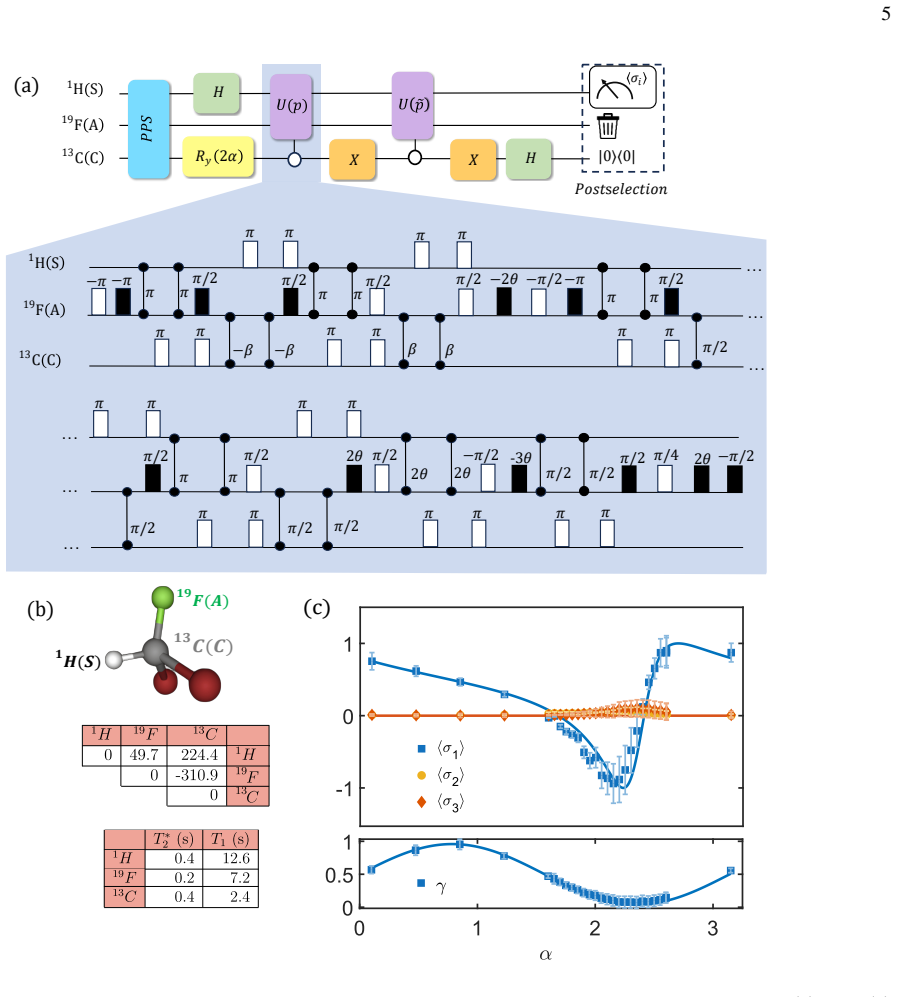
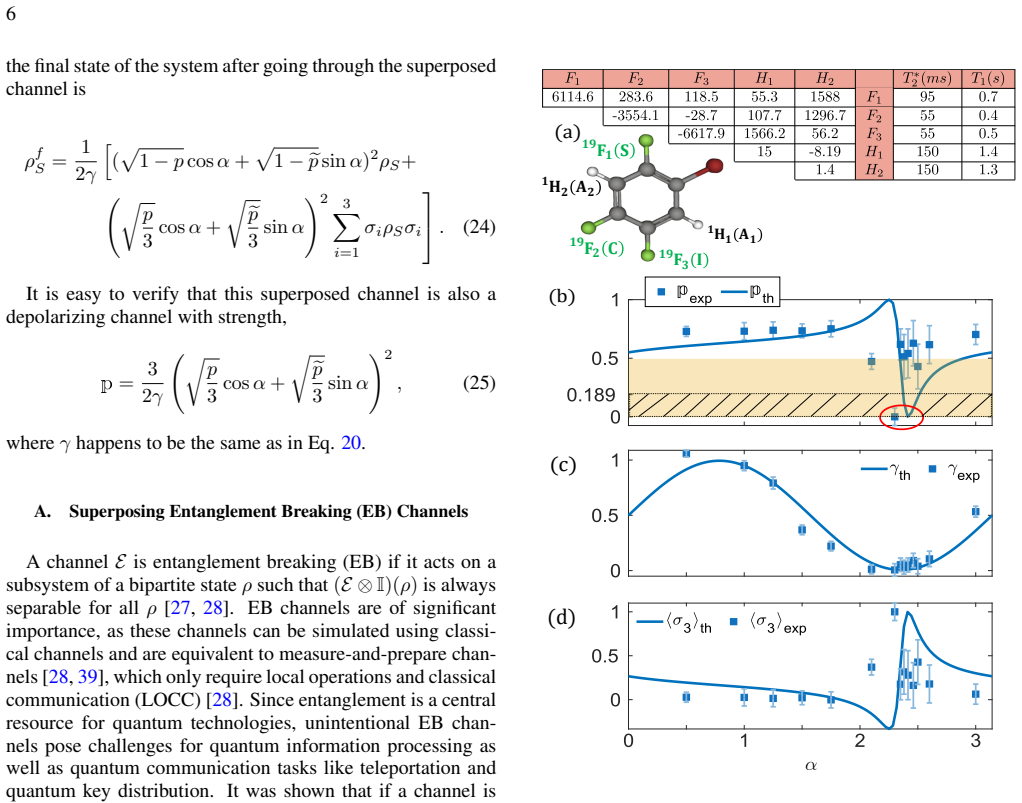
Noisy quantum channels degrade quantum resources such as coherence and entanglement and hence pose challenges for realizing quantum technologies. Coherent control of noisy channels allows us to minimize their effects on the quantum system. Here we achieve the cancellation of two noisy quantum channels by superposing their corresponding Stinespring dilation unitaries. We first arrive at conditions under which superposition of channels results in a valid quantum channel. We then consider superposing two dephasing channels and observe their destructive interference, thereby effectively recovering the quantum coherence. On superposing two zero-capacity depolarizing channels, we show superactivation of quantum capacity. We experimentally realize the cancellation of two dephasing channels using a three-qubit NMR register. Furthermore, using a five-qubit NMR register, we realize the cancellation of two depolarization channels and demonstrate superactivation of quantum capacity.
Editorial analysis
A structured set of objections, weighed in public.
Referee Report
Summary. The paper derives conditions under which the superposition of two quantum channels yields a valid quantum channel. It then shows theoretically that superposing two dephasing channels produces destructive interference that recovers coherence, and that superposing two zero-capacity depolarizing channels activates positive quantum capacity. These effects are experimentally realized on a three-qubit NMR register (dephasing cancellation) and a five-qubit NMR register (depolarization cancellation plus capacity superactivation).
Significance. If the NMR implementations faithfully reproduce the ideal Stinespring superpositions, the work supplies the first experimental demonstration of both channel-superposition noise cancellation and superactivation of quantum capacity. This would strengthen the experimental footing of a theoretically known but previously unrealized phenomenon and supply a concrete testbed for coherent control of noisy maps.
major comments (1)
- [Experimental sections] Experimental sections: the manuscript reports coherence recovery and capacity activation but does not provide process-tomography fidelity or diamond-norm distance between the measured effective channel and the ideal superposed channel. Without this metric it is impossible to confirm that the observed effects survive subtraction of residual decoherence and pulse errors inherent to the liquid-state NMR implementation.
Simulated Author's Rebuttal
We thank the referee for the positive evaluation of the work's significance and for the detailed comment on the experimental sections. We respond point-by-point below.
read point-by-point responses
-
Referee: Experimental sections: the manuscript reports coherence recovery and capacity activation but does not provide process-tomography fidelity or diamond-norm distance between the measured effective channel and the ideal superposed channel. Without this metric it is impossible to confirm that the observed effects survive subtraction of residual decoherence and pulse errors inherent to the liquid-state NMR implementation.
Authors: We agree that process-tomography fidelity and diamond-norm distance to the target superposed channel constitute stronger quantitative evidence. In the revised manuscript we will add these metrics for the three-qubit dephasing experiment, where full process tomography is experimentally tractable. For the five-qubit depolarization experiment we will include the best attainable fidelity estimates together with a rigorous error budget that bounds the deviation from the ideal superposed map; full 5-qubit process tomography remains beyond the resources of the current liquid-state NMR setup. revision: partial
Circularity Check
No significant circularity; derivation and experiment are independent of self-referential fitting or self-citation chains.
full rationale
The paper derives conditions for valid superposed channels from standard quantum channel theory, then applies them to dephasing and depolarizing cases before reporting NMR realizations. No step reduces a claimed prediction or capacity value to a fitted parameter by the paper's own equations, nor does any load-bearing premise rest solely on self-citation. The experimental sections rely on external NMR measurements rather than internal consistency checks that would force the result. This is the common case of a self-contained theoretical-plus-experimental manuscript.
Axiom & Free-Parameter Ledger
axioms (2)
- standard math Stinespring dilation exists for every quantum channel and can be superposed to yield another valid channel under stated conditions.
- domain assumption Depolarizing channels with zero quantum capacity remain zero-capacity when considered individually.
Reference graph
Works this paper leans on
-
[1]
D. K. L. Oi, Interference of quantum channels, Phys. Rev. Lett. 91, 067902 (2003)
2003
-
[2]
S. S. Roy, A. Shukla, and T. Mahesh, Nmr implementa- tion of a quantum delayed-choice experiment, Physical Re- view A—Atomic, Molecular, and Optical Physics85, 022109 (2012)
2012
-
[3]
Chatterjee, H
A. Chatterjee, H. S. Karthik, T. S. Mahesh, and A. R. Usha Devi, Extreme violations of leggett-garg inequalities for a system evolving under superposition of unitaries, Phys. Rev. Lett.135, 220202 (2025)
2025
-
[4]
Oreshkov, F
O. Oreshkov, F. Costa, and ˇC. Brukner, Quantum correlations with no causal order, Nature Communications3, 1092 (2012)
2012
-
[5]
Hardy, Towards quantum gravity: a framework for prob- abilistic theories with non-fixed causal structure, Journal of Physics A: Mathematical and Theoretical40, 3081 (2007)
L. Hardy, Towards quantum gravity: a framework for prob- abilistic theories with non-fixed causal structure, Journal of Physics A: Mathematical and Theoretical40, 3081 (2007)
2007
-
[6]
W. C. Myrvold and J. Christian, eds.,Quantum Reality, Rela- tivistic Causality, and Closing the Epistemic Circle(Springer, 2009)
2009
-
[7]
Chiribella, G
G. Chiribella, G. M. D’Ariano, P. Perinotti, and B. Valiron, Quantum computations without definite causal structure, Phys. Rev. A88, 022318 (2013)
2013
-
[8]
P. A. Gu´erin, A. Feix, M. Ara´ujo, and i. c. v. Brukner, Exponen- tial communication complexity advantage from quantum super- position of the direction of communication, Phys. Rev. Lett. 117, 100502 (2016)
2016
-
[10]
L. Chen, Y .-X. Yang, G.-C. Li, X.-S. Hong, S.-Q. Zhang, H.-Q. Xu, Y .-C. Liu, G. Chiribella, G. Chen, C.-F. Li, and G.-C. Guo, Nonlinear enhancement of measurement precision via a hybrid quantum switch (2025), arXiv:2506.20632 [quant-ph]
arXiv 2025
-
[11]
Yuan, C.-G
Y .-x. Yuan, C.-G. Song, and Q.-y. Cai, Enhanced quantum metrology with entangled quantum switch and probe state, Physica Scripta100, 075108 (2025)
2025
-
[12]
X. Zhao, Y . Yang, and G. Chiribella, Quantum metrology with indefinite causal order, Phys. Rev. Lett.124, 190503 (2020)
2020
-
[13]
L. M. Procopio, A. Moqanaki, M. Ara ´ujo, F. Costa, I. Alonso Calafell, E. G. Dowd, D. R. Hamel, L. A. Rozema, ˇC. Brukner, and P. Walther, Experimental superposition of or- ders of quantum gates, Nature Communications6, 7913 (2015)
2015
-
[14]
Goswami, C
K. Goswami, C. Giarmatzi, M. Kewming, F. Costa, C. Bran- ciard, J. Romero, and A. G. White, Indefinite causal order in a quantum switch, Phys. Rev. Lett.121, 090503 (2018)
2018
-
[15]
G. Rubino, L. A. Rozema, A. Feix, M. Ara ´ujo, J. M. Zeuner, L. M. Procopio, ˇCaslav Brukner, and P. Walther, Experimental verification of an indefinite causal order, Science Advances3, e1602589 (2017), https://www.science.org/doi/pdf/10.1126/sciadv.1602589
-
[16]
Chiribella and H
G. Chiribella and H. Kristj ´ansson, Quantum shannon theory with superpositions of trajectories, Proceedings of the Royal Society A: Mathematical, Physical and Engineering Sciences 475, 20180903 (2019)
2019
-
[17]
Lai, J.-D
P.-R. Lai, J.-D. Lin, Y .-T. Huang, H.-C. Jan, and Y .-N. Chen, Quick charging of a quantum battery with superposed trajecto- ries, Phys. Rev. Res.6, 023136 (2024)
2024
-
[18]
Kumar, R
A. Kumar, R. Christy Rani Grace, and P. Madhu, Cross- correlations in nmr, Progress in Nuclear Magnetic Resonance Spectroscopy37, 191 (2000)
2000
-
[19]
Salhov, Q
A. Salhov, Q. Cao, J. Cai, A. Retzker, F. Jelezko, and G. Genov, Protecting quantum information via destructive interference of correlated noise, Phys. Rev. Lett.132, 223601 (2024)
2024
-
[20]
Salzmann, K
M. Salzmann, K. Pervushin, G. Wider, H. Senn, and K. W ¨uthrich, Trosy in triple-resonance experiments: new per- spectives for sequential nmr assignment of large proteins, Pro- ceedings of the National Academy of Sciences95, 13585 (1998)
1998
-
[21]
A. A. Abbott, J. Wechs, D. Horsman, M. Mhalla, and C. Bran- ciard, Communication through coherent control of quantum channels, Quantum4, 333 (2020)
2020
-
[22]
Chiribella, M
G. Chiribella, M. Banik, S. S. Bhattacharya, T. Guha, M. Al- imuddin, A. Roy, S. Saha, S. Agrawal, and G. Kar, Indefinite causal order enables perfect quantum communication with zero capacity channels, New Journal of Physics23, 033039 (2021)
2021
-
[23]
S. Saha and U. Sen, Interference between lossy quantum evolu- tions activates information backflow (2025), arXiv:2507.22150 [quant-ph]
arXiv 2025
-
[24]
Nathanson and M
M. Nathanson and M. B. Ruskai, Pauli diagonal channels con- stant on axes, Journal of Physics A: Mathematical and Theoret- ical40, 8171 (2007)
2007
-
[25]
Siudzi ´nska, Geometry of pauli maps and pauli channels, Phys
K. Siudzi ´nska, Geometry of pauli maps and pauli channels, Phys. Rev. A100, 062331 (2019)
2019
-
[26]
M. R. Geller and Z. Zhou, Efficient error models for fault- tolerant architectures and the pauli twirling approximation, 9 Phys. Rev. A88, 012314 (2013)
2013
-
[27]
M. Horodecki, P. W. Shor, and M. B. Ruskai, Entanglement breaking channels, Reviews in Mathematical Physics15, 629 (2003), https://doi.org/10.1142/S0129055X03001709
-
[28]
M. B. Ruskai, Qubit entanglement breaking chan- nels, Reviews in Mathematical Physics15, 643 (2003), https://doi.org/10.1142/S0129055X03001710
-
[29]
X. Yuan, Y . Liu, Q. Zhao, B. Regula, J. Thompson, and M. Gu, Universal and operational benchmarking of quantum memories, npj Quantum Information7, 108 (2021)
2021
-
[30]
Rosset, F
D. Rosset, F. Buscemi, and Y .-C. Liang, Resource theory of quantum memories and their faithful verification with minimal assumptions, Phys. Rev. X8, 021033 (2018)
2018
-
[31]
L. B. Vieira, H.-Y . Ku, and C. Budroni, Entanglement- breaking channels are a quantum memory resource (2024), arXiv:2402.16789 [quant-ph]
arXiv 2024
-
[32]
S. Hao, H. Shi, W. Li, J. H. Shapiro, Q. Zhuang, and Z. Zhang, Entanglement-assisted communication surpassing the ultimate classical capacity, Phys. Rev. Lett.126, 250501 (2021)
2021
-
[33]
Pereg, Communication over entanglement-breaking chan- nels with unreliable entanglement assistance, Phys
U. Pereg, Communication over entanglement-breaking chan- nels with unreliable entanglement assistance, Phys. Rev. A108, 042616 (2023)
2023
-
[34]
M. A. Nielsen and I. L. Chuang,Quantum Computation and Quantum Information: 10th Anniversary Edition(Cambridge University Press, 2010)
2010
-
[35]
W. F. Stinespring, Positive functions on c*-algebras, Proceed- ings of the American Mathematical Society6, 211–216 (1955)
1955
-
[36]
P. Xie, Hyb error: A hybrid metric combining absolute and rel- ative errors (2024), arXiv:2403.07492 [math.NA]
arXiv 2024
-
[37]
J. R. Samal, A. K. Pati, and A. Kumar, Experimental test of the quantum no-hiding theorem, Phys. Rev. Lett.106, 080401 (2011)
2011
-
[38]
Sakaguchi, H
U. Sakaguchi, H. Ozawa, and T. Fukumi, Method for effective pure states with any number of spins, Phys. Rev. A61, 042313 (2000)
2000
-
[39]
A. S. Holevo, Quantum coding theorems, Russ. Math. Surv.53, 1295 (1998)
1998
-
[40]
Choi, Completely positive linear maps on complex ma- trices, Linear Algebra and its Applications10, 285 (1975)
M.-D. Choi, Completely positive linear maps on complex ma- trices, Linear Algebra and its Applications10, 285 (1975)
1975
-
[41]
Jamiołkowski, Linear transformations which preserve trace and positive semidefiniteness of operators, Reports on Mathe- matical Physics3, 275 (1972)
A. Jamiołkowski, Linear transformations which preserve trace and positive semidefiniteness of operators, Reports on Mathe- matical Physics3, 275 (1972)
1972
-
[42]
Horodecki, P
M. Horodecki, P. Horodecki, and R. Horodecki, Separability of mixed states: necessary and sufficient conditions, Physics Letters A223, 1 (1996)
1996
-
[43]
M. M. Wilde,Quantum Information Theory, 2nd ed. (Cam- bridge University Press, 2017)
2017
-
[44]
King, The capacity of the quantum depolarizing channel (2002), arXiv:quant-ph/0204172 [quant-ph]
C. King, The capacity of the quantum depolarizing channel (2002), arXiv:quant-ph/0204172 [quant-ph]
Pith/arXiv arXiv 2002
-
[45]
Fanizza, F
M. Fanizza, F. Kianvash, and V . Giovannetti, Quantum flags and new bounds on the quantum capacity of the depolarizing channel, Phys. Rev. Lett.125, 020503 (2020)
2020
-
[46]
Sutter, V
D. Sutter, V . B. Scholz, A. Winter, and R. Renner, Approximate degradable quantum channels, IEEE Transactions on Informa- tion Theory63, 7832 (2017)
2017
-
[47]
Leditzky, N
F. Leditzky, N. Datta, and G. Smith, Useful states and entangle- ment distillation, IEEE Transactions on Information Theory64, 4689 (2018)
2018
-
[48]
G. Smith and J. Yard, Quantum communication with zero-capacity channels, Science321, 1812 (2008), https://www.science.org/doi/pdf/10.1126/science.1162242
-
[49]
B. M. Fung, Use of pairs of pseudopure states for nmr quantum computing, Phys. Rev. A63, 022304 (2001)
2001
-
[50]
Toˇsner, T
Z. Toˇsner, T. V osegaard, C. Kehlet, N. Khaneja, S. J. Glaser, and N. C. Nielsen, Optimal control in nmr spectroscopy: Numeri- cal implementation in simpson, Journal of Magnetic Resonance 197, 120 (2009)
2009
-
[51]
Khaneja, T
N. Khaneja, T. Reiss, C. Kehlet, T. Schulte-Herbr ¨uggen, and S. J. Glaser, Optimal control of coupled spin dynamics: design of nmr pulse sequences by gradient ascent algorithms, Journal of Magnetic Resonance172, 296 (2005)
2005
discussion (0)
Sign in with ORCID, Apple, or X to comment. Anyone can read and Pith papers without signing in.