Gravitational superfluorescence from superradiant axion clouds
Pith reviewed 2026-06-27 12:28 UTC · model grok-4.3
The pith
Superradiant axion clouds around black holes undergo self-stimulated gravitational wave avalanches.
A machine-rendered reading of the paper's core claim, the machinery that carries it, and where it could break.
Core claim
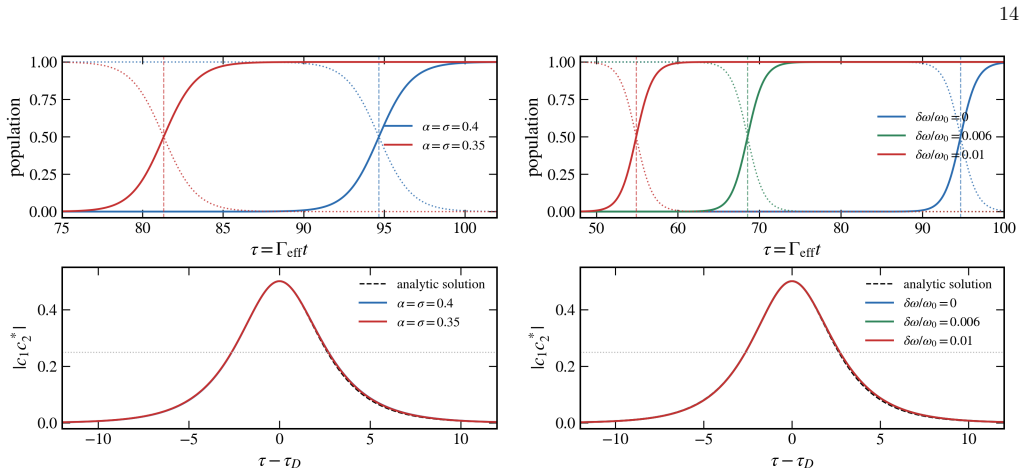
Boson clouds formed via superradiance around spinning black holes offer a novel probe of ultralight particles. Such gravitational atoms can undergo a self-stimulated avalanche: a coherent quadrupolar transition is seeded by external gravitational waves and amplified by self-generated radiation feedback. An effective two-level description, validated by numerical simulations, captures the logistic population transfer and the resulting delayed gravitational-wave pulse with a characteristic envelope, and assesses its detectability with future detectors.
What carries the argument
The effective two-level description of the axion cloud, which tracks coherent quadrupolar transitions and radiation feedback to produce logistic population transfer.
If this is right
- The cloud emits a delayed gravitational-wave pulse possessing a specific envelope shape.
- This emission is potentially detectable by future gravitational-wave observatories.
- The mechanism supplies a transient signal for ultralight bosonic dark matter distinct from continuous superradiant emission.
- The process constitutes a gravitational analogue of atomic superfluorescence.
Where Pith is reading between the lines
- Pulse timing and envelope could encode the axion mass and black-hole spin, offering a way to extract those parameters from a single event.
- Analogous cooperative emission may occur for other bosonic fields around compact objects, broadening the set of testable ultralight candidates.
- The transient nature of the signal could be searched for in existing or planned gravitational-wave data streams as a complement to continuous-wave searches.
Load-bearing premise
The effective two-level description accurately captures the logistic population transfer and resulting gravitational-wave pulse from the axion cloud dynamics.
What would settle it
A full numerical evolution of the axion cloud that produces population transfer without the predicted logistic form and delayed pulse envelope would falsify the two-level model.
Figures

read the original abstract
Boson clouds formed via superradiance around spinning black holes offer a novel probe of ultralight particles. We show that such gravitational atoms can undergo a self-stimulated avalanche: a coherent quadrupolar transition is seeded by external gravitational waves and amplified by self-generated radiation feedback. We formulate an effective two-level description, validated by numerical simulations, that captures the logistic population transfer and the resulting delayed gravitational-wave pulse with a characteristic envelope, and assess its detectability with future detectors. As a gravitational analogue of superfluorescence, this cooperative emission mechanism opens a new observational avenue into the ultralight dark sector.
Editorial analysis
A structured set of objections, weighed in public.
Referee Report
Summary. The manuscript claims that superradiant axion clouds around Kerr black holes can undergo gravitational superfluorescence: a coherent quadrupolar transition seeded by external gravitational waves and amplified by self-generated radiation feedback. It formulates an effective two-level model, validated by numerical simulations, that produces logistic population transfer and a delayed gravitational-wave pulse with a characteristic envelope, and assesses detectability with future detectors as a gravitational analogue of superfluorescence.
Significance. If the two-level reduction and its numerical validation hold, the result identifies a cooperative emission channel in gravitational atoms that could yield distinctive, delayed GW pulses from ultralight axion clouds, providing a new observational signature beyond standard superradiant instability. The work explicitly builds on existing superradiance literature and supplies an effective model plus simulation support for the logistic transfer and pulse envelope.
major comments (1)
- [effective two-level model and numerical validation section] The central claim rests on the effective two-level description accurately capturing the avalanche dynamics. The manuscript must demonstrate, via the numerical simulations referenced in the abstract, that couplings to neighboring superradiant modes with distinct (l,m,ω) remain negligible across the relevant cloud densities and black-hole spins; otherwise the self-stimulated feedback loop can be altered or quenched by off-resonant interactions.
minor comments (2)
- Clarify the precise definition of the characteristic envelope of the delayed GW pulse and its dependence on the seeding amplitude.
- Add a brief statement on the range of axion masses and cloud parameters for which the two-level truncation is expected to remain valid.
Simulated Author's Rebuttal
We thank the referee for their careful reading of the manuscript and for identifying this key point regarding the validity of the two-level reduction. We respond to the major comment below.
read point-by-point responses
-
Referee: [effective two-level model and numerical validation section] The central claim rests on the effective two-level description accurately capturing the avalanche dynamics. The manuscript must demonstrate, via the numerical simulations referenced in the abstract, that couplings to neighboring superradiant modes with distinct (l,m,ω) remain negligible across the relevant cloud densities and black-hole spins; otherwise the self-stimulated feedback loop can be altered or quenched by off-resonant interactions.
Authors: We agree that an explicit demonstration of negligible couplings to neighboring modes is necessary to fully substantiate the two-level model. Our existing numerical simulations solve the coupled axion-gravitational wave system and already exhibit logistic population transfer and pulse envelopes that match the two-level predictions to high accuracy; this agreement would be disrupted by significant off-resonant driving. To address the referee's request directly, we will add a dedicated paragraph (with supporting figures) in the numerical validation section that quantifies the detuning and excitation amplitudes for the nearest neighboring (l,m,ω) modes over the relevant ranges of cloud density and black-hole spin, confirming that their contributions remain below the percent level and do not quench the avalanche. revision: yes
Circularity Check
Derivation self-contained; no circular reductions identified
full rationale
The paper formulates an effective two-level system for the avalanche process, states that it is validated by numerical simulations, and presents the logistic transfer and GW pulse as outputs of that model. No quoted equations or self-citations reduce the claimed pulse or avalanche to a fitted parameter by construction, nor does any load-bearing step rely on a self-citation chain whose validity depends on the present result. The mechanism is framed as an application of existing superradiance concepts to a new cooperative emission channel, keeping the derivation independent of its own outputs.
Axiom & Free-Parameter Ledger
axioms (2)
- domain assumption Boson clouds form via superradiance around spinning black holes and can be treated as gravitational atoms
- domain assumption An effective two-level description captures the dynamics of the coherent quadrupolar transition
invented entities (1)
-
self-stimulated avalanche in gravitational atoms
no independent evidence
Reference graph
Works this paper leans on
-
[1]
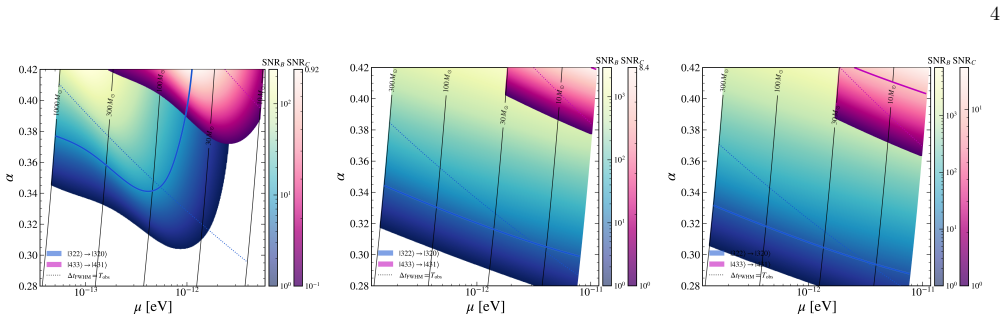
Consequently, the same coherence that drives the avalanche also shapes the es- caping signal: a quasi-monochromatic GW pulse with a full width at half-maximum ∆t FWHM = 4 arcosh(2)t p ≃ 5.27t p and a bandwidth ∆f∼(2πt p)−1. For the B (|322⟩ → |320⟩) and C (|433⟩ → |431⟩) channels, the characteristic amplitudeh 0 is evaluated under the assumption that the ...
2021
-
[2]
S. Weinberg, “A new light boson?,”Phys. Rev. Lett.40 (Jan, 1978) 223–226.https: //link.aps.org/doi/10.1103/PhysRevLett.40.223
-
[3]
A. Arvanitaki, S. Dimopoulos, S. Dubovsky, N. Kaloper, and J. March-Russell, “String Axiverse,”Phys. Rev. D 81(2010) 123530,arXiv:0905.4720 [hep-th]
Pith/arXiv arXiv 2010
-
[4]
D. J. E. Marsh, “Axion Cosmology,”Phys. Rept.643 (2016) 1–79,arXiv:1510.07633 [astro-ph.CO]
Pith/arXiv arXiv 2016
-
[5]
Ultralight scalars as cosmological dark matter,
L. Hui, J. P. Ostriker, S. Tremaine, and E. Witten, “Ultralight scalars as cosmological dark matter,”Phys. Rev. D95no. 4, (2017) 043541,arXiv:1610.08297 [astro-ph.CO]
Pith/arXiv arXiv 2017
-
[6]
E. G. M. Ferreira, “Ultra-light dark matter,”Astron. Astrophys. Rev.29no. 1, (2021) 7,arXiv:2005.03254 [astro-ph.CO]
arXiv 2021
-
[7]
Generation of Waves by a Rotating Body,
Y. B. Zeldovich, “Generation of Waves by a Rotating Body,”Soviet Journal of Experimental and Theoretical Physics Letters14(1971) 180
1971
-
[8]
Amplification of waves during reflection from a rotating
A. A. Starobinskii, “Amplification of waves during reflection from a rotating ”black hole”,”Sov. Phys. JETP37no. 1, (1973) 28–32
1973
-
[9]
Floating Orbits, Superradiant Scattering and the Black-hole Bomb,
W. H. Press and S. A. Teukolsky, “Floating Orbits, Superradiant Scattering and the Black-hole Bomb,” Nature238(1972) 211–212
1972
-
[10]
Superradiance: New Frontiers in Black Hole Physics,
R. Brito, V. Cardoso, and P. Pani, “Superradiance: New Frontiers in Black Hole Physics,”Lect. Notes Phys. 906(2015) pp.1–237,arXiv:1501.06570 [gr-qc]
Pith/arXiv arXiv 2015
-
[11]
Exploring the String Axiverse with Precision Black Hole Physics,
A. Arvanitaki and S. Dubovsky, “Exploring the String Axiverse with Precision Black Hole Physics,”Phys. Rev. D83(2011) 044026,arXiv:1004.3558 [hep-th]
Pith/arXiv arXiv 2011
-
[12]
Discovering the QCD Axion with Black Holes and Gravitational Waves,
A. Arvanitaki, M. Baryakhtar, and X. Huang, “Discovering the QCD Axion with Black Holes and Gravitational Waves,”Phys. Rev. D91no. 8, (2015) 084011,arXiv:1411.2263 [hep-ph]
Pith/arXiv arXiv 2015
-
[13]
The Spectra of Gravitational Atoms,
D. Baumann, H. S. Chia, J. Stout, and L. ter Haar, “The Spectra of Gravitational Atoms,”JCAP12(Dec.,
-
[14]
006,arXiv:1908.10370 [gr-qc]
arXiv 1908
-
[15]
Stochastic and resolvable gravitational waves from ultralight bosons,
R. Brito, S. Ghosh, E. Barausse, E. Berti, V. Cardoso, I. Dvorkin, A. Klein, and P. Pani, “Stochastic and resolvable gravitational waves from ultralight bosons,” Phys. Rev. Lett.119no. 13, (2017) 131101, arXiv:1706.05097 [gr-qc]
Pith/arXiv arXiv 2017
-
[16]
Follow-up signals from superradiant instabilities of black hole merger remnants,
S. Ghosh, E. Berti, R. Brito, and M. Richartz, “Follow-up signals from superradiant instabilities of black hole merger remnants,”Phys. Rev. D99no. 10, (May, 2019) 104030,arXiv:1812.01620 [gr-qc]
Pith/arXiv arXiv 2019
-
[17]
LIGO Scientific, Virgo, KAGRA Collaboration, R. Abbottet al., “All-sky search for gravitational wave emission from scalar boson clouds around spinning black holes in LIGO O3 data,”Phys. Rev. D105no. 10, (2022) 102001,arXiv:2111.15507 [astro-ph.HE]
arXiv 2022
-
[18]
C. Yuan, Y. Jiang, and Q.-G. Huang, “Constraints on an ultralight scalar boson from Advanced LIGO and Advanced Virgo’s first three observing runs using the stochastic gravitational-wave background,”Phys. Rev. D106no. 2, (2022) 023020,arXiv:2204.03482 6 [astro-ph.CO]
arXiv 2022
-
[19]
Subdominant modes of the scalar superradiant instability and gravitational wave beats,
Y.-d. Guo, S.-s. Bao, and H. Zhang, “Subdominant modes of the scalar superradiant instability and gravitational wave beats,”Phys. Rev. D107no. 7, (2023) 075009,arXiv:2212.07186 [gr-qc]
arXiv 2023
-
[20]
J. Liu, “Gravitational laser: the stimulated radiation of gravitational waves from the clouds of ultralight bosons,”Commun. Theor. Phys.78no. 3, (2026) 035403,arXiv:2401.16096 [gr-qc]
arXiv 2026
-
[21]
The Stochastic Gravitational Wave Background from Primordial Gravitational Atoms,
Z. Kang, T. Li, and W. Ye, “The Stochastic Gravitational Wave Background from Primordial Gravitational Atoms,”JCAP11(Nov., 2024) 039, arXiv:2407.13385 [hep-ph]
arXiv 2024
-
[22]
Ultralight Boson Ionization from Comparable-Mass Binary Black Holes,
Y. Guo, Z. Zhong, Y. Chen, V. Cardoso, T. Ikeda, and L. Zhou, “Ultralight Boson Ionization from Comparable-Mass Binary Black Holes,” arXiv:2509.09643 [gr-qc]
-
[23]
Stimulated Axion Decay in Superradiant Clouds around Primordial Black Holes,
J. G. Rosa and T. W. Kephart, “Stimulated Axion Decay in Superradiant Clouds around Primordial Black Holes,”Phys. Rev. Lett.120no. 23, (2018) 231102, arXiv:1709.06581 [gr-qc]
Pith/arXiv arXiv 2018
-
[24]
T. Ikeda, R. Brito, and V. Cardoso, “Blasts of light from axions,”Phys. Rev. Lett.122no. 8, (Mar., 2019) 081101,1811.04950 [gr-qc]
Pith/arXiv arXiv 2019
-
[25]
Superradiance: Axionic Couplings and Plasma Effects,
T. F. M. Spieksma, E. Cannizzaro, T. Ikeda, V. Cardoso, and Y. Chen, “Superradiance: Axionic Couplings and Plasma Effects,”Phys. Rev. D108no. 6, (Sept., 2023) 063013,arXiv:2306.16447 [gr-qc]
arXiv 2023
-
[26]
Probing Axions with Event Horizon Telescope Polarimetric Measurements,
Y. Chen, J. Shu, X. Xue, Q. Yuan, and Y. Zhao, “Probing Axions with Event Horizon Telescope Polarimetric Measurements,”Phys. Rev. Lett.124 no. 6, (2020) 061102,arXiv:1905.02213 [hep-ph]
arXiv 2020
-
[27]
Stringent axion constraints with Event Horizon Telescope polarimetric measurements of M87 ∗,
Y. Chen, Y. Liu, R.-S. Lu, Y. Mizuno, J. Shu, X. Xue, Q. Yuan, and Y. Zhao, “Stringent axion constraints with Event Horizon Telescope polarimetric measurements of M87 ∗,”Nature Astron.6no. 5, (2022) 592–598,arXiv:2105.04572 [hep-ph]
arXiv 2022
-
[28]
Photon Ring Astrometry for Superradiant Clouds,
Y. Chen, X. Xue, R. Brito, and V. Cardoso, “Photon Ring Astrometry for Superradiant Clouds,”Phys. Rev. Lett.130no. 11, (2023) 111401,arXiv:2211.03794 [gr-qc]
arXiv 2023
-
[29]
Black hole spin constraints on the mass spectrum and number of axionlike fields,
M. J. Stott and D. J. E. Marsh, “Black hole spin constraints on the mass spectrum and number of axionlike fields,”Phys. Rev. D98no. 8, (Oct., 2018) 083006,arXiv:1805.02016 [hep-ph]
Pith/arXiv arXiv 2018
-
[30]
Superradiance and the Spins of Black Holes from LIGO and X-ray binaries,
N. Fernandez, A. Ghalsasi, and S. Profumo, “Superradiance and the Spins of Black Holes from LIGO and X-ray binaries,”arXiv:1911.07862 [hep-ph]
arXiv 1911
-
[31]
Ultralight Boson Dark Matter and Event Horizon Telescope Observations of M87*,
H. Davoudiasl and P. B. Denton, “Ultralight Boson Dark Matter and Event Horizon Telescope Observations of M87*,”Phys. Rev. Lett.123no. 2, (2019) 021102, arXiv:1904.09242 [astro-ph.CO]
Pith/arXiv arXiv 2019
-
[32]
K. K. Y. Ng, S. Vitale, O. A. Hannuksela, and T. G. F. Li, “Constraints on Ultralight Scalar Bosons within Black Hole Spin Measurements from the LIGO-Virgo GWTC-2,”Phys. Rev. Lett.126no. 15, (2021) 151102, arXiv:2011.06010 [gr-qc]
arXiv 2021
-
[33]
The BH-PSR Gravitational Molecule,
T. Liu and K.-F. Lyu, “The BH-PSR Gravitational Molecule,”arXiv:2107.09971 [astro-ph.HE]
-
[34]
Bounds on ultralight bosons from the Event Horizon Telescope observation of Sgr A∗,
A. K. Saha, P. Parashari, T. N. Maity, A. Dubey, S. Bouri, and R. Laha, “Bounds on ultralight bosons from the Event Horizon Telescope observation of Sgr A∗,”Eur. Phys. J. C84no. 9, (2024) 901, arXiv:2208.03530 [astro-ph.HE]
arXiv 2024
-
[35]
Constraints on an axionlike particle from black hole spin superradiance,
L.-d. Cheng, H. Zhang, and S.-s. Bao, “Constraints on an axionlike particle from black hole spin superradiance,”Phys. Rev. D107no. 6, (2023) 063021, arXiv:2201.11338 [gr-qc]
arXiv 2023
-
[36]
Extreme-Mass-Ratio Inspirals in Ultralight Dark Matter,
F. Duque, C. F. B. Macedo, R. Vicente, and V. Cardoso, “Extreme-Mass-Ratio Inspirals in Ultralight Dark Matter,”Phys. Rev. Lett.133no. 12, (2024) 121404,arXiv:2312.06767 [gr-qc]
arXiv 2024
-
[37]
Stepping up superradiance constraints on axions,
S. J. Witte and A. Mummery, “Stepping up superradiance constraints on axions,”Phys. Rev. D111 no. 8, (2025) 083044,arXiv:2412.03655 [hep-ph]
arXiv 2025
-
[38]
Getting more out of black hole superradiance: a statistically rigorous approach to ultralight boson constraints from black hole spin measurements,
S. Hoof, D. J. E. Marsh, J. Sisk-Reyn´ es, J. H. Matthews, and C. Reynolds, “Getting more out of black hole superradiance: a statistically rigorous approach to ultralight boson constraints from black hole spin measurements,”Monthly Notices of the Royal Astronomical Society(09, 2025) staf1564
2025
-
[39]
Superradiance Constraints from GW231123,
A. Caputo, G. Franciolini, and S. J. Witte, “Superradiance Constraints from GW231123,” arXiv:2507.21788 [hep-ph]
-
[40]
Ultralight boson constraints from gravitational wave observations of spinning binary black holes,
P. S. Aswathi, W. E. East, N. Siemonsen, L. Sun, and D. Jones, “Ultralight boson constraints from gravitational wave observations of spinning binary black holes,”arXiv:2507.20979 [gr-qc]
-
[41]
Probing Axions via Spectroscopic Measurements of S-stars at the Galactic Center,
Z. Bai, V. Cardoso, Y. Chen, T. Do, A. Hees, H. Xiao, and X. Xue, “Probing Axions via Spectroscopic Measurements of S-stars at the Galactic Center,” arXiv:2507.07482 [hep-ph]
-
[42]
Probing dense environments around Sgr A* with S-star dynamics,
G. M. Tomaselli and A. Caputo, “Probing dense environments around Sgr A* with S-star dynamics,” Phys. Rev. D113no. 8, (2026) 083035, arXiv:2509.03568 [astro-ph.GA]
Pith/arXiv arXiv 2026
-
[43]
Scalar Fields around Black Hole Binaries in LIGO-Virgo-KAGRA,
S. Roy, R. Vicente, J. C. Aurrekoetxea, K. Clough, and P. G. Ferreira, “Scalar Fields around Black Hole Binaries in LIGO-Virgo-KAGRA,”Phys. Rev. Lett.136 no. 19, (2026) 191402,arXiv:2510.17967 [gr-qc]
Pith/arXiv arXiv 2026
-
[44]
Ring formation from black hole superradiance through repeated particle production on bound orbits,
Z.-H. Lyu, R.-G. Cai, Z.-K. Guo, J.-F. He, and J. Liu, “Ring formation from black hole superradiance through repeated particle production on bound orbits,”Phys. Rev. D112no. 10, (2025) 104066,arXiv:2507.03490 [gr-qc]
arXiv 2025
-
[45]
Constraining interacting dark energy models with black hole superradiance,
Z.-H. Lyu, R.-G. Cai, S.-J. Wang, and X.-X. Zeng, “Constraining interacting dark energy models with black hole superradiance,”Phys. Rev. D113no. 8, (2026) 083041,arXiv:2511.16244 [astro-ph.CO]
Pith/arXiv arXiv 2026
-
[46]
Probing Ultralight Bosons with Binary Black Holes,
D. Baumann, H. S. Chia, and R. A. Porto, “Probing Ultralight Bosons with Binary Black Holes,”Phys. Rev. D99no. 4, (Feb., 2019) 044001,arXiv:1804.03208 [gr-qc]
Pith/arXiv arXiv 2019
-
[47]
Gravitational Collider Physics,
D. Baumann, H. S. Chia, R. A. Porto, and J. Stout, “Gravitational Collider Physics,”Phys. Rev. D101 no. 8, (2020) 083019,arXiv:1912.04932 [gr-qc]. 7
arXiv 2020
-
[48]
Ionization of gravitational atoms,
D. Baumann, G. Bertone, J. Stout, and G. M. Tomaselli, “Ionization of gravitational atoms,”Phys. Rev. D105no. 11, (2022) 115036,arXiv:2112.14777 [gr-qc]
arXiv 2022
-
[49]
Sharp Signals of Boson Clouds in Black Hole Binary Inspirals,
D. Baumann, G. Bertone, J. Stout, and G. M. Tomaselli, “Sharp Signals of Boson Clouds in Black Hole Binary Inspirals,”Phys. Rev. Lett.128no. 22, (2022) 221102,arXiv:2206.01212 [gr-qc]
arXiv 2022
-
[50]
Ultralight boson cloud depletion in binary systems,
E. Berti, R. Brito, C. F. B. Macedo, G. Raposo, and J. L. Rosa, “Ultralight boson cloud depletion in binary systems,”Phys. Rev. D99no. 10, (2019) 104039, arXiv:1904.03131 [gr-qc]
Pith/arXiv arXiv 2019
-
[51]
Gravitational floating orbits around hairy black holes,
J. Zhang and H. Yang, “Gravitational floating orbits around hairy black holes,”Phys. Rev. D99no. 6, (2019) 064018,arXiv:1808.02905 [gr-qc]
Pith/arXiv arXiv 2019
-
[52]
Dynamic Signatures of Black Hole Binaries with Superradiant Clouds,
J. Zhang and H. Yang, “Dynamic Signatures of Black Hole Binaries with Superradiant Clouds,”Phys. Rev. D 101no. 4, (Feb., 2020) 043020,arXiv:1907.13582 [gr-qc]
arXiv 2020
-
[53]
Signatures of Ultralight Bosons in the Orbital Eccentricity of Binary Black Holes,
M. Boˇ skovi´ c, M. Koschnitzke, and R. A. Porto, “Signatures of Ultralight Bosons in the Orbital Eccentricity of Binary Black Holes,”Phys. Rev. Lett. 133no. 12, (2024) 121401,arXiv:2403.02415 [gr-qc]
arXiv 2024
-
[54]
T. Takahashi, H. Omiya, and T. Tanaka, “Axion cloud evaporation during inspiral of black hole binaries: The effects of backreaction and radiation,”PTEP2022 no. 4, (2022) 043E01,arXiv:2112.05774 [gr-qc]
arXiv 2022
-
[55]
Self-interacting axion clouds around rotating black holes in binary systems,
T. Takahashi, H. Omiya, and T. Tanaka, “Self-interacting axion clouds around rotating black holes in binary systems,”Phys. Rev. D110no. 10, (2024) 104038,arXiv:2408.08349 [gr-qc]
arXiv 2024
-
[56]
Signatures of ultralight bosons in compact binary inspiral and outspiral,
Y. Cao and Y. Tang, “Signatures of ultralight bosons in compact binary inspiral and outspiral,”Phys. Rev. D 108no. 12, (2023) 123017,arXiv:2307.05181 [gr-qc]
arXiv 2023
-
[57]
Termination of superradiance from a binary companion,
X. Tong, Y. Wang, and H.-Y. Zhu, “Termination of superradiance from a binary companion,”Phys. Rev. D 106no. 4, (2022) 043002,arXiv:2205.10527 [gr-qc]
arXiv 2022
-
[58]
Dynamical friction in gravitational atoms,
G. M. Tomaselli, T. F. M. Spieksma, and G. Bertone, “Dynamical friction in gravitational atoms,”JCAP07 (2023) 070,arXiv:2305.15460 [gr-qc]
arXiv 2023
-
[59]
Resonant history of gravitational atoms in black hole binaries,
G. M. Tomaselli, T. F. M. Spieksma, and G. Bertone, “Resonant history of gravitational atoms in black hole binaries,”Phys. Rev. D110no. 6, (2024) 064048, arXiv:2403.03147 [gr-qc]
arXiv 2024
-
[60]
Legacy of boson clouds on black hole binaries,
G. M. Tomaselli, T. F. M. Spieksma, and G. Bertone, “Legacy of boson clouds on black hole binaries,”Phys. Rev. Lett.133no. 12, (Sept., 2024) 121402, arXiv:2407.12908 [gr-qc]
arXiv 2024
-
[61]
Superradiant clouds may be relevant for close compact object binaries,
A. Guo, J. Zhang, and H. Yang, “Superradiant clouds may be relevant for close compact object binaries,” Phys. Rev. D110no. 2, (2024) 023022, arXiv:2401.15003 [gr-qc]
arXiv 2024
-
[62]
Common envelope evolution of ultralight boson clouds,
A. Guo, Q.-Y. Zhang, H. Yang, and J. Zhang, “Common envelope evolution of ultralight boson clouds,”Phys. Rev. D113no. 4, (2026) 043018, arXiv:2508.18738 [gr-qc]
arXiv 2026
-
[63]
Gravitational waves from superradiant cloud level transition,
S.-T. Peng and J. Zhang, “Gravitational waves from superradiant cloud level transition,”Phys. Rev. D113 no. 6, (2026) 064038,arXiv:2504.00728 [gr-qc]
Pith/arXiv arXiv 2026
-
[64]
Probing Boson Clouds with Supermassive Black Hole Binaries,
X. Li, J. Ren, and X.-L. Zhang, “Probing Boson Clouds with Supermassive Black Hole Binaries,” arXiv:2505.02866 [hep-ph]
-
[65]
Gravitational waves from resonant transitions of tidally perturbed gravitational atoms,
A. Kyriazis and F. Yang, “Gravitational waves from resonant transitions of tidally perturbed gravitational atoms,”JHEP11(2025) 062,arXiv:2503.18121 [hep-ph]
arXiv 2025
-
[66]
Smooth binary evolution from wide resonances in boson clouds,
G. M. Tomaselli, “Smooth binary evolution from wide resonances in boson clouds,”Phys. Rev. D112no. 6, (2025) 063033,arXiv:2507.15110 [gr-qc]
arXiv 2025
-
[67]
Self-gravity in superradiance clouds: Implications for binary dynamics and observational prospects,
H. Kim and A. Lenoci, “Self-gravity in superradiance clouds: Implications for binary dynamics and observational prospects,”Phys. Rev. D112no. 10, (2025) 104014,arXiv:2508.08367 [gr-qc]
arXiv 2025
-
[68]
Detectability of gravitational atoms in black hole binaries with the Einstein Telescope,
R. Della Monica and R. Brito, “Detectability of gravitational atoms in black hole binaries with the Einstein Telescope,”Phys. Rev. D112no. 2, (2025) 024074,arXiv:2503.23419 [gr-qc]
arXiv 2025
-
[69]
C. Dyson, T. F. M. Spieksma, R. Brito, M. van de Meent, and S. Dolan, “Environmental Effects in Extreme-Mass-Ratio Inspirals: Perturbations to the Environment in Kerr Spacetimes,”Phys. Rev. Lett.134 no. 21, (2025) 211403,arXiv:2501.09806 [gr-qc]
arXiv 2025
-
[70]
Extreme mass-ratio inspiral within an ultralight scalar cloud: Scalar radiation,
D. Li, C. Weller, P. Bourg, M. LaHaye, N. Yunes, and H. Yang, “Extreme mass-ratio inspiral within an ultralight scalar cloud: Scalar radiation,”Phys. Rev. D 112no. 8, (2025) 084057,arXiv:2507.02045 [gr-qc]
arXiv 2025
-
[71]
Resonances as signatures of scalar clouds in eccentric extreme-mass-ratio inspirals,
Q.-X. Xu, R. Brito, R. Della Monica, R. Vicente, and C. Yuan, “Resonances as signatures of scalar clouds in eccentric extreme-mass-ratio inspirals,” arXiv:2605.03756 [gr-qc]
-
[72]
New sources of gravitational wave signals: The black hole graviton laser,
´E. Dupuis and M. B. Paranjape, “New sources of gravitational wave signals: The black hole graviton laser,”Int. J. Mod. Phys. D27no. 14, (2018) 1847009, arXiv:1807.03163 [gr-qc]
Pith/arXiv arXiv 2018
-
[73]
Coherence in spontaneous radiation processes,
R. H. Dicke, “Coherence in spontaneous radiation processes,”Phys. Rev.93(Jan, 1954) 99–110
1954
-
[74]
Cooperative radiation processes in two-level systems: Superfluorescence,
R. Bonifacio and L. A. Lugiato, “Cooperative radiation processes in two-level systems: Superfluorescence,” Phys. Rev. A11(May, 1975) 1507–1521
1975
-
[75]
Theory of superradiance in an extended, optically thick medium,
J. C. MacGillivray and M. S. Feld, “Theory of superradiance in an extended, optically thick medium,” Phys. Rev. A14(Sep, 1976) 1169–1189
1976
-
[76]
Superradiance: An essay on the theory of collective spontaneous emission,
M. Gross and S. Haroche, “Superradiance: An essay on the theory of collective spontaneous emission,”Physics Reports93no. 5, (1982) 301–396
1982
-
[77]
Maggiore,Gravitational Waves: Volume 1: Theory and Experiments
M. Maggiore,Gravitational Waves: Volume 1: Theory and Experiments. Oxford University Press, 10, 2007. https://doi.org/10.1093/acprof: oso/9780198570745.001.0001
-
[78]
The construction and use of LISA sensitivity curves,
T. Robson, N. J. Cornish, and C. Liu, “The construction and use of LISA sensitivity curves,”Class. Quant. Grav.36no. 10, (2019) 105011, arXiv:1803.01944 [astro-ph.HE]
Pith/arXiv arXiv 2019
-
[79]
Detector configuration of DECIGO/BBO and identification of cosmological neutron-star binaries,
K. Yagi and N. Seto, “Detector configuration of DECIGO/BBO and identification of cosmological neutron-star binaries,”Phys. Rev. D83(2011) 044011, 8 arXiv:1101.3940 [astro-ph.CO]. [Erratum: Phys.Rev.D 95, 109901 (2017)]. 9 Supplemental Material: Gravitational superfluorescence from superradiant axion clouds A. GRA VIT A TIONAL-A TOM CONVENTIONS AND CHANNEL...
Pith/arXiv arXiv 2011
-
[80]
1 solves Eq
Projecting onto the helicity selected by the transition matrix element, Ψ =h ijeL ij andS=S ijeL ij, and splitting the total field into external and self-generated contributions Ψ = Ψ E + ΨS, gives the reduced atom–field system ˙c1 =iκ[Ψ E(t,0) + ΨS(t,0)]e −iδωt c2 ,˙c 2 =iκ[Ψ ∗ E(t,0) + Ψ∗ S(t,0)]e +iδωt c1 , ∂2 t ΨS −2iω∂ tΨS − ∇2ΨS −ω 2ΨS =ηS(x)c 1c∗ 2...
1902
discussion (0)
Sign in with ORCID, Apple, or X to comment. Anyone can read and Pith papers without signing in.