Magnetic Moment of Octet Baryons in Isospin Asymmetric Magnetized Strange Matter
Pith reviewed 2026-06-27 12:20 UTC · model grok-4.3
The pith
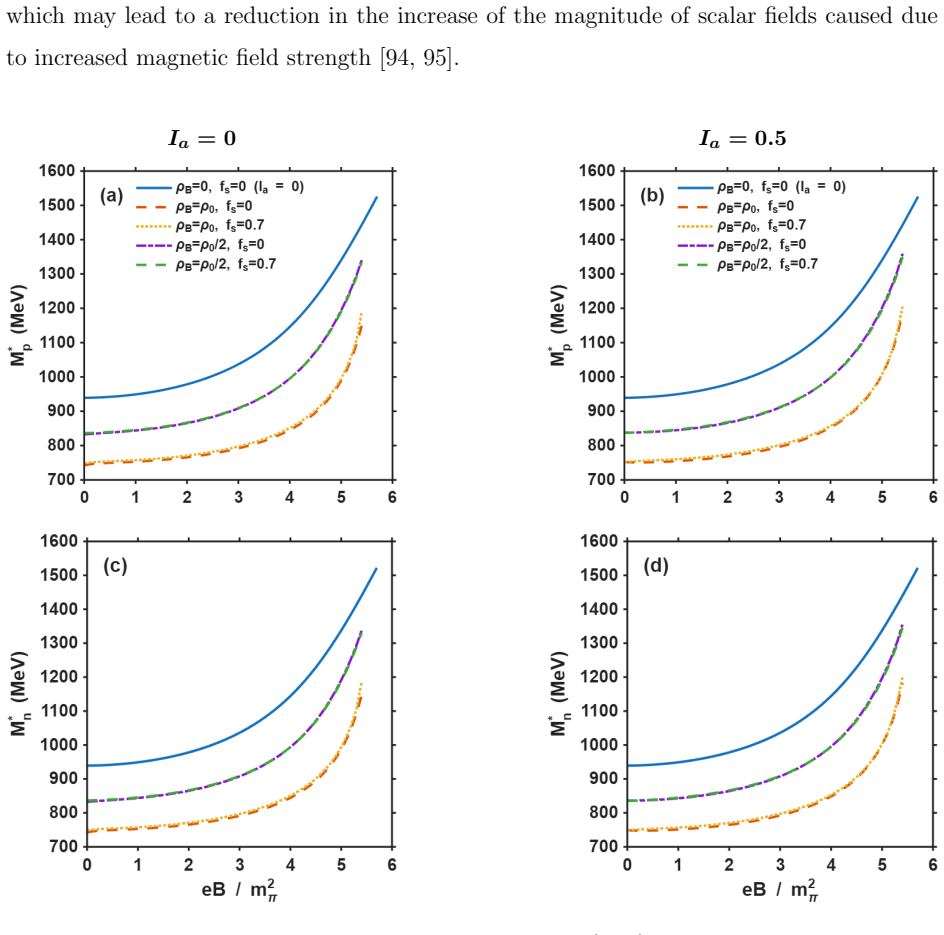
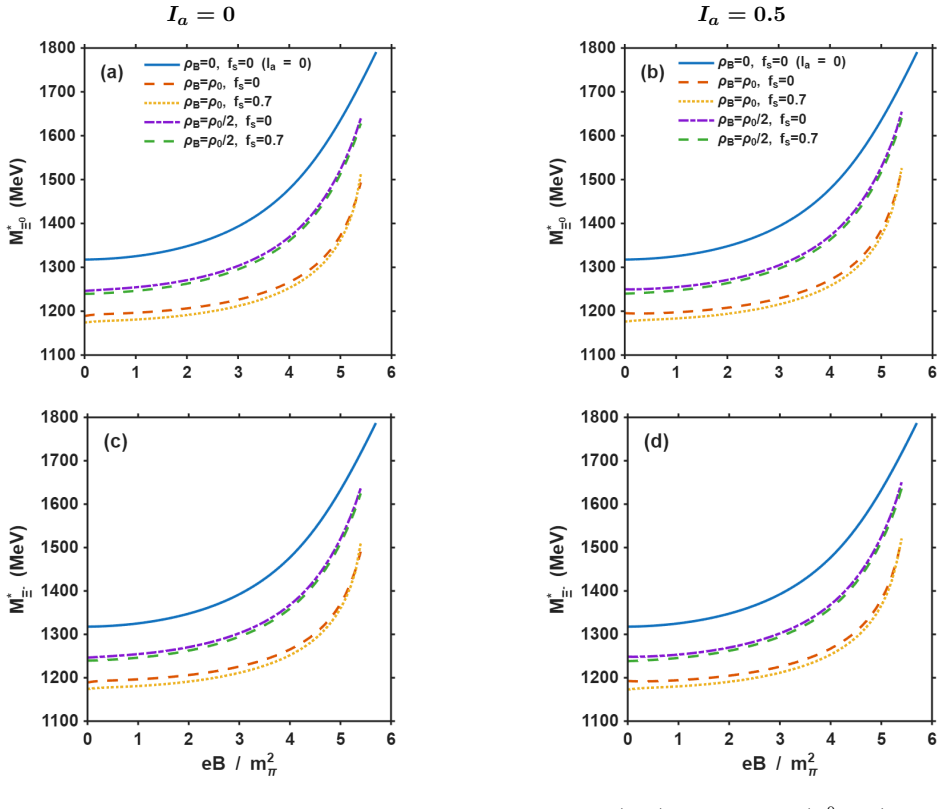
Dirac sea effects cause octet baryon effective masses to increase monotonically with magnetic field at finite temperature.
A machine-rendered reading of the paper's core claim, the machinery that carries it, and where it could break.
Core claim
Within the unified CQMF plus χCQM framework, the Dirac sea effect at finite temperature induces magnetic catalysis that enhances scalar condensates with rising magnetic field strength, producing a monotonic increase in the effective masses of octet baryons.
What carries the argument
The unified theoretical framework obtained by combining the chiral SU(3) quark mean field (CQMF) model with the chiral constituent quark (χCQM) model, with explicit inclusion of Dirac sea effects.
If this is right
- Magnetic moments of octet baryons must be recomputed with the field-dependent effective masses that result from the Dirac sea contribution.
- Vacuum polarization effects become essential for any electromagnetic observable of baryons in strongly magnetized strange matter.
- The mass increase affects the thermodynamic and transport properties of the medium in environments with strong magnetic fields.
- Results apply directly to modeling baryon behavior in heavy-ion collision fireballs and in the interiors of magnetized compact stars.
Where Pith is reading between the lines
- The same framework could be used to predict how magnetic moments themselves vary with field strength once the mass shift is included.
- The monotonic mass growth may alter the equation of state and stability criteria for magnetized neutron stars containing strange matter.
- Lattice QCD simulations with background magnetic fields at finite temperature could provide an independent check on the predicted mass increase.
Load-bearing premise
The combined CQMF and χCQM model correctly describes the electromagnetic properties of baryons in isospin asymmetric strange hadronic matter under strong external magnetic fields.
What would settle it
A calculation or measurement showing that effective masses of octet baryons do not increase or instead decrease with rising magnetic field strength at finite temperature in isospin asymmetric strange matter would disprove the central claim.
Figures






read the original abstract
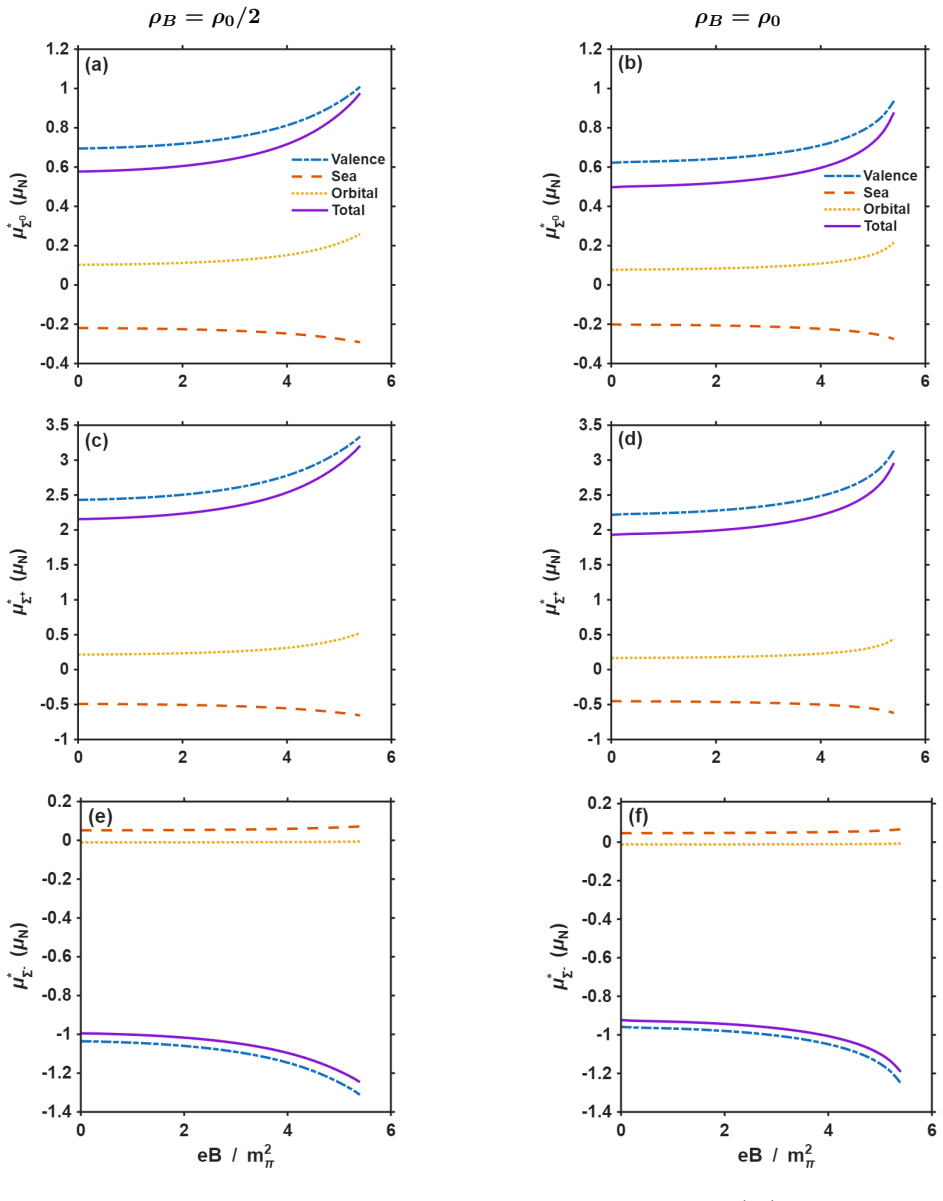
We investigate the magnetic moments of octet baryons in isospin asymmetric strange hadronic matter under strong external magnetic fields within a unified theoretical framework by combining the chiral SU(3) quark mean field (CQMF) model with the chiral constituent quark ($\chi$CQM) model. At finite temperature, the inclusion of Dirac sea (DS) effect leads to magnetic catalysis attributing to the enhancement of scalar condensates with increasing magnetic field strength. As a consequence, the effective masses of the octet baryons exhibit a monotonic increase as a function of magnetic field. The results highlight the crucial role of vacuum polarization effects in determining the electromagnetic properties of baryons in strongly magnetized matter having relevance in heavy-ion collision and compact stars.
Editorial analysis
A structured set of objections, weighed in public.
Referee Report
Summary. The paper investigates the magnetic moments of octet baryons in isospin asymmetric strange hadronic matter under strong external magnetic fields using a unified framework that combines the chiral SU(3) quark mean field (CQMF) model with the chiral constituent quark (χCQM) model. At finite temperature, inclusion of Dirac sea effects produces magnetic catalysis via enhancement of scalar condensates with increasing magnetic field, leading to a monotonic increase in the effective masses of the octet baryons; the work emphasizes the role of vacuum polarization in determining electromagnetic properties relevant to heavy-ion collisions and compact stars.
Significance. If the central result on monotonic mass increase due to Dirac sea contributions holds, the manuscript provides a concrete illustration of magnetic catalysis within an effective quark model for isospin-asymmetric strange matter. The CQMF+χCQM construction supplies an internally consistent treatment of the asymmetric case and generates falsifiable predictions for baryon magnetic moments under strong fields, which is a strength for applications to compact stars and heavy-ion environments.
minor comments (2)
- The abstract states the monotonic increase in effective masses but does not quote the specific temperature range, magnetic field interval, or parameter values (e.g., from CQMF or χCQM) used to obtain the result; adding these in §3 or a dedicated results section would improve reproducibility.
- Notation for the combined CQMF+χCQM framework is introduced without an explicit equation defining how the Dirac sea contribution is added to the effective mass formula; a short derivation or reference to the relevant equation would clarify the origin of the catalysis effect.
Simulated Author's Rebuttal
We thank the referee for their positive assessment of our manuscript and the recommendation for minor revision. The referee's summary accurately captures our central results on the role of Dirac sea effects in producing magnetic catalysis and the resulting monotonic increase in octet baryon effective masses within the combined CQMF+χCQM framework for isospin-asymmetric strange matter.
Circularity Check
No significant circularity detected
full rationale
The provided abstract and context describe a combined CQMF + χCQM effective model whose central result (monotonic rise in effective baryon masses from Dirac-sea magnetic catalysis at finite T) follows directly from the model's vacuum-polarization terms. No quoted equations or steps reduce a claimed prediction to a fitted input by construction, nor does any load-bearing premise rest solely on an unverified self-citation chain. The framework is presented as internally consistent for the isospin-asymmetric case; the derivation remains self-contained within standard effective-model assumptions and does not exhibit the enumerated circularity patterns.
Axiom & Free-Parameter Ledger
Reference graph
Works this paper leans on
-
[1]
Nambu and G
Y. Nambu and G. Jona-Lasinio, Phys. Rev.124, 246 (1961)
1961
-
[2]
D. J. Gross and F. Wilczek, Phys. Rev. Lett.30, 1343 (1973)
1973
-
[3]
Fukushima, T
K. Fukushima, T. Hatsuda, Rep. Prog. Phys.74, 014001 (2011)
2011
-
[4]
Shuryak, Prog
E. Shuryak, Prog. Part. Nucl. Phys.53, 273 (2004)
2004
-
[5]
A. W. Thomas, Adv. Nucl. Phys.13, 1 (1984)
1984
-
[6]
Skokov, A
V. Skokov, A. Y. Illarionov and V. Toneev, Int. J. Mod. Phys. A24, 5925 (2009)
2009
-
[7]
W. T. Deng and X. G. Huang, Phys. Rev. C85, 044907 (2012)
2012
-
[8]
X. G. Huang, Rept. Prog. Phys.79, 076302 (2016)
2016
-
[9]
Bzdak and V
A. Bzdak and V. Skokov, Phys. Lett. B710, 171 (2012)
2012
-
[10]
Gezhagn and A
T. Gezhagn and A. K. Chaubey, Front. in Phys.9, 791108 (2022)
2022
-
[11]
Tuchin, Int
K. Tuchin, Int. J. Mod. Phys. E23, 1430001 (2014)
2014
-
[12]
V. P. Gusynin, V. A. Miransky and I. A. Shovkovy, Nucl. Phys. B462, 249 (1996)
1996
-
[13]
J. O. Andersen, W. R. Naylor and A. Tranberg, Rev. Mod. Phys.88, 025001 (2016)
2016
-
[14]
Tuchin, Phys
K. Tuchin, Phys. Rev. C87, 024912 (2013)
2013
-
[15]
McLerran and V
L. McLerran and V. Skokov, Nucl. Phys. A929, 184 (2014)
2014
-
[16]
D. E. Kharzeev, J. Liao, S. A. Voloshin and G. Wang, Prog. Part. Nucl. Phys.88, 1 (2016)
2016
-
[17]
Fukushima , D
K. Fukushima , D. E. Kharzeev, and H. J. Warringa, Phys. Rev. D78, 074033 (2008)
2008
- [18]
-
[19]
R. C. Duncan and C. Thompson, Astrophys. J. Lett.392, L9 (1992)
1992
-
[20]
Kouveliotouet al., Nature393, 235 (1998)
C. Kouveliotouet al., Nature393, 235 (1998)
1998
-
[21]
Turolla, S
R. Turolla, S. Zane and A. Watts, Rept. Prog. Phys.78, 116901 (2015)
2015
-
[22]
P. M. Woods and C. Thompson, arXiv:astro-ph/0406133
-
[23]
Dexheimer, R
V. Dexheimer, R. Negreiros and S. Schramm, Eur. Phys. J. A48, 189 (2012)
2012
-
[24]
Rabhi, H
A. Rabhi, H. Pais, P. K. Panda and C. Providencia, J. Phys. G36, 115204 (2009). 34
2009
-
[25]
Broderick, M
A. Broderick, M. Prakash and J. M. Lattimer, Astrophys. J.537, 351 (2000)
2000
-
[26]
Papazoglouet al., Phys
P. Papazoglouet al., Phys. Rev. C57, 2576 (1998)
1998
-
[27]
C. Y. Ryu and M. K. Cheoun, J. Phys. Conf. Ser.312, 042021 (2011)
2011
-
[28]
D. P. Menezeset al., Phys. Rev. C79, 035807 (2009)
2009
-
[29]
Singh, A
H. Singh, A. Kumar and H. Dahiya, Chin. Phys. C41, 094104 (2017)
2017
-
[30]
Ramalho, K
G. Ramalho, K. Tsushima and M. K. Cheoun, Symmetry17, no.5, 681 (2025)
2025
-
[31]
Coleman and S
S. Coleman and S. L. Glashow, Phys. Rev. Lett.6, 423 (1961)
1961
-
[32]
B´ eg, M. A. B. and Lee, B. W. and Pais, A., Phys. Rev. Lett.13, 514 (1964)
1964
-
[33]
A. L. Choudhury and V. Joshi, Phys. Rev. D13, 3120 (1976)
1976
-
[34]
DeGrand, R
T. DeGrand, R. L. Jaffe, K. Johnson, and J. Kiskis, Phys. Rev. D12, 2060 (1975)
2060
-
[35]
Nambu and G
Y. Nambu and G. Jona-Lasinio, Phys. Rev.122, 345 (1961)
1961
-
[36]
Ramalho and K
G. Ramalho and K. Tsushima, Phys. Rev. D84, 054014 (2011)
2011
-
[37]
Sharmaet al., Phys
N. Sharmaet al., Phys. Rev. D81, 073001 (2010)
2010
-
[38]
T. P. Cheng, L. F. Li, Phys. Rev. Lett.74, 2872 (1995)
1995
-
[39]
Gupta, Phys
M. Gupta, Phys. Rev. D67, 114015 (2003)
2003
-
[40]
R. M. Aguirre and A. L. De Paoli, Eur. Phys. J. A52, 343 (2016)
2016
-
[41]
B. L. Ioffe, Nucl. Phys. B188, 317 (1981)
1981
-
[42]
F. X. Lee, Phys. Rev. D57, 1801 (1998)
1998
-
[43]
Bernard and U
V. Bernard and U. G. Meissner, Ann. Rev. Nucl. Part. Sci.57, 33 (2007)
2007
-
[44]
Bernard, N
V. Bernard, N. Kaiser, and U.-G. Meißner, Int. J. Mod. Phys. E4, 193 (1995)
1995
-
[45]
J. J. Aubertet al., (European Muon Collaboration) Phys. Lett. B123, 275 (1983)
1983
-
[46]
D. F. Geesaman, K. Saito and A. W. Thomas, Ann. Rev. Nucl. Part. Sci.45, 337 (1995)
1995
-
[47]
D. H. Lu, A. W. Thomas and K. Tsushima, arXiv:nucl-th/0112001
-
[48]
Strauchet al., Phys
S. Strauchet al., Phys. Rev. Lett.91, 052301 (2003)
2003
-
[49]
Malace, D
S. Malace, D. Gaskell, D. W. Higinbotham and I. Cloet, Int. J. Mod. Phys. E23, 1430013 (2014)
2014
-
[50]
C. Y. Ryu, C. H. Hyun, S. W. Hong, and B. K. Jennings, J. Phys. G: Nucl. Part. Phys.37, 105002 (2010)
2010
-
[51]
P. A. M. Guichon, Phys. Lett. B200, 235 (1988)
1988
-
[52]
Saito and A
K. Saito and A. W. Thomas, Phys. Lett. B327, 9 (1994)
1994
-
[53]
Fukushima, Phys
K. Fukushima, Phys. Rev. D77, 114028 (2008). 35
2008
-
[54]
T. S. T. Ali, J. Mod. Phys.4, 1471 (2013)
2013
-
[55]
Papazoglouet al., Phys
P. Papazoglouet al., Phys. Rev. C59, 411 (1999)
1999
-
[56]
Chakrabarty, D
S. Chakrabarty, D. Bandyopadhyay, and S. Pal, Phys. Rev. Lett.78, 2898 (1997)
1997
-
[57]
Skokov, B
V. Skokov, B. Friman, and K. Redlich, Phys. Rev. C83, 054904 (2011)
2011
-
[58]
S. P. Klevansky, Rev. Mod. Phys.64, 649 (1992)
1992
-
[59]
V. A. Miransky and I. A. Shovkovy, Phys. Rept.576, 1 (2015)
2015
-
[60]
V. A. Miransky and I. A. Shovkovy, Phys. Rev. D66, 045006 (2002)
2002
-
[61]
I. A. Shovkovy, Lect. Notes Phys.871, 13 (2013)
2013
-
[62]
G. S. Baliet al., JHEP02, 44 (2012)
2012
-
[63]
V. P. Pagura, D. G´ omez Dumm, S. Noguera, and N. N. Scoccola, EPJ Web Conf.137, 13012 (2017)
2017
-
[64]
G. S. Baliet al., Phys. Rev. D86, 071502 (2012)
2012
-
[65]
G. S. Baliet al., JHEP04, 130 (2013)
2013
-
[66]
V. G. Bornyakovet al., Phys. Rev. D90, 034501 (2014)
2014
-
[67]
Buballa, Phys
M. Buballa, Phys. Rept.407, 205 (2005)
2005
-
[68]
Kubis and M
S. Kubis and M. Kutschera, Phys. Lett. B399, 191 (1997)
1997
-
[69]
B. A. Li, L. W. Chen and C. M. Ko, Phys. Rept.464, 113 (2008)
2008
-
[70]
P. Wang, Z. Y. Zhang and Y. W. Yu, Commun. Theor. Phys.36, 71 (2001)
2001
-
[71]
Kumari and A
M. Kumari and A. Kumar, Eur. Phys. J. Plus136, 19 (2021)
2021
-
[72]
Dahiya, Chin
H. Dahiya, Chin. Phys. C42, 093102 (2018)
2018
-
[73]
P. Wang, V. E. Lyubovitskij, T. Gutsche and A. Faessler, Phys. Rev. C67, 015210 (2003)
2003
-
[74]
Mishra, A
A. Mishra, A. Kumar and S. P. Misra, Phys. Rev. D110, 014003 (2024)
2024
-
[75]
Mukherjeeet al., Phys
A. Mukherjeeet al., Phys. Rev. D98, 056024 (2018)
2018
-
[76]
R. M. Aguirre, Phys. Rev. C100, 065203 (2019)
2019
-
[77]
Haber, F
A. Haber, F. Preis and A. Schmitt, Phys. Rev. D90, 125036 (2014)
2014
-
[78]
Strickland, V
M. Strickland, V. Dexheimer, and D. P. Menezes, Phys. Rev. D86, 125032 (2012)
2012
-
[79]
Shen and H
H. Shen and H. Toki, Phys. Rev. C61, 045205 (2000)
2000
-
[80]
Bariket al., Phys
N. Bariket al., Phys. Rev. D31, 1652 (1985)
1985
discussion (0)
Sign in with ORCID, Apple, or X to comment. Anyone can read and Pith papers without signing in.