Slowly rotating traversable wormholes supported by radially varying string-fluid matter: From regular geometries to photon trajectories
Pith reviewed 2026-06-27 12:46 UTC · model grok-4.3
The pith
Radially varying string fluids support slowly rotating traversable wormholes that remain regular and asymptotically flat.
A machine-rendered reading of the paper's core claim, the machinery that carries it, and where it could break.
Core claim
The central claim is that a string fluid with radially dependent transverse pressure supplies a consistent source for slowly rotating traversable wormholes. This choice keeps the energy density and shape function regular, satisfies the field equations, and yields geometries without horizons that are asymptotically flat. Slow rotation adds frame-dragging effects that separate co-rotating and counter-rotating photon trajectories most strongly near the throat, while static potentials dominate at large distances. Different radial profiles of the fluid produce distinctive photon-sphere structures.
What carries the argument
The radially dependent transverse pressure in the string fluid, chosen so the energy density and shape function remain well-behaved and satisfy the Einstein equations for a regular asymptotically flat geometry.
If this is right
- The spacetime stays regular and horizon-free when slow rotation is included.
- Photon trajectories display frame-dragging differences strongest near the throat.
- Different radial profiles of the string fluid yield distinctive photon-ring patterns.
- At large distances the spacetime is governed by the static gravitational potentials.
- Anisotropic matter influences both spacetime curvature and light propagation.
Where Pith is reading between the lines
- These wormhole models could be tested by comparing predicted photon rings against observations of light around compact objects.
- The radial-variation approach might extend to other anisotropic matter sources or to faster rotation regimes.
- Photon trajectory differences could help distinguish wormholes from black holes in future imaging data.
- Stability of the geometries against small perturbations remains an open question for these matter profiles.
Load-bearing premise
The transverse pressure can be chosen to depend on radius so that the energy density and shape function stay well-behaved, satisfy the Einstein equations, and produce a regular horizon-free asymptotically flat geometry.
What would settle it
A calculation showing that no radial dependence of the transverse pressure produces an energy density and shape function that remain positive and finite while satisfying the Einstein equations for an asymptotically flat rotating wormhole metric.
Figures

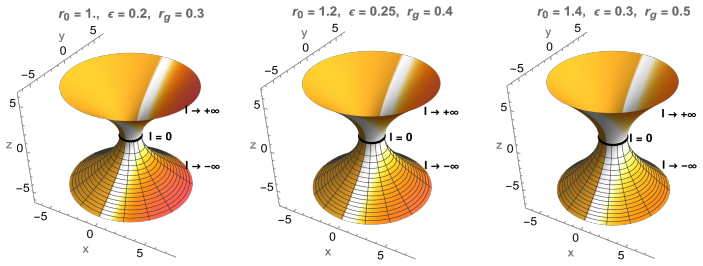
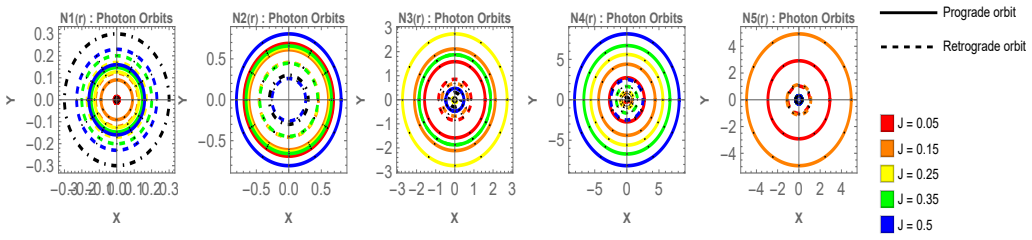
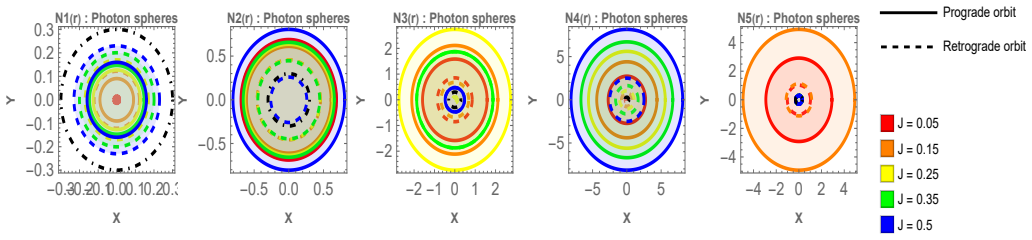
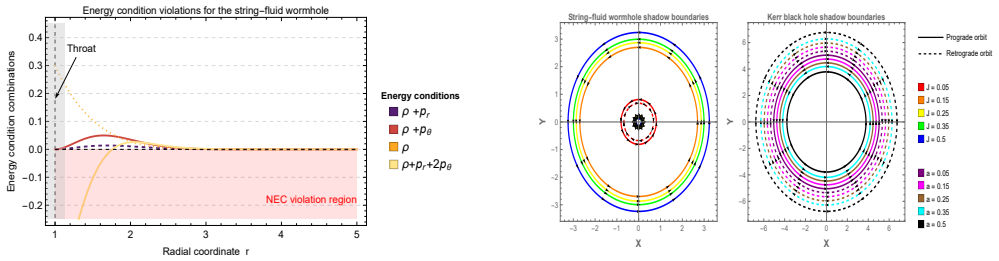
read the original abstract
This work investigates slowly rotating traversable wormholes supported by string fluids whose properties vary with distance from the throat. This radial variation allows the matter to transition smoothly from a de Sitter-like core near the center to a string-dominated environment further out, producing a regular, horizon-free, and asymptotically flat spacetime. By letting the transverse pressure depend on radius, the fluid naturally adapts to the surrounding geometry, resulting in a well-behaved energy density and shape function. Even modest rotation introduces frame-dragging effects that gently twist photon paths, creating subtle differences between co-rotating and counter-rotating trajectories. These effects are strongest near the throat, while at larger distances the spacetime is largely governed by the static gravitational potentials. Circular photon orbits reveal that the interplay of the redshift function, wormhole shape, and rotation shapes the photon-sphere structure. Different radial profiles of the string fluid generate distinctive photon-ring patterns, offering potential observational signatures of both the rotation and the internal matter distribution. Overall, radially varying string fluids provide a flexible and physically consistent source for traversable wormholes, bridging smoothly between vacuum-like and string-dominated regions while maintaining regularity and supporting slow rotation. This study highlights how anisotropic matter can influence both curvature and light propagation, providing a realistic framework for horizonless exotic spacetimes and suggesting new avenues to explore subtle observational effects around traversable wormholes.
Editorial analysis
A structured set of objections, weighed in public.
Referee Report
Summary. The paper constructs slowly rotating traversable wormholes supported by string fluids with radially dependent properties. The transverse pressure is chosen as a function of radius to produce a smooth transition from a de Sitter-like core near the throat to a string-dominated regime at larger distances, yielding regular, horizon-free, asymptotically flat spacetimes that satisfy the Einstein equations. The analysis further examines frame-dragging effects on photon trajectories and the structure of circular photon orbits for different radial profiles of the string fluid, identifying potential observational signatures.
Significance. If the explicit solutions and photon-orbit calculations hold, the work supplies a concrete example of anisotropic matter sourcing slowly rotating wormholes while maintaining regularity and asymptotic flatness. It also quantifies how modest rotation modifies light propagation near the throat, which may be relevant for horizonless spacetime models and future observational searches for exotic compact objects.
minor comments (3)
- [§2] §2 (metric ansatz): the slow-rotation frame-dragging term is introduced but its explicit functional dependence on the radial coordinate and angular velocity parameter should be written out to make the perturbative order transparent.
- [§4] §4 (energy-momentum tensor): the chosen radial profiles for the string-fluid density and transverse pressure are stated to produce well-behaved quantities, yet the text does not tabulate the resulting energy conditions or null-energy-condition violation measure as a function of radius.
- [Figure 5] Figure 5 (photon rings): the caption does not label which curves correspond to co-rotating versus counter-rotating orbits, reducing clarity when comparing the reported differences in photon-sphere radii.
Simulated Author's Rebuttal
We thank the referee for the careful summary and positive evaluation of the significance of our work on slowly rotating traversable wormholes sourced by radially varying string fluids. The recommendation of minor revision is noted. No specific major comments appear in the report, so we have no individual points requiring detailed rebuttal. We will implement appropriate minor revisions in the resubmitted version.
Circularity Check
No significant circularity; explicit ansatz construction
full rationale
The paper constructs wormhole solutions by explicitly choosing a radially dependent transverse pressure for the string fluid so that the Einstein equations produce regular, horizon-free, asymptotically flat metrics with slow rotation. This is presented as a model-building exercise rather than a first-principles derivation whose outputs reduce to the inputs by definition. No load-bearing self-citations, uniqueness theorems, or fitted parameters renamed as predictions appear in the provided material. The central results follow directly from the stated ansatz choices and are reported as such, making the derivation chain self-contained.
Axiom & Free-Parameter Ledger
free parameters (1)
- radial profile parameters for string fluid density and pressure
axioms (2)
- standard math Einstein field equations
- domain assumption Slow rotation approximation to first order
Reference graph
Works this paper leans on
-
[1]
M. S. Morris and K. S. Thorne, Am. J. Phys.56, 395 (1988)
1988
-
[2]
H. G. Ellis, J. Math. Phys.14, 104 (1973)
1973
-
[3]
K. A. Bronnikov, Acta Phys. Polon. B4, 251 (1973)
1973
-
[4]
H. G. Ellis, Gen. Rel. Grav.10, 105 (1979)
1979
-
[5]
Gurtas Dogan, A
S. Gurtas Dogan, A. Guvendi, and O. Mustafa, Nucl. Phys. B1018, 117000 (2025)
2025
-
[6]
Gurtas Dogan, A
S. Gurtas Dogan, A. Guvendi, and O. Mustafa, Phys. Lett. B868, 139626 (2025)
2025
-
[7]
S. Gurtas Dogan, A. Guvendi, and O. Mustafa, Eur. Phys. J. C85, 896 (2025), arXiv:2504.10518 [physics.class-ph]
arXiv 2025
-
[8]
S. Gurtas Dogan, A. Guvendi, and O. Mustafa, Phys. Lett. B868, 139824 (2025), arXiv:2503.18967 [gr-qc]
arXiv 2025
-
[9]
A. Guvendi, O. Mustafa, and S. Gurtas Dogan, Phys. Lett. B862, 139313 (2025), arXiv:2503.12550 [gr-qc]
arXiv 2025
-
[10]
A. Guvendi, S. Gurtas Dogan, and R. L. L. Vitória, Eur. Phys. J. Plus139, 721 (2024), arXiv:2408.00356 [hep-th]
arXiv 2024
-
[11]
A. Guvendi and S. G. Dogan, Gen. Rel. Grav.56, 32 (2024), arXiv:2503.16564 [gr-qc]
arXiv 2024
-
[12]
Guvendi and S
A. Guvendi and S. Gurtas Dogan, Few Body Syst.64, 65 (2023)
2023
-
[13]
Guvendi and H
A. Guvendi and H. Hassanabadi, Phys. Lett. B843, 138045 (2023)
2023
-
[14]
A. Guvendi and F. Ahmed, Int. J. Mod. Phys. A38, 2350179 (2023), arXiv:2402.00088 [gr-qc]
arXiv 2023
-
[15]
Ditta, I
A. Ditta, I. Hussain, G. Mustafa, A. Errehymy, and M. Daoud, Eur. Phys. J. C81, 880 (2021)
2021
-
[16]
Errehymy, S
A. Errehymy, S. Hansraj, S. K. Maurya, C. Hansraj, and M. Daoud, Phys. Dark Univ.41, 101258 (2023)
2023
-
[17]
Errehymy, S
A. Errehymy, S. K. Maurya, S. Hansraj, M. Daoud, H. I. Alrebdi, and A.-H. Abdel-Aty, Annalen Phys.535, 2300178 (2023)
2023
-
[18]
Errehymy, Phys
A. Errehymy, Phys. Dark Univ.44, 101438 (2024)
2024
-
[19]
Errehymy, S
A. Errehymy, S. K. Maurya, S. Hansraj, M. Mahmoud, K. S. Nisar, and A.-H. Abdel-Aty, Chin. J. Phys.89, 56 (2024)
2024
-
[20]
Mustafa, A
G. Mustafa, A. Errehymy, F. Javed, S. K. Maurya, S. Hansraj, and S. Sadiq, JHEAp42, 1 (2024)
2024
-
[21]
Errehymy, S
A. Errehymy, S. K. Maurya, G.-E. Vîlcu, M. A. Khan, and M. Daoud, Astropart. Phys.160, 102972 (2024)
2024
-
[22]
Errehymy, A
A. Errehymy, A. Banerjee, S. Hansraj, O. Donmez, K. S. Nisar, and A.-H. Abdel-Aty, Eur. Phys. J. C84, 573 (2024)
2024
-
[23]
A. Errehymy, Y. Khedif, O. Donmez, M. Daoud, K. Myrzakulov, and S. Bekov, Eur. Phys. J. C84, 908 (2024), arXiv:2408.07667 [gr-qc]
arXiv 2024
-
[24]
A. Errehymy, A. Banerjee, O. Donmez, M. Daoud, K. S. Nisar, and A.-H. Abdel-Aty, Gen. Rel. Grav.56, 76 (2024), arXiv:2406.04049 [gr-qc]
arXiv 2024
-
[25]
E. Battista, S. Capozziello, and A. Errehymy, Eur. Phys. J. C84, 1314 (2024), arXiv:2409.09750 [gr-qc]
arXiv 2024
-
[26]
Errehymy, Y
A. Errehymy, Y. Khedif, M. Daoud, K. Myrzakulov, A. H. Abdel-Aty, and K. S. Nisar, JHEAp47, 100370 (2025)
2025
-
[27]
A. Errehymy, O. Donmez, A. Syzdykova, K. Myrzakulov, S. Muminov, A. Dauletov, and J. Rayimbaev, Annals Phys.480, 170105 (2025), arXiv:2505.21081 [gr-qc]
arXiv 2025
-
[28]
A. Errehymy, O. Donmez, B. Turimov, K. Myrzakulov, N. Alessa, and A. H. Abdel-Aty, Annals Phys.481, 170164 (2025), arXiv:2507.16465 [gr-qc]
arXiv 2025
-
[29]
A. Errehymy and S. Hansraj, Annals Phys.482, 170200 (2025), arXiv:2508.17492 [gr-qc]
arXiv 2025
-
[30]
Errehymy, B
A. Errehymy, B. Turimov, A. Syzdykova, K. Myrzakulov, N. Alessa, and A. H. Abdel-Aty, Nucl. Phys. B1019, 117116 (2025)
2025
-
[31]
R. Feng, Y. Yu, L. Wu, J. Wang, Q. Tan, and S. N. Burokur, Opt. Lett.50, 5161 (2025). 15
2025
-
[32]
T. Xie, X. Ma, X. Yang, P. Cui, X. Ning, and J. Lü, IEEE J. Sel. Top. Appl. Earth Obs. Remote Sens.18, 27781 (2025)
2025
-
[33]
W. Yu, Q. Wu, X. Chen, J. Huo, J. Li, J. Yang, and A. Zhang, Laser Photon. Rev. , e1816 (2025)
2025
-
[34]
Y. Yang, Y. W. Ni, P. F. Chen, and X. S. Feng, Astro- phys. J.985, 104 (2025)
2025
-
[35]
Fang and R
Y. Fang and R. Cai, Mon. Not. Roy. Astron. Soc.542, 1172 (2025)
2025
-
[36]
J. Zhang, W. Huang, Q. Wang, A. D. Shaw, M. I. Friswell, and K. Huang, Phys. Rev. Applied (2026), 10.1103/nxpg-92kv
-
[37]
Xiang, Y
Y. Xiang, Y. Ye, P. Feng, H. Li, X. Pang, X. Lan, and N. Zhang, Mon. Not. Roy. Astron. Soc.546, stag150 (2026)
2026
-
[38]
H. Lin, C. Pan, Q. Zhang, S. Wang, Y. Zhang, S. Qiao, and J. Wang, IEEE Trans. Instrum. Meas.75, 1 (2026)
2026
-
[39]
P. K. F. Kuhfittig, Phys. Rev. D67, 064015 (2003), arXiv:gr-qc/0401028
Pith/arXiv arXiv 2003
-
[40]
P. E. Kashargin and S. V. Sushkov, Phys. Rev. D78, 064071 (2008), arXiv:0809.1923 [gr-qc]
Pith/arXiv arXiv 2008
-
[41]
B. Kleihaus and J. Kunz, Phys. Rev. D90, 121503 (2014), arXiv:1409.1503 [gr-qc]
Pith/arXiv arXiv 2014
-
[42]
C. Hoffmann, T. Ioannidou, S. Kahlen, B. Klei- haus, and J. Kunz, Phys. Rev. D97, 124019 (2018), arXiv:1803.11044 [gr-qc]
Pith/arXiv arXiv 2018
-
[43]
X. Y. Chew, V. Dzhunushaliev, V. Folomeev, B. Klei- haus, and J. Kunz, Phys. Rev. D100, 044019 (2019), arXiv:1906.08742 [gr-qc]
arXiv 2019
-
[44]
B. Azad, J. L. Blazquez-Salcedo, F. S. Khoo, and J. Kunz, Phys. Lett. B848, 138349 (2024), arXiv:2301.05243 [gr-qc]
arXiv 2024
-
[45]
G. Clément and D. Gal’tsov, Phys. Lett. B838, 137677 (2023), arXiv:2210.08913 [gr-qc]
arXiv 2023
-
[46]
A. Cisterna, K. Müller, K. Pallikaris, and A. Viganò, Phys. Rev. D108, 024066 (2023), arXiv:2306.14541 [gr- qc]
arXiv 2023
-
[47]
T. Tangphati, B. Chaihao, D. Samart, P. Channuie, and D. Momeni, Nucl. Phys. B999, 116446 (2024), arXiv:2307.13968 [gr-qc]
arXiv 2024
- [48]
-
[49]
E. Deligianni, B. Kleihaus, J. Kunz, P. Nedkova, and S. Yazadjiev, Phys. Rev. D104, 064043 (2021), arXiv:2107.01421 [gr-qc]
arXiv 2021
-
[50]
E. Deligianni, J. Kunz, P. Nedkova, S. Yazadjiev, and R. Zheleva, Phys. Rev. D104, 024048 (2021), arXiv:2103.13504 [gr-qc]
arXiv 2021
-
[51]
Errehymy, A
A. Errehymy, A. Guvendi, S. Gurtas Dogan, and O. Mustafa, Phys. Lett. B869, 139847 (2025)
2025
-
[52]
A. Errehymy, A. Guvendi, S. G. Dogan, and O. Mustafa, Eur. Phys. J. C86, 124 (2026), arXiv:2509.16739 [gr-qc]
arXiv 2026
-
[53]
A. Errehymy, S. K. Maurya, M. Govender, K. N. Singh, J.Rayimbaev, B.Myrzakulova, andS.Murodov, (2026), arXiv:2604.18246 [gr-qc]
Pith/arXiv arXiv 2026
-
[54]
Errehymy, M
A. Errehymy, M. Govender, S. K. Maurya, K. N. Singh, B. Myrzakulova, J. Rayimbaev, and M. Vapayev, Phys. Lett. B876, 140435 (2026)
2026
-
[55]
Errehymy, M
A. Errehymy, M. Govender, O. Donmez, B. Myrzakulova, J. Rayimbaev, and M. Matyoqubov, Phys. Lett. B876, 140388 (2026)
2026
-
[56]
R. P. Geroch, J. Math. Phys.11, 1955 (1970)
1955
-
[57]
R. P. Geroch, J. Math. Phys.11, 2580 (1970)
1970
-
[58]
R. O. Hansen, J. Math. Phys.15, 46 (1974)
1974
-
[59]
K. S. Thorne, Rev. Mod. Phys.52, 299 (1980)
1980
-
[60]
Gürsel, Gen
Y. Gürsel, Gen. Rel. Grav.15, 737 (1983)
1983
-
[61]
D. R. Mayerson, SciPost Phys.15, 154 (2023), arXiv:2210.05687 [gr-qc]
arXiv 2023
-
[62]
R. R. Caldwell, R. Dave, and P. J. Steinhardt, Phys. Rev. Lett.80, 1582 (1998), arXiv:astro-ph/9708069
Pith/arXiv arXiv 1998
-
[63]
P. J. E. Peebles and B. Ratra, Rev. Mod. Phys.75, 559 (2003), arXiv:astro-ph/0207347
Pith/arXiv arXiv 2003
-
[64]
V. V. Kiselev, Class. Quant. Grav.20, 1187 (2003), arXiv:gr-qc/0210040
Pith/arXiv arXiv 2003
-
[65]
S. Capozziello, V. F. Cardone, G. Lambiase, and A.Troisi,Int.J.Mod.Phys.D15,69(2006),arXiv:astro- ph/0601266
arXiv 2006
-
[66]
H. H. Soleng, Gen. Rel. Grav.27, 367 (1995), arXiv:gr- qc/9412053
arXiv 1995
-
[67]
Y. Sofue and V. Rubin, Ann. Rev. Astron. Astrophys. 39, 137 (2001), arXiv:astro-ph/0010594
Pith/arXiv arXiv 2001
-
[68]
Vilenkin, Phys
A. Vilenkin, Phys. Rev. D24, 2082 (1981)
2082
-
[69]
R. J. Nemiroff and B. Patla, Am. J. Phys.76, 265 (2008), arXiv:astro-ph/0703739
Pith/arXiv arXiv 2008
-
[70]
Arshad and U
S. Arshad and U. Sheikh, Int. J. Theor. Phys.63, 90 (2024)
2024
-
[71]
L. C. Nunes dos Santos, Phys. Rev. D111, 064032 (2025), arXiv:2502.15846 [gr-qc]
arXiv 2025
-
[72]
C. R. Muniz, M. S. Cunha, and L. C. N. Santos, (2025), arXiv:2505.07028 [gr-qc]
arXiv 2025
-
[73]
Estrada, (2026), arXiv:2602.03050 [gr-qc]
M. Estrada, (2026), arXiv:2602.03050 [gr-qc]
Pith/arXiv arXiv 2026
-
[74]
P. S. Letelier, Phys. Rev. D20, 1294 (1979)
1979
-
[75]
P. S. Letelier, Phys. Rev. D22, 807 (1980)
1980
-
[76]
R. M. Wald,General Relativity(Chicago Univ. Pr., Chicago, USA, 1984)
1984
-
[77]
J. B. Hartle, Astrophys. J.150, 1005 (1967)
1967
-
[78]
J. B. Hartle and K. S. Thorne, Astrophys. J.153, 807 (1968)
1968
-
[79]
K. S. Thorne, Rend. Scu. Int. Fis. Enrico Fermi 47: 237- 83 (1971). (1970)
1971
-
[80]
Papapetrou, Ann
A. Papapetrou, Ann. Inst. H. Poincare Phys. Theor. A 4, 83 (1966)
1966
discussion (0)
Sign in with ORCID, Apple, or X to comment. Anyone can read and Pith papers without signing in.