Modeling the impact of filter-substrate refraction in the Roman point spread function
Pith reviewed 2026-06-27 11:23 UTC · model grok-4.3
The pith
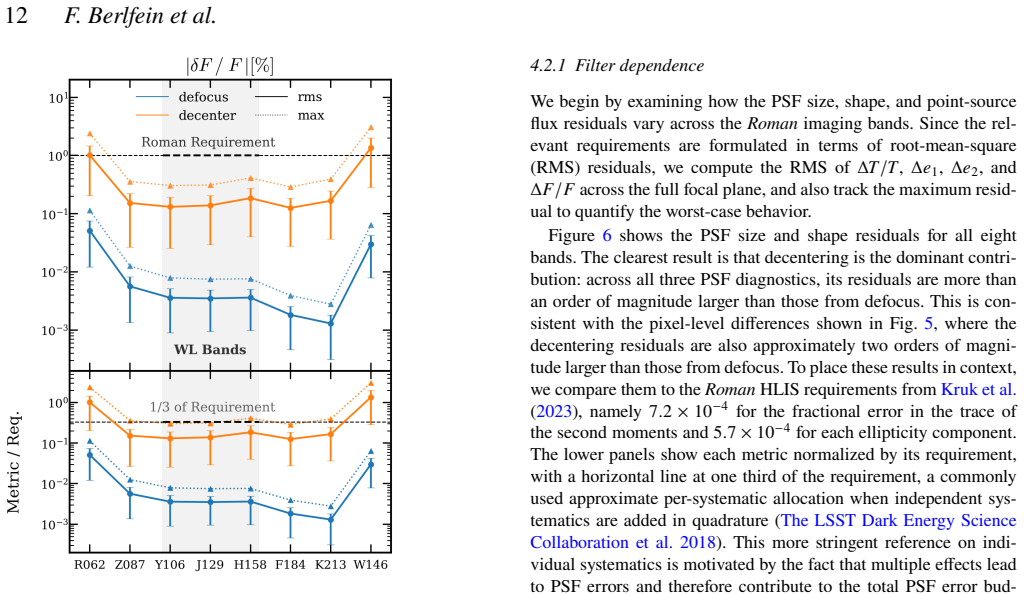
The dominant effect of filter-substrate refraction on the Roman point spread function is a lateral image shift that produces PSF size and ellipticity residuals of 0.3-0.4 percent.
A machine-rendered reading of the paper's core claim, the machinery that carries it, and where it could break.
Core claim
The lateral shift from filter-substrate refraction is the dominant chromatic perturbation to the Roman PSF, producing size and ellipticity residuals of order 0.3-0.4% in most bands that exceed weak lensing requirements by an order of magnitude, while the longitudinal shift is subdominant; the effect is strongly field-dependent and can be implemented in large-scale image simulations to reproduce the changes accurately.
What carries the argument
wavelength-dependent lateral displacement of the image position due to refraction in the filter substrate
If this is right
- The lateral shift dominates the longitudinal shift in producing PSF perturbations across all eight imaging bands.
- PSF size and ellipticity residuals reach 0.3-0.4 percent in most bands and grow larger toward the edges of the focal plane.
- These residuals exceed the Roman weak lensing science requirements by roughly an order of magnitude.
- Flux residuals remain below one third of the 1 percent requirement in most bands except R062 and W146.
- The lateral-shift effect can be added to frameworks for large-scale image simulations while accurately reproducing the PSF size and shape changes.
Where Pith is reading between the lines
- PSF modeling pipelines for Roman data will need to incorporate position-dependent corrections for this refraction to reach required weak lensing precision.
- The field dependence means that residuals will vary systematically across the detector, affecting how ellipticity is averaged in shear measurements.
- The simulation implementation method allows the effect to be tested in end-to-end survey simulations without altering the core optical model.
- Similar thick-filter designs in other space-based imagers could produce comparable lateral shifts that also require explicit modeling.
Load-bearing premise
The image simulations accurately capture the ray paths through the filter substrate without unmodeled aberrations or manufacturing variations, and the stated Roman weak lensing requirements are the correct benchmark for acceptable residuals.
What would settle it
Direct comparison of PSF size and ellipticity measured on images with and without the filter refraction effect included, at the 0.3 percent level across multiple bands and field positions, would confirm or refute the reported residuals.
Figures





read the original abstract
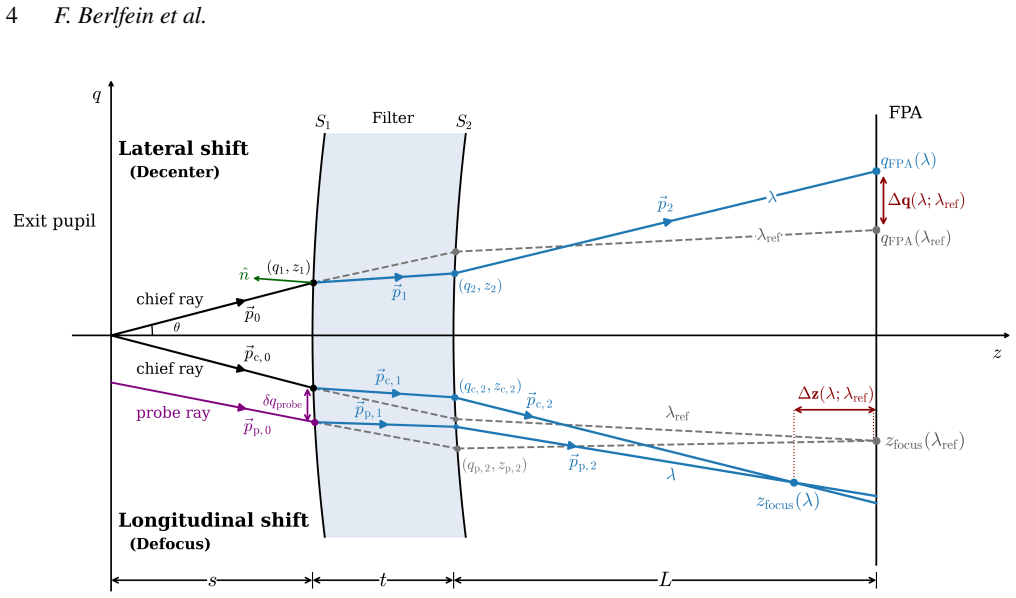
For broadband imaging surveys, filter-substrate refraction causes light at different wavelengths to follow slightly different paths through the filter substrate before reaching the detector. This effect produces two chromatic perturbations to the point spread function (PSF): a shift in the effective focal position along the optical axis (longitudinal shift), which manifests as a defocus-like perturbation, and a wavelength-dependent displacement of the image position in the focal plane (lateral shift), which manifests as image decentering. Using image simulations, we provide the first study of these two effects independently across all eight Roman imaging bands and over the full focal plane. We compute the resulting PSF and photometric errors from images with and without the effect included, and compare the magnitude of the effect to the Roman science requirements. We find that the lateral shift is the dominant contribution, producing PSF size and ellipticity residuals in most bands of order ~0.3-0.4%. These exceed the Roman science requirements for weak lensing by roughly an order of magnitude. The effect is also strongly field dependent, increasing toward the edges of the focal plane. By contrast, flux residuals remain below one third of the 1% requirement for most bands, except in R062 and W146. We find the longitudinal shift to be subdominant and negligible in most bands, including the weak lensing bands. Finally, we implement the dominant lateral-shift effect in a framework suitable for large-scale image simulations and validate that the resulting PSF size and shape changes are accurately reproduced. Overall, we find that filter-substrate refraction is a relevant chromatic effect for Roman PSF modeling, and we provide tools to model and incorporate it in large-scale image simulations.
Editorial analysis
A structured set of objections, weighed in public.
Referee Report
Summary. The manuscript uses image simulations to study chromatic perturbations to the Roman Space Telescope PSF arising from filter-substrate refraction across all eight imaging bands and the full focal plane. It separates the effects into a subdominant longitudinal (defocus-like) shift and a dominant lateral shift, reports that the latter produces PSF size and ellipticity residuals of order 0.3-0.4% (exceeding weak-lensing requirements by roughly an order of magnitude) with strong field dependence, finds flux residuals mostly acceptable, and implements plus validates a simplified lateral-shift model for large-scale simulations.
Significance. If the simulation outputs are accurate, the work identifies a previously unexamined chromatic systematic relevant to Roman weak-lensing PSF modeling and supplies a practical implementation for large simulations; this is a concrete contribution to mission-specific instrumentation analysis.
major comments (1)
- [Abstract] Abstract: the headline quantitative result (lateral-shift residuals of ~0.3-0.4% exceeding requirements by ~10x) is load-bearing for the central claim yet rests entirely on the fidelity of the image simulations in isolating wavelength-dependent ray paths through the substrate; the manuscript reports no independent cross-checks against analytical ray tracing, closed-form lateral-shift formulas, or laboratory measurements to bound possible systematic offsets in the modeled shift amplitude.
minor comments (1)
- [Abstract] The abstract references 'the Roman science requirements for weak lensing' without quoting the numerical thresholds used for the order-of-magnitude comparison; adding the explicit values would improve clarity.
Simulated Author's Rebuttal
We thank the referee for the careful review and the recommendation for major revision. We address the single major comment below, agreeing that additional validation strengthens the work and outlining the planned changes.
read point-by-point responses
-
Referee: [Abstract] Abstract: the headline quantitative result (lateral-shift residuals of ~0.3-0.4% exceeding requirements by ~10x) is load-bearing for the central claim yet rests entirely on the fidelity of the image simulations in isolating wavelength-dependent ray paths through the substrate; the manuscript reports no independent cross-checks against analytical ray tracing, closed-form lateral-shift formulas, or laboratory measurements to bound possible systematic offsets in the modeled shift amplitude.
Authors: We agree that the lack of explicit independent cross-checks is a limitation of the current manuscript. In the revised version we will add a new subsection to the Methods section that derives the expected lateral shift from the closed-form expression for refraction through a plane-parallel substrate, Δx(λ) = d · (n(λ) - 1)/n(λ) · tan(i), where d is the substrate thickness and i the angle of incidence, and directly compares these analytic predictions to the shifts measured in the image simulations across multiple field positions and bands. The comparison will be shown in a new figure with residuals quantified to <1 %. We will also state that laboratory measurements of the actual Roman filter assemblies are not available in the literature and lie outside the scope of this modeling study, while the refractive indices are taken from standard tabulated values. These additions will bound possible systematic offsets in the simulation pipeline. revision: yes
Circularity Check
No significant circularity; results from independent forward simulations
full rationale
The paper derives PSF size/ellipticity residuals and field dependence directly from ray-tracing image simulations of wavelength-dependent refraction through the filter substrate. No parameters are fitted to the reported residuals, no self-citations supply load-bearing uniqueness theorems or ansatzes, and the lateral-shift model is validated by direct comparison to the full simulations rather than by construction. The derivation chain is therefore self-contained against external optical modeling benchmarks.
Axiom & Free-Parameter Ledger
axioms (1)
- standard math Standard laws of refraction and geometric optics apply to light propagation through the filter substrate.
Reference graph
Works this paper leans on
-
[1]
The Near-Infrared Spectrograph (NIRSpec) on the James Webb Space Telescope. I. Overview of the instrument and its capabilities. , keywords =. doi:10.1051/0004-6361/202142663 , archivePrefix =. 2202.03305 , primaryClass =
work page internal anchor Pith review Pith/arXiv arXiv doi:10.1051/0004-6361/202142663
-
[2]
Weak gravitational lensing shear estimation with METACALIBRATION for the Roman High-Latitude Imaging Survey. , keywords =. doi:10.1093/mnras/stac2644 , archivePrefix =. 2203.08845 , primaryClass =
-
[3]
A joint Roman Space Telescope and Rubin Observatory synthetic wide-field imaging survey. , keywords =. doi:10.1093/mnras/stad664 , archivePrefix =. 2209.06829 , primaryClass =
-
[4]
CosmoDC2: A Synthetic Sky Catalog for Dark Energy Science with LSST. , keywords =. doi:10.3847/1538-4365/ab510c , archivePrefix =. 1907.06530 , primaryClass =
-
[5]
The Open Journal of Astrophysics , keywords =
Validating Synthetic Galaxy Catalogs for Dark Energy Science in the LSST Era. The Open Journal of Astrophysics , keywords =. doi:10.21105/astro.2110.03769 , archivePrefix =. 2110.03769 , primaryClass =
-
[6]
The Milky Way Tomography with SDSS. I. Stellar Number Density Distribution. , keywords =. doi:10.1086/523619 , archivePrefix =. astro-ph/0510520 , primaryClass =
work page internal anchor Pith review Pith/arXiv arXiv doi:10.1086/523619
-
[7]
2019, Journal of Open Source Software, 4, 1298, doi: 10.21105/joss.01298
Andrea Zonca and Leo Singer and Daniel Lenz and Martin Reinecke and Cyrille Rosset and Eric Hivon and Krzysztof Gorski , title =. 2019 , month = mar, publisher =. doi:10.21105/joss.01298 , url =
-
[8]
GalSim: The modular galaxy image simulation toolkit
GALSIM: The modular galaxy image simulation toolkit. Astronomy and Computing , keywords =. doi:10.1016/j.ascom.2015.02.002 , archivePrefix =. 1407.7676 , primaryClass =
work page internal anchor Pith review Pith/arXiv arXiv doi:10.1016/j.ascom.2015.02.002 2015
-
[9]
Probabilistic Forward Modeling of Galaxy Catalogs with Normalizing Flows. , keywords =. doi:10.3847/1538-3881/ad54bf , archivePrefix =. 2405.04740 , primaryClass =
-
[10]
Fourier Power Function Shapelets (FPFS) Shear Estimator: Performance on Image Simulations
Fourier Power Function Shapelets (FPFS) shear estimator: performance on image simulations. , keywords =. doi:10.1093/mnras/sty2548 , archivePrefix =. 1805.08514 , primaryClass =
work page internal anchor Pith review Pith/arXiv arXiv doi:10.1093/mnras/sty2548
-
[11]
LSST: from Science Drivers to Reference Design and Anticipated Data Products
LSST: From Science Drivers to Reference Design and Anticipated Data Products. , keywords =. doi:10.3847/1538-4357/ab042c , archivePrefix =. 0805.2366 , primaryClass =
work page internal anchor Pith review Pith/arXiv arXiv doi:10.3847/1538-4357/ab042c
-
[12]
Testing KiDS cross-correlation redshifts with simulations. , keywords =. doi:10.1051/0004-6361/202038835 , archivePrefix =. 2007.01846 , primaryClass =
-
[13]
Photometric Redshifts with the LSST. II. The Impact of Near-infrared and Near-ultraviolet Photometry. , keywords =. doi:10.3847/1538-3881/ab8a43 , archivePrefix =. 2004.07885 , primaryClass =
-
[14]
Simulation methodology and general results
Simulating image coaddition with the Nancy Grace Roman Space Telescope - I. Simulation methodology and general results. , keywords =. doi:10.1093/mnras/stae182 , archivePrefix =. 2303.08749 , primaryClass =
-
[15]
The Outer Rim Simulation: A Path to Many-core Supercomputers. , keywords =. doi:10.3847/1538-4365/ab4da1 , archivePrefix =. 1904.11970 , primaryClass =
-
[16]
Generating synthetic cosmological data with GalSampler. , keywords =. doi:10.1093/mnras/staa1495 , archivePrefix =. 1909.07340 , primaryClass =
-
[17]
DSPS: Differentiable stellar population synthesis. , keywords =. doi:10.1093/mnras/stad456 , archivePrefix =. 2112.06830 , primaryClass =
-
[18]
An updated MILES stellar library and stellar population models
An updated MILES stellar library and stellar population models. , keywords =. doi:10.1051/0004-6361/201116842 , archivePrefix =. 1107.2303 , primaryClass =
work page internal anchor Pith review Pith/arXiv arXiv doi:10.1051/0004-6361/201116842
-
[19]
Andrew J. Benson , keywords =. Galacticus: A semi-analytic model of galaxy formation , journal =. 2012 , issn =. doi:https://doi.org/10.1016/j.newast.2011.07.004 , url =
-
[20]
Robert Kurucz CD-ROM , year = 1993, month = jan, volume =
ATLAS9 Stellar Atmosphere Programs and 2 km/s grid. Robert Kurucz CD-ROM , year = 1993, month = jan, volume =
1993
-
[21]
A Spectroscopic Determination of the Mass Distribution of DA White Dwarfs. , keywords =. doi:10.1086/171575 , adsurl =
-
[22]
Weak lensing for precision cosmology
Weak Lensing for Precision Cosmology. , keywords =. doi:10.1146/annurev-astro-081817-051928 , archivePrefix =. 1710.03235 , primaryClass =
work page internal anchor Pith review Pith/arXiv arXiv doi:10.1146/annurev-astro-081817-051928
-
[23]
Annual Review of Nuclear and Particle Science , keywords =
Weak Gravitational Lensing and Its Cosmological Applications. Annual Review of Nuclear and Particle Science , keywords =. doi:10.1146/annurev.nucl.58.110707.171151 , archivePrefix =. 0805.0139 , primaryClass =
-
[24]
Weak gravitational lensing. Scholarpedia , keywords =. doi:10.4249/scholarpedia.32440 , archivePrefix =. 1612.06535 , primaryClass =
work page internal anchor Pith review Pith/arXiv arXiv doi:10.4249/scholarpedia.32440
-
[25]
Cosmology with Weak Lensing Surveys
Cosmology with weak lensing surveys. , keywords =. doi:10.1016/j.physrep.2008.02.003 , archivePrefix =. astro-ph/0612667 , primaryClass =
work page internal anchor Pith review Pith/arXiv arXiv doi:10.1016/j.physrep.2008.02.003 2008
-
[26]
Cosmology with cosmic shear observations: a review
Kilbinger, Martin. Cosmology with cosmic shear observations: a review. Rept. Prog. Phys. 2015. doi:10.1088/0034-4885/78/8/086901. arXiv:1411.0115
work page internal anchor Pith review Pith/arXiv arXiv doi:10.1088/0034-4885/78/8/086901 2015
-
[27]
Monthly Notices of the Royal Astronomical Society , volume =
Massey, Richard and Hoekstra, Henk and Kitching, Thomas and Rhodes, Jason and Cropper, Mark and Amiaux, Jérôme and Harvey, David and Mellier, Yannick and Meneghetti, Massimo and Miller, Lance and Paulin-Henriksson, Stéphane and Pires, Sandrine and Scaramella, Roberto and Schrabback, Tim , title =. Monthly Notices of the Royal Astronomical Society , volume...
-
[28]
Huterer, Dragan and Takada, Masahiro and Bernstein, Gary and Jain, Bhuvnesh , title =. Monthly Notices of the Royal Astronomical Society , volume =. 2006 , month =. doi:10.1111/j.1365-2966.2005.09782.x , url =
-
[29]
The Shear Testing Programme - I. Weak lensing analysis of simulated ground-based observations. , keywords =. doi:10.1111/j.1365-2966.2006.10198.x , archivePrefix =. astro-ph/0506112 , primaryClass =
-
[30]
Liaudat, Tobias and Starck, Jean-Luc and Kilbinger, Martin. Point spread function modelling for astronomical telescopes: a review focused on weak gravitational lensing studies. Front. Astron. Space Sci. 2023. doi:10.3389/fspas.2023.1158213. arXiv:2306.07996
-
[31]
PSF modelling for very wide-field CCD astronomy
PSF modelling for very wide-field CCD astronomy. , keywords =. doi:10.1051/0004-6361/201219230 , archivePrefix =. 1302.0145 , primaryClass =
work page internal anchor Pith review Pith/arXiv arXiv doi:10.1051/0004-6361/201219230
-
[32]
Dark Energy Survey year 3 results: point spread function modelling. , keywords =. doi:10.1093/mnras/staa3679 , archivePrefix =. 2011.03409 , primaryClass =
-
[33]
Toward High-Precision Astrometry with WFPC2. I. Deriving an Accurate Point-Spread Function. , keywords =. doi:10.1086/316632 , archivePrefix =. astro-ph/0006325 , primaryClass =
work page internal anchor Pith review Pith/arXiv arXiv doi:10.1086/316632
-
[34]
Applied Optics and Optical Engineering, Volume XI , series = 1, year = 1992, editor =
Basic Wavefront Aberration Theory for Optical Metrology. Applied Optics and Optical Engineering, Volume XI , series = 1, year = 1992, editor =
1992
-
[35]
Image Ellipticity from Atmospheric Aberrations
Image Ellipticity from Atmospheric Aberrations. , keywords =. doi:10.1086/517873 , archivePrefix =. astro-ph/0703102 , primaryClass =
work page internal anchor Pith review Pith/arXiv arXiv doi:10.1086/517873
-
[36]
Atmospheric point spread function interpolation for weak lensing in short exposure imaging data. , keywords =. doi:10.1111/j.1365-2966.2012.22134.x , archivePrefix =. 1206.1383 , primaryClass =
-
[37]
The Effect of Detector Nonlinearity on WFIRST PSF Profiles for Weak Gravitational Lensing Measurements. , keywords =. doi:10.1088/1538-3873/128/968/104001 , archivePrefix =. 1605.01001 , primaryClass =
work page internal anchor Pith review Pith/arXiv arXiv doi:10.1088/1538-3873/128/968/104001
-
[38]
The brighter-fatter effect and pixel correlations in CCD sensors
The brighter-fatter effect and pixel correlations in CCD sensors. Journal of Instrumentation , keywords =. doi:10.1088/1748-0221/9/03/C03048 , archivePrefix =. 1402.0725 , primaryClass =
work page internal anchor Pith review Pith/arXiv arXiv doi:10.1088/1748-0221/9/03/c03048
-
[39]
Cosmic shear requirements on the wavelength dependence of telescope point spread functions. , keywords =. doi:10.1111/j.1365-2966.2010.16461.x , archivePrefix =. 1001.0759 , primaryClass =
-
[40]
Shear measurement bias due to spatially varying spectral energy distributions in galaxies
Shear measurement bias due to spatially varying spectral energy distributions in galaxies. arXiv e-prints , keywords =. doi:10.48550/arXiv.1907.04459 , archivePrefix =. 1907.04459 , primaryClass =
work page internal anchor Pith review Pith/arXiv arXiv doi:10.48550/arxiv.1907.04459 1907
-
[41]
Updated point spread function simulations for JWST with WebbPSF. Space Telescopes and Instrumentation 2014: Optical, Infrared, and Millimeter Wave , year = 2014, editor =. doi:10.1117/12.2056689 , adsurl =
-
[42]
Progess in Optics , keywords =
The effects of atmospheric turbulence in optical astronomy. Progess in Optics , keywords =. doi:10.1016/S0079-6638(08)70204-X , adsurl =
-
[43]
PSF calibration requirements for dark energy from cosmic shear
Point spread function calibration requirements for dark energy from cosmic shear. , keywords =. doi:10.1051/0004-6361:20079150 , archivePrefix =. 0711.4886 , primaryClass =
work page internal anchor Pith review Pith/arXiv arXiv doi:10.1051/0004-6361:20079150
-
[44]
Chromatic CCD effects on weak lensing measurements for LSST
Meyers, Joshua E. and Burchat, Patricia R. Chromatic CCD effects on weak lensing measurements for LSST. JINST. 2015. doi:10.1088/1748-0221/10/06/C06004. arXiv:1505.02307
work page internal anchor Pith review Pith/arXiv arXiv doi:10.1088/1748-0221/10/06/c06004 2015
-
[45]
Impact of Atmospheric Chromatic Effects on Weak Lensing Measurements
Meyers, Joshua E. and Burchat, Patricia R. Impact of Atmospheric Chromatic Effects on Weak Lensing Measurements. Astrophys. J. 2015. doi:10.1088/0004-637X/807/2/182. arXiv:1409.6273
work page internal anchor Pith review Pith/arXiv arXiv doi:10.1088/0004-637x/807/2/182 2015
-
[46]
, archivePrefix = "arXiv", eprint =
The impact of galaxy colour gradients on cosmic shear measurement. , keywords =. doi:10.1111/j.1365-2966.2011.20395.x , archivePrefix =. 1105.5595 , primaryClass =
-
[47]
On the shear estimation bias induced by the spatial variation of colour across galaxy profiles
Semboloni, Elisabetta and others. On the shear estimation bias induced by the spatial variation of colour across galaxy profiles. Mon. Not. Roy. Astron. Soc. 2013. doi:10.1093/mnras/stt602. arXiv:1211.5025
work page internal anchor Pith review Pith/arXiv arXiv doi:10.1093/mnras/stt602 2013
-
[48]
Atmospheric dispersion effects in weak lensing measurements
Atmospheric Dispersion Effects in Weak Lensing Measurements. , keywords =. doi:10.1086/668294 , archivePrefix =. 1204.1346 , primaryClass =
work page internal anchor Pith review Pith/arXiv arXiv doi:10.1086/668294
-
[49]
Implications of a wavelength dependent PSF for weak lensing measurements
Implications of a wavelength-dependent PSF for weak lensing measurements. , keywords =. doi:10.1093/mnras/sty830 , archivePrefix =. 1707.04334 , primaryClass =
work page internal anchor Pith review Pith/arXiv arXiv doi:10.1093/mnras/sty830
-
[50]
Wavelength Dependent PSFs and their impact on Weak Lensing Measurements
Wavelength-dependent PSFs and their impact on weak lensing measurements. , keywords =. doi:10.1093/mnras/sty1636 , archivePrefix =. 1804.04277 , primaryClass =
work page internal anchor Pith review Pith/arXiv arXiv doi:10.1093/mnras/sty1636
-
[51]
The three-year shear catalog of the Subaru Hyper Suprime-Cam SSP Survey. , keywords =. doi:10.1093/pasj/psac006 , archivePrefix =. 2107.00136 , primaryClass =
-
[52]
Weak gravitational lensing shear measurement with FPFS: analytical mitigation of noise bias and selection bias. , keywords =. doi:10.1093/mnras/stac342 , archivePrefix =. 2110.01214 , primaryClass =
-
[53]
Analytical weak-lensing shear responses of galaxy properties and galaxy detection. , keywords =. doi:10.1093/mnras/stad890 , archivePrefix =. 2208.10522 , primaryClass =
-
[54]
Analytical noise bias correction for precise weak lensing shear inference. , keywords =. doi:10.1093/mnras/stae2764 , archivePrefix =. 2408.06337 , primaryClass =
-
[55]
A differentiable perturbation-based weak lensing shear estimator. , keywords =. doi:10.1093/mnras/stad3895 , archivePrefix =. 2309.06506 , primaryClass =
-
[56]
Polar shapelets. , keywords =. doi:10.1111/j.1365-2966.2005.09453.x , archivePrefix =. astro-ph/0408445 , primaryClass =
-
[57]
Shapelets - I. A method for image analysis. , keywords =. doi:10.1046/j.1365-8711.2003.05901.x , archivePrefix =. astro-ph/0105178 , primaryClass =
-
[58]
Shapes and Shears, Stars and Smears: Optimal Measurements for Weak Lensing
Shapes and Shears, Stars and Smears: Optimal Measurements for Weak Lensing. , keywords =. doi:10.1086/338085 , archivePrefix =. astro-ph/0107431 , primaryClass =
work page internal anchor Pith review Pith/arXiv arXiv doi:10.1086/338085
-
[59]
Shear calibration biases in weak-lensing surveys. , keywords =. doi:10.1046/j.1365-8711.2003.06683.x , archivePrefix =. astro-ph/0301054 , primaryClass =
-
[60]
Systematic errors in weak lensing: application to SDSS galaxy-galaxy weak lensing. , keywords =. doi:10.1111/j.1365-2966.2005.09282.x , archivePrefix =. astro-ph/0501201 , primaryClass =
-
[61]
Metacalibration: Direct Self-Calibration of Biases in Shear Measurement
Metacalibration: Direct Self-Calibration of Biases in Shear Measurement. arXiv e-prints , keywords =. doi:10.48550/arXiv.1702.02600 , archivePrefix =. 1702.02600 , primaryClass =
work page internal anchor Pith review Pith/arXiv arXiv doi:10.48550/arxiv.1702.02600
-
[62]
The Open Journal of Astrophysics , keywords =
Dark Energy Survey Year 6 Results: Point-Spread Function Modeling. The Open Journal of Astrophysics , keywords =. doi:10.33232/001c.132299 , archivePrefix =. 2501.05781 , primaryClass =
-
[63]
OpenUniverse2024: a shared, simulated view of the sky for the next generation of cosmological surveys. , keywords =. doi:10.1093/mnras/staf1833 , archivePrefix =. 2501.05632 , primaryClass =
-
[64]
Biological Cybernetics , year =
Teuvo Kohonen , title =. Biological Cybernetics , year =. doi:10.1007/BF00337288 , url =
-
[65]
Dark Energy Survey Year 3 results: redshift calibration of the weak lensing source galaxies. , keywords =. doi:10.1093/mnras/stab1515 , archivePrefix =. 2012.08566 , primaryClass =
-
[66]
Enhancing weak lensing redshift distribution characterization by optimizing the Dark Energy Survey Self-Organizing Map Photo-z method. arXiv e-prints , keywords =. doi:10.48550/arXiv.2408.00922 , archivePrefix =. 2408.00922 , primaryClass =
-
[67]
A Cohesive Deep Drilling Field Strategy for LSST Cosmology. , keywords =. doi:10.3847/1538-4365/ad79f5 , archivePrefix =. 2405.10781 , primaryClass =
-
[68]
The Dark Energy Survey. arXiv e-prints , keywords =. doi:10.48550/arXiv.astro-ph/0510346 , archivePrefix =. astro-ph/0510346 , primaryClass =
work page internal anchor Pith review Pith/arXiv arXiv doi:10.48550/arxiv.astro-ph/0510346
-
[69]
2018, PASJ, 70, S4, doi: 10.1093/pasj/psx066
The Hyper Suprime-Cam SSP Survey: Overview and survey design. , keywords =. doi:10.1093/pasj/psx066 , archivePrefix =. 1704.05858 , primaryClass =
work page internal anchor Pith review Pith/arXiv arXiv doi:10.1093/pasj/psx066
-
[70]
The Messenger , year = 2013, month = dec, volume =
The Kilo-Degree Survey. The Messenger , year = 2013, month = dec, volume =
2013
-
[71]
Hyper Suprime-Cam Year 3 results: Cosmology from cosmic shear power spectra. , keywords =. doi:10.1103/PhysRevD.108.123519 , archivePrefix =. 2304.00701 , primaryClass =
-
[72]
KiDS-1000 cosmology: Cosmic shear constraints and comparison between two point statistics. , keywords =. doi:10.1051/0004-6361/202039070 , archivePrefix =. 2007.15633 , primaryClass =
-
[73]
Hyper Suprime-Cam Year 3 results: Cosmology from cosmic shear two-point correlation functions. , keywords =. doi:10.1103/PhysRevD.108.123518 , archivePrefix =. 2304.00702 , primaryClass =
-
[74]
Dark Energy Survey Year 3 results: Cosmology from cosmic shear and robustness to data calibration. , keywords =. doi:10.1103/PhysRevD.105.023514 , archivePrefix =. 2105.13543 , primaryClass =
-
[75]
Dark Energy Survey Year 3 results: Cosmology from cosmic shear and robustness to modeling uncertainty. , keywords =. doi:10.1103/PhysRevD.105.023515 , archivePrefix =. 2105.13544 , primaryClass =
-
[76]
Overview of the Instrumentation for the Dark Energy Spectroscopic Instrument
Overview of the Instrumentation for the Dark Energy Spectroscopic Instrument. , keywords =. doi:10.3847/1538-3881/ac882b , archivePrefix =. 2205.10939 , primaryClass =
work page internal anchor Pith review Pith/arXiv arXiv doi:10.3847/1538-3881/ac882b
-
[77]
Wide-Field InfrarRed Survey Telescope-Astrophysics Focused Telescope Assets WFIRST-AFTA 2015 Report
Wide-Field InfrarRed Survey Telescope-Astrophysics Focused Telescope Assets WFIRST-AFTA 2015 Report. arXiv e-prints , keywords =. doi:10.48550/arXiv.1503.03757 , archivePrefix =. 1503.03757 , primaryClass =
work page internal anchor Pith review Pith/arXiv arXiv doi:10.48550/arxiv.1503.03757 2015
-
[78]
Euclid preparation. I. The Euclid Wide Survey. , keywords =. doi:10.1051/0004-6361/202141938 , archivePrefix =. 2108.01201 , primaryClass =
-
[79]
Cosmology with the Roman Space Telescope: synergies with the Rubin Observatory Legacy Survey of Space and Time. , keywords =. doi:10.1093/mnras/stab533 , archivePrefix =. 2004.04702 , primaryClass =
-
[80]
Report of the Dark Energy Task Force
Report of the Dark Energy Task Force. arXiv e-prints , keywords =. doi:10.48550/arXiv.astro-ph/0609591 , archivePrefix =. astro-ph/0609591 , primaryClass =
work page internal anchor Pith review Pith/arXiv arXiv doi:10.48550/arxiv.astro-ph/0609591
discussion (0)
Sign in with ORCID, Apple, or X to comment. Anyone can read and Pith papers without signing in.