Do Super-Puffs Defy Core Accretion? Population-Wide Interior Structure Constraints
Pith reviewed 2026-06-27 11:32 UTC · model grok-4.3
The pith
Most cold super-puffs fit core accretion once age is adjusted, but six planets do not.
A machine-rendered reading of the paper's core claim, the machinery that carries it, and where it could break.
Core claim
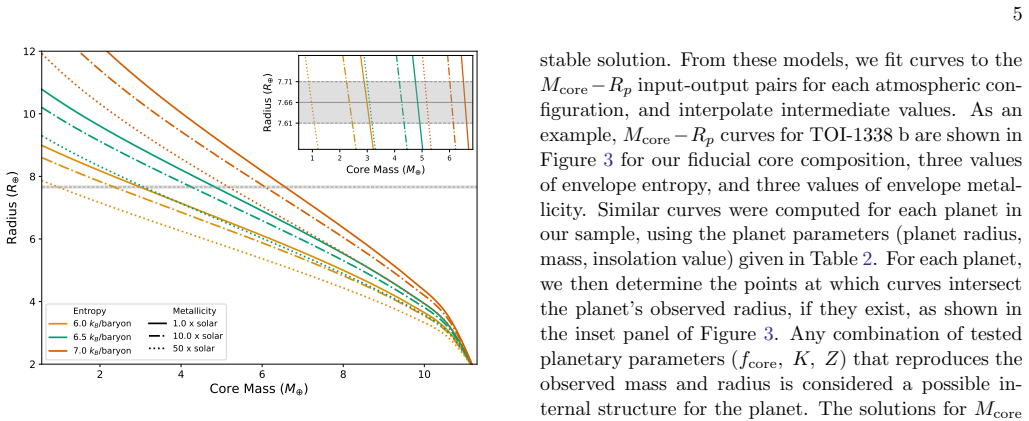
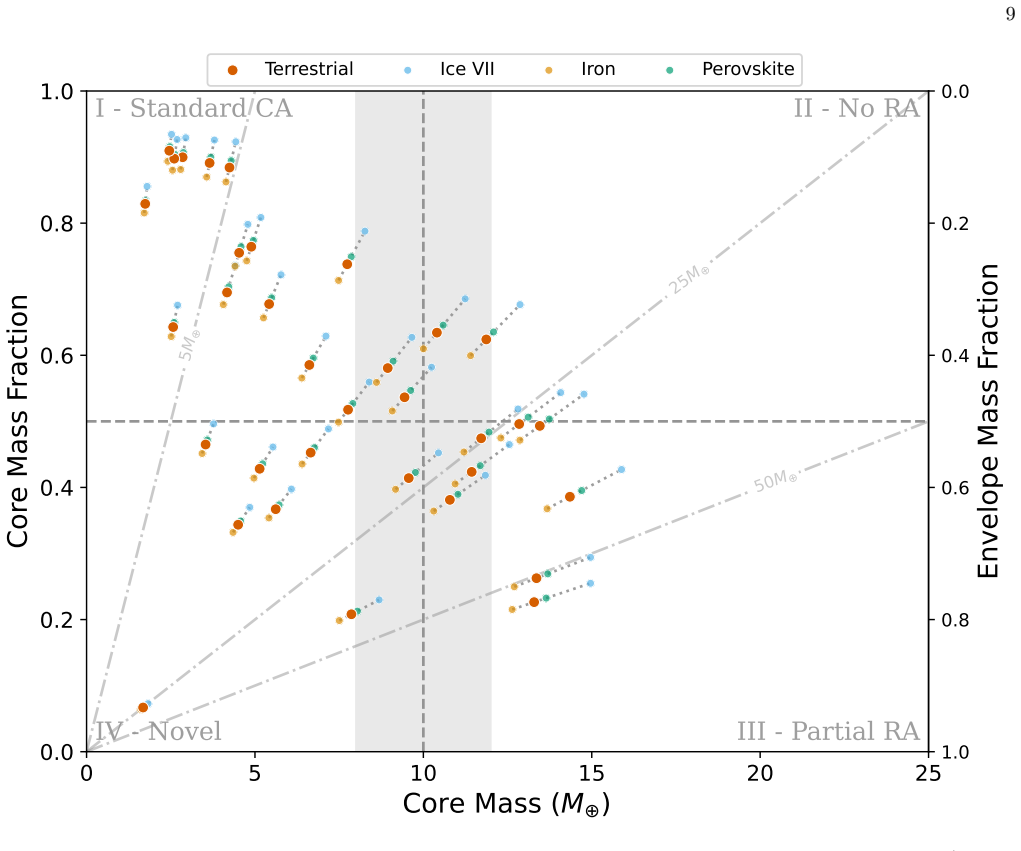
Hydrostatic interior structures computed for 34 cold super-puffs show that 28 are reproducible by core-accretion models once planet age is varied. The six planets that remain inconsistent are HIP 41378 f, Kepler-30 d, Kepler-51 d, Kepler-177 c, TOI-1420 b, and WASP-107 b. All but TOI-1420 b become compatible if an extra heat source is allowed. Late impacts can produce the required inflation for up to 1 Gyr; radiogenic heating cannot.
What carries the argument
Population-wide hydrostatic interior structure calculations that match observed mass and radius while allowing age and composition to vary within core-accretion limits.
If this is right
- 28 of the 34 cold super-puffs remain consistent with core accretion.
- Late impacts can inflate sub-Neptunes to super-puff densities for up to 1 Gyr.
- Radiogenic heating alone is insufficient to reach the observed densities.
- Five of the six inconsistent planets could be reconciled with an added heat source.
- A compiled index lists all currently known super-puffs.
Where Pith is reading between the lines
- More precise mass and radius data on the six exceptions could separate ring explanations from impact heating.
- Super-puff occurrence may trace rare dynamical events layered on top of standard formation.
- Applying the same modeling approach to irradiated super-puffs could quantify how much of their low density is due to stellar heating versus formation history.
Load-bearing premise
The published masses, radii, and ages are accurate and the hydrostatic models capture the relevant physics without needing extra free parameters beyond age.
What would settle it
A new mass or radius measurement for any of the six listed planets that falls outside the range allowed by the models even when extra heating or rings are included.
Figures



read the original abstract
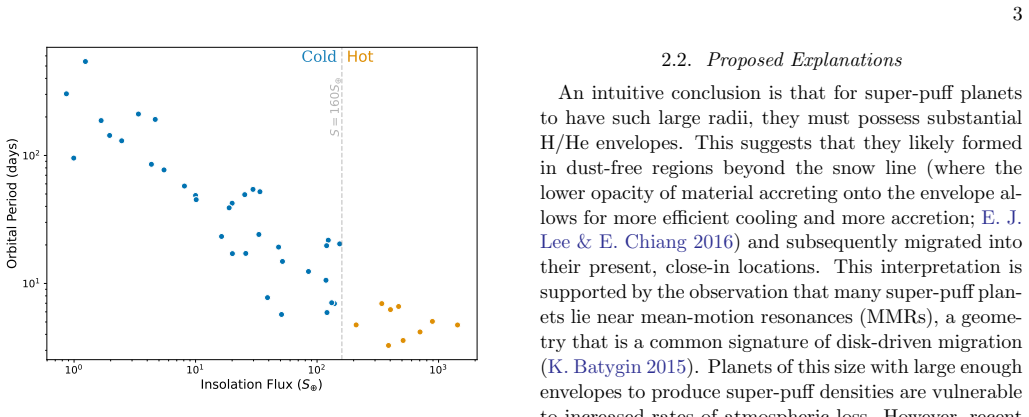
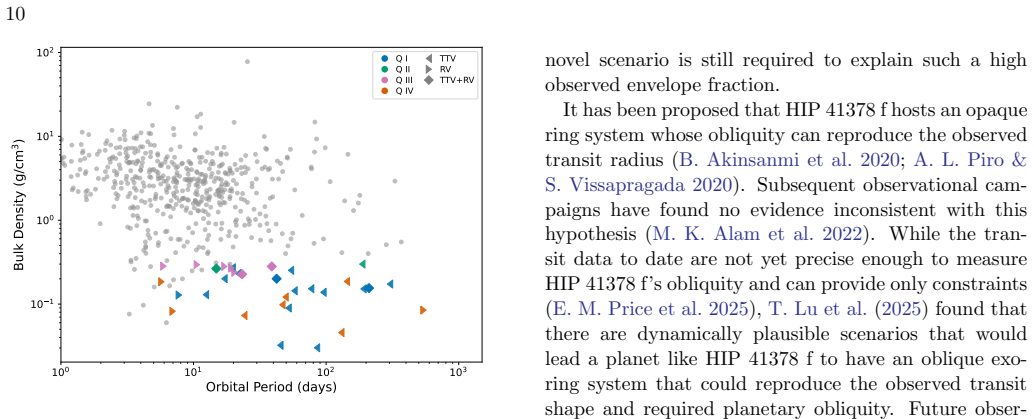
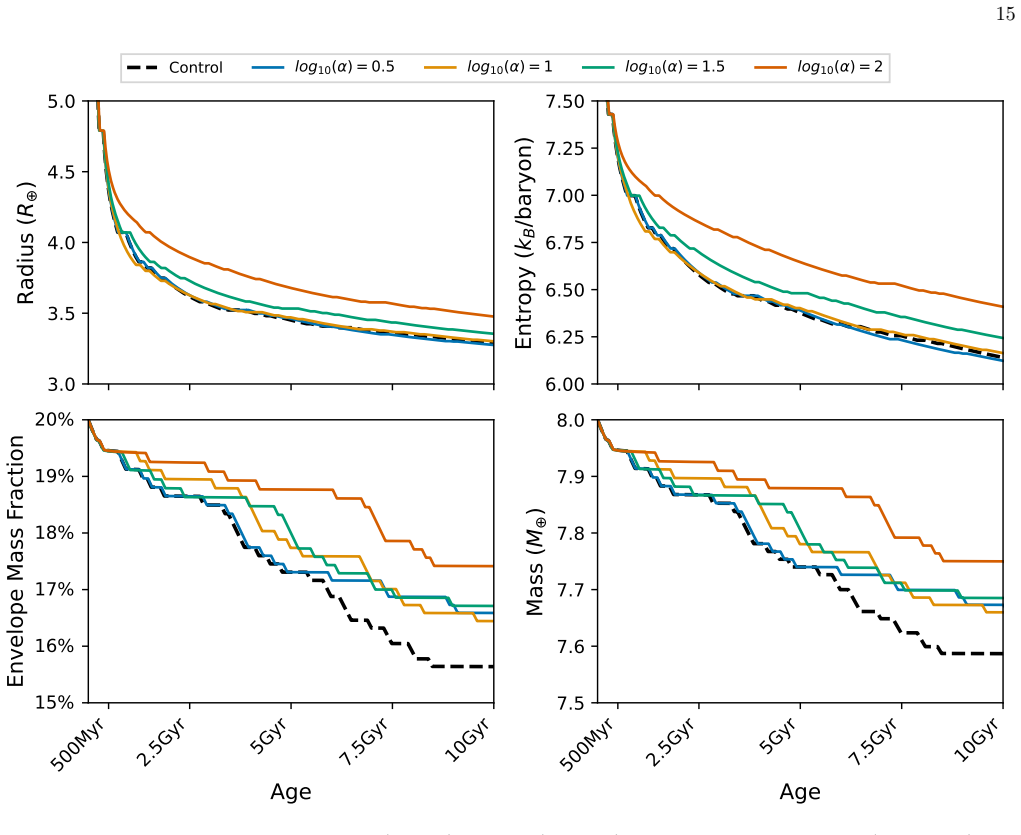
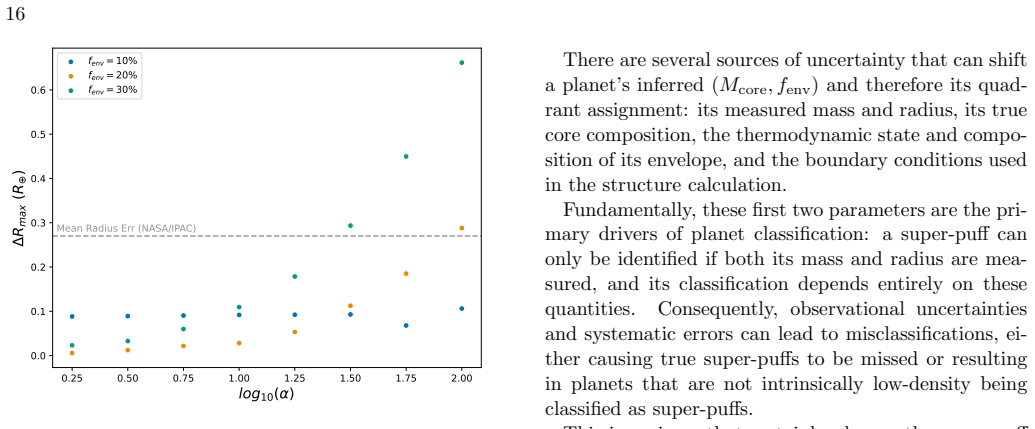
Sub-Saturn mass planets with extremely low bulk densities $(\rho\lesssim0.3)\mathrm{g/cm^3}$, or ``super-puffs'', are one of the most interesting and least understood populations of exoplanets. While many short-period super-puffs can be attributed to the effects of high irradiation and star-planet interactions, cold super-puffs appear to challenge the expectations of core accretion theory. We constrain the possible properties of 34 cold super-puffs by computing hydrostatic interior structures using PlanetSolver. We find that 28 planets in our sample can be reproduced by models consistent with core accretion based on their observed masses and radii and adjusting for planet age. We identify HIP 41378 f, Kepler-30 d, Kepler-51 d, Kepler-177 c, TOI-1420 b, and WASP-107 b as planets inconsistent with core accretion theory which necessitate a non-standard explanation (e.g. exo-rings). With the exception of TOI-1420 b, core accretion-compatible solutions are possible for these planets if an additional heat source is present. We modify planetary evolution models to determine whether enhanced radiogenic heating or late impacts with sub-planetary mass objects can plausibly inflate sub-Neptunes enough to achieve super-puff densities. We find that the effects of radiogenic heating are insufficient to produce super-puff densities, but that impacts can in many cases produce the necessary inflation for upwards of 1Gyr. We also compile and present here an index of all currently known super-puffs.
Editorial analysis
A structured set of objections, weighed in public.
Referee Report
Summary. The manuscript claims that hydrostatic interior structure calculations with PlanetSolver for 34 cold super-puffs show that 28 can be reproduced by core-accretion models (rocky/icy core + H/He envelope) once planet age is adjusted as a free parameter, while six specific planets (HIP 41378 f, Kepler-30 d, Kepler-51 d, Kepler-177 c, TOI-1420 b, WASP-107 b) remain inconsistent even after age adjustment and require non-standard explanations such as exo-rings; the authors further modify evolution models to show that late impacts can sustain the necessary inflation for up to ~1 Gyr while radiogenic heating cannot, and they compile an index of all known super-puffs.
Significance. If robust, the work supplies a systematic, population-level test of whether cold super-puffs challenge core accretion, supporting the standard theory for the large majority while isolating a small set of outliers whose explanation may involve rings or impacts. The explicit comparison of radiogenic versus impact heating and the public index of super-puffs are concrete contributions that can be used by the community. The strength lies in the uniform application of a single structure code across the sample.
major comments (3)
- [§4] §4 (inconsistent planets subsection): the central claim that the six named planets cannot be reproduced by core-accretion models rests on the failure of PlanetSolver to match observed radii after age adjustment; however, the manuscript provides no tabulated or plotted sensitivity of the required ages to the observational uncertainties in mass, radius, and stellar age, so it is unclear whether the inconsistency survives within 1-σ error bars.
- [Methods] Methods (PlanetSolver description): the declaration of inconsistency for the six planets assumes that PlanetSolver includes all relevant physics at the relevant P-T conditions; the text does not report the specific EOS, opacity tables, or atmospheric boundary conditions used, nor does it test the effect of plausible additions such as composition gradients or enhanced envelope opacities that could alter the radius-age relation.
- [§5] §5 (impact-heating models): while impacts are stated to produce the necessary inflation for upwards of 1 Gyr, the manuscript does not quantify the minimum impactor mass or impact rate required for each of the six planets, nor does it compare those rates to expected dynamical environments, leaving the physical plausibility of the scenario untested.
minor comments (2)
- [Abstract] Abstract: the total sample of 34 planets is stated without a forward reference to the table or section that lists all objects and their adopted M, R, and age values.
- [Super-puff index] Super-puff index: the selection criteria (density threshold, orbital-period cut, etc.) used to compile the index should be stated explicitly so that the catalog can be reproduced or extended.
Simulated Author's Rebuttal
We thank the referee for their constructive report and positive evaluation of the manuscript's contributions. We address each major comment below, agreeing where revisions are warranted to improve clarity and robustness.
read point-by-point responses
-
Referee: [§4] the central claim that the six named planets cannot be reproduced by core-accretion models rests on the failure of PlanetSolver to match observed radii after age adjustment; however, the manuscript provides no tabulated or plotted sensitivity of the required ages to the observational uncertainties in mass, radius, and stellar age, so it is unclear whether the inconsistency survives within 1-σ error bars.
Authors: We agree that an explicit sensitivity analysis to observational uncertainties would strengthen the claim of inconsistency. In the revised manuscript we will add a new subsection (or appendix) that tabulates and plots the range of required ages for the six planets when mass, radius, and stellar age are varied within their 1-σ uncertainties. This will directly show whether any of the six planets become consistent with core accretion within errors. revision: yes
-
Referee: [Methods] the declaration of inconsistency for the six planets assumes that PlanetSolver includes all relevant physics at the relevant P-T conditions; the text does not report the specific EOS, opacity tables, or atmospheric boundary conditions used, nor does it test the effect of plausible additions such as composition gradients or enhanced envelope opacities that could alter the radius-age relation.
Authors: The methods section references the PlanetSolver implementation but does not list the exact EOS, opacity tables, or boundary conditions. We will expand the methods to explicitly state the EOS (e.g., the specific H/He and rock/ice tables), opacity sources, and atmospheric boundary conditions employed. We will also add a short discussion of why composition gradients and enhanced opacities were not included in the baseline runs, together with a qualitative assessment of how they might affect the radius-age relation for the outlier planets. revision: yes
-
Referee: [§5] while impacts are stated to produce the necessary inflation for upwards of 1 Gyr, the manuscript does not quantify the minimum impactor mass or impact rate required for each of the six planets, nor does it compare those rates to expected dynamical environments, leaving the physical plausibility of the scenario untested.
Authors: The impact-heating calculations demonstrate that sub-planetary impacts can maintain the required radii for ~1 Gyr, which is the central result. A full per-planet calculation of minimum impactor mass and rate, including comparison to each system's dynamical environment, would require additional assumptions about orbital architectures and is outside the scope of the present study. We will nevertheless add a brief paragraph that reports the minimum impactor masses implied by our models for the six planets and notes that such rates are within the range seen in some young systems, while acknowledging that system-specific N-body work would be needed for a definitive test. revision: partial
Circularity Check
No significant circularity; derivation is a direct model-data comparison
full rationale
The paper runs PlanetSolver hydrostatic models on observed M, R, and age values to test whether standard core-accretion structures can reproduce the radii. The 28/6 split is an output of that comparison, not a re-expression of any fitted parameter or self-citation. Age is treated as an external observational input rather than a free parameter tuned to force agreement. No equations or claims reduce a prediction to its own inputs by construction, and the central claim remains falsifiable against independent M/R/age measurements and model physics.
Axiom & Free-Parameter Ledger
free parameters (2)
- planet age adjustment
- additional heat source magnitude
axioms (2)
- standard math Planetary interiors obey hydrostatic equilibrium
- domain assumption Observed mass and radius are accurate inputs for interior modeling
invented entities (1)
-
exo-rings
no independent evidence
Reference graph
Works this paper leans on
-
[1]
C., Hollenbach, D., Laughlin, G., & Gorti, U
Adams, F. C., Hollenbach, D., Laughlin, G., & Gorti, U. 2004, ApJ, 611, 360, doi: 10.1086/421989
-
[2]
Adams, F. C., Meyer, M. R., & Adams, A. D. 2021, ApJ, 909, 1, doi: 10.3847/1538-4357/abdd2b
-
[3]
Akinsanmi, B., Santos, N. C., Faria, J. P., et al. 2020, A&A, 635, L8, doi: 10.1051/0004-6361/202037618
-
[4]
Alam, M. K., Kirk, J., Dressing, C. D., et al. 2022, ApJL, 927, L5, doi: 10.3847/2041-8213/ac559d
-
[5]
Anderson, K. R., & Adams, F. C. 2012, PASP, 124, 809, doi: 10.1086/667539
-
[6]
Barkaoui, K., Pozuelos, F. J., Hellier, C., et al. 2024, Nature Astronomy, 8, 909–919, doi: 10.1038/s41550-024-02259-y
-
[7]
2020, PASP, 132, 024502, doi: 10.1088/1538-3873/ab3ce8
Barnes, R., Luger, R., Deitrick, R., et al. 2020, PASP, 132, 024502, doi: 10.1088/1538-3873/ab3ce8
-
[8]
2015, MNRAS, 451, 2589, doi: 10.1093/mnras/stv1063
Batygin, K. 2015, MNRAS, 451, 2589, doi: 10.1093/mnras/stv1063
-
[9]
2025, ApJ, 985, 87, doi: 10.3847/1538-4357/adccc4
Batygin, K. 2025, ApJ, 985, 87, doi: 10.3847/1538-4357/adccc4
-
[10]
Batygin, K., Adams, F. C., & Becker, J. 2023, ApJL, 951, L19, doi: 10.3847/2041-8213/acdb5d
-
[11]
Batygin, K., & Stevenson, D. J. 2010, ApJL, 714, L238, doi: 10.1088/2041-8205/714/2/L238
-
[12]
Batygin, K., & Stevenson, D. J. 2013, The Astrophysical Journal, 769, L9, doi: 10.1088/2041-8205/769/1/L9
-
[13]
Bayliss, D., Hartman, J. D., Bakos, G. ´A’., et al. 2015, The Astronomical Journal, 150, 49, doi: 10.1088/0004-6256/150/2/49
-
[14]
Beatty, T. G., Stevens, D. J., Collins, K. A., et al. 2017, The Astronomical Journal, 154, 25, doi: 10.3847/1538-3881/aa7511
-
[15]
C., Vanderburg, A., Rodriguez, J
Becker, J. C., Vanderburg, A., Rodriguez, J. E., et al. 2019, AJ, 157, 19, doi: 10.3847/1538-3881/aaf0a2
-
[16]
2022, The Astronomical Journal, 163, 277, doi: 10.3847/1538-3881/ac6353
Belkovski, M., Becker, J., Howe, A., Malsky, I., & Batygin, K. 2022, The Astronomical Journal, 163, 277, doi: 10.3847/1538-3881/ac6353
-
[17]
Biersteker, J. B., & Schlichting, H. E. 2019, Monthly Notices of the Royal Astronomical Society, 485, 4454–4463, doi: 10.1093/mnras/stz738
-
[18]
Bodenheimer, P., Lin, D. N. C., & Mardling, R. A. 2001, ApJ, 548, 466, doi: 10.1086/318667
-
[19]
S., Dumusque, X., Massa, A., et al
Bonomo, A. S., Dumusque, X., Massa, A., et al. 2023, Astronomy and Astrophysics, 677, A33, doi: 10.1051/0004-6361/202346211
-
[20]
Borucki, W. J., Koch, D., Basri, G., et al. 2010, Science, 327, 977, doi: 10.1126/science.1185402
-
[21]
Brahm, R., Hartman, J. D., Jord´ an, A., et al. 2018, The Astronomical Journal, 155, 112, doi: 10.3847/1538-3881/aaa898
-
[22]
2022, ApJ, 937, 39, doi: 10.3847/1538-4357/ac8a97
Chance, Q., Ballard, S., & Stassun, K. 2022, ApJ, 937, 39, doi: 10.3847/1538-4357/ac8a97
-
[23]
Christiansen, J. L., McElroy, D. L., Harbut, M., et al. 2025, PSJ, 6, 186, doi: 10.3847/PSJ/ade3c2
-
[24]
Cochran, W. D., Fabrycky, D. C., Torres, G., et al. 2011, The Astrophysical Journal Supplement Series, 197, 7, doi: 10.1088/0067-0049/197/1/7
-
[25]
Collaboration, A., Price-Whelan, A. M., Lim, P. L., et al. 2022, The Astrophysical Journal, 935, 167, doi: 10.3847/1538-4357/ac7c74
work page internal anchor Pith review doi:10.3847/1538-4357/ac7c74 2022
-
[26]
Crossfield, I. J. M., Ciardi, D. R., Petigura, E. A., et al. 2016, ApJS, 226, 7, doi: 10.3847/0067-0049/226/1/7
-
[27]
arXiv , author =:1910.04563 , journal =
David, T. J., Petigura, E. A., Luger, R., et al. 2019, The Astrophysical Journal, 885, L12, doi: 10.3847/2041-8213/ab4c99 de Freitas, D. B., Lanza, A. F., da Silva Gomes, F. O., & Das Chagas, M. L. 2021, A&A, 650, A40, doi: 10.1051/0004-6361/202140287
-
[28]
2011, ApJS, 197, 12, doi: 10.1088/0067-0049/197/1/12
Demory, B.-O., & Seager, S. 2011, ApJS, 197, 12, doi: 10.1088/0067-0049/197/1/12
-
[29]
2025, A&A, 703, A72, doi: 10.1051/0004-6361/202556526
Eberlein, M., & Helled, R. 2025, A&A, 703, A72, doi: 10.1051/0004-6361/202556526
-
[30]
I., Brahm, R., Petrovich, C., et al
Espinoza-Retamal, J. I., Brahm, R., Petrovich, C., et al. 2026, ApJL, 996, L13, doi: 10.3847/2041-8213/ae2bfa
-
[31]
Fabrycky, D. C., Ford, E. B., Steffen, J. H., et al. 2012, ApJ, 750, 114, doi: 10.1088/0004-637X/750/2/114
-
[32]
Fatuzzo, M., & Adams, F. C. 2015, ApJ, 813, 55, doi: 10.1088/0004-637X/813/1/55 21
-
[34]
2020b, ApJ, 890, 93, doi: 10.3847/1538-4357/ab6a9b
Gao, P., & Zhang, X. 2020b, ApJ, 890, 93, doi: 10.3847/1538-4357/ab6a9b
-
[35]
Ginsburg, A., Sip˝ ocz, B. M., Brasseur, C. E., et al. 2019, The Astronomical Journal, 157, 98, doi: 10.3847/1538-3881/aafc33
-
[36]
Guerrero, N. M., Seager, S., Huang, C. X., et al. 2021, ApJS, 254, 39, doi: 10.3847/1538-4365/abefe1
-
[37]
2017, The Astronomical Journal, 154, 5, doi: 10.3847/1538-3881/aa71ef
Hadden, S., & Lithwick, Y. 2017, The Astronomical Journal, 154, 5, doi: 10.3847/1538-3881/aa71ef
-
[38]
Hallatt, T., & Lee, E. J. 2022, ApJ, 924, 9, doi: 10.3847/1538-4357/ac32c9
-
[39]
Han, T., Robertson, P., Brandt, T. D., et al. 2025, ApJL, 988, L4, doi: 10.3847/2041-8213/ade794
-
[40]
Harris, C. R., Millman, K. J., Van Der Walt, S. J., et al. 2020, Nature, 585, 357–362, doi: 10.1038/s41586-020-2649-2
-
[41]
Hartman, J. D., Bakos, G. ´A’., Bayliss, D., et al. 2019, The Astronomical Journal, 157, 55, doi: 10.3847/1538-3881/aaf8b6
-
[42]
R., Collier Cameron, A., et al
Hellier, C., Anderson, D. R., Collier Cameron, A., et al. 2017, Monthly Notices of the Royal Astronomical Society, 465, 3693–3707, doi: 10.1093/mnras/stw3005
-
[43]
Howe, A. R., Becker, J. C., & Adams, F. C. 2026, AJ, 171, 148, doi: 10.3847/1538-3881/ae3aa6
-
[44]
Howe, A. R., Becker, J. C., Stark, C. C., & Adams, F. C. 2025, The Astronomical Journal, 169, 149, doi: 10.3847/1538-3881/adabdb
-
[45]
Howe, A. R., & Burrows, A. 2015, The Astrophysical Journal, 808, 150, doi: 10.1088/0004-637X/808/2/150
-
[46]
Howe, A. R., Burrows, A., & Verne, W. 2014, ApJ, 787, 173, doi: 10.1088/0004-637X/787/2/173
-
[47]
Hunter, J. D. 2007, Computing In Science & Engineering, 9, 90, doi: 10.1109/MCSE.2007.55
-
[48]
2009, ApJ, 700, 1921, doi: 10.1088/0004-637X/700/2/1921
Ibgui, L., & Burrows, A. 2009, ApJ, 700, 1921, doi: 10.1088/0004-637X/700/2/1921
-
[49]
1998, ApJ, 499, 758, doi: 10.1086/305658
Johnstone, D., Hollenbach, D., & Bally, J. 1998, ApJ, 499, 758, doi: 10.1086/305658
-
[50]
2001, SciPy: Open source scientific tools for Python, http://www.scipy.org/
Jones, E., Oliphant, T., Peterson, P., et al. 2001, SciPy: Open source scientific tools for Python, http://www.scipy.org/
2001
-
[51]
Jontof-Hutter, D. 2019, Annual Review of Earth and Planetary Sciences, 47, 141, doi: 10.1146/annurev-earth-053018-060352
-
[53]
Jontof-Hutter, D., Lissauer, J. J., Rowe, J. F., & Fabrycky, D. C. 2014, ApJ, 785, 15, doi: 10.1088/0004-637X/785/1/15
-
[54]
Karalis, A., Lee, E. J., & Thorngren, D. P. 2025, The Astrophysical Journal, 978, 46, doi: 10.3847/1538-4357/ad946c
-
[55]
2016, in Positioning and Power in Academic Publishing: Players, Agents and Agendas, ed
Kluyver, T., Ragan-Kelley, B., P´ erez, F., et al. 2016, in Positioning and Power in Academic Publishing: Players, Agents and Agendas, ed. F. Loizides & B. Schmidt, IOS Press, 87 – 90
2016
-
[56]
Laughlin, G., Crismani, M., & Adams, F. C. 2011, ApJL, 729, L7, doi: 10.1088/2041-8205/729/1/L7
-
[57]
Lee, E. J., & Chiang, E. 2015, ApJ, 811, 41, doi: 10.1088/0004-637X/811/1/41
-
[58]
Lee, E. J., & Chiang, E. 2016, ApJ, 817, 90, doi: 10.3847/0004-637X/817/2/90
-
[59]
2021, The Astronomical Journal, 161, 202, doi: 10.3847/1538-3881/abe6a7
Liang, Y., Robnik, J., & Seljak, U. 2021, The Astronomical Journal, 161, 202, doi: 10.3847/1538-3881/abe6a7
-
[60]
E., Bello-Arufe, A., Berta-Thompson, Z
Libby-Roberts, J. E., Bello-Arufe, A., Berta-Thompson, Z. K., et al. 2025, doi: 10.48550/arXiv.2505.21358
-
[61]
doi:10.1038/s41586-025-09840-z , eprint =
Livingston, J. H., Petigura, E. A., David, T. J., et al. 2026, Nature, 649, 310–314, doi: 10.1038/s41586-025-09840-z
-
[62]
Lopez, E. D., & Fortney, J. J. 2014, The Astrophysical Journal, 792, 1, doi: 10.1088/0004-637X/792/1/1
-
[63]
Lopez, E. D., Fortney, J. J., & Miller, N. 2012, The Astrophysical Journal, 761, 59, doi: 10.1088/0004-637X/761/1/59
-
[64]
Lu, T., Li, G., Cassese, B., & Lin, D. N. C. 2025, ApJ, 980, 39, doi: 10.3847/1538-4357/ada4b2
-
[65]
Mamajek, E. E., Wright, J. T., Tuchow, N. W., et al. 2026, PASP, 138, 023001, doi: 10.1088/1538-3873/ae37da
-
[66]
2024, Astronomy and Astrophysics, 682, A129, doi: 10.1051/0004-6361/202347472
Mantovan, G., Malavolta, L., Desidera, S., et al. 2024, Astronomy and Astrophysics, 682, A129, doi: 10.1051/0004-6361/202347472
-
[67]
Marcy, G. W., Isaacson, H., Howard, A. W., et al. 2014, ApJS, 210, 20, doi: 10.1088/0067-0049/210/2/20
-
[68]
Marley, M. S., Fortney, J. J., Hubickyj, O., Bodenheimer, P., & Lissauer, J. J. 2007, ApJ, 655, 541, doi: 10.1086/509759
-
[69]
2014, ApJ, 783, 53, doi: 10.1088/0004-637X/783/1/53
Masuda, K. 2014, ApJ, 783, 53, doi: 10.1088/0004-637X/783/1/53
-
[70]
McKee, B. J., & Montet, B. T. 2023, The Astronomical Journal, 165, 236, doi: 10.3847/1538-3881/accd66
-
[71]
2010, in Proceedings of the 9th Python in Science Conference, ed
McKinney, W. 2010, in Proceedings of the 9th Python in Science Conference, ed. S. van der Walt & J. Millman, 51 – 56
2010
-
[72]
2020, The Astrophysical Journal, 897, 7, doi: 10.3847/1538-4357/ab959c 22
Millholland, S., Petigura, E., & Batygin, K. 2020, The Astrophysical Journal, 897, 7, doi: 10.3847/1538-4357/ab959c 22
-
[73]
Mills, S. M., Fabrycky, D. C., Migaszewski, C., et al. 2016, Nature, 533, 509–512, doi: 10.1038/nature17445
-
[74]
Mills, S. M., & Mazeh, T. 2017, ApJL, 839, L8, doi: 10.3847/2041-8213/aa67eb
-
[75]
1980, Progress of Theoretical Physics, 64, 544, doi: 10.1143/PTP.64.544
Mizuno, H. 1980, Progress of Theoretical Physics, 64, 544, doi: 10.1143/PTP.64.544
-
[76]
2012, A&A, 547, A111, doi: 10.1051/0004-6361/201118457 Moˇ cnik, T., Hellier, C., Anderson, D
Mordasini, C., Alibert, Y., Klahr, H., & Henning, T. 2012, A&A, 547, A111, doi: 10.1051/0004-6361/201118457 Moˇ cnik, T., Hellier, C., Anderson, D. R., Clark, B. J. M., &
-
[77]
2017, Monthly Notices of the Royal Astronomical Society, 469, 1622–1629, doi: 10.1093/mnras/stx972
Southworth, J. 2017, Monthly Notices of the Royal Astronomical Society, 469, 1622–1629, doi: 10.1093/mnras/stx972
-
[78]
2020, 903, L37, doi: 10.3847/2041-8213/abc251
Safarzadeh, M. 2020, 903, L37, doi: 10.3847/2041-8213/abc251
-
[79]
2014, Astronomy and Astrophysics, 561, A103, doi: 10.1051/0004-6361/201220935
Ofir, A., Dreizler, S., Zechmeister, M., & Husser, T.-O. 2014, Astronomy and Astrophysics, 561, A103, doi: 10.1051/0004-6361/201220935
-
[80]
2025, AJ, 169, 90, doi: 10.3847/1538-3881/ad91a7
Ofir, A., Yoffe, G., & Aharonson, O. 2025, The Astronomical Journal, 169, 90, doi: 10.3847/1538-3881/ad91a7
-
[81]
Ohno, K., & Fortney, J. J. 2022, arXiv e-prints, arXiv:2201.02794. https://arxiv.org/abs/2201.02794
arXiv 2022
-
[82]
Ohno, K., & Tanaka, Y. A. 2021, ApJ, 920, 124, doi: 10.3847/1538-4357/ac1516
discussion (0)
Sign in with ORCID, Apple, or X to comment. Anyone can read and Pith papers without signing in.