Q-DICE: Quantum Distributed Interconnect Compiler and Emulator
Pith reviewed 2026-06-27 13:11 UTC · model grok-4.3
The pith
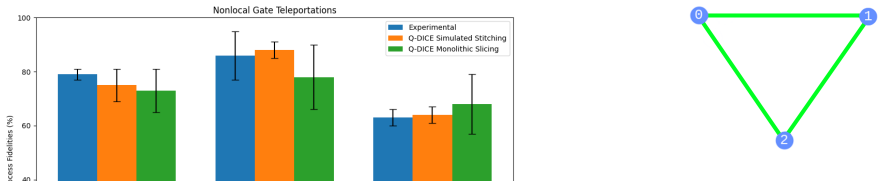
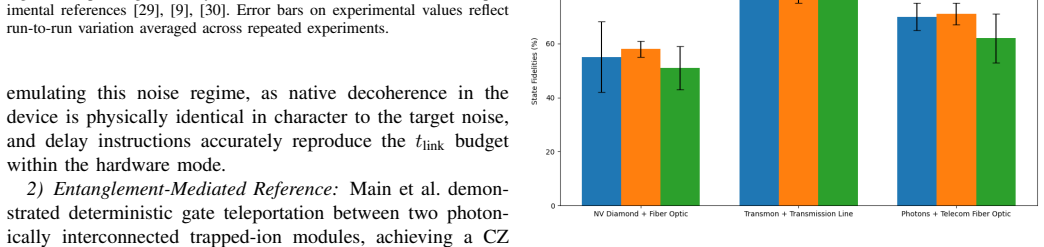
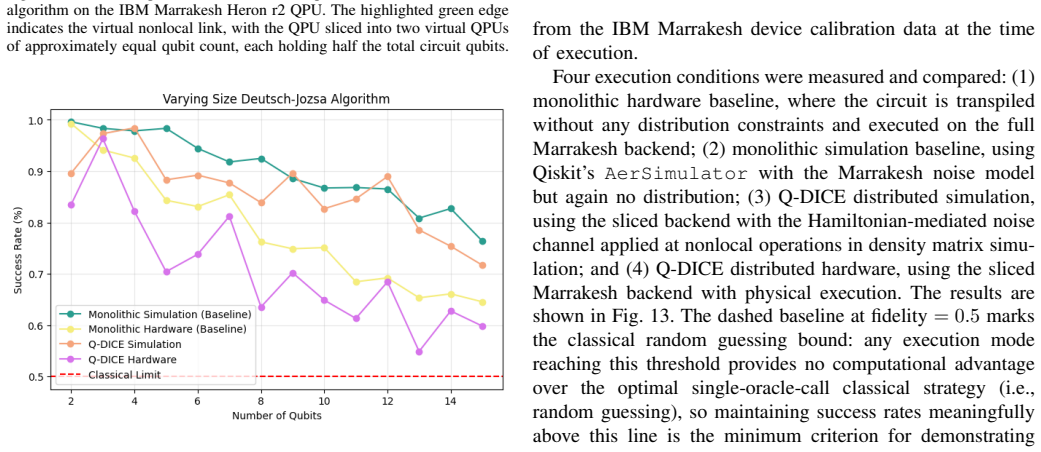
Q-DICE emulates distributed quantum circuits on simulators and NISQ hardware while matching experimental fidelity to within 4 percent.
A machine-rendered reading of the paper's core claim, the machinery that carries it, and where it could break.
Core claim
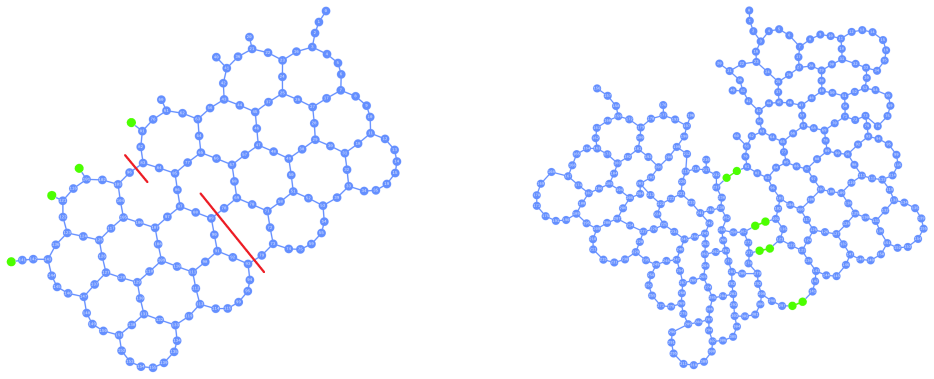
Q-DICE constitutes a distribution-aware compiler and noise-modeling engine that constructs distributed QPU backends via QPU slicing and stitching, models nonlocal links with physically motivated Kraus operators and stochastic error channels, and enforces topology constraints through boundary-aware circuit mapping, thereby reproducing real distributed quantum system behavior with a worst-case fidelity deviation of 4 percent on validated circuits.
What carries the argument
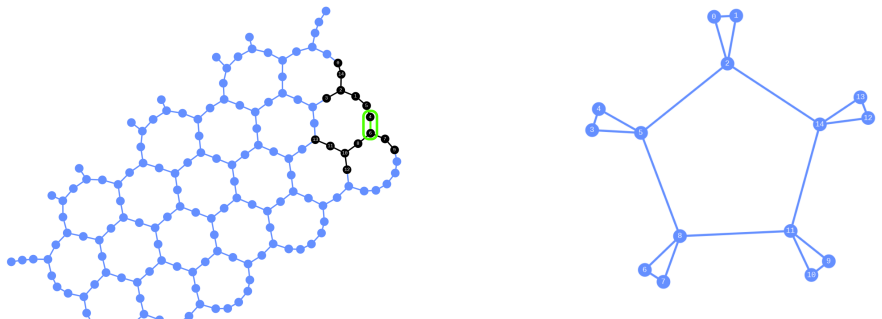
Q-DICE emulation environment, which uses QPU slicing and stitching to build backends, Kraus operators plus stochastic channels to model link noise, and boundary-aware mapping to enforce distributed topology during transpilation.
If this is right
- Researchers without hardware access can now evaluate distribution protocols and algorithms under realistic noise and topology constraints.
- System co-design for distributed quantum computing can proceed through simulation that faithfully reproduces experimental outcomes.
- New interconnect and mapping strategies can be tested against the same noise models used in hardware demonstrations.
Where Pith is reading between the lines
- The tool could support rapid iteration on entanglement distribution methods before they reach physical testbeds.
- Integration with existing circuit simulators might allow direct comparison of monolithic versus distributed performance on the same noise models.
Load-bearing premise
Modeling nonlocal link noise with physically motivated Kraus operators and stochastic error channels accurately captures the behavior of real distributed quantum hardware.
What would settle it
Execution of an additional experimentally realized distributed circuit on both Q-DICE and the corresponding optically linked trapped-ion hardware that produces a fidelity deviation exceeding 4 percent.
Figures



read the original abstract
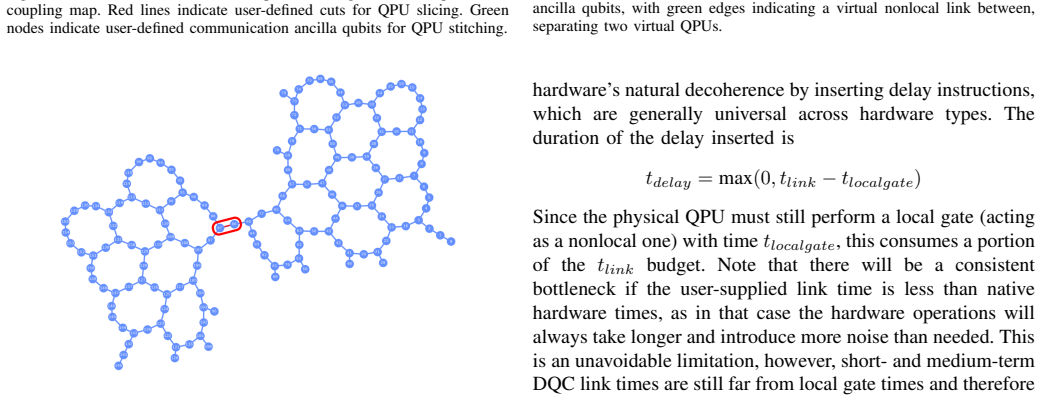
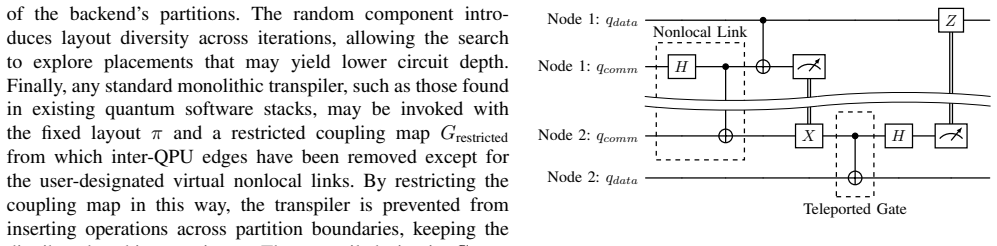
As distributed quantum computing (DQC) offers a leading path towards scalable quantum computation, the ability to benchmark distributed algorithms under realistic conditions becomes critical for system co-design. However, without access to physical systems, researchers lack tools to evaluate distribution protocols. We introduce Q-DICE (Quantum Distributed Interconnect Compiler and Emulator), a hardware-aware emulation environment for benchmarking distributed quantum circuits on classical simulators and on NISQ-era monolithic hardware. This work provides three core contributions: (1) a programmatic scheme to construct distributed QPU backends, utilizing two novel techniques - QPU slicing and stitching - to facilitate distributed circuit mapping, (2) a methodology for modeling nonlocal link noise using physically motivated Kraus operators and stochastic error channels, and (3) a boundary-aware circuit mapping algorithm enforcing distributed QPU topology constraints during transpilation. Together, these components constitute a distribution-aware compiler and noise-modeling engine that faithfully enforces the physical limitations of distributed quantum hardware within existing execution environments. We validate Q-DICE against a multitude of experimentally demonstrated quantum circuits, including a distributed Grover's search on optically linked trapped-ion hardware, achieving a worst-case fidelity deviation of 4% between simulated and experimental results. These findings demonstrate Q-DICE's capacity to accurately reproduce real distributed quantum system behavior across platforms, streamlining experimentation with distributed quantum algorithms and architectures.
Editorial analysis
A structured set of objections, weighed in public.
Referee Report
Summary. The manuscript introduces Q-DICE, a hardware-aware emulation environment and compiler for distributed quantum circuits. It describes three contributions: (1) a programmatic scheme for constructing distributed QPU backends via QPU slicing and stitching, (2) modeling of nonlocal link noise via physically motivated Kraus operators and stochastic error channels, and (3) a boundary-aware circuit mapping algorithm. The central claim is that Q-DICE accurately reproduces real distributed quantum hardware behavior, validated on multiple experimentally demonstrated circuits including a distributed Grover's search on optically linked trapped-ion hardware, with a reported worst-case fidelity deviation of 4%.
Significance. If the validation details hold and the noise model is shown to be predictive rather than fitted post hoc, the tool could provide a practical resource for co-design of distributed quantum algorithms and architectures by allowing simulation of realistic interconnect constraints on classical or monolithic NISQ hardware. The explicit comparison to experimental data is a positive feature, but the current presentation does not yet establish the result as robust.
major comments (2)
- [Abstract / Validation section] Abstract (and validation/results section): the central claim of faithful reproduction of real distributed hardware rests on a reported worst-case fidelity deviation of 4% across 'a multitude of experimentally demonstrated quantum circuits.' No information is supplied on the number of circuits tested, the distribution of deviations, error bars, how many shots or repetitions were used, or whether the noise-model parameters were chosen independently of the validation data. This information is required to assess whether the 4% figure supports the claim that the Kraus-operator and stochastic-channel methodology accurately captures real hardware.
- [Noise modeling section] Methodology for nonlocal link noise (presumably § on noise modeling): the paper states that the model uses 'physically motivated Kraus operators and stochastic error channels,' but without derivation of the specific operators, their parameter sources (e.g., measured T1/T2 of the interconnect or ab-initio calculation), or an ablation showing that simpler depolarizing models would not suffice, it is not possible to evaluate whether the modeling choice is load-bearing or merely descriptive.
minor comments (1)
- [Abstract] The abstract refers to 'existing execution environments' without naming which simulators or hardware backends (e.g., Qiskit, Cirq, or specific trapped-ion emulators) were used for the reported experiments.
Simulated Author's Rebuttal
We thank the referee for their detailed and constructive comments on our manuscript introducing Q-DICE. We address each of the major comments point-by-point below, with commitments to revisions that will enhance the clarity and robustness of our validation and noise modeling sections.
read point-by-point responses
-
Referee: [Abstract / Validation section] the central claim of faithful reproduction of real distributed hardware rests on a reported worst-case fidelity deviation of 4% across 'a multitude of experimentally demonstrated quantum circuits.' No information is supplied on the number of circuits tested, the distribution of deviations, error bars, how many shots or repetitions were used, or whether the noise-model parameters were chosen independently of the validation data. This information is required to assess whether the 4% figure supports the claim.
Authors: We agree that these details are essential for rigorously supporting our claims. In the revised manuscript, we will expand the validation section to specify the number of circuits tested, provide the distribution of fidelity deviations along with error bars, report the number of shots and repetitions used in both simulation and experiment, and clarify that the noise model parameters were derived from independent experimental characterizations of the interconnect (such as measured coherence times) and not fitted to the validation data. This will allow readers to better evaluate the predictive power of our approach. revision: yes
-
Referee: [Noise modeling section] the paper states that the model uses 'physically motivated Kraus operators and stochastic error channels,' but without derivation of the specific operators, their parameter sources (e.g., measured T1/T2 of the interconnect or ab-initio calculation), or an ablation showing that simpler depolarizing models would not suffice, it is not possible to evaluate whether the modeling choice is load-bearing or merely descriptive.
Authors: The referee raises a valid point regarding the need for greater transparency in our noise modeling methodology. We will revise the noise modeling section to include the explicit derivation of the Kraus operators based on the physical characteristics of the nonlocal links, specify the sources of the parameters (drawn from measured T1/T2 times and other hardware metrics from the referenced experiments), and add an ablation study comparing our model to a standard depolarizing channel. This will demonstrate that the physically motivated model provides superior fidelity matching and is indeed load-bearing for accurate emulation. revision: yes
Circularity Check
No significant circularity detected
full rationale
The provided abstract and context describe Q-DICE as a hardware-aware emulator validated directly against external experimental results on distributed quantum circuits (e.g., optically linked trapped-ion Grover search with 4% worst-case fidelity deviation). No equations, derivation steps, fitted parameters presented as predictions, or self-citations are visible in the text. The central claims rely on external benchmarks and physically motivated noise models without reduction to self-definition or internal fits. This is the expected self-contained case.
Axiom & Free-Parameter Ledger
Forward citations
Cited by 1 Pith paper
-
Towards an Optimally Distributed Quantum Fourier Transform Circuit
Presents an optimal gate-packing partitioning scheme for the QFT that aims to minimize e-bit count in distributed quantum systems and validates it on hardware.
Reference graph
Works this paper leans on
-
[1]
Quantum Computing in the NISQ Era and Beyond,
J. Preskill, “Quantum Computing in the NISQ Era and Beyond,” Quantum, vol. 2, p. 79, 2018
2018
-
[2]
Distributed quantum computation,
J. I. Cirac, A. K. Ekert, S. F. Huelga, and C. Macchiavello, “Distributed quantum computation,”Physical Review A, vol. 59, no. 6, p. 4249, 1999
1999
-
[3]
Quantum internet: A vision for the road ahead,
S. Wehner, D. Elkouss, and R. Hanson, “Quantum internet: A vision for the road ahead,”Science, vol. 362, no. 6412, 2018
2018
-
[4]
Can quantum-mechanical de- scription of physical reality be considered complete?
A. Einstein, B. Podolsky, and N. Rosen, “Can quantum-mechanical de- scription of physical reality be considered complete?”Physical Review, vol. 47, no. 10, pp. 777–780, 1935
1935
-
[5]
Optimal local implementation of nonlocal quantum gates,
J. Eisert, K. Jacobs, P. Papadopoulos, and M. B. Plenio, “Optimal local implementation of nonlocal quantum gates,”Phys. Rev. A, vol. 62, p. 052317, Oct 2000. [Online]. Available: https://link.aps.org/doi/10.1103/ PhysRevA.62.052317
2000
-
[6]
Teleporting an unknown quantum state via dual classical and einstein-podolsky-rosen channels,
C. H. Bennett, G. Brassard, C. Cr ´epeau, R. Jozsa, A. Peres, and W. K. Wootters, “Teleporting an unknown quantum state via dual classical and einstein-podolsky-rosen channels,”Physical Review Letters, vol. 70, no. 13, pp. 1895–1899, 1993
1993
-
[7]
General many-body entanglement swapping protocol: Opportunities for distributed quantum computing,
S. Huhtanen, Y . Mafi, A. G. Moghaddam, and T. Ojanen, “General many-body entanglement swapping protocol: Opportunities for distributed quantum computing,” 2026. [Online]. Available: https://arxiv.org/abs/2506.22430
arXiv 2026
-
[8]
B. Yuan, C. Zhang, H. He, Y . Fei, C. Han, S. Wang, H. Sun, Q. Mu, B. Zhao, F. Liu, W. Wang, and Z. Shan, “Tunable Nonlocal ZZ Interaction for Remote Controlled-Z Gates Between Distributed Fixed-Frequency Qubits,” 2026. [Online]. Available: https://arxiv.org/abs/2603.28526
arXiv 2026
-
[9]
Distributed quantum computing across an optical network link,
D. Main, P. Drmota, D. P. Nadlinger, E. M. Ainley, A. Agrawal, B. C. Nichol, R. Srinivas, G. Araneda, and C. J. Ballance, “Distributed quantum computing across an optical network link,”Nature, vol. 638, pp. 383–388, Feb 2025
2025
-
[10]
SDQC: Distributed Quantum Computing Architecture Utilizing Entangled Ion Qubit Shuttling,
S. Baek, S.-H. Lee, D. Min, and J. Kim, “SDQC: Distributed Quantum Computing Architecture Utilizing Entangled Ion Qubit Shuttling,”
-
[11]
Available: https://arxiv.org/abs/2512.02890
[Online]. Available: https://arxiv.org/abs/2512.02890
-
[12]
Development of Quantum Interconnects (QuICs) for Next-Generation Information Technologies,
D. Awschalom, K. K. Berggren, H. Bernien, S. Bhave, L. D. Carr, P. Davids, S. E. Economou, D. Englund, A. Faraon, M. Fejer, S. Guha, M. V . Gustafsson, E. Hu, L. Jiang, J. Kim, B. Korzh, P. Kumar, P. G. Kwiat, M. Lon ˇcar, M. D. Lukin, D. A. Miller, C. Monroe, S. W. Nam, P. Narang, J. S. Orcutt, M. G. Raymer, A. H. Safavi-Naeini, M. Spiropulu, K. Srinivas...
-
[13]
Distributed Quantum Computing: A Survey,
M. Caleffi, M. Amoretti, D. Ferrari, J. Illiano, A. Manzalini, and A. S. Cacciapuoti, “Distributed Quantum Computing: A Survey,”Computer Networks, vol. 254, p. 110672, Dec 2024
2024
-
[14]
NetSquid, a NETwork Simulator for QUantum Information using Discrete events,
T. Coopmans, R. Knegjens, A. Dahlberg, D. Maier, L. Nijsten, J. de Oliveira Filho, M. Papendrecht, J. Rabbie, F. Rozpedek, M. Skrzypczyk, L. Wubben, W. de Jong, D. Podareanu, A. Torres- Knoop, D. Elkouss, and S. Wehner, “NetSquid, a NETwork Simulator for QUantum Information using Discrete events,”Communications Physics, vol. 4, no. 1, p. 164, Jul 2021
2021
-
[15]
Quisp: a quantum internet simulation package,
R. Satoh, M. Hajdu ˇsek, N. Benchasattabuse, S. Nagayama, K. Teramoto, T. Matsuo, S. A. Metwalli, P. Pathumsoot, T. Satoh, S. Suzuki, and R. V . Meter, “Quisp: a quantum internet simulation package,” in2022 IEEE International Conference on Quantum Computing and Engineering (QCE), 2022, pp. 353–364
2022
-
[16]
SimulaQron - A Simulator for Developing Quantum Internet Software,
A. Dahlberg and S. Wehner, “SimulaQron - A Simulator for Developing Quantum Internet Software,”Quantum Science and Technology, vol. 4, no. 1, p. 015001, Oct 2018
2018
-
[17]
SimQN: A Network-Layer Simulator for the Quantum Network Investigation,
X. Chen, C. Liu, X. Wu, C. Ying, and J. Xin, “SimQN: A Network-Layer Simulator for the Quantum Network Investigation,” inProceedings of the IEEE International Conference on Quantum Computing and Engineering (QCE), 2023, pp. 1–7
2023
-
[18]
Quantum simulation of noisy quantum networks,
F. Riera-S `abat, J. Miguel-Ramiro, and W. D ¨ur, “Quantum simulation of noisy quantum networks,” 2025. [Online]. Available: https: //arxiv.org/abs/2506.09144
arXiv 2025
-
[19]
Quantum Computing with Qiskit,
A. Javadi-Abhari, M. Treinish, K. Krsulich, C. J. Wood, J. Lishman, J. Gacon, S. Martiel, P. D. Nation, L. S. Bishop, A. W. Cross, B. R. Johnson, and J. M. Gambetta, “Quantum Computing with Qiskit,” unpublished
-
[20]
Towards a distributed quantum computing ecosystem,
M. Cuomo, M. Caleffi, and A. S. Cacciapuoti, “Towards a distributed quantum computing ecosystem,”IET Quantum Communication, vol. 2, no. 1, pp. 3–8, Mar 2021
2021
-
[21]
Cirq Developers, “Cirq,” Zenodo, Jun. 2024. [Online]. Available: https://doi.org/10.5281/zenodo.11398180
-
[22]
t|ket⟩: A Retargetable Compiler for NISQ Devices,
S. Sivarajah, S. Dilkes, A. Cowtan, W. Simmons, A. Edgington, and R. Duncan, “t|ket⟩: A Retargetable Compiler for NISQ Devices,” Quantum Science and Technology, vol. 6, no. 1, p. 014003, Nov 2020
2020
-
[23]
Hardware-Aware Emulation of Quantum Network Noise on NISQ Devices,
S. Niuet al., “Hardware-Aware Emulation of Quantum Network Noise on NISQ Devices,”arXiv preprint arXiv:2401.05432, 2024
arXiv 2024
-
[24]
Simulating the quantum internet,
A. Dahlberg, M. Skrzypczyk, and S. Wehner, “Simulating the quantum internet,”Communications of the ACM, vol. 66, no. 6, pp. 72–81, 2023
2023
-
[25]
M. A. Nielsen and I. L. Chuang,Quantum Computation and Quantum Information, 10th ed. Cambridge University Press, 2010
2010
-
[26]
The quantum internet,
H. J. Kimble, “The quantum internet,”Nature, vol. 453, no. 7198, p. 1023–1030, Jun. 2008. [Online]. Available: http://dx.doi.org/10.1038/ nature07127
2008
-
[27]
Distributed quantum computing in silicon,
P. Inc, F. Afzalet al., “Distributed quantum computing in silicon,”
-
[28]
Available: https://arxiv.org/abs/2406.01704
[Online]. Available: https://arxiv.org/abs/2406.01704
-
[29]
High-rate, high-fidelity entanglement of qubits across an elementary quantum network,
L. J. Stephenson, D. P. Nadlinger, B. C. Nichol, S. An, P. Drmota, T. G. Ballance, K. Thirumalai, J. F. Goodwin, D. M. Lucas, and C. J. Ballance, “High-rate, high-fidelity entanglement of qubits across an elementary quantum network,”Physical Review Letters, vol. 124, no. 11, Mar. 2020. [Online]. Available: http://dx.doi.org/10.1103/PhysRevLett.124.110501
-
[30]
M. R. Geller and Z. Zhou, “Efficient Error Models for Fault- Tolerant Architectures and the Pauli Twirling Approximation,” Physical Review A, vol. 88, no. 1, Jul. 2013. [Online]. Available: http://dx.doi.org/10.1103/PhysRevA.88.012314
-
[31]
Deterministic teleportation of a quantum gate between two logical qubits,
K. S. Chou, J. Z. Blumoff, C. S. Wang, P. C. Reinhold, C. J. Axline, Y . Y . Gao, L. Frunzio, M. H. Devoret, L. Jiang, and R. J. Schoelkopf, “Deterministic teleportation of a quantum gate between two logical qubits,”Nature, vol. 561, no. 7723, p. 368–373, Sep. 2018. [Online]. Available: http://dx.doi.org/10.1038/s41586-018-0470-y
-
[32]
Unconditionally teleported quantum gates between remote solid-state qubit registers,
M. Iuliano, N. Demetriou, H. B. van Ommen, C. Karels, T. H. Taminiau, and R. Hanson, “Unconditionally teleported quantum gates between remote solid-state qubit registers,” 2026. [Online]. Available: https://arxiv.org/abs/2601.04848
arXiv 2026
-
[33]
Realization of a multinode quantum network of remote solid-state qubits,
M. Pompili, S. L. N. Hermans, S. Baier, H. K. C. Beukers, P. C. Humphreys, R. N. Schouten, R. F. L. Vermeulen, M. J. Tiggelman, L. dos Santos Martins, B. Dirkse, S. Wehner, and R. Hanson, “Realization of a multinode quantum network of remote solid-state qubits,”Science, vol. 372, no. 6539, p. 259–264, Apr. 2021. [Online]. Available: http://dx.doi.org/10.1...
-
[34]
Quantum secret sharing in a triangular superconducting quantum network,
H. Yan, A. Zang, J. Grebel, X. Wu, M.-H. Chou, G. Andersson, C. R. Conner, Y . J. Joshi, S. Li, J. M. Miller, R. G. Povey, H. Qiao, E. Chitambar, and A. N. Cleland, “Quantum secret sharing in a triangular superconducting quantum network,” 2025. [Online]. Available: https://arxiv.org/abs/2506.10878
arXiv 2025
-
[35]
Y . Tsujimoto, M. Tanaka, N. Iwasaki, R. Ikuta, S. Miki, T. Yamashita, H. Terai, T. Yamamoto, M. Koashi, and N. Imoto, “High- Fidelity Entanglement Swapping and Generation of Three-Qubit GHZ State Using Asynchronous Telecom Photon Pair Sources,” Scientific Reports, vol. 8, no. 1, Jan. 2018. [Online]. Available: http://dx.doi.org/10.1038/s41598-018-19738-8
-
[36]
Large scale modular quantum computer architecture with atomic memory and photonic interconnects,
C. Monroe, R. Raussendorf, A. Ruthven, K. R. Brown, P. Maunz, L.-M. Duan, and J. Kim, “Large scale modular quantum computer architecture with atomic memory and photonic interconnects,”Physical Review A, vol. 89, no. 2, p. 022317, 2014
2014
-
[37]
Quantum Data Center Infrastructures: A Scalable Architectural Design Perspective,
H. Shapourian, E. Kaur, T. Sewell, J. Zhao, M. Kilzer, R. Kompella, and R. Nejabati, “Quantum Data Center Infrastructures: A Scalable Architectural Design Perspective,” 2025. [Online]. Available: https: //arxiv.org/abs/2501.05598
arXiv 2025
-
[38]
Benchmarking Quantum Data Center Architectures: A Performance and Scalability Perspective,
S. Pouryousef, E. Kaur, H. Shapourian, D. Towsley, R. Kompella, and R. Nejabati, “Benchmarking Quantum Data Center Architectures: A Performance and Scalability Perspective,” 2026. [Online]. Available: https://arxiv.org/abs/2601.01353
arXiv 2026
discussion (0)
Sign in with ORCID, Apple, or X to comment. Anyone can read and Pith papers without signing in.