Planted-Solution Pauli Hamiltonians as a Quantum Benchmarking Primitive
Pith reviewed 2026-06-27 13:01 UTC · model grok-4.3
The pith
A construction produces Pauli Hamiltonians with exactly known ground-state energies by planting block-product states into sums of frustration-free local clauses.
A machine-rendered reading of the paper's core claim, the machinery that carries it, and where it could break.
Core claim
The construction embeds a planted block-product state as the simultaneous ground state of a sum of frustration-free local clauses on overlapping supports, exposes the resulting model only as a polynomial-size linear combination of Pauli operators, and admits optional Clifford conjugation that preserves the spectrum. The framework subsumes classical planted constraint-satisfaction problems as a diagonal special case, providing a direct embedding channel through which classical hardness properties can be inherited.
What carries the argument
The sum of frustration-free local clauses on overlapping supports that share the planted block-product state as common ground state, rewritten as a polynomial number of Pauli terms.
If this is right
- The resulting Hamiltonians serve as reference instances with known ground-state energies for benchmarking quantum ground-state estimation algorithms.
- Classical planted constraint-satisfaction problems embed directly as the diagonal case, transferring known hardness properties into the quantum setting.
- Optional Clifford conjugation generates new instances while leaving the spectrum unchanged.
- All instances remain polynomial in the number of Pauli terms, keeping them tractable to write down.
Where Pith is reading between the lines
- These instances could be used to measure how algorithm performance scales with the degree of classical hardness inherited from the planted problem.
- The same planting technique might be adapted to produce reference states for other quantum simulation tasks beyond energy estimation.
- Because the construction is explicit, one could generate families of instances with controlled locality or interaction range to isolate algorithmic bottlenecks.
Load-bearing premise
Frustration-free local clauses on overlapping supports can always be chosen so their sum has the planted block-product state as ground state and expands to only a polynomial number of Pauli operators.
What would settle it
An explicit construction of the clauses for some block-product state whose resulting Pauli Hamiltonian has an eigenstate of strictly lower energy than the planted state would falsify the central claim.
Figures

read the original abstract
We introduce a construction of Pauli Hamiltonians with exactly known ground-state energies, intended as reference instances for ground-state energy estimation algorithms. The construction embeds a planted block-product state as the simultaneous ground state of a sum of frustration-free local clauses on overlapping supports, exposes the resulting model only as a polynomial-size linear combination of Pauli operators, and admits optional Clifford conjugation that preserves the spectrum. The framework subsumes classical planted constraint-satisfaction problems as a diagonal special case, providing a direct embedding channel through which classical hardness properties can be inherited. Open-source software, certification keys, and example instances are made publicly available.
Editorial analysis
A structured set of objections, weighed in public.
Referee Report
Summary. The manuscript introduces a construction of Pauli Hamiltonians with exactly known ground-state energies by embedding a planted block-product state as the simultaneous ground state of a sum of frustration-free local clauses defined on overlapping supports. The resulting Hamiltonian is exposed only as a polynomial-size linear combination of Pauli operators; the framework admits optional Clifford conjugation (which preserves the spectrum) and subsumes classical planted constraint-satisfaction problems as the diagonal special case. Open-source software, certification keys, and example instances are provided.
Significance. If the construction is valid, the work supplies a useful benchmarking primitive for ground-state energy estimation algorithms. The ability to plant known ground states while retaining a compact Pauli representation, together with the direct embedding channel from classical planted CSPs, allows controlled inheritance of hardness properties. Public release of software and instances further supports reproducibility and adoption as a standard test suite.
minor comments (1)
- The abstract states that the sum of frustration-free clauses yields the planted state as ground state but does not sketch the explicit construction of the clauses on overlapping supports; a one-sentence clarification in the abstract or introduction would improve immediate readability.
Simulated Author's Rebuttal
We thank the referee for their positive assessment of the manuscript and for recommending acceptance.
Circularity Check
No significant circularity
full rationale
The paper's construction directly defines frustration-free local clauses whose individual ground states are the planted block-product state by explicit design; the sum therefore has that state as ground state with energy equal to the sum of clause minima, and each constant-support clause expands to a fixed number of Pauli terms, yielding a polynomial-size Hamiltonian by elementary counting. Clifford conjugation is a unitary similarity transformation and therefore spectrum-preserving by definition. No parameter is fitted to data and then relabeled a prediction, no uniqueness theorem is imported from self-citation, and no ansatz is smuggled via prior work. The derivation is self-contained against the stated assumptions and does not reduce to its own inputs.
Axiom & Free-Parameter Ledger
axioms (1)
- domain assumption Frustration-free local clauses on overlapping supports can share a common block-product ground state that remains the ground state of their sum.
Reference graph
Works this paper leans on
-
[1]
R. P. Feynman, International Journal of Theoretical Physics21, 467 (1982)
1982
-
[2]
Lloyd, Science273, 1073 (1996)
S. Lloyd, Science273, 1073 (1996)
1996
-
[3]
I. M. Georgescu, S. Ashhab, and F. Nori, Reviews of Modern Physics86, 153 (2014)
2014
-
[4]
A. Y. Kitaev, A. H. Shen, and M. N. Vyalyi,Classical and Quantum Computation(American Mathematical So- ciety, 2002)
2002
-
[5]
Kempe, A
J. Kempe, A. Kitaev, and O. Regev, SIAM Journal on Computing35, 1070 (2006)
2006
-
[6]
Preskill, Quantum2, 79 (2018)
J. Preskill, Quantum2, 79 (2018)
2018
-
[7]
Eisert, D
J. Eisert, D. Hangleiter, N. Walk, I. Roth, D. Markham, R. Parekh, U. Chabaud, and E. Kashefi, Nature Reviews Physics2, 382 (2020)
2020
-
[8]
Boixo, S
S. Boixo, S. V. Isakov, V. N. Smelyanskiy, R. Babbush, N. Ding, Z. Jiang, M. J. Bremner, J. M. Martinis, and H. Neven, Nature Physics14, 595 (2018). 8
2018
-
[9]
Aruteet al., Nature574, 505 (2019)
F. Aruteet al., Nature574, 505 (2019)
2019
-
[10]
Jerrum, Random Structures & Algorithms3, 347 (1992)
M. Jerrum, Random Structures & Algorithms3, 347 (1992)
1992
-
[11]
Achlioptas and F
D. Achlioptas and F. Ricci-Tersenghi, inProceedings of the 38th Annual ACM Symposium on Theory of Comput- ing (STOC)(2006) pp. 130–139
2006
-
[12]
Barthel, A
W. Barthel, A. K. Hartmann, M. Leone, F. Ricci- Tersenghi, M. Weigt, and R. Zecchina, Physical Review Letters88, 188701 (2002)
2002
-
[13]
Krz¸ aka la, A
F. Krz¸ aka la, A. Montanari, F. Ricci-Tersenghi, G. Se- merjian, and L. Zdeborov´ a, Proceedings of the National Academy of Sciences104, 10318 (2007)
2007
-
[14]
Achlioptas and C
D. Achlioptas and C. Moore, SIAM Journal on Comput- ing36, 740 (2006)
2006
-
[15]
I. Hen, J. Job, T. Albash, T. F. Rønnow, M. Troyer, and D. A. Lidar, Physical Review A92, 042325 (2015)
2015
-
[16]
Boixo, T
S. Boixo, T. F. Rønnow, S. V. Isakov, Z. Wang, D. Wecker, D. A. Lidar, J. M. Martinis, and M. Troyer, Nature Physics10, 218 (2014)
2014
-
[17]
Hen, Physical Review Applied12, 011003 (2019)
I. Hen, Physical Review Applied12, 011003 (2019)
2019
-
[18]
Kowalsky, T
M. Kowalsky, T. Albash, I. Hen, and D. A. Lidar, Quan- tum Science and Technology7, 025008 (2022)
2022
-
[19]
Bravyi and A
S. Bravyi and A. Kitaev, Physical Review A71, 022316 (2005)
2005
-
[20]
Verstraete, V
F. Verstraete, V. Murg, and J. I. Cirac, Advances in Physics57, 143 (2008)
2008
-
[21]
The Heisenberg Representation of Quantum Computers
D. Gottesman, arXiv preprint quant-ph/9807006 10.48550/arXiv.quant-ph/9807006 (1998), arXiv:quant- ph/9807006
work page internal anchor Pith review Pith/arXiv arXiv doi:10.48550/arxiv.quant-ph/9807006 1998
-
[22]
Aaronson and D
S. Aaronson and D. Gottesman, Physical Review A70, 052328 (2004)
2004
-
[23]
Hen, planted-solution-quantum-benchmarking, GitHub repository (2026), accessed: 2026-01-18
I. Hen, planted-solution-quantum-benchmarking, GitHub repository (2026), accessed: 2026-01-18. Appendix A: Software, reproducibility, and instance generation To ensure transparency, reproducibility, and broad community use, all benchmark instances used in this work are generated using an open-source software frame- work. The software implements the plante...
2026
-
[24]
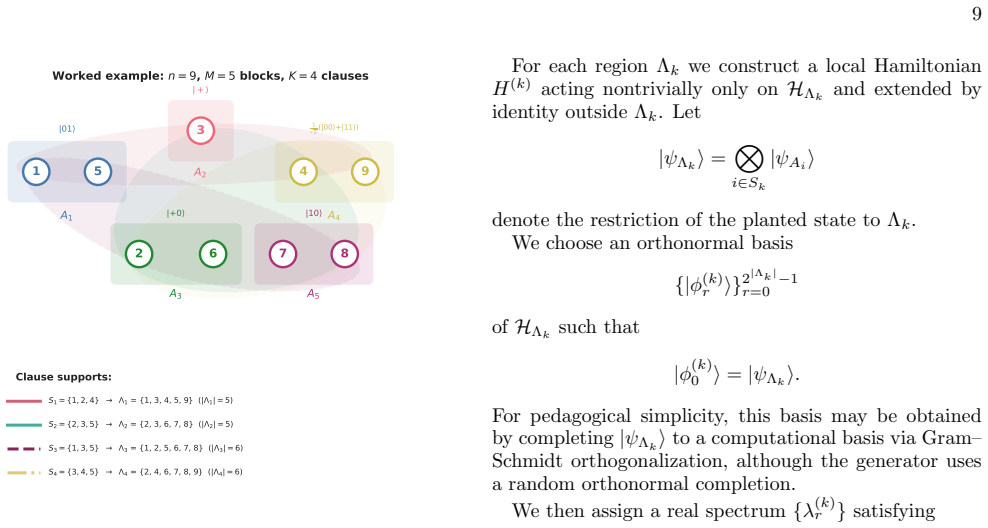
We drawK= 4 random subsets of blocks, each of size three, S1 ={1,2,4}, S 2 ={2,3,5}, S3 ={1,3,5}, S 4 ={3,4,5},(B2) which define the corresponding support regions Λk = [ i∈Sk Ai
These block states define the planted global product state |Ψ⋆⟩= 5O i=1 |ψAi ⟩, with qubits ordered according to the block definitions above. We drawK= 4 random subsets of blocks, each of size three, S1 ={1,2,4}, S 2 ={2,3,5}, S3 ={1,3,5}, S 4 ={3,4,5},(B2) which define the corresponding support regions Λk = [ i∈Sk Ai. In this example, Λ 1 ={1,3,4,5,9}wit...
discussion (0)
Sign in with ORCID, Apple, or X to comment. Anyone can read and Pith papers without signing in.