Ambient and Pressure Dependent Superconductivity with Hydrogen Storage Potential in Quaternary Hydride LiMgZr2H12: A Comprehensive First-principles Insights
Pith reviewed 2026-06-27 08:20 UTC · model grok-4.3
The pith
LiMgZr2H12 superconducts at 72.76 K at ambient pressure, rising to 77.3 K at 10 GPa.
A machine-rendered reading of the paper's core claim, the machinery that carries it, and where it could break.
Core claim
LiMgZr2H12 with Pmmm symmetry is stable at ambient pressure; its electronic structure yields an electron-phonon coupling constant that gives Tc = 72.76 K at 0 GPa and Tc = 77.3 K at 10 GPa in the Allen-Dynes formula. The material remains mechanically stable and ductile over 0-10 GPa, possesses a machinability index higher than stainless steel, and offers a gravimetric hydrogen storage capacity of 5.36 wt%.
What carries the argument
The LiMgZr2H12 crystal structure (Pmmm symmetry) and the electron-phonon coupling constant λ obtained from DFT phonon and electronic structure calculations, inserted into the Allen-Dynes equation.
Load-bearing premise
The electron-phonon coupling constant from the DFT calculations, together with the conventional choice of Coulomb pseudopotential μ* = 0.1, correctly predicts the superconducting transition temperature.
What would settle it
Experimental synthesis of LiMgZr2H12 followed by direct measurement of its critical temperature or confirmation of its dynamical stability at ambient pressure.
Figures
read the original abstract
Molecular hydrides have attracted relatively less attention in the search for high Tc superconductors because their hydrogen quasi-molecular units tend to be electronically inactive for superconductivity. In contrast, hydrogen rich compounds under high pressure have been widely considered strong candidates for achieving room-temperature superconductivity. However, their dependence on extreme pressure conditions significantly constrains their practical applicability. This work investigates hydrogen-rich superconducting materials that may be stable under ambient pressure conditions. Motivated by recent studies on the MgZrH2n family, a LiMgZr2H12 structure with Pmmm symmetry was designed. The mechanical, thermodynamic, and dynamical stability of the compound, together with its electronic and optical properties, were systematically investigated using first-principles calculations. Li doping in LiMgZr2H12 significantly increases the hydrogen derived contribution near the Fermi level (EF) and strengthens the electron-phonon coupling constant ({\lambda}) compared with MgZrH6. LiMgZr2H12 exhibits a critical temperature of 72.76 K at ambient pressure, which is further enhanced by applying pressure. At 10 GPa the critical temperature increases to 77.3 K. Elastic property analysis shows that the material remains mechanically stable over the pressure range studied (0-10 GPa). It also behaves like a ductile material suitable for current carrying applications. The material has a high machinability index, which is much higher than that of stainless steels. In addition, LiMgZr2H12 exhibits a gravimetric hydrogen storage capacity of 5.36 wt%, indicating its potential as a promising candidate for hybrid hydrogen storage technologies. This work offers a new direction for designing high-Tc hydrides at ambient conditions.
Editorial analysis
A structured set of objections, weighed in public.
Referee Report
Summary. The manuscript reports first-principles DFT calculations on the quaternary hydride LiMgZr2H12 (Pmmm symmetry), claiming mechanical, dynamical and thermodynamic stability at ambient pressure. It predicts a superconducting Tc of 72.76 K at 0 GPa rising to 77.3 K at 10 GPa via the Allen-Dynes formula, together with a gravimetric hydrogen storage capacity of 5.36 wt% and ductile mechanical behavior suitable for applications.
Significance. If the Tc result is robust, the work would be significant: it identifies a candidate high-Tc hydride that is stable at ambient pressure (unlike most high-pressure hydrides) while also offering hydrogen-storage functionality. The study includes elastic constants, phonon spectra, electronic structure, and pressure dependence up to 10 GPa. Credit is due for the systematic stability checks and the dual superconductivity/storage focus.
major comments (1)
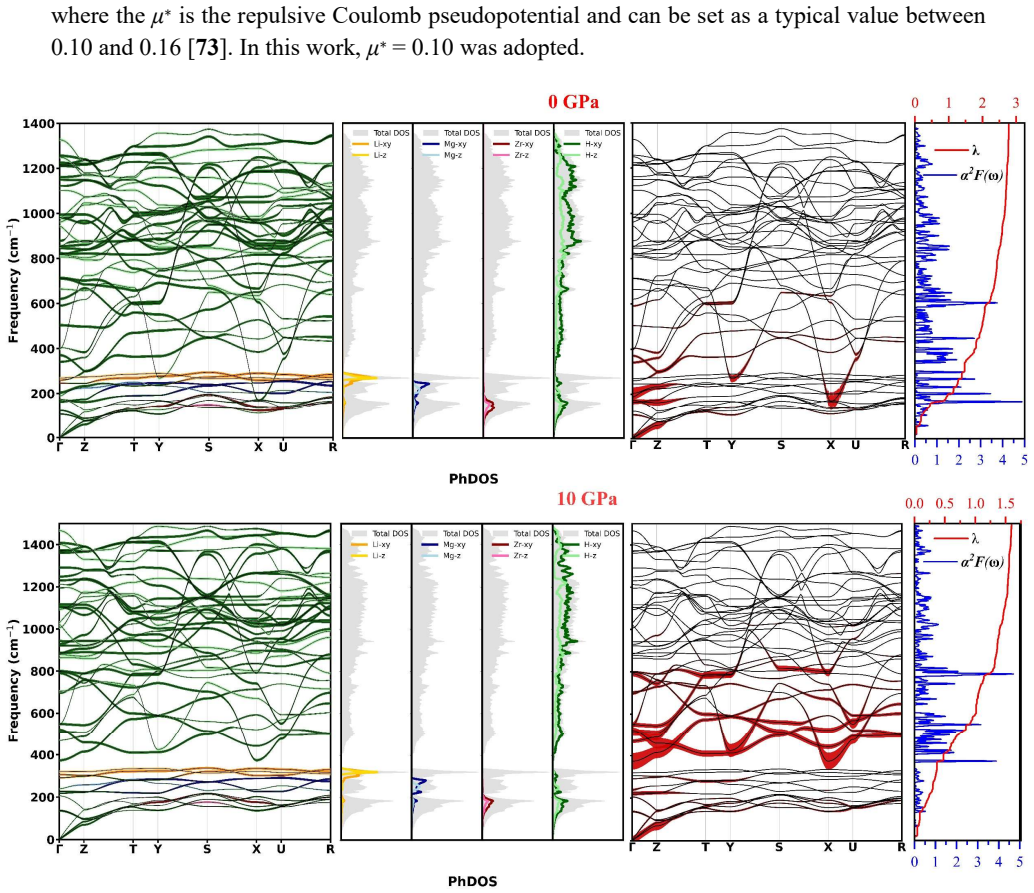
- [Superconducting properties / Tc calculation] The reported Tc values (72.76 K at 0 GPa, 77.3 K at 10 GPa) are obtained by inserting a DFT-derived λ and ω_log into the Allen-Dynes equation with the Coulomb pseudopotential fixed at the conventional value μ*=0.1. No raw λ or ω_log values are stated, no sensitivity analysis versus μ* (e.g., 0.10–0.13) is performed, and no independent Eliashberg or first-principles μ* calculation is provided. In the high-λ regime typical of these hydrides this single external parameter controls the quantitative claim.
minor comments (2)
- [Abstract] The abstract states that Li doping 'significantly increases' the hydrogen-derived DOS at EF and strengthens λ relative to MgZrH6, but no numerical comparison (DOS values, λ values, or a table) is referenced.
- [Methods / Computational details] Convergence parameters for the phonon and Eliashberg calculations (k-mesh, q-mesh, cutoff energies) are not summarized; typical uncertainties in such Tc predictions should be quantified.
Simulated Author's Rebuttal
We thank the referee for their careful reading and constructive feedback on our manuscript. We address the concern regarding the superconducting Tc calculation point by point below and will revise the manuscript to improve transparency and robustness where possible.
read point-by-point responses
-
Referee: The reported Tc values (72.76 K at 0 GPa, 77.3 K at 10 GPa) are obtained by inserting a DFT-derived λ and ω_log into the Allen-Dynes equation with the Coulomb pseudopotential fixed at the conventional value μ*=0.1. No raw λ or ω_log values are stated, no sensitivity analysis versus μ* (e.g., 0.10–0.13) is performed, and no independent Eliashberg or first-principles μ* calculation is provided. In the high-λ regime typical of these hydrides this single external parameter controls the quantitative claim.
Authors: We agree that explicitly reporting the raw λ and ω_log values is necessary for full transparency and will add these quantities (computed via DFPT) to the revised manuscript, including their pressure dependence. We will also perform and report a sensitivity analysis of Tc versus μ* over the range 0.10–0.13 to quantify the dependence on this parameter. The conventional choice μ*=0.1 follows the standard practice in the hydride superconductivity literature and enables direct comparison with prior theoretical studies; we will cite representative examples. However, a full numerical solution of the Eliashberg equations or an ab initio evaluation of μ* lies outside the scope of the present DFT-based investigation and would require substantially more advanced methodology and computational resources. revision: partial
- Request for an independent Eliashberg or first-principles μ* calculation, which cannot be addressed within the current DFT phonon and Allen-Dynes framework without a major expansion of the study scope.
Circularity Check
No circularity: standard DFT + Allen-Dynes workflow with conventional μ*
full rationale
The paper computes electronic bands, phonons, and λ via DFT (standard first-principles steps), then inserts the resulting λ and ω_log into the Allen-Dynes/McMillan formula using the externally fixed conventional value μ*=0.1. No equation in the manuscript defines Tc in terms of itself, renames a fitted quantity as a prediction, or reduces the central claim to a self-citation chain. The formula and μ* choice are independent of the target result and are standard practice; the derivation chain therefore remains self-contained against external benchmarks.
Axiom & Free-Parameter Ledger
free parameters (1)
- Coulomb pseudopotential μ* =
0.1 (assumed)
axioms (2)
- domain assumption The Pmmm LiMgZr2H12 structure is dynamically stable (no imaginary phonon modes).
- domain assumption DFT with chosen functional and pseudopotentials yields reliable electron-phonon coupling for this hydride.
Reference graph
Works this paper leans on
-
[1]
Design of a 60.8 K superconducting hydride LiMgZr2H12 at ambient pressure via Lithium doping,
Q. Wei, X. Wang, J. Luo, M. Zhang, and B. Wei, “Design of a 60.8 K superconducting hydride LiMgZr2H12 at ambient pressure via Lithium doping,” 2026, arXiv. doi: 10.48550/ARXIV.2602.03471
-
[2]
High-temperature superconductivity in hydrides,
I. A. Troyan et al., “High-temperature superconductivity in hydrides,” Physics-Uspekhi, vol. 65, no. 07, pp. 748–761, Jul. 2022, doi: 10.3367/UFNe.2021.05.039187
-
[3]
Understanding Hydrogen Rich Superconductors: Importance of Effective Mass and Dirty Limit,
A. L. Cornelius, K. V. Lawler, and A. Salamat, “Understanding Hydrogen Rich Superconductors: Importance of Effective Mass and Dirty Limit,” 2022, arXiv. doi: 10.48550/ARXIV.2202.04254
-
[4]
Superconductivity up to 243 K in the yttrium-hydrogen system under high pressure,
P. Kong et al., “Superconductivity up to 243 K in the yttrium-hydrogen system under high pressure,” Nature Communications, vol. 12, no. 1, p. 5075, Aug. 2021, doi: 10.1038/s41467-021- 25372-2
-
[6]
L. Ma et al., “High-Temperature Superconducting Phase in Clathrate Calcium Hydride CaH6 up to 215 K at a Pressure of 172 GPa,” Physical Review Letters, vol. 128, no. 16, p. 167001, Apr. 2022, doi: 10.1103/PhysRevLett.128.167001
-
[7]
Prediction of high-temperature superconductors with Tc up to 214.3 K in Mg-Zr-H ternary hydrides,
Y. Wang, K. Hu, and M. Pan, “Prediction of high-temperature superconductors with Tc up to 214.3 K in Mg-Zr-H ternary hydrides,” Materials Today Physics, vol. 53, p. 101695, Apr. 2025, doi: 10.1016/j.mtphys.2025.101695
-
[8]
G. Kresse and J. Furthmüller, “Efficient iterative schemes for ab initio total-energy calculations using a plane-wave basis set,” Physical Review B, vol. 54, no. 16, pp. 11169–11186, Oct. 1996, doi: 10.1103/PhysRevB.54.11169. 29 | P a g e
-
[9]
G. Kresse and J. Hafner, “Ab initio molecular dynamics for liquid metals,” Physical Review B, vol. 47, no. 1, pp. 558–561, Jan. 1993, doi: 10.1103/PhysRevB.47.558
-
[10]
Self-consistent equations including exchange and correlation effects,
W. Kohn and L. J. Sham, “Self-Consistent Equations Including Exchange and Correlation Effects,” Physical Review, vol. 140, no. 4A, pp. A1133–A1138, Nov. 1965, doi: 10.1103/PhysRev.140.A1133
-
[11]
P. Hohenberg and W. Kohn, “Inhomogeneous Electron Gas,” Physical Review, vol. 136, no. 3B, pp. B864–B871, Nov. 1964, doi: 10.1103/PhysRev.136.B864
-
[12]
Available: https://doi.org/10.1103/PhysRevLett.77.3865
J. P. Perdew, K. Burke, and M. Ernzerhof, “Generalized Gradient Approximation Made Simple,” Physical Review Letters, vol. 77, no. 18, pp. 3865–3868, Oct. 1996, doi: 10.1103/PhysRevLett.77.3865
-
[13]
G. Kresse and D. Joubert, “From ultrasoft pseudopotentials to the projector augmented- wave method,” Physical Review B, vol. 59, no. 3, pp. 1758–1775, Jan. 1999, doi: 10.1103/PhysRevB.59.1758
-
[14]
Projector augmented-wave method
P. E. Blöchl, “Projector augmented-wave method,” Physical Review B, vol. 50, no. 24, pp. 17953–17979, Dec. 1994, doi: 10.1103/PhysRevB.50.17953
-
[15]
First-Principles Calculation of Stress,
O. H. Nielsen and R. M. Martin, “First-Principles Calculation of Stress,” Physical Review Letters, vol. 50, no. 9, pp. 697–700, Feb. 1983, doi: 10.1103/PhysRevLett.50.697
-
[16]
Phonons and related crystal properties from density-functional perturbation theory,
S. Baroni, S. De Gironcoli, A. Dal Corso, and P. Giannozzi, “Phonons and related crystal properties from density-functional perturbation theory,” Reviews of Modern Physics, vol. 73, no. 2, pp. 515–562, Jul. 2001, doi: 10.1103/RevModPhys.73.515
-
[17]
Available: https://doi.org/10.1088/1361-648X/aa8f79
P. Giannozzi et al., “Advanced capabilities for materials modelling with Quantum ESPRESSO,” Journal of Physics: Condensed Matter, vol. 29, no. 46, p. 465901, Nov. 2017, doi: 10.1088/1361-648X/aa8f79
-
[18]
QUANTUM ESPRESSO: a modular and open-source software project for quantum simulations of materials,
P. Giannozzi et al., “QUANTUM ESPRESSO: a modular and open-source software project for quantum simulations of materials,” Journal of Physics: Condensed Matter, vol. 21, no. 39, p. 395502, Sept. 2009, doi: 10.1088/0953-8984/21/39/395502
-
[20]
L. Yan et al., “Surface passivation induced a significant enhancement of superconductivity in layered two-dimensional MSi2N4 (M = Ta and Nb) materials,” Nanoscale, vol. 13, no. 45, pp. 18947–18954, 2021, doi: 10.1039/D1NR05560G
-
[21]
D. P. Broom, Hydrogen Storage Materials: The Characterisation of Their Storage Properties. in Green Energy and Technology. London: Springer, 2011. doi: 10.1007/978-0-85729- 221-6
-
[22]
Band structure diagram paths based on crystallography,
Y. Hinuma, G. Pizzi, Y. Kumagai, F. Oba, and I. Tanaka, “Band structure diagram paths based on crystallography,” Computational Materials Science, vol. 128, pp. 140–184, Feb. 2017, doi: 10.1016/j.commatsci.2016.10.015. 30 | P a g e
-
[23]
High-throughput electronic band structure calculations: Challenges and tools,
W. Setyawan and S. Curtarolo, “High-throughput electronic band structure calculations: Challenges and tools,” Computational Materials Science, vol. 49, no. 2, pp. 299–312, Aug. 2010, doi: 10.1016/j.commatsci.2010.05.010
-
[25]
Hydrogen Dominant Metallic Alloys: High Temperature Superconductors?,
N. W. Ashcroft, “Hydrogen Dominant Metallic Alloys: High Temperature Superconductors?,” Physical Review Letters, vol. 92, no. 18, p. 187002, May 2004, doi: 10.1103/PhysRevLett.92.187002
-
[26]
R. M. Martin, Electronic Structure: Basic Theory and Practical Methods, 1st ed. Cambridge University Press, 2004. doi: 10.1017/CBO9780511805769
-
[27]
H. Ebert, D. Ködderitzsch, and J. Minár, “Calculating condensed matter properties using the KKR-Green’s function method—recent developments and applications,” Reports on Progress in Physics, vol. 74, no. 9, p. 096501, Aug. 2011, doi: 10.1088/0034-4885/74/9/096501
-
[28]
Electron-phonon interactions from first principles,
F. Giustino, “Electron-phonon interactions from first principles,” Reviews of Modern Physics, vol. 89, no. 1, p. 015003, Feb. 2017, doi: 10.1103/RevModPhys.89.015003
-
[29]
THE ELECTRON-PHONON INTERACTION IN METALS,
G. GRIMVALL, “THE ELECTRON-PHONON INTERACTION IN METALS,” THE ELECTRON-PHONON INTERACTION IN METALS, 1981
1981
-
[30]
Van Hove singularities and spectral smearing in high- temperature superconducting H3S,
Y. Quan and W. E. Pickett, “Van Hove singularities and spectral smearing in high- temperature superconducting H3S,” Physical Review B, vol. 93, no. 10, p. 104526, Mar. 2016, doi: 10.1103/PhysRevB.93.104526
-
[31]
Effect of van Hove singularities on high-Tc superconductivity in H3S,
W. Sano, T. Koretsune, T. Tadano, R. Akashi, and R. Arita, “Effect of van Hove singularities on high-Tc superconductivity in H3S,” arXiv.org. Accessed: May 25, 2026. [Online]. Available: https://arxiv.org/abs/1512.07365v3
Pith/arXiv arXiv 2026
-
[32]
Chemically Assisted Precompression of Hydrogen Molecules in Alkaline-Earth Tetrahydrides,
M. Peña-Alvarez et al., “Chemically Assisted Precompression of Hydrogen Molecules in Alkaline-Earth Tetrahydrides,” The Journal of Physical Chemistry Letters, vol. 13, no. 36, pp. 8447–8454, Sept. 2022, doi: 10.1021/acs.jpclett.2c02157
-
[33]
Conventional superconductivity at 203 kelvin at high pressures in the sulfur hydride system,
A. P. Drozdov, M. I. Eremets, I. A. Troyan, V. Ksenofontov, and S. I. Shylin, “Conventional superconductivity at 203 kelvin at high pressures in the sulfur hydride system,” Nature, vol. 525, no. 7567, pp. 73–76, Sept. 2015, doi: 10.1038/nature14964
-
[34]
Superconductivity at 250 K in lanthanum hydride under high pressures,
A. P. Drozdov et al., “Superconductivity at 250 K in lanthanum hydride under high pressures,” Nature, vol. 569, no. 7757, pp. 528–531, May 2019, doi: 10.1038/s41586-019-1201-8
-
[35]
A technique for relativistic spin-polarised calculations,
D. D. Koelling and B. N. Harmon, “A technique for relativistic spin-polarised calculations,” Journal of Physics C: Solid State Physics, vol. 10, no. 16, pp. 3107–3114, Aug. 1977, doi: 10.1088/0022-3719/10/16/019
-
[36]
Density functional perturbation theory with spin-orbit coupling: Phonon band structure of lead,
M. J. Verstraete, M. Torrent, F. Jollet, G. Zérah, and X. Gonze, “Density functional perturbation theory with spin-orbit coupling: Phonon band structure of lead,” Physical Review B, vol. 78, no. 4, p. 045119, Jul. 2008, doi: 10.1103/PhysRevB.78.045119. 31 | P a g e
-
[37]
Effect of spin-orbit coupling on the electron-phonon interaction of the superconductors Pb and Tl,
R. Heid, K.-P. Bohnen, I. Yu. Sklyadneva, and E. V. Chulkov, “Effect of spin-orbit coupling on the electron-phonon interaction of the superconductors Pb and Tl,” Physical Review B, vol. 81, no. 17, p. 174527, May 2010, doi: 10.1103/PhysRevB.81.174527
-
[38]
F. Peng, Y. Sun, C. J. Pickard, R. J. Needs, Q. Wu, and Y. Ma, “Hydrogen Clathrate Structures in Rare Earth Hydrides at High Pressures: Possible Route to Room-Temperature Superconductivity,” Physical Review Letters, vol. 119, no. 10, p. 107001, Sept. 2017, doi: 10.1103/PhysRevLett.119.107001
-
[39]
W. Zhao et al., “High temperature superconductivity of quaternary hydrides XM3Be5H32(X, M = Ca, Sr, Ba, Y, La, Ac, Th) under moderate pressure,” Materials Today Physics, vol. 43, p. 101387, Apr. 2024, doi: 10.1016/j.mtphys.2024.101387
-
[40]
Giustino, Materials Modelling Using Density Functional Theory: Properties and Predictions
F. Giustino, Materials Modelling Using Density Functional Theory: Properties and Predictions. Oxford University Press, 2014
2014
-
[41]
J. Gao, Q.-J. Liu, and B. Tang, “Elastic stability criteria of seven crystal systems and their application under pressure: Taking carbon as an example,” Journal of Applied Physics, vol. 133, no. 13, p. 135901, Apr. 2023, doi: 10.1063/5.0139232
-
[42]
S. S. M. Mahin, S. Barua, B. R. Rano, I. M. Syed, and S. H. Naqib, “DFT‐Based Insights Into Elastic, Thermophysical, Electronic, and Optical Properties of Topological Insulators XTe5 (X = Zr, Hf)”, doi: 10.1002/apxr.202500132
-
[43]
A. Bootchanont, K. Phacheerak, I. Fongkaew, S. Limpijumnong, and W. Sailuam, “The pressure effect on the structural, elastic, and mechanical properties of orthorhombic MgSiN2 from first-principles calculations,” Solid State Communications, vol. 336, p. 114318, Oct. 2021, doi: 10.1016/j.ssc.2021.114318
-
[44]
M. I. Naher and S. H. Naqib, " First-principles insights into the mechanical, optoelectronic, thermophysical, and lattice dynamical properties of binary topological semimetal BaGa2," Results in Physics, vol. 37, p. 105507, June 2022, https://doi.org/10.1016/j.rinp.2022.105507
-
[45]
M. R. Rana, S. Islam, K. Hoque, G. G. Biswas, M. E. Hossain, S. H. Naqib, and M.A. Ali, ''DFT prediction of the stability and physical properties of M2GaB (M = Sc, V , Nb, Ta)," Journal of Materials Research and Technology, vol. 24, pp. 7795-7815, 2023, https://doi.org/10.1016/j.jmrt.2023.05.008
-
[46]
Mechanical behavior, bonding nature and defect processes of Mo2ScAlC2: A new ordered MAX phase,
M. A. Hadi, S. H. Naqib, S. -R. G. Christopoulos, A. Chroneos, and A. K. M. A. Islam, " Mechanical behavior, bonding nature and defect processes of Mo2ScAlC2: A new ordered MAX phase," Journal of Alloys and Compounds, vol. 724, pp. 1167-1175, 2017, https://doi.org/10.1016/j.jallcom.2017.07.110
-
[47]
F. Zerarga, D. Allali, A. Bouhemadou , R. Khenata, B. Deghfel, S. Saad Essaoud, R. Ahmed, Y . Al-Douri, S. S. Safaai, S. Bin-Omran, S. H. Naqib, " Ab initio study of the pressure dependence of mechanical and thermodynamic properties of GeB2O4 (B = Mg, Zn and Cd) spinel crystals," Computational Condensed Matter, vol. 32, p. e00705, Sept. 2022, https://doi....
-
[48]
Mst. Bina Aktar, F. Parvin, A. K. M. Azharul Islam, and S. H. Naqib, " Structural, elastic, electronic, bonding, thermo-mechanical and optical properties of predicted NbAlB MAB phase in comparison to MoAlB: DFT based ab-initio insights," Results in Physics, vol. 52, p. 106921, Sept. 2023, https://doi.org/10.1016/j.rinp.2023.106921
-
[49]
Ueber die Beziehung zwischen den beiden Elasticitätsconstanten isotroper Körper,
W. Voigt, “Ueber die Beziehung zwischen den beiden Elasticitätsconstanten isotroper Körper,” Annalen der Physik, vol. 274, no. 12, pp. 573–587, 1889, doi: 10.1002/andp.18892741206
-
[50]
A. Reuss, “Berechnung der Fließgrenze von Mischkristallen auf Grund der Plastizitätsbedingung für Einkristalle .,” ZAMM - Journal of Applied Mathematics and Mechanics / Zeitschrift für Angewandte Mathematik und Mechanik, vol. 9, no. 1, pp. 49–58, 1929, doi: 10.1002/zamm.19290090104
-
[51]
The Elastic Behaviour of a Crystalline Aggregate,
R. Hill, “The Elastic Behaviour of a Crystalline Aggregate,” Proceedings of the Physical Society. Section A, vol. 65, no. 5, p. 349, May 1952, doi: 10.1088/0370-1298/65/5/307
-
[52]
J. F. Nye, Physical Properties of Crystals: Their Representation by Tensors and Matrices. Clarendon Press, 1985
1985
-
[53]
Poisson’s ratio and modern materials,
G. N. Greaves, A. L. Greer, R. S. Lakes, and T. Rouxel, “Poisson’s ratio and modern materials,” Nature Materials, vol. 10, no. 11, pp. 823–837, Nov. 2011, doi: 10.1038/nmat3134
-
[54]
Critical Poisson’s ratio between toughness and brittleness,
J. Cao and F. Li, “Critical Poisson’s ratio between toughness and brittleness,” Philosophical Magazine Letters, vol. 96, no. 11, pp. 425–431, Nov. 2016, doi: 10.1080/09500839.2016.1243264
-
[55]
S. F. Pugh, “XCII. Relations between the elastic moduli and the plastic properties of polycrystalline pure metals,” The London, Edinburgh, and Dublin Philosophical Magazine and Journal of Science, vol. 45, no. 367, pp. 823–843, Aug. 1954, doi: 10.1080/14786440808520496
-
[56]
The bulk modulus and Poisson’s ratio of ‘incompressible’ materials,
P. H. Mott, J. R. Dorgan, and C. M. Roland, “The bulk modulus and Poisson’s ratio of ‘incompressible’ materials,” Journal of Sound and Vibration, vol. 312, no. 4, pp. 572–575, May 2008, doi: 10.1016/j.jsv.2008.01.026
-
[57]
N. Miao, B. Sa, J. Zhou, and Z. Sun, “Theoretical investigation on the transition-metal borides with Ta3B4-type structure: A class of hard and refractory materials,” Computational Materials Science, vol. 50, no. 4, pp. 1559–1566, Feb. 2011, doi: 10.1016/j.commatsci.2010.12.015
-
[59]
P. Ravindran, L. Fast, P. A. Korzhavyi, B. Johansson, J. Wills, and O. Eriksson, “Density functional theory for calculation of elastic properties of orthorhombic crystals: Application to TiSi2,” Journal of Applied Physics, vol. 84, no. 9, pp. 4891–4904, Nov. 1998, doi: 10.1063/1.368733. 33 | P a g e
-
[60]
X. Gao, Y. Jiang, R. Zhou, and J. Feng, “Stability and elastic properties of Y–C binary compounds investigated by first principles calculations,” Journal of Alloys and Compounds, vol. 587, pp. 819–826, Feb. 2014, doi: 10.1016/j.jallcom.2013.11.005
-
[61]
Elastic anisotropy of crystals,
C. M. Kube, “Elastic anisotropy of crystals,” AIP Advances, vol. 6, no. 9, p. 095209, Sept. 2016, doi: 10.1063/1.4962996
-
[62]
The Elastic Anisotropy of Crystals,
D. H. Chung and W. R. Buessem, “The Elastic Anisotropy of Crystals,” Journal of Applied Physics, vol. 38, no. 5, pp. 2010–2012, Apr. 1967, doi: 10.1063/1.1709819
-
[63]
Universal Elastic Anisotropy Index,
S. I. Ranganathan and M. Ostoja-Starzewski, “Universal Elastic Anisotropy Index,” Physical Review Letters, vol. 101, no. 5, p. 055504, Aug. 2008, doi: 10.1103/PhysRevLett.101.055504
-
[64]
Deformation Potentials in Silicon. I. Uniaxial Strain,
L. Kleinman, “Deformation Potentials in Silicon. I. Uniaxial Strain,” Physical Review, vol. 128, no. 6, pp. 2614–2621, Dec. 1962, doi: 10.1103/PhysRev.128.2614
-
[65]
Theoretical study of mechanical, thermal and optical properties of (Ti1-xNbx)3AlC2 solid solutions,
Z.-Y. Jiao, S.-H. Ma, and Y.-L. Guo, “Theoretical study of mechanical, thermal and optical properties of (Ti1-xNbx)3AlC2 solid solutions,” The European Physical Journal B, vol. 91, no. 6, p. 134, Jun. 2018, doi: 10.1140/epjb/e2018-80696-5
-
[66]
High Lattice Thermal Conductivity Solids,
D. T. Morelli and G. A. Slack, “High Lattice Thermal Conductivity Solids,” in High Thermal Conductivity Materials, S. L. Shindé and J. S. Goela, Eds., New York, NY: Springer, 2006, pp. 37–68. doi: 10.1007/0-387-25100-6_2
-
[67]
A simplified method for calculating the debye temperature from elastic constants,
O. L. Anderson, “A simplified method for calculating the debye temperature from elastic constants,” Journal of Physics and Chemistry of Solids, vol. 24, no. 7, pp. 909–917, Jul. 1963, doi: 10.1016/0022-3697(63)90067-2
-
[68]
Possible explanation of high-Tc in some 2D cuprate superconductors,
A. K. M. A. Islam and S. H. Naqib, " Possible explanation of high-Tc in some 2D cuprate superconductors," Journal of Physics and Chemistry of Solids, vol. 58, no. 7, pp. 1153-1159, Jul. 1997, doi: 10.1016/S0022-3697(96)00145-X
-
[69]
P. Y. Yu and M. Cardona, Fundamentals of Semiconductors: Physics and Materials Properties. in Graduate Texts in Physics. Berlin, Heidelberg: Springer Berlin Heidelberg, 2010. doi: 10.1007/978-3-642-00710-1
-
[70]
Wooten, Optical properties of solids
F. Wooten, Optical properties of solids. Academic Press, 1972
1972
-
[71]
Linear optical properties in the projector-augmented wave methodology,
M. Gajdoš, K. Hummer, G. Kresse, J. Furthmüller, and F. Bechstedt, “Linear optical properties in the projector-augmented wave methodology,” Physical Review B, vol. 73, no. 4, p. 045112, Jan. 2006, doi: 10.1103/PhysRevB.73.045112
-
[72]
Transition Temperature of Strong-Coupled Superconductors,
W. L. McMillan, “Transition Temperature of Strong-Coupled Superconductors,” Physical Review, vol. 167, no. 2, pp. 331–344, Mar. 1968, doi: 10.1103/PhysRev.167.331
-
[73]
Transition temperature of strong-coupled superconductors reanalyzed,
P. B. Allen and R. C. Dynes, “Transition temperature of strong-coupled superconductors reanalyzed,” Physical Review B, vol. 12, no. 3, pp. 905–922, Aug. 1975, doi: 10.1103/PhysRevB.12.905. 34 | P a g e
-
[74]
Superconducting Hydrides Under Pressure,
C. J. Pickard, I. Errea, and M. I. Eremets, “Superconducting Hydrides Under Pressure,” Annual Review of Condensed Matter Physics, vol. 11, no. Volume 11, 2020, pp. 57–76, Mar. 2020, doi: 10.1146/annurev-conmatphys-031218-013413
-
[75]
doi: 10.1088/1402- 4896/adbfcd
Md. Maruf Mridha and S. H. Naqib, " Pressure dependent elastic, electronic, superconducting, and optical properties of ternary barium phosphides (BaM2P2; M = Ni, Rh): DFT based insights," Physica Scripta, vol. 95, no. 10, p. 105809, Oct. 2020, doi: 10.1088/1402- 4896/abb968
discussion (0)
Sign in with ORCID, Apple, or X to comment. Anyone can read and Pith papers without signing in.