The 35-Myr old infant planet TOI-837 b has a mildly misaligned orbit
Pith reviewed 2026-06-27 08:19 UTC · model grok-4.3
The pith
The 35-Myr-old planet TOI-837 b shows a true obliquity of 26 degrees.
A machine-rendered reading of the paper's core claim, the machinery that carries it, and where it could break.
Core claim
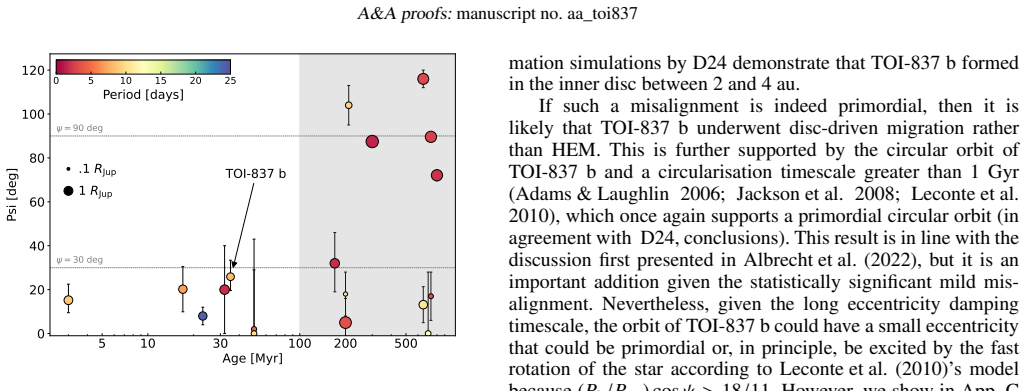
The central claim is that TOI-837 b possesses a mildly misaligned orbit with true obliquity ψ = 25.9^{+7.5}_{-6.3} deg. This is obtained from a sky-projected obliquity λ = 341.1^{+2.3}_{-2.5} deg measured via the Rossiter-McLaughlin effect, converted using the stellar rotation period of 3.00 ± 0.02 days. The authors state that this configuration, together with the primordial circular orbit and the bound companion, favors primordial obliquity excitation by secular torque on the protoplanetary disk followed by disk-driven migration.
What carries the argument
The Rossiter-McLaughlin effect observed with ESPRESSO, which records the anomalous radial-velocity signal during transit to extract the sky-projected spin-orbit angle λ before conversion to the true obliquity ψ.
If this is right
- Obliquity can be excited while the protoplanetary disk is still present.
- Disk-driven migration can move a planet inward while preserving a mild misalignment.
- High-eccentricity migration is disfavored for this system because the orbit remains circular at young age.
- Young planets in clusters with bound companions are promising targets for testing early obliquity excitation.
Where Pith is reading between the lines
- Comparable obliquity measurements on other planets in the same cluster could reveal whether mild misalignments are typical at 35 Myr.
- Modeling the gravitational influence of the bound companion on the disk could predict the expected range of initial tilts.
- If confirmed, the result implies that some observed misalignments in older systems trace back to disk-stage processes rather than later dynamical encounters.
Load-bearing premise
The conversion from measured sky-projected obliquity to true obliquity assumes the stellar inclination is correctly inferred from the rotation period without significant bias from the bound companion.
What would settle it
A revised stellar inclination measurement or independent determination of the three-dimensional spin-orbit angle that places ψ consistent with zero would falsify the reported mild misalignment.
Figures

read the original abstract
The measurement of the spin-orbit obliquity, that is, the angle between the orbital axis of a planet and the stellar spin axis, provides crucial insights into how planets form and migrate. Observations of young transiting planets, which have not yet experienced significant tidal alterations, offer a unique opportunity to study their original obliquity configuration. We observed the warm Saturn-sized TOI-837 b (member of the 35 Myr old open cluster IC 2602) in-transit using ESPRESSO at VLT, collecting high-precision radial velocities to measure the Rossiter-McLaughlin effect. We found a sky-projected obliquity of $\lambda = 341.1^{+2.3}_{-2.5}$ deg. Using our knowledge of the stellar rotation period ($3.00 \pm 0.02$ d), we estimated a true obliquity of $\psi = 25.9^{+7.5}_{-6.3}$ deg, which indicates prograde motion and suggests a mildly misaligned orbit. This places TOI-837 b as the first planet younger than 100 Myr with accessible $\psi$ incompatible with an aligned orbit. Together with the primordial circular orbit of TOI-837 b and the presence of a bound stellar companion, this mild misalignment favours the possibility of a primordial obliquity excitation (secular torque on the protoplanetary disc) followed by disc-driven migration, rather than high-eccentricity migration after formation.
Editorial analysis
A structured set of objections, weighed in public.
Referee Report
Summary. The paper reports ESPRESSO/VLT radial-velocity observations of the Rossiter-McLaughlin effect during transit of the 35-Myr-old Saturn-sized planet TOI-837 b, measuring a sky-projected obliquity λ = 341.1^{+2.3}_{-2.5} deg. Using the independently measured stellar rotation period P_rot = 3.00 ± 0.02 d, the authors derive a true obliquity ψ = 25.9^{+7.5}_{-6.3} deg and argue that this mild misalignment, together with the planet's circular orbit and bound stellar companion, favors primordial obliquity excitation via secular disc torques followed by disc-driven migration.
Significance. If the λ measurement and the subsequent conversion to ψ are robust, the result would constitute the first true-obliquity constraint for any planet younger than 100 Myr that is statistically inconsistent with alignment. This would provide direct empirical input on the initial conditions of planet-disc interactions and migration pathways at early times, complementing the existing sample of older systems.
major comments (2)
- [Abstract] Abstract: The claim that ψ is incompatible with an aligned orbit rests on the conversion λ → ψ via an estimated stellar inclination i_star derived from P_rot = 3.00 ± 0.02 d together with an unspecified v sin i. Because cos ψ = sin i_star cos λ (with i_orb ≈ 90°), any underestimate of the uncertainty in i_star or any bias toward lower i_star directly determines whether the lower bound on ψ reaches zero; the abstract provides neither the adopted i_star value nor the propagation of its uncertainty.
- [Abstract] Abstract: No information is supplied on the ESPRESSO data-reduction pipeline, the method used to extract the radial velocities, the functional form or priors adopted for the Rossiter-McLaughlin model fit, or any tests for systematics (including possible contamination or line-profile distortions from the bound stellar companion). These steps are load-bearing for the reported λ = 341.1^{+2.3}_{-2.5} deg and its uncertainty.
Simulated Author's Rebuttal
We thank the referee for their careful reading and constructive comments on our manuscript. We address each major comment below. Where the abstract can be made more self-contained we will revise; where the requested information is already present in the main text we explain its location.
read point-by-point responses
-
Referee: [Abstract] Abstract: The claim that ψ is incompatible with an aligned orbit rests on the conversion λ → ψ via an estimated stellar inclination i_star derived from P_rot = 3.00 ± 0.02 d together with an unspecified v sin i. Because cos ψ = sin i_star cos λ (with i_orb ≈ 90°), any underestimate of the uncertainty in i_star or any bias toward lower i_star directly determines whether the lower bound on ψ reaches zero; the abstract provides neither the adopted i_star value nor the propagation of its uncertainty.
Authors: The conversion from λ to ψ, including the derivation of i_star from P_rot together with the spectroscopically measured v sin i and the full propagation of uncertainties, is presented in detail in the main text (stellar parameters and obliquity sections). The reported uncertainty on ψ already folds in the contribution from i_star. We agree, however, that the abstract would be clearer if it stated the adopted i_star value. We will revise the abstract to include this information. revision: yes
-
Referee: [Abstract] Abstract: No information is supplied on the ESPRESSO data-reduction pipeline, the method used to extract the radial velocities, the functional form or priors adopted for the Rossiter-McLaughlin model fit, or any tests for systematics (including possible contamination or line-profile distortions from the bound stellar companion). These steps are load-bearing for the reported λ = 341.1^{+2.3}_{-2.5} deg and its uncertainty.
Authors: All of the requested information—ESPRESSO data-reduction pipeline, radial-velocity extraction method, the functional form and priors of the Rossiter-McLaughlin model, and the systematics tests (including checks for contamination and line-profile effects from the bound companion)—is supplied in the Observations, Data Analysis, and Results sections of the manuscript. We therefore do not believe additional material is required, though we remain willing to expand any specific subsection if the referee identifies a remaining gap. revision: no
Circularity Check
No significant circularity; derivation is observational measurement plus standard geometric conversion
full rationale
The paper reports a direct measurement of sky-projected obliquity λ via the Rossiter-McLaughlin effect on ESPRESSO radial velocities. It then applies the standard geometric conversion to true obliquity ψ using the independently measured stellar rotation period P_rot = 3.00 ± 0.02 d (quoted as external knowledge). No equation in the abstract or described chain reduces ψ to a fitted parameter by construction, renames a known result, or relies on a self-citation chain for a uniqueness theorem. The conversion depends on an assumed stellar inclination derived from P_rot and v sin i, but this is an external input rather than a tautological fit. The result is therefore self-contained against external benchmarks and receives the default non-circularity outcome.
Axiom & Free-Parameter Ledger
axioms (2)
- domain assumption The Rossiter-McLaughlin effect measured in high-resolution radial velocities during transit yields the sky-projected spin-orbit angle λ.
- domain assumption The stellar rotation period (3.00 ± 0.02 d) is known independently and can be combined with λ to obtain the true obliquity ψ.
Reference graph
Works this paper leans on
-
[1]
Decoupling of a giant planet from its disk in an inclined binary system. , keywords =. doi:10.1051/0004-6361/201526162 , archivePrefix =. 1508.06198 , primaryClass =
-
[2]
, year = 2012, month = nov, volume =
A primordial origin for misalignments between stellar spin axes and planetary orbits. , year = 2012, month = nov, volume =. doi:10.1038/nature11560 , adsurl =
-
[3]
Tidal dissipation in planet-hosting stars: damping of spin-orbit misalignment and survival of hot Jupiters. , keywords =. doi:10.1111/j.1365-2966.2012.20893.x , archivePrefix =. 1109.4703 , primaryClass =
-
[4]
Prospecting transit duration variations in extrasolar planetary systems. , keywords =. doi:10.1051/0004-6361/201117207 , archivePrefix =. 1109.0936 , primaryClass =
-
[5]
Updating the theoretical tidal evolution constants: Apsidal motion and the moment of inertia. , keywords =. doi:10.1051/0004-6361/201936007 , archivePrefix =. 1907.11538 , primaryClass =
-
[6]
Obliquity-driven sculpting of exoplanetary systems. Nature Astronomy , keywords =. doi:10.1038/s41550-019-0701-7 , archivePrefix =. 1903.01386 , primaryClass =
-
[7]
Calculating the Tidal, Spin, and Dynamical Evolution of Extrasolar Planetary Systems. , keywords =. doi:10.1086/340752 , adsurl =
-
[8]
Long-term tidal evolution of short-period planets with companions. , keywords =. doi:10.1111/j.1365-2966.2007.12500.x , archivePrefix =. 0706.0224 , primaryClass =
-
[9]
Validation of TESS exoplanet candidates orbiting solar analogues in the all-sky PLATO input catalogue. , keywords =. doi:10.1093/mnras/stac2451 , archivePrefix =. 2208.12276 , primaryClass =
-
[10]
, year = 1995, month = nov, volume =
A Jupiter-mass companion to a solar-type star. , year = 1995, month = nov, volume =. doi:10.1038/378355a0 , adsurl =
doi:10.1038/378355a0 1995
-
[11]
Journal of Astronomical Telescopes, Instruments, and Systems , year = 2015, month = jan, volume =
Transiting Exoplanet Survey Satellite (TESS). Journal of Astronomical Telescopes, Instruments, and Systems , year = 2015, month = jan, volume =. doi:10.1117/1.JATIS.1.1.014003 , adsurl =
-
[12]
Software and Cyberinfrastructure for Astronomy IV , year = 2016, editor =
The TESS science processing operations center. Software and Cyberinfrastructure for Astronomy IV , year = 2016, editor =. doi:10.1117/12.2233418 , adsurl =
-
[13]
The TESS Objects of Interest Catalog from the TESS Prime Mission. , keywords =. doi:10.3847/1538-4365/abefe1 , archivePrefix =. 2103.12538 , primaryClass =
-
[14]
Photometry of 10 Million Stars from the First Two Years of TESS Full Frame Images: Part I. , keywords =. doi:10.3847/2515-5172/abca2e , archivePrefix =. 2011.06459 , primaryClass =
-
[15]
Journal of Geophysical Research (Planets) , keywords =
Hot Jupiters: Origins, Structure, Atmospheres. Journal of Geophysical Research (Planets) , keywords =. doi:10.1029/2020JE006629 , archivePrefix =. 2102.05064 , primaryClass =
-
[16]
Giant Planets at Small Orbital Distances. , keywords =. doi:10.1086/309935 , archivePrefix =. astro-ph/9511109 , primaryClass =
-
[17]
Bayesian Analysis of Hot-Jupiter Radius Anomalies: Evidence for Ohmic Dissipation?. , keywords =. doi:10.3847/1538-3881/aaba13 , archivePrefix =. 1709.04539 , primaryClass =
-
[18]
The Mass-Metallicity Relation for Giant Planets. , keywords =. doi:10.3847/0004-637X/831/1/64 , archivePrefix =. 1511.07854 , primaryClass =
-
[19]
Planetary Radii across Five Orders of Magnitude in Mass and Stellar Insolation: Application to Transits. , keywords =. doi:10.1086/512120 , archivePrefix =. astro-ph/0612671 , primaryClass =
-
[20]
Grain opacity and the bulk composition of extrasolar planets. I. Results from scaling the ISM opacity. , keywords =. doi:10.1051/0004-6361/201321479 , archivePrefix =. 1403.5272 , primaryClass =
-
[21]
Frontiers in Astronomy and Space Sciences , keywords =
Warm giant exoplanet characterisation: current state, challenges and outlook. Frontiers in Astronomy and Space Sciences , keywords =. doi:10.3389/fspas.2023.1179000 , archivePrefix =. 2304.12782 , primaryClass =
-
[22]
Analysis of the planetary mass uncertainties on the accuracy of atmospherical retrieval. , keywords =. doi:10.1051/0004-6361/202244881 , archivePrefix =. 2211.02897 , primaryClass =
-
[23]
Quick-look Pipeline Lightcurves for 9.1 Million Stars Observed over the First Year of the TESS Extended Mission. , keywords =. doi:10.3847/2515-5172/ac2ef0 , archivePrefix =. 2110.05542 , primaryClass =
-
[24]
TESS Science Processing Operations Center FFI Target List Products. , keywords =. doi:10.3847/2515-5172/abc9b3 , archivePrefix =. 2011.05495 , primaryClass =
-
[25]
Kepler Presearch Data Conditioning II - A Bayesian Approach to Systematic Error Correction. , keywords =. doi:10.1086/667697 , archivePrefix =. 1203.1383 , primaryClass =
-
[26]
Kepler Presearch Data Conditioning I Architecture and Algorithms for Error Correction in Kepler Light Curves. , keywords =. doi:10.1086/667698 , archivePrefix =. 1203.1382 , primaryClass =
-
[27]
, year = 2014, month = jan, volume =
Multiscale Systematic Error Correction via Wavelet-Based Bandsplitting in Kepler Data. , year = 2014, month = jan, volume =. doi:10.1086/674989 , adsurl =
doi:10.1086/674989 2014
-
[28]
Kepler Data Validation I Architecture, Diagnostic Tests, and Data Products for Vetting Transiting Planet Candidates. , keywords =. doi:10.1088/1538-3873/aab694 , archivePrefix =. 1803.04526 , primaryClass =
-
[29]
American Astronomical Society Meeting Abstracts \#233 , year = 2019, series =
TESS Follow-up Observing Program Working Group (TFOP WG) Sub Group 1 (SG1): Ground-based Time-series Photometry. American Astronomical Society Meeting Abstracts \#233 , year = 2019, series =
2019
-
[30]
Tapir: A web interface for transit/eclipse observability
-
[31]
Summary of the content and survey properties
Gaia Data Release 3. Summary of the content and survey properties. , keywords =. doi:10.1051/0004-6361/202243940 , archivePrefix =. 2208.00211 , primaryClass =
-
[32]
Las Cumbres Observatory Global Telescope Network. , keywords =. doi:10.1086/673168 , archivePrefix =. 1305.2437 , primaryClass =
-
[33]
Software and Cyberinfrastructure for Astronomy V , year = 2018, editor =
Real-time processing of the imaging data from the network of Las Cumbres Observatory Telescopes using BANZAI. Software and Cyberinfrastructure for Astronomy V , year = 2018, editor =. doi:10.1117/12.2314340 , archivePrefix =. 1811.04163 , primaryClass =
-
[34]
European Physical Journal Web of Conferences , year = 2011, series =
TRAPPIST: a robotic telescope dedicated to the study of planetary systems. European Physical Journal Web of Conferences , year = 2011, series =. doi:10.1051/epjconf/20101106002 , archivePrefix =. 1101.5807 , primaryClass =
-
[35]
The Messenger , year = 2011, month = sep, volume =
TRAPPIST: TRAnsiting Planets and PlanetesImals Small Telescope. The Messenger , year = 2011, month = sep, volume =
2011
-
[36]
Revista Mexicana de Astronomia y Astrofisica Conference Series , year = 2021, series =
Observatorio El Sauce: Hosting Robotic Science in Chile. Revista Mexicana de Astronomia y Astrofisica Conference Series , year = 2021, series =. doi:10.22201/ia.14052059p.2021.53.12 , adsurl =
-
[37]
The Messenger , year = 2003, month = dec, volume =
Setting New Standards with HARPS. The Messenger , year = 2003, month = dec, volume =
2003
-
[38]
Chasing exoplanets with the La Silla 3.6-m telescope
HARPS: ESO's coming planet searcher. Chasing exoplanets with the La Silla 3.6-m telescope. The Messenger , keywords =
-
[39]
The Journal of Open Source Software , keywords =
ACTIN: A tool to calculate stellar activity indices. The Journal of Open Source Software , keywords =. doi:10.21105/joss.00667 , archivePrefix =. 1811.11172 , primaryClass =
-
[40]
Stellar chromospheric activity of 1674 FGK stars from the AMBRE-HARPS sample. I. A catalogue of homogeneous chromospheric activity. , keywords =. doi:10.1051/0004-6361/202039765 , archivePrefix =. 2012.10199 , primaryClass =
-
[41]
Three years of Sun-as-a-star radial-velocity observations on the approach to solar minimum. , keywords =. doi:10.1093/mnras/stz1215 , archivePrefix =. 1904.12186 , primaryClass =
-
[42]
Intrinsic Colors, Temperatures, and Bolometric Corrections of Pre-main-sequence Stars. , keywords =. doi:10.1088/0067-0049/208/1/9 , archivePrefix =. 1307.2657 , primaryClass =
-
[43]
On the Occurrence Rate of Hot Jupiters in Different Stellar Environments. , keywords =. doi:10.1088/0004-637X/799/2/229 , archivePrefix =. 1412.1731 , primaryClass =
-
[44]
A Framework for Prioritizing the TESS Planetary Candidates Most Amenable to Atmospheric Characterization. , keywords =. doi:10.1088/1538-3873/aadf6f , archivePrefix =. 1805.03671 , primaryClass =
-
[45]
An Efficient Automated Validation Procedure for Exoplanet Transit Candidates. , keywords =. doi:10.1088/0004-637X/761/1/6 , archivePrefix =. 1206.1568 , primaryClass =
-
[46]
A search for transiting planets around FGKM dwarfs and subgiants in the TESS full frame images of the Southern ecliptic hemisphere. , keywords =. doi:10.1093/mnras/staa2438 , archivePrefix =. 2008.09832 , primaryClass =
-
[47]
Search for exoplanets in open clusters of the Southern ecliptic hemisphere and their frequency
A PSF-based Approach to TESS High quality data Of Stellar clusters (PATHOS) - II. Search for exoplanets in open clusters of the Southern ecliptic hemisphere and their frequency. , keywords =. doi:10.1093/mnras/staa1465 , archivePrefix =. 2005.12281 , primaryClass =
-
[48]
The GAPS Programme at TNG. XXXV. Fundamental properties of transiting exoplanet host stars. , keywords =. doi:10.1051/0004-6361/202243467 , archivePrefix =. 2205.15796 , primaryClass =
-
[49]
The GAPS programme with HARPS-N at TNG. X. Differential abundances in the XO-2 planet-hosting binary. , keywords =. doi:10.1051/0004-6361/201526375 , archivePrefix =. 1506.01614 , primaryClass =
-
[50]
, year = 1973, month = sep, volume =
The nitrogen abundance of the very metal-poor star HD 122563. , year = 1973, month = sep, volume =. doi:10.1086/152374 , adsurl =
doi:10.1086/152374 1973
-
[51]
Modelling of Stellar Atmospheres , year = 2003, editor =
New Grids of ATLAS9 Model Atmospheres. Modelling of Stellar Atmospheres , year = 2003, editor =. doi:10.48550/arXiv.astro-ph/0405087 , archivePrefix =. astro-ph/0405087 , primaryClass =
-
[52]
The GAPS Programme at TNG. XXV. Stellar atmospheric parameters and chemical composition through GIARPS optical and near-infrared spectra. , keywords =. doi:10.1051/0004-6361/202038511 , archivePrefix =. 2007.00475 , primaryClass =
-
[53]
Departures from LTE for neutral Li in late-type stars. , keywords =. doi:10.1051/0004-6361/200912221 , archivePrefix =. 0906.0899 , primaryClass =
-
[54]
, keywords =
The Tycho-2 catalogue of the 2.5 million brightest stars. , keywords =
-
[55]
The GAPS programme with HARPS-N at TNG. XI. Pr 0211 in M 44: the first multi-planet system in an open cluster. , keywords =. doi:10.1051/0004-6361/201527933 , archivePrefix =. 1602.00009 , primaryClass =
-
[56]
An Ultra-short Period Rocky Super-Earth with a Secondary Eclipse and a Neptune-like Companion around K2-141. , keywords =. doi:10.3847/1538-3881/aaa5b5 , archivePrefix =. 1801.03502 , primaryClass =
-
[57]
batman: BAsic Transit Model cAlculatioN in Python. , keywords =. doi:10.1086/683602 , archivePrefix =. 1507.08285 , primaryClass =
-
[58]
Efficient, uninformative sampling of limb darkening coefficients for two-parameter laws. , keywords =. doi:10.1093/mnras/stt1435 , archivePrefix =. 1308.0009 , primaryClass =
-
[59]
EXOFAST: A Fast Exoplanetary Fitting Suite in IDL. , keywords =. doi:10.1086/669497 , archivePrefix =. 1206.5798 , primaryClass =
-
[60]
A new extensive library of PHOENIX stellar atmospheres and synthetic spectra. , keywords =. doi:10.1051/0004-6361/201219058 , archivePrefix =. 1303.5632 , primaryClass =
-
[61]
LDTK: Limb Darkening Toolkit. , keywords =. doi:10.1093/mnras/stv1857 , archivePrefix =. 1508.02634 , primaryClass =
-
[62]
Journal of Global Optimization , keywords =
Differential Evolution - A Simple and Efficient Heuristic for global Optimization over Continuous Spaces. Journal of Global Optimization , keywords =. doi:10.1023/A:1008202821328 , adsurl =
-
[63]
Communications in Applied Mathematics and Computational Science , keywords =
Ensemble samplers with affine invariance. Communications in Applied Mathematics and Computational Science , keywords =. doi:10.2140/camcos.2010.5.65 , adsurl =
-
[64]
emcee: The MCMC Hammer. , keywords =. doi:10.1086/670067 , archivePrefix =. 1202.3665 , primaryClass =
-
[65]
Statistical Science , year = 1992, month = jan, volume =
Inference from Iterative Simulation Using Multiple Sequences. Statistical Science , year = 1992, month = jan, volume =. doi:10.1214/ss/1177011136 , adsurl =
-
[66]
On detecting terrestrial planets with timing of giant planet transits. , keywords =. doi:10.1111/j.1365-2966.2005.08922.x , adsurl =
-
[67]
The Use of Transit Timing to Detect Terrestrial-Mass Extrasolar Planets. Science , keywords =. doi:10.1126/science.1107822 , archivePrefix =. astro-ph/0412028 , primaryClass =
-
[68]
Revisiting Kepler-11 and Kepler-9
TRADES: A new software to derive orbital parameters from observed transit times and radial velocities. Revisiting Kepler-11 and Kepler-9. , keywords =. doi:10.1051/0004-6361/201424080 , archivePrefix =. 1408.2844 , primaryClass =
-
[69]
HARPS-N radial velocities confirm the low densities of the Kepler-9 planets. , keywords =. doi:10.1093/mnras/stz181 , archivePrefix =. 1901.05471 , primaryClass =
-
[70]
Exploiting timing capabilities of the CHEOPS mission with warm-Jupiter planets. , keywords =. doi:10.1093/mnras/stab1782 , archivePrefix =. 2106.11331 , primaryClass =
-
[71]
A Recommendation to Retire VESPA for Exoplanet Validation. , keywords =. doi:10.3847/2515-5172/acd9a6 , adsurl =
-
[72]
Modeling Kepler Transit Light Curves as False Positives: Rejection of Blend Scenarios for Kepler-9, and Validation of Kepler-9 d, A Super-earth-size Planet in a Multiple System. , keywords =. doi:10.1088/0004-637X/727/1/24 , archivePrefix =. 1008.4393 , primaryClass =
-
[73]
General framework, models, and performance
PASTIS: Bayesian extrasolar planet validation - I. General framework, models, and performance. , keywords =. doi:10.1093/mnras/stu601 , archivePrefix =. 1403.6725 , primaryClass =
-
[74]
A new formalism for the floating-mean and Keplerian periodograms
The generalised Lomb-Scargle periodogram. A new formalism for the floating-mean and Keplerian periodograms. , keywords =. doi:10.1051/0004-6361:200811296 , archivePrefix =. 0901.2573 , primaryClass =
-
[75]
Annals of Statistics , year = 1978, month = jul, volume =
Estimating the Dimension of a Model. Annals of Statistics , year = 1978, month = jul, volume =
1978
-
[76]
Kass and Adrian E
Robert E. Kass and Adrian E. Raftery , title =. Journal of the American Statistical Association , volume =. 1995 , publisher =
1995
-
[77]
, year = 2008, month = feb, volume =
First Speckle Interferometry at SOAR Telescope with Electron-Multiplication CCD. , year = 2008, month = feb, volume =. doi:10.1086/528809 , adsurl =
doi:10.1086/528809 2008
-
[78]
Ten Years of Speckle Interferometry at SOAR. , keywords =. doi:10.1088/1538-3873/aaa7d9 , archivePrefix =. 1801.04772 , primaryClass =
-
[79]
SOAR TESS Survey. I. Sculpting of TESS Planetary Systems by Stellar Companions. , keywords =. doi:10.3847/1538-3881/ab55e9 , archivePrefix =. 1908.10871 , primaryClass =
-
[80]
SOAR TESS Survey. II. The Impact of Stellar Companions on Planetary Populations. , keywords =. doi:10.3847/1538-3881/ac17f6 , archivePrefix =. 2103.12076 , primaryClass =
discussion (0)
Sign in with ORCID, Apple, or X to comment. Anyone can read and Pith papers without signing in.