A semi-definite programming formulation of the device-dependent guessing probability
Pith reviewed 2026-06-27 09:33 UTC · model grok-4.3
The pith
A semidefinite programming formulation computes the maximum probability an adversary can guess outcomes in characterized prepare-and-measure quantum setups.
A machine-rendered reading of the paper's core claim, the machinery that carries it, and where it could break.
Core claim
The paper establishes a semidefinite programming formulation that exactly determines the maximum probability with which an adversary can guess the outcomes of characterized prepare-and-measure setups. This formulation is used to benchmark and compute certifiable randomness in various scenarios. The work also shows that entanglement between the state preparation device and the measurement strictly increases the adversary's predictive power in the elementary setup of a binary measurement acting on a qubit state.
What carries the argument
The semidefinite programming formulation of the device-dependent guessing probability, which captures the maximum predictive power of an adversary in prepare-and-measure scenarios.
If this is right
- Exact certifiable randomness amounts can now be computed for specific characterized setups where only upper bounds were available previously.
- The semidefinite program provides a general method to estimate intrinsic randomness in the simplest prepare-and-measure processes.
- Entanglement between the preparing device and the measurement strictly increases the adversary's guessing probability even for binary measurements on qubit states.
Where Pith is reading between the lines
- The formulation could be used to optimize the choice of states and measurements in quantum random number generators to maximize certifiable randomness.
- Protocols in quantum cryptography might incorporate this SDP to quantify security against guessing attacks under partial device characterization.
- The method opens a route to study how relaxing full characterization affects the computed guessing probability in intermediate device-dependent scenarios.
Load-bearing premise
The prepare-and-measure setups are fully characterized, allowing the guessing probability to be exactly captured by a semidefinite program without additional unmodeled degrees of freedom or device imperfections beyond the stated characterization.
What would settle it
A direct calculation or numerical simulation of the maximum guessing probability in a specific fully characterized prepare-and-measure setup that yields a value different from the output of the semidefinite program would falsify the formulation.
Figures
read the original abstract
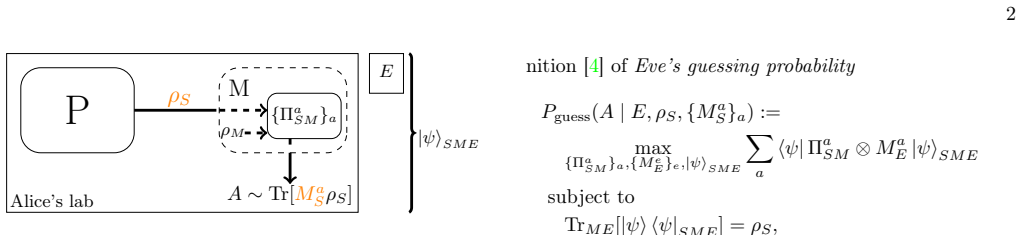
In quantum mechanics, a measurement applied to a state in general produces some amount of intrinsic randomness. This is not only a fundamental feature of the theory, but is also at the basis of any quantum process to generate random numbers. The simplest of such processes consists of a single, fully charaterized, measurement acting on a single, fully characterized, state. Unfortunately, no general method to estimate the intrinsic randomness produced in such setups is known. In this work, we address this issue by presenting a semidefinite programming formulation of the maximum probability with which an adversary, Eve, can guess the outcomes of characterized but untrusted prepare-and-measure setups. We then present several applications of this construction. First, we apply our method to a variety of specific setups, allowing us both to benchmark the approach and, more importantly, to determine the exact amount of certifiable randomness in scenarios where only upper bounds were previously available. Then, we show that the presence of entanglement between the device preparing the state and the measurement strictly increases Eve's predictive power, already in the most elementary setup of a binary measurement acting on a qubit state.
Editorial analysis
A structured set of objections, weighed in public.
Referee Report
Summary. The manuscript presents a semidefinite programming (SDP) formulation for the maximum probability with which an adversary (Eve) can guess the outcomes of fully characterized but untrusted prepare-and-measure quantum setups. It applies the formulation to specific setups to obtain exact certifiable randomness values (where only bounds were previously known) and shows that entanglement between the preparation device and the measurement device strictly increases Eve's guessing power already for a binary measurement on a qubit state.
Significance. If the SDP is shown to be exact under the stated device characterization, the work supplies a general computational method to quantify intrinsic randomness in the simplest quantum setups, directly relevant to device-dependent quantum random number generation. The entanglement result, if rigorously established, would have concrete implications for security analyses in such protocols.
major comments (2)
- [SDP formulation] SDP formulation (main text, around the definition of the program): the construction must explicitly enforce that the optimization is performed only over extensions consistent with the fixed characterization of the state ρ and POVM {M_i} acting precisely on the qubit Hilbert space. Introducing an auxiliary system for entanglement generally produces a different effective POVM on the qubit unless the auxiliary is in a product state; without a proof that the SDP constraints prevent this, the exactness claim and the reported numerical values for specific setups are at risk.
- [Binary qubit case] Binary qubit case (application section demonstrating strict increase): the claim that entanglement strictly increases Eve's predictive power is load-bearing for the paper's second main result. It depends on the SDP correctly capturing only strategies allowed by the fixed characterization; if the program inadvertently optimizes over altered effective POVMs, the strict increase may not hold and requires re-derivation or additional constraints.
minor comments (1)
- [Abstract] Abstract: 'charaterized' is a typo and should read 'characterized'.
Simulated Author's Rebuttal
We thank the referee for the detailed and insightful report. The two major comments both center on whether the SDP formulation rigorously enforces consistency with the fixed device characterization (state ρ and POVM {M_i} on the qubit space) when auxiliary systems are introduced. We address each point below and indicate the revisions we will make.
read point-by-point responses
-
Referee: [SDP formulation] SDP formulation (main text, around the definition of the program): the construction must explicitly enforce that the optimization is performed only over extensions consistent with the fixed characterization of the state ρ and POVM {M_i} acting precisely on the qubit Hilbert space. Introducing an auxiliary system for entanglement generally produces a different effective POVM on the qubit unless the auxiliary is in a product state; without a proof that the SDP constraints prevent this, the exactness claim and the reported numerical values for specific setups are at risk.
Authors: We agree that an explicit argument is required to confirm that the SDP only optimizes over extensions that preserve the given marginal state ρ and the given POVM {M_i} on the qubit space. In the current formulation the state variable is constrained by a partial-trace condition that recovers exactly ρ, while the objective uses the fixed operators M_i without extension; this structure is intended to keep the effective POVM unchanged. Nevertheless, the manuscript does not contain a self-contained proof that no effective alteration can occur. We will therefore add a short paragraph (or appendix remark) immediately after the SDP definition that derives the preservation of the marginal POVM from the constraints. With this addition the exactness claim and the numerical values will rest on firmer ground. revision: yes
-
Referee: [Binary qubit case] Binary qubit case (application section demonstrating strict increase): the claim that entanglement strictly increases Eve's predictive power is load-bearing for the paper's second main result. It depends on the SDP correctly capturing only strategies allowed by the fixed characterization; if the program inadvertently optimizes over altered effective POVMs, the strict increase may not hold and requires re-derivation or additional constraints.
Authors: The referee is correct that the strict-increase result inherits the same foundational requirement as the SDP itself. Once the clarification paragraph mentioned above is inserted, the binary-qubit calculation can be re-checked under the strengthened constraints; we expect the numerical gap to remain, but we will explicitly verify and report the updated values (or prove analytically that the gap persists) in the revised manuscript. If the gap narrows, we will state the corrected bound. revision: partial
Circularity Check
No significant circularity; SDP formulation is self-contained
full rationale
The paper introduces an SDP to compute the device-dependent guessing probability for fully characterized prepare-and-measure setups. No load-bearing step reduces by construction to fitted inputs, self-definitions, or self-citation chains. The formulation is presented as a direct optimization over extensions consistent with the given states and POVMs; the claim that entanglement strictly increases Eve's power is obtained by applying this SDP to the binary qubit case rather than being presupposed. The derivation chain is therefore independent of the target result and does not match any of the enumerated circularity patterns.
Axiom & Free-Parameter Ledger
axioms (1)
- domain assumption Fully characterized prepare-and-measure setups can be modeled via semidefinite programs to compute exact adversary guessing probability.
Reference graph
Works this paper leans on
-
[1]
The relation between the noise parametersδandεis chosen so that the resulting mea- surement statistics are identical in the two scenarios
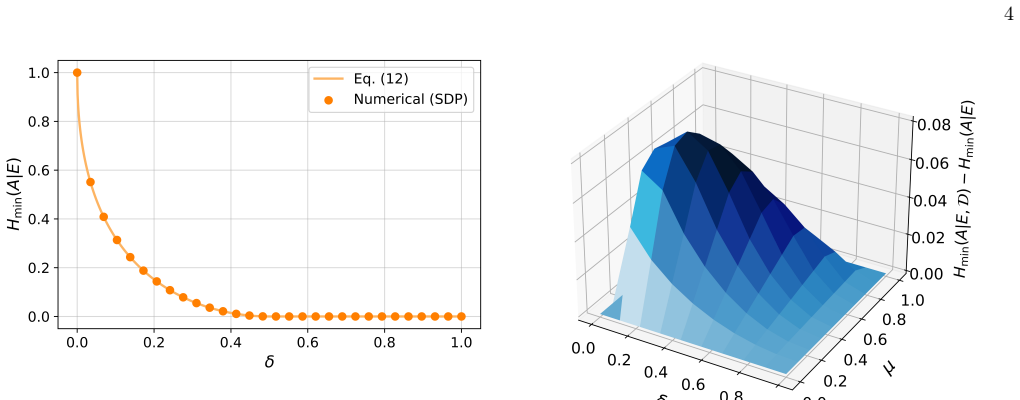
The authors provethefollowinganalyticallowerboundtotheguessing probability Pguess(A|E, ρ S,{M a S }a)≥ 1 2 1 + 2 p δ(1−δ) ,(12) withε= 1− √ 1−δ. The relation between the noise parametersδandεis chosen so that the resulting mea- surement statistics are identical in the two scenarios. In Fig. 2, we plot the value of the conditional min- entropy in Eq. (2) p...
-
[2]
The results from [4, Thms
in assuming that: 1) systemsSandMare in a prod- uct stateρ S ⊗σ M; and 2) Eve holds systemsEandF purifying, respectively,SandM, but she cannot measure them jointly. The results from [4, Thms. 3 and 4] show that in a setting where 1) holds, assuming 2) incurs in a restriction to Eve’s power. Naturally, this leaves open the question of whether 1) alone has ...
-
[3]
Herrero-Collantes and J
M. Herrero-Collantes and J. C. Garcia-Escartin, Quan- tum random number generators, Reviews of Modern Physics89, 015004 (2017)
2017
-
[4]
M. N. Bera, A. Acín, M. Kuś, M. W. Mitchell, and M. Lewenstein, Randomness in quantum mechanics: phi- losophy, physics and technology, Reports on progress in physics80, 124001 (2017)
2017
-
[5]
Mannalatha, S
V. Mannalatha, S. Mishra, and A. Pathak, A compre- hensive review of quantum random number generators: concepts, classification and the origin of randomness: A. pathak et al., Quantum Information Processing22, 439 (2023)
2023
-
[6]
Senno, T
G. Senno, T. Strohm, and A. Acín, Quantifying the in- trinsic randomness of quantum measurements, Physical Review Letters131, 130202 (2023)
2023
-
[7]
Navascués, S
M. Navascués, S. Pironio, and A. Acín, Bounding the set of quantum correlations, Physical Review Letters98, 010401 (2007)
2007
-
[8]
F. Curran, M. Moradi, G. Senno, M. Stobinska, and A. Acín, Maximal intrinsic randomness of noisy quan- tum measurements, arXiv preprint arXiv:2506.22294 https://doi.org/10.48550/arXiv.2506.22294 (2025)
-
[9]
Berta and F
M. Berta and F. Brandao, Robust randomness genera- tiononquantumcomputers,AvailableonAmazonBraket (2021)
2021
-
[10]
Avesani, H
M. Avesani, H. Tebyanian, P. Villoresi, and G. Vallone, Unbounded randomness from uncharacterized sources, Communications Physics5, 273 (2022)
2022
-
[11]
R. D’Avino, G. Senno, M. Alimuddin, and A. Acín, Entanglement in the energy-constrained prepare-and-measure scenario: applications to randomness certification and channel dis- crimination, arXiv preprint arXiv:2510.27559 https://doi.org/10.48550/arXiv.2510.27559 (2025)
-
[12]
C. R. I. Carceller and A. Tavakoli, The role of entangle- ment in energy-restricted communication and random- ness generation, Quantum Science and Technology11, 025020 (2026)
2026
-
[13]
True randomness from realistic quantum devices
D. Frauchiger, R. Renner, and M. Troyer, True randomness from realistic quantum devices, arXiv preprint arXiv:1311.4547 https://doi.org/10.48550/arXiv.1311.4547 (2013)
work page internal anchor Pith review Pith/arXiv arXiv doi:10.48550/arxiv.1311.4547 2013
-
[14]
Konig, R
R. Konig, R. Renner, and C. Schaffner, The operational meaning of min-and max-entropy, IEEE Transactions on Information theory55, 4337 (2009)
2009
-
[15]
Navascués, G
M. Navascués, G. de la Torre, and T. Vértesi, Characteri- zation of quantum correlations with local dimension con- straintsanditsdevice-independentapplications,Physical Review X4, 011011 (2014)
2014
-
[16]
We abuse notation by usingsandtto denote both the operators inOand the labels indexing the corresponding basis vectors|s⟩,|t⟩of the auxiliary Hilbert space
-
[17]
kX e=1 ˜σe SM # =ρ S, TrM
H. Dai, B. Chen, X. Zhang, and X. Ma, Intrinsic ran- domness under general quantum measurements, Physical Review Research5, 033081 (2023). 7 Appendix A. Moment matrix formulation We now consider the optimisation problem in Eq. (4), which we rewrite here for convenience P Q guess = max {Πa SM }a,{˜σe SM }e, kX a=1 Tr[Πa SM ˜σa SM ],(A1) subject to TrM " kX...
2023
-
[18]
The operators ˜Πa SM := dX i,j=1 |i⟩ ⟨j| ⊗ ˜K i,j|a M (e),∀a∈ {1, ..., k}(C29) define a complete projective measurement. We next integrate all the operators above in an extended Hilbert space˜H= ˆH ⊗C k, through the relation ˜t:= kX e=1 ˆt(e)⊗ |e⟩⟨e|.(C30) Similarly, we define the states ˜σe SM := ˆσe SM ′ ⊗ |e⟩⟨e|.(C31) It can then be verified that the o...
-
[19]
The completeness constraintP a ⟨m|⟨1|Γ e |n⟩|K i,j|a M ⟩=δ ij ⟨m|⟨1|Γ e |n⟩|1⟩translates to (C1)
-
[20]
The projectivity constraintP l ⟨m| ⟨(Kl,i|a M )†|Γ e |n⟩|K l,j|b M ⟩=δ ab ⟨m|⟨1|Γ e |n⟩|K i,j|a M ⟩translates to (C2). 13
-
[21]
The constraintΓe ⪰0ensures the matrices are positive semidefinite. Since all conditions of Proposition 4 are met, there exists a Hilbert space ˜H, subnormalized states{˜σe SM }e, and operators{ ˜K i,j|a M }a forming a valid projective measurement˜Πa SM =Pd i,j=1 |i⟩ ⟨j| ⊗ ˜K i,j|a M such that Tr (|j⟩ ⟨i| ⊗ ˜t˜s†)˜σe SM =c ij e (ts†).(C35) fors, t∈ O. It d...
discussion (0)
Sign in with ORCID, Apple, or X to comment. Anyone can read and Pith papers without signing in.