Saturation of Nuclear Binding from Lattice Hamiltonians
Pith reviewed 2026-06-27 08:09 UTC · model grok-4.3
The pith
Hartree-Fock upper bounds on lattice Hamiltonians show two-nucleon potentials alone fail to produce accurate nuclear binding.
A machine-rendered reading of the paper's core claim, the machinery that carries it, and where it could break.
Core claim
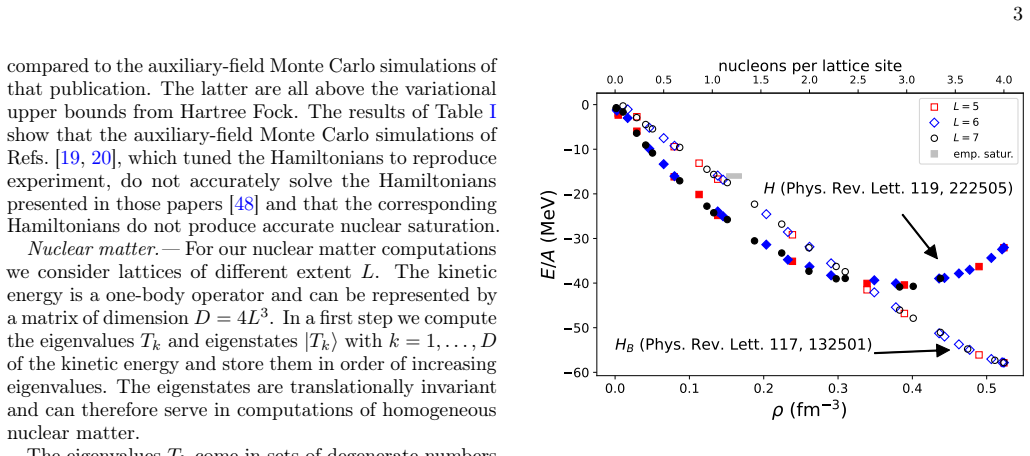
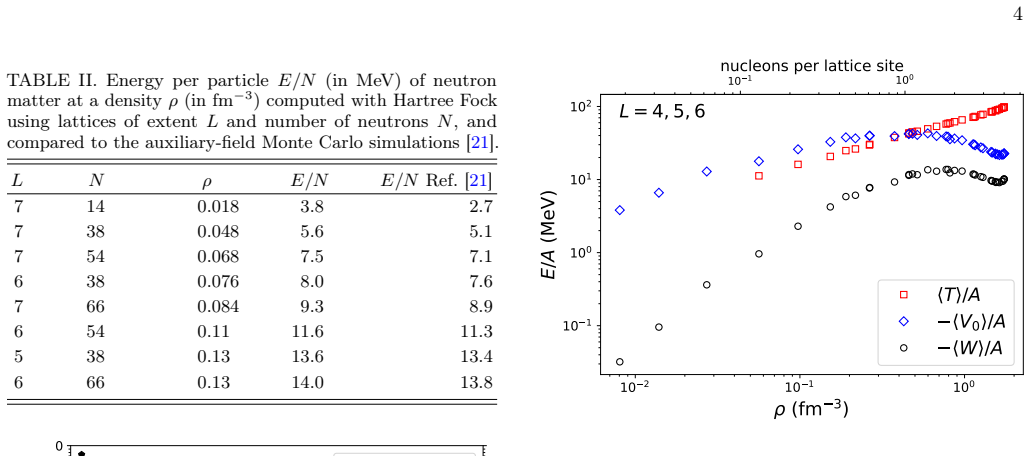
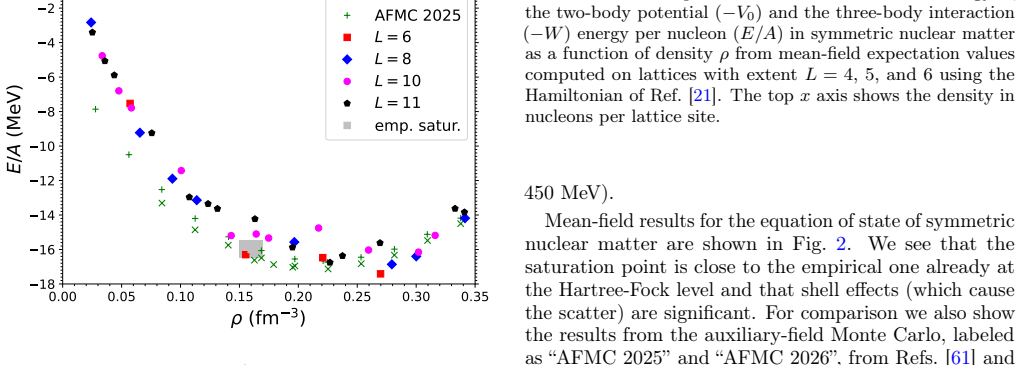
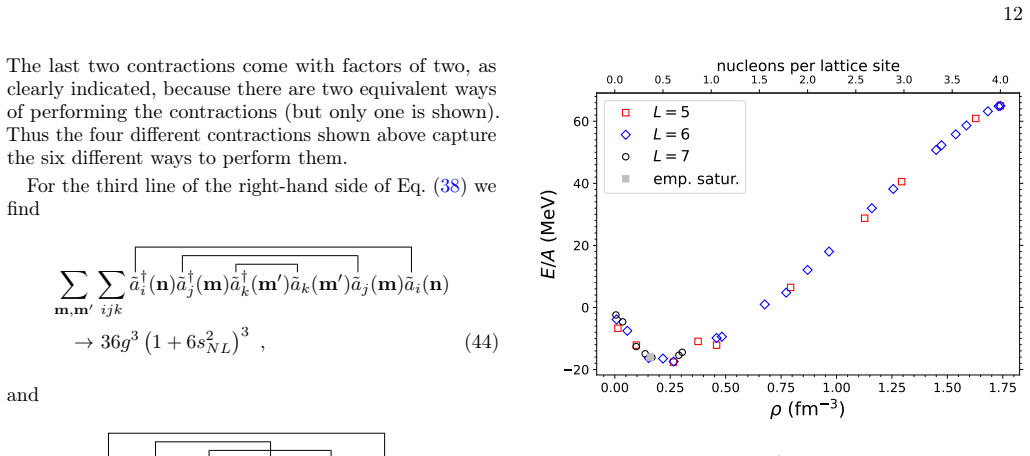
Variational Hartree-Fock upper bounds for the ground-state energies of light nuclei and nuclear matter computed with established lattice Hamiltonians demonstrate that two-nucleon potentials alone do not yield accurate binding, unlike auxiliary-field Monte Carlo simulations of the same Hamiltonians. For Hamiltonians that also include three-nucleon potentials the constant binding energy per nucleon arises from dense packing on the lattice.
What carries the argument
Hartree-Fock variational calculations performed on discrete spatial lattice Hamiltonians for light nuclei and infinite matter.
If this is right
- Two-nucleon potentials on lattices do not produce accurate binding energies for nuclei beyond the lightest ones when evaluated variationally.
- Three-nucleon potentials together with lattice Hamiltonians produce saturation through the effect of dense packing rather than through repulsive components.
- The observed discrepancy between Hartree-Fock upper bounds and auxiliary-field Monte Carlo results points to differences in how each method samples the same Hamiltonian.
- Saturation of binding energy per nucleon in these lattice models is controlled by the discrete spacing and packing density rather than by the form of the potentials.
Where Pith is reading between the lines
- If auxiliary-field Monte Carlo results remain valid, they must be capturing correlations that lie beyond the mean-field level captured by Hartree-Fock.
- Repeating the comparison at different lattice spacings could test whether the packing effect scales in a manner consistent with continuum limits.
- The findings suggest that any lattice formulation of nuclear forces must separate packing artifacts from genuine interaction-driven saturation.
Load-bearing premise
The lattice Hamiltonians and interaction parameters in these Hartree-Fock calculations are identical to those used in the auxiliary-field Monte Carlo simulations being compared.
What would settle it
A side-by-side computation of ground-state energies for one specific two-nucleon lattice Hamiltonian using both Hartree-Fock and auxiliary-field Monte Carlo with exactly the same parameters, lattice spacing and interaction strengths.
Figures
read the original abstract
There is a conundrum regarding the binding of $\alpha$ particles in nuclei. On one hand, auxiliary-field Monte Carlo simulations of Hamiltonians on discrete spatial lattices proposed that attractive two-nucleon potentials, alone or together with attractive three-nucleon potentials, yield accurate nuclear binding. On the other hand, such Hamiltonians typically overbind all but the lightest nuclei in continuum-space approaches. We address this puzzle by performing Hartree-Fock computations of the light nuclei $^4$He, $^8$Be, $^{12}$C, and $^{16}$O, and of nuclear and neutron matter using established lattice Hamiltonians. These variational upper bounds for the ground-state energies show that the Hamiltonians with only two-nucleon potentials do not yield accurate binding, in contrast to the results from auxiliary-field Monte Carlo simulations. The case is different for Hamiltonians with three-nucleon potentials although it is the dense packing on the lattice -- and not repulsive potentials -- that yield a constant binding energy per nucleon.
Editorial analysis
A structured set of objections, weighed in public.
Referee Report
Summary. The manuscript addresses a conundrum in nuclear binding energies by performing Hartree-Fock variational calculations on established lattice Hamiltonians for the nuclei ^4He, ^8Be, ^12C, and ^16O as well as nuclear and neutron matter. It reports that two-nucleon-only Hamiltonians produce variational upper bounds inconsistent with accurate binding (in contrast to prior auxiliary-field Monte Carlo results), while inclusion of three-nucleon potentials yields saturation of binding energy per nucleon due to dense lattice packing rather than repulsive core effects.
Significance. If the lattice Hamiltonians, spacings, and couplings employed here are identical to those in the contrasted AFMC literature, the variational bounds supply a useful consistency check that isolates lattice discretization effects from potential form. The work supplies rigorous upper bounds that can benchmark future calculations and clarifies that saturation arises from packing rather than repulsion when 3N forces are present.
major comments (2)
- [Abstract, §1] Abstract and §1 (Introduction): The central claim that HF upper bounds contradict AFMC results for 2N-only Hamiltonians is load-bearing and requires explicit verification that the lattice spacing a, two-nucleon couplings C_{S,T}, three-nucleon couplings, and all other parameters are numerically identical to those used in the cited AFMC simulations. No table or dedicated subsection in the provided text confirms this parameter equality; any mismatch would render the reported discrepancy an artifact of different Hamiltonians rather than a resolution of the conundrum.
- [§3, §4] §3 (Results for light nuclei) and §4 (Nuclear matter): The manuscript must supply the numerical HF energies, error estimates on the variational bounds, and direct side-by-side comparison (with references) to the specific AFMC ground-state energies being contrasted. Without these tabulated values and citations, it is impossible to verify that the HF bounds actually lie above the AFMC energies for the same Hamiltonian.
minor comments (1)
- [§2] Notation for the lattice Hamiltonian (e.g., definition of the two- and three-body operators) should be cross-referenced to the original AFMC papers in a single consolidated table for clarity.
Simulated Author's Rebuttal
We thank the referee for the constructive comments, which help ensure the clarity and verifiability of our results. We address each point below and will revise the manuscript to incorporate the requested details.
read point-by-point responses
-
Referee: [Abstract, §1] Abstract and §1 (Introduction): The central claim that HF upper bounds contradict AFMC results for 2N-only Hamiltonians is load-bearing and requires explicit verification that the lattice spacing a, two-nucleon couplings C_{S,T}, three-nucleon couplings, and all other parameters are numerically identical to those used in the cited AFMC simulations. No table or dedicated subsection in the provided text confirms this parameter equality; any mismatch would render the reported discrepancy an artifact of different Hamiltonians rather than a resolution of the conundrum.
Authors: We agree that explicit confirmation of parameter identity is essential. The lattice Hamiltonians employed here are the established ones from the cited AFMC literature, using identical values for a, C_{S,T}, and three-nucleon couplings where applicable. To make this transparent, we will add a dedicated subsection (or table) in Section 2 that lists all parameters with their numerical values and direct citations to the AFMC source papers. revision: yes
-
Referee: [§3, §4] §3 (Results for light nuclei) and §4 (Nuclear matter): The manuscript must supply the numerical HF energies, error estimates on the variational bounds, and direct side-by-side comparison (with references) to the specific AFMC ground-state energies being contrasted. Without these tabulated values and citations, it is impossible to verify that the HF bounds actually lie above the AFMC energies for the same Hamiltonian.
Authors: We will expand §§3 and 4 to include tables of the computed HF energies for ^4He, ^8Be, ^12C, ^16O, and the matter systems, together with variational error estimates. Side-by-side comparisons to the specific AFMC ground-state energies from the referenced works will be added, with citations, to demonstrate that the HF upper bounds lie above the AFMC results for the 2N-only Hamiltonians. revision: yes
Circularity Check
No significant circularity detected
full rationale
The paper performs independent Hartree-Fock variational upper-bound calculations on established lattice Hamiltonians for light nuclei and nuclear matter, then contrasts the resulting binding energies with prior auxiliary-field Monte Carlo literature. No derivation step reduces by construction to its own inputs: there are no self-definitional relations, no fitted parameters renamed as predictions, and no load-bearing self-citations that close the central claim. The contrast relies on external benchmarks and new computations rather than tautological re-expression of prior results.
Axiom & Free-Parameter Ledger
axioms (1)
- domain assumption Hartree-Fock method supplies variational upper bounds to exact ground-state energies
Reference graph
Works this paper leans on
-
[1]
Epelbaum, H.-W
E. Epelbaum, H.-W. Hammer, and U.-G. Meißner, Mod- ern theory of nuclear forces, Rev. Mod. Phys.81, 1773 (2009)
2009
-
[2]
Machleidt and D
R. Machleidt and D. Entem, Chiral effective field theory and nuclear forces, Phys. Rep.503, 1 (2011)
2011
-
[3]
Nogga, and A
A.Gezerlis, I.Tews, E.Epelbaum, S.Gandolfi, K.Hebeler, A. Nogga, and A. Schwenk, Quantum Monte Carlo calcu- lations with chiral effective field theory interactions, Phys. Rev. Lett.111, 032501 (2013)
2013
-
[4]
Piarulli, L
M. Piarulli, L. Girlanda, R. Schiavilla, R. N. Pérez, J. E. Amaro, and E. R. Arriola, Minimally nonlocal nucleon- nucleon potentials with chiral two-pion exchange including ∆resonances, Phys. Rev. C91, 024003 (2015)
2015
-
[5]
Ekström, G
A. Ekström, G. R. Jansen, K. A. Wendt, G. Hagen, T. Pa- penbrock, B. D. Carlsson, C. Forssén, M. Hjorth-Jensen, P. Navrátil, and W. Nazarewicz, Accurate nuclear radii and binding energies from a chiral interaction, Phys. Rev. C91, 051301 (2015)
2015
-
[6]
Piarulli, L
M. Piarulli, L. Girlanda, R. Schiavilla, A. Kievsky, A. Lo- vato, L. E. Marcucci, S. C. Pieper, M. Viviani, and R.B.Wiringa,Localchiralpotentialswith∆-intermediate states and the structure of light nuclei, Phys. Rev. C94, 054007 (2016)
2016
-
[7]
H. W. Hammer, S. König, and U. van Kolck, Nuclear effective field theory: Status and perspectives, Rev. Mod. Phys.92, 025004 (2020)
2020
-
[8]
Reinert, H
P. Reinert, H. Krebs, and E. Epelbaum, Semilocal momentum-space regularized chiral two-nucleon poten- tials up to fifth order, Eur. Phys. J. A54, 86 (2018)
2018
-
[9]
Maris, E
P. Maris, E. Epelbaum, R. J. Furnstahl, J. Golak, K. Hebeler, T. Hüther, H. Kamada, H. Krebs, U.-G. Meißner, J. A. Melendez, A. Nogga, P. Reinert, R. Roth, R. Skibiński, V. Soloviov, K. Topolnicki, J. P. Vary, Y. Volkotrub, H. Witała, and T. Wolfgruber (LENPIC Collaboration), Light nuclei with semilocal momentum- space regularized chiral interactions up t...
2021
-
[10]
Hagen, A
G. Hagen, A. Ekström, C. Forssén, G. R. Jansen, W. Nazarewicz, T. Papenbrock, K. A. Wendt, S. Bacca, N. Barnea, B. Carlsson, C. Drischler, K. Hebeler, M. Hjorth-Jensen, M. Miorelli, G. Orlandini, A. Schwenk, and J. Simonis, Neutron and weak-charge distributions of the 48Ca nucleus, Nat. Phys.12, 186 (2016)
2016
-
[11]
Hagen, G
G. Hagen, G. R. Jansen, and T. Papenbrock, Structure of 78Nifrom first-principles computations, Phys. Rev. Lett. 117, 172501 (2016). 6
2016
-
[12]
T. D. Morris, J. Simonis, S. R. Stroberg, C. Stumpf, G. Hagen, J. D. Holt, G. R. Jansen, T. Papenbrock, R. Roth, and A. Schwenk, Structure of the lightest tin isotopes, Phys. Rev. Lett.120, 152503 (2018)
2018
-
[13]
F. Bonaiti, G. Hagen, and T. Papenbrock, Structure of the doubly magic nuclei208Pb and 266Pb from ab initio computations, arXiv:2508.14217
-
[14]
Gysbers, G
P. Gysbers, G. Hagen, J. D. Holt, G. R. Jansen, T. D. Mor- ris, P. Navrátil, T. Papenbrock, S. Quaglioni, A. Schwenk, S. R. Stroberg, and K. A. Wendt, Discrepancy between experimental and theoreticalβ-decay rates resolved from first principles, Nat. Phys.15, 428 (2019)
2019
-
[15]
B. Hu, W. Jiang, T. Miyagi, Z. Sun, A. Ekström, C. Forssén, G. Hagen, J. D. Holt, T. Papenbrock, S. R. Stroberg, and I. Vernon, Ab initio predictions link the neutron skin of 208Pb to nuclear forces, Nat. Phys.18, 1196 (2022)
2022
-
[16]
Z. H. Sun, A. Ekström, C. Forssén, G. Hagen, G. R. Jansen, and T. Papenbrock, Multiscale physics of atomic nuclei from first principles, Phys. Rev. X15, 011028 (2025)
2025
-
[17]
C. R. Ding, C. C. Wang, J. M. Yao, H. Hergert, H. Z. Liang, and S. K. Bogner, From spin to pseudospin sym- metry: The origin of magic numbers in nuclear structure, Phys. Rev. Lett.136, 052501 (2026)
2026
-
[18]
König, H
S. König, H. W. Grießhammer, H.-W. Hammer, and U. van Kolck, Effective theory of 3h and 3he, J. Phys. G: Nucl. Part. Phys.43, 055106 (2016)
2016
-
[19]
Elhatisari, N
S. Elhatisari, N. Li, A. Rokash, J. M. Alarcón, D. Du, N. Klein, B.-N. Lu, U.-G. Meißner, E. Epelbaum, H. Krebs, T. A. Lähde, D. Lee, and G. Rupak, Nuclear binding near a quantum phase transition, Phys. Rev. Lett. 117, 132501 (2016)
2016
-
[20]
Elhatisari, E
S. Elhatisari, E. Epelbaum, H. Krebs, T. A. Lähde, D. Lee, N. Li, B.-N. Lu, U.-G. Meißner, and G. Rupak, Ab initio calculations of the isotopic dependence of nuclear cluster- ing, Phys. Rev. Lett.119, 222505 (2017)
2017
-
[21]
B.-N. Lu, N. Li, S. Elhatisari, D. Lee, E. Epelbaum, and U.-G. Meißner, Essential elements for nuclear binding, Phys. Lett. B797, 134863 (2019)
2019
-
[22]
Gnech, B
A. Gnech, B. Fore, A. J. Tropiano, and A. Lovato, Distill- ing the essential elements of nuclear binding via neural- network quantum states, Phys. Rev. Lett.133, 142501 (2024)
2024
-
[23]
Drischler, K
C. Drischler, K. Hebeler, and A. Schwenk, Chiral inter- actions up to next-to-next-to-next-to-leading order and nuclear saturation, Phys. Rev. Lett.122, 042501 (2019)
2019
-
[24]
W. G. Jiang, A. Ekström, C. Forssén, G. Hagen, G. R. Jansen, and T. Papenbrock, Accurate bulk properties of nuclei from A = 2to ∞ from potentials with∆isobars, Phys. Rev. C102, 054301 (2020)
2020
-
[25]
P. Arthuis, K. Hebeler, and A. Schwenk, Neutron-rich nuclei and neutron skins from chiral low-resolution inter- actions (2024), arXiv:2401.06675 [nucl-th]
arXiv 2024
-
[26]
Elhatisari, L
S. Elhatisari, L. Bovermann, Y.-Z. Ma, E. Epelbaum, D. Frame, F. Hildenbrand, M. Kim, Y. Kim, H. Krebs, T. A. Lähde, D. Lee, N. Li, B.-N. Lu, U.-G. Meißner, G. Rupak, S. Shen, Y.-H. Song, and G. Stellin, Wavefunc- tion matching for solving quantum many-body problems, Nature630, 59 (2024)
2024
-
[27]
P. F. Bedaque and U. van Kolck, Effective field theory for few-nucleon systems, Annual Review of Nuclear and Particle Science52, 339 (2002), nucl-th/0203055
Pith/arXiv arXiv 2002
-
[28]
Hebeler, S
K. Hebeler, S. K. Bogner, R. J. Furnstahl, A. Nogga, and A. Schwenk, Improved nuclear matter calculations from chiral low-momentum interactions, Phys. Rev. C83, 031301 (2011)
2011
-
[29]
Hagen, D
G. Hagen, D. J. Dean, M. Hjorth-Jensen, T. Papenbrock, and A. Schwenk, Benchmark calculations for3H, 4He, 16O, and 40Ca with ab initio coupled-cluster theory, Phys. Rev. C76, 044305 (2007)
2007
-
[30]
Ekström, G
A. Ekström, G. Baardsen, C. Forssén, G. Ha- gen, M. Hjorth-Jensen, G. R. Jansen, R. Machleidt, W. Nazarewicz, T. Papenbrock, J. Sarich, and S. M. Wild, Optimized chiral nucleon-nucleon interaction at next- to-next-to-leading order, Phys. Rev. Lett.110, 192502 (2013)
2013
-
[31]
Carlson, V
J. Carlson, V. R. Pandharipande, and R. B. Wiringa, Three-nucleon interaction in 3-, 4- and∞-body systems, Nucl. Phys. A401, 59 (1983)
1983
-
[32]
S. C. Pieper, V. R. Pandharipande, R. B. Wiringa, and J. Carlson, Realistic models of pion-exchange three- nucleon interactions, Phys. Rev. C64, 014001 (2001)
2001
-
[33]
Hammer, A
H.-W. Hammer, A. Nogga, and A. Schwenk, Colloquium: Three-body forces: From cold atoms to nuclei, Rev. Mod. Phys.85, 197 (2013)
2013
-
[34]
Hebeler, J
K. Hebeler, J. D. Holt, J. Menéndez, and A. Schwenk, Nuclear forces and their impact on neutron-rich nuclei and neutron-rich matter, Annu. Rev. Nucl. Part. Sci.65, 457 (2015)
2015
-
[35]
Hebeler, Three-nucleon forces: Implementation and applications to atomic nuclei and dense matter, Phys
K. Hebeler, Three-nucleon forces: Implementation and applications to atomic nuclei and dense matter, Phys. Rep.890, 1 (2021)
2021
-
[36]
Dickhoff and C
W. Dickhoff and C. Barbieri, Self-consistent Green’s func- tion method for nuclei and nuclear matter, Prog. Part. Nucl. Phys.52, 377 (2004)
2004
-
[37]
B. R. Barrett, P. Navrátil, and J. P. Vary, Ab initio no core shell model, Prog. Part. Nucl. Phys.69, 131 (2013)
2013
-
[38]
V. Somà, C. Barbieri, and T. Duguet, Ab initio Gorkov- Green’s function calculations of open-shell nuclei, Phys. Rev. C87, 011303 (2013)
2013
-
[39]
Hagen, T
G. Hagen, T. Papenbrock, M. Hjorth-Jensen, and D. J. Dean, Coupled-cluster computations of atomic nuclei, Rep. Prog. Phys.77, 096302 (2014)
2014
-
[40]
Hergert, S
H. Hergert, S. K. Bogner, T. D. Morris, A. Schwenk, and K. Tsukiyama, The in-medium similarity renormalization group: A novel ab initio method for nuclei, Phys. Rep. 621, 165 (2016)
2016
-
[41]
K. D. Launey, T. Dytrych, and J. P. Draayer, Symmetry- guided large-scale shell-model theory, Prog. Part. Nucl. Phys.89, 101 (2016)
2016
-
[42]
S. R. Stroberg, H. Hergert, S. K. Bogner, and J. D. Holt, Nonempirical Interactions for the Nuclear Shell Model: An Update, Annu. Rev. Nucl. Part. Sci.69, 307 (2019)
2019
-
[43]
Tichai, R
A. Tichai, R. Roth, and T. Duguet, Many-body perturba- tion theories for finite nuclei, Front. Phys.8, 164 (2020)
2020
-
[44]
Heinz, A
M. Heinz, A. Tichai, J. Hoppe, K. Hebeler, and A. Schwenk, In-medium similarity renormalization group with three-body operators, Phys. Rev. C103, 044318 (2021)
2021
-
[45]
M. Piarulli, A. Baroni, L. Girlanda, A. Kievsky, A. Lovato, E. Lusk, L. E. Marcucci, S. C. Pieper, R. Schiavilla, M. Viviani, and R. B. Wiringa, Light-nuclei spectra from chiral dynamics, ArXiv e-prints (2017), arXiv:1707.02883 [nucl-th]
Pith/arXiv arXiv 2017
-
[46]
Rothman, B
M. Rothman, B. Johnson-Toth, G. Hagen, M. Heinz, and T. Papenbrock, NuLattice: Ab initio computations of 7 atomic nuclei on lattices, Eur. Phys. J. A62, 28 (2026)
2026
-
[47]
M. Wang, W. J. Huang, F. G. Kondev, G. Audi, and S. Naimi, The AME 2020 atomic mass evaluation (II). Tables, graphs and references, Chin. Phys. C45, 030003 (2021)
2020
-
[48]
[19, 20, 65–70] solved the many-body problem by applying the transfer matrix formalism [71] with a discrete temporal lattice spacing at = 1/(150 MeV)
The auxiliary field Monte Carlo calculations of Refs. [19, 20, 65–70] solved the many-body problem by applying the transfer matrix formalism [71] with a discrete temporal lattice spacing at = 1/(150 MeV). Such calculations are not equivalent to calculations withat → 0(see Supplemen- tal Material). Based on our comparison to Refs. [19, 20], the differences...
-
[49]
Gandolfi, A
S. Gandolfi, A. Y. Illarionov, K. E. Schmidt, F. Pederiva, and S. Fantoni, Quantum Monte Carlo calculation of the equation of state of neutron matter, Phys. Rev. C79, 054005 (2009)
2009
-
[50]
Hagen, T
G. Hagen, T. Papenbrock, A. Ekström, K. A. Wendt, G. Baardsen, S. Gandolfi, M. Hjorth-Jensen, and C. J. Horowitz, Coupled-cluster calculations of nucleonic mat- ter, Phys. Rev. C89, 014319 (2014)
2014
-
[51]
Marino, W
F. Marino, W. G. Jiang, and S. J. Novario, Diagrammatic ab initio methods for infinite nuclear matter with modern chiral interactions, Phys. Rev. C110, 054322 (2024)
2024
-
[52]
Christina Colizza, The Anatomy of a Wirecutter Guide, https://www.nytimes.com/wirecutter/reviews/ anatomy-of-a-guide/(2025), accessed: 2026-04-09
2025
-
[53]
Elhatisari, private communications (2026)
S. Elhatisari, private communications (2026)
2026
-
[54]
Rothman, G
M. Rothman, G. Hagen, M. Heinz, and T. Papenbrock, Nulattice v1.2: Saturation of nuclear binding from lattice hamiltonians (2026)
2026
-
[55]
C.-C. Wang, J.-A. Shi, and B.-N. Lu, Cutoff-independent predictions from nuclear lattice effective field theory, arXiv:2604.20681
-
[56]
O. Agar, Z. Ren, and S. Elhatisari, From binding and saturation to criticality in nuclear matter with lattice effective field theory, arXiv:2604.09154
-
[57]
Nogga, S
A. Nogga, S. K. Bogner, and A. Schwenk, Low-momentum interaction in few-nucleon systems, Phys. Rev. C70, 061002 (2004)
2004
-
[58]
S. K. Bogner, A. Schwenk, R. J. Furnstahl, and A. Nogga, Is nuclear matter perturbative with low-momentum inter- actions?, Nucl. Phys. A763, 59 (2005), nucl-th/0504043
Pith/arXiv arXiv 2005
-
[59]
Bogner, R
S. Bogner, R. Furnstahl, and A. Schwenk, From low- momentum interactions to nuclear structure, Prog. Part. Nucl. Phys.65, 94 (2010)
2010
-
[60]
F. Alp, Y. Dietz, K. Hebeler, and A. Schwenk, Equation of state and Fermi liquid properties of dense matter based on chiral effective field theory interactions, Phys. Rev. C 112, 055802 (2025)
2025
-
[61]
Niu and B.-N
Z.-W. Niu and B.-N. Lu, Sign-problem-free nuclear quan- tumMonteCarlosimulation,Phys.Rev.Lett.135,222504 (2025)
2025
-
[62]
E. H. Lieb, The stability of matter, Rev. Mod. Phys.48, 553 (1976)
1976
-
[63]
Freer, H
M. Freer, H. Horiuchi, Y. Kanada-En’yo, D. Lee, and U.-G. Meißner, Microscopic clustering in light nuclei, Rev. Mod. Phys.90, 035004 (2018)
2018
-
[64]
T. Otsuka, A. Volya, and N. Itagaki, Theoretical studies of α clustering in nuclei and beyond, Eur. Phys. J. A62, 108 (2026), arXiv:2602.24175 [nucl-th]
Pith/arXiv arXiv 2026
-
[65]
Epelbaum, H
E. Epelbaum, H. Krebs, D. Lee, and U.-G. Meißner, Lat- tice calculations for A = 3 , 4, 6, 12 nuclei using chiral effective field theory, Eur. Phys. J. A45, 335 (2010)
2010
-
[66]
Epelbaum, H
E. Epelbaum, H. Krebs, D. Lee, and U.-G. Meißner, Lat- tice effective field theory calculations forA = 3, 4, 6, 12 nuclei, Phys. Rev. Lett.104, 142501 (2010)
2010
-
[67]
Epelbaum, H
E. Epelbaum, H. Krebs, D. Lee, and U.-G. Meißner, Ab InitioCalculation of the Hoyle State, Phys. Rev. Lett. 106, 192501 (2011)
2011
-
[68]
Epelbaum, H
E. Epelbaum, H. Krebs, T. A. Lähde, D. Lee, and U.-G. Meißner, Structure and rotations of the Hoyle state, Phys. Rev. Lett.109, 252501 (2012)
2012
-
[69]
Epelbaum, H
E. Epelbaum, H. Krebs, T. A. Lähde, D. Lee, and U.-G. Meißner, Viability of carbon-based life as a function of the light quark mass, Phys. Rev. Lett.110, 112502 (2013)
2013
-
[70]
Epelbaum, H
E. Epelbaum, H. Krebs, T. A. Lähde, D. Lee, U.-G. Meißner, and G. Rupak, Ab initio calculation of the spec- trum and structure of16O, Phys. Rev. Lett.112, 102501 (2014)
2014
-
[71]
Lee, Lattice simulations for few- and many-body sys- tems, Prog
D. Lee, Lattice simulations for few- and many-body sys- tems, Prog. Part. Nucl. Phys.63, 117 (2009)
2009
-
[72]
R.J.Furnstahl, N.Klco, D.R.Phillips,andS.Wesolowski, Quantifying truncation errors in effective field theory, Phys. Rev. C92, 024005 (2015)
2015
-
[73]
determined by fitting to the low-energy nucleon-nucleon phase shifts, the observed deuteron energy, and the low-energy alpha- alpha S-wave phase shifts
C. Mishra, A. Ekström, G. Hagen, T. Papenbrock, and L. Platter, Two-pion exchange as a leading-order contri- bution in chiral effective field theory, Phys. Rev. C106, 024004 (2022). 8 END MA TTER Details about the Hamiltonians.—The Hamiltonians employed in this work are described in detail in Refs. [19– 21]. We list the relevant expressions here for compl...
2022
discussion (0)
Sign in with ORCID, Apple, or X to comment. Anyone can read and Pith papers without signing in.