Factorizing quarkonium LDMEs and TMDSTFs using effective field theory
Pith reviewed 2026-06-27 09:06 UTC · model grok-4.3
The pith
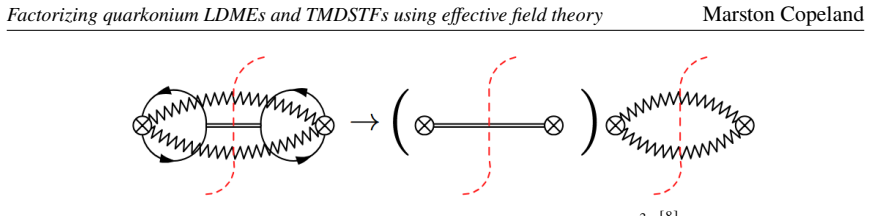
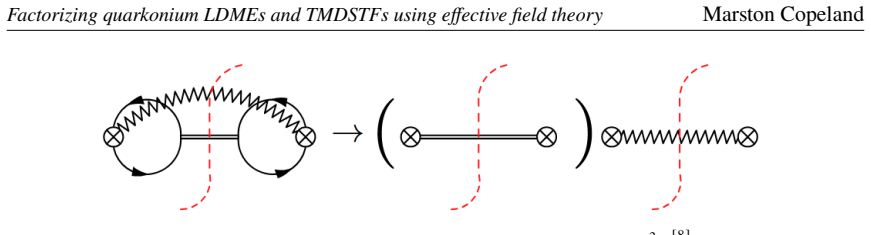
A Hubbard-Stratonovich transformation decouples soft and ultrasoft sectors from heavy quarks in NRQCD, refactorizing production matrix elements as color-singlet wave functions and gluon field correlators.
A machine-rendered reading of the paper's core claim, the machinery that carries it, and where it could break.
Core claim
By applying a Hubbard-Stratonovich transformation and appropriate field redefinitions, the soft and ultrasoft sectors of NRQCD can be decoupled from the heavy quark and antiquark fields in a hybrid vNRQCD/pNRQCD Lagrangian at leading order in the velocity power-counting. This enables re-factorization of quarkonium production matrix elements in terms of matrix elements of color-singlet composite fields, which can be written as the wave-function at the origin and state independent vacuum correlators of chromo-electric and chromo-magnetic gluon fields. The approach verifies relationships between the LDMEs of different S-wave quarkonia originally derived using pNRQCD and derives new relationship
What carries the argument
Hubbard-Stratonovich transformation and field redefinitions applied to the hybrid vNRQCD/pNRQCD Lagrangian, which decouple the soft and ultrasoft gluon sectors from the heavy quark fields at leading velocity order.
If this is right
- LDMEs for different S-wave quarkonia satisfy the same relations previously derived in pNRQCD.
- Production matrix elements in the TMD framework are expressed through a smaller set of state-independent gluon correlators.
- TMD soft transition functions obey additional operator relations that tighten constraints on their nonperturbative values.
- Quarkonium cross sections can be written in terms of the wave function at the origin times vacuum gluon correlators rather than full four-fermion matrix elements.
Where Pith is reading between the lines
- The decoupling procedure may extend order-by-order in the velocity expansion, allowing systematic improvement of the factorization.
- The resulting constraints on TMD soft transition functions can be confronted directly with transverse-momentum spectra measured at the LHC or EIC.
- Analogous transformations could be attempted in other heavy-quark effective theories that mix soft and ultrasoft modes.
Load-bearing premise
The Hubbard-Stratonovich transformation and field redefinitions preserve the leading-order velocity power counting without introducing uncontrolled corrections when applied to the hybrid Lagrangian.
What would settle it
An explicit expansion of the transformed Lagrangian that produces velocity-suppressed operators promoted to leading order, or a numerical mismatch between the derived LDME relations and those previously obtained in pNRQCD.
Figures

read the original abstract
We use effective field theory to factorize production matrix elements that appear in the NRQCD framework for quarkonium cross sections. By applying a Hubbard-Stratonovich transformation and appropriate field redefinitions, we show that the soft and ultrasoft sectors of NRQCD can be decoupled from the heavy quark and antiquark fields in a hybrid vNRQCD/pNRQCD Lagrangian at leading order in the velocity power-counting. This enables us to re-factorize quarkonium production matrix elements in terms of matrix elements of color-singlet composite fields, which we can write as the wave-function at the origin, and state independent vacuum correlators of chromo-electric and chromo-magnetic gluon fields. This approach verifies powerful relationships between the LDMEs of different S-wave quarkonia originally derived using pNRQCD. Additionally, it allows us to derive new relationships for the production matrix elements used in the transverse momentum dependent factorization (TMD) framework, known as TMD soft transition functions, providing a much stronger set of constraints on these nonperturbative operators. This work significantly advances our understanding of quarkonium production, particularly in the TMD framework.
Editorial analysis
A structured set of objections, weighed in public.
Referee Report
Summary. The paper applies effective field theory techniques to factorize NRQCD production matrix elements for quarkonium. Starting from a hybrid vNRQCD/pNRQCD Lagrangian, a Hubbard-Stratonovich transformation followed by field redefinitions is used to decouple the soft and ultrasoft gluon sectors from the heavy-quark fields at leading order in the velocity expansion. This re-expresses the matrix elements in terms of color-singlet composite operators (wave function at the origin and state-independent vacuum correlators of chromoelectric and chromomagnetic fields), thereby recovering known LDME relations from pNRQCD and deriving new constraints on TMD soft transition functions (TMDSTFs).
Significance. If the decoupling is shown to preserve strict leading-order velocity power counting, the work supplies an EFT-derived route to the same LDME relations previously obtained in pNRQCD and yields stronger, non-perturbative constraints on TMDSTFs. The approach is parameter-free once the hybrid Lagrangian is accepted and offers a systematic way to relate production matrix elements across different quarkonium states.
major comments (1)
- [§3] §3 (decoupling step): The Hubbard-Stratonovich transformation applied to the hybrid Lagrangian introduces auxiliary fields that are non-local in the soft sector. Because the original hybrid Lagrangian already contains mixed soft-ultrasoft vertices at O(v^0), the subsequent field redefinitions must cancel all induced operators that would otherwise enter at the same order as the retained color-singlet operators. No explicit expansion to O(v^2) or matching onto the known pNRQCD Lagrangian is shown to confirm that no v-suppressed mixing occurs.
Simulated Author's Rebuttal
We thank the referee for their careful reading of the manuscript and for identifying the need for greater explicitness in the decoupling procedure. We address the single major comment below and agree that an explicit check will strengthen the presentation.
read point-by-point responses
-
Referee: [§3] §3 (decoupling step): The Hubbard-Stratonovich transformation applied to the hybrid Lagrangian introduces auxiliary fields that are non-local in the soft sector. Because the original hybrid Lagrangian already contains mixed soft-ultrasoft vertices at O(v^0), the subsequent field redefinitions must cancel all induced operators that would otherwise enter at the same order as the retained color-singlet operators. No explicit expansion to O(v^2) or matching onto the known pNRQCD Lagrangian is shown to confirm that no v-suppressed mixing occurs.
Authors: We agree that the manuscript would benefit from an explicit demonstration that the field redefinitions eliminate mixed soft-ultrasoft operators at O(v^0) without generating additional contributions at the same order. The transformations are constructed so that the auxiliary fields absorb the mixed vertices exactly at leading order in the velocity power counting of the hybrid Lagrangian; any residual mixing is power-suppressed by construction. Nevertheless, to make this cancellation transparent, we will add an appendix to the revised manuscript that performs the explicit expansion through O(v^2) and verifies consistency with the known pNRQCD Lagrangian at the orders relevant for the LDME factorization. This addition addresses the concern directly while preserving the leading-order focus of the original derivation. revision: yes
Circularity Check
No circularity: derivation from EFT Lagrangian is independent of inputs
full rationale
The paper derives the decoupling of soft/ultrasoft sectors via Hubbard-Stratonovich transformation plus field redefinitions applied to the hybrid vNRQCD/pNRQCD Lagrangian at leading velocity order, then uses this to re-factorize LDMEs and TMDSTFs as color-singlet wave functions and vacuum correlators. This is presented as a direct consequence of the EFT Lagrangian manipulations rather than a fit or redefinition of existing quantities. Prior pNRQCD relationships are only verified, not used as load-bearing premises for the new TMDSTF constraints. No self-definitional steps, fitted inputs renamed as predictions, or self-citation chains that reduce the central claim to its own inputs appear in the provided derivation outline.
Axiom & Free-Parameter Ledger
Reference graph
Works this paper leans on
- [1]
-
[2]
M. G. Echevarria, S. F. Romera and P. Taels, JHEP09, 188 (2024) doi:10.1007/JHEP09(2024)188 [arXiv:2407.04793 [hep-ph]]
-
[3]
M. G. Echevarria, R. Kishore and S. F. Romera, JHEP04, 149 (2026) doi:10.1007/JHEP04(2026)149 [arXiv:2510.11809 [hep-ph]]
work page internal anchor Pith review Pith/arXiv arXiv doi:10.1007/jhep04(2026)149 2026
-
[4]
N. Brambilla, H. S. Chung, A. Vairo and X. P. Wang, JHEP03, 242 (2023) doi:10.1007/JHEP03(2023)242 [arXiv:2210.17345 [hep-ph]]
- [5]
-
[6]
S.FlemingandT.Mehen,Phys.Rev.D73,034502(2006)doi:10.1103/PhysRevD.73.034502 [arXiv:hep-ph/0509313 [hep-ph]]
work page internal anchor Pith review Pith/arXiv arXiv doi:10.1103/physrevd.73.034502 2006
-
[7]
M.Copeland,S.Fleming,R.Gupta,R.HodgesandT.Mehen,Phys.Rev.D109,no.5,054017 (2024) doi:10.1103/PhysRevD.109.054017 [arXiv:2308.08605 [hep-ph]]
-
[8]
M. Copeland, S. Fleming, R. Gupta, R. Hodges and T. Mehen, Phys. Rev. D109, 074032 (2024) doi:10.1103/PhysRevD.109.074032 [arXiv:2310.13737 [hep-ph]]
-
[9]
M. G. Echevarria, S. F. Romera and I. Scimemi, JHEP12, 181 (2023) doi:10.1007/JHEP12(2023)181 [arXiv:2308.12356 [hep-ph]]
-
[10]
N. Brambilla, M. Butenschoen and X. P. Wang, Phys. Rev. D112, no.1, L011902 (2025) doi:10.1103/8xqs-45pz [arXiv:2411.16384 [hep-ph]]. 7
discussion (0)
Sign in with ORCID, Apple, or X to comment. Anyone can read and Pith papers without signing in.