Recent applications of the subtracted second RPA method
Pith reviewed 2026-06-27 08:02 UTC · model grok-4.3
The pith
The subtracted second RPA overcomes pathological issues in the second RPA within energy density functional theory and improves agreement with experimental data for nuclear excitations.
A machine-rendered reading of the paper's core claim, the machinery that carries it, and where it could break.
Core claim
SSRPA overcomes the pathological issues encountered by SRPA within Energy Density Functional theory and yields improved agreement with experimental data for both charge-conserving and charge-exchange nuclear excitations.
What carries the argument
The subtraction procedure applied to the second RPA response function, which removes the anomalous contributions responsible for instabilities in SRPA calculations.
If this is right
- SSRPA calculations remain stable without unphysical negative energies or divergences.
- Quantitative agreement with experimental spectra improves for giant resonances and other collective modes.
- Beyond-mean-field correlations provide better constraints on the nuclear equation of state.
- The method applies equally to isoscalar and isovector nuclear excitations.
Where Pith is reading between the lines
- The subtraction idea could be tested in other many-body frameworks that suffer from similar double-counting instabilities.
- Improved excitation energies might tighten predictions for nuclear reactions in astrophysical environments.
- Numerical scaling studies could check whether SSRPA remains feasible for heavier nuclei.
Load-bearing premise
The subtraction procedure removes the pathologies of SRPA while preserving its physical content without introducing new uncontrolled approximations or artifacts.
What would settle it
An SSRPA calculation that still produces negative excitation energies or diverges for a case where experimental data is available would falsify the central claim.
Figures














read the original abstract
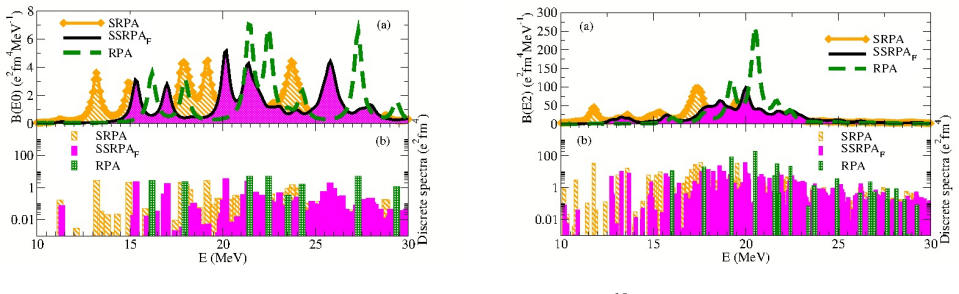
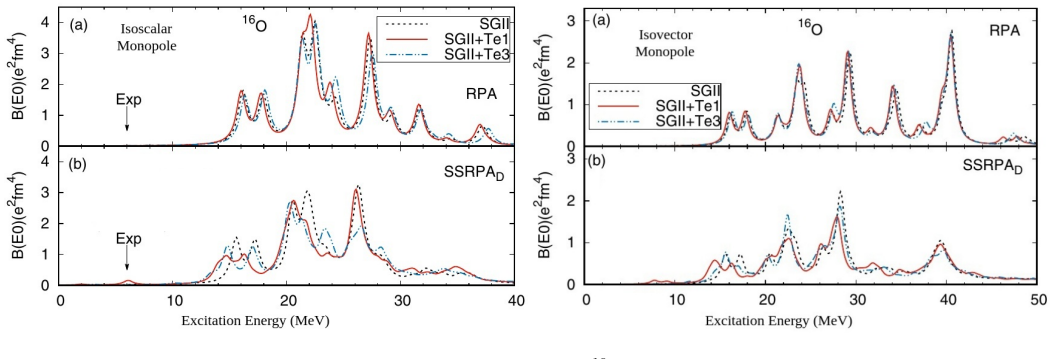
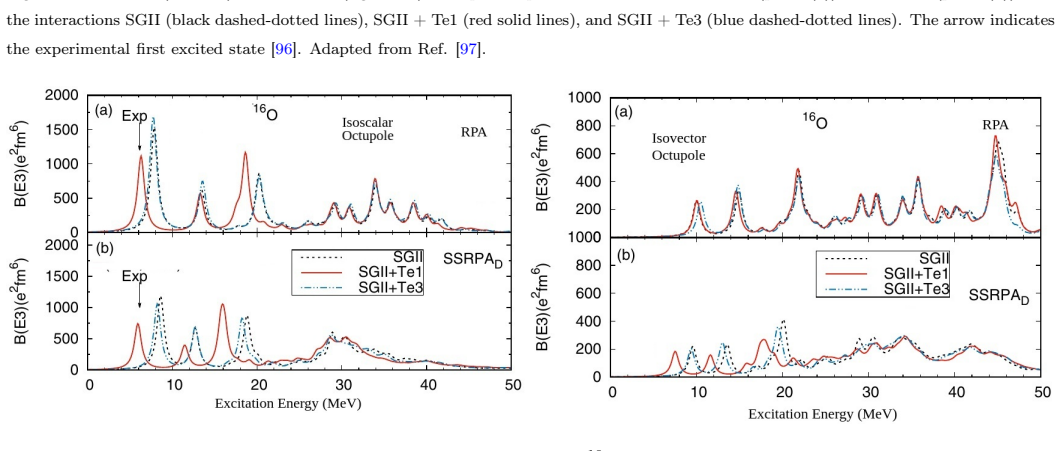
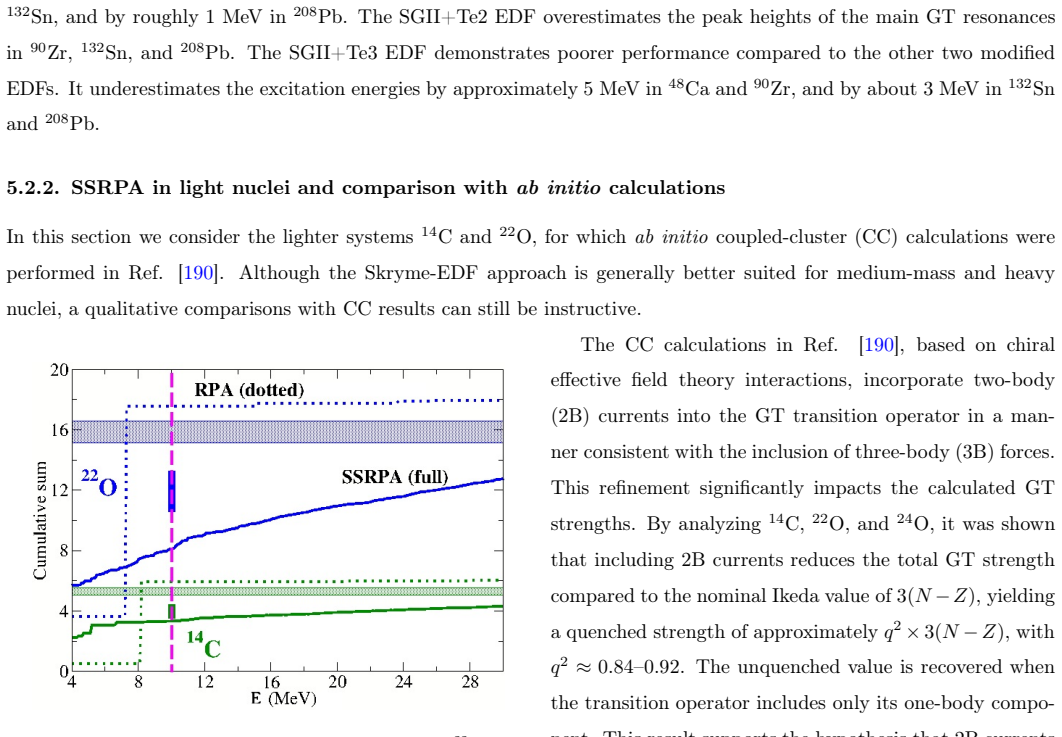
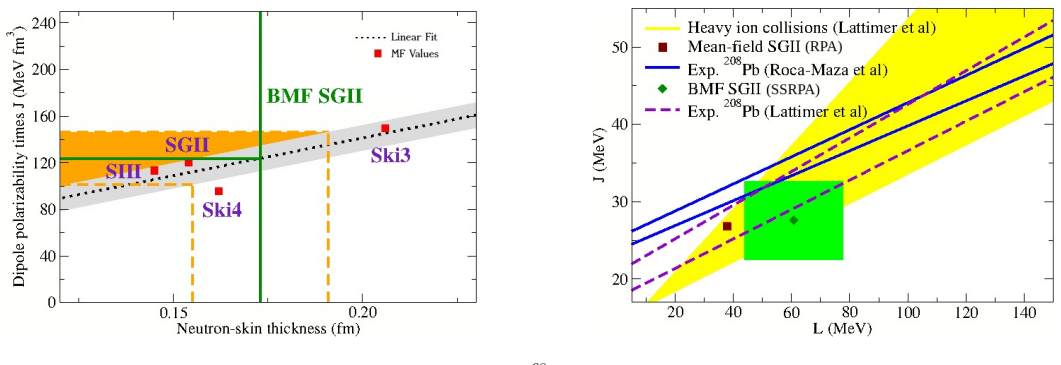
In this review, we discuss the most recent developments and applications of the Subtracted Second RPA (SSRPA), an extension of the Second RPA (SRPA), which overcomes its pathological issues encountered within the Energy Density Functional theory. After recalling the formal properties of the SRPA and SSRPA, the anomalous behavior of SRPA is shown and discussed by presenting several applications with different kinds of nuclear interactions. The most recent pathology-free SSRPA studies are then presented both for charge-conserving and charge-exchange nuclear excitations. The comparison with experimental data is presented to assess and quantify the improvement introduced by the SSRPA with respect to the RPA and SRPA. The impact of beyond-mean-field correlations induced in SSRPA is also qualitatively estimated in connection with the modeling of the nuclear equation of state. We conclude by discussing the future perspectives of the SSRPA, focusing on its potential connections with some current experimental challenges and outlining necessary theoretical extensions and numerical developments.
Editorial analysis
A structured set of objections, weighed in public.
Referee Report
Summary. This review discusses recent developments and applications of the Subtracted Second RPA (SSRPA) as an extension of the Second RPA (SRPA) that overcomes pathological issues (double-counting, instabilities) within Energy Density Functional theory. It recalls formal properties of SRPA/SSRPA, illustrates SRPA anomalies via applications with different nuclear interactions, presents pathology-free SSRPA results for charge-conserving and charge-exchange excitations, compares these to experimental data to quantify improvements over RPA/SRPA, qualitatively estimates beyond-mean-field correlations' impact on the nuclear equation of state, and outlines future perspectives and needed extensions.
Significance. If the central claims hold, the review offers a timely synthesis of SSRPA's advantages for nuclear response calculations, compiling evidence of improved data agreement and pathology avoidance that could inform modeling of excitations and the EOS. The compilation of charge-conserving and charge-exchange applications provides a useful reference point for the field.
major comments (1)
- [Abstract; applications sections on charge-conserving and charge-exchange modes] Abstract and applications sections: the central claim that SSRPA removes SRPA pathologies while exactly preserving physical content requires explicit demonstration that model-independent constraints (energy-weighted sum rules, continuity equation, current conservation) remain satisfied in the numerical results shown for the recent SSRPA studies; the review recalls formal properties but does not report such verifications for the presented applications, leaving open whether reported improvements partly reflect uncontrolled effects of subtraction.
Simulated Author's Rebuttal
We thank the referee for the careful reading of the manuscript and the constructive feedback. We address the single major comment below.
read point-by-point responses
-
Referee: [Abstract; applications sections on charge-conserving and charge-exchange modes] Abstract and applications sections: the central claim that SSRPA removes SRPA pathologies while exactly preserving physical content requires explicit demonstration that model-independent constraints (energy-weighted sum rules, continuity equation, current conservation) remain satisfied in the numerical results shown for the recent SSRPA studies; the review recalls formal properties but does not report such verifications for the presented applications, leaving open whether reported improvements partly reflect uncontrolled effects of subtraction.
Authors: The SSRPA method is constructed precisely so that the subtraction removes the double-counting and instability pathologies of SRPA while leaving the physical content unchanged; this guarantees by construction that the energy-weighted sum rules, continuity equation and current conservation are preserved exactly, as already stated in the formal-properties section of the review. The numerical results shown are taken directly from the cited recent SSRPA publications, in which these constraints were verified. To make the review self-contained and remove any possible ambiguity, we will add a short paragraph (or footnote) in the applications sections that explicitly recalls these verifications and points to the checks performed in the original works. This addition will be purely clarificatory and will not alter any of the reported results. revision: yes
Circularity Check
Review paper recalling prior formal properties; no new derivations or predictions that reduce to inputs by construction.
full rationale
The manuscript is explicitly a review summarizing existing SSRPA formalism and applications from prior literature. No load-bearing derivation chain is presented in the provided text that equates a claimed result to its own fitted inputs or self-citations by construction. Formal properties are recalled rather than re-derived, and applications are presented as comparisons to data without introducing new self-referential predictions. This matches the default expectation for non-circular reviews.
Axiom & Free-Parameter Ledger
Reference graph
Works this paper leans on
-
[1]
M. N. Harakeh, A. Van der Woude, Giant resonances , Oxford studies in nuclear physics, Oxford Univ. Press, Oxf ord, 2002. URL https://cds.cern.ch/record/579269
2002
-
[2]
M. Mumpower, R. Surman, G. McLaughlin, A. Aprahamian, The impact of individual nuclear properties on r-process nu cleosyn Progress in Particle and Nuclear Physics 86 (2016) 86–126. doi:https://doi.org/10.1016/j.ppnp.2015.09.001. URL https://www.sciencedirect.com/science/article/pii/S0146641015000897
-
[3]
Perego, F.-K
A. Perego, F.-K. Thielemann, G. Cescutti, r-process nucleosynthesis from compact binary mergers , Handbook of Gravitational Wave Astronomy (2021). URL https://api.semanticscholar.org/CorpusID:237571376
2021
-
[4]
B. Amend, J. Zrake, D. H. Hartmann, R-process rain from binary neutron star mergers in the galac tic halo , The Astrophysical Journal 939 (1) (2022) 59. doi:10.3847/1538-4357/ac951b. URL https://doi.org/10.3847/1538-4357/ac951b
-
[5]
A. Shevchenko, J. Carter, G. R. J. Cooper, R. W. Fearick, Y . Kalmykov, P. v. Neumann-Cosel, V. Y. Ponomarev, A. Richter, I. Usman, J. Wambach, Analysis of fine structure in the nuclear continuum , Phys. Rev. C 77 (2008) 024302. doi:10.1103/PhysRevC.77.024302. URL https://link.aps.org/doi/10.1103/PhysRevC.77.024302
-
[6]
P. von Neumann-Cosel, V. Y. Ponomarev, A. Richter, J. Wam bach, Gross, intermediate and fine structure of nuclear giant reso nances: The European Physical Journal A 55 (12) (2019) 224. doi:10.1140/epja/i2019-12795-1 . URL https://doi.org/10.1140/epja/i2019-12795-1
-
[8]
A. Shevchenko, O. Burda, J. Carter, G. R. J. Cooper, R. W. F earick, S. V. Förtsch, H. Fujita, Y. Fujita, Y. Kalmykov, D. Lacroix, J. J. Lawrie, P . von Neumann-Cosel, R. Neveling, V. Y. Ponomarev, A. Richter, E. Sideras-Haddad , F. D. Smit, J. Wambach, Global investigation of the fine structure of the isoscalar g iant quadrupole resonance , Phys. Rev. C 7...
-
[9]
I. Poltoratska, R. W. Fearick, A. M. Krumbholz, E. Litvin ova, H. Mat- subara, P. von Neumann-Cosel, V. Y. Ponomarev, A. Richter, A . Tamii, Fine structure of the isovector giant dipole resonance in 208Pb: Characteristic scales and level densities , Phys. Rev. C 89 (2014) 054322. doi:10.1103/PhysRevC.89.054322. URL https://link.aps.org/doi/10.1103/PhysRev...
-
[10]
I. T. Usman, Z. Buthelezi, J. Carter, G. R. J. Cooper, R. W . Fearick, S. V. Förtsch, H. Fujita, Y. Fujita, P. von Neumann-Cosel, R. Neveling, P. Papakonstantinou, I. Pysme netska, A. Richter, R. Roth, E. Sideras-Haddad, F. D. Smit, Fine structure of the isoscalar giant quadrupole resonance in 28Si and 27Al, Phys. Rev. C 94 (2016) 024308. doi:10.1103/Phys...
-
[11]
C. Kureba, Z. Buthelezi, J. Carter, G. Cooper, R. Fearic k, S. Förtsch, M. Jingo, W. Kleinig, A. Krug- mann, A. Krumbolz, J. Kvasil, J. Mabiala, J. Mira, V. Nestere nko, P. von Neumann-Cosel, R. Neveling, P. Papka, P.-G. Reinhard, A. Richter, E. Sideras-Haddad, F. Smit, G. Steyn, J. Swartz, A. Tamii, I. Usman, Wavelet signatures of k-splitting of the isos...
-
[12]
R. W. Fearick, B. Erler, H. Matsubara, P. von Neumann-Co sel, A. Richter, R. Roth, A. Tamii, Origin of fine structure of the giant dipole resonance in sd-shell nuclei , Phys. Rev. C 97 (2018) 044325. doi:10.1103/PhysRevC.97.044325. URL https://link.aps.org/doi/10.1103/PhysRevC.97.044325
-
[13]
M. Jingo, E. Z. Buthelezi, J. Carter, G. R. J. Cooper, R. W . Fearick, S. V. Förtsch, C. O. Kureba, A. M. Krumbholz, P. von Neumann-Cosel, R. Neveling, P. Papka, I. Poltoratska, V. Y. Ponomarev, A. Richter, E. Sideras-Haddad, F. D. Smit, J. A. S wartz, A. Tamii, I. T. Usman, Studies of the giant dipole resonance in 27al , 40ca , 56fe , 58 ni and 208pb wit...
-
[14]
L. M. Donaldson, J. Carter, P. von Neumann-Cosel, V. O. N esterenko, R. Neveling, P.-G. Reinhard, I. T. Us- man, P. Adsley, C. A. Bertulani, J. W. Brümmer, E. Z. Buthelez i, G. R. J. Cooper, R. W. Fearick, S. V. Förtsch, H. Fujita, Y. Fujita, M. Jingo, N. Y. Kheswa, W. Klei nig, C. O. Kureba, J. Kvasil, M. Latif, K. C. W. Li, J. P. Mira, F. Nemulodi, P. P...
-
[15]
A. Bahini, V. O. Nesterenko, I. T. Usman, P. von Neumann- Cosel, R. Neveling, J. Carter, J. Kvasil, A. Repko, P. Adsley, N. Botha, J. W. Brümmer, L. M. Donaldson, S. Jongile, T. C. Khumalo, M. B. Latif, K. C. W. Li, P. Z. Mabika, P. T. Molema, C. S. Moodle y, S. D. Olorunfunmi, P. Papka, L. Pellegri, B. Rebeiro, E. Sideras-Haddad, F. D. S mit, S. Triambak...
-
[16]
J. Carter, L. Donaldson, H. Fujita, Y. Fujita, M. Jingo, C. Kureba, M. Latif, E. Litvinova, F. Nemu- 101 lodi, P. von Neumann-Cosel, R. Neveling, P. Papakonstantin ou, P. Papka, L. Pellegri, V. Ponomarev, A. Richter, R. Roth, E. Sideras-Haddad, F. Smit, J. Swartz, A . Tamii, R. Trippel, I. Usman, H. Wibowo, Damping of the isovector giant dipole resonance ...
-
[17]
A. Bahini, R. Neveling, P. von Neumann-Cosel, J. Carter , I. T. Usman, P. Adsley, N. Botha, J. W. Brümmer, L. M. Donaldson, S. Jongile, T. C. Khumalo, M. B. Latif, K. C. W. Li, P. Z. Mabika, P. T. Molema, C. S. Moodley, S. D. Olorunfunmi, P. Papka, L. Pellegri, B. Rebeiro, E. Side ras-Haddad, F. D. Smit, S. Triambak, M. Wiedeking, J. J. van Zyl, Isoscalar...
-
[18]
A. Bahini, P. von Neumann-Cosel, J. Carter, I. T. Usman, N. N. Arsenyev, A. P. Severyukhin, E. Litvi- nova, R. W. Fearick, R. Neveling, P. Adsley, N. Botha, J. W. Br ümmer, L. M. Donaldson, S. Jongile, T. C. Khumalo, M. B. Latif, K. C. W. Li, P. Z. Mabika, P. T. Molema, C. S. Moodley, S. D. Olorunfunmi, P. Papka, L. Pellegri, B. Rebeiro, E. Sideras-Haddad...
-
[19]
I. Hamamoto, Particle–vibration coupling in the nucle i 209Bi and 209Pb, Nuclear Physics A 126 (1969) 545–561. doi:10.1016/0375-9474(69)90846-X
-
[20]
M. Baldo, P. F. Bortignon, G. Colò, D. Rizzo, L. Sciacchi tano, Beyond the mean field in the particle-vibration coupling scheme, Journal of Physics G: Nuclear and Particle Physics 42 (2015) 115104. doi:10.1088/0954-3899/42/11/115104
-
[21]
Y. F. Niu, Z. M. Niu, G. Colò, E. Vigezzi, Particle-vibration coupling effect on the β decay of magic nuclei , Phys. Rev. Lett. 114 (2015) 142501. doi:10.1103/PhysRevLett.114.142501. URL https://link.aps.org/doi/10.1103/PhysRevLett.114.142501
-
[22]
Q. Liu, J. Engel, N. Hinohara, M. Kortelainen, Effects of quasiparticle-vibration coupling on gamow-tell er strength and β deca Phys. Rev. C 109 (2024) 044308. doi:10.1103/PhysRevC.109.044308. URL https://link.aps.org/doi/10.1103/PhysRevC.109.044308
-
[23]
E. Litvinova, P. Ring, V. Tselyaev, Relativistic quasiparticle time blocking approximation: Dipole response of open-shell nuclei Phys. Rev. C 78 (2008) 014312. doi:10.1103/PhysRevC.78.014312. URL https://link.aps.org/doi/10.1103/PhysRevC.78.014312
-
[24]
E. Litvinova, P. Ring, V. Tselyaev, Mode coupling and the pygmy dipole resonance in a relativist ic two-phonon model , Phys. Rev. Lett. 105 (2010) 022502. doi:10.1103/PhysRevLett.105.022502. URL https://link.aps.org/doi/10.1103/PhysRevLett.105.022502
-
[25]
Soloviev, Theory of Atomic Nuclei: Quasiparticles a nd Phonons, Institute of Physics, Bristol, 1992
V. Soloviev, Theory of Atomic Nuclei: Quasiparticles a nd Phonons, Institute of Physics, Bristol, 1992. 102
1992
-
[26]
V. Soloviev, Fragmentation of single-particle and collective motions i n the quasiparticle-phonon nuclear model , Progress in Particle and Nuclear Physics 19 (1987) 107–165. doi:https://doi.org/10.1016/0146-6410(87)90004-4. URL https://www.sciencedirect.com/science/article/pii/0146641087900044
-
[27]
S. Bacca, N. Barnea, G. Hagen, G. Orlandini, T. Papenbro ck, First principles description of the giant dipole resonance in 16O, Phys. Rev. Lett. 111 (2013) 122502. doi:10.1103/PhysRevLett.111.122502. URL https://link.aps.org/doi/10.1103/PhysRevLett.111.122502
-
[28]
J. E. Sobczyk, B. Acharya, S. Bacca, G. Hagen, Ab initio computation of the longitudinal response functio n in 40Ca, Phys. Rev. Lett. 127 (2021) 072501. doi:10.1103/PhysRevLett.127.072501. URL https://link.aps.org/doi/10.1103/PhysRevLett.127.072501
-
[29]
J. E. Sobczyk, B. Acharya, S. Bacca, G. Hagen, 40Ca transverse response function from coupled-cluster theory , Phys. Rev. C 109 (2024) 025502. doi:10.1103/PhysRevC.109.025502. URL https://link.aps.org/doi/10.1103/PhysRevC.109.025502
-
[30]
F. Marino, F. Bonaiti, S. Bacca, G. Hagen, G. R. Jansen, Structure and dynamics of open-shell nuclei from spherical coupled-cluster Phys. Rev. C 112 (2025) 014315. doi:10.1103/vbsk-fmqh. URL https://link.aps.org/doi/10.1103/vbsk-fmqh
-
[31]
F. Raimondi, C. Barbieri, Nuclear electromagnetic dipole response with the self-con sistent green’s function formalism , Phys. Rev. C 99 (2019) 054327. doi:10.1103/PhysRevC.99.054327. URL https://link.aps.org/doi/10.1103/PhysRevC.99.054327
-
[32]
A. Porro, T. Duguet, J.-P. Ebran, M. Frosini, R. Roth, V. Somà, Ab initio description of monopole resonances in light- and m edium-mass nuclei , The European Physical Jour- nal A 60 (7) (2024) 155. doi:10.1140/epja/s10050-024-01377-5 . URL https://doi.org/10.1140/epja/s10050-024-01377-5
-
[33]
A. Porro, T. Duguet, J.-P. Ebran, M. Frosini, R. Roth, V. Somà, Ab initio description of monopole resonances in light- and m edium-mass nuclei , The European Physical Jour- nal A 60 (6) (2024) 133. doi:10.1140/epja/s10050-024-01340-4 . URL https://doi.org/10.1140/epja/s10050-024-01340-4
-
[34]
Y. Beaujeault-Taudière, M. Frosini, J.-P. Ebran, T. Du guet, R. Roth, V. Somà, Zero- and finite-temperature electromagnetic strength dis tributions in closed- and open-shell nuclei from first princ iples, Phys. Rev. C 107 (2023) L021302. doi:10.1103/PhysRevC.107.L021302. URL https://link.aps.org/doi/10.1103/PhysRevC.107.L021302
-
[35]
D. Lacroix, A. Mai, P. von Neumann-Cosel, A. Richter, J. Wambach, Multiple scales in the fine structure of the isoscalar giant q uadrupole resonance in 208Pb, Physics Letters B 479 (1) (2000) 15–20. doi:https://doi.org/10.1016/S0370-2693(00)00301-4. URL https://www.sciencedirect.com/science/article/pii/S0370269300003014
-
[36]
B. Schwesinger, J. Wambach, Fragmentation of nuclear s trength distributions by 2p2h excitations, Nucl. Phys. A 426 (1984) 253–275. doi:10.1016/0375-9474(84)90107-6. 103
-
[37]
S. Drozdz, V. Klemt, J. Speth, J. Wambach, Natural-pari ty excitations in light nuclei described with realistic two-body interactions, Nucl. Phys. A 451 (1986) 11–20. doi:10.1016/0375-9474(86)90238-1
-
[38]
K. Takayanagi, K. Shimizu, A. Arima, A generalized rpa theory of the nuclear response function , Nuclear Physics A 477 (2) (1988) 205–230. doi:https://doi.org/10.1016/0375-9474(88)90319-3. URL https://www.sciencedirect.com/science/article/pii/0375947488903193
-
[39]
S. Ait-Tahar, D. Brink, Second rpa calculations of the charge-exchange quadrupole response functions in closed-shell nuclei , Nuclear Physics A 560 (3) (1993) 765–796. doi:https://doi.org/10.1016/0375-9474(93)90170-3. URL https://www.sciencedirect.com/science/article/pii/0375947493901703
-
[40]
Double-Dipole Excitations in 40Ca
S. Nishizaki, J. Wambach, Double-dipole excitations i n 40Ca , Phys. Lett. B 349 (1995) 7–10. arXiv:nucl-th/9412008, doi:10.1016/0370-2693(95)00229-E
work page internal anchor Pith review Pith/arXiv arXiv doi:10.1016/0370-2693(95)00229-e 1995
-
[41]
S. Ayik, D. Lacroix, P. Chomaz, Fragmentation and damping of the collective response in ext ended random-phase approximation Phys. Rev. C 61 (1999) 014608. doi:10.1103/PhysRevC.61.014608. URL https://link.aps.org/doi/10.1103/PhysRevC.61.014608
-
[42]
S. Drozdz, S. Nishizaki, J. Speth, J. Wambach, The nuclear response within extended rpa theories , Physics Reports 197 (1) (1990) 1–65. doi:https://doi.org/10.1016/0370-1573(90)90084-F. URL https://www.sciencedirect.com/science/article/pii/037015739090084F
-
[43]
J. Engel, M. Bender, J. Dobaczewski, W. Nazarewicz, R. S urman,β decay rates of r-process waiting-point nuclei in a self-con sisten Phys. Rev. C 60 (1999) 014302. doi:10.1103/PhysRevC.60.014302. URL https://link.aps.org/doi/10.1103/PhysRevC.60.014302
-
[44]
D. Bohm, D. Pines, A collective description of electron interactions: Iii. co ulomb interactions in a degenerate electron gas , Phys. Rev. 92 (1953) 609–625. doi:10.1103/PhysRev.92.609. URL https://link.aps.org/doi/10.1103/PhysRev.92.609
-
[45]
Gell-Mann, K
M. Gell-Mann, K. A. Brueckner, Correlation energy of an electron gas at high density , Phys. Rev. 106 (1957) 364–
1957
-
[46]
URL https://link.aps.org/doi/10.1103/PhysRev.106.364
doi:10.1103/PhysRev.106.364. URL https://link.aps.org/doi/10.1103/PhysRev.106.364
-
[47]
Rowe, An intepretation of time-dependent hartree-fock theory , Nuclear Physics 80 (1) (1966) 209–222
D. Rowe, An intepretation of time-dependent hartree-fock theory , Nuclear Physics 80 (1) (1966) 209–222. doi:https://doi.org/10.1016/0029-5582(66)90837-6. URL https://www.sciencedirect.com/science/article/pii/0029558266908376
-
[48]
P. Ring, P. Schuck, The nuclear many-body problem, Spri nger Berlin, Heidelberg, 2004
2004
-
[49]
J. W. Negele, The mean-field theory of nuclear structure and dynamics , Rev. Mod. Phys. 54 (1982) 913–1015. doi:10.1103/RevModPhys.54.913. URL https://link.aps.org/doi/10.1103/RevModPhys.54.913
-
[50]
A. L. Fetter, J. D. Walecka (Eds.), The many-body proble m. A lecture note and reprint volume, Vol. 6, 2003. 104
2003
-
[51]
W. Dickhoff, C. Barbieri, Self-consistent green’s function method for nuclei and nuc lear matter , Progress in Particle and Nuclear Physics 52 (2) (2004) 377–496. doi:https://doi.org/10.1016/j.ppnp.2004.02.038. URL https://www.sciencedirect.com/science/article/pii/S0146641004000535
-
[52]
W. H. Dickhoff, D. Van Neck, Many-Body Theory Exposed!, 2 nd Edition, World Scientific, 2008
2008
-
[53]
D. J. ROWE, Equations-of-motion method and the extended shell model , Rev. Mod. Phys. 40 (1968) 153–166. doi:10.1103/RevModPhys.40.153. URL https://link.aps.org/doi/10.1103/RevModPhys.40.153
-
[54]
G. P. Chen, V. K. Voora, M. M. Agee, S. G. Balasubramani, F . Furche, Random-phase approximation methods , Annual Review of Physical Chemistry 68 (Volume 68, 2017) (2 017) 421–445. doi:https://doi.org/10.1146/annurev-physchem-040215 -112308. URL https://www.annualreviews.org/content/journals/10.1146/annurev-physchem-040215-112308
-
[55]
Co’, Introducing the random phase approximation theory , Universe 9 (3) (2023)
G. Co’, Introducing the random phase approximation theory , Universe 9 (3) (2023). doi:10.3390/universe9030141. URL https://www.mdpi.com/2218-1997/9/3/141
-
[56]
Da Providência, Variational approach to the many-body problem , Nuclear Physics 61 (1) (1965) 87–96
J. Da Providência, Variational approach to the many-body problem , Nuclear Physics 61 (1) (1965) 87–96. doi:https://doi.org/10.1016/0029-5582(65)90937-5. URL https://www.sciencedirect.com/science/article/pii/0029558265909375
-
[57]
Yannouleas, Zero-temperature second random phase approximation and it s formal properties , Phys
C. Yannouleas, Zero-temperature second random phase approximation and it s formal properties , Phys. Rev. C 35 (1987) 1159–1161. doi:10.1103/PhysRevC.35.1159. URL https://link.aps.org/doi/10.1103/PhysRevC.35.1159
-
[58]
D. Gambacurta, M. Grasso, F. Catara, Residual interaction in second random-phase approximatio n with density-dependent forces: Journal of Physics G: Nuclear and Particle Physics 38 (3) (20 11) 035103. doi:10.1088/0954-3899/38/3/035103. URL https://dx.doi.org/10.1088/0954-3899/38/3/035103
-
[59]
F. Minato, Estimation of a 2p2h effect on gamow-teller transitions with in the second tamm-dancoff approximation , Phys. Rev. C 93 (2016) 044319. doi:10.1103/PhysRevC.93.044319. URL https://link.aps.org/doi/10.1103/PhysRevC.93.044319
-
[60]
C. Fiolhais, F. Nogueira, M. Marques, A Primer in Densit y Functional Theory, Vol. 620, 2003. doi:10.1007/3-540-37072-2
-
[61]
P. Hohenberg, W. Kohn, Inhomogeneous electron gas , Phys. Rev. 136 (1964) B864–B871. doi:10.1103/PhysRev.136.B864. URL https://link.aps.org/doi/10.1103/PhysRev.136.B864
-
[62]
W. Kohn, L. J. Sham, Self-consistent equations including exchange and correla tion effects , Phys. Rev. 140 (1965) A1133–A1138. doi:10.1103/PhysRev.140.A1133. URL https://link.aps.org/doi/10.1103/PhysRev.140.A1133 105
-
[63]
Engel, Intrinsic-density functionals, Phys
J. Engel, Intrinsic-density functionals, Phys. Rev. C 75 (2007) 014306. doi:10.1103/PhysRevC.75.014306. URL https://link.aps.org/doi/10.1103/PhysRevC.75.014306
-
[64]
V. I. Tselyaev, Subtraction method and stability condition in extended ran dom-phase approximation theories , Phys. Rev. C 88 (2013) 054301. doi:10.1103/PhysRevC.88.054301. URL https://link.aps.org/doi/10.1103/PhysRevC.88.054301
-
[65]
Runge, E
E. Runge, E. K. U. Gross, Density-functional theory for time-dependent systems , Phys. Rev. Lett. 52 (1984) 997–
1984
-
[66]
URL https://link.aps.org/doi/10.1103/PhysRevLett.52.997
doi:10.1103/PhysRevLett.52.997. URL https://link.aps.org/doi/10.1103/PhysRevLett.52.997
-
[67]
S. Adachi, E. Lipparini, Sum rules in extended rpa theories , Nuclear Physics A 489 (3) (1988) 445–460. doi:https://doi.org/10.1016/0375-9474(88)90006-1. URL https://www.sciencedirect.com/science/article/pii/0375947488900061
-
[68]
E. Lipparini, S. Stringari, Sum rules and giant resonances in nuclei , Physics Reports 175 (3) (1989) 103–261. doi:https://doi.org/10.1016/0370-1573(89)90029-X. URL https://www.sciencedirect.com/science/article/pii/037015738990029X
-
[69]
Thouless, Stability conditions and nuclear rotations in the hartree- fock theory , Nuclear Physics 21 (1960) 225–
D. Thouless, Stability conditions and nuclear rotations in the hartree- fock theory , Nuclear Physics 21 (1960) 225–
1960
-
[70]
URL https://www.sciencedirect.com/science/article/pii/0029558260900481
doi:https://doi.org/10.1016/0029-5582(60)90048-1. URL https://www.sciencedirect.com/science/article/pii/0029558260900481
-
[71]
R. Roth, T. Neff, H. Hergert, H. Feldmeier, Nuclear structure based on correlated realistic nucleon–n ucleon potentials , Nuclear Physics A 745 (1) (2004) 3–33. doi:https://doi.org/10.1016/j.nuclphysa.2004.08.024. URL https://www.sciencedirect.com/science/article/pii/S0375947404008917
-
[72]
R. Roth, H. Hergert, P. Papakonstantinou, T. Neff, H. Fel dmeier, Matrix elements and few-body calculations within the unita ry Phys. Rev. C 72 (2005) 034002. doi:10.1103/PhysRevC.72.034002. URL https://link.aps.org/doi/10.1103/PhysRevC.72.034002
-
[73]
N. Paar, P. Papakonstantinou, H. Hergert, R. Roth, Collective multipole excitations based on correlated real istic nucleon-nucleon Phys. Rev. C 74 (2006) 014318. doi:10.1103/PhysRevC.74.014318. URL https://link.aps.org/doi/10.1103/PhysRevC.74.014318
-
[74]
P. Papakonstantinou, R. Roth, Second random phase approximation and renormalized realis tic interactions, Physics Letters B 671 (3) (2009) 356–360. doi:https://doi.org/10.1016/j.physletb.2008.12.037. URL https://www.sciencedirect.com/science/article/pii/S0370269308015128
-
[75]
P. Papakonstantinou, R. Roth, Large-scale second random-phase approximation calculati ons with finite-range interactions , Phys. Rev. C 81 (2010) 024317. doi:10.1103/PhysRevC.81.024317. URL https://link.aps.org/doi/10.1103/PhysRevC.81.024317
-
[76]
P. Papakonstantinou, Second random-phase approximation, thouless’ theorem, an d the stability condition reexamined and clarified Phys. Rev. C 90 (2014) 024305. doi:10.1103/PhysRevC.90.024305. URL https://link.aps.org/doi/10.1103/PhysRevC.90.024305 106
-
[77]
Y.-W. Lui, H. L. Clark, D. H. Youngblood, Giant resonances in 16O, Phys. Rev. C 64 (2001) 064308. doi:10.1103/PhysRevC.64.064308. URL https://link.aps.org/doi/10.1103/PhysRevC.64.064308
-
[78]
D. H. Youngblood, Y.-W. Lui, H. L. Clark, Isoscalar e0, e1, and e2 strength in 40Ca, Phys. Rev. C 63 (2001) 067301. doi:10.1103/PhysRevC.63.067301. URL https://link.aps.org/doi/10.1103/PhysRevC.63.067301
-
[79]
J. Ahrens, H. Borchert, K. Czock, H. Eppler, H. Gimm, H. G undrum, M. Kröning, P. Riehn, G. Sita Ram, A. Zieger, B. Ziegler, Total nuclear photon absorption cross sections for some lig ht elements, Nuclear Physics A 251 (3) (1975) 479–492. doi:https://doi.org/10.1016/0375-9474(75)90543-6. URL https://www.sciencedirect.com/science/article/pii/0375947475905436
-
[80]
S. F. LeBrun, A. M. Nathan, S. D. Hoblit, Photon scattering in the giant dipole resonance region of 16O, Phys. Rev. C 35 (1987) 2005–2010. doi:10.1103/PhysRevC.35.2005. URL https://link.aps.org/doi/10.1103/PhysRevC.35.2005
-
[81]
A. Veyssière, H. Beil, R. Bergère, P. Carlos, A. Leprêtr e, A. De Miniac, A study of the photoneutron contribution to the giant dipole resonance of s-d shell nuclei , Nuclear Physics A 227 (3) (1974) 513–540. doi:https://doi.org/10.1016/0375-9474(74)90774-X. URL https://www.sciencedirect.com/science/article/pii/037594747490774X
discussion (0)
Sign in with ORCID, Apple, or X to comment. Anyone can read and Pith papers without signing in.