Deep Learning Calibration of the Quasar X-ray/UV Luminosity Relation for Cosmological Applications
Pith reviewed 2026-06-27 08:45 UTC · model grok-4.3
The pith
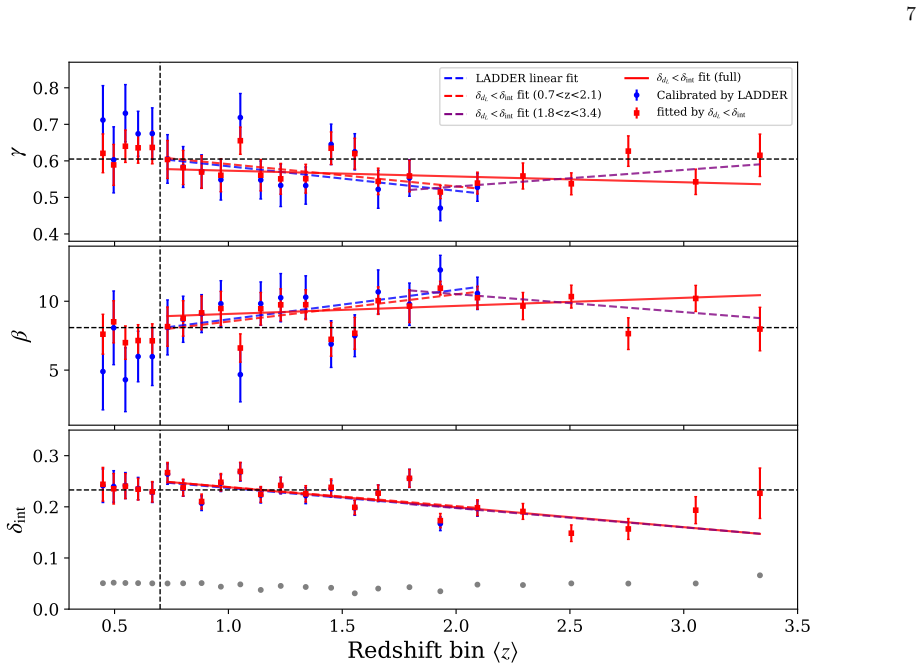
The quasar X-ray/UV luminosity scaling relation varies non-linearly with redshift in current observations.
A machine-rendered reading of the paper's core claim, the machinery that carries it, and where it could break.
Core claim
When the quasar sample is compared against the reference expansion history, the X-ray to UV luminosity relation displays a non-linear redshift dependence that a simple linear correction term fails to remove. The low-redshift portion of the sample differs significantly from the higher-redshift portion, and this difference is identified as a property of the present quasar observations rather than an artifact of cosmological-model assumptions.
What carries the argument
The deep-learning reconstruction of the supernova Hubble diagram used as an independent reference to isolate redshift trends in the quasar luminosity relation.
If this is right
- The portion of the quasar sample below redshift 0.7 must be screened or removed before the objects are used for cosmology.
- A single linear term in redshift is insufficient to standardize the luminosity relation across the full observed range.
- Further modeling of both the mean relation and its intrinsic scatter is required before quasars can serve as reliable high-redshift probes.
- Advanced data-processing steps beyond current cleaning will be needed to convert quasars into standardizable candles.
Where Pith is reading between the lines
- Selection biases or measurement systematics in quasar surveys may carry a more complex redshift dependence than previously modeled.
- Future larger samples could be split by additional observables to test whether the non-linearity correlates with source properties other than redshift.
- If the trend persists in cleaner data, quasar constraints on early-universe physics would be limited to the higher-redshift subset alone.
Load-bearing premise
The reconstructed expansion history from the supernova sample serves as an unbiased reference that does not itself create artificial non-linear trends when applied to the quasar data.
What would settle it
Repeating the analysis on a new, independently calibrated set of distance indicators at the same redshifts and finding that the non-linear redshift dependence vanishes.
Figures

read the original abstract
Quasars can serve as standard candles through an empirical scaling relation between their ultraviolet (UV) and X-ray luminosities. As high-redshift probes, it is critical to test whether this relation evolves with redshift. In this work, we reconstruct the Hubble diagram of the Pantheon+ sample using the deep learning--based LADDER algorithm and use it as a reference to investigate the quasar scaling relation. Our results, which are consistent with those from Gaussian process regression and narrow-bin analyses, show that the potentially contaminated sample at $z<0.7$ differs significantly from the $z>0.7$ sample; thus, it should be further screened or excluded when quasars are used as cosmological probes. We find that the scaling relation exhibits a non-linear redshift dependence that cannot be accounted for by a simple linear correction, and that this behavior is a feature of the current data sample rather than a consequence of cosmological model misspecification. To use quasars as standardizable candles, further modeling of the scaling relation and intrinsic dispersion, or more advanced data processing techniques, is required.
Editorial analysis
A structured set of objections, weighed in public.
Referee Report
Summary. The manuscript uses the LADDER deep-learning algorithm to reconstruct the Hubble diagram from the Pantheon+ supernovae sample and employs this reconstruction as a reference to examine the quasar X-ray/UV luminosity scaling relation. It reports that the relation exhibits non-linear redshift dependence that cannot be removed by a simple linear correction, that this behavior is intrinsic to the current quasar data sample rather than a sign of cosmological model misspecification, and that the z < 0.7 subsample differs significantly from the z > 0.7 subsample and should therefore be screened or excluded for cosmological applications. Results are stated to be consistent with Gaussian-process regression and narrow-bin analyses.
Significance. If the central findings hold after quantitative validation, the work would demonstrate that quasars cannot yet be treated as standardizable candles without additional modeling of redshift-dependent effects or refined sample selection, thereby limiting their immediate utility as high-redshift cosmological probes and motivating further development of the luminosity relation and its intrinsic dispersion.
major comments (2)
- [Abstract] Abstract: the statement that results are 'consistent with those from Gaussian process regression and narrow-bin analyses' supplies no quantitative statistics (e.g., best-fit slopes and intercepts with uncertainties, χ^{2} values, or p-values for the z < 0.7 versus z > 0.7 comparison), so the strength of support for the non-linear redshift dependence cannot be assessed from the provided information.
- [Abstract] Abstract: the claim that the observed non-linear redshift dependence is 'a feature of the current data sample rather than a consequence of cosmological model misspecification' rests on the LADDER-reconstructed distances serving as an unbiased reference; without reported tests of reconstruction residuals versus redshift or explicit checks that such residuals do not correlate with the reported non-linearity (particularly across the z = 0.7 boundary), the possibility that network-induced artifacts produce the apparent non-linearity remains unaddressed.
Simulated Author's Rebuttal
We thank the referee for their careful reading and constructive comments on our manuscript. We provide point-by-point responses to the major comments below.
read point-by-point responses
-
Referee: [Abstract] Abstract: the statement that results are 'consistent with those from Gaussian process regression and narrow-bin analyses' supplies no quantitative statistics (e.g., best-fit slopes and intercepts with uncertainties, χ^{2} values, or p-values for the z < 0.7 versus z > 0.7 comparison), so the strength of support for the non-linear redshift dependence cannot be assessed from the provided information.
Authors: We agree that quantitative statistics would allow a clearer assessment of the claimed consistency and the significance of the subsample differences. In the revised manuscript we will report the relevant best-fit slopes, intercepts with uncertainties, χ² values, and p-values for the z < 0.7 versus z > 0.7 comparison. revision: yes
-
Referee: [Abstract] Abstract: the claim that the observed non-linear redshift dependence is 'a feature of the current data sample rather than a consequence of cosmological model misspecification' rests on the LADDER-reconstructed distances serving as an unbiased reference; without reported tests of reconstruction residuals versus redshift or explicit checks that such residuals do not correlate with the reported non-linearity (particularly across the z = 0.7 boundary), the possibility that network-induced artifacts produce the apparent non-linearity remains unaddressed.
Authors: The consistency of the non-linearity with independent Gaussian-process and narrow-bin results already indicates it is unlikely to be a LADDER-specific artifact. Nevertheless, we acknowledge the value of direct residual diagnostics. In the revision we will add explicit tests of LADDER reconstruction residuals versus redshift together with checks for any correlation with the reported non-linearity across the z = 0.7 boundary. revision: yes
Circularity Check
No significant circularity; derivation uses external Pantheon+ reference
full rationale
The paper reconstructs the Hubble diagram from the Pantheon+ supernova sample via the LADDER algorithm as an independent reference to calibrate the quasar UV-X-ray scaling relation and test for redshift evolution. Results are cross-validated against Gaussian process regression and narrow-bin analyses, with the non-linear redshift dependence attributed to the quasar sample itself. No load-bearing step reduces by construction to a self-citation chain, fitted input renamed as prediction, or self-definitional equivalence; the reference dataset and multiple external methods keep the derivation self-contained against benchmarks.
Axiom & Free-Parameter Ledger
axioms (1)
- domain assumption The LADDER reconstruction of the Pantheon+ sample provides an accurate, unbiased reference Hubble diagram for testing the quasar relation.
Forward citations
Cited by 1 Pith paper
-
Redshift-Dependent Intrinsic Dispersion in the Quasar UV/X-ray Luminosity Relation
Intrinsic dispersion in the quasar UV/X-ray luminosity relation decreases with redshift above z~1.6 and modeling it as redshift-dependent shifts Omega_m0 by ~0.025 in flat LambdaCDM.
Reference graph
Works this paper leans on
-
[1]
We therefore adopt the quasar sample collected and processed by Lussoet al.[35], which contains ap- proximately 2400 quasars
Quasar Sample The main goal of this work is to study the properties of the scaling relation when using quasars as standardizable candles. We therefore adopt the quasar sample collected and processed by Lussoet al.[35], which contains ap- proximately 2400 quasars. This sample was initially compiled from about 19,000 objects drawn from various literature so...
-
[2]
narrow-bin method
SNe Ia Sample SNe Ia are well-established cosmological probes. In this work, we use the Pantheon+ sample, which includes 1701 light curves of 1550 distinct SNe Ia from 18 different surveys, covering a redshift range of 0.001< z <2.26 [6]. Their apparent magnitudesm B are derived from light- curve fitting using the SALT2 method [6, 53–56]. The relation bet...
1970
-
[3]
L. Chen, Q.-G. Huang, and K. Wang, JCAP02, 028 (2019), arXiv:1808.05724 [astro-ph.CO]
Pith/arXiv arXiv 2019
-
[4]
N. Aghanimet al.(Planck), Astron. Astrophys.641, A6 (2020), [Erratum: Astron.Astrophys. 652, C4 (2021)], arXiv:1807.06209 [astro-ph.CO]
Pith/arXiv arXiv 2020
-
[5]
A. G. Riess, S. Casertano, W. Yuan, J. B. Bowers, 9 L. Macri, J. C. Zinn, and D. Scolnic, Astrophys. J. Lett. 908, L6 (2021), arXiv:2012.08534 [astro-ph.CO]
arXiv 2021
-
[6]
W. L. Freedman, Astrophys. J.919, 16 (2021), arXiv:2106.15656 [astro-ph.CO]
arXiv 2021
-
[7]
A. G. Riesset al., Astrophys. J. Lett.934, L7 (2022), arXiv:2112.04510 [astro-ph.CO]
Pith/arXiv arXiv 2022
-
[8]
D. Broutet al., Astrophys. J.938, 110 (2022), arXiv:2202.04077 [astro-ph.CO]
Pith/arXiv arXiv 2022
-
[9]
S. Alamet al.(BOSS), Mon. Not. Roy. Astron. Soc.470, 2617 (2017), arXiv:1607.03155 [astro-ph.CO]
Pith/arXiv arXiv 2017
-
[10]
M. Ataet al.(eBOSS), Mon. Not. Roy. Astron. Soc.473, 4773 (2018), arXiv:1705.06373 [astro-ph.CO]
Pith/arXiv arXiv 2018
-
[11]
J. E. Bautistaet al.(BOSS), Astron. Astrophys.603, A12 (2017), arXiv:1702.00176 [astro-ph.CO]
Pith/arXiv arXiv 2017
-
[12]
G. Risaliti and E. Lusso, Nature Astronomy3, 272 (2019), arXiv:1811.02590 [astro-ph.CO]
Pith/arXiv arXiv 2019
-
[13]
G. Bargiacchi, M. Benetti, S. Capozziello, E. Lusso, G. Risaliti, and M. Signorini, MNRAS515, 1795 (2022), arXiv:2111.02420 [astro-ph.CO]
arXiv 2022
-
[14]
L. Fan, G. Fang, and J. Hu, Ap&SS368, 59 (2023), arXiv:2306.16828 [astro-ph.CO]
arXiv 2023
- [15]
-
[16]
D. J. Mortlocket al., Nature474, 616 (2011), arXiv:1106.6088 [astro-ph.CO]
Pith/arXiv arXiv 2011
-
[17]
Banadoset al., Nature553, 473 (2018), arXiv:1712.01860 [astro-ph.GA]
E. Banadoset al., Nature553, 473 (2018), arXiv:1712.01860 [astro-ph.GA]
Pith/arXiv arXiv 2018
-
[18]
F. Wang, J. Yang, X. Fan, J. F. Hennawi, A. J. Barth, E. Banados, F. Bian, K. Boutsia, T. Con- nor, F. B. Davies, R. Decarli, A.-C. Eilers, E. P. Fa- rina, R. Green, L. Jiang, J.-T. Li, C. Mazzucchelli, R. Nanni, J.-T. Schindler, B. Venemans, F. Walter, X.- B. Wu, and M. Yue, Astrophys. J. Lett.907, L1 (2021), arXiv:2101.03179 [astro-ph.GA]
arXiv 2021
-
[19]
G. Risaliti, E. Lusso, E. Nardini, C. Niccolai, M. Ralowski, A. Sacchi, A. Shlentsova, M. Signorini, and B. Trefoloni, (2026), arXiv:2606.07730 [astro-ph.HE]
Pith/arXiv arXiv 2026
-
[20]
J. A. Baldwin, Astrophys. J.214, 679 (1977)
1977
-
[21]
P. S. Osmer and J. C. Shields, ASP Conf. Ser.162, 235 (1999), arXiv:astro-ph/9811459
Pith/arXiv arXiv 1999
-
[22]
M. Elvis and M. Karovska, Astrophys. J. Lett.581, L67 (2002), arXiv:astro-ph/0211385
Pith/arXiv arXiv 2002
-
[23]
D. Watson, K. D. Denney, M. Vestergaard, and T. M. Davis, Astrophys. J. Lett.740, L49 (2011), arXiv:1109.4632 [astro-ph.CO]
Pith/arXiv arXiv 2011
-
[24]
P. Marziani and J. W. Sulentic, Adv. Space Res.54, 1331 (2014), arXiv:1310.3143 [astro-ph.CO]
Pith/arXiv arXiv 2014
-
[25]
J. M. Wang, P. Du, D. Valls-Gabaud, C. Hu, and H. Netzer, Phys. Rev. Lett.110, 081301 (2013), arXiv:1301.4225 [astro-ph.CO]
Pith/arXiv arXiv 2013
-
[26]
F. La Franca, S. Bianchi, G. Ponti, E. Branchini, and G. Matt, Astrophys. J. Lett.787, L12 (2014), arXiv:1404.2607 [astro-ph.CO]
Pith/arXiv arXiv 2014
-
[27]
E. Kilerci Eser, M. Vestergaard, B. M. Peterson, K. D. Denney, and M. C. Bentz, Astrophys. J.801, 8 (2015), arXiv:1411.2977 [astro-ph.GA]
Pith/arXiv arXiv 2015
-
[28]
J.-M. Wang, Y.-Y. Songsheng, Y.-R. Li, P. Du, and Z.-X. Zhang, Nature Astron.4, 517 (2020), arXiv:1906.08417 [astro-ph.CO]
arXiv 2020
-
[29]
J. P. Hu, Y. Y. Wang, and F. Y. Wang, Astron. Astro- phys.643, A93 (2020), arXiv:2008.12439 [astro-ph.CO]
arXiv 2020
-
[30]
B. Wang, Y. Liu, H. Yu, and P. Wu, Astrophys. J.962, 103 (2024), arXiv:2401.01540 [astro-ph.CO]
arXiv 2024
-
[31]
Li, Z.-H
G.-X. Li, Z.-H. Li, N. Song, C. Chen, C. Dong, J.-W. Tian, Z.-C. Zhang, J.-Y.-H. Li, H.-L. Tian, and M.-Y.- N. Ma, Astronomy & Astrophysics706, A337 (2026)
2026
-
[32]
Tananbaum, Y
H. Tananbaum, Y. Avni, G. Branduardi, M. Elvis, G. Fabbiano, E. Feigelson, R. Giacconi, J. P. Henry, J. P. Pye, A. Soltan, and G. Zamorani, Astrophys. J. Lett. 234, L9 (1979)
1979
-
[33]
Zamorani, J
G. Zamorani, J. P. Henry, T. Maccacaro, H. Tananbaum, A. Soltan, Y. Avni, J. Liebert, J. Stocke, P. A. Strittmat- ter, R. J. Weymann, M. G. Smith, and J. J. Condon, Astrophys. J.245, 357 (1981)
1981
-
[34]
Avni and H
Y. Avni and H. Tananbaum, Astrophys. J.305, 83 (1986)
1986
-
[35]
G. Risaliti and E. Lusso, Astrophys. J.815, 33 (2015), arXiv:1505.07118 [astro-ph.CO]
Pith/arXiv arXiv 2015
-
[36]
G. Risaliti and E. Lusso, Astron. Nachr.338, 329 (2017), arXiv:1612.02838 [astro-ph.CO]
Pith/arXiv arXiv 2017
-
[37]
E. Lussoet al., Astron. Astrophys.642, A150 (2020), arXiv:2008.08586 [astro-ph.GA]
arXiv 2020
- [38]
-
[39]
E. Lusso and G. Risaliti, Astrophys. J.819, 154 (2016), arXiv:1602.01090 [astro-ph.GA]
Pith/arXiv arXiv 2016
-
[40]
E. Lusso and G. Risaliti, Astron. Astrophys.602, A79 (2017), arXiv:1703.05299 [astro-ph.HE]
Pith/arXiv arXiv 2017
-
[41]
Lusso, Astronomische Nachrichten340, 267 (2019), arXiv:1812.03179 [astro-ph.HE]
E. Lusso, Astronomische Nachrichten340, 267 (2019), arXiv:1812.03179 [astro-ph.HE]
Pith/arXiv arXiv 2019
- [42]
-
[43]
N. Khadka and B. Ratra, Mon. Not. Roy. Astron. Soc. 497, 263 (2020), arXiv:2004.09979 [astro-ph.CO]
arXiv 2020
-
[44]
N. Khadka and B. Ratra, Mon. Not. Roy. Astron. Soc. 502, 6140 (2021), arXiv:2012.09291 [astro-ph.CO]
arXiv 2021
-
[45]
X. Li, R. E. Keeley, A. Shafieloo, and K. Liao, Astrophys. J.960, 103 (2024), arXiv:2308.06951 [astro-ph.CO]
arXiv 2024
- [46]
-
[47]
X. Li, R. E. Keeley, A. Shafieloo, X. Zheng, S. Cao, M. Biesiada, and Z.-H. Zhu, Mon. Not. Roy. Astron. Soc.507, 919 (2021), arXiv:2103.16032 [astro-ph.CO]
arXiv 2021
-
[48]
A. Sacchiet al., Astron. Astrophys.663, L7 (2022), arXiv:2206.13528 [astro-ph.CO]
arXiv 2022
-
[49]
Z. Li, L. Huang, and J. Wang, Mon. Not. Roy. Astron. Soc.517, 1901 (2022), arXiv:2210.02816 [astro-ph.CO]
arXiv 1901
-
[50]
B. Wang, Y. Liu, Z. Yuan, N. Liang, H. Yu, and P. Wu, Astrophys. J.940, 174 (2022), arXiv:2210.14432 [astro- ph.CO]
arXiv 2022
-
[51]
G. Risaliti, E. Lusso, E. Nardini, G. Bargiacchi, S. Bisogni, A. Sacchi, M. Signorini, and B. Trefoloni, Astron. Nachr.344, e230054 (2023), arXiv:2304.13752 [astro-ph.CO]
arXiv 2023
-
[52]
X. Li, R. E. Keeley, and A. Shafieloo, Astrophys. J.983, 141 (2025), arXiv:2408.15547 [astro-ph.CO]
arXiv 2025
-
[53]
J. Wu, Y. Liu, H. Yu, and P. Wu, Chin. Phys. C49, 075101 (2025), arXiv:2504.10862 [astro-ph.CO]
arXiv 2025
-
[54]
R. Shah, S. Saha, P. Mukherjee, U. Garain, and S. Pal, Astrophys. J. Suppl.273, 27 (2024), arXiv:2401.17029 [astro-ph.CO]
arXiv 2024
-
[55]
M. Kunz, B. A. Bassett, and R. A. Hlozek, Phys. Rev. D75, 103508 (2007)
2007
-
[56]
J. Guyet al.(SNLS), Astron. Astrophys.523, A7 (2010), 10 arXiv:1010.4743 [astro-ph.CO]
Pith/arXiv arXiv 2010
-
[57]
R. Kessler and D. Scolnic, Astrophys. J. Lett.836, 56 (2017), arXiv:1610.04677 [astro-ph.CO]
Pith/arXiv arXiv 2017
-
[58]
D. Broutet al., Astrophys. J.938, 111 (2022), arXiv:2112.03864 [astro-ph.CO]
arXiv 2022
-
[59]
M. L. Menzel, A. Merloni, A. Georgakakis, M. Sal- vato, E. Aubourg, W. N. Brandt, M. Brusa, J. Buch- ner, T. Dwelly, K. Nandra, I. Pˆ aris, P. Petitjean, and A. Schwope, Mon. Not. R. Astron. Soc.457, 110 (2016), arXiv:1511.07870 [astro-ph.GA]
Pith/arXiv arXiv 2016
-
[60]
E. Nardini, E. Lusso, G. Risaliti, S. Bisogni, F. Civano, M. Elvis, G. Fabbiano, R. Gilli, A. Marconi, F. Salvestrini, and C. Vignali, Astron. Astrophys.632, A109 (2019), arXiv:1910.04604 [astro-ph.GA]
arXiv 2019
-
[61]
F. Salvestrini, G. Risaliti, S. Bisogni, E. Lusso, and C. Vignali, Astron. Astrophys.631, A120 (2019), arXiv:1909.12309 [astro-ph.GA]
arXiv 2019
-
[62]
F. Vito, W. N. Brandt, F. E. Bauer, F. Calura, R. Gilli, B. Luo, O. Shemmer, C. Vignali, G. Zamorani, M. Brusa, F. Civano, A. Comastri, and R. Nanni, Astron. Astro- phys.630, A118 (2019), arXiv:1908.09849 [astro-ph.GA]
arXiv 2019
-
[63]
D’Agostini, (2005), arXiv:physics/0511182
G. D’Agostini, (2005), arXiv:physics/0511182
Pith/arXiv arXiv 2005
-
[64]
R. E. Kass and A. E. Raftery, J. Am. Statist. Assoc.90, 773 (1995)
1995
-
[65]
R. Trotta, Contemp. Phys.49, 71 (2008), arXiv:0803.4089 [astro-ph]
Pith/arXiv arXiv 2008
-
[66]
Skilling, AIP Conf
J. Skilling, AIP Conf. Proc.735, 395 (2004)
2004
-
[67]
Feroz, M
F. Feroz, M. P. Hobson, and M. Bridges, Mon. Not. Roy. Astron. Soc.398, 1601 (2009)
2009
-
[68]
J. Buchneret al., Astron. Astrophys.564, A125 (2014), arXiv:1402.0004 [astro-ph.HE]
Pith/arXiv arXiv 2014
-
[69]
Lewis, arXiv e-prints , arXiv:1910.13970 (2019), arXiv:1910.13970 [astro-ph.IM]
A. Lewis, arXiv e-prints , arXiv:1910.13970 (2019), arXiv:1910.13970 [astro-ph.IM]
Pith/arXiv arXiv 1910
-
[70]
J. P. Hu and F. Y. Wang, Astron. Astrophys.661, A71 (2022), arXiv:2202.09075 [astro-ph.CO]
arXiv 2022
discussion (0)
Sign in with ORCID, Apple, or X to comment. Anyone can read and Pith papers without signing in.