Partitioned Iterative Quantum Scheduling of Satellites for Urgent Disaster Response: Case study of Wildfire
Pith reviewed 2026-06-27 09:43 UTC · model grok-4.3
The pith
A partitioned iterative quantum scheduling method coordinates satellite constellations for wildfire detection using real data.
A machine-rendered reading of the paper's core claim, the machinery that carries it, and where it could break.
Core claim
We bring quantum scheduling algorithms closer to implementation by examining the iterative quantum algorithm framework with analytic guarantees and distributed quantum computing methods. We develop a distributed/parallelization scheme in conjunction with the quantum algorithm design and apply these techniques to real-world datasets for wildfire detection. While our quantum subprocesses are currently too small to see significant quantum advantage, our results validate the utility of these techniques and continue forging the path toward distributed quantum computing.
What carries the argument
The partitioned iterative quantum scheduling framework that breaks large satellite scheduling instances into smaller subproblems solvable by quantum methods while preserving analytic guarantees.
If this is right
- Enables coordination of larger satellite constellations than direct application of quantum algorithms would allow.
- Supplies analytic performance guarantees relative to some classical scheduling methods.
- Extends to other urgent disaster-response scheduling tasks beyond wildfires.
- Demonstrates practical use of distributed quantum techniques on utility-scale problems.
- Validates the combined quantum-classical workflow on real Earth-observation data.
Where Pith is reading between the lines
- Scaling tests on simulated larger constellations could reveal when quantum advantage appears.
- The partitioning strategy may transfer to other combinatorial resource-allocation problems in orbital mechanics.
- Hybrid classical-quantum solvers could further reduce overhead for even bigger instances.
- Success here suggests similar partitioned quantum methods for additional time-critical satellite tasks such as flood or earthquake monitoring.
Load-bearing premise
The satellite scheduling problem can be partitioned and mapped to the iterative quantum framework without losing analytic guarantees or introducing intractable classical overhead at realistic constellation sizes.
What would settle it
A calculation showing that for constellation sizes needed for continuous global wildfire monitoring the classical partitioning and recombination overhead grows faster than any quantum benefit from the subprocesses.
Figures

read the original abstract
The standard in Earth-observation tasks today is having near real-time access to surface images in response to changing conditions. For instance, as urban environments interface more with wildlands and wildfires become less predictable, their tracking with satellite resources becomes essential. This requires the coordination of increasingly large constellations of satellites, giving rise to challenging computational problems. With wildfire detection and tracking as a backdrop, we investigate the power of special purpose and novel computing paradigms to tackle the ensuing satellite scheduling problems, making a compelling case for quantum algorithms. We bring quantum scheduling algorithms closer to implementation by examining both the emerging iterative quantum algorithm framework, which comes with analytic guarantees compared to some classical algorithms, and distributed quantum computing methods whose relevance is on the rise as utility-scale problems begin to get solved with quantum computers. Drawing strength from several computing fronts, we develop a distributed/parallelization scheme in conjunction with the quantum algorithm design and apply these techniques to real-world datasets for wildfire detection. While our quantum subprocesses are currently too small to see significant quantum advantage, our results validate the utility of these techniques, and continue forging the path toward distributed quantum computing.
Editorial analysis
A structured set of objections, weighed in public.
Referee Report
Summary. The manuscript develops a partitioned iterative quantum scheduling approach for coordinating large satellite constellations in urgent disaster response, using wildfire detection as the case study. It combines an iterative quantum algorithm framework (with claimed analytic guarantees) and distributed/parallelization techniques, applies the method to real-world datasets, and concludes that the results validate the utility of these techniques even though the quantum subprocesses remain too small to exhibit significant advantage.
Significance. If the partitioning scheme is shown to preserve the analytic guarantees of the underlying iterative quantum framework while keeping classical coordination overhead sub-dominant, the work would provide a concrete step toward applying quantum optimization methods to practical Earth-observation scheduling problems. The explicit use of real wildfire datasets and the focus on distributed quantum computing are strengths that could help bridge algorithmic theory to utility-scale applications.
major comments (2)
- [Distributed/parallelization scheme description] The central claim that the partitioned scheme validates the utility of the quantum techniques rests on the unshown assertion that partitioning preserves the convergence or approximation bounds of the iterative quantum algorithm. No derivation or bound is supplied demonstrating that the original analytic guarantees survive the partitioning step.
- [Scaling and overhead discussion] No analysis or scaling bound is given for the classical coordination overhead incurred by the distributed scheme as constellation size increases. If this overhead grows faster than the quantum component can compensate, the claimed practicality for realistic disaster-response scenarios does not follow.
minor comments (2)
- [Abstract] The abstract states that subprocesses are 'too small to see significant quantum advantage' yet claims validation of utility; this tension should be clarified with a precise statement of what 'utility' is being validated in the absence of advantage.
- [Methods] Notation for the partitioned subproblems and the iterative quantum update rule should be introduced with explicit definitions and cross-references to the original iterative framework being extended.
Simulated Author's Rebuttal
We thank the referee for their thoughtful and constructive review. The two major comments identify important gaps in the theoretical justification and scalability analysis of the partitioned scheme. We address each point below and commit to revisions that will strengthen the manuscript without altering its core contributions or conclusions.
read point-by-point responses
-
Referee: [Distributed/parallelization scheme description] The central claim that the partitioned scheme validates the utility of the quantum techniques rests on the unshown assertion that partitioning preserves the convergence or approximation bounds of the iterative quantum algorithm. No derivation or bound is supplied demonstrating that the original analytic guarantees survive the partitioning step.
Authors: We acknowledge that the manuscript does not contain an explicit derivation showing that the analytic guarantees of the underlying iterative quantum algorithm are preserved under partitioning. The scheme partitions the satellite scheduling problem into subproblems that are solved independently with the iterative quantum method, followed by classical coordination to ensure consistency across iterations. In the revised version we will add a dedicated subsection (likely in Section 3 or a new theoretical appendix) that provides a formal argument or bound demonstrating preservation: because each subproblem inherits the same iterative structure and the coordination step only merges feasible partial solutions without altering the per-subproblem convergence properties, the original guarantees carry over with an additive error term controlled by the number of partitions. A sketch of this argument will be included. revision: yes
-
Referee: [Scaling and overhead discussion] No analysis or scaling bound is given for the classical coordination overhead incurred by the distributed scheme as constellation size increases. If this overhead grows faster than the quantum component can compensate, the claimed practicality for realistic disaster-response scenarios does not follow.
Authors: We agree that a quantitative discussion of classical coordination overhead is required to support practicality claims at larger scales. The present work evaluates the approach on real wildfire datasets whose constellation sizes keep coordination costs negligible relative to the quantum subproblem solves. In the revision we will add a new paragraph (or short subsection) in the discussion or methods section that supplies an asymptotic estimate of the coordination overhead—specifically, that the classical merge step scales linearly with the number of partitions per iteration and remains sub-dominant provided the quantum solve time per subproblem exceeds a modest constant factor. This will be accompanied by a brief comparison to the expected quantum runtime scaling, clarifying the regime in which the overall scheme remains advantageous. revision: yes
Circularity Check
No significant circularity; validation rests on external dataset application rather than self-referential reduction
full rationale
The paper references an existing iterative quantum algorithm framework with analytic guarantees and develops a distributed/parallelization scheme applied to real-world wildfire datasets. No equations, fitted parameters, or predictions are presented that reduce by construction to the inputs (e.g., no self-definitional mapping or fitted-input-called-prediction). Self-citations to prior frameworks are not load-bearing for the central claim, as the work explicitly notes subprocesses are too small for quantum advantage and positions results as validation of utility on external data. The derivation chain remains self-contained against external benchmarks without reducing to renamed inputs or self-citation chains.
Axiom & Free-Parameter Ledger
axioms (1)
- domain assumption Iterative quantum algorithms possess analytic guarantees relative to some classical algorithms
Reference graph
Works this paper leans on
-
[1]
Here, we have used FOV val- ues of 50km x 50km, 100km x 100km, and 150km x 150km
Define our FOV set. Here, we have used FOV val- ues of 50km x 50km, 100km x 100km, and 150km x 150km
-
[2]
Either a single satellite or constellations of up to three satel- lites can be specified using the satellites listed in Sec
Select the satellite(s) that will be used. Either a single satellite or constellations of up to three satel- lites can be specified using the satellites listed in Sec. III C
-
[3]
Select an unused FOV entry from our set of FOVs
-
[4]
Settto be the first timestamp in our satellite or- bital tracks
-
[5]
Select all satellite positions attand generate the latitude and longitude coordinates of the current FOV centered on the current satellite position
-
[6]
If yes, storet, the satellite name, and vectorized perime- ter in our database of imaging requests that will be used for testing the algorithm
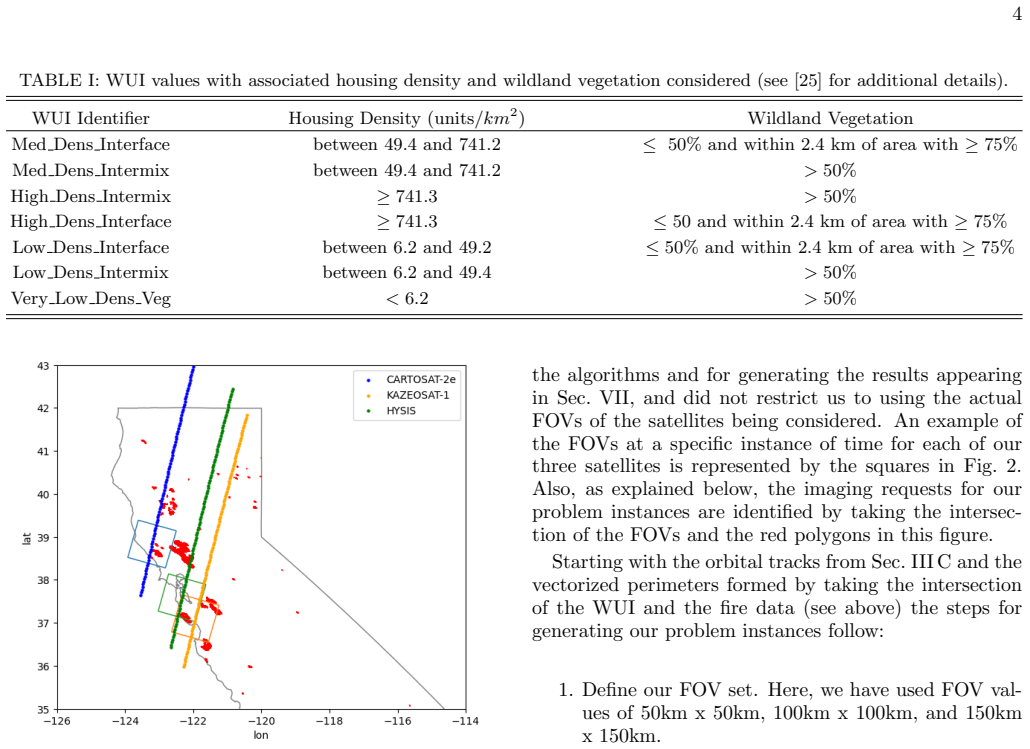
Determine if any of the vectorized perimeters formed from taking the intersection of our WUI and wildfire data intersect with the current FOV. If yes, storet, the satellite name, and vectorized perime- ter in our database of imaging requests that will be used for testing the algorithm. See the red poly- gons residing within the three rectangles in Fig. 2,...
-
[7]
Repeat Steps (3)-(6) until all FOVs have been pro- cessed. 5 IV. FORMULA TION OF THE SA TELLITE SCHEDULING PROBLEM Our formulation of the satellite scheduling problem into a quadratic unconstrained binary optimization prob- lem (QUBO) will closely follow the work of Naget al.[33] and later follow-ups [34–37]. QUBO problems are equivalent to classical Isin...
-
[8]
Select the node with the minimum degreed i (num- ber of edges connected to that node)
-
[9]
Add this node to the solution set, then remove it and all its neighbors from the graph
-
[10]
This method can be modified to a weighted case by re- placing degreed i with weighted degree, (di +1)/w i in the initial ranking
Repeat steps (1)-(2) until the graph is empty. This method can be modified to a weighted case by re- placing degreed i with weighted degree, (di +1)/w i in the initial ranking. B. QAOA QAOA which stands for either the Quantum Approx- imate Optimization Algorithm [7] or the Quantum Al- ternating Operator Ansatz [8] is a quantum optimization algorithm that ...
-
[11]
Run QAOA on the graph problem, optimizing an- gles, and calculate the expectation values D σ(z) i E for all the qubits
-
[12]
Select the node with the maximum expectation value D σ(z) i E
-
[13]
Add this node to the solution set and then remove it and all its neighbors from the graph
-
[14]
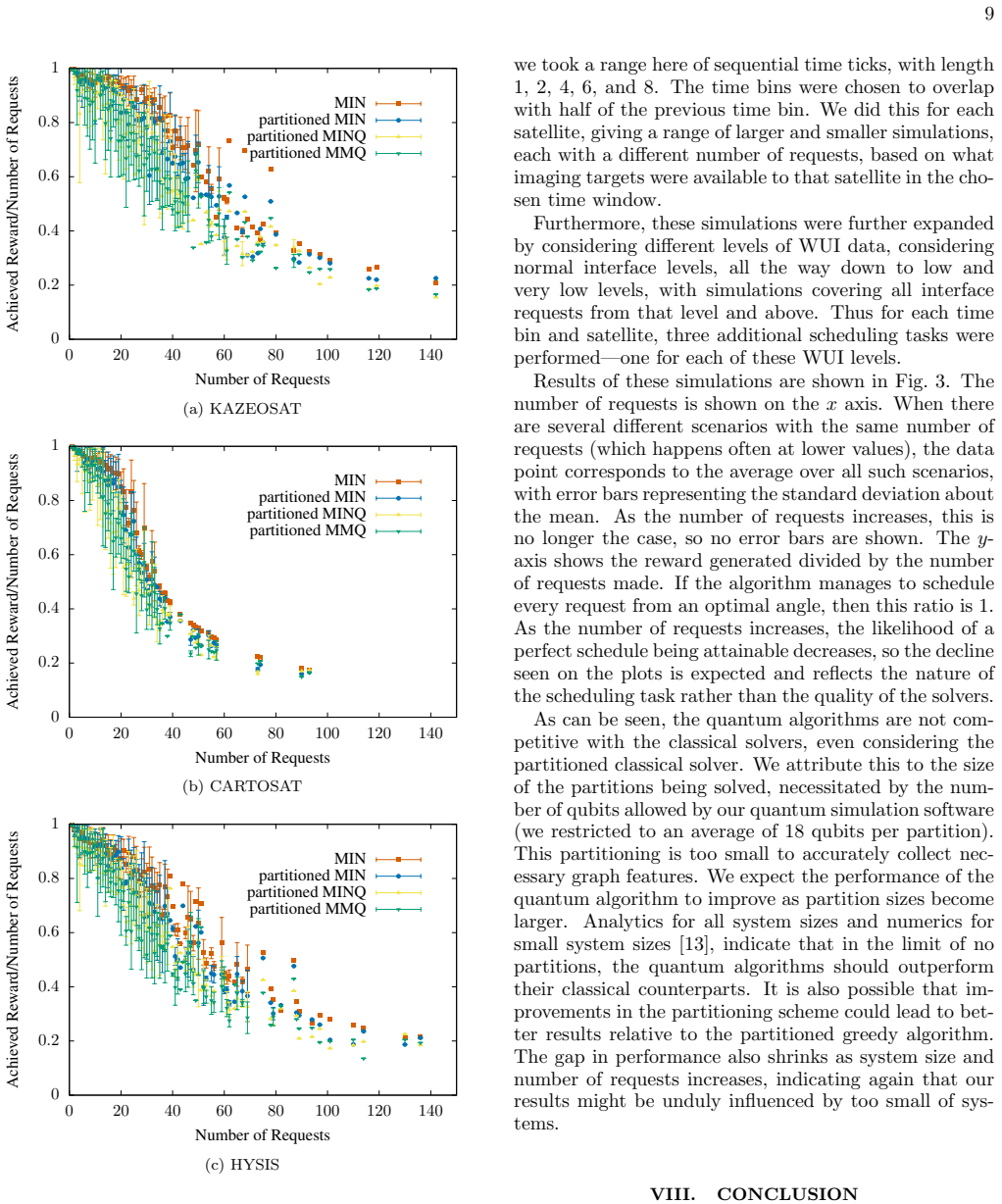
Repeat steps (1)-(3) until the graph is discon- nected, and add all remaining nodes to the solution set. In Ref. [13], it was shown that this algorithm for un- weighted MIS and ap= 1 QAOA circuit performs ex- actly the same as classical MIN. That work also showed some improvement of this algorithm over classical MIN forp >1 and weighted problems. Here, we...
-
[15]
Wilkinson, M
R. Wilkinson, M. Mleczko, R. Brewin, K. Gaston, M. Mueller, J. Shutler, X. Yan, and K. Anderson, Sci- ence of The Total Environment909, 168584 (2024), ISSN 0048-9697, URLhttps://www.sciencedirect.com/sc ience/article/pii/S0048969723072121
2024
-
[16]
Rep., United Nations Environment Programme, Nairobi (2022)
Tech. Rep., United Nations Environment Programme, Nairobi (2022)
2022
-
[17]
G. R. van der Werf, J. T. Randerson, L. Giglio, T. T. van Leeuwen, Y. Chen, B. M. Rogers, M. Mu, M. J. E. van Marle, D. C. Morton, G. J. Collatz, et al., Earth System Science Data9, 697 (2017), URLhttps://essd.coper nicus.org/articles/9/697/2017/
2017
-
[18]
S. H. Doerr and C. Sant´ ın, Philosophical Transactions of the Royal Society B: Biological Sciences371(2016), URLhttps://doi.org/10.1098/rstb.2015.0345
-
[19]
J. Paci, M. Newman, and T. Gage, Tech. Rep., Gordon and Betty Moore Foundation (2023), URLhttps://ww w.moore.org/docs/default-source/default-documen t-library/the-economic-fiscal-and-environmental -costs-of-wildfires-in-ca.pdf?sfvrsn=1b1b620c_0
2023
-
[20]
E. Farhi, J. Goldstone, S. Gutmann, and M. Sipser, arxiv (2000), quant-ph/0001106, URLhttps://arxiv.org/ab s/quant-ph/0001106
Pith/arXiv arXiv 2000
-
[21]
E. Farhi, J. Goldstone, and S. Gutmann,A quantum ap- proximate optimization algorithm(2014), URLhttps: //arxiv.org/abs/1411.4028
Pith/arXiv arXiv 2014
-
[22]
Hadfield, Z
S. Hadfield, Z. Wang, B. O'Gorman, E. Rieffel, D. Ven- turelli, and R. Biswas, Algorithms12, 34 (2019), URL https://doi.org/10.3390%2Fa12020034
2019
-
[23]
H. N. Djidjev, G. Chapuis, G. Hahn, and G. Rizk, arXiv preprint arXiv:1801.08653 (2018)
Pith/arXiv arXiv 2018
-
[24]
H. Yu, F. Wilczek, and B. Wu, Chinese Physics Letters 38, 030304 (2021)
2021
-
[25]
S. Ebadi, A. Keesling, M. Cain, T. T. Wang, H. Levine, D. Bluvstein, G. Semeghini, A. Omran, J.-G. Liu, R. Samajdar, et al., Science376, 1209–1215 (2022), ISSN 1095-9203, URLhttp://dx.doi.org/10.1126/science .abo6587
-
[26]
J. R. Finzgar, A. Kerschbaumer, M. J. A. Schuetz, C. B. Mendl, and H. G. Katzgraber,Quantum-informed recur- sive optimization algorithms(2023), 2308.13607
arXiv 2023
-
[27]
L. T. Brady and S. Hadfield (2023), 2309.13110
arXiv 2023
-
[28]
S. Bravyi, A. Kliesch, R. Koenig, and E. Tang, Phys. Rev. Lett.125, 260505 (2020), URLhttps://link.aps .org/doi/10.1103/PhysRevLett.125.260505
-
[29]
Bravyi, A
S. Bravyi, A. Kliesch, R. Koenig, and E. Tang, Quantum 6, 678 (2022), URLhttps://doi.org/10.22331%2Fq-2 022-03-30-678
2022
-
[30]
Z. Bian, F. Chudak, R. Israel, B. Lackey, W. Macready, and A. Roy, Frontiers in Physics2, 56 (2014)
2014
-
[31]
Z. Bian, F. Chudak, R. Israel, B. Lackey, W. G. Macready, and A. Roy,Mapping constrained optimiza- tion problems to quantum annealing with application to fault diagnosis(2016), 1603.03111
Pith/arXiv arXiv 2016
-
[32]
Lackey,A belief propagation algorithm based on do- main decomposition(2018), 1810.10005
B. Lackey,A belief propagation algorithm based on do- main decomposition(2018), 1810.10005
Pith/arXiv arXiv 2018
-
[33]
F. Li, X. Zhang, S. Kondragunta, C. C. Schmidt, and C. D. Holmes, Remote Sensing of Environment237, 111600 (2020), ISSN 0034-4257, URLhttps://www.scie ncedirect.com/science/article/pii/S0034425719306 11 200
2020
-
[34]
Y. Kang, E. Jang, J. Im, and C. Kwon, GIScience & Remote Sensing59, 2019 (2022)
2019
-
[35]
com/science/article/pii/S0034425721004144
Remote Sensing of Environment267, 112694 (2021), ISSN 0034-4257, URLhttps://www.sciencedirect. com/science/article/pii/S0034425721004144
2021
-
[36]
S. Kato, H. Miyamoto, S. Amici, A. Oda, H. Matsushita, and R. Nakamura, International Journal of Applied Earth Observation and Geoinformation103, 102491 (2021), ISSN 1569-8432, URLhttps://www.scienced irect.com/science/article/pii/S0303243421001987
2021
-
[37]
J. C. Mason, T. Holzmann, J. Swope, A. G. Davies, S. Chien, J. Mueting, T. Harrison, V. Shah, and J. Wal- ter, inIGARSS 2023 - 2023 IEEE International Geo- science and Remote Sensing Symposium(2023), pp. 829– 832
2023
-
[38]
Ignatenko, P
V. Ignatenko, P. Laurila, A. Radius, L. Lamentowski, O. Antropov, and D. Muff, inIGARSS 2020 - 2020 IEEE International Geoscience and Remote Sensing Sympo- sium(2020), pp. 3581–3584
2020
-
[39]
Radeloff, D
V. Radeloff, D. Helmers, M. H. Mockrin, A. R. Carl- son, T. J. Hawbaker, and S. Martinuzzi,The 1990- 2020 wildland-urban interface of the conterminous united states - geospatial data (4th edition)(2023), URLhttps: //www.fs.usda.gov/rds/archive/catalog/RDS-201 5-0012-4
1990
-
[40]
Koltunov, S
A. Koltunov, S. L. Ustin, and E. M. Prins, Remote Sens- ing of Environment127, 194 (2012), ISSN 0034-4257, URLhttps://www.sciencedirect.com/science/arti cle/pii/S0034425712003549
2012
-
[41]
T. J. Schmit, P. Griffith, M. M. Gunshor, J. M. Daniels, S. J. Goodman, and W. J. Lebair, Bulletin of the Ameri- can Meteorological Society98, 681 (2017), URLhttps: //journals.ametsoc.org/view/journals/bams/98/4/b ams-d-15-00230.1.xml
2017
-
[42]
C. C. Schmidt, J. Hoffman, E. Prins, and S. Lindstrom, Tech. Rep., NOAA NESDIS Center for Satellite Applica- tions and Research (2020), URLhttps://www.star.nes dis.noaa.gov/goesr/documents/ATBDs/Enterprise/AT BD_Enterprise_Fire_Hot_Spot_v2.7_2020-10-31.pdf. [29]U.S. Forest Service - Geospatial Data Discovery,https: //data-usfs.hub.arcgis.com/documents/780...
2020
-
[43]
D. E. Calkin, J. D. Cohen, M. A. Finney, and M. P. Thompson, Proceedings of the Na- tional Academy of Sciences111, 746 (2014), https://www.pnas.org/doi/pdf/10.1073/pnas.1315088111, URLhttps://www.pnas.org/doi/abs/10.1073/pnas. 1315088111
-
[44]
C. H. Acton, Planetary and Space Science44, 65 (1996), ISSN 0032-0633, planetary data system, URLhttps: //www.sciencedirect.com/science/article/pii/0032 063395001077
1996
-
[45]
Acton, N
C. Acton, N. Bachman, B. Semenov, and E. Wright, Planetary and Space Science150, 9 (2018), ISSN 0032- 0633, enabling Open and Interoperable Access to Plane- tary Science and Heliophysics Databases and Tools, URL https://www.sciencedirect.com/science/article/pi i/S0032063316303129
2018
-
[46]
S. Nag, A. S. Li, and J. H. Merrick, Advances in Space Research61, 891 (2018), ISSN 0273-1177, URLhttps: //www.sciencedirect.com/science/article/pii/S027 3117717308050
2018
-
[47]
T. Stollenwerk, V. Michaud, E. Lobe, M. Picard, A. Basermann, and T. Botter,Image acquisition planning for earth observation satellites with a quantum annealer (2020), 2006.09724
Pith/arXiv arXiv 2020
-
[48]
S. Rainjonneau, I. Tokarev, S. Iudin, S. Rayaprolu, K. Pinto, D. Lemtiuzhnikova, M. Koblan, E. Barashov, M. Kordzanganeh, M. Pflitsch, et al., IEEE Journal of Selected Topics in Applied Earth Observations and Re- mote Sensing16, 7062 (2023), URLhttps://doi.org/ 10.1109%2Fjstars.2023.3287154
arXiv 2023
-
[49]
A. Makarov, M. M. Taddei, E. Osaba, G. Franceschetto, E. Villar-Rodriguez, and I. Oregi,Optimization of image acquisition for earth observation satellites via quantum computing(2023), 2307.14419
arXiv 2023
-
[50]
N. Quetschlich, V. Koch, L. Burgholzer, and R. Wille, A hybrid classical quantum computing approach to the satellite mission planning problem(2023), 2308.00029
arXiv 2023
-
[51]
T. Kadowaki and H. Nishimori, Phys. Rev. E58, 5355 (1998), URLhttps://link.aps.org/doi/10.1103/Phy sRevE.58.5355
work page doi:10.1103/phy 1998
-
[52]
M. M. Halld´ orsson and J. Radhakrishnan, Algorithmica 18, 145 (1997), URLhttps://doi.org/10.1007/BF0252 3693
-
[53]
Y. J. Patel, S. Jerbi, T. B¨ ack, and V. Dunjko,Reinforce- ment learning assisted recursive qaoa(2022), 2207.06294
arXiv 2022
- [54]
-
[55]
S. Bravyi, G. Smith, and J. A. Smolin, Physical Review X6, 021043 (2016), 1506.01396
Pith/arXiv arXiv 2016
-
[56]
C. Piveteau and D. Sutter,Circuit knitting with classical communication(2023), 2205.00016
arXiv 2023
-
[57]
Sanders and C
P. Sanders and C. Schulz, inExperimental Algorithms, 12th International Symposium, SEA 2013, Rome, Italy, June 5-7, 2013. Proceedings(Springer, 2013), vol. 7933, pp. 164–175
2013
discussion (0)
Sign in with ORCID, Apple, or X to comment. Anyone can read and Pith papers without signing in.