Bending the Rules of Propagation: Caustic Beamforming for Next-Generation Wireless Systems
Pith reviewed 2026-06-27 08:28 UTC · model grok-4.3
The pith
Caustic beamforming lets wireless signals bend around obstacles to enhance security and reliability in future networks.
A machine-rendered reading of the paper's core claim, the machinery that carries it, and where it could break.
Core claim
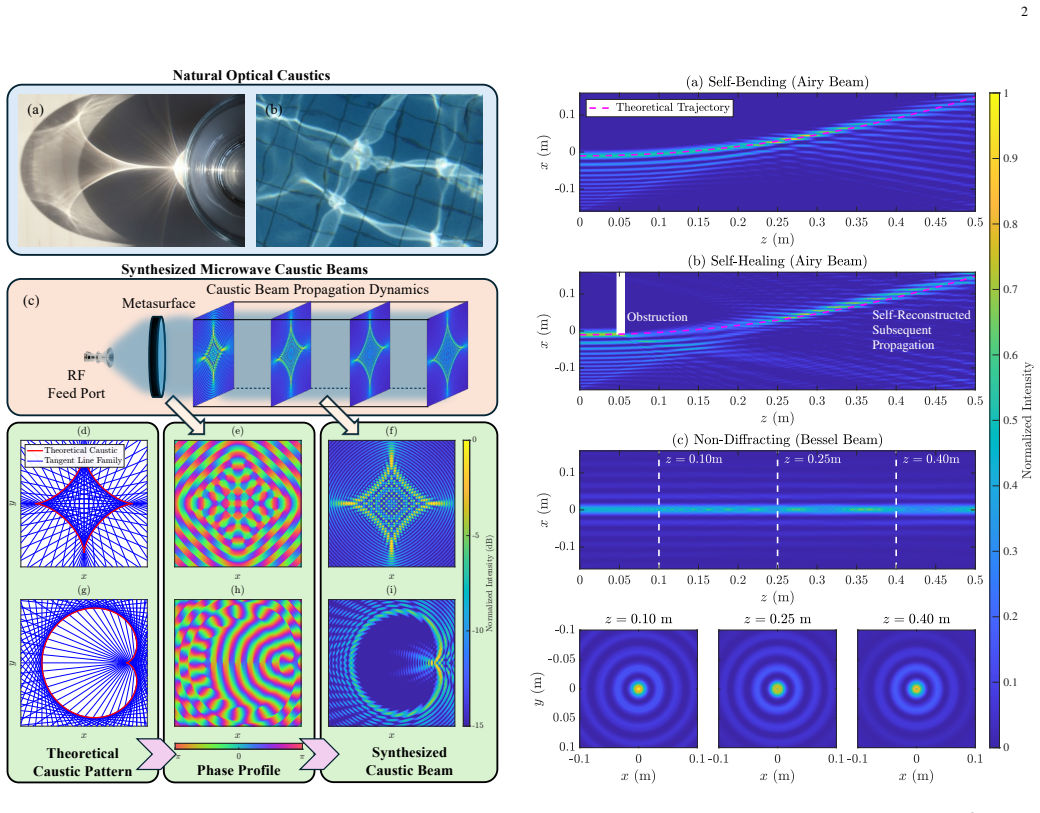
Caustic beamforming classifies beams according to mathematical origins and uses their self-bending, self-healing, and near-field non-diffracting properties to support applications in 6G networks, including bypassing eavesdroppers for physical layer security, achieving more uniform coverage, and sustaining blockage-resilient links, enabled by feasible hardware architectures.
What carries the argument
Caustic beams, generated from mathematical functions that produce curved intensity patterns with self-bending and self-healing traits, applied to electromagnetic wave control in wireless channels.
If this is right
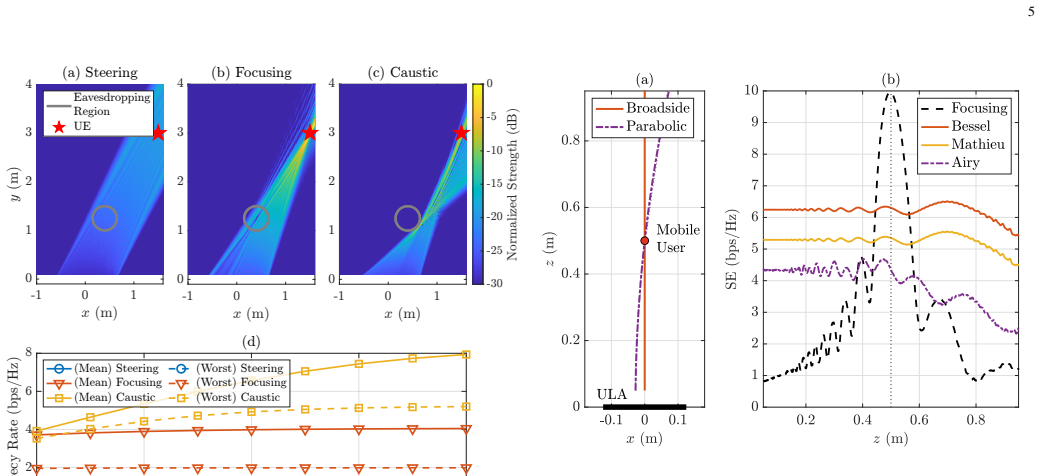
- Physical layer security improves because beams can be shaped to curve away from potential eavesdropper locations.
- Coverage becomes more uniform across an area because near-field non-diffracting behavior reduces rapid intensity falloff.
- Links remain operational after partial blockages because self-healing restores the beam intensity downstream.
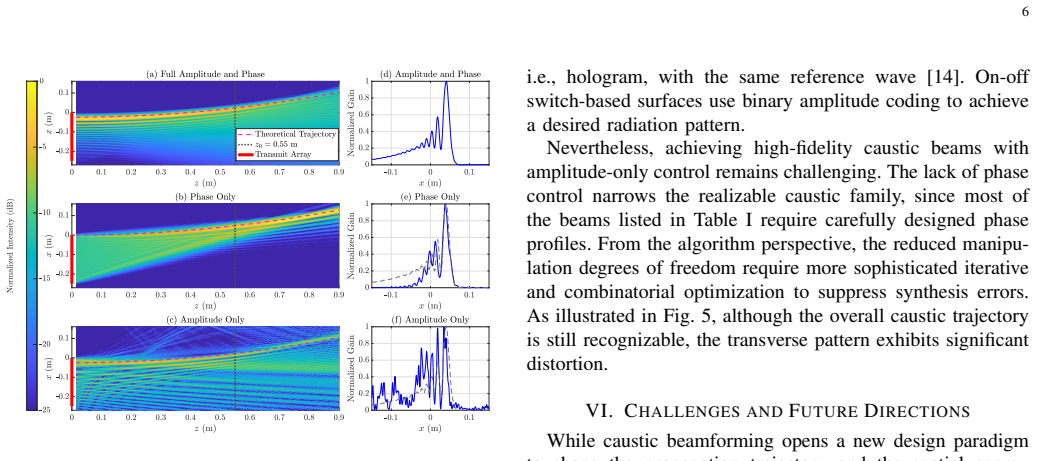
- Hardware such as phased arrays or reconfigurable surfaces can be used to realize the required beam patterns.
Where Pith is reading between the lines
- The same beam designs could be tested at millimeter-wave or terahertz frequencies where blockage effects are stronger.
- Hybrid systems might combine standard beam steering with caustic adjustments to handle both far-field and near-field scenarios.
- Control algorithms would need to solve for beam parameters in real time to maintain the desired caustic properties under mobility.
Load-bearing premise
The self-bending, self-healing, and non-diffracting traits established for caustic beams in optics can be generated and steered controllably in real wireless electromagnetic environments.
What would settle it
A controlled wireless experiment at typical RF frequencies that generates a designed caustic beam pattern but measures no measurable curvature in propagation path or recovery after a blockage compared with a standard beam.
Figures
read the original abstract
Conventional beamforming techniques primarily steer energy along desired directions or focus it at specific locations. These techniques become fragile when facing frequent blockage and highly dynamic propagation environments. In this article, we present caustic beamforming as a new paradigm for wireless beam control. First, we classify representative caustic beams according to their underlying mathematical origins and present three unique properties, namely self-bending, self-healing, and near-field non-diffracting. Building on these propagation properties, we then propose several application scenarios in sixth-generation (6G) networks. We undertake two case studies focused on physical layer security and service stability that highlight the capability of caustic beams to bypass potential eavesdroppers, deliver more uniform coverage, and sustain blockage-resilient links. We further discuss the enabling hardware architectures that facilitate practical deployments, and finally outline key open challenges regarding caustic beams that require further research.
Editorial analysis
A structured set of objections, weighed in public.
Referee Report
Summary. The manuscript proposes caustic beamforming as a new paradigm for wireless beam control in 6G networks. It classifies representative caustic beams by mathematical origin, presents the properties of self-bending, self-healing, and near-field non-diffracting behavior, outlines application scenarios, conducts two conceptual case studies on physical layer security and service stability, discusses enabling hardware architectures such as metasurfaces and phased arrays, and identifies open challenges.
Significance. If the claimed propagation properties can be realized and controlled in RF electromagnetic environments, the approach could enable new capabilities for blockage-resilient links and physical-layer security. The manuscript provides no electromagnetic derivations, full-wave simulations, measurements, or analysis of realistic propagation effects (multipath, material losses, far-field transition), so the significance remains prospective and dependent on future validation of the optics-to-wireless translation.
major comments (2)
- [Case Studies] Case Studies section: The claims that caustic beams can bypass eavesdroppers and deliver blockage-resilient links rest entirely on assumed persistence of the optical properties in wireless channels; no EM derivations, full-wave simulations, or multipath analysis are provided to show these properties survive in realistic propagation environments.
- [Hardware Architectures] Hardware Architectures section: The discussion of metasurfaces and phased arrays for generating caustic beams lacks specific phase-profile designs, control mechanisms, or references to existing RF implementations capable of producing the required non-standard wavefronts at millimeter-wave or sub-THz frequencies.
minor comments (1)
- [Abstract] The abstract states that three unique properties are presented but does not name them until later in the text; an explicit listing in the abstract would improve readability.
Simulated Author's Rebuttal
We thank the referee for the constructive feedback and for recognizing the prospective significance of caustic beamforming if the claimed properties can be realized in RF environments. We address each major comment below, clarifying the conceptual scope of the manuscript while agreeing to strengthen explicit caveats on validation needs.
read point-by-point responses
-
Referee: [Case Studies] Case Studies section: The claims that caustic beams can bypass eavesdroppers and deliver blockage-resilient links rest entirely on assumed persistence of the optical properties in wireless channels; no EM derivations, full-wave simulations, or multipath analysis are provided to show these properties survive in realistic propagation environments.
Authors: We agree that the case studies are illustrative and rest on the assumption that the self-bending, self-healing, and near-field non-diffracting properties translate from optics to RF channels. The manuscript frames these as conceptual demonstrations of potential 6G applications rather than validated performance results. We will revise the Case Studies section to add explicit statements that these scenarios assume persistence of the properties in realistic wireless environments (including multipath and material effects) and that full EM derivations, full-wave simulations, and propagation analysis are required for validation. This revision will align the presentation more closely with the prospective nature already noted in the abstract and introduction. revision: yes
-
Referee: [Hardware Architectures] Hardware Architectures section: The discussion of metasurfaces and phased arrays for generating caustic beams lacks specific phase-profile designs, control mechanisms, or references to existing RF implementations capable of producing the required non-standard wavefronts at millimeter-wave or sub-THz frequencies.
Authors: The Hardware Architectures section is intentionally high-level, outlining candidate technologies (metasurfaces, phased arrays) that could support the required wavefront control based on the mathematical origins of caustic beams presented earlier. We acknowledge the absence of specific phase-profile equations, control algorithms, or direct citations to mmWave/sub-THz implementations. We will revise the section to incorporate additional references to existing RF metasurface beam-shaping literature and to note that concrete phase-profile designs for caustic beams at these frequencies constitute an important open implementation challenge. A brief illustrative phase-profile example derived from one of the classified beam families will be added if space allows, while keeping the focus on the paradigm rather than hardware engineering details. revision: partial
Circularity Check
No significant circularity; claims rest on external mathematical origins from optics
full rationale
The paper classifies caustic beams by their mathematical origins (external to the work), states the three properties as established facts from prior domains, and then maps those properties to 6G use cases and hardware. No equations, parameter fits, or self-citations are shown that reduce any claimed prediction or uniqueness result back to the paper's own inputs by construction. The derivation chain is therefore independent of the present manuscript and scores at the low end of the allowed range.
Axiom & Free-Parameter Ledger
axioms (1)
- domain assumption Caustic beams exhibit self-bending, self-healing, and near-field non-diffracting propagation properties.
invented entities (1)
-
caustic beamforming paradigm
no independent evidence
Reference graph
Works this paper leans on
-
[1]
Recommendation ITU-R M.2160-0: Framework and overall objectives of the future development of IMT for 2030 and beyond,
ITU-R, “Recommendation ITU-R M.2160-0: Framework and overall objectives of the future development of IMT for 2030 and beyond,” ITU, Tech. Rep., Nov. 2023
2030
-
[2]
6G wireless communications: From far-field beam steering to near-field beam focusing,
H. Zhang, N. Shlezinger, F. Guidi, D. Dardari, and Y . C. Eldar, “6G wireless communications: From far-field beam steering to near-field beam focusing,”IEEE Commun. Mag., vol. 61, no. 4, pp. 72–77, Apr. 2023
2023
-
[3]
Curving THz wireless data links around obstacles,
H. Guerboukha, B. Zhao, Z. Fang, E. Knightly, and D. M. Mittleman, “Curving THz wireless data links around obstacles,”Comms. Eng., vol. 3, no. 1, p. 58, Mar. 2024
2024
-
[4]
Terahertz wireless data center: Gaussian beam or Airy beam?
W. Zhao, S. Abadal, G. Song, J. Jiang, and C. Han, “Terahertz wireless data center: Gaussian beam or Airy beam?”IEEE Trans. Wireless Commun., vol. 25, pp. 7922–7938, 2026
2026
-
[5]
Airy beams for near-field communications: Fundamentals, potentials, and limitations,
D. Darsena, F. Verde, M. D. Renzo, and V . Galdi, “Airy beams for near-field communications: Fundamentals, potentials, and limitations,”
-
[6]
Available: https://arxiv.org/abs/2508.13714
[Online]. Available: https://arxiv.org/abs/2508.13714
-
[7]
Shaping caustics into propagation-invariant light,
A. Zannotti, C. Denz, M. A. Alonso, and M. R. Dennis, “Shaping caustics into propagation-invariant light,”Nat. Commun., vol. 11, no. 1, p. 3597, July 2020
2020
-
[8]
Proportional phase modulation approach for steering of Airy beams,
J.-W. Hao, F. Deng, and K.-M. Luk, “Proportional phase modulation approach for steering of Airy beams,”IEEE Trans. Antennas Propag., vol. 73, no. 8, pp. 5360–5367, Aug. 2025
2025
-
[9]
Robust and secure near-field communi- cation via curved caustic beams,
S. Liu, X. Yu, and R. Schober, “Robust and secure near-field communi- cation via curved caustic beams,”IEEE Wireless Commun. Lett., vol. 15, pp. 3069–3073, May 2026
2026
-
[10]
IV catastrophe optics: Morphologies of caustics and their diffraction patterns,
M. Berry and C. Upstill, “IV catastrophe optics: Morphologies of caustics and their diffraction patterns,” inProgress in Optics, E. Wolf, Ed. Elsevier, 1980, vol. 18, pp. 257–346
1980
-
[11]
Light propagation with phase discontinuities: Generalized laws of reflection and refraction,
N. Yuet al., “Light propagation with phase discontinuities: Generalized laws of reflection and refraction,”Science, vol. 334, no. 6054, pp. 333– 337, Sept. 2011
2011
-
[12]
Throughput analysis for near-field mobile communications: Beamfocusing or caustic beamforming?
J. Wang, X. Yu, and R. Schober, “Throughput analysis for near-field mobile communications: Beamfocusing or caustic beamforming?” 2026. [Online]. Available: https://arxiv.org/abs/2606.09652
Pith/arXiv arXiv 2026
-
[13]
Bending beams for 6G near-field communications,
S. Droulias, G. Stratidakis, and A. Alexiou, “Bending beams for 6G near-field communications,”IEEE Trans. Wireless Commun., vol. 24, no. 2, pp. 1467–1480, Feb. 2025
2025
-
[14]
Programmable double traveling waves in living liquid crystals,
J. Wuet al., “Programmable double traveling waves in living liquid crystals,”Nat. Commun., vol. 16, no. 1, p. 10605, Dec. 2025
2025
-
[15]
Sensing- enhanced channel estimation for near-field XL-MIMO systems,
S. Liu, X. Yu, Z. Gao, J. Xu, D. W. K. Ng, and S. Cui, “Sensing- enhanced channel estimation for near-field XL-MIMO systems,”IEEE J. Sel. Areas Commun., vol. 43, no. 3, pp. 628–643, Mar. 2025
2025
-
[16]
A physics-informed Airy beam learning framework for blockage avoidance in sub-Terahertz wireless networks,
H. Chen, A. Kludze, and Y . Ghasempour, “A physics-informed Airy beam learning framework for blockage avoidance in sub-Terahertz wireless networks,”Nat. Commun., vol. 16, no. 1, p. 7387, Aug. 2025
2025
discussion (0)
Sign in with ORCID, Apple, or X to comment. Anyone can read and Pith papers without signing in.