Analytic structure of the QCD phase diagram in the complex-temperature plane
Pith reviewed 2026-06-27 08:36 UTC · model grok-4.3
The pith
Lattice data at zero density shows the nearest complex-temperature singularity in QCD has real part between chiral transition and susceptibility peak temperatures.
A machine-rendered reading of the paper's core claim, the machinery that carries it, and where it could break.
Core claim
Treating temperature as complex, the nearest singularities in the T-plane bound analyticity of observables. From lattice QCD at μ=0, the extracted continuum location has real part between the chiral-limit transition temperature and the physical-mass chiral-susceptibility peak temperature, with nonzero imaginary part. This matches expectations from universal scaling and is illustrated in effective models where trajectories in complex T and μ are related by the same scaling.
What carries the argument
Iterated conformal-Padé approximants that isolate the nearest Yang-Lee edge singularity from lattice data in the complex temperature plane.
If this is right
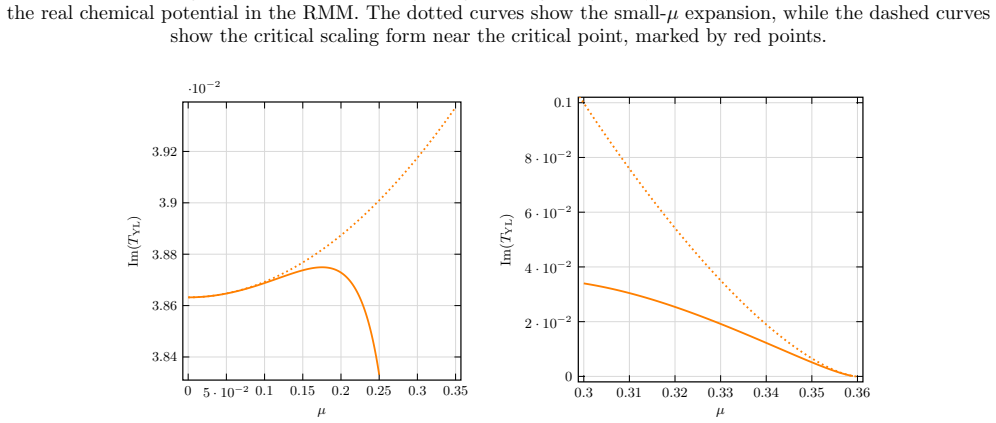
- The leading singularity admits an analytic expansion in μ² at small chemical potential.
- Near a critical point the trajectory crosses over to the Puiseux form of Ising scaling.
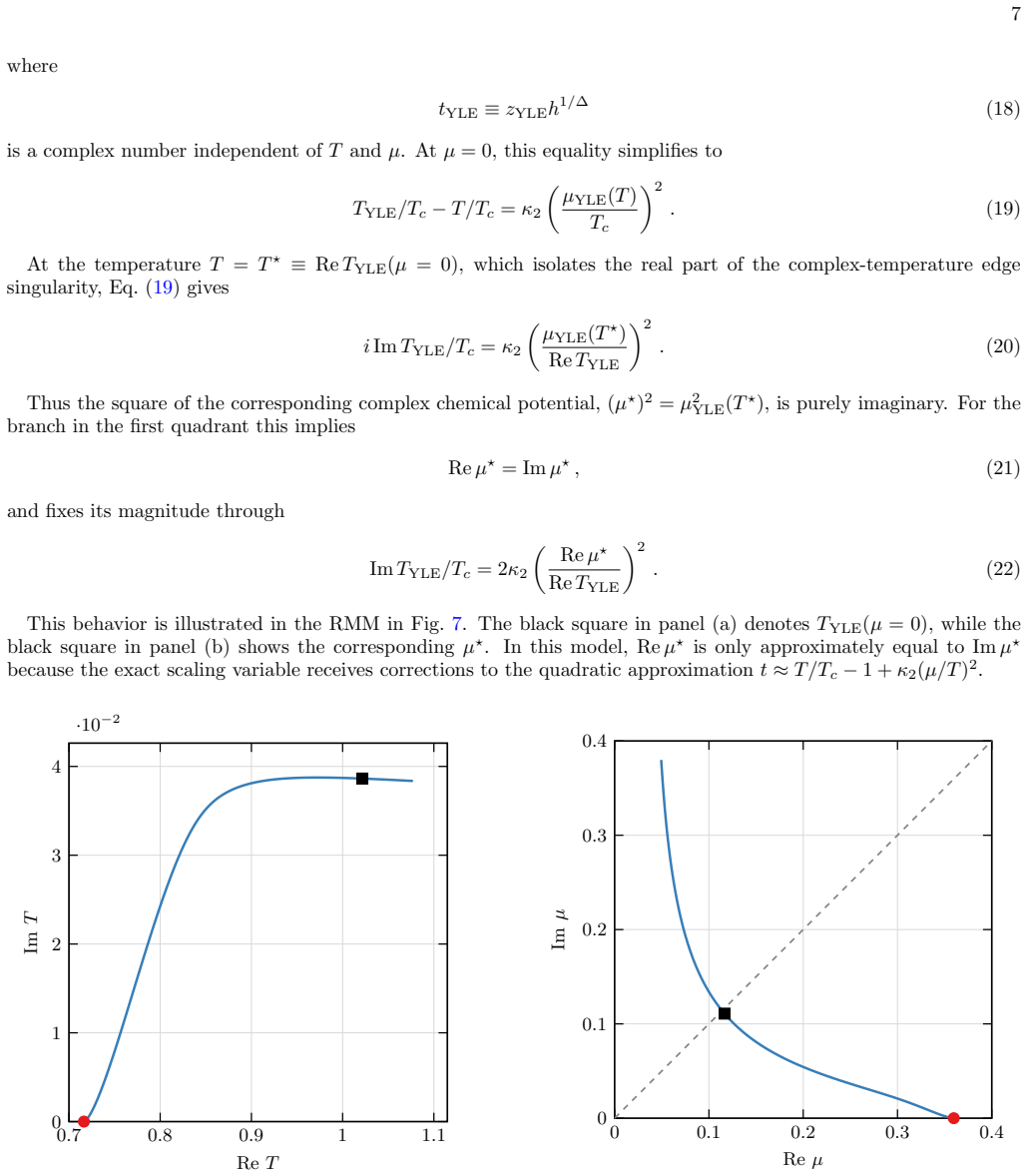
- Complex-T and complex-μ singularities are controlled by the same scaling variables and mapping coefficients.
- Comparison of the two provides a consistency test for critical-point searches.
Where Pith is reading between the lines
- This approach could be applied to data at small nonzero μ to map how the singularity moves.
- It suggests that the domain of analyticity in T shrinks as μ increases toward a critical point.
- The method offers an independent check on the location of any QCD critical point without directly simulating at finite density.
Load-bearing premise
The iterated conformal-Padé approximants correctly identify the position of the nearest singularity without bias from lattice artifacts or other singularities.
What would settle it
Higher statistics lattice simulations at finer spacings yielding a singularity whose real part lies outside the expected interval between the two temperatures would disprove the extracted location.
Figures




read the original abstract
We study the analytic structure of the QCD phase diagram by treating temperature as a complex variable. The nearest Yang-Lee edge singularities in the complex $T$ plane bound the domain of analyticity of temperature-dependent thermodynamic observables and complement the more commonly studied singularities in the complex chemical-potential plane. Our analysis combines three complementary perspectives: universal critical scaling, a first-principles extraction from lattice-QCD data, and explicit illustrations in effective models. We illustrate the resulting structure in a random-matrix model and in a quark-meson model, where the singularity trajectories can be followed explicitly. At small real chemical potential, the leading complex-temperature singularity admits an analytic expansion in $\mu^2$, while near a critical point it crosses over to the universal Puiseux form dictated by Ising critical scaling. We show that the complex-$T$ and complex-$\mu$ trajectories are controlled by the same scaling variables and mapping coefficients, so their comparison provides a stringent consistency test of critical-point searches and constrains the extent of the critical scaling regime. Finally, we analyze lattice-QCD data at $\mu=0$ using an iterated conformal-Pade approach and extract the continuum location of the nearest complex-temperature singularity. The result is consistent with the expectation that, at physical quark masses, the real part of the leading singularity lies between the chiral-limit transition temperature and the physical-mass chiral-susceptibility peak temperature, while its imaginary part remains nonzero.
Editorial analysis
A structured set of objections, weighed in public.
Referee Report
Summary. The paper examines the analytic structure of the QCD phase diagram by treating temperature as a complex variable and focusing on the nearest Yang-Lee edge singularities that bound the domain of analyticity of thermodynamic observables. It integrates three approaches: universal critical scaling near Ising points, explicit trajectory calculations in a random-matrix model and a quark-meson model, and a first-principles extraction of the leading complex-T singularity from lattice-QCD data at μ=0 via an iterated conformal-Padé procedure. The work derives an analytic expansion in μ² for the singularity at small real chemical potential, shows crossover to the universal Puiseux form near a critical point, demonstrates that complex-T and complex-μ trajectories share the same scaling variables, and reports a continuum-extrapolated singularity location whose real part lies between the chiral-limit transition temperature and the physical-mass susceptibility peak, with nonzero imaginary part.
Significance. If the lattice extraction is robust, the results supply a new, complementary diagnostic for the QCD phase diagram that can test consistency of critical-point searches and delimit the extent of the critical scaling regime. The model illustrations and the shared scaling structure between T and μ planes are useful for guiding future lattice analyses.
major comments (1)
- [abstract/final paragraph] Abstract, final paragraph: the central quantitative claim rests on the continuum location of the nearest complex-T singularity extracted from lattice-QCD data at μ=0 via iterated conformal-Padé approximants. No quantitative error analysis, validation against known singularities, or systematic-uncertainty assessment (farther singularities, discretization effects, fitting-window choice) is provided, leaving the reliability of the reported location and the consistency statement only partially supported.
Simulated Author's Rebuttal
We thank the referee for the careful reading and constructive feedback. We address the major comment below.
read point-by-point responses
-
Referee: [abstract/final paragraph] Abstract, final paragraph: the central quantitative claim rests on the continuum location of the nearest complex-T singularity extracted from lattice-QCD data at μ=0 via iterated conformal-Padé approximants. No quantitative error analysis, validation against known singularities, or systematic-uncertainty assessment (farther singularities, discretization effects, fitting-window choice) is provided, leaving the reliability of the reported location and the consistency statement only partially supported.
Authors: We agree that the manuscript would benefit from a more explicit quantitative error analysis and systematic-uncertainty assessment for the lattice extraction. In the revised version we will add a dedicated subsection that (i) reports bootstrap-based statistical uncertainties on the extracted singularity location, (ii) validates the iterated conformal-Padé procedure on synthetic data generated from the random-matrix and quark-meson models (where exact singularity positions are known), and (iii) quantifies systematic effects by varying the fitting window, examining the stability under inclusion of higher-order approximants (to bound contamination from farther singularities), and comparing results across the available lattice spacings before the continuum extrapolation. These additions will directly support the reliability of the reported continuum location and the consistency statements. revision: yes
Circularity Check
No significant circularity; extraction uses external lattice data
full rationale
The paper's derivation combines external lattice-QCD data at μ=0 (analyzed via iterated conformal-Padé), universal critical scaling from the literature, and independent explicit calculations in random-matrix and quark-meson models. The reported continuum singularity location is obtained directly from the external data set rather than from any parameter fitted within the paper or from a self-citation chain. No equation reduces the claimed location or its consistency statement to a quantity defined by the same inputs, and no load-bearing premise rests solely on an unverified self-citation. The central claim therefore remains self-contained against external benchmarks.
Axiom & Free-Parameter Ledger
axioms (2)
- domain assumption Thermodynamic observables are analytic in the complex temperature plane except at Yang-Lee edge singularities.
- domain assumption Ising universality class governs the critical scaling near the QCD critical point.
Reference graph
Works this paper leans on
-
[1]
M. A. Stephanov, QCD critical point and complex chemical potential singularities, Phys. Rev. D73, 094508 (2006), arXiv:hep-lat/0603014
Pith/arXiv arXiv 2006
-
[2]
X. An, D. Mesterh´ azy, and M. A. Stephanov, Functional renormalization group approach to the Yang-Lee edge singularity, JHEP07, 041, arXiv:1605.06039 [hep-th]
-
[3]
X. An, D. Mesterh´ azy, and M. A. Stephanov, On spinodal points and Lee-Yang edge singularities, J. Stat. Mech.1803, 033207 (2018), arXiv:1707.06447 [hep-th]
Pith/arXiv arXiv 2018
-
[4]
S. Mukherjee and V. Skokov, Universality driven analytic structure of the QCD crossover: radius of convergence in the baryon chemical potential, Phys. Rev. D103, L071501 (2021), arXiv:1909.04639 [hep-ph]
arXiv 2021
-
[5]
A. Connelly, G. Johnson, F. Rennecke, and V. Skokov, Universal Location of the Yang-Lee Edge Singularity inO(N) Theories, Phys. Rev. Lett.125, 191602 (2020), arXiv:2006.12541 [cond-mat.stat-mech]
arXiv 2020
-
[6]
F. Rennecke and V. V. Skokov, Universal location of Yang–Lee edge singularity for a one-component field theory in 1≤d≤4, Annals Phys.444, 169010 (2022), arXiv:2203.16651 [hep-ph]
arXiv 2022
-
[7]
G. Johnson, F. Rennecke, and V. V. Skokov, Universal location of Yang-Lee edge singularity in classic O(N) universality classes, Phys. Rev. D107, 116013 (2023), arXiv:2211.00710 [hep-ph]. 14
arXiv 2023
-
[8]
Basar, QCD critical point, Lee-Yang edge singularities, and Pad´ e resummations, Phys
G. Basar, QCD critical point, Lee-Yang edge singularities, and Pad´ e resummations, Phys. Rev. C110, 015203 (2024), arXiv:2312.06952 [hep-th]
arXiv 2024
- [9]
-
[10]
V. V. Skokov, Two lectures on Yang-Lee edge singularity and analytic structure of QCD equation of state, SciPost Phys. Lect. Notes91, 1 (2025), arXiv:2411.02663 [hep-ph]
arXiv 2025
-
[11]
T. Wada, M. Kitazawa, and K. Kanaya, Locating Critical Points Using Ratios of Lee-Yang Zeros, Phys. Rev. Lett.134, 162302 (2025), arXiv:2410.19345 [hep-lat]
arXiv 2025
- [12]
-
[13]
D. A. Clarke, P. Dimopoulos, F. Di Renzo, J. Goswami, C. Schmidt, S. Singh, and K. Zambello, Searching for the QCD critical end point using multipoint Pad´ e approximations, Phys. Rev. D112, L091504 (2025), arXiv:2405.10196 [hep-lat]
arXiv 2025
-
[14]
Z.-Y. Wan, Y. Lu, F. Gao, and Y.-X. Liu, Lee–Yang edge singularities in QCD via the Dyson–Schwinger equations, Eur. Phys. J. C84, 899 (2024), arXiv:2401.04957 [hep-ph]
arXiv 2024
-
[15]
A. Adam, S. Bors´ anyi, Z. Fodor, J. N. Guenther, P. Kumar, P. Parotto, A. P´ asztor, and C. H. Wong, High-precision baryon number cumulants from lattice QCD in a finite box: Cumulant ratios, Lee-Yang zeros, and critical endpoint predictions, Phys. Rev. D113, 074525 (2026), arXiv:2507.13254 [hep-lat]
arXiv 2026
-
[16]
Z.-y. Wan, Y. Lu, F. Gao, and Y.-x. Liu, Lee Yang edge singularities of QCD in association with the Roberge-Weiss and chiral phase transitions, Phys. Rev. D112, 094007 (2025), arXiv:2504.12964 [hep-ph]
arXiv 2025
-
[17]
T. Wada, M. Kitazawa, and K. Kanaya, Finite-size scaling of Lee-Yang zeros and its application to the 3-state Potts model and heavy-quark QCD, PoSLA TTICE2024, 167 (2025), arXiv:2501.18904 [hep-lat]
arXiv 2025
-
[18]
T. Wada, G. Kov´ acs, M. Kitazawa, and T. M. Doi, Lee-Yang zeros and edge singularity in a mean-field approach, (2026), arXiv:2605.19964 [hep-ph]
Pith/arXiv arXiv 2026
- [19]
-
[20]
A. M. Halasz, A. D. Jackson, R. E. Shrock, M. A. Stephanov, and J. J. M. Verbaarschot, On the phase diagram of QCD, Phys. Rev. D58, 096007 (1998), arXiv:hep-ph/9804290
Pith/arXiv arXiv 1998
-
[21]
S. Mukherjee, F. Rennecke, and V. V. Skokov, Analytical structure of the equation of state at finite density: Resummation versus expansion in a low energy model, Phys. Rev. D105, 014026 (2022), arXiv:2110.02241 [hep-ph]
arXiv 2022
-
[22]
V. Skokov, K. Morita, and B. Friman, Mapping the phase diagram of strongly interacting matter, Phys. Rev. D83, 071502 (2011), arXiv:1008.4549 [hep-ph]
Pith/arXiv arXiv 2011
-
[23]
V. Skokov, B. Friman, E. Nakano, K. Redlich, and B. J. Schaefer, Vacuum fluctuations and the thermodynamics of chiral models, Phys. Rev. D82, 034029 (2010), arXiv:1005.3166 [hep-ph]
Pith/arXiv arXiv 2010
-
[24]
H. Shah, M. Hippert, J. Noronha, C. Ratti, and V. Vovchenko, Lattice-based equation of state with a critical point from constant entropy contours and its comparison to effective QCD approaches, (2026), arXiv:2601.08823 [hep-ph]
arXiv 2026
-
[25]
H. T. Ding et al. (HotQCD), Chiral Phase Transition Temperature in ( 2+1 )-Flavor QCD, Phys. Rev. Lett.123, 062002 (2019), arXiv:1903.04801 [hep-lat]
arXiv 2019
-
[26]
O. Costin and G. V. Dunne, Uniformization and Constructive Analytic Continuation of Taylor Series, Commun. Math. Phys.392, 863 (2022), arXiv:2009.01962 [math.CV]
arXiv 2022
-
[27]
Basar, Universality, Lee-Yang Singularities, and Series Expansions, Phys
G. Basar, Universality, Lee-Yang Singularities, and Series Expansions, Phys. Rev. Lett.127, 171603 (2021), arXiv:2105.08080 [hep-th]
arXiv 2021
- [28]
-
[29]
We thank Szabolcs Bors´ anyi for generously providing the lattice QCD data from Ref. [32]
-
[30]
Y. Aoki, S. Borsanyi, S. Durr, Z. Fodor, S. D. Katz, S. Krieg, and K. K. Szabo, The QCD transition temperature: results with physical masses in the continuum limit II., JHEP06, 088, arXiv:0903.4155 [hep-lat]
-
[31]
A. Bazavov et al. (HotQCD), Chiral crossover in QCD at zero and non-zero chemical potentials, Phys. Lett. B795, 15 (2019), arXiv:1812.08235 [hep-lat]
arXiv 2019
-
[32]
S. Bors´ anyi, Z. Fodor, J. N. Guenther, R. Kara, S. D. Katz, P. Parotto, A. P´ asztor, C. Ratti, and K. K. Szab´ o, Lattice QCD equation of state at finite chemical potential from an alternative expansion scheme, Phys. Rev. Lett.126, 232001 (2021), arXiv:2102.06660 [hep-lat]
arXiv 2021
-
[33]
N. P. Landsman and C. G. van Weert, Real and Imaginary Time Field Theory at Finite Temperature and Density, Phys. Rept.145, 141 (1987)
1987
discussion (0)
Sign in with ORCID, Apple, or X to comment. Anyone can read and Pith papers without signing in.