Cluster Mass Inference from Galaxy Kinematics
Pith reviewed 2026-06-27 06:14 UTC · model grok-4.3
The pith
A neural network trained on simulations infers cluster masses from galaxy positions and velocities with half the usual scatter.
A machine-rendered reading of the paper's core claim, the machinery that carries it, and where it could break.
Core claim
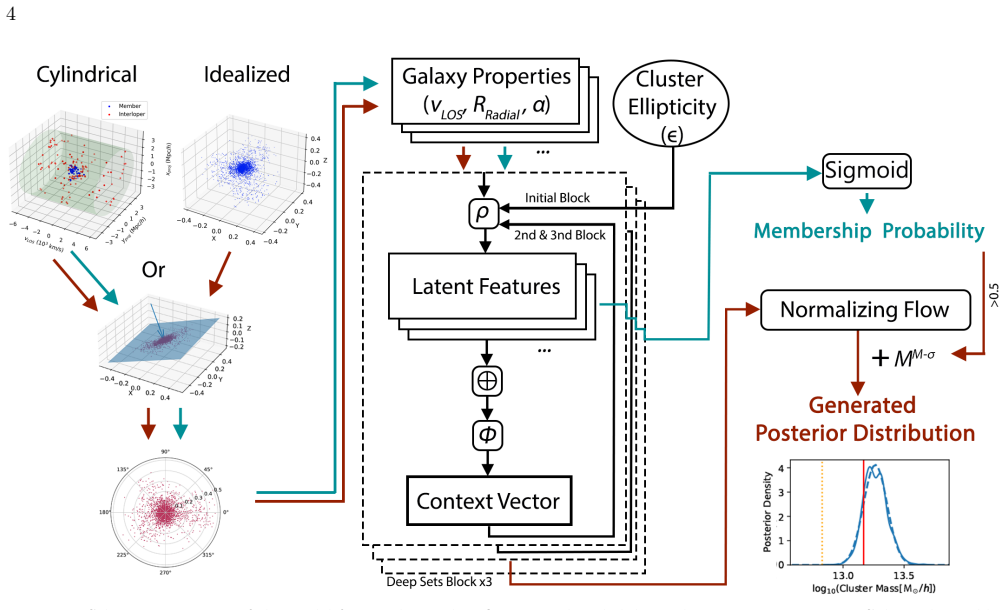
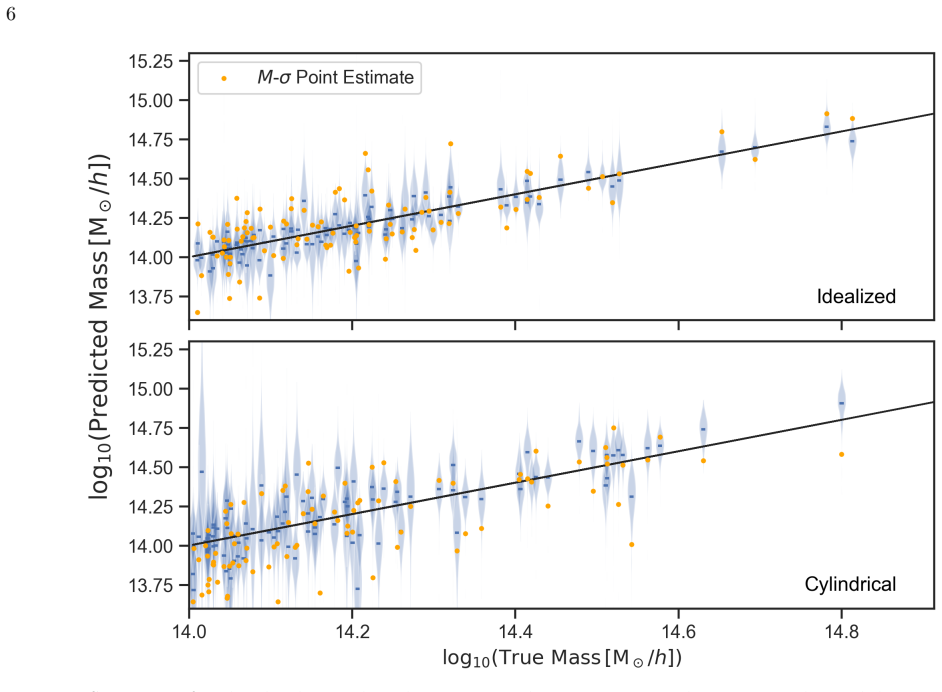
The central claim is that a permutation-invariant Deep Sets architecture combined with neural posterior estimation via normalizing flows recovers cluster masses by learning explicit residual corrections to the classical M-σ relation, reducing scatter to approximately 0.1 dex in idealized interloper-free cases and maintaining performance in realistic cylindrical observations at masses above 10^14.5 solar masses per h.
What carries the argument
Permutation-invariant Deep Sets architecture with normalizing-flow posterior estimation that isolates kinematic information beyond velocity dispersion.
If this is right
- Mass estimates improve enough to tighten cosmological constraints from upcoming cluster surveys.
- Full posterior outputs supply reliable uncertainty quantification for each cluster.
- Performance remains stable against interloper contamination in high-mass systems.
- The kinematic information content is saturated, establishing a baseline for later refinements.
Where Pith is reading between the lines
- The same set-based architecture could be retrained on other cluster observables such as richness or X-ray temperature to extract complementary information.
- Cross-validation against independent mock catalogs would test whether the learned corrections transfer beyond the training simulation.
- Deployment on wide-field surveys would allow direct tests of whether the reduced scatter improves dark-energy constraints from cluster abundance.
Load-bearing premise
The simulation used for training accurately captures how real galaxy positions and velocities relate to true cluster mass.
What would settle it
Applying the trained model to real observed clusters and checking whether the inferred masses match independent weak-lensing measurements to within the predicted 0.1 dex scatter.
Figures

read the original abstract
The masses of galaxy clusters carry cosmological and astrophysical information. We develop a simulation-based inference pipeline to infer cluster masses from full projected phase-space information of member and interloper galaxies. Our method combines a permutation-invariant Deep Sets architecture with neural posterior estimation using normalizing flows, enabling the recovery of expressive posterior distributions. We train the model to predict residual corrections to the classical $M$--$\sigma$ relation, thus explicitly isolating information beyond velocity dispersion. Using the Uchuu-UniverseMachine simulation, we evaluate the method under both idealized (interloper-free) and realistic (cylindrical) observational setups. In the idealized case, our model reduces the scatter in mass estimates to as low as $\sim 0.1$ dex, representing a twofold improvement over the traditional $M$--$\sigma$ relation. In the cylindrical setup, we achieve comparable performance at the high-mass end ($> 10^{14.5}\,M_\odot/h$), demonstrating robustness against interloper contamination. We demonstrate that set-based simulation-driven inference provides a powerful and flexible framework for galaxy cluster mass estimation, enabling improved accuracy and reliable uncertainty characterization for upcoming large-scale surveys. Our model saturates the kinematic information content and thus suggests a baseline for future studies.
Editorial analysis
A structured set of objections, weighed in public.
Referee Report
Summary. The manuscript presents a simulation-based inference pipeline combining a permutation-invariant Deep Sets architecture with neural posterior estimation via normalizing flows to infer galaxy cluster masses from projected phase-space data of member and interloper galaxies. The model is trained on the Uchuu-UniverseMachine simulation to predict residual corrections to the classical M–σ relation, with reported scatter reductions to ~0.1 dex (twofold improvement) in idealized interloper-free cases and comparable high-mass performance (>10^14.5 M_⊙/h) in realistic cylindrical setups.
Significance. If the simulation-based corrections generalize, the approach offers a flexible framework for more accurate mass estimates with reliable uncertainty quantification, leveraging full phase-space information beyond velocity dispersion alone. The explicit residual modeling and permutation-invariant architecture are methodological strengths that could serve as a baseline for future survey analyses.
major comments (1)
- [Abstract] Abstract and evaluation sections: all quantitative claims (including the ~0.1 dex scatter and twofold improvement) are obtained exclusively by training and testing on Uchuu-UniverseMachine mocks; the central claim of applicability to real clusters therefore rests on the untested assumption that the joint distribution p(phase-space, M_true) in this simulation—including galaxy formation physics, orbital distributions, projection effects, and interloper statistics—matches observations sufficiently closely for the learned corrections to remain valid. No cross-simulation validation or comparison to observed cluster samples is reported.
minor comments (1)
- Additional details on training procedure, validation splits, hyperparameter choices, and overfitting diagnostics would strengthen the soundness of the reported performance metrics.
Simulated Author's Rebuttal
We thank the referee for their careful reading and constructive comments on our manuscript. We address the major comment below, acknowledging the scope of our simulation-based study.
read point-by-point responses
-
Referee: [Abstract] Abstract and evaluation sections: all quantitative claims (including the ~0.1 dex scatter and twofold improvement) are obtained exclusively by training and testing on Uchuu-UniverseMachine mocks; the central claim of applicability to real clusters therefore rests on the untested assumption that the joint distribution p(phase-space, M_true) in this simulation—including galaxy formation physics, orbital distributions, projection effects, and interloper statistics—matches observations sufficiently closely for the learned corrections to remain valid. No cross-simulation validation or comparison to observed cluster samples is reported.
Authors: We agree that all reported quantitative results, including the scatter reduction to ~0.1 dex and the twofold improvement, are obtained exclusively from training and testing on Uchuu-UniverseMachine mocks. The manuscript does not include cross-simulation validation or direct comparisons to observed cluster samples. The work is presented as a simulation-based inference framework evaluated in controlled mock settings (both interloper-free and cylindrical), with the abstract and methods sections explicitly stating that the model is trained on this simulation. We do not claim that the learned corrections are directly applicable to real clusters; rather, the results demonstrate the information gain achievable within this simulation's joint distribution of phase-space and mass. This is a genuine limitation, as the validity for observations depends on the simulation's fidelity in galaxy formation, orbits, projections, and interlopers—an assumption not tested here. We will revise the abstract, introduction, and conclusions to more explicitly state that the performance metrics are simulation-specific and to emphasize the need for future cross-validation on other simulations and observational comparisons as next steps. revision: partial
Circularity Check
No significant circularity; performance gain is empirical evaluation on simulation test set
full rationale
The paper trains a permutation-invariant Deep Sets + NPE model on Uchuu-UniverseMachine mocks to output residual corrections to the classical M-σ relation and then measures the resulting scatter reduction (~0.1 dex, twofold improvement) by direct comparison against M-σ on held-out simulation realizations. This is a standard supervised-learning evaluation against an independent baseline on the same external data distribution; no equation reduces the reported improvement to a quantity defined by the model itself, no self-citation chain is load-bearing for the central claim, and no fitted parameter is renamed as a prediction. The derivation chain remains self-contained within the simulation-based framework.
Axiom & Free-Parameter Ledger
axioms (1)
- domain assumption The Uchuu-UniverseMachine simulation accurately represents the mapping from observed galaxy kinematics to true halo mass in the real universe.
Reference graph
Works this paper leans on
-
[1]
The SRG/eROSITA All-Sky Survey: Cosmology Constraints from Cluster Abundances in the Western Galactic Hemisphere. arXiv e-prints , keywords =. doi:10.48550/arXiv.2402.08458 , archivePrefix =. 2402.08458 , primaryClass =
-
[2]
Predicting dark matter halo masses from simulated galaxy images and environments. arXiv e-prints , keywords =. doi:10.48550/arXiv.2407.13735 , archivePrefix =. 2407.13735 , primaryClass =
-
[3]
Inferring the mass content of galaxy clusters with satellite kinematics and Jeans Anisotropic modeling. arXiv e-prints , keywords =. doi:10.48550/arXiv.2407.11721 , archivePrefix =. 2407.11721 , primaryClass =
-
[4]
Masses of Sunyaev-Zel'dovich Galaxy Clusters Detected by The Atacama Cosmology Telescope: Stacked Lensing Measurements with Subaru HSC Year 3 data. arXiv e-prints , keywords =. doi:10.48550/arXiv.2407.08201 , archivePrefix =. 2407.08201 , primaryClass =
-
[5]
How does the velocity anisotropy of halo stars, dark matter and satellite galaxies depend on host halo properties?. arXiv e-prints , keywords =. doi:10.48550/arXiv.2407.14827 , archivePrefix =. 2407.14827 , primaryClass =
-
[6]
A Robust and Efficient Deep Learning Method for Dynamical Mass Measurements of Galaxy Clusters. , keywords =. doi:10.3847/1538-4357/ab4f82 , archivePrefix =. 1902.05950 , primaryClass =
-
[7]
HaloFlow. I. Neural Inference of Halo Mass from Galaxy Photometry and Morphology. , keywords =. doi:10.3847/1538-4357/ad4344 , archivePrefix =. 2310.04503 , primaryClass =
-
[8]
The FLAMINGO Project: An assessment of the systematic errors in the predictions of models for galaxy cluster counts used to infer cosmological parameters. arXiv e-prints , keywords =. doi:10.48550/arXiv.2408.17217 , archivePrefix =. 2408.17217 , primaryClass =
-
[9]
The Uchuu-universe machine data set: galaxies in and around clusters. , keywords =. doi:10.1093/mnras/stac3514 , archivePrefix =. 2209.12918 , primaryClass =
-
[10]
The Rockstar Phase-Space Temporal Halo Finder and the Velocity Offsets of Cluster Cores
The ROCKSTAR Phase-space Temporal Halo Finder and the Velocity Offsets of Cluster Cores. , keywords =. doi:10.1088/0004-637X/762/2/109 , archivePrefix =. 1110.4372 , primaryClass =
work page internal anchor Pith review Pith/arXiv arXiv doi:10.1088/0004-637x/762/2/109
-
[11]
Astronomy and Computing , keywords =
C ^ 2 -GAME: Classification of cluster galaxy membership with machine learning. Astronomy and Computing , keywords =. doi:10.1016/j.ascom.2023.100743 , archivePrefix =. 2205.01700 , primaryClass =
-
[12]
UniverseMachine: The Correlation between Galaxy Growth and Dark Matter Halo Assembly from z=0-10
UNIVERSEMACHINE: The correlation between galaxy growth and dark matter halo assembly from z = 0-10. , keywords =. doi:10.1093/mnras/stz1182 , archivePrefix =. 1806.07893 , primaryClass =
work page internal anchor Pith review Pith/arXiv arXiv doi:10.1093/mnras/stz1182
-
[13]
Variational Inference with Normalizing Flows
Variational Inference with Normalizing Flows. arXiv e-prints , keywords =. doi:10.48550/arXiv.1505.05770 , archivePrefix =. 1505.05770 , primaryClass =
work page internal anchor Pith review Pith/arXiv arXiv doi:10.48550/arxiv.1505.05770
-
[14]
Pyro: Deep Universal Probabilistic Programming
Pyro: Deep Universal Probabilistic Programming. arXiv e-prints , keywords =. doi:10.48550/arXiv.1810.09538 , archivePrefix =. 1810.09538 , primaryClass =
work page internal anchor Pith review Pith/arXiv arXiv doi:10.48550/arxiv.1810.09538
-
[15]
40th International Conference on Machine Learning , keywords =
Sampling-Based Accuracy Testing of Posterior Estimators for General Inference. 40th International Conference on Machine Learning , keywords =. doi:10.48550/arXiv.2302.03026 , archivePrefix =. 2302.03026 , primaryClass =
-
[16]
Tracing cosmic evolution with clusters of galaxies , author =. Rev. Mod. Phys. , volume =. 2005 , month =. doi:10.1103/RevModPhys.77.207 , url =
-
[17]
Cosmological Parameters from Observations of Galaxy Clusters
Cosmological Parameters from Observations of Galaxy Clusters. , keywords =. doi:10.1146/annurev-astro-081710-102514 , archivePrefix =. 1103.4829 , primaryClass =
work page internal anchor Pith review Pith/arXiv arXiv doi:10.1146/annurev-astro-081710-102514
-
[18]
Cosmic Visions Dark Energy: Science
Cosmic Visions Dark Energy: Science. arXiv e-prints , keywords =. doi:10.48550/arXiv.1604.07626 , archivePrefix =. 1604.07626 , primaryClass =
work page internal anchor Pith review Pith/arXiv arXiv doi:10.48550/arxiv.1604.07626
-
[19]
Constraints on Cosmological Parameters from Future Galaxy Cluster Surveys
Constraints on Cosmological Parameters from Future Galaxy Cluster Surveys. , keywords =. doi:10.1086/320939 , archivePrefix =. astro-ph/0002336 , primaryClass =
work page internal anchor Pith review Pith/arXiv arXiv doi:10.1086/320939
-
[20]
The dynamical state and mass-concentration relation of galaxy clusters. , keywords =. doi:10.1111/j.1365-2966.2012.21892.x , archivePrefix =. 1206.1049 , primaryClass =
-
[21]
The mass-concentration relation in massive galaxy clusters at redshift ~1
The mass-concentration relation in massive galaxy clusters at redshift 1. , keywords =. doi:10.1093/mnras/stt1086 , archivePrefix =. 1306.6096 , primaryClass =
work page internal anchor Pith review Pith/arXiv arXiv doi:10.1093/mnras/stt1086
-
[22]
The Mass Profile and Accretion History of Cold Dark Matter Halos
The mass profile and accretion history of cold dark matter haloes. , keywords =. doi:10.1093/mnras/stt526 , archivePrefix =. 1302.0288 , primaryClass =
work page internal anchor Pith review Pith/arXiv arXiv doi:10.1093/mnras/stt526
-
[23]
, keywords =
Observation of the Coma cluster of galaxies with ROSAT during the all-sky-survey. , keywords =
-
[24]
Mantz, Adam B. and Allen, Steven W. and Morris, R. Glenn and von der Linden, Anja and Applegate, Douglas E. and Kelly, Patrick L. and Burke, David L. and Donovan, David and Ebeling, Harald , title =. Monthly Notices of the Royal Astronomical Society , volume =. 2016 , month =. doi:10.1093/mnras/stw2250 , url =
-
[25]
Chandra measurements of a complete sample of X-ray luminous galaxy clusters: the luminosity-mass relation. , keywords =. doi:10.1093/mnras/stw2621 , archivePrefix =. 1510.04270 , primaryClass =
work page internal anchor Pith review Pith/arXiv arXiv doi:10.1093/mnras/stw2621
-
[26]
Small-Scale Fluctuations of Relic Radiation. , keywords =. doi:10.1007/BF00653471 , adsurl =
-
[27]
Comments on Astrophysics and Space Physics , keywords =
The Observations of Relic Radiation as a Test of the Nature of X-Ray Radiation from the Clusters of Galaxies. Comments on Astrophysics and Space Physics , keywords =
-
[28]
Chandra Cluster Cosmology Project III: Cosmological Parameter Constraints
Chandra Cluster Cosmology Project III: Cosmological Parameter Constraints. , keywords =. doi:10.1088/0004-637X/692/2/1060 , archivePrefix =. 0812.2720 , primaryClass =
work page internal anchor Pith review Pith/arXiv arXiv doi:10.1088/0004-637x/692/2/1060
-
[29]
Constraints on Omega_m, Omega_L, and Sigma_8, from Galaxy Cluster Redshift Distributions
Constraints on _ m , _ , and _ 8 from Galaxy Cluster Redshift Distributions. , keywords =. doi:10.1086/324309 , archivePrefix =. astro-ph/0105396 , primaryClass =
work page internal anchor Pith review Pith/arXiv arXiv doi:10.1086/324309
-
[30]
Constraining dark energy with Sunyaev-Zel'dovich cluster surveys
Constraining Dark Energy with Sunyaev-Zel'dovich Cluster Surveys. , keywords =. doi:10.1103/PhysRevLett.88.231301 , archivePrefix =. astro-ph/0110353 , primaryClass =
work page internal anchor Pith review Pith/arXiv arXiv doi:10.1103/physrevlett.88.231301
-
[31]
Importance of Cluster Structural Evolution in Using X-Ray and Sunyaev-Zeldovich Effect Galaxy Cluster Surveys to Study Dark Energy. , keywords =. doi:10.1086/346179 , archivePrefix =. astro-ph/0208002 , primaryClass =
work page internal anchor Pith review Pith/arXiv arXiv doi:10.1086/346179
-
[32]
The Atacama Cosmology Telescope: A Catalog of >4000 Sunyaev-Zel dovich Galaxy Clusters. , keywords =. doi:10.3847/1538-4365/abd023 , archivePrefix =. 2009.11043 , primaryClass =
-
[33]
Correlations of Richness and Global Properties in Galaxy Clusters
Correlations of Richness and Global Properties in Galaxy Clusters. , keywords =. doi:10.1086/345929 , archivePrefix =. astro-ph/0211096 , primaryClass =
work page internal anchor Pith review Pith/arXiv arXiv doi:10.1086/345929
-
[34]
Weighing the Giants - III. Methods and Measurements of Accurate Galaxy Cluster Weak-Lensing Masses
Weighing the Giants - III. Methods and measurements of accurate galaxy cluster weak-lensing masses. , keywords =. doi:10.1093/mnras/stt2129 , archivePrefix =. 1208.0605 , primaryClass =
work page internal anchor Pith review Pith/arXiv arXiv doi:10.1093/mnras/stt2129
-
[35]
Dark Energy Survey Year 1 Results: Weak Lensing Mass Calibration of redMaPPer Galaxy Clusters
Dark Energy Survey Year 1 results: weak lensing mass calibration of redMaPPer galaxy clusters. , keywords =. doi:10.1093/mnras/sty2711 , archivePrefix =. 1805.00039 , primaryClass =
work page internal anchor Pith review Pith/arXiv arXiv doi:10.1093/mnras/sty2711
-
[36]
Helvetica Physica Acta , year = 1933, month = jan, volume =
Die Rotverschiebung von extragalaktischen Nebeln. Helvetica Physica Acta , year = 1933, month = jan, volume =
1933
-
[37]
Galaxy Cluster Mass Reconstruction Project: I. Methods and first results on galaxy-based techniques
Galaxy cluster mass reconstruction project - I. Methods and first results on galaxy-based techniques. , keywords =. doi:10.1093/mnras/stu545 , archivePrefix =. 1403.4610 , primaryClass =
work page internal anchor Pith review Pith/arXiv arXiv doi:10.1093/mnras/stu545
-
[38]
and Diaferio, Antonaldo and Rines, Kenneth J
Geller, Margaret J. and Diaferio, Antonaldo and Rines, Kenneth J. and Serra, Ana Laura , title =. The Astrophysical Journal , abstract =. 2013 , month =. doi:10.1088/0004-637X/764/1/58 , url =
-
[39]
Dynamical Mass Measurements of Contaminated Galaxy Clusters Using Machine Learning
Dynamical Mass Measurements of Contaminated Galaxy Clusters Using Machine Learning. , keywords =. doi:10.3847/0004-637X/831/2/135 , archivePrefix =. 1509.05409 , primaryClass =
work page internal anchor Pith review Pith/arXiv arXiv doi:10.3847/0004-637x/831/2/135
-
[40]
A Deep Learning Approach to Galaxy Cluster X-ray Masses
A Deep Learning Approach to Galaxy Cluster X-Ray Masses. , keywords =. doi:10.3847/1538-4357/ab14eb , archivePrefix =. 1810.07703 , primaryClass =
work page internal anchor Pith review Pith/arXiv arXiv doi:10.3847/1538-4357/ab14eb
-
[41]
Simulation-based inference of dynamical galaxy cluster masses with 3D convolutional neural networks. , keywords =. doi:10.1093/mnras/staa3922 , archivePrefix =. 2009.03340 , primaryClass =
-
[42]
Mass Estimation of Galaxy Clusters with Deep Learning. I. Sunyaev-Zel'dovich Effect. , keywords =. doi:10.3847/1538-4357/aba694 , archivePrefix =. 2003.06135 , primaryClass =
-
[43]
Cosmic Microwave Background Cluster Lensing
Mass Estimation of Galaxy Clusters with Deep Learning II. Cosmic Microwave Background Cluster Lensing. , keywords =. doi:10.3847/1538-4357/ac32d0 , archivePrefix =. 2005.13985 , primaryClass =
-
[44]
Approximate Bayesian Uncertainties on Deep Learning Dynamical Mass Estimates of Galaxy Clusters. , keywords =. doi:10.3847/1538-4357/abd101 , archivePrefix =. 2006.13231 , primaryClass =
-
[45]
The dynamical mass of the Coma cluster from deep learning. Nature Astronomy , keywords =. doi:10.1038/s41550-022-01711-1 , archivePrefix =. 2206.14834 , primaryClass =
-
[46]
Benchmarks and explanations for deep learning estimates of X-ray galaxy cluster masses. , keywords =. doi:10.1093/mnras/stad2005 , archivePrefix =. 2303.00005 , primaryClass =
-
[47]
Galaxy cluster mass estimation with deep learning and hydrodynamical simulations. , keywords =. doi:10.1093/mnras/staa3030 , archivePrefix =. 2005.11819 , primaryClass =
-
[48]
Estimating Dark Matter Halo Masses in Simulated Galaxy Clusters with Graph Neural Networks. arXiv e-prints , keywords =. doi:10.48550/arXiv.2411.12629 , archivePrefix =. 2411.12629 , primaryClass =
-
[49]
HaloFlow II: Robust Galaxy Halo Mass Inference with Domain Adaptation. arXiv e-prints , keywords =. doi:10.48550/arXiv.2603.12380 , archivePrefix =. 2603.12380 , primaryClass =
-
[50]
Machine-learning Cosmology from Void Properties. , keywords =. doi:10.3847/1538-4357/aceaf6 , archivePrefix =. 2212.06860 , primaryClass =
-
[51]
Machine Learning: Science and Technology , keywords =
Predicting the thermal Sunyaev-Zel'dovich field using modular and equivariant set-based neural networks. Machine Learning: Science and Technology , keywords =. doi:10.1088/2632-2153/ac78c2 , archivePrefix =. 2203.00026 , primaryClass =
-
[52]
Quijote-PNG: The Information Content of the Halo Mass Function. , keywords =. doi:10.3847/1538-4357/acfe70 , archivePrefix =. 2305.10597 , primaryClass =
-
[53]
Robust Field-level Likelihood-free Inference with Galaxies. , keywords =. doi:10.3847/1538-4357/acd1e2 , archivePrefix =. 2302.14101 , primaryClass =
-
[54]
Proceedings of the National Academy of Sciences , volume =
Kyle Cranmer and Johann Brehmer and Gilles Louppe , title =. Proceedings of the National Academy of Sciences , volume =. 2020 , doi =
2020
-
[55]
Proceedings of the 36th International Conference on Machine Learning , pages =
Automatic Posterior Transformation for Likelihood-Free Inference , author =. Proceedings of the 36th International Conference on Machine Learning , pages =. 2019 , editor =
2019
-
[56]
Flexible statistical inference for mechanistic models of neural dynamics , url =
Lueckmann, Jan-Matthis and Goncalves, Pedro J and Bassetto, Giacomo and \". Flexible statistical inference for mechanistic models of neural dynamics , url =. Advances in Neural Information Processing Systems , editor =
-
[57]
Fast -free Inference of Simulation Models with Bayesian Conditional Density Estimation , url =
Papamakarios, George and Murray, Iain , booktitle =. Fast -free Inference of Simulation Models with Bayesian Conditional Density Estimation , url =
-
[58]
Neural Spline Flows. arXiv e-prints , keywords =. doi:10.48550/arXiv.1906.04032 , archivePrefix =. 1906.04032 , primaryClass =
-
[59]
Invertible Generative Modeling using Linear Rational Splines. arXiv e-prints , keywords =. doi:10.48550/arXiv.2001.05168 , archivePrefix =. 2001.05168 , primaryClass =
-
[60]
Identification of members in the central and outer regions of galaxy clusters
Identification of Members in the Central and Outer Regions of Galaxy Clusters. , keywords =. doi:10.1088/0004-637X/768/2/116 , archivePrefix =. 1211.3669 , primaryClass =
work page internal anchor Pith review Pith/arXiv arXiv doi:10.1088/0004-637x/768/2/116
-
[61]
A Deep Redshift Survey of the Perseus Cluster (A426): Spatial Distribution and Kinematics of Galaxies. , keywords =. doi:10.3847/1538-4365/ad390d , archivePrefix =. 2403.19307 , primaryClass =
-
[62]
Dark Energy Survey Year 1 Results: Cosmological constraints from cluster abundances and weak lensing. , keywords =. doi:10.1103/PhysRevD.102.023509 , archivePrefix =. 2002.11124 , primaryClass =
-
[63]
Cosmological parameters constraints from galaxy cluster mass function measurements in combination with other cosmological data. Astronomy Letters , keywords =. doi:10.1134/S1063773712060011 , archivePrefix =. 1202.2889 , primaryClass =
work page internal anchor Pith review Pith/arXiv arXiv doi:10.1134/s1063773712060011
-
[64]
Weighing the Giants IV: Cosmology and Neutrino Mass
Weighing the giants - IV. Cosmology and neutrino mass. , keywords =. doi:10.1093/mnras/stu2096 , archivePrefix =. 1407.4516 , primaryClass =
work page internal anchor Pith review Pith/arXiv arXiv doi:10.1093/mnras/stu2096
-
[65]
New constraints on $f(R)$ gravity from clusters of galaxies
New constraints on f(R) gravity from clusters of galaxies. , keywords =. doi:10.1103/PhysRevD.92.044009 , archivePrefix =. 1412.0133 , primaryClass =
work page internal anchor Pith review Pith/arXiv arXiv doi:10.1103/physrevd.92.044009
-
[66]
arXiv e-prints , keywords =
Inferring Halo Mass and Scale Radius of Galaxy Clusters Using Convolutional Neural Networks and Uchuu-UniverseMachine Catalogs. arXiv e-prints , keywords =
-
[67]
Zaheer, Manzil and Kottur, Satwik and Ravanbakhsh, Siamak and Poczos, Barnabas and Salakhutdinov, Ruslan and Smola, Alexander , year =. Deep. arXiv e-prints , pages =
-
[68]
Machine Learning Techniques for Astrophysics and Cosmology: Simulation-Based Inference
Machine Learning Techniques for Astrophysics and Cosmology: Simulation-Based Inference. arXiv e-prints , keywords =. doi:10.48550/arXiv.2605.10719 , archivePrefix =. 2605.10719 , primaryClass =
work page internal anchor Pith review Pith/arXiv arXiv doi:10.48550/arxiv.2605.10719
-
[69]
The Uchuu simulations: Data Release 1 and dark matter halo concentrations. , keywords =. doi:10.1093/mnras/stab1755 , archivePrefix =. 2007.14720 , primaryClass =
-
[70]
Constraining neutrino properties with a Euclid-like galaxy cluster survey
Constraining neutrino properties with a Euclid-like galaxy cluster survey. , keywords =. doi:10.1088/1475-7516/2013/06/020 , archivePrefix =. 1303.4550 , primaryClass =
work page internal anchor Pith review Pith/arXiv arXiv doi:10.1088/1475-7516/2013/06/020 2013
-
[71]
The observed growth of massive galaxy clusters - IV. Robust constraints on neutrino properties. , keywords =. doi:10.1111/j.1365-2966.2010.16794.x , archivePrefix =. 0911.1788 , primaryClass =
-
[72]
Constraints on Cosmology from the Cosmic Microwave Background Power Spectrum of the 2500 deg ^ 2 SPT-SZ Survey. , keywords =. doi:10.1088/0004-637X/782/2/74 , archivePrefix =. 1212.6267 , primaryClass =
work page internal anchor Pith review Pith/arXiv arXiv doi:10.1088/0004-637x/782/2/74
-
[73]
Possible indication for non-zero neutrino mass and additional neutrino species from cosmological observations. Astronomy Letters , keywords =. doi:10.1134/S1063773713060030 , archivePrefix =. 1301.4791 , primaryClass =
work page internal anchor Pith review Pith/arXiv arXiv doi:10.1134/s1063773713060030
-
[74]
Improved Cosmological Constraints from SDSS redMaPPer Clusters via X-ray Follow-up of a Complete Subsample of Systems. arXiv e-prints , keywords =. doi:10.48550/arXiv.1910.13548 , archivePrefix =. 1910.13548 , primaryClass =
-
[75]
Cosmological constraints from the abundance, weak lensing, and clustering of galaxy clusters: Application to the SDSS. , keywords =. doi:10.1051/0004-6361/202348296 , archivePrefix =. 2310.09146 , primaryClass =
-
[76]
Multiprobe cosmology from the abundance of SPT clusters and DES galaxy clustering and weak lensing. , keywords =. doi:10.1103/PhysRevD.111.063533 , archivePrefix =. 2412.07765 , primaryClass =
-
[77]
Concentrations of Dark Halos from their Assembly Histories
Concentrations of Dark Halos from Their Assembly Histories. , keywords =. doi:10.1086/338765 , archivePrefix =. astro-ph/0108151 , primaryClass =
work page internal anchor Pith review Pith/arXiv arXiv doi:10.1086/338765
-
[78]
The statistics of CDM halo concentrations. , keywords =. doi:10.1111/j.1365-2966.2007.12381.x , archivePrefix =. 0706.2919 , primaryClass =
-
[79]
Dynamical state for 964 galaxy clusters from Chandra X-ray images. , keywords =. doi:10.1093/mnras/staa2363 , archivePrefix =. 2008.01299 , primaryClass =
-
[80]
On the connection between giant radio halos and cluster mergers
On the Connection Between Giant Radio Halos and Cluster Mergers. , keywords =. doi:10.1088/2041-8205/721/2/L82 , archivePrefix =. 1008.3624 , primaryClass =
work page internal anchor Pith review Pith/arXiv arXiv doi:10.1088/2041-8205/721/2/l82 2041
discussion (0)
Sign in with ORCID, Apple, or X to comment. Anyone can read and Pith papers without signing in.