Hamiltonian-Aware ADAPT Variational Quantum Eigensolver for Molecular Ground-State Simulation
Pith reviewed 2026-06-27 06:34 UTC · model grok-4.3
The pith
A Hamiltonian-aware selection criterion and adaptive pruning let ADAPT-VQE build smaller, more accurate ansatze for molecular ground states without added cost.
A machine-rendered reading of the paper's core claim, the machinery that carries it, and where it could break.
Core claim
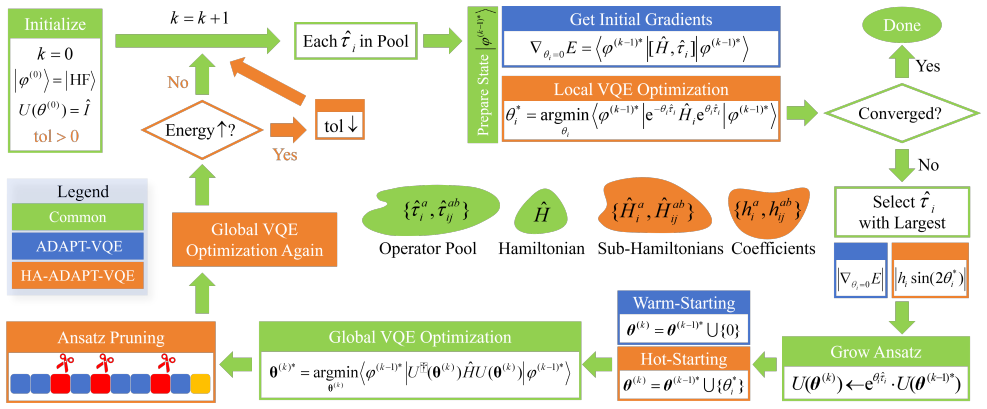
The Hamiltonian-Aware ADAPT-VQE establishes a novel excitation operator selection criterion that incorporates Hamiltonian information to break the local constraint of prior criteria, prioritizes meaningful operators at no extra cost, and pairs it with a problem-adaptive pruning method that removes redundant operators while guaranteeing convergence for ansatze of any scale; systematic tests on strongly correlated molecules confirm the method avoids energy plateaus and improves energy error, ansatz size, and measurement cost over baseline ADAPT-VQE.
What carries the argument
The Hamiltonian-aware excitation operator selection criterion combined with problem-adaptive pruning of redundant operators.
If this is right
- Avoids energy plateaus that stall optimization in adaptive VQE.
- Produces ansatze with fewer operators for the same target accuracy.
- Reduces the number of measurements needed during the variational loop.
- Maintains convergence guarantees while pruning for ansatze of arbitrary size.
Where Pith is reading between the lines
- The pruning rule could be tested on other adaptive variational algorithms that build circuits operator by operator.
- Lower measurement cost may allow the method to scale to slightly larger molecules before decoherence becomes limiting.
- The selection criterion might be combined with different gradient or energy estimators without changing the core overhead claim.
Load-bearing premise
That folding Hamiltonian information into the selection rule and pruning redundant operators will reliably break local constraints and maintain convergence without extra overhead or loss of accuracy.
What would settle it
Systematic runs on the same set of strongly correlated molecules that show persistent energy plateaus, larger ansatze, or higher measurement counts than standard ADAPT-VQE would falsify the performance claims.
Figures



read the original abstract
Designing compact ans\"atze in Variational Quantum Eigensolver (VQE) is crucial for solving energetic problems of practical molecules on near-term quantum devices. However, existing Adaptive Derivative-Assembled Pseudo-Trotter (ADAPT) ans\"atze face two challenges: improper operator selection and accumulation of degraded operators. In this paper, we propose the Hamiltonian-Aware (HA) ADAPT-VQE algorithm to address these issues. First, we establish a novel excitation operator selection criterion. It breaks the local constraint of existing criteria by incorporating Hamiltonian information, prioritizes physically meaningful excitation operators, and incurs no extra classical or quantum computational overhead. Furthermore, we develop a problem-adaptive method for discriminating and pruning redundant excitation operators stemming from improper selection and inevitable degradation. This method balances redundant operator pruning and convergence guarantee, and is applicable to ans\"atze with arbitrary scales. Systematic numerical experiments on typical strongly correlated molecular systems demonstrate that our HA-ADAPT-VQE avoids energy plateaus and outperforms baseline algorithms in terms of energy error, ansatz size, and measurement cost. This work offers an efficient, robust ansatz construction paradigm, facilitating the development and practical deployment of large-scale VQE in quantum chemistry.
Editorial analysis
A structured set of objections, weighed in public.
Referee Report
Summary. The manuscript proposes the Hamiltonian-Aware ADAPT-VQE (HA-ADAPT-VQE) algorithm to improve ansatz construction in adaptive VQE for molecular ground-state problems. It introduces a new excitation operator selection criterion that incorporates Hamiltonian information to prioritize physically relevant operators without added classical or quantum cost, along with a problem-adaptive pruning method to remove redundant operators while preserving convergence guarantees for ansatze of arbitrary size. Systematic numerical experiments on strongly correlated molecular systems are presented to demonstrate avoidance of energy plateaus and outperformance relative to baseline ADAPT-VQE variants in energy accuracy, ansatz compactness, and measurement overhead.
Significance. If the numerical results hold under the reported conditions, the work provides a practical advance in adaptive VQE ansatz design for quantum chemistry, addressing two well-known limitations of existing ADAPT methods. The parameter-free character of the selection rule and the scalability claim for the pruning procedure are notable strengths, as is the focus on standard test molecules that allows direct comparison with prior literature.
major comments (3)
- [§4.1, Eq. (8)] §4.1, Eq. (8): the assertion that the Hamiltonian-aware gradient incorporates no extra overhead is not immediately obvious from the definition; the classical pre-computation of the Hamiltonian matrix elements in the operator pool appears to scale with pool size, and a explicit operation-count comparison to the standard ADAPT gradient (Eq. (5)) is needed to substantiate the claim.
- [Table 3] Table 3, H2O and N2 rows: the reported energy errors for HA-ADAPT-VQE are lower than baselines, but the table does not indicate the number of independent runs, random-seed variation, or convergence tolerance used; without these, it is difficult to judge whether the observed improvements are statistically robust or sensitive to implementation details.
- [§5.3] §5.3: the pruning threshold is described as 'problem-adaptive,' yet the manuscript provides no explicit rule or hyper-parameter schedule for choosing the threshold across different molecular Hamiltonians; if the threshold must be tuned per instance, the claimed generality for arbitrary-scale ansatze is weakened.
minor comments (3)
- The abstract states that experiments demonstrate outperformance 'in terms of energy error, ansatz size, and measurement cost,' but the main text should explicitly cross-reference the specific figures or tables that quantify each of these three metrics.
- Notation for the operator pool and the Hamiltonian matrix elements is introduced inconsistently between §3 and §4; a single consolidated table of symbols would improve readability.
- Figure 4 caption should state the bond lengths or geometries used for the LiH and BeH2 dissociation curves.
Simulated Author's Rebuttal
We thank the referee for the positive assessment and recommendation for minor revision. Below we address each major comment point by point.
read point-by-point responses
-
Referee: [§4.1, Eq. (8)] §4.1, Eq. (8): the assertion that the Hamiltonian-aware gradient incorporates no extra overhead is not immediately obvious from the definition; the classical pre-computation of the Hamiltonian matrix elements in the operator pool appears to scale with pool size, and a explicit operation-count comparison to the standard ADAPT gradient (Eq. (5)) is needed to substantiate the claim.
Authors: We agree that an explicit comparison clarifies the claim. The classical pre-computation of the relevant Hamiltonian matrix elements is performed once for the fixed pool and reuses the same two-body integrals already required for the molecular Hamiltonian; the per-iteration cost of evaluating Eq. (8) is identical to that of Eq. (5) because both rely on the same set of expectation values. We will insert a short operation-count table in the revised §4.1. revision: yes
-
Referee: [Table 3] Table 3, H2O and N2 rows: the reported energy errors for HA-ADAPT-VQE are lower than baselines, but the table does not indicate the number of independent runs, random-seed variation, or convergence tolerance used; without these, it is difficult to judge whether the observed improvements are statistically robust or sensitive to implementation details.
Authors: We will augment the caption of Table 3 (and the corresponding text in §6) with the number of independent runs (ten per molecule), the random seeds employed, and the energy convergence tolerance (10^{-8} Hartree) to allow readers to assess statistical robustness. revision: yes
-
Referee: [§5.3] §5.3: the pruning threshold is described as 'problem-adaptive,' yet the manuscript provides no explicit rule or hyper-parameter schedule for choosing the threshold across different molecular Hamiltonians; if the threshold must be tuned per instance, the claimed generality for arbitrary-scale ansatze is weakened.
Authors: The threshold is computed directly from the operator degradation metric, which is evaluated from the current ansatz and the molecular Hamiltonian; no external hyper-parameter or per-instance tuning is required. We will add the explicit selection rule to the revised §5.3 to make this parameter-free character unambiguous. revision: yes
Circularity Check
No significant circularity identified
full rationale
The paper proposes HA-ADAPT-VQE as an algorithmic improvement to existing ADAPT-VQE methods, introducing a new excitation operator selection criterion that incorporates Hamiltonian information and a problem-adaptive pruning technique. These are defined explicitly in the abstract and described as incurring no extra overhead while being validated through systematic numerical experiments on standard molecular systems. No load-bearing steps reduce by construction to self-definitions, fitted inputs renamed as predictions, or chains of self-citations; the central claims rest on empirical outperformance rather than tautological equivalence to inputs. The derivation is self-contained as a proposal plus benchmarking.
Axiom & Free-Parameter Ledger
Reference graph
Works this paper leans on
-
[1]
Recent advances in wave function- based methods of molecular-property calcula- tions.Chemical reviews, 112(1):543–631, 2012
Trygve Helgaker, Sonia Coriani, Poul Jørgensen, Kasper Kristensen, Jeppe Olsen, and Kenneth Ruud. Recent advances in wave function- based methods of molecular-property calcula- tions.Chemical reviews, 112(1):543–631, 2012
2012
-
[2]
The activated complex in chem- ical reactions.The Journal of chemical physics, 3(2):107–115, 1935
Henry Eyring. The activated complex in chem- ical reactions.The Journal of chemical physics, 3(2):107–115, 1935
1935
-
[3]
Courier Corporation, 1996
Attila Szabo and Neil S Ostlund.Modern quan- tum chemistry: introduction to advanced elec- tronic structure theory. Courier Corporation, 1996
1996
-
[4]
A full coupled-cluster singles and doubles model: The inclusion of disconnected triples.The Jour- nal of chemical physics, 76(4):1910–1918, 1982
George D Purvis III and Rodney J Bartlett. A full coupled-cluster singles and doubles model: The inclusion of disconnected triples.The Jour- nal of chemical physics, 76(4):1910–1918, 1982
1910
-
[5]
Understanding and reducing errors in density functional calculations.Physical review letters, 111(7):073003, 2013
Min-Cheol Kim, Eunji Sim, and Kieron Burke. Understanding and reducing errors in density functional calculations.Physical review letters, 111(7):073003, 2013
2013
-
[6]
Self-consistent equations including exchange and correlation ef- fects.Physical review, 140(4A):A1133, 1965
Walter Kohn and Lu Jeu Sham. Self-consistent equations including exchange and correlation ef- fects.Physical review, 140(4A):A1133, 1965
1965
-
[7]
Electronic landscape of the p- cluster of nitrogenase as revealed through many- electron quantum wavefunction simulations.Na- ture chemistry, 11(11):1026–1033, 2019
Zhendong Li, Sheng Guo, Qiming Sun, and Gar- net Kin-Lic Chan. Electronic landscape of the p- cluster of nitrogenase as revealed through many- electron quantum wavefunction simulations.Na- ture chemistry, 11(11):1026–1033, 2019
2019
-
[8]
Approx- imate account of the connected quadruply ex- cited clusters in the coupled-pair many-electron theory.Physical Review A, 30(5):2193, 1984
J Paldus, J Čížek, and M Takahashi. Approx- imate account of the connected quadruply ex- cited clusters in the coupled-pair many-electron theory.Physical Review A, 30(5):2193, 1984
1984
-
[9]
A fusion of the closed-shell coupled cluster singles and doubles method and valence-bond theory for bond breaking.The Journal of chemical physics, 137(11), 2012
David W Small and Martin Head-Gordon. A fusion of the closed-shell coupled cluster singles and doubles method and valence-bond theory for bond breaking.The Journal of chemical physics, 137(11), 2012. 11
2012
-
[10]
Cambridge Univer- sity Press, 2010
Michael A Nielsen and Isaac L Chuang.Quan- tum Computation and Quantum Information 10th Anniversary Edition. Cambridge Univer- sity Press, 2010
2010
-
[11]
Quantum al- gorithm providing exponential speed increase for finding eigenvalues and eigenvectors.Physical Review Letters, 83(24):5162, 1999
Daniel S Abrams and Seth Lloyd. Quantum al- gorithm providing exponential speed increase for finding eigenvalues and eigenvectors.Physical Review Letters, 83(24):5162, 1999
1999
-
[12]
Quantum computing in the nisq era and beyond.Quantum, 2:79, 2018
John Preskill. Quantum computing in the nisq era and beyond.Quantum, 2:79, 2018
2018
-
[13]
The bitter truth about gate-based quantum algorithms in the nisq era.Quantum Science and Technology, 5(4):044007, 2020
Frank Leymann and Johanna Barzen. The bitter truth about gate-based quantum algorithms in the nisq era.Quantum Science and Technology, 5(4):044007, 2020
2020
-
[14]
A variational eigenvalue solver on a photonic quantum processor.Nature communi- cations, 5(1):4213, 2014
Alberto Peruzzo, Jarrod McClean, Peter Shad- bolt, Man-Hong Yung, Xiao-Qi Zhou, Pe- ter J Love, Alán Aspuru-Guzik, and Jeremy L O’brien. A variational eigenvalue solver on a photonic quantum processor.Nature communi- cations, 5(1):4213, 2014
2014
-
[15]
Hartree-fock on a superconducting qubit quan- tum computer.Science, 369(6507):1084–1089, 2020
Google AI Quantum, Collaborators, Frank Arute, Kunal Arya, Ryan Babbush, Dave Ba- con, Joseph C Bardin, Rami Barends, Sergio Boixo, Michael Broughton, Bob B Buckley, et al. Hartree-fock on a superconducting qubit quan- tum computer.Science, 369(6507):1084–1089, 2020
2020
-
[16]
Quantum computational chemistry.Reviews of Modern Physics, 92(1):015003, 2020
Sam McArdle, Suguru Endo, Alan Aspuru- Guzik, Simon C Benjamin, and Xiao Yuan. Quantum computational chemistry.Reviews of Modern Physics, 92(1):015003, 2020
2020
-
[17]
The variational quan- tum eigensolver: a review of methods and best practices.Physics Reports, 986:1–128, 2022
Jules Tilly, Hongxiang Chen, Shuxiang Cao, Dario Picozzi, Kanav Setia, Ying Li, Ed- ward Grant, Leonard Wossnig, Ivan Rungger, George H Booth, et al. The variational quan- tum eigensolver: a review of methods and best practices.Physics Reports, 986:1–128, 2022
2022
-
[18]
Variational quantum algorithms.Nature Reviews Physics, 3(9):625– 644, 2021
Marco Cerezo, Andrew Arrasmith, Ryan Bab- bush, Simon C Benjamin, Suguru Endo, Keisuke Fujii, Jarrod R McClean, Kosuke Mitarai, Xiao Yuan, Lukasz Cincio, et al. Variational quantum algorithms.Nature Reviews Physics, 3(9):625– 644, 2021
2021
-
[19]
Strategies for quantum computing molecular energies using the unitary coupled cluster ansatz.Quantum Science and Technology, 4(1):014008, 2018
Jonathan Romero, Ryan Babbush, Jarrod R Mc- Clean, Cornelius Hempel, Peter J Love, and Alán Aspuru-Guzik. Strategies for quantum computing molecular energies using the unitary coupled cluster ansatz.Quantum Science and Technology, 4(1):014008, 2018
2018
-
[20]
Hardware- efficient variational quantum eigensolver for small molecules and quantum magnets.Nature, 549(7671):242–246, 2017
Abhinav Kandala, Antonio Mezzacapo, Kristan Temme, Maika Takita, Markus Brink, Jerry M Chow, and Jay M Gambetta. Hardware- efficient variational quantum eigensolver for small molecules and quantum magnets.Nature, 549(7671):242–246, 2017
2017
-
[21]
Barren plateaus in quantum neural net- work training landscapes.Nature communica- tions, 9(1):4812, 2018
Jarrod R McClean, Sergio Boixo, Vadim N Smelyanskiy, Ryan Babbush, and Hartmut Neven. Barren plateaus in quantum neural net- work training landscapes.Nature communica- tions, 9(1):4812, 2018
2018
-
[22]
An adaptive variational algorithm for exact molecular simu- lations on a quantum computer.Nature commu- nications, 10(1):3007, 2019
Harper R Grimsley, Sophia E Economou, Edwin Barnes, and Nicholas J Mayhall. An adaptive variational algorithm for exact molecular simu- lations on a quantum computer.Nature commu- nications, 10(1):3007, 2019
2019
-
[23]
Quantum simula- tion of fundamental particles and forces.Nature Reviews Physics, 5(7):420–432, 2023
Christian W Bauer, Zohreh Davoudi, Natalie Klco, and Martin J Savage. Quantum simula- tion of fundamental particles and forces.Nature Reviews Physics, 5(7):420–432, 2023
2023
-
[24]
Shot-efficient adapt-vqe via reused pauli mea- surements and variance-based shot allocation
Azhar Ikhtiarudin, Gagus Ketut Sunnar- dianto, Fadjar Fathurrahman, Mohammad Ke- mal Agusta, and Hermawan Kresno Dipojono. Shot-efficient adapt-vqe via reused pauli mea- surements and variance-based shot allocation. arXiv preprint arXiv:2507.16879, 2025
arXiv 2025
-
[25]
How to really measure operator gradients in adapt- vqe.arXiv preprint arXiv:2306.03227, 2023
Panagiotis G Anastasiou, Nicholas J Mayhall, Edwin Barnes, and Sophia E Economou. How to really measure operator gradients in adapt- vqe.arXiv preprint arXiv:2306.03227, 2023
Pith/arXiv arXiv 2023
-
[26]
qubit- adapt-vqe: An adaptive algorithm for construct- inghardware-efficientansätzeon aquantumpro- cessor.PRX Quantum, 2(2):020310, 2021
Ho Lun Tang, VO Shkolnikov, George S Bar- ron, Harper R Grimsley, Nicholas J Mayhall, Edwin Barnes, and Sophia E Economou. qubit- adapt-vqe: An adaptive algorithm for construct- inghardware-efficientansätzeon aquantumpro- cessor.PRX Quantum, 2(2):020310, 2021
2021
-
[27]
Tetris-adapt-vqe: An adaptive algorithm that yields shallower, denser circuit ansätze.Physical Review Research, 6(1):013254, 2024
Panagiotis G Anastasiou, Yanzhu Chen, Nicholas J Mayhall, Edwin Barnes, and Sophia E Economou. Tetris-adapt-vqe: An adaptive algorithm that yields shallower, denser circuit ansätze.Physical Review Research, 6(1):013254, 2024
2024
-
[28]
Amplitude reordering accelerates the adaptive variational quantum eigensolver algorithms.Journal of Chemical Theory and Computation, 18(9):5267– 5275, 2022
Zhihao Lan and WanZhen Liang. Amplitude reordering accelerates the adaptive variational quantum eigensolver algorithms.Journal of Chemical Theory and Computation, 18(9):5267– 5275, 2022. 12
2022
-
[29]
Reducing the resources required by adapt-vqe using coupled exchange operators and improved subroutines
Mafalda Ramôa, Panagiotis G Anastasiou, Luis Paulo Santos, Nicholas J Mayhall, Edwin Barnes, and Sophia E Economou. Reducing the resources required by adapt-vqe using coupled exchange operators and improved subroutines. npj Quantum Information, 11(1):86, 2025
2025
-
[30]
An ef- ficient adaptive variational quantum solver of the schrödinger equation based on reduced den- sity matrices.The Journal of chemical physics, 154(24), 2021
Jie Liu, Zhenyu Li, and Jinlong Yang. An ef- ficient adaptive variational quantum solver of the schrödinger equation based on reduced den- sity matrices.The Journal of chemical physics, 154(24), 2021
2021
-
[31]
Con- structing compact adapt unitary coupled-cluster ansatz with parameter-based criterion.Jour- nal of Chemical Theory and Computation, 22(10):5090–5101, 2026
Runhong He, Xin Hong, Qiaozhen Chai, Ji Guan, Junyuan Zhou, Arapat Ablimit, Guolong Cui, and Shenggang Ying. Con- structing compact adapt unitary coupled-cluster ansatz with parameter-based criterion.Jour- nal of Chemical Theory and Computation, 22(10):5090–5101, 2026. PMID: 42127224
2026
-
[32]
Qubit-excitation-based adaptive variational quantum eigensolver.Communica- tions Physics, 4(1):228, 2021
Yordan S Yordanov, Vasileios Armaos, Crispin HW Barnes, and David RM Arvidsson- Shukur. Qubit-excitation-based adaptive variational quantum eigensolver.Communica- tions Physics, 4(1):228, 2021
2021
-
[33]
Circuit-depth reduction of unitary-coupled- cluster ansatz by energy sorting.The Jour- nal of Physical Chemistry Letters, 14(43):9596– 9603, 2023
Yi Fan, Changsu Cao, Xusheng Xu, Zhenyu Li, Dingshun Lv, and Man-Hong Yung. Circuit-depth reduction of unitary-coupled- cluster ansatz by energy sorting.The Jour- nal of Physical Chemistry Letters, 14(43):9596– 9603, 2023
2023
-
[34]
Pruned-adapt-vqe: compact- ing molecular ansatze by removing irrelevant op- erators.Journal of Chemical Theory and Com- putation, 21(18):8720–8728, 2025
Nonia Vaquero-Sabater, Abel Carreras, and David Casanova. Pruned-adapt-vqe: compact- ing molecular ansatze by removing irrelevant op- erators.Journal of Chemical Theory and Com- putation, 21(18):8720–8728, 2025
2025
-
[35]
Hamiltonian- informed point group symmetry-respecting an- sätze for the variational quantum eigensolver
Runhong He, Arapat Ablimit, Xin Hong, Qiaozhen Chai, Junyuan Zhou, Ji Guan, Guo- long Cui, and Shenggang Ying. Hamiltonian- informed point group symmetry-respecting an- sätze for the variational quantum eigensolver. Journal of Chemical Theory and Computation, 0(0):null, 0
-
[36]
Uni- versity of Toronto Press, 1966
Sydney Henry Gould.Variational methods for eigenvalue problems: an introduction to the We- instein method of intermediate problems. Uni- versity of Toronto Press, 1966
1966
-
[37]
Quantum algorithms for electronic structure cal- culations: Particle-hole hamiltonian and opti- mized wave-function expansions.Physical Re- view A, 98(2):022322, 2018
Panagiotis Kl Barkoutsos, Jerome F Gonthier, Igor Sokolov, Nikolaj Moll, Gian Salis, An- dreas Fuhrer, Marc Ganzhorn, Daniel J Eg- ger, Matthias Troyer, Antonio Mezzacapo, et al. Quantum algorithms for electronic structure cal- culations: Particle-hole hamiltonian and opti- mized wave-function expansions.Physical Re- view A, 98(2):022322, 2018
2018
-
[38]
Springer, 1993
Pascual Jordan and Eugene Paul Wigner.Über das paulische äquivalenzverbot. Springer, 1993
1993
-
[39]
Circuit-efficient qubit excitation- based variational quantum eigensolver.Journal of Chemical Theory and Computation, 2025
Zhijie Sun, Xiaopeng Li, Jie Liu, Zhenyu Li, and Jinlong Yang. Circuit-efficient qubit excitation- based variational quantum eigensolver.Journal of Chemical Theory and Computation, 2025
2025
-
[40]
Efficient quan- tum circuits for quantum computational chem- istry.Physical Review A, 102(6):062612, 2020
Yordan S Yordanov, David RM Arvidsson- Shukur, and Crispin HW Barnes. Efficient quan- tum circuits for quantum computational chem- istry.Physical Review A, 102(6):062612, 2020
2020
-
[41]
Changsu Cao, Jiaqi Hu, Wengang Zhang, Xusheng Xu, Dechin Chen, Fan Yu, Jun Li, Han-Shi Hu, Dingshun Lv, and Man-Hong Yung. Progress toward larger molecular simulation on a quantum computer: Simulating a system with up to 28 qubits accelerated by point-group sym- metry.Physical Review A, 105(6):062452, 2022
2022
-
[42]
Lie- algebraic incompleteness of symmetry-adapted vqe for non-abelian molecular point groups
Leon D da Silva and Marcelo P Santos. Lie- algebraic incompleteness of symmetry-adapted vqe for non-abelian molecular point groups. arXiv preprint arXiv:2603.21009, 2026
Pith/arXiv arXiv 2026
-
[43]
Adaptive, problem-tailored variational quantum eigensolver mitigates rough parameter landscapes and barren plateaus.npj Quantum Information, 9(1):19, 2023
Harper R Grimsley, George S Barron, Edwin Barnes, Sophia E Economou, and Nicholas J Mayhall. Adaptive, problem-tailored variational quantum eigensolver mitigates rough parameter landscapes and barren plateaus.npj Quantum Information, 9(1):19, 2023
2023
-
[44]
Fast gradient-free opti- mization of excitations in variational quantum eigensolvers.Communications Physics, 8(1):418, 2025
Jonas Jäger, Thierry N Kaldenbach, Max Haas, and Erik Schultheis. Fast gradient-free opti- mization of excitations in variational quantum eigensolvers.Communications Physics, 8(1):418, 2025
2025
-
[45]
Mindspore quantum: A user-friendly, high-performance, and ai-compatible quantum computing frame- work, 2024
Xusheng Xu, Jiangyu Cui, Zidong Cui, Runhong He, Qingyu Li, Xiaowei Li, Yanling Lin, Jiale Liu, Wuxin Liu, Jiale Lu, Maolin Luo, Chufan Lyu, Shijie Pan, Mosharev Pavel, Runqiu Shu, Jialiang Tang, Ruoqian Xu, Shu Xu, Kang Yang, Fan Yu, Qingguo Zeng, Haiying Zhao, Qiang Zheng, Junyuan Zhou, Xu Zhou, Yikang Zhu, Zuoheng Zou, Abolfazl Bayat, Xi Cao, Wei Cui, ...
2024
-
[46]
Eval- uating analytic gradients on quantum hardware
Maria Schuld, Ville Bergholm, Christian Gogolin, Josh Izaac, and Nathan Killoran. Eval- uating analytic gradients on quantum hardware. Physical Review A, 99(3):032331, 2019
2019
-
[47]
Stochas- tic gradient descent for hybrid quantum-classical optimization.Quantum, 4:314, 2020
Ryan Sweke, Frederik Wilde, Johannes Meyer, Maria Schuld, Paul K Fährmann, Barthélémy Meynard-Piganeau, and Jens Eisert. Stochas- tic gradient descent for hybrid quantum-classical optimization.Quantum, 4:314, 2020
2020
-
[48]
Quasi-newton methods and their application to function minimisation
Charles G Broyden. Quasi-newton methods and their application to function minimisation. Mathematics of Computation, 21(99):368–381, 1967
1967
-
[49]
Pyscf: the python-based simulations of chemistry frame- work.Wiley Interdisciplinary Reviews: Compu- tational Molecular Science, 8(1):e1340, 2018
Qiming Sun, Timothy C Berkelbach, Nick S Blunt, George H Booth, Sheng Guo, Zhendong Li, Junzi Liu, James D McClain, Elvira R Say- futyarova, Sandeep Sharma, et al. Pyscf: the python-based simulations of chemistry frame- work.Wiley Interdisciplinary Reviews: Compu- tational Molecular Science, 8(1):e1340, 2018
2018
-
[50]
Scipy 1.0: fundamental algorithms for scientific com- puting in python.Nature methods, 17(3):261– 272, 2020
Pauli Virtanen, Ralf Gommers, Travis E Oliphant, Matt Haberland, Tyler Reddy, David Cournapeau, Evgeni Burovski, Pearu Peterson, Warren Weckesser, Jonathan Bright, et al. Scipy 1.0: fundamental algorithms for scientific com- puting in python.Nature methods, 17(3):261– 272, 2020. 14
2020
discussion (0)
Sign in with ORCID, Apple, or X to comment. Anyone can read and Pith papers without signing in.