Ultrashort Pulse Train Generation on a 100TW Laser Beamline Using a Delay Mask After the Final Focusing Optics
Pith reviewed 2026-06-27 05:31 UTC · model grok-4.3
The pith
A 500 μm fused silica plate with central aperture after focusing optics splits a high-power laser pulse into two equal-intensity portions for ultrashort train generation.
A machine-rendered reading of the paper's core claim, the machinery that carries it, and where it could break.
Core claim
The experiment demonstrates the feasibility of using a 500 um thick circular fused silica plate featuring a central aperture as a two-section delay mask. This design enables two distinct transverse portions of the incident laser pulse to be focused with equal intensity after the final focusing optics on a 240 TW laser system operated at 120 TW.
What carries the argument
The two-section delay mask: a 500 μm fused silica plate with central aperture placed after the final focusing optics, which delays one portion relative to the other while maintaining equal focus intensity.
Load-bearing premise
The central aperture and plate thickness produce two transverse beam portions that focus with equal intensity.
What would settle it
Direct measurement of the focused spot intensities from the inner and outer beam portions showing they differ by more than a few percent.
Figures

read the original abstract
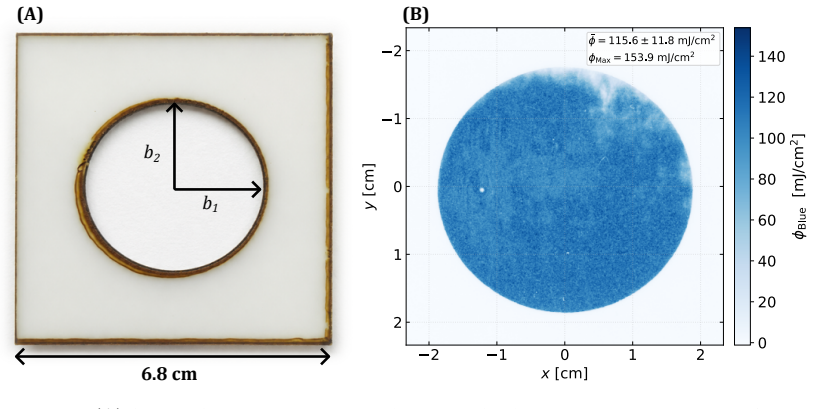
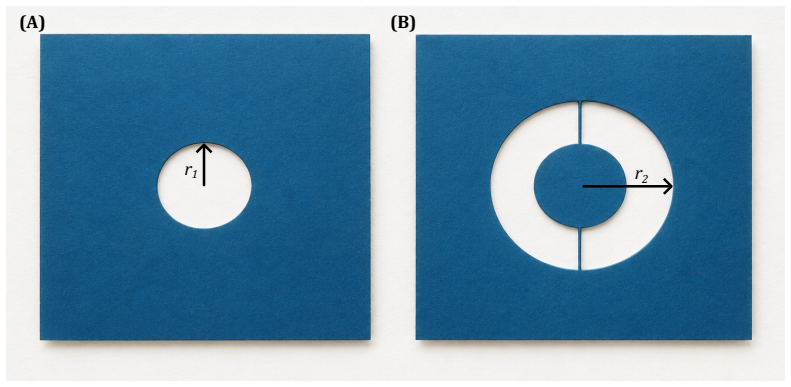
Experimental results aimed at demonstrating the feasibility of a two-section delay mask for the generation of ultrashort pulse trains are reported. Based on the initial simulation results, a 500 um thick circular fused silica plate featuring a central aperture was designed to enable two distinct transverse portions of the incident laser pulse to be focused, ideally, with equal intensity. This fulfills one of the requirements of the resonant multipulse ionization injection (ReMPI) scheme for laser wakefield acceleration. The experiment was carried out at the CNR-INO Intense Laser Irradiation Laboratory using a 240 TW laser system operated at 120 TW, as part of the ongoing preparation for the first experimental demonstration of ReMPI.
Editorial analysis
A structured set of objections, weighed in public.
Referee Report
Summary. The manuscript reports on the design and experimental implementation of a two-section delay mask consisting of a 500 μm thick fused silica plate with a central aperture, positioned after the final focusing optics on a 100 TW laser beamline. The setup aims to split the incident pulse into two transverse portions that focus with equal intensity, fulfilling a key requirement of the resonant multipulse ionization injection (ReMPI) scheme for laser wakefield acceleration. The experiment was conducted at the CNR-INO Intense Laser Irradiation Laboratory using a 240 TW system operated at 120 TW as preparation for the first ReMPI demonstration.
Significance. If the central experimental claim holds with supporting data, the work would demonstrate a practical post-focusing optical solution for generating the required pulse trains in ReMPI, advancing laser wakefield acceleration techniques by addressing a specific beam-splitting and delay condition without major modifications to the laser chain.
major comments (2)
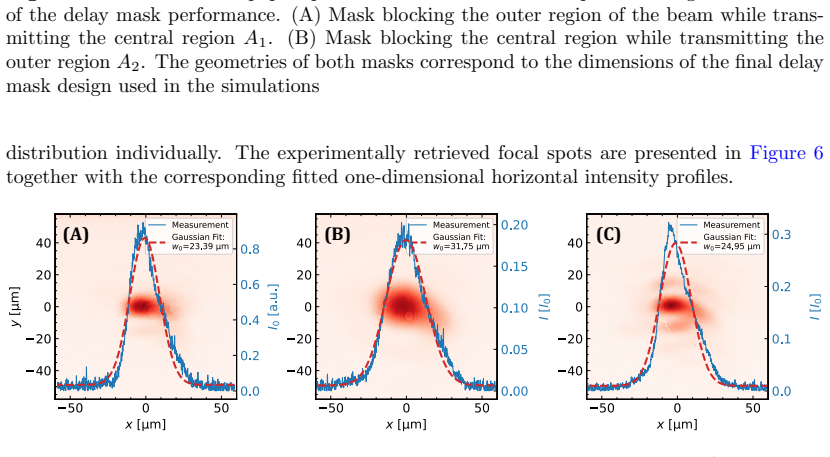
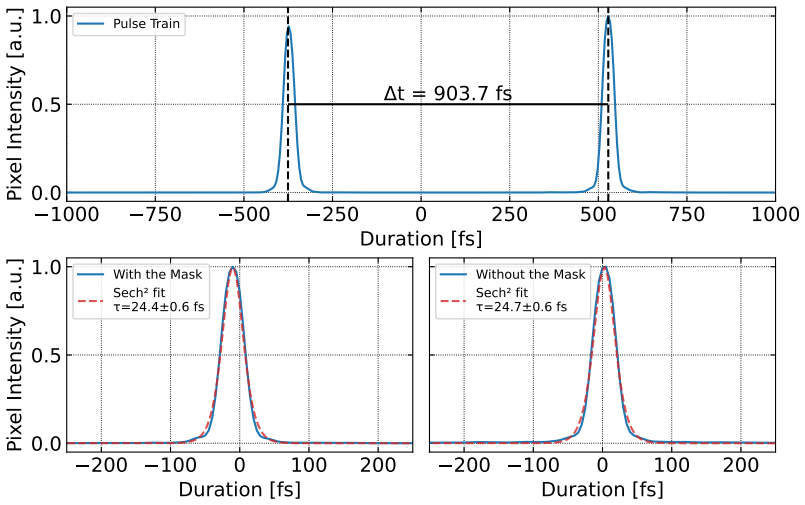
- [Abstract] Abstract: The central claim that the 500 μm plate 'enables two distinct transverse portions... to be focused, ideally, with equal intensity' is presented as an experimental result, yet no quantitative measurements (e.g., focal-spot intensity ratios, energy balance between portions, or diagnostic images) are reported to confirm equality was achieved. This directly undermines evaluation of whether the ReMPI requirement was met.
- The manuscript references 'initial simulation results' for the design but provides no comparison between simulated and measured focal intensities or delay values, leaving the experimental validation of the key assumption (equal-intensity focusing of the two portions) unsupported by data.
Simulated Author's Rebuttal
We thank the referee for their detailed review and constructive feedback on our manuscript. We address each major comment below and commit to revising the manuscript to strengthen the presentation of experimental validation.
read point-by-point responses
-
Referee: [Abstract] Abstract: The central claim that the 500 μm plate 'enables two distinct transverse portions... to be focused, ideally, with equal intensity' is presented as an experimental result, yet no quantitative measurements (e.g., focal-spot intensity ratios, energy balance between portions, or diagnostic images) are reported to confirm equality was achieved. This directly undermines evaluation of whether the ReMPI requirement was met.
Authors: We agree that the abstract phrasing implies experimental confirmation of equal-intensity focusing, while the current manuscript primarily reports the design, implementation, and setup of the delay mask as a feasibility test without including the requested quantitative diagnostics. The experiment at 120 TW was conducted as preparation for ReMPI, but supporting focal-spot images, intensity ratios, and energy balance data were not reported. We will revise the abstract to clarify the scope and add the missing quantitative measurements and diagnostic images in the results section of the revised manuscript. revision: yes
-
Referee: [—] The manuscript references 'initial simulation results' for the design but provides no comparison between simulated and measured focal intensities or delay values, leaving the experimental validation of the key assumption (equal-intensity focusing of the two portions) unsupported by data.
Authors: The manuscript does reference initial simulations used to design the 500 μm plate and central aperture, but we acknowledge that no direct comparison to experimental focal intensities or measured delays is provided. This leaves the validation of equal-intensity focusing incomplete. We will incorporate available experimental data on focal spots and delays, along with a side-by-side comparison to the simulations, in the revised manuscript to address this gap. revision: yes
Circularity Check
No significant circularity in experimental feasibility report
full rationale
The paper is an experimental report on fabricating and testing a two-section delay mask for ultrashort pulse trains on a laser beamline. No mathematical derivations, equations, fitted parameters presented as predictions, or load-bearing self-citations appear in the abstract or described structure. The mask design references prior simulations, but the work itself consists of experimental setup and results without reducing any claim to its own inputs by construction. This is a self-contained experimental feasibility test with no derivation chain to analyze.
Axiom & Free-Parameter Ledger
axioms (1)
- domain assumption The 500 um fused silica plate with central aperture produces two beam portions that focus with equal intensity.
Reference graph
Works this paper leans on
-
[1]
Nonlinear Plasma Waves Resonantly Driven by Optimized Laser Pulse Trains
D. Umstadter, E. Esarey, and J. Kim. “Nonlinear Plasma Waves Resonantly Driven by Optimized Laser Pulse Trains”. In:Physical Review Letters72.8 (1994), pp. 1224–1227. doi:10.1103/PhysRevLett.72.1224
-
[2]
The resonant multi-pulse ionization injection
P. Tomassini et al. “The resonant multi-pulse ionization injection”. In:Physics of Plasmas 24.10 (2017), p. 103220.doi:10.1063/1.5000696
-
[3]
High-quality GeV-scale electron bunches with the Resonant Multi- Pulse Ionization Injection
P. Tomassini et al. “High-quality GeV-scale electron bunches with the Resonant Multi- Pulse Ionization Injection”. In:Nuclear Instruments and Methods in Physics Research Section A909 (2018), pp. 1–4.doi:10.1016/j.nima.2018.03.002
-
[4]
High-quality 5 GeV electron bunches with resonant multi-pulse ion- ization injection
P. Tomassini et al. “High-quality 5 GeV electron bunches with resonant multi-pulse ion- ization injection”. In:Plasma Physics and Controlled Fusion62.2 (2020), p. 014010.doi: 10.1088/1361-6587/ab45c5
-
[5]
P. Tomassini et al. “Ultra-high-brightness and tuneable attosecond-long electron beams with the laser wake field acceleration”. In:Scientific Reports15 (2025), p. 40794.doi: 10.1038/s41598-025-24672-7
-
[6]
EuPRAXIA Conceptual Design Report
R. W. Assmann, M. K. Weikum, T. Akhter, et al. “EuPRAXIA Conceptual Design Report”. In:The European Physical Journal Special Topics229.24 (2020), pp. 3675– 4284.doi:10.1140/epjst/e2020-000127-8
-
[7]
High-resolution femtosecond pulse shaping
A. M. Weiner, J. P. Heritage, and E. M. Kirschner. “High-resolution femtosecond pulse shaping”. In:J. Opt. Soc. Am. B5.8 (1988), pp. 1563–1572.doi:10.1364/JOSAB.5. 001563
-
[8]
C. W. Siders et al. “Efficient high-energy pulse-train generation using a 2n-pulse Michel- son interferometer”. In:Applied Optics37.22 (1998), pp. 5302–5305.doi:10.1364/AO. 37.005302
work page doi:10.1364/ao 1998
-
[9]
Generation of laser pulse trains for tests of multi-pulse laser wake- field acceleration
R.J. Shalloo et al. “Generation of laser pulse trains for tests of multi-pulse laser wake- field acceleration”. In:Nuclear Instruments and Methods in Physics Research Section A: Accelerators, Spectrometers, Detectors and Associated Equipment829 (2016). 2nd European Advanced Accelerator Concepts Workshop - EAAC 2015, pp. 383–385.doi: https://doi.org/10.101...
-
[10]
Generation of a train of ultrashort pulses from a compact birefringent crystal array
B. Dromey et al. “Generation of a train of ultrashort pulses from a compact birefringent crystal array”. In:Applied Optics46.22 (2007), pp. 5142–5146.doi:10.1364/AO.46. 005142
-
[11]
Simple technique for generating trains of ultrashort pulses
T. Robinson et al. “Simple technique for generating trains of ultrashort pulses”. In:Optics Letters32.15 (2007), pp. 2203–2205.doi:10.1364/OL.32.002203
-
[12]
Overview and specifications of laser and target areas at the Intense Laser Irradiation Laboratory
L. A. Gizzi et al. “Overview and specifications of laser and target areas at the Intense Laser Irradiation Laboratory”. In:High Power Laser Science and Engineering9 (2021), e10.doi:10.1017/hpl.2020.47
-
[13]
Modelling of pulse train generation for resonant laser wakefield ac- celeration using a delay mask
G. Vantaggiato et al. “Modelling of pulse train generation for resonant laser wakefield ac- celeration using a delay mask”. In:Nuclear Instruments and Methods in Physics Research Section A909 (2018), pp. 114–117.doi:10.1016/j.nima.2018.02.024
-
[14]
A study of ultrashort pulse train generated via tailored transparent delay mask
A. Marasciulli et al. “A study of ultrashort pulse train generated via tailored transparent delay mask”. In:Conference on Lasers and Electro-Optics. 2021, SW3Q.3.doi:10.1364/ CLEO_SI.2021.SW3Q.3. 9
2021
-
[15]
A. Marasciulli et al. “Signatures of resonantly driven laser-wakefield excitation by a pulse train generated by an optical delay mask”. In:Applied Optics62 (2023), pp. 9368–9374. doi:10.1364/AO.506107
-
[16]
Measuring fluence distribution of intense short laser based on the ra- diochromic effect
Y. He et al. “Measuring fluence distribution of intense short laser based on the ra- diochromic effect”. In:Optics Letters46 (2021), pp. 2795–2798.doi:10.1364/OL.424698
-
[17]
Diffraction Theory of Electromagnetic Waves
J. A. Stratton and L. J. Chu. “Diffraction Theory of Electromagnetic Waves”. In:Physical Review56 (1 1939), pp. 99–107.doi:10.1103/PhysRev.56.99
-
[18]
L. Labate et al. “Effects of small misalignments on the intensity and Strehl ratio for a laser beam focused by an off-axis parabola”. In:Applied Optics55 (23 2016), pp. 6506– 6515.doi:10.1364/AO.55.006506
-
[19]
Intra-cycle depolarization of ultraintense laser pulses focused by off-axis parabolic mirrors
L. Labate, G. Vantaggiato, and L. A. Gizzi. “Intra-cycle depolarization of ultraintense laser pulses focused by off-axis parabolic mirrors”. In:High Power Laser Science and Engineering6 (2018), e32.doi:10.1017/hpl.2018.27
-
[20]
Compression of amplified chirped optical pulses
D. Strickland and G. Mourou. “Compression of amplified chirped optical pulses”. In: Optics Communications56 (1985), pp. 219–221.doi:10.1016/0030-4018(85)90120-8. 10
discussion (0)
Sign in with ORCID, Apple, or X to comment. Anyone can read and Pith papers without signing in.