Probing cosmic dynamics in f(T) teleparallel gravity: Constraints from logarithmic and log-periodic deceleration ansatzes
Pith reviewed 2026-06-27 06:17 UTC · model grok-4.3
The pith
Logarithmic and log-periodic forms of the deceleration parameter in power-law f(T) gravity yield Hubble expansions that depart from Lambda CDM and favor dynamically evolving dark energy.
A machine-rendered reading of the paper's core claim, the machinery that carries it, and where it could break.
Core claim
Adopting logarithmic and log-periodic ansatzes for the deceleration parameter q(z) inside f(T) = alpha (-T)^n teleparallel gravity produces a Hubble parameter H(z) whose observational constraints show a clear departure from standard cosmological-constant behavior and therefore indicate dynamically evolving dark energy, while the models stay thermodynamically consistent and return an age compatible with observations.
What carries the argument
The logarithmic and log-periodic parametrizations of the deceleration parameter q(z) that fix the redshift dependence of the Hubble parameter and permit chi-squared constraints on the model parameters alpha and n.
If this is right
- The equation of state parameter evolves with redshift rather than remaining fixed at -1.
- Geometrical diagnostics confirm a departure from Lambda CDM behavior.
- Energy density, pressure, and all standard energy conditions remain satisfied.
- The models stay thermodynamically consistent at every epoch.
- The derived age of the universe lies inside current observational limits.
Where Pith is reading between the lines
- The same parametrizations could be inserted into other modified-gravity actions to test whether the evolving-dark-energy signal is specific to teleparallel geometry.
- If the departure persists, it would motivate direct searches for geometric mechanisms inside the torsion scalar that could source the variation.
- Future surveys at higher redshift could check whether the log-periodic form continues to describe the transition from deceleration to acceleration.
Load-bearing premise
The chosen logarithmic and log-periodic parametrizations of the deceleration parameter supply a physically adequate description of the expansion history across epochs.
What would settle it
A high-precision determination that the deceleration parameter follows exactly the Lambda CDM functional form at all redshifts, with no deviation in the geometrical diagnostics, would falsify the claim of dynamically evolving dark energy.
Figures
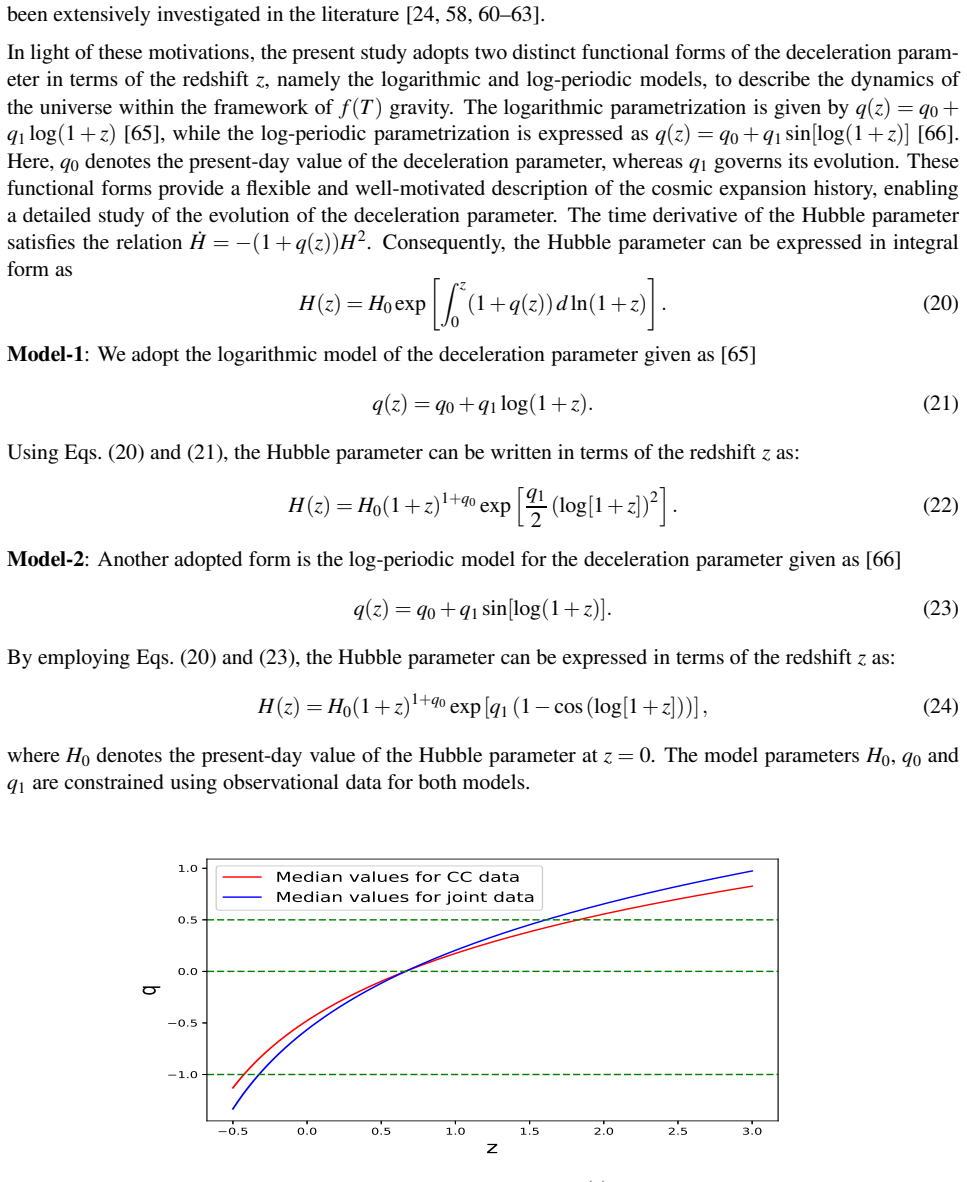
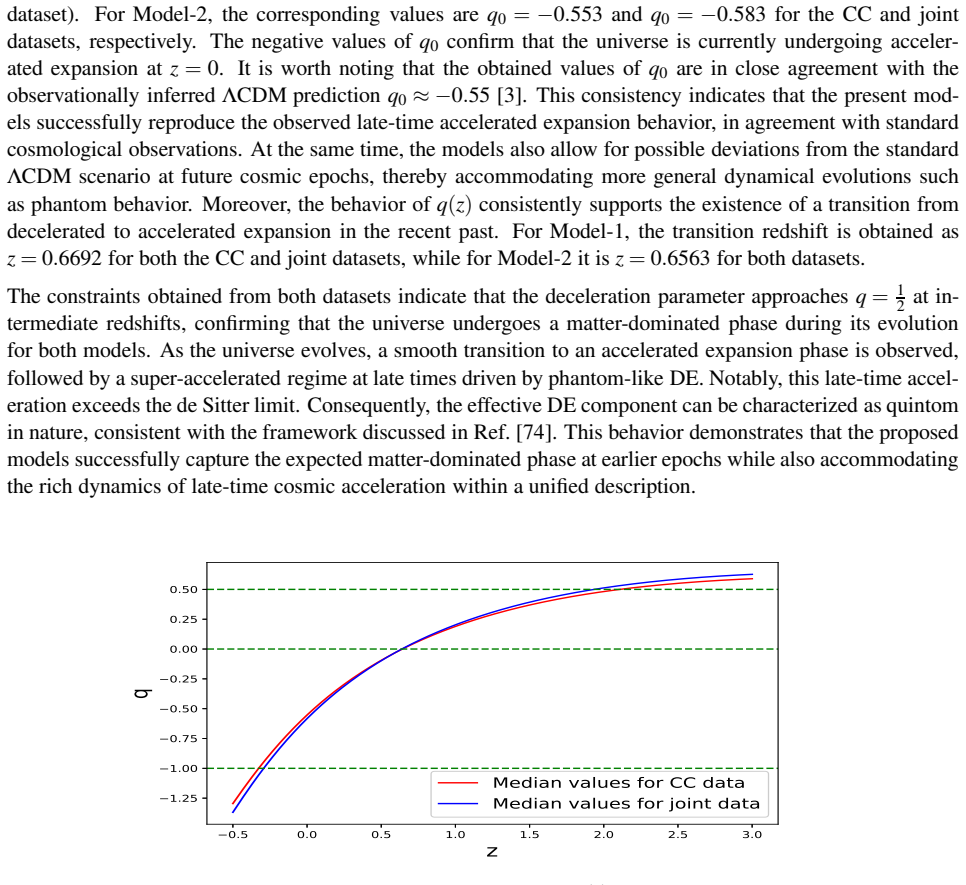
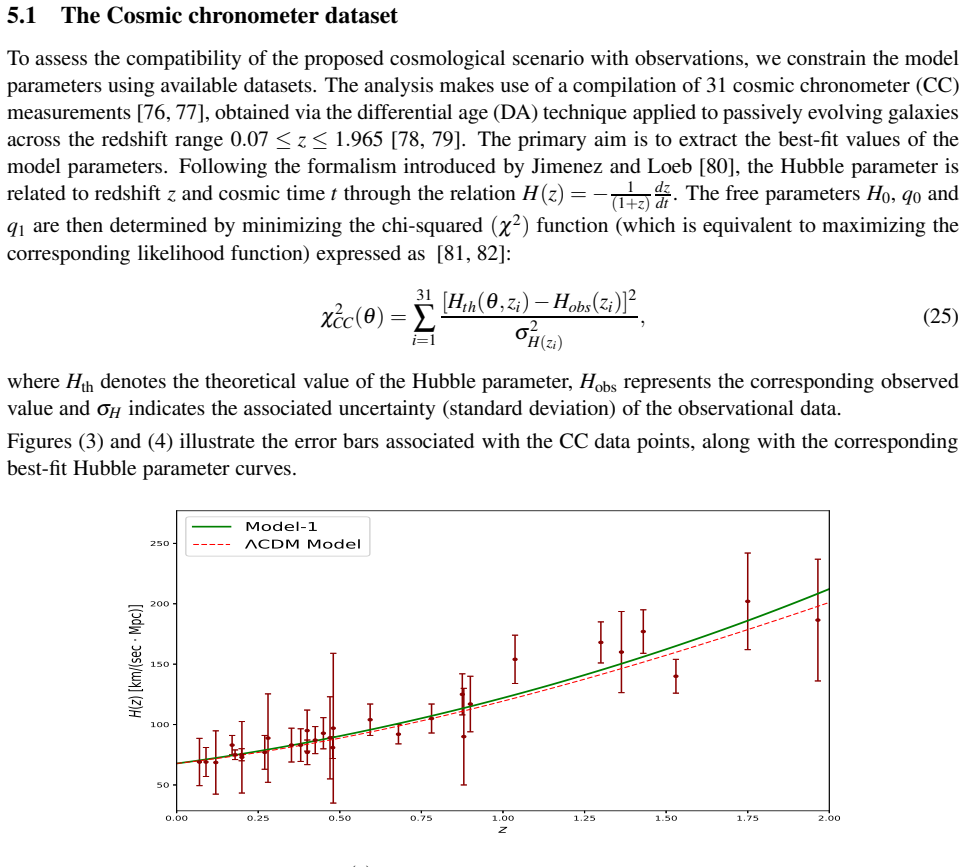
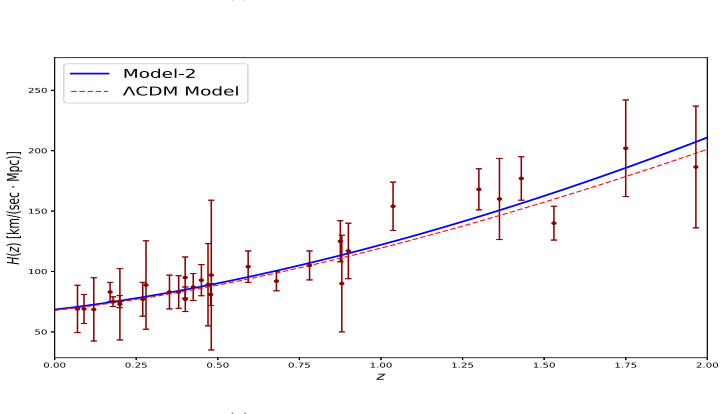



read the original abstract
In this study, we probe the cosmological evolution of the universe within the framework of modified teleparallel gravity by considering a power-law form of the function $f(T)=\alpha(-T)^{n}$. To characterize the expansion dynamics, we employ logarithmic and log-periodic parametrizations of the deceleration parameter. These specific parametrizations provide a flexible and well-structured description of the cosmic expansion history across different cosmological epochs. The corresponding Hubble parameter is obtained as a function of redshift, facilitating a systematic investigation of the background dynamics. The model parameters are constrained using cosmic chronometer (CC) and joint (CC+Pantheon) datasets through a Bayesian analysis based on the $\chi^{2}$-minimization approach. The evolution of key cosmological quantities, including the deceleration parameter, energy density, pressure, equation of state parameter and energy conditions, is examined in detail. The geometrical diagnostics indicate a clear departure from the standard cosmological constant behavior, pointing toward a dynamically evolving dark energy scenario. Further, the proposed models remain thermodynamically consistent and the estimated age of the universe is found to be compatible with observational constraints, thereby reinforcing the robustness and viability of the framework.
Editorial analysis
A structured set of objections, weighed in public.
Referee Report
Summary. The paper investigates cosmological evolution in f(T) teleparallel gravity with the power-law form f(T)=α(-T)^n. It adopts logarithmic and log-periodic parametrizations of the deceleration parameter q(z) to obtain H(z) as a function of redshift, constrains the parameters via χ² minimization on cosmic chronometer and joint CC+Pantheon datasets, and examines the evolution of q(z), energy density, pressure, equation-of-state parameter, energy conditions, and geometrical diagnostics. The abstract concludes that the diagnostics show clear departure from ΛCDM (indicating dynamical dark energy), that the models are thermodynamically consistent, and that the inferred universe age is compatible with observations.
Significance. If the central results hold after addressing the derivation issue, the work would supply concrete observational bounds on power-law f(T) models using flexible expansion-history ansatzes, together with explicit checks of thermodynamic consistency and age compatibility. The use of standard CC and Pantheon data with Bayesian χ² analysis provides reproducible empirical grounding for the viability of the chosen parametrizations within the f(T) setting.
major comments (2)
- [Abstract] Abstract: the claim that 'geometrical diagnostics indicate a clear departure from the standard cosmological constant behavior' is load-bearing for the central conclusion of dynamically evolving dark energy. This departure is obtained from the externally imposed logarithmic and log-periodic q(z) forms rather than from solutions of the modified Friedmann equations that follow from f(T)=α(-T)^n with T=-6H². The power-law f(T) yields a specific differential equation for H(z) whose solutions are not in general logarithmic or log-periodic in z.
- [Methodology] Methodology (parametrization of q(z) and derivation of H(z)): the Hubble parameter is constructed directly from the chosen q(z) ansatzes and then fitted to data; the f(T) field equations are not solved to obtain H(z) or q(z). Consequently the reported evolution of energy density, pressure, and equation of state, as well as the thermodynamic and age checks, are performed on an externally prescribed expansion history rather than on a solution internal to the f(T) model.
Simulated Author's Rebuttal
We thank the referee for the thorough review and insightful comments on our manuscript. We address the major points below, acknowledging where clarification and revision are needed while defending the phenomenological approach taken.
read point-by-point responses
-
Referee: [Abstract] Abstract: the claim that 'geometrical diagnostics indicate a clear departure from the standard cosmological constant behavior' is load-bearing for the central conclusion of dynamically evolving dark energy. This departure is obtained from the externally imposed logarithmic and log-periodic q(z) forms rather than from solutions of the modified Friedmann equations that follow from f(T)=α(-T)^n with T=-6H². The power-law f(T) yields a specific differential equation for H(z) whose solutions are not in general logarithmic or log-periodic in z.
Authors: We agree that the logarithmic and log-periodic q(z) parametrizations are imposed externally to derive H(z), and these forms are not obtained as solutions to the differential equation arising from the power-law f(T) model. The departure from ΛCDM is indeed diagnosed from the data-constrained expansion histories rather than from internal solutions of the modified Friedmann equations. Our intent was to use these flexible ansatzes as a probe within the f(T) framework to explore possible dynamical behaviors consistent with observations. We will revise the abstract to explicitly state that the diagnostics reflect the constrained parametrizations and to temper the claim of 'clear departure' by noting the phenomenological nature of the approach. revision: yes
-
Referee: [Methodology] Methodology (parametrization of q(z) and derivation of H(z)): the Hubble parameter is constructed directly from the chosen q(z) ansatzes and then fitted to data; the f(T) field equations are not solved to obtain H(z) or q(z). Consequently the reported evolution of energy density, pressure, and equation of state, as well as the thermodynamic and age checks, are performed on an externally prescribed expansion history rather than on a solution internal to the f(T) model.
Authors: The referee accurately notes that H(z) is obtained from the q(z) ansatzes and fitted directly to the CC and CC+Pantheon datasets via χ² minimization, without solving the f(T) field equations for H(z). The subsequent calculations of energy density, pressure, equation-of-state, energy conditions, thermodynamics, and age are performed on this externally prescribed history. This constitutes a phenomenological exploration rather than a self-consistent solution internal to the power-law f(T) model. We will revise the methodology section to clarify this distinction, add a discussion of the limitations, and explain the rationale for using flexible parametrizations to constrain viable expansion histories in the f(T) context. revision: yes
Axiom & Free-Parameter Ledger
free parameters (4)
- α
- n
- logarithmic q(z) coefficients
- log-periodic q(z) coefficients
axioms (2)
- domain assumption Homogeneous and isotropic FLRW spacetime
- domain assumption Teleparallel equivalent of general relativity as the base theory
Reference graph
Works this paper leans on
-
[1]
A. G. Riess, A. V . Filippenko, P . Challis, A. Clocchiatti , A. Diercks et al., Observational Evidence from Supernovae for an Accelerating Universe and a Cosmological Constant, Astronomical Journal, 116, 1009- 1038 (1998) https://doi.org/10.1086/300499
work page internal anchor Pith review doi:10.1086/300499 1998
-
[2]
Measurements of Omega and Lambda from 42 High-Redshift Supernovae
S. Perlmutter, G. Aldering, G. Goldhaber, R. A. Knop, P . N ugent et al., Measurements of Ω and Λ from 42 High-Redshift Supernovae, Astrophysical Journal, 517, 565–586 (1999) https://doi.org/10.1086/307221
work page internal anchor Pith review doi:10.1086/307221 1999
-
[3]
N. Aghanim, Y . Akrami, M. Ashdown, J. Aumont, C. Baccigal upi, et al., Planck 2018 results. VI. Cosmological parameters, Astronomy and Astro physics, 641, A6 (2020) https://doi.org/10.1051/0004-6361/201833910
-
[4]
22 [27] [28] [29] [30] [31] [32] [33] [34] [35] [36] [37] [38] [39] [40] Luis P
S. Weinberg, The cosmological constant problem, Review s of Modern Physics, 61, 1 (1989) https://doi.org/10.1103/RevModPhys.61.1
-
[5]
E. Di V alentino, O. Mena, S. Pan, L. Visinelli, W. Y ang, et al., In the realm of the Hubble tension—a review of solutions, Classical and Quantu m Gravity, 38, 153001 (2021) https://doi.org/10.1088/1361-6382/ac086d
-
[6]
S. M. Carroll, The cosmological constant, Living Review s in Relativity, 4, 1-56 (2001) https://doi.org/10.12942/lrr-2001-1
-
[7]
T. Padmanabhan, Cosmological constant—the weight of th e vacuum, Physics reports, 380, 235–320 (2003) https://doi.org/10.1016/S0370-1573(03)00120-0
-
[8]
E. J. Copeland, M. Sami, S. Tsujikawa, Dynamics of dark en ergy, International Journal of Modern Physics D, 15, 1753–1935 (2006) https://doi.org/10.1142/S021827180600942X
-
[9]
H. A. Buchdahl, Non-linear Lagrangians and cosmologica l theory, Monthly Notices of the Royal Astro- nomical Society, 150, 1-8 (1970) https://doi.org/10.1093/mnras/150.1.1
-
[10]
T. Harko, F. S. N. Lobo, S. Nojiri, S. D. Odintsov, f (R,T ) gravity, Physical Review D,84, 024020 (2011) https://doi.org/10.1103/PhysRevD.84.024020 22
-
[11]
S. Nojiri, S. D. Odintsov, Unified cosmic history in modi fied gravity: from f (R) theory to Lorentz non-invariant models, Physics Reports, 505, 59-144 (2011) https://doi.org/10.1016/j.physrep.2011.04.001
-
[12]
J. B. Jim´ enez, L. Heisenberg, T. Koivisto, Coincident general relativity, Physical Review D, 98, 044048 (2018) https://doi.org/10.1103/PhysRevD.98.044048
-
[13]
Modified Gravity Theories on a Nutshell: Inflation, Bounce and Late-time Evolution
S. Nojiri, S. D. Odintsov, V . K. Oikonomou, Modified grav ity theories on a nut- shell: Inflation, bounce and late-time evolution, Physics R eports, 692, 1-104 (2017) https://doi.org/10.1016/j.physrep.2017.06.001
work page internal anchor Pith review doi:10.1016/j.physrep.2017.06.001 2017
-
[14]
K. Bamba, S. D. Odintsov, L. Sebastiani, S. Zerbini, Fin ite-time future singularities in modified Gauss– Bonnet and f(R, G) gravity and singularity avoidance, The Eu ropean Physical Journal C, 67, 295–310 (2010) https://doi.org/10.1140/epjc/s10052-010-1292-8
-
[15]
E. Elizalde,and R. Myrzakulov, V . V . Obukhov, D. S´ aez- G´ omez,Λ CDM epoch reconstruction from F (R, G) and modified Gauss–Bonnet gravities, Classical and Q uantum Gravity, 27, 095007 (2010) https://doi.org/10.1088/0264-9381/27/9/095007
-
[16]
T. Harko, F. S. N. Lobo, f (R,Lm) gravity, The European Physical Journal C, 70, 373–379 (2010) https://doi.org/10.1140/epjc/s10052-010-1467-3
-
[17]
S. Capozziello, R. D’Agostino, O. Luongo, Extended gra vity cosmography, International Journal of Modern Physics D, 28, 1930016 (2019) https://doi.org/10.1142/S0218271819300167
-
[18]
S. Capozziello, V . De Falco, C. Ferrara, The role of the b oundary term in f (Q,B) symmetric teleparallel gravity,The European Physical Jou rnal C, 83, 915 (2023) https://doi.org/10.1140/epjc/s10052-023-12072-y
-
[19]
S. Kotambkar, G. P . Singh, R. Kelkar, B. K. Bishi, Anisot ropic Bianchi type I cosmological models with generalized Chaplygin gas and dynamical gravitational and cosmological constants, Communications in Theoretical Physics, 67, 222 (2017) https://doi.org/10.1088/0253-6102/67/2/222
-
[20]
A. R. Lalke, G. P . Singh, A. Singh, Late-time accelerati on from ekpyrotic bounce in f (Q,T ) gravity, International Journal of Geometric Methods in Mod ern Physics, 20, 2350131 (2023) doi:https://doi.org/10.1142/S0219887823501311
-
[21]
N. Hulke, G. P . Singh, B. K. Bishi, A. Singh, V ariable Cha plygin gas cosmolo- gies in f (R,T ) gravity with particle creation, New Astronomy, 77, 101357 (2020) https://doi.org/10.1016/j.newast.2020.101357
-
[22]
A. Singh, S. Mandal, R. Chaubey, R. Raushan, Observatio nal constraints on the expansion scalar and shear relation in the Locally rotationally symmetric Bianc hi I model, Physics of the Dark Universe, 47, 101798 (2025) https://doi.org/10.1016/j.dark.2024.101798
-
[23]
K. N. Singh, G. R. P . Teruel, S. K. Maurya, T. Chowdhury, F . Rahaman, Conservative worm- holes in generalized K(R,T ) function, Journal of High Energy Astrophysics, 44, 132–145 (2024) https://doi.org/10.1016/j.jheap.2024.09.009
-
[24]
H. Chaudhary, S. K. J. Pacif, G. Mustafa, F. Atamurotov, F. Javed, Extracting H0 and rd in q(t) parametrization models, Journal of High Energy Astrophysi cs, 45, 340–349 (2025) https://doi.org/10.1016/j.jheap.2025.01.001
-
[25]
G. K. Goswami, R. Rani, J. K. Singh, A. Pradhan, FLRW cosm ology in Weyl type f (Q) gravity and observational constraints, Journal of High Ene rgy Astrophysics, 43, 105–113 (2024) https://doi.org/10.1016/j.jheap.2024.06.011 23
-
[26]
B. K. Shukla, S. Sahlu, D. Sofuo˘ glu, P . Mishra, A. H. Alf edeel, Multi-components fluid in f (R,T ) gravity with observational constraints, The European Phys ical Journal Plus, 140, 1–14 (2025) https://doi.org/10.1140/epjp/s13360-025-06200-8
-
[27]
L. A. Escamilla, D. Fiorucci, G. Montani, E. Di V alentin o, Exploring the Hubble tension with a late time Modified Gravity scenario, Physics of the Dar k Universe, 46, 101652 (2024) https://doi.org/10.1016/j.dark.2024.101652
-
[28]
K. R. Patle, G. P . Singh, R. Garg, Dynamical constraints on variable vac- uum energy in Brans-Dicke theory, arXiv preprint arXiv:260 1.00419, (2026) https://doi.org/10.48550/arXiv.2601.00419
-
[29]
G. R. Bengochea, R. Ferraro, Dark torsion as the cosmic s peed-up, Physical Review D, 79, 124019 (2009) doi:https://doi.org/10.1103/PhysRevD.79.124019
-
[30]
Yi-Fu Cai, S. Capozziello, M. De Laurentis, E. N. Sarida kis, f (T) teleparal- lel gravity and cosmology, Reports on Progress in Physics, 79, 106901 (2016) https://doi.org/10.1088/0034-4885/79/10/106901
-
[31]
A. Paliathanasis, J. D. Barrow, P . G. L. Leach, Cosmolog ical solutions of f (T) gravity, Physical Review D, 94, 023525 (2016) https://doi.org/10.1103/PhysRevD.94.023525
-
[32]
I. G. Salako, M. E. Rodrigues, A. V . Kpadonou, M. J. S. Hou ndjo, J. Tossa, Λ CDM model in f (T ) gravity: reconstruction, thermodynamics and stability, J ournal of Cosmology and Astroparticle Physics, 2013, 060–060 (2013) https://doi.org/10.1088/1475-7516/2013/11/060
-
[33]
S. Capozziello, V . F. Cardone, H. Farajollahi, A. Ravan pak, Cosmography in f (T ) gravity, Physical Review D, 84, 043527 (2011) https://doi.org/10.1103/PhysRevD.84.043527
-
[34]
Di Liu, M. J. Reboucas, Energy conditions bounds on f (T ) gravity, Physical Review D, 86, 083515 (2012) https://doi.org/10.1103/PhysRevD.86.083515
-
[35]
Yi-Fu Cai, Shih-Hung Chen, J. B. Dent, S. Dutta, E. N. Sar idakis, Matter bounce cosmology with the f (T ) gravity, Classical and Quantum Gravity, 28, 215011 (2011) https://doi.org/10.1088/0264-9381/28/21/215011
-
[36]
A. Zhadyranova, M. Koussour, S. Bekkhozhayev, V . Zhuma bekova, J. Rayimbaev, Exploring late-time cosmic acceleration: A study of a linear f (T ) cosmological model using observational data, Physics of the Dark Universe, 45, 101514 (2024) https://doi.org/10.1016/j.dark.2024.101514
-
[37]
K. Bamba, Chao-Qiang Geng, Chung-Chi Lee, Ling-Wei Luo , Equation of state for dark en- ergy in f (T ) gravity, Journal of Cosmology and Astroparticle Physics, 2011, 021–021 (2011) https://doi.org/10.1088/1475-7516/2011/01/021
-
[38]
A. Paliathanasis, S. Basilakos, E. N. Saridakis, S. Cap ozziello, K. Atazadeh, F. Darabi, M. Tsamparlis, New Schwarzschild-like solutions in f (T ) gravity through Noether symmetries, Physical Review D, 89, 104042 (2014) https://doi.org/10.1103/PhysRevD.89.104042
-
[39]
S. Capozziello, R. D’Agostino, O. Luongo, Model-indep endent reconstruction of f (T ) teleparallel cosmology, General Relativity and Gravitati on, 49, 141 (2017) https://doi.org/10.1007/s10714-017-2304-x
-
[40]
S. H. Shekh, A. Pradhan, A. Dixit, S. N. Bayaskar, S. C. Da runde, Cosmographical analysis for H(z) parametrization towards viscous f (T ) gravity, Modern Physics Letters A, 40, 2450187 (2025) https://doi.org/10.1142/S0217732324501876 24
-
[41]
L. K. Duchaniya, K. Gandhi, B. Mishra, Attractor behavi or of f (T ) modified grav- ity and the cosmic acceleration, Physics of the Dark Univers e, 44, 101461 (2024) https://doi.org/10.1016/j.dark.2024.101461
-
[42]
S. K. Maurya, A. Errehymy, M. Govender, G. Mustafa, N. Al -Harbi et al., Anisotropic compact stars in complexity formalism and isotropic stars made of anisotr opic fluid under minimal geometric de- formation (MGD) context in f (T ) gravity-theory, The European Physical Journal C, 83, 348 (2023) https://doi.org/10.1140/epjc/s10052-023-11507-w
-
[43]
D. C. Maurya, Accelerating scenarios of viscous fluid un iverse in modified f (T ) grav- ity, International Journal of Geometric Methods in Modern P hysics, 19, 2250144 (2022) https://doi.org/10.1142/S0219887822501444
-
[44]
K. Bamba, G. G. L. Nashed, W. El Hanafy, Sh. K. Ibraheem, B ounce inflation in f (T ) Cosmology: A unified inflaton-quintessence field, Physical R eview D, 94, 083513 (2016) https://doi.org/10.1103/PhysRevD.94.083513
-
[45]
N. S. Kavya, S. W. Mishra, P . K. Sahoo, V . V enkatesha, Can teleparallel f (T ) models play a bridge between early and late time Universe?, Monthly Notices of th e Royal Astronomical Society, 532, 3126– 3133 (2024) https://doi.org/10.1093/mnras/stae1723
-
[46]
P . Bhar, F. Rahaman, S. Das, S. Aktar, A. Errehymy, Aniso tropic quintessence compact star in f (T ) gravity with Tolman–Kuchowicz metric potentials, Communi cations in Theoretical Physics, 76, 015401 (2024) https://doi.org/10.1088/1572-9494/ad08ad
-
[47]
R. C. Nunes, S. Pan, E. N. Saridakis, New observational c onstraints on f (T ) gravity from cosmic chronometers, Journal of Cosmology and Astropartic le Physics, 2016, 011–011 (2016) https://doi.org/10.1088/1475-7516/2016/08/011
-
[48]
H. Chaudhary, U. Debnath, T. Roy, S. Maity, G. Mustafa et al., Constraints on the pa- rameters of modified Chaplygin–Jacobi and modified Chaplygi n–Abel gases in f (T ) grav- ity, International Journal of Geometric Methods in Modern P hysics, 21, 2450248 (2024) https://doi.org/10.1142/S0219887824502487
-
[49]
L. K. Duchaniya, S. V . Lohakare, B. Mishra, S. K. Tripath y, Dynamical stability analy- sis of accelerating f (T ) gravity models, The European Physical Journal C, 82, 448 (2022) https://doi.org/10.1140/epjc/s10052-022-10406-w
-
[50]
M. Chakraborty, S. Chakraborty, The classical and quan tum implications of the Ray- chaudhuri equation in f (T )-gravity, Classical and Quantum Gravity, 40, 155010 (2023) https://doi.org/10.1088/1361-6382/ace231
-
[51]
S. K. Maurya, J. Kumar, S. Kiroriwal, Role of decoupling process on the configurations of compact stars induced by Thomas-Fermi dark matter with null complex ity in f (T ) gravity, Journal of High Energy Astrophysics, 44, 194–209 (2024) https://doi.org/10.1016/j.jheap.2024.09.012
-
[52]
A. Dixit, A. Pradhan, D. C. Maurya, A probe of cosmologic al models in modified teleparal- lel gravity, International Journal of Geometric Methods in Modern Physics, 18, 2150208 (2021) https://doi.org/10.1142/S021988782150208X
-
[53]
K. R. Patle, G. P . Singh, Revisiting f (T ) Teleparallel Gravity with a Parametrized Hub- ble Parameter and Observational Constraints, arXiv prepri nt arXiv:2603.18971, (2026) https://doi.org/10.48550/arXiv.2603.18971
-
[54]
S. Das, A. Beesham, S. Chattopadhyay, Study of neutron s tar in f (T ) and f (G) grav- 25 ity framework with polytropic gas background, Annals of Phy sics, 458, 169460 (2023) https://doi.org/10.1016/j.aop.2023.169460
-
[55]
X. Ren, S. F. Y an, Y . Zhao, Y . F. Cai, E. N. Saridakis et al. , Gaussian processes and effective field theory of f (T ) gravity under the H 0 tension, The Astrophysical Journal, 932, 131 (2023) https://doi.org/10.3847/1538-4357/ac6ba5
-
[56]
A. G. Riess, L. G. Strolger, J. Tonry, S. Casertano, H. C. Ferguson, Type Ia supernova discoveries at z¿ 1 from the Hubble Space Telescope: Evidence for past decel eration and constraints on dark energy evolution, The Astrophysical Journal, 607, 665–687 (2004) https://doi.org/10.1086/383612
-
[57]
Y . Gong, A. Wang, Observational constraints on the acce leration of the Universe, Physical Review D, 73, 083506 (2006) https://doi.org/10.1103/PhysRevD.73.083506
-
[58]
D. Arora, H. Chaudhary, S. K. J. Pacif, G. Mustafa, Diagn ostic and comparative analysis of dark energy models with q(z) parametrizations, The European Physical Journal Plus, 139, 371 (2024) https://doi.org/10.1140/epjp/s13360-024-05163-6
-
[59]
E. S´ anchez, A. Carnero, J. Garc´ ıa-Bellido, E. Gaztanaga, F. De Simoni et al., Tracing the sound horizon scale with photometric redshift surveys, Monthly Notices o f the Royal Astronomical Society, 411, 277– 288 (2011) https://doi.org/10.1111/j.1365-2966.2010.17679.x
-
[60]
G. N. Gadbail, S. Mandal, P . K. Sahoo, Parametrization of deceleration parameter in f(q) gravity, Physics, 4, 1403–1412 (2022) https://doi.org/10.3390/physics4040090
-
[61]
M. Koussour, N. Myrzakulov, A. H. A. Alfedeel, F. Awad, M . Bennai, Modeling cosmic acceleration with a generalized varying deceleration parameter, Physic s of the Dark Universe, 42, 101339 (2023) https://doi.org/10.1016/j.dark.2023.101339
-
[62]
S. H. Shekh, K. S. Wankhade, S. N. Khan, A. Dixit, Late tim es Λ CDM f (T ) grav- ity model with parameterized q(z), Modern Physics Letters A , 39, 2450094 (2024) https://doi.org/10.1142/S0217732324500949
-
[63]
A. Al Mamon, S. Das, A divergence-free parametrization of deceleration parameter for scalar field dark energy, International Journal of Modern Ph ysics D, 25, 1650032 (2016) https://doi.org/10.1142/S0218271816500322
-
[64]
L. Xu, H. Liu, Constraints to deceleration parameters b y recent cosmic observations, Modern Physics Letters A, 23, 1939–1948 (2008) https://doi.org/10.1142/S0217732308025991
-
[65]
Sofuo˘ glu, B
D. Sofuo˘ glu, B. Shukla, A. Beesham, Scalar Field Cosmology with Logarithmic Deceleration Parameter, in Proceedings of the 3rd International Online Conference o n Universe, MDPI: Basel, Switzerland (2026)
2026
-
[66]
A. Samaddar, S. S. Singh, Reconstructing cosmic expans ion in f (R,G) gravity us- ing a log-periodic deceleration model, Physics of the Dark U niverse, 50, 102081 (2025) https://doi.org/10.1016/j.dark.2025.102081
-
[67]
R. Aldrovandi, J. G. Pereira, Teleparallel gravity: an introduction, Springer Science & Business Media, volume 173, (2012) https://doi.org/10.1007/978-94-007-5143-9
-
[68]
E. V . Linder, Einstein’s other gravity and the accelera tion of the universe, Physical Review D, 81, 127301 (2010) https://doi.org/10.1103/PhysRevD.81.127301
-
[69]
J. W. Maluf, The teleparallel equivalent of general rel ativity, Annalen der Physik, 525, 339–357 (2013) https://doi.org/10.1002/andp.201200272 26
-
[70]
M. Koussour, A. Altaibayeva, S. Bekov, F. Holmurodov, S . Muminov et al., Exploring cosmological evolution and constraints in f (T ) teleparallel gravity, Physics of the Dark Universe, 46, 101664 (2024) https://doi.org/10.1016/j.dark.2024.101664
-
[71]
N. Banerjee, S. Das, Acceleration of the universe with a simple trigonometric potential, General Relativ- ity and Gravitation, 37, 1695–1703 (2005) https://doi.org/10.1007/s10714-005-0152-6
-
[72]
J. Cunha, J. A. S. d. Lima, Transition redshift: new kine matic constraints from su- pernovae, Monthly Notices of the Royal Astronomical Societ y, 390, 210–217 (2008) https://doi.org/10.1111/j.1365-2966.2008.13640.x
-
[73]
C. Escamilla-Rivera, A. N´ ajera, Dynamical dark energ y models in the light of gravitational- wave transient catalogues, Journal of Cosmology and Astrop article Physics, 2022, 060 (2022) https://doi.org/10.1088/1475-7516/2022/03/060
-
[74]
W. Zhao, Y . Zhang, Quintom models with an equation of state crossing-1, Physical Review D, 73, 123509 (2006) https://doi.org/10.1103/PhysRevD.73.123509
-
[75]
, archivePrefix = "arXiv", eprint =
D. Foreman-Mackey, D. W. Hogg, D. Lang, J. Goodman, emce e: the MCMC hammer, Publications of the Astronomical Society of the Pacific, 125, 306 (2013) https://doi.org/10.1086/670067
-
[76]
J. Simon, L. V erde, R. Jimenez, Constraints on the redsh ift dependence of the dark energy potential, Physical Review D, 71, 123001 (2005) https://doi.org/10.1103/PhysRevD.71.123001
work page internal anchor Pith review doi:10.1103/physrevd.71.123001 2005
-
[77]
G. S. Sharov, V . O. V asiliev, How predictions of cosmological models depend on Hubble parameter data sets, arXiv preprint arXiv:1807.07323 (2018) https://doi.org/10.26456/mmg/2018-611
work page internal anchor Pith review Pith/arXiv arXiv doi:10.26456/mmg/2018-611 2018
-
[78]
D. Stern, R. Jimenez, L. V erde, M. Kamionkowski, S. A. St anford, Cosmic chronometers: constraining the equation of state of dark energy. I: H(z) measurements, Journal of Cosmology and Astroparticle Physics, 2010, 008 (2010) https://doi.org/10.1088/1475-7516/2010/02/008
-
[79]
M. Moresco, Raising the bar: new constraints on the Hubb le parameter with cosmic chronome- ters at z 2, Monthly Notices of the Royal Astronomical Society: Lette rs, 450, L16–L20 (2015) https://doi.org/10.1093/mnrasl/slv037
work page internal anchor Pith review doi:10.1093/mnrasl/slv037 2015
-
[80]
The Astrophysical Journal , abstract =
R. Jimenez, A. Loeb, Constraining cosmological parame ters based on relative galaxy ages, The Astro- physical Journal, 573, 37 (2002) https://doi.org/10.1086/340549
discussion (0)
Sign in with ORCID, Apple, or X to comment. Anyone can read and Pith papers without signing in.