REVIEW 2 major objections 2 minor 141 references
Phase diagram of the Kitaev-Heisenberg-$\Gamma$ model: Classical and quantum magnetism, frustration, and subdominant interactions
T0 review · 2 major / 2 minor · reviewed 2026-06-27 · grok-4.3
Pith's one-line read Quantum fluctuations suppress many classical noncollinear orders in the Kitaev-Heisenberg-Γ model, leaving fewer dominant incommensurate phases.
desk verdict This numerical phase diagram updates the Kitaev-Heisenberg-Γ model by showing quantum suppression of many classical noncollinear orders, but the quantum claims rest on unverified handling of incommensurate states. read the letter →
The pith
A machine-rendered reading of the paper's core claim, the machinery that carries it, and where it could break.
The reading
What carries the argument
The ground-state phase diagram obtained by classical energy minimization contrasted with quantum many-body numerical solvers that isolate the effect of quantum fluctuations on the same interaction terms.
What would settle it
Direct observation, in a quantum simulation or material, of one of the classical noncollinear multiple-Q orders persisting inside a parameter region the diagram labels as suppressed, or the appearance of a spiral spin liquid inside one of the identified frustrated windows.
Extended reading notes
Core claim
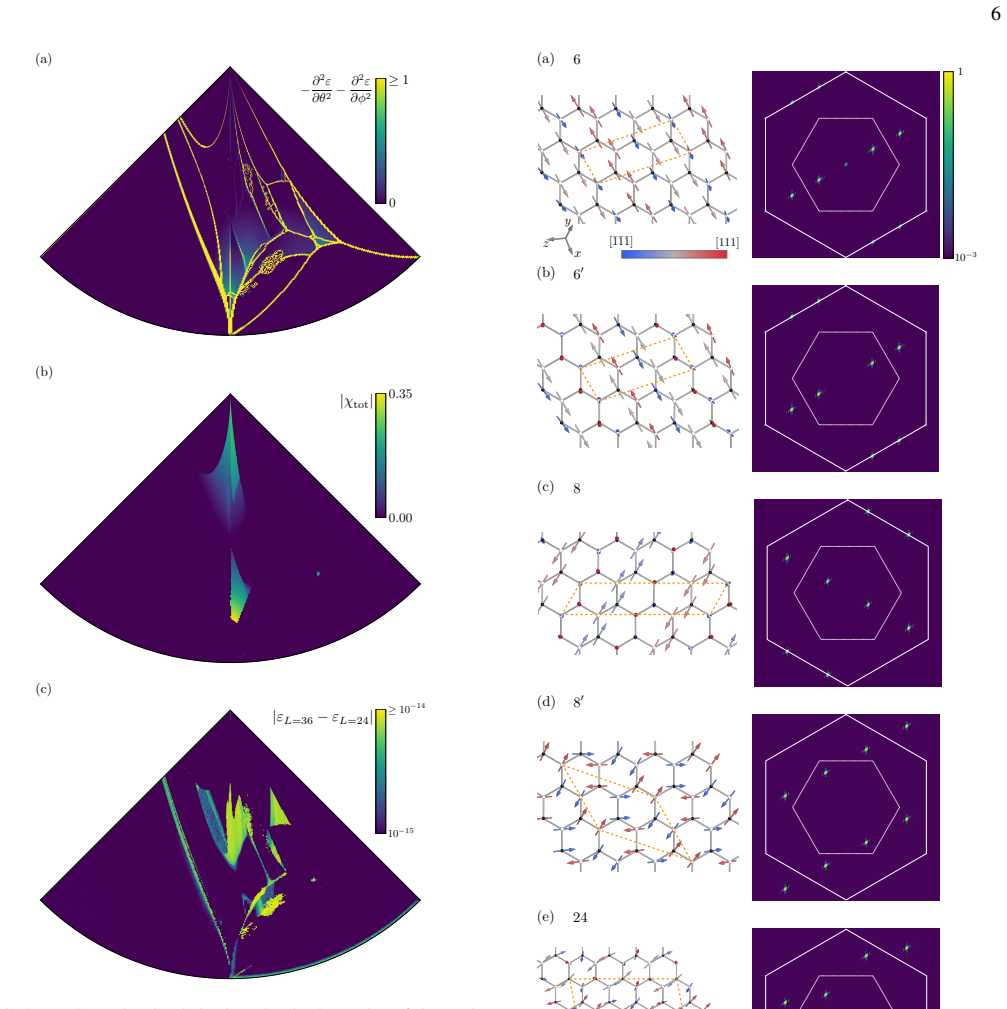
In the classical case the model supports a zoo of noncollinear orders consisting of various noncollinear multiple-Q magnetic orders with and without incommensurate modulations. In the quantum case quantum fluctuations suppress many of the competing orders found classically, resulting in a reduced number of dominant incommensurate orders together with highly frustrated regions in which spiral spin liquid states as well as new magnetically ordered states are potentially stabilized by other additional magnetic interactions.
Load-bearing premise
The quantum numerical techniques accurately locate all ground states without finite-size artifacts or missed phases that would alter which classical orders survive or which regions remain frustrated.
Editorial extensions
If this is right
- Quantum fluctuations eliminate many classical noncollinear multiple-Q orders.
- Only a smaller set of incommensurate orders remain dominant once quantum effects are included.
- Highly frustrated regions appear that are sensitive to subdominant interactions.
- Spiral spin liquid states become candidates for stabilization inside those regions by additional magnetic terms.
- The resulting diagram supplies a concrete reference for interpreting low-temperature data on candidate materials.
Reading between the lines
- Subdominant interactions could be tuned to select among the remaining orders or to realize a spin liquid inside the frustrated windows.
- Some of the classically stable orders that disappear in the quantum ground state might reappear as metastable excitations or at finite temperature.
- The pattern of suppression by fluctuations may recur in other spin models that combine Kitaev-like bond-dependent terms with Heisenberg and Gamma exchanges.
Editorial analysis
A structured set of objections, weighed in public.
Referee Report
Summary. The manuscript maps the ground-state phase diagram of the Kitaev-Heisenberg-Γ model on the honeycomb lattice. Classically, it reports a rich set of noncollinear multiple-Q orders, including incommensurate modulations. In the quantum case, using state-of-the-art numerics, it claims that quantum fluctuations suppress many of these competing orders, leaving a reduced set of dominant incommensurate phases together with highly frustrated regions that may host spiral spin liquids or new magnetically ordered states stabilized by subdominant interactions. The results are positioned as a guide for interpreting experiments on Kitaev candidate materials.
Significance. If the quantum phase diagram is robust, the work supplies a concrete reference for how Heisenberg and Γ terms compete with the Kitaev interaction, identifies candidate regions for spin-liquid physics, and highlights the sensitivity of the diagram to additional interactions. The classical zoo of orders and the reported quantum suppression constitute a systematic benchmark that could be tested against future experiments or higher-order calculations.
major comments (2)
- [Quantum methods / results] Quantum methods section (likely §4 or equivalent): the claim that quantum fluctuations suppress many classical noncollinear and incommensurate orders rests on the numerical identification of true ground states. Standard 2D techniques (DMRG on cylinders, ED) are susceptible to boundary-induced commensurability pinning and slow convergence for incommensurate modulations; the manuscript must demonstrate that finite-size scaling, boundary-condition variation, and order-parameter diagnostics rule out artifactual suppression or missed phases that would alter the reported reduction in order variety and the location of frustrated regions.
- [Quantum phase diagram] Frustrated-region analysis: the identification of 'highly frustrated regions' where spiral spin liquids or new orders are 'potentially stabilized' requires explicit evidence (e.g., structure-factor peaks, entanglement spectra, or Binder-ratio crossings) that distinguishes these states from weakly ordered or finite-size artifacts. Without such diagnostics, the central claim that quantum fluctuations leave only a reduced number of dominant incommensurate orders cannot be assessed.
minor comments (2)
- [Abstract] Abstract and introduction: the phrasing 'zoo of noncollinear orders' and 'highly frustrated regions' is informal; replace with quantitative descriptors (e.g., number of distinct Q-vectors or range of interaction ratios).
- [Figures] Figure captions and text: ensure all classical and quantum phase boundaries are labeled with the precise interaction ratios at which transitions occur, and state the system sizes used for each panel.
Simulated Author's Rebuttal
We thank the referee for their careful reading of our manuscript and for the constructive comments on the quantum numerical methods and frustrated-region analysis. We address each major comment below and indicate planned revisions to strengthen the presentation of our results.
read point-by-point responses
-
Referee: Quantum methods section (likely §4 or equivalent): the claim that quantum fluctuations suppress many classical noncollinear and incommensurate orders rests on the numerical identification of true ground states. Standard 2D techniques (DMRG on cylinders, ED) are susceptible to boundary-induced commensurability pinning and slow convergence for incommensurate modulations; the manuscript must demonstrate that finite-size scaling, boundary-condition variation, and order-parameter diagnostics rule out artifactual suppression or missed phases that would alter the reported reduction in order variety and the location of frustrated regions.
Authors: We appreciate the referee's emphasis on rigorous validation of the quantum ground states. Our calculations employ DMRG on honeycomb cylinders of multiple widths (up to 6) and lengths, supplemented by exact diagonalization on finite clusters, with structure-factor analysis to identify orders. Boundary conditions were varied (open and periodic) and results compared across sizes to assess pinning and convergence. To directly address the concern for incommensurate phases, the revised manuscript will include an expanded methods subsection with explicit finite-size scaling plots for representative points, additional boundary-condition tests, and quantitative order-parameter diagnostics. These additions will provide stronger support for the reported quantum suppression of classical orders without altering the overall phase-diagram conclusions. revision: yes
-
Referee: Frustrated-region analysis: the identification of 'highly frustrated regions' where spiral spin liquids or new orders are 'potentially stabilized' requires explicit evidence (e.g., structure-factor peaks, entanglement spectra, or Binder-ratio crossings) that distinguishes these states from weakly ordered or finite-size artifacts. Without such diagnostics, the central claim that quantum fluctuations leave only a reduced number of dominant incommensurate orders cannot be assessed.
Authors: We agree that more explicit diagnostics will improve the characterization of the highly frustrated regions. Our identification currently rests on the absence of sharp magnetic Bragg peaks in the structure factor together with energy comparisons across competing orders. In the revised version we will add entanglement spectra for selected points in these regions and Binder-ratio analysis (where system sizes permit) to better distinguish potential spin-liquid or weakly ordered behavior from finite-size artifacts. These enhancements will reinforce the claim of a reduced set of dominant incommensurate orders while clarifying the nature of the frustrated areas. revision: yes
Circularity Check
No significant circularity in numerical phase-diagram construction.
full rationale
The paper reports classical and quantum numerical results for the Kitaev-Heisenberg-Γ model phase diagram. No load-bearing step reduces by construction to a fitted parameter, self-definition, or self-citation chain; the suppression of classical orders and identification of frustrated regions are direct outputs of the simulations (DMRG, ED, etc.) rather than algebraic identities or renamed inputs. The derivation chain is therefore self-contained against external benchmarks.
Assumptions & free parameters
Cite this review
Pith. "Pith review of Phase diagram of the Kitaev-Heisenberg-$\Gamma$ model: Classical and quantum magnetism, frustration, and subdominant interactions." pith.science (2026). https://pith.science/paper/VRCIMRDK
@misc{pith2026260613263,
  author       = {Pith},
  title        = {Pith review of: Phase diagram of the Kitaev-Heisenberg-$\Gamma$ model: Classical and quantum magnetism, frustration, and subdominant interactions},
  year         = {2026},
  howpublished = {\url{https://pith.science/paper/VRCIMRDK}},
  note         = {Machine review of arXiv:2606.13263}
}
abstract
The Kitaev spin liquid provides a rare example of exactly solvable quantum spin liquid states. Intensive research over the past two decades has identified a variety of its candidate materials. In real materials, however, the Kitaev interaction is inevitably accompanied by additional magnetic interactions such as the Heisenberg and $\Gamma$ interactions. These interactions often induce magnetic ordering at low temperatures, making it essential to clarify their effects in the search for and design of Kitaev spin liquid candidate materials. In this study, we revisit the ground-state phase diagram of the Kitaev-Heisenberg-$\Gamma$ model from both classical and quantum perspectives, using state-of-the-art numerical techniques. In the classical case, we reveal a $zoo$ $of$ $noncollinear$ $orders$, where a variety of noncollinear multiple-$Q$ magnetic orders with and without incommensurate modulations emerge. In the quantum case, we unravel that quantum fluctuations suppress many of the competing orders found in the classical case, resulting in a reduced number of dominant incommensurate orders. We further identify $highly$ $frustrated$ regions, where spiral spin liquid states as well as new magnetically ordered states are potentially stabilized by other additional magnetic interactions. Our results provide a comprehensive perspective on the Kitaev-Heisenberg-$\Gamma$ model for both classical and quantum spins and offer a valuable guide not only for interpreting experimental results on candidate materials, but also for searching and designing new materials to realize the Kitaev spin liquid.
Figures


Figures from the paper (7 more)


Reference graph
Works this paper leans on
-
[1]
B. Zeng, X. Chen, D.-L. Zhou, and X.-G. Wen,Quantum In- formation Meets Quantum Matter(Springer New York, 2019)
2019
-
[2]
Anderson, Resonating valence bonds: A new kind of insu- lator?, Mater
P. Anderson, Resonating valence bonds: A new kind of insu- lator?, Mater. Res. Bull.8, 153 (1973)
1973
-
[3]
Fazekas and P
P. Fazekas and P. W. Anderson, On the ground state properties of the anisotropic triangular antiferromagnet, Philos. Mag.30, 423 (1974)
1974
-
[4]
Jackeli and G
G. Jackeli and G. Khaliullin, Mott Insulators in the Strong Spin-Orbit Coupling Limit: From Heisenberg to a Quantum Compass and Kitaev Models, Phys. Rev. Lett.102, 017205 (2009)
2009
-
[5]
hK/dehKTBGXCnmEeuJxpfpwQYpU=
J. G. Rau, E. K.-H. Lee, and H.-Y . Kee, Spin-Orbit Physics Giving Rise to Novel Phases in Correlated Systems: Iridates 14 <latexit sha1_base64="hK/dehKTBGXCnmEeuJxpfpwQYpU=">AAAC1nicfVE9LwRRFD3G9/ei1IgNWYls3ioQldAoLZZN2MjMeNbE7MxkZnaDDZ2oJCpbqEgU4mdo/AGFSi1KSoUzb0eB2Dd579177rn3vjnX8GwrCIV4btKaW1rb2js6u7p7evv6EwOD64Fb9k2ZM13b9fOGHkjbcmQutEJb5j1f6iXDlhvG/m...
2016
-
[6]
S. M. Winter, A. A. Tsirlin, M. Daghofer, J. van den Brink, Y . Singh, P. Gegenwart, and R. Valent´ı, Models and materials for generalized Kitaev magnetism, J. Phys.: Condens. Matter 29, 493002 (2017)
2017
-
[7]
Takagi, T
H. Takagi, T. Takayama, G. Jackeli, G. Khaliullin, and S. E. Nagler, Concept and realization of Kitaev quantum spin liq- uids, Nat. Rev. Phys.1, 264 (2019)
2019
-
[8]
Motome, R
Y . Motome, R. Sano, S. Jang, Y . Sugita, and Y . Kato, Materi- als design of Kitaev spin liquids beyond the Jackeli-Khaliullin mechanism, J. Phys.: Condens. Matter32, 404001 (2020)
2020
Show all 141 references
-
[9]
Trebst and C
S. Trebst and C. Hickey, Kitaev materials, Phys. Rep.950, 1 (2022). 15
2022
-
[10]
Kim, H.-S
C. Kim, H.-S. Kim, and J.-G. Park, Spin-orbital entangled state and realization of Kitaev physics in3dcobalt com- pounds: a progress report, J. Phys.: Condens. Matter34, 023001 (2022)
2022
-
[11]
Rousochatzakis, N
I. Rousochatzakis, N. B. Perkins, Q. Luo, and H.-Y . Kee, Be- yond Kitaev physics in strong spin-orbit coupled magnets, Rep. Prog. Phys.87, 026502 (2024)
2024
-
[12]
V . O. Garlea and C. L. Sarkis, Review of honeycomb- based Kitaev materials with zigzag magnetic ordering, arXiv:2410.11083
-
[13]
Matsuda, T
Y . Matsuda, T. Shibauchi, and H.-Y . Kee, Kitaev quantum spin liquids, Rev. Mod. Phys.97, 045003 (2025)
2025
-
[14]
Ojeda-Aristizabalet al., Lessons fromα−RuCl 3 for pur- suing quantum spin liquid physics in atomically thin materials, arXiv:2511.13838
C. Ojeda-Aristizabalet al., Lessons fromα−RuCl 3 for pur- suing quantum spin liquid physics in atomically thin materials, arXiv:2511.13838
-
[15]
Chaloupka, G
J. Chaloupka, G. Jackeli, and G. Khaliullin, Kitaev- Heisenberg Model on a Honeycomb Lattice: Possible Ex- otic Phases in Iridium OxidesA 2IrO3, Phys. Rev. Lett.105, 027204 (2010)
2010
-
[16]
Singh and P
Y . Singh and P. Gegenwart, Antiferromagnetic Mott insulat- ing state in single crystals of the honeycomb lattice material Na2IrO3, Phys. Rev. B82, 064412 (2010)
2010
-
[17]
Singh, S
Y . Singh, S. Manni, J. Reuther, T. Berlijn, R. Thomale, W. Ku, S. Trebst, and P. Gegenwart, Relevance of the Heisenberg- Kitaev Model for the Honeycomb Lattice IridatesA 2IrO3, Phys. Rev. Lett.108, 127203 (2012)
2012
-
[18]
Comin, G
R. Comin, G. Levy, B. Ludbrook, Z.-H. Zhu, C. N. Veenstra, J. A. Rosen, Y . Singh, P. Gegenwart, D. Stricker, J. N. Han- cock, D. van der Marel, I. S. Elfimov, and A. Damascelli, Na2IrO3 as a Novel Relativistic Mott Insulator with a 340- meV Gap, Phys. Rev. Lett.109, 266406 (2012)
2012
-
[19]
Chaloupka, G
J. Chaloupka, G. Jackeli, and G. Khaliullin, Zigzag Magnetic Order in the Iridium OxideNa 2IrO3, Phys. Rev. Lett.110, 097204 (2013)
2013
-
[20]
Foyevtsova, H
K. Foyevtsova, H. O. Jeschke, I. I. Mazin, D. I. Khomskii, and R. Valent´ı, Ab initio analysis of the tight-binding param- eters and magnetic interactions in Na 2IrO3, Phys. Rev. B88, 035107 (2013)
2013
-
[21]
C. H. Sohn, H.-S. Kim, T. F. Qi, D. W. Jeong, H. J. Park, H. K. Yoo, H. H. Kim, J.-Y . Kim, T. D. Kang, D.-Y . Cho, G. Cao, J. Yu, S. J. Moon, and T. W. Noh, Mixing between Jeff = 1 2 and 3 2 orbitals in Na 2IrO3: A spectroscopic and density functional calculation study, Phys....
2013
-
[22]
V . M. Katukuri, S. Nishimoto, V . Yushankhai, A. Stoyanova, H. Kandpal, S. Choi, R. Coldea, I. Rousochatzakis, L. Hozoi, and J. van den Brink, Kitaev interactions betweenj= 1/2 moments in honeycomb Na2IrO3 are large and ferromagnetic: insights fromab initioquantum chemistry c...
2014
-
[23]
Yamaji, Y
Y . Yamaji, Y . Nomura, M. Kurita, R. Arita, and M. Imada, First-Principles Study of the Honeycomb-Lattice Iridates Na2IrO3 in the Presence of Strong Spin-Orbit Interaction and Electron Correlations, Phys. Rev. Lett.113, 107201 (2014)
2014
-
[24]
Hwan Chun, J.-W
S. Hwan Chun, J.-W. Kim, J. Kim, H. Zheng, C. C. Stoumpos, C. D. Malliakas, J. F. Mitchell, K. Mehlawat, Y . Singh, Y . Choi, T. Gog, A. Al-Zein, M. M. Sala, M. Krisch, J. Chaloupka, G. Jackeli, G. Khaliullin, and B. J. Kim, Di- rect evidence for dominant bond-directional inte...
2015
-
[25]
S. M. Winter, Y . Li, H. O. Jeschke, and R. Valent´ı, Challenges in design of Kitaev materials: Magnetic interactions from competing energy scales, Phys. Rev. B93, 214431 (2016)
2016
-
[26]
S. C. Williams, R. D. Johnson, F. Freund, S. Choi, A. Jesche, I. Kimchi, S. Manni, A. Bombardi, P. Manuel, P. Gegenwart, and R. Coldea, Incommensurate counterrotating magnetic or- der stabilized by Kitaev interactions in the layered honeycomb α−Li2IrO3, Phys. Rev. B93, 195158 (2016)
2016
-
[27]
K. W. Plumb, J. P. Clancy, L. J. Sandilands, V . V . Shankar, Y . F. Hu, K. S. Burch, H.-Y . Kee, and Y .-J. Kim,α−RuCl3: A spin-orbit assisted Mott insulator on a honeycomb lattice, Phys. Rev. B90, 041112 (2014)
2014
-
[28]
H.-S. Kim, V . S. V ., A. Catuneanu, and H.-Y . Kee, Kitaev mag- netism in honeycomb RuCl3 with intermediate spin-orbit cou- pling, Phys. Rev. B91, 241110(R) (2015)
2015
-
[29]
Kubota, H
Y . Kubota, H. Tanaka, T. Ono, Y . Narumi, and K. Kindo, Suc- cessive magnetic phase transitions inα−RuCl 3: XY-like frustrated magnet on the honeycomb lattice, Phys. Rev. B91, 094422 (2015)
2015
-
[30]
Yadav, N
R. Yadav, N. A. Bogdanov, V . M. Katukuri, S. Nishimoto, J. van den Brink, and L. Hozoi, Kitaev exchange and field- induced quantum spin-liquid states in honeycombα-RuCl 3, Sci. Rep.6, 37925 (2016)
2016
-
[31]
Banerjee, C
A. Banerjee, C. A. Bridges, J.-Q. Yan, A. A. Aczel, L. Li, M. B. Stone, G. E. Granroth, M. D. Lumsden, Y . Yiu, J. Knolle, S. Bhattacharjee, D. L. Kovrizhin, R. Moessner, D. A. Tennant, D. G. Mandrus, and S. E. Nagler, Proximate Kitaev quantum spin liquid behaviour in a honeyc...
2016
-
[32]
S. Sinn, C. H. Kim, B. H. Kim, K. D. Lee, C. J. Won, J. S. Oh, M. Han, Y . J. Chang, N. Hur, H. Sato, B.-G. Park, C. Kim, H.-D. Kim, and T. W. Noh, Electronic Structure of the Kitaev Materialα-RuCl 3 Probed by Photoemission and Inverse Pho- toemission Spectroscopies, Sci. Rep....
2016
-
[33]
S. Kim, B. Yuan, and Y .-J. Kim, ¡i¿α¡/i¿-RuCl3 and other Kitaev materials, APL Materials10(2022)
2022
-
[34]
M ¨oller, P
M. M ¨oller, P. A. Maksimov, S. Jiang, S. R. White, R. Va- lent´ı, and A. L. Chernyshev, Rethinkingα−RuCl 3: Param- eters, models, and phase diagram, Phys. Rev. B112, 104403 (2025)
2025
-
[35]
Kasahara, T
Y . Kasahara, T. Ohnishi, Y . Mizukami, O. Tanaka, S. Ma, K. Sugii, N. Kurita, H. Tanaka, J. Nasu, Y . Motome, T. Shibauchi, and Y . Matsuda, Majorana quantization and half- integer thermal quantum Hall effect in a Kitaev spin liquid, Nature559, 227 (2018)
2018
-
[36]
Yamashita, J
M. Yamashita, J. Gouchi, Y . Uwatoko, N. Kurita, and H. Tanaka, Sample dependence of half-integer quantized ther- mal Hall effect in the Kitaev spin-liquid candidateα−RuCl 3, Phys. Rev. B102, 220404(R) (2020)
2020
-
[37]
Yokoi, S
T. Yokoi, S. Ma, Y . Kasahara, S. Kasahara, T. Shibauchi, N. Kurita, H. Tanaka, J. Nasu, Y . Motome, C. Hickey, S. Trebst, and Y . Matsuda, Half-integer quantized anomalous thermal Hall effect in the Kitaev material candidateα-RuCl 3, Science373, 568 (2021)
2021
-
[38]
J. A. N. Bruin, R. R. Claus, Y . Matsumoto, N. Kurita, H. Tanaka, and H. Takagi, Robustness of the thermal Hall ef- fect close to half-quantization inα-RuCl 3, Nat. Phys.18, 401 (2022)
2022
-
[39]
Kasahara, S
Y . Kasahara, S. Suetsugu, T. Asaba, S. Kasahara, T. Shibauchi, N. Kurita, H. Tanaka, and Y . Matsuda, Quantized and unquan- tized thermal Hall conductance of the Kitaev spin liquid can- didateα−RuCl 3, Phys. Rev. B106, L060410 (2022)
2022
-
[40]
Imamura, S
K. Imamura, S. Suetsugu, Y . Mizukami, Y . Yoshida, K. Hashimoto, K. Ohtsuka, Y . Kasahara, N. Kurita, H. Tanaka, P. Noh, J. Nasu, E.-G. Moon, Y . Matsuda, and T. Shibauchi, Majorana-fermion origin of the planar thermal Hall effect in the Kitaev magnetα-RuCl 3, Sci. Adv.10(2024)
2024
-
[41]
Tanaka, Y
O. Tanaka, Y . Mizukami, R. Harasawa, K. Hashimoto, 16 K. Hwang, N. Kurita, H. Tanaka, S. Fujimoto, Y . Matsuda, E.-G. Moon, and T. Shibauchi, Thermodynamic evidence for a field-angle-dependent Majorana gap in a Kitaev spin liquid, Nat. Phys.18, 429 (2022)
2022
-
[42]
Imamura, R
K. Imamura, R. Namba, R. Ishioka, K. Ishihara, Y . Matsuda, S. Lee, E.-G. Moon, K. Hashimoto, and T. Shibauchi, Bulk excitations in ultracleanα−RuCl 3: Quantitative evidence for Majorana dispersions in a Kitaev quantum spin liquid, Phys. Rev. B111, 184440 (2025)
2025
-
[43]
Liu and G
H. Liu and G. Khaliullin, Pseudospin exchange interactions ind 7 cobalt compounds: Possible realization of the Kitaev model, Phys. Rev. B97, 014407 (2018)
2018
-
[44]
R. Sano, Y . Kato, and Y . Motome, Kitaev-Heisenberg Hamil- tonian for high-spind 7 Mott insulators, Phys. Rev. B97, 014408 (2018)
2018
-
[45]
J.-Q. Yan, S. Okamoto, Y . Wu, Q. Zheng, H. D. Zhou, H. B. Cao, and M. A. McGuire, Magnetic order in single crystals of Na3Co2SbO6 with a honeycomb arrangement of3d 7 Co2+ ions, Phys. Rev. Mater.3, 074405 (2019)
2019
-
[46]
H. Liu, J. Chaloupka, and G. Khaliullin, Kitaev Spin Liquid in 3dTransition Metal Compounds, Phys. Rev. Lett.125, 047201 (2020)
2020
-
[47]
W. Chen, X. Li, Z. Hu, Z. Hu, L. Yue, R. Sutarto, F. He, K. Iida, K. Kamazawa, W. Yu, X. Lin, and Y . Li, Spin-orbit phase behavior ofNa 2Co2TeO6 at low temperatures, Phys. Rev. B103, L180404 (2021)
2021
-
[48]
X. Hong, M. Gillig, R. Hentrich, W. Yao, V . Kocsis, A. R. Witte, T. Schreiner, D. Baumann, N. P ´erez, A. U. B. Wolter, Y . Li, B. B ¨uchner, and C. Hess, Strongly scattered phonon heat transport of the candidate Kitaev materialNa2Co2TeO6, Phys. Rev. B104, 144426 (2021)
2021
-
[49]
G. Lin, J. Jeong, C. Kim, Y . Wang, Q. Huang, T. Masuda, S. Asai, S. Itoh, G. G ¨unther, M. Russina, Z. Lu, J. Sheng, L. Wang, J. Wang, G. Wang, Q. Ren, C. Xi, W. Tong, L. Ling, Z. Liu, L. Wu, J. Mei, Z. Qu, H. Zhou, X. Wang, J.-G. Park, Y . Wan, and J. Ma, Field-induced quant...
2021
-
[50]
A. M. Samarakoon, Q. Chen, H. Zhou, and V . O. Garlea, Static and dynamic magnetic properties of honeycomb lattice anti- ferromagnetsNa 2M2TeO6,M= Coand Ni, Phys. Rev. B 104, 184415 (2021)
2021
-
[51]
C. Kim, J. Jeong, G. Lin, P. Park, T. Masuda, S. Asai, S. Itoh, H.-S. Kim, H. Zhou, J. Ma, and J.-G. Park, Antiferromagnetic Kitaev interaction inJ eff = 1/2cobalt honeycomb materials Na3Co2SbO6 and Na 2Co2TeO6, J. Phys.: Condens. Matter 34, 045802 (2021)
2021
-
[52]
X. Li, Y . Gu, Y . Chen, V . O. Garlea, K. Iida, K. Kamazawa, Y . Li, G. Deng, Q. Xiao, X. Zheng, Z. Ye, Y . Peng, I. A. Za- liznyak, J. M. Tranquada, and Y . Li, Giant Magnetic In-Plane Anisotropy and Competing Instabilities inNa 3Co2SbO6, Phys. Rev. X12, 041024 (2022)
2022
-
[53]
Zhang, Y
X. Zhang, Y . Xu, T. Halloran, R. Zhong, C. Broholm, R. J. Cava, N. Drichko, and N. P. Armitage, A magnetic continuum in the cobalt-based honeycomb magnet BaCo 2(AsO4)2, Nat. Mater.22, 58 (2022)
2022
-
[54]
Halloran, F
T. Halloran, F. Desrochers, E. Z. Zhang, T. Chen, L. E. Chern, Z. Xu, B. Winn, M. Graves-Brook, M. B. Stone, A. I. Kolesnikov, Y . Qiu, R. Zhong, R. Cava, Y . B. Kim, and C. Bro- holm, Geometrical frustration versus Kitaev interactions in BaCo2(AsO4)2, Proc. Natl. Acad. Sci.120(2023)
2023
-
[55]
X. Xu, L. Wu, Y . Zhu, and R. J. Cava,K2Co2TeO6: A layered magnet with aS= 1 2 Co2+ honeycomb lattice, Phys. Rev. B 108, 174432 (2023)
2023
-
[56]
W. Yao, Y . Zhao, Y . Qiu, C. Balz, J. R. Stewart, J. W. Lynn, and Y . Li, Magnetic ground state of the KitaevNa2Co2TeO6 spin liquid candidate, Phys. Rev. Res.5, L022045 (2023)
2023
-
[57]
Haraguchi, Y
Y . Haraguchi, Y . Yoshida, A. Matsuo, K. Kindo, and H. A. Katori,CaCo 2TeO6: A topochemically prepared3d 7 honey- comb Kitaev magnet, Phys. Rev. B110, 184411 (2024)
2024
-
[58]
P. A. Maksimov, S. Jiang, L. P. Regnault, and A. L. Cherny- shev, Strong Kitaev Interaction in BaCo2(AsO4)2, Phys. Rev. Lett.135, 066703 (2025)
2025
-
[59]
Haraguchi, C
Y . Haraguchi, C. Michioka, A. Matsuo, K. Kindo, H. Ueda, and K. Yoshimura, Magnetic ordering with an XY-like anisotropy in the honeycomb lattice iridatesZnIrO 3 and MgIrO3 synthesized via a metathesis reaction, Phys. Rev. Mater.2, 054411 (2018)
2018
-
[60]
Haraguchi and H
Y . Haraguchi and H. A. Katori, Strong antiferromagnetic in- teraction owing to a large trigonal distortion in the spin-orbit- coupled honeycomb lattice iridateCdIrO 3, Phys. Rev. Mater. 4, 044401 (2020)
2020
-
[61]
Jang and Y
S.-H. Jang and Y . Motome, Electronic and magnetic properties of iridium ilmenitesAIrO 3 (A= Mg,Zn, andMn), Phys. Rev. Mater.5, 104409 (2021)
2021
-
[62]
S.-H. Jang, R. Sano, Y . Kato, and Y . Motome, Antiferromag- netic Kitaev interaction inf-electron based honeycomb mag- nets, Phys. Rev. B99, 241106 (2019)
2019
-
[63]
S.-H. Jang, R. Sano, Y . Kato, and Y . Motome, Computational design off-electron Kitaev magnets: Honeycomb and hyper- honeycomb compoundsA 2PrO3 (A=alkali metals), Phys. Rev. Mater.4, 104420 (2020)
2020
-
[64]
J. Xing, E. Feng, Y . Liu, E. Emmanouilidou, C. Hu, J. Liu, D. Graf, A. P. Ramirez, G. Chen, H. Cao, and N. Ni, N ´eel- type antiferromagnetic order and magnetic field–temperature phase diagram in the spin- 1 2 rare-earth honeycomb compound YbCl3, Phys. Rev. B102, 014427 (2020)
2020
-
[65]
Ramanathan, J
A. Ramanathan, J. E. Leisen, and H. S. La Pierre, In-Plane Cation Ordering and Sodium Displacements in Layered Hon- eycomb Oxides with Tetravalent Lanthanides: Na2LnO3 (Ln = Ce, Pr, and Tb), Inorg. Chem.60, 1398 (2021)
2021
-
[66]
M. J. Daum, A. Ramanathan, A. I. Kolesnikov, S. Calder, M. Mourigal, and H. S. La Pierre, Collective excitations in the tetravalent lanthanide honeycomb antiferromagnetNa 2PrO3, Phys. Rev. B103, L121109 (2021)
2021
-
[67]
Ishikawa, R
H. Ishikawa, R. Kurihara, T. Yajima, D. Nishio-Hamane, Y . Shimizu, T. Sakakibara, A. Matsuo, and K. Kindo, SmI3 : 4f 5 honeycomb magnet with spin-orbital entangled Γ7 Kramers doublet, Phys. Rev. Mater.6, 064405 (2022)
2022
-
[68]
Jang and Y
S.-H. Jang and Y . Motome, Exploring rare-earth Kitaev magnets by massive-scale computational analysis, Commun. Mater.5(2024)
2024
-
[69]
Okuma, K
R. Okuma, K. MacFarquharson, and R. Coldea, Selective Syn- thesis and Crystal Chemistry of Candidate Rare-Earth Kitaev Materials: Honeycomb and Hyperhoneycomb Na 2PrO3, In- org. Chem.63, 15941 (2024)
2024
-
[70]
Salavati, N
M. Salavati, N. Alajlan, and T. Rabczuk, Super-stretchability in two-dimensional RuCl 3 and RuBr 3 confirmed by first- principles simulations, Physica E: Low Dimens. Syst. Nanos- truct.113, 79 (2019)
2019
-
[71]
D. Ni, X. Gui, K. M. Powderly, and R. J. Cava, Honeycomb- Structure RuI 3, A New Quantum Material Related toα- RuCl3, Advanced Materials34, 2106831 (2022)
2022
-
[72]
K. Nawa, Y . Imai, Y . Yamaji, H. Fujihara, W. Yamada, R. Takahashi, T. Hiraoka, M. Hagihala, S. Torii, T. Aoyama, T. Ohashi, Y . Shimizu, H. Gotou, M. Itoh, K. Ohgushi, and T. J. Sato, Strongly Electron-Correlated Semimetal RuI3 with a Layered Honeycomb Structure, J. Phys. So...
2021
-
[73]
Y . Imai, K. Nawa, Y . Shimizu, W. Yamada, H. Fujihara, T. Aoyama, R. Takahashi, D. Okuyama, T. Ohashi, M. Hag- ihala, S. Torii, D. Morikawa, M. Terauchi, T. Kawamata, M. Kato, H. Gotou, M. Itoh, T. J. Sato, and K. Ohgushi, Zigzag magnetic order in the Kitaev spin-liquid candi...
2022
-
[74]
Samanta, D
S. Samanta, D. Hong, and H.-S. Kim, Electronic Structures of Kitaev Magnet Candidates RuCl3 and RuI3, Nanomater.14, 9 (2023)
2023
-
[75]
Zhanget al., High Quality Single Crystal of Kitaev Spin Liquid Candidate Material RuBr3 Synthesized under High Pressure, arXiv:2502.11479
B. Zhanget al., High Quality Single Crystal of Kitaev Spin Liquid Candidate Material RuBr3 Synthesized under High Pressure, arXiv:2502.11479
-
[76]
K. Nawa, Y . Imai, M. Kofu, R. Mole, H. Fujihara, T. Hiraoka, R. Murasaki, P. Piyawongwatthana, D. Okuyama, H. Gotou, K. Ohgushi, and T. J. Sato, Magnetic excitations of the Kitaev model candidate RuBr3, npj Quantum Mater.11(2026)
2026
-
[77]
Gretarssonet al., Three-dimensional zigzag correlations in the van der Waals Kitaev magnet RuBr3, arXiv:2604.05346
H. Gretarssonet al., Three-dimensional zigzag correlations in the van der Waals Kitaev magnet RuBr3, arXiv:2604.05346
-
[78]
P. P. Stavropoulos, D. Pereira, and H.-Y . Kee, Microscopic Mechanism for a Higher-Spin Kitaev Model, Phys. Rev. Lett. 123, 037203 (2019)
2019
-
[79]
M. Kim, P. Kumaravadivel, J. Birkbeck, W. Kuang, S. G. Xu, D. G. Hopkinson, J. Knolle, P. A. McClarty, A. I. Berdyugin, M. Ben Shalom, R. V . Gorbachev, S. J. Haigh, S. Liu, J. H. Edgar, K. S. Novoselov, I. V . Grigorieva, and A. K. Geim, Micromagnetometry of two-dimensional f...
2019
-
[80]
C. Xu, J. Feng, H. Xiang, and L. Bellaiche, Interplay be- tween Kitaev interaction and single ion anisotropy in ferro- magnetic CrI3 and CrGeTe3 monolayers, npj Comput. Mater. 4, 57 (2018)
2018
-
[81]
I. Lee, F. G. Utermohlen, D. Weber, K. Hwang, C. Zhang, J. van Tol, J. E. Goldberger, N. Trivedi, and P. C. Ham- mel, Fundamental Spin Interactions Underlying the Magnetic Anisotropy in the Kitaev Ferromagnet CrI 3, Phys. Rev. Lett. 124, 017201 (2020)
2020
-
[82]
P. P. Stavropoulos, X. Liu, and H.-Y . Kee, Magnetic anisotropy in spin-3/2 with heavy ligand in honeycomb Mott insulators: Application toCrI 3, Phys. Rev. Res.3, 013216 (2021)
2021
-
[83]
C. Xu, J. Feng, M. Kawamura, Y . Yamaji, Y . Nahas, S. Prokhorenko, Y . Qi, H. Xiang, and L. Bellaiche, Possi- ble Kitaev Quantum Spin Liquid State in 2D Materials with S= 3/2, Phys. Rev. Lett.124, 087205 (2020)
2020
-
[84]
Fukui, Y
K. Fukui, Y . Kato, J. Nasu, and Y . Motome, Ground-state phase diagram of spin-SKitaev-Heisenberg models, Phys. Rev. B106, 174416 (2022)
2022
-
[85]
J. G. Rau, E. K.-H. Lee, and H.-Y . Kee, Generic Spin Model for the Honeycomb Iridates beyond the Kitaev Limit, Phys. Rev. Lett.112, 077204 (2014)
2014
-
[86]
J. G. Rau and H.-Y . Kee, Trigonal distortion in the honeycomb iridates: Proximity of zigzag and spiral phases in Na 2IrO3, arXiv:1408.4811
-
[87]
J. Lou, L. Liang, Y . Yu, and Y . Chen, Global Phase Diagram of the Extended Kitaev-Heisenberg Model on Honeycomb Lat- tice, arXiv:1501.06990
-
[88]
Rusna ˇcko, D
J. Rusna ˇcko, D. Gotfryd, and J. Chaloupka, Kitaev-like honey- comb magnets: Global phase behavior and emergent effective models, Phys. Rev. B99, 064425 (2019)
2019
-
[89]
Pohle, N
R. Pohle, N. Shannon, and Y . Motome, Spin nematics meet spin liquids: Exotic quantum phases in the spin-1 bilinear- biquadratic model with Kitaev interactions, Phys. Rev. B107, L140403 (2023)
2023
-
[90]
Pohle, N
R. Pohle, N. Shannon, and Y . Motome, Eight-color chiral spin liquid in theS= 1bilinear-biquadratic model with Kitaev interactions, Phys. Rev. Res.6, 033077 (2024)
2024
-
[91]
Ikegami, K
S. Ikegami, K. Fukui, R. Pohle, and Y . Motome, Kitaev meets Affleck-Kennedy-Lieb-Tasaki: Competing quantum disorder in spin-3/2 honeycomb systems, Phys. Rev. B113, 144433 (2026)
2026
-
[92]
Reuther and P
J. Reuther and P. W ¨olfle,J 1−J2 frustrated two-dimensional heisenberg model: Random phase approximation and func- tional renormalization group, Phys. Rev. B81, 144410 (2010)
2010
-
[93]
F. L. Buessen, V . Noculak, S. Trebst, and J. Reuther, Func- tional renormalization group for frustrated magnets with non- diagonal spin interactions, Phys. Rev. B100, 125164 (2019)
2019
-
[94]
M ¨uller, D
T. M ¨uller, D. Kiese, N. Niggemann, B. Sbierski, J. Reuther, S. Trebst, R. Thomale, and Y . Iqbal, Pseudo-fermion func- tional renormalization group for spin models, Rep. Prog. Phys. 87, 036501 (2024)
2024
-
[95]
Chaloupka and G
J. Chaloupka and G. Khaliullin, Hidden symmetries of the extended Kitaev-Heisenberg model: Implications for the honeycomb-lattice iridatesA 2IrO3, Phys. Rev. B92, 024413 (2015)
2015
-
[96]
Kimchi and Y .-Z
I. Kimchi and Y .-Z. You, Kitaev-heisenberg-J2-J3 model for the iridatesA 2iro3, Phys. Rev. B84, 180407(R) (2011)
2011
-
[97]
Sizyuk, C
Y . Sizyuk, C. Price, P. W¨olfle, and N. B. Perkins, Importance of anisotropic exchange interactions in honeycomb iridates: Minimal model for zigzag antiferromagnetic order inna2iro3, Phys. Rev. B90, 155126 (2014)
2014
-
[98]
C. C. Price and N. B. Perkins, Critical Properties of the Kitaev- Heisenberg Model, Phys. Rev. Lett.109, 187201 (2012)
2012
-
[99]
Price and N
C. Price and N. B. Perkins, Finite-temperature phase diagram of the classical Kitaev-Heisenberg model, Phys. Rev. B88, 024410 (2013)
2013
-
[100]
Jiang, Z.-c
H.-c. Jiang, Z.-c. Gu, X.-l. Qi, and S. Trebst, Possible prox- imity of the Mott insulating iridate Na 2IrO3 to a topological phase: Phase diagram of the Heisenberg-Kitaev model in a magnetic field, Phys. Rev. B83, 245104 (2011)
2011
-
[101]
Schaffer, S
R. Schaffer, S. Bhattacharjee, and Y . B. Kim, Quantum phase transition in Heisenberg-Kitaev model, Phys. Rev. B86, 224417 (2012)
2012
-
[102]
Osorio Iregui, P
J. Osorio Iregui, P. Corboz, and M. Troyer, Probing the stabil- ity of the spin-liquid phases in the Kitaev-Heisenberg model using tensor network algorithms, Phys. Rev. B90, 195102 (2014)
2014
-
[103]
Gotfryd, J
D. Gotfryd, J. Rusna ˇcko, K. Wohlfeld, G. Jackeli, J. Chaloupka, and A. M. Ole´s, Phase diagram and spin correla- tions of the Kitaev-Heisenberg model: Importance of quantum effects, Phys. Rev. B95, 024426 (2017)
2017
-
[104]
R. R. P. Singh and J. Oitmaa, High-temperature thermody- namics of the honeycomb-lattice Kitaev-Heisenberg model: A high-temperature series expansion study, Phys. Rev. B96, 144414 (2017)
2017
-
[105]
Sato and F
T. Sato and F. F. Assaad, Quantum Monte Carlo simulation of generalized Kitaev models, Phys. Rev. B104, L081106 (2021)
2021
-
[106]
Reuther, R
J. Reuther, R. Thomale, and S. Trebst, Finite-temperature phase diagram of the Heisenberg-Kitaev model, Phys. Rev. B 84, 100406(R) (2011)
2011
-
[107]
L. E. Chern, R. Kaneko, H.-Y . Lee, and Y . B. Kim, Magnetic field induced competing phases in spin-orbital entangled Ki- taev magnets, Phys. Rev. Res.2, 013014 (2020)
2020
-
[108]
K. Liu, N. Sadoune, N. Rao, J. Greitemann, and L. Pollet, Revealing the phase diagram of Kitaev materials by machine learning: Cooperation and competition between spin liquids, Phys. Rev. Res.3, 023016 (2021). 18
2021
-
[109]
Rayyan, Q
A. Rayyan, Q. Luo, and H.-Y . Kee, Extent of frustration in the classical Kitaev-Γmodel via bond anisotropy, Phys. Rev. B 104, 094431 (2021)
2021
-
[110]
K. Chen, Q. Luo, Z. Zhou, S. He, B. Xi, C. Jia, H.-G. Luo, and J. Zhao, Triple-meron crystal in high-spin Kitaev magnets, New J. Phys.25, 023006 (2023)
2023
-
[111]
P. P. Stavropoulos, Y . Yang, I. Rousochatzakis, and N. B. Perkins, Complex orders and chirality in the classical Kitaev- Γmodel, Phys. Rev. B110, 214406 (2024)
2024
-
[112]
Yamada, T
T. Yamada, T. Suzuki, and S.-i. Suga, Ground-state properties of theK−Γmodel on a honeycomb lattice, Phys. Rev. B102, 024415 (2020)
2020
-
[113]
I. Rousochatzakis, The spin-1/2 K-ΓHoneycomb Model: Semiclassical, strong coupling and exact diagonalization re- sults, KITP Program: Correlated Systems with Multicompo- nent Local Hilbert Spaces (2020)
2020
-
[114]
Gohlke, G
M. Gohlke, G. Wachtel, Y . Yamaji, F. Pollmann, and Y . B. Kim, Quantum spin liquid signatures in Kitaev-like frustrated magnets, Phys. Rev. B97, 075126 (2018)
2018
-
[115]
J. S. Gordon, A. Catuneanu, E. S. Sørensen, and H.-Y . Kee, Theory of the field-revealed Kitaev spin liquid, Nature Com- munications10, 10.1038/s41467-019-10405-8 (2019)
2019 doi
-
[116]
Gohlke, L
M. Gohlke, L. E. Chern, H.-Y . Kee, and Y . B. Kim, Emer- gence of nematic paramagnet via quantum order-by-disorder and pseudo-Goldstone modes in Kitaev magnets, Phys. Rev. Res.2, 043023 (2020)
2020
-
[117]
H.-Y . Lee, R. Kaneko, L. E. Chern, T. Okubo, Y . Yamaji, N. Kawashima, and Y . B. Kim, Magnetic field induced quan- tum phases in a tensor network study of Kitaev magnets, Nat. Commun.11(2020)
2020
-
[118]
F. L. Buessen and Y . B. Kim, Functional renormalization group study of the Kitaev-Γmodel on the honeycomb lattice and emergent incommensurate magnetic correlations, Phys. Rev. B103, 184407 (2021)
2021
-
[119]
J. M. Luttinger and L. Tisza, Theory of Dipole Interaction in Crystals, Phys. Rev.70, 954 (1946)
1946
-
[120]
D. B. Litvin, The Luttinger-Tisza method, Physica77, 205 (1974)
1974
-
[121]
J. Wang, B. Normand, and Z.-X. Liu, One Proximate Kitaev Spin Liquid in theK−J−ΓModel on the Honeycomb Lat- tice, Phys. Rev. Lett.123, 197201 (2019)
2019
-
[122]
Bradbury, R
J. Bradbury, R. Frostig, P. Hawkins, M. J. Johnson, Y . Katariya, C. Leary, D. Maclaurin, G. Necula, A. Paszke, J. VanderPlas, S. Wanderman-Milne, and Q. Zhang, JAX: composable transformations of Python+NumPy programs (2018)
2018
-
[123]
Babuschkin, K
DeepMind, I. Babuschkin, K. Baumli, A. Bell, S. Bhupatiraju, J. Bruce, P. Buchlovsky, D. Budden, T. Cai, A. Clark, I. Dani- helka, A. Dedieu, C. Fantacci, J. Godwin, C. Jones, R. Hems- ley, T. Hennigan, M. Hessel, S. Hou, S. Kapturowski, T. Keck, I. Kemaev, M. King, M. Kunesch...
2020
-
[124]
D. P. Kingma and J. Ba, Adam: A Method for Stochastic Op- timization, International Conference on Learning Representa- tions, arXiv:2206.08946
-
[125]
A. A. Abrikosov, Electron scattering on magnetic impurities in metals and anomalous resistivity effects, Phys. Phys. Fiz.2, 5 (1965)
1965
-
[126]
V . N. Popov and S. A. Fedotov, The functional integration method and diagram technique for spin systems, Sov. Phys. JETP67, 535 (1988)
1988
-
[127]
Salmhofer,Renormalization(Springer Berlin Heidelberg, 1999)
M. Salmhofer,Renormalization(Springer Berlin Heidelberg, 1999)
1999
-
[128]
Salmhofer and C
M. Salmhofer and C. Honerkamp, Fermionic Renormalization Group Flows: Technique and Theory, Prog. Theor. Phys.105, 1 (2001)
2001
-
[129]
Kopietz, L
P. Kopietz, L. Bartosch, and F. Sch ¨utz,Introduction to the Functional Renormalization Group(Springer Berlin Heidel- berg, 2010)
2010
-
[130]
Metzner, M
W. Metzner, M. Salmhofer, C. Honerkamp, V . Meden, and K. Sch¨onhammer, Functional renormalization group approach to correlated fermion systems, Rev. Mod. Phys.84, 299 (2012)
2012
-
[131]
A. A. Katanin, Fulfillment of Ward identities in the functional renormalization group approach, Phys. Rev. B70, 115109 (2004)
2004
-
[132]
Iqbal, R
Y . Iqbal, R. Thomale, F. Parisen Toldin, S. Rachel, and J. Reuther, Functional renormalization group for three- dimensional quantum magnetism, Phys. Rev. B94, 140408(R) (2016)
2016
-
[133]
F. L. Buessen and S. Trebst, Competing magnetic orders and spin liquids in two- and three-dimensional kagome systems: Pseudofermion functional renormalization group perspective, Phys. Rev. B94, 235138 (2016)
2016
-
[134]
S. R. Sklan and C. L. Henley, Nonplanar ground states of frus- trated antiferromagnets on an octahedral lattice, Phys. Rev. B 88, 024407 (2013)
2013
-
[135]
Rousochatzakis and N
I. Rousochatzakis and N. B. Perkins, Classical Spin Liquid Instability Driven By Off-Diagonal Exchange in Strong Spin- Orbit Magnets, Phys. Rev. Lett.118, 147204 (2017)
2017
-
[136]
Bergman, J
D. Bergman, J. Alicea, E. Gull, S. Trebst, and L. Ba- lents, Order-by-disorder and spiral spin-liquid in frustrated diamond-lattice antiferromagnets, Nat. Phys.3, 487 (2007)
2007
-
[137]
X.-P. Yao, J. Q. Liu, C.-J. Huang, X. Wang, and G. Chen, Generic spiral spin liquids, Front. Phys.16(2021)
2021
-
[138]
S. Gao, M. A. McGuire, Y . Liu, D. L. Abernathy, C. d. Cruz, M. Frontzek, M. B. Stone, and A. D. Christianson, Spiral Spin Liquid on a Honeycomb Lattice, Phys. Rev. Lett.128, 227201 (2022)
2022
-
[139]
Okumura, H
S. Okumura, H. Kawamura, T. Okubo, and Y . Motome, Novel Spin-Liquid States in the Frustrated Heisenberg Antiferro- magnet on the Honeycomb Lattice, J. Phys. Soc. Jpn.79, 114705 (2010)
2010
-
[140]
M. L. Baez and J. Reuther, Numerical treatment of spin sys- tems with unrestricted spin length S : A functional renormal- ization group study, Phys. Rev. B96, 045144 (2017)
2017
-
[141]
Y . Gu, X. Li, Y . Chen, K. Iida, A. Nakao, K. Munakata, V . O. Garlea, Y . Li, G. Deng, I. A. Zaliznyak, J. M. Tran- quada, and Y . Li, In-plane multi-qmagnetic ground state of Na3Co2SbO6, Phys. Rev. B109, L060410 (2024)
2024
Reviewed June 27, 2026 · model on record in the stance chip above.
Discussion (0). Continue with ORCID to comment.