A robust super-time-stepping scheme for Ohmic and ambipolar diffusion
Pith reviewed 2026-06-27 05:41 UTC · model grok-4.3
The pith
A Runge-Kutta-Gegenbauer super-time-stepping scheme achieves stable super-timestepping for Ohmic and ambipolar diffusion even with strong anisotropy.
A machine-rendered reading of the paper's core claim, the machinery that carries it, and where it could break.
Core claim
The Runge-Kutta-Gegenbauer scheme retains computational efficiency beyond purely explicit schemes while providing excellent stability compared with other traditional substepping methods. It remains stable in the presence of strongly anisotropic diffusion, enabling accurate magnetic-field evolution in regimes characteristic of protoplanetary disks and collapsing dense cores. Benchmark tests, including magnetic reconnection and magnetorotational-instability setups, confirm the method's accuracy, efficiency, and suitability for large-scale non-ideal MHD simulations.
What carries the argument
The Runge-Kutta-Gegenbauer scheme, which uses the stability properties of Gegenbauer polynomials to advance diffusion terms over multiple substeps while preserving overall stability.
If this is right
- Diffusion terms can be integrated with effective timesteps larger than the explicit CFL limit without sacrificing stability.
- Strongly anisotropic resistivity no longer forces a reduction to the smallest local diffusion timescale.
- Truncation errors near boundaries produce less instability than in conventional super-time-stepping methods.
- The scheme reproduces known solutions for magnetic reconnection and the magnetorotational instability at the same accuracy level as explicit methods.
- Large-scale simulations of protoplanetary disks and dense cores become feasible with non-ideal MHD physics included throughout the domain.
Where Pith is reading between the lines
- The method could be combined with existing Godunov-type MHD solvers to treat the full induction equation without operator splitting.
- Extension to Hall diffusion would require only a change in the diffusion operator while retaining the same substepping framework.
- Adaptive selection of the number of Gegenbauer stages based on local resistivity eigenvalues could further improve efficiency.
- The same polynomial construction might apply to other parabolic operators such as thermal conduction in stratified atmospheres.
Load-bearing premise
The stability properties of Gegenbauer polynomials will continue to hold when resistivity is strongly anisotropic and when truncation errors appear near boundaries.
What would settle it
A dedicated test run with extreme anisotropy in the resistivity tensor that produces growing oscillations or unphysical field reversals would show the scheme is not robust.
Figures





read the original abstract
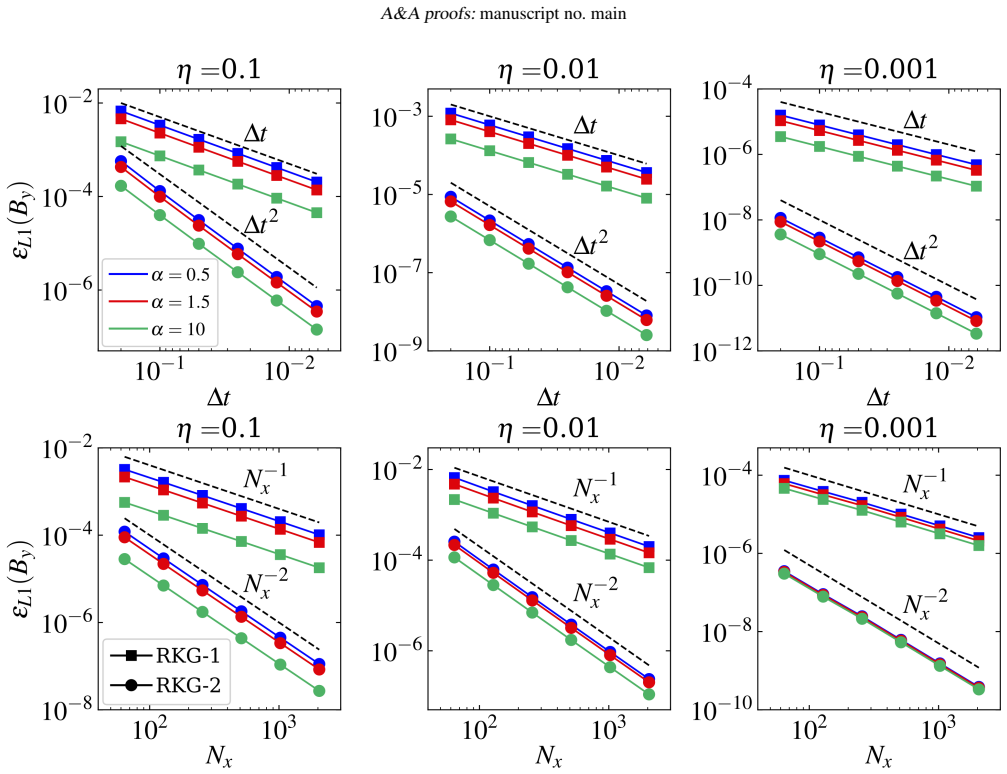
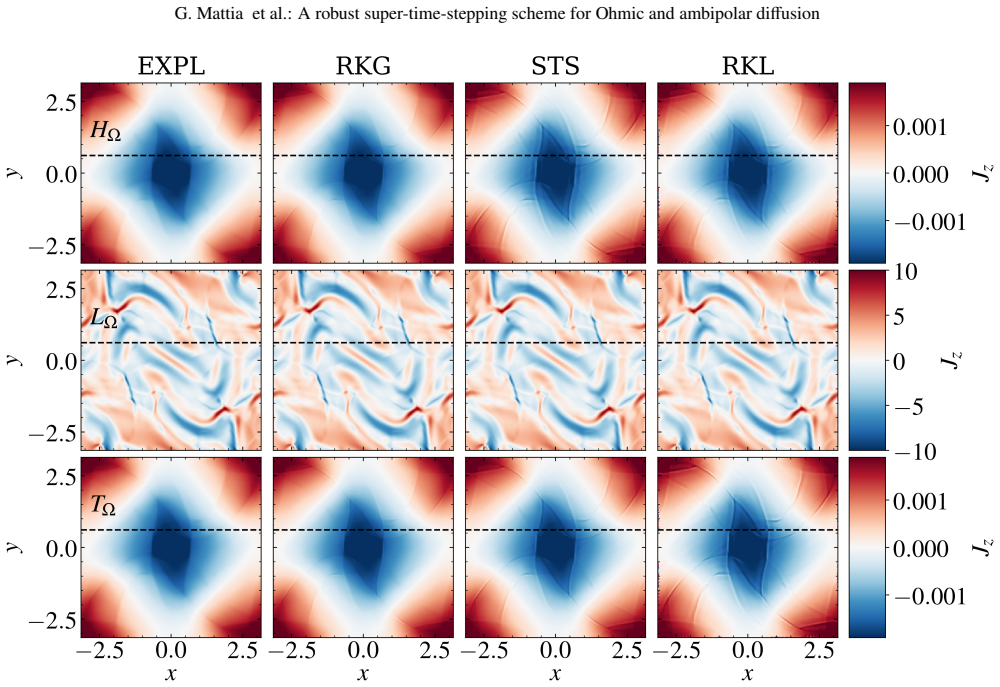
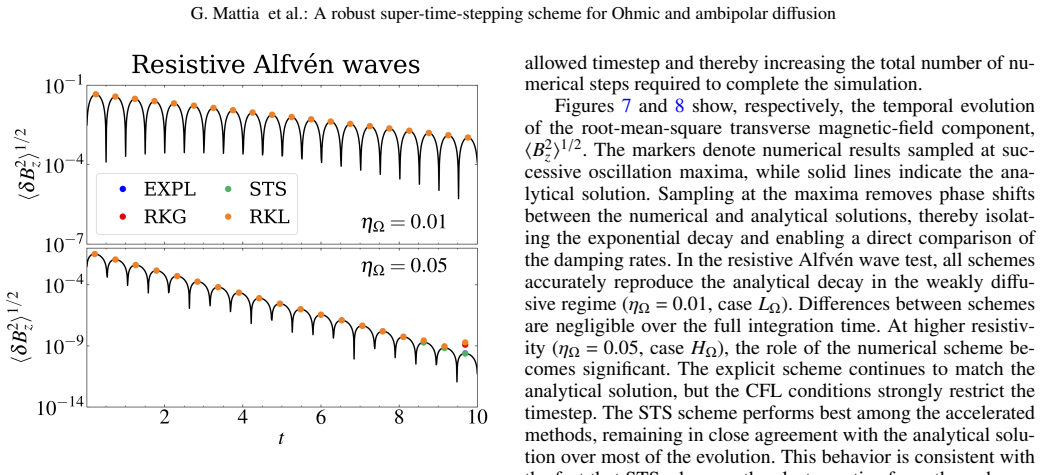
Context. Non-ideal magnetohydrodynamics (MHD) is a key tool for modeling magnetic flux transport in astrophysical systems such as molecular clouds, protostellar cores, and protoplanetary disks. Conventional explicit methods for non-ideal MHD diffusion are severely limited by timestep constraints, while substepping approaches can be unstable due to truncation errors near boundaries and strong magnetic-field gradients. Aims. Our main goal is to address these limitations by developing robust super-time-stepping methods for Ohmic and ambipolar diffusion. Methods. We present a super-time-stepping method based on the stability of the Gegenbauer polynomials. The method is designed to enhance robustness in the presence of strongly anisotropic resistivity and to reduce sensitivity to truncation errors near boundaries. We implement the scheme in the PLUTO code and assess its performance through dedicated Ohmic and ambipolar diffusion tests. We also compare this novel numerical scheme against two common astrophysical problems, namely magnetic reconnection and the magnetorotational instability. Results. The novel Runge-Kutta-Gegenbauer scheme retains computational efficiency beyond purely explicit schemes while providing excellent stability compared with other traditional substepping methods. It remains stable in the presence of strongly anisotropic diffusion, enabling accurate magnetic-field evolution in regimes characteristic of protoplanetary disks and collapsing dense cores. Benchmark tests, including magnetic reconnection and magnetorotational-instability setups, confirm the method's accuracy, efficiency, and suitability for large-scale non-ideal MHD simulations.
Editorial analysis
A structured set of objections, weighed in public.
Referee Report
Summary. The manuscript introduces a Runge-Kutta-Gegenbauer super-time-stepping scheme for Ohmic and ambipolar diffusion in non-ideal MHD. Implemented in the PLUTO code, the method is tested on dedicated diffusion problems and benchmarked against magnetic reconnection and magnetorotational instability setups, with the central claim that it delivers efficiency gains over explicit schemes, superior stability relative to other substepping approaches, and robustness under strong anisotropy.
Significance. If the reported stability and accuracy hold, the scheme would enable larger timesteps in simulations of protoplanetary disks and collapsing cores where anisotropic non-ideal effects dominate. The approach is grounded in polynomial stability properties rather than fitted parameters, and the inclusion of reconnection and MRI benchmarks directly targets the regimes of interest. The stress-test concern regarding translation of Gegenbauer stability to anisotropic resistivity and boundary truncation errors does not land, as the manuscript provides dedicated tests in those regimes.
minor comments (2)
- [Abstract] Abstract: the phrase 'retains computational efficiency beyond purely explicit schemes' would benefit from a quantitative statement of the speedup factor achieved in the reported tests.
- [Methods] The description of boundary handling in the super-time-stepping implementation should include a brief statement on how truncation errors are controlled, even if the tests demonstrate robustness.
Simulated Author's Rebuttal
We thank the referee for the positive assessment of our manuscript and the recommendation of minor revision. No specific major comments were raised in the report.
Circularity Check
No significant circularity; derivation anchored in external polynomial stability properties
full rationale
The paper presents a Runge-Kutta-Gegenbauer super-time-stepping scheme explicitly derived from the established stability properties of Gegenbauer polynomials (abstract: 'a super-time-stepping method based on the stability of the Gegenbauer polynomials'). This is a standard external mathematical fact, not constructed from the paper's own fitted results or prior self-citations. No load-bearing steps reduce to self-definition, parameter fitting renamed as prediction, or uniqueness theorems imported from the authors' own prior work. Benchmark tests and comparisons to reconnection/MRI problems provide independent verification outside any internal loop. The central efficiency/stability claims therefore remain self-contained.
Axiom & Free-Parameter Ledger
Reference graph
Works this paper leans on
-
[1]
Handbook of Mathematical Functions
-
[2]
and Amiez, Genevgve and Gremaud, Pierre , year =
Alexiades, V. and Amiez, Genevgve and Gremaud, Pierre , year =. Super-time-stepping acceleration of explicit schemes for parabolic problems , volume =. Communications in Numerical Methods in Engineering , doi =
-
[3]
, year = 1942, month = oct, volume =
Existence of Electromagnetic-Hydrodynamic Waves. , year = 1942, month = oct, volume =. doi:10.1038/150405d0 , adsurl =
doi:10.1038/150405d0 1942
-
[4]
Dynamics of Protoplanetary Disks. , keywords =. doi:10.1146/annurev-astro-081710-102521 , archivePrefix =. 1011.1496 , primaryClass =
-
[5]
Effect of Ambipolar Diffusion on the Nonlinear Evolution of Magnetorotational Instability in Weakly Ionized Disks. , keywords =. doi:10.1088/0004-637X/736/2/144 , archivePrefix =. 1103.1380 , primaryClass =
-
[6]
Wave Propagation in Molecular Clouds. , keywords =. doi:10.1086/177462 , adsurl =
-
[7]
Barenblatt, G. I. , title =. Prikl.\ Mat.\ Mekh. , volume =
-
[8]
Magnetic fields in spiral galaxies. , keywords =. doi:10.1007/s00159-015-0084-4 , archivePrefix =. 1509.04522 , primaryClass =
-
[9]
Journal of Computational Physics , keywords =
A 4 ^ th -order accurate finite volume method for ideal classical and special relativistic MHD based on pointwise reconstructions. Journal of Computational Physics , keywords =. doi:10.1016/j.jcp.2023.112701 , archivePrefix =. 2310.11831 , primaryClass =
-
[10]
2D or not 2D? Exploring 3D relativistic magnetic reconnection dynamics with highly accurate numerical simulations. , keywords =. doi:10.1093/mnras/stag286 , archivePrefix =. 2512.15954 , primaryClass =
-
[11]
Journal of Computational Physics , year = 2008, month = mar, volume =
An improved weighted essentially non-oscillatory scheme for hyperbolic conservation laws. Journal of Computational Physics , year = 2008, month = mar, volume =. doi:10.1016/j.jcp.2007.11.038 , adsurl =
-
[12]
Astrophysical magnetic fields and nonlinear dynamo theory. , keywords =. doi:10.1016/j.physrep.2005.06.005 , archivePrefix =. astro-ph/0405052 , primaryClass =
-
[13]
Butcher, J. C. , biburl =. The Numerical analysis of ordinary differential equations : Runge-Kutta and general linear methods , url =
-
[14]
Caplan, Ronald M. and Johnston, Craig D. and Daldoff, Lars K. S. and Linker, Jon A. , title =. 2024 , month =. doi:10.1088/1742-6596/2742/1/012020 , url =
-
[15]
doi:10.1007/978-88-470-5280-2 , adsurl =
Basics of Plasma Astrophysics. doi:10.1007/978-88-470-5280-2 , adsurl =
-
[16]
An Explicit Scheme for Incorporating Ambipolar Diffusion in a Magnetohydrodynamics Code. , keywords =. doi:10.1088/0067-0049/181/2/413 , archivePrefix =. 0812.3748 , primaryClass =
-
[17]
Mathematische Annalen , year = 1928, month = jan, volume =
\"U ber die partiellen Differenzengleichungen der mathematischen Physik. Mathematische Annalen , year = 1928, month = jan, volume =. doi:10.1007/BF01448839 , adsurl =
-
[18]
, year = 2012, month = sep, volume =
Magnetic Fields in Molecular Clouds. , year = 2012, month = sep, volume =. doi:10.1146/annurev-astro-081811-125514 , adsurl =
-
[19]
Journal of Computational Physics , year = 2002, month = jan, volume = 175, pages =
Hyperbolic Divergence Cleaning for the MHD Equations. Journal of Computational Physics , year = 2002, month = jan, volume = 175, pages =. doi:10.1006/jcph.2001.6961 , adsurl =
-
[20]
The coefficients of differentiated expansions and derivatives of ultraspherical polynomials , journal =. 1991 , issn =. doi:https://doi.org/10.1016/0898-1221(91)90089-M , url =
-
[21]
Simulating hydromagnetic processes in star formation: introducing ambipolar diffusion into an adaptive mesh refinement code. , keywords =. doi:10.1111/j.1365-2966.2008.14026.x , archivePrefix =. 0810.0299 , primaryClass =
-
[22]
Higher Transcendental Functions , year = 1953, pages =
Higher Transcendental Functions. Higher Transcendental Functions , year = 1953, pages =
1953
-
[23]
Collimation of Astrophysical Jets: The Role of the Accretion Disk Magnetic Field Distribution. , keywords =. doi:10.1086/507976 , archivePrefix =. astro-ph/0511611 , primaryClass =
-
[24]
Magnetically disrupted discs and surface accretion
A global 3D simulation of magnetospheric accretion - I. Magnetically disrupted discs and surface accretion. , keywords =. doi:10.1093/mnras/stad3712 , archivePrefix =. 2309.15318 , primaryClass =
-
[25]
MHD simulations of the magnetorotational instability in a shearing box with zero net flux. I. The issue of convergence. , keywords =. doi:10.1051/0004-6361:20077942 , archivePrefix =. 0705.3621 , primaryClass =
-
[26]
Array programming with NumPy. , keywords =. doi:10.1038/s41586-020-2649-2 , archivePrefix =. 2006.10256 , primaryClass =
-
[27]
A Powerful Local Shear Instability in Weakly Magnetized Disks. II. Nonlinear Evolution. , keywords =. doi:10.1086/170271 , adsurl =
-
[28]
Computing in Science and Engineering , keywords =
Matplotlib: A 2D Graphics Environment. Computing in Science and Engineering , keywords =. doi:10.1109/MCSE.2007.55 , adsurl =
-
[29]
A Powerful Local Shear Instability in Weakly Magnetized Disks. I. Linear Analysis. , keywords =. doi:10.1086/170270 , adsurl =
-
[30]
3D Radiation Nonideal Magnetohydrodynamical Simulations of the Inner Rim in Protoplanetary Disks. , keywords =. doi:10.3847/1538-4357/835/2/230 , archivePrefix =. 1612.02740 , primaryClass =
-
[31]
Radiation magnetohydrodynamics in global simulations of protoplanetary discs. , keywords =. doi:10.1051/0004-6361/201322451 , archivePrefix =. 1310.5865 , primaryClass =
-
[32]
Strong Stability-Preserving High-Order Time Discretization Methods. SIAM Review , keywords =. doi:10.1137/S003614450036757X , adsurl =
-
[33]
Global Simulations of Protoplanetary Disks With Ohmic Resistivity and Ambipolar Diffusion. , keywords =. doi:10.1088/0004-637X/801/2/84 , archivePrefix =. 1501.05431 , primaryClass =
-
[34]
Proceedings of the Royal Society of London Series A , year = 1982, month = sep, volume =
Eigenvalues of the Barenblatt-Pattle Similarity Solution in Nonlinear Diffusion. Proceedings of the Royal Society of London Series A , year = 1982, month = sep, volume =. doi:10.1098/rspa.1982.0122 , adsurl =
-
[35]
Hairer, E. and N. Solving Ordinary Differential Equations
-
[36]
and Lax, P
Harten, A. and Lax, P. and Leer, B. , title =. SIAM Review , volume =. 1983 , doi =
1983
-
[37]
On the coefficients of differentiated expansions of ultraspherical polynomials , journal =. 1992 , issn =. doi:https://doi.org/10.1016/0168-9274(92)90010-B , url =
-
[38]
Energy distribution and substructure formation in astrophysical MHD simulations. , keywords =. doi:10.1093/mnras/stad3807 , archivePrefix =. 2308.16062 , primaryClass =
-
[39]
Ambipolar diffusion in the magnetorotational instability. , keywords =. doi:10.1111/j.1365-2966.2004.07383.x , archivePrefix =. astro-ph/0309707 , primaryClass =
-
[40]
High-order Godunov schemes for global 3D MHD simulations of accretion disks. I. Testing the linear growth of the magneto-rotational instability. , keywords =. doi:10.1051/0004-6361/200912443 , archivePrefix =. 0906.5516 , primaryClass =
-
[41]
The combined influence of Ohmic, Hall, and ambipolar diffusion on dead zones
Thanatology in protoplanetary discs. The combined influence of Ohmic, Hall, and ambipolar diffusion on dead zones. , keywords =. doi:10.1051/0004-6361/201423660 , archivePrefix =. 1402.4133 , primaryClass =
-
[42]
Gap opening in protoplanetary discs: gas dynamics from global axisymmetric non-ideal MHD simulations with consistent thermochemistry. , keywords =. doi:10.1093/mnras/stad1632 , archivePrefix =. 2304.05972 , primaryClass =
-
[43]
Global three-dimensional simulations of outer protoplanetary discs with ambipolar diffusion. , keywords =. doi:10.1093/mnras/stab2220 , archivePrefix =. 2106.10167 , primaryClass =
-
[44]
Global simulations of protoplanetary disks with net magnetic flux. I. Non-ideal MHD case. , keywords =. doi:10.1051/0004-6361/201630056 , archivePrefix =. 1612.00883 , primaryClass =
-
[45]
Turbulence in the Outer Regions of Protoplanetary Disks. I. Weak Accretion with No Vertical Magnetic Flux. , keywords =. doi:10.1088/0004-637X/764/1/66 , archivePrefix =. 1210.4164 , primaryClass =
-
[46]
Exact shearing box solutions of magnetohydrodynamic flows with resistivity, viscosity and cooling. , keywords =. doi:10.1111/j.1365-2966.2007.12270.x , archivePrefix =. 0709.1388 , primaryClass =
-
[47]
Protostars and Planets VII , year = 2023, editor =
Hydro-, Magnetohydro-, and Dust-Gas Dynamics of Protoplanetary Disks. Protostars and Planets VII , year = 2023, editor =. doi:10.48550/arXiv.2203.09821 , archivePrefix =. 2203.09821 , primaryClass =
-
[48]
IDEFIX: A versatile performance-portable Godunov code for astrophysical flows. , keywords =. doi:10.1051/0004-6361/202346005 , archivePrefix =. 2304.13746 , primaryClass =
-
[49]
Journal of Computational Physics , keywords =
On the divergence-free condition in Godunov-type schemes for ideal magnetohydrodynamics: the upwind constrained transport method. Journal of Computational Physics , keywords =. doi:10.1016/j.jcp.2003.09.016 , archivePrefix =. astro-ph/0310183 , primaryClass =
-
[50]
Chemical solver to compute molecule and grain abundances and non-ideal MHD resistivities in prestellar core-collapse calculations. , keywords =. doi:10.1051/0004-6361/201526780 , archivePrefix =. 1604.05613 , primaryClass =
-
[51]
Plasma Physics and Controlled Fusion , keywords =
Magnetic reconnection: from the Sweet-Parker model to stochastic plasmoid chains. Plasma Physics and Controlled Fusion , keywords =. doi:10.1088/0741-3335/58/1/014021 , archivePrefix =. 1507.07756 , primaryClass =
-
[52]
Non-ideal magnetohydrodynamics on a moving mesh. , keywords =. doi:10.1093/mnras/sty397 , archivePrefix =. 1710.10265 , primaryClass =
-
[53]
Incorporating Ambipolar and Ohmic Diffusion in the AMR MHD Code RAMSES. , keywords =. doi:10.1088/0067-0049/201/2/24 , archivePrefix =. 1206.2476 , primaryClass =
-
[54]
Ambipolar diffusion in low-mass star formation. I. General comparison with the ideal magnetohydrodynamic case. , keywords =. doi:10.1051/0004-6361/201526371 , archivePrefix =. 1509.05630 , primaryClass =
-
[55]
The Journal of Open Source Software , keywords =
PyPLUTO: a data analysis Python package for the PLUTO code. The Journal of Open Source Software , keywords =. doi:10.21105/joss.08448 , archivePrefix =. 2501.09748 , primaryClass =
-
[56]
Theory of Star Formation. , keywords =. doi:10.1146/annurev.astro.45.051806.110602 , archivePrefix =. 0707.3514 , primaryClass =
-
[57]
A second-order accurate Super TimeStepping formulation for anisotropic thermal conduction. , keywords =. doi:10.1111/j.1365-2966.2012.20744.x , adsurl =
-
[58]
Journal of Computational Physics , year = 2014, month = jan, volume =
A stabilized Runge-Kutta-Legendre method for explicit super-time-stepping of parabolic and mixed equations. Journal of Computational Physics , year = 2014, month = jan, volume =. doi:10.1016/j.jcp.2013.08.021 , adsurl =
-
[59]
Mignone, A. and Bodo, G. and Massaglia, S. and Matsakos, T. and Tesileanu, O. and Zanni, C. and Ferrari, A. , year =. The Astrophysical Journal Supplement Series , volume =. doi:10.1086/513316 , urldate =
-
[60]
A conservative orbital advection scheme for simulations of magnetized shear flows with the PLUTO code. , keywords =. doi:10.1051/0004-6361/201219557 , archivePrefix =. 1207.2955 , primaryClass =
-
[61]
Journal of Computational Physics , keywords =
High-order conservative reconstruction schemes for finite volume methods in cylindrical and spherical coordinates. Journal of Computational Physics , keywords =. doi:10.1016/j.jcp.2014.04.001 , archivePrefix =. 1404.0537 , primaryClass =
-
[62]
Journal of Computational Physics , keywords =
Systematic construction of upwind constrained transport schemes for MHD. Journal of Computational Physics , keywords =. doi:10.1016/j.jcp.2020.109748 , archivePrefix =. 2004.10542 , primaryClass =
-
[63]
A multi-state HLL approximate Riemann solver for ideal magnetohydrodynamics. Journal of Computational Physics , year = "2005", month = "Sep", volume =. doi:10.1016/j.jcp.2005.02.017 , adsurl =
-
[64]
Nonhomologous contraction and equilibria of self-gravitating, magnetic interstellar clouds embedded in an intercloud medium: star formation. II. Results. , keywords =. doi:10.1086/154478 , adsurl =
-
[65]
Ambipolar diffusion in the Bifrost code. , keywords =. doi:10.1051/0004-6361/202037809 , archivePrefix =. 2004.11927 , primaryClass =
-
[66]
Journal of Computational Physics , keywords =
Runge-Kutta-Gegenbauer explicit methods for advection-diffusion problems. Journal of Computational Physics , keywords =. doi:10.1016/j.jcp.2019.03.001 , adsurl =
-
[67]
Their origin and their activity
Cosmical magnetic fields. Their origin and their activity
-
[68]
Protostars and Planets V , year = 2007, editor =
Disk Winds, Jets, and Outflows: Theoretical and Computational Foundations. Protostars and Planets V , year = 2007, editor =. doi:10.48550/arXiv.astro-ph/0603592 , archivePrefix =. astro-ph/0603592 , primaryClass =
-
[69]
On the impact of the numerical method on magnetic reconnection and particle acceleration - I. The MHD case. , keywords =. doi:10.1093/mnras/stab2813 , archivePrefix =. 2109.12858 , primaryClass =
-
[70]
The impact of resistive electric fields on particle acceleration in reconnection layers. , keywords =. doi:10.1093/mnras/stac2807 , archivePrefix =. 2210.01113 , primaryClass =
-
[71]
Journal of Computational Physics , year = 1981, month = oct, volume =
Approximate Riemann Solvers, Parameter Vectors, and Difference Schemes. Journal of Computational Physics , year = 1981, month = oct, volume =. doi:10.1016/0021-9991(81)90128-5 , adsurl =
-
[72]
M. Rossazza and A. Mignone and M. Bugli and S. Truzzi and L. Riha and T. Panoc and O. Vysocky and N. Shukla and A. Romeo and V. Berta , keywords =. The PLUTO code on GPUs: A first look at Eulerian MHD methods , journal =. 2026 , issn =. doi:https://doi.org/10.1016/j.ascom.2026.101076 , url =
-
[73]
Star formation in molecular clouds: observation and theory. , keywords =. doi:10.1146/annurev.aa.25.090187.000323 , adsurl =
-
[74]
Journal of the British Astronomical Association , year = 1992, month = aug, volume =
Books-Received - the Physics of Astrophysics - V.2 - Gas Dynamics. Journal of the British Astronomical Association , year = 1992, month = aug, volume =
1992
-
[75]
Journal of Computational Physics , keywords =
Super-time-stepping schemes for parabolic equations with boundary conditions. Journal of Computational Physics , keywords =. doi:10.1016/j.jcp.2020.109879 , adsurl =
-
[76]
doi:10.1002/9783527617722 , adsurl =
Physical processes in the interstellar medium. doi:10.1002/9783527617722 , adsurl =
-
[77]
The Athena++ Adaptive Mesh Refinement Framework: Design and Magnetohydrodynamic Solvers. , keywords =. doi:10.3847/1538-4365/ab929b , archivePrefix =. 2005.06651 , primaryClass =
-
[78]
Radiation Magnetohydrodynamic Simulations of Protostellar Collapse: Protostellar Core Formation. , keywords =. doi:10.1088/0004-637X/763/1/6 , archivePrefix =. 1206.3567 , primaryClass =
-
[79]
Radiation Magnetohydrodynamic Simulations of Protostellar Collapse: Nonideal Magnetohydrodynamic Effects and Early Formation of Circumstellar Disks. , keywords =. doi:10.1088/0004-637X/801/2/117 , archivePrefix =. 1501.04102 , primaryClass =
-
[80]
Riemann Solvers and Numerical Methods for Fluid Dynamics: A Practical Introduction , journal =
Toro, Eleuterio , year =. Riemann Solvers and Numerical Methods for Fluid Dynamics: A Practical Introduction , journal =
discussion (0)
Sign in with ORCID, Apple, or X to comment. Anyone can read and Pith papers without signing in.