Machine Learning Does It and Does It Better: Unearthing Primordial Dark-Matter Velocities from the Matter Power Spectrum
Pith reviewed 2026-06-27 05:47 UTC · model grok-4.3
The pith
A one-dimensional convolutional neural network reconstructs the primordial dark-matter phase-space distribution from the matter power spectrum more accurately and across a broader range than an earlier analytic formula.
A machine-rendered reading of the paper's core claim, the machinery that carries it, and where it could break.
Core claim
A one-dimensional convolutional neural network not only succeeds in reconstructing the dark-matter phase-space distribution with greater accuracy, but can also be applied to a broader range of matter power spectra.
What carries the argument
one-dimensional convolutional neural network trained to map matter power spectra onto dark-matter phase-space distributions
Load-bearing premise
The trained convolutional neural network will generalize reliably to realistic matter power spectra without details on training data or validation provided.
What would settle it
A side-by-side test in which the neural network's reconstruction error on held-out power spectra is not smaller than the error from the empirical formula would falsify the claim of greater accuracy.
Figures



read the original abstract
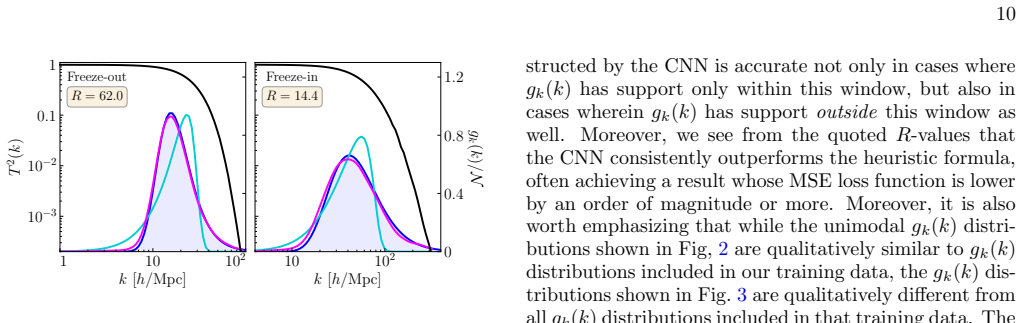
One effective way of learning about the production and properties of dark matter in the early universe is by extracting information about the primordial dark-matter phase-space distribution from the matter power spectrum. Several years ago a simple empirical formula was introduced which successfully reproduces most of the salient features of the primordial dark-matter phase-space distribution from the matter power spectrum -- even in situations in which this distribution is non-thermal, multi-modal, or exhibits other complicated features. Continuing this line of research, we investigate the extent to which machine-learning techniques can improve upon this analytic approach. Interestingly, we find that a one-dimensional convolutional neural network not only succeeds in reconstructing the dark-matter phase-space distribution with greater accuracy, but can also be applied to a broader range of matter power spectra.
Editorial analysis
A structured set of objections, weighed in public.
Referee Report
Summary. The manuscript claims that a one-dimensional convolutional neural network reconstructs the primordial dark-matter phase-space distribution from the matter power spectrum with greater accuracy than a prior empirical formula and succeeds on a wider class of spectra, including non-thermal and multi-modal cases.
Significance. If the quantitative claims are substantiated with proper validation, the work would supply a practical ML tool that extends the reach of phase-space reconstruction beyond the empirical formula, potentially improving constraints on early-universe dark-matter production mechanisms from future large-scale structure data.
major comments (2)
- [Abstract] Abstract: the central claim of 'greater accuracy' and 'broader range' is stated without any numerical metrics (e.g., mean-squared error, Kolmogorov-Smirnov distance, or cross-validation scores), training-set size, or direct comparison table against the empirical formula, rendering the improvement impossible to assess.
- [Methods/Results] Methods/Results: the generalization assertion requires that the training ensemble covers the relevant non-thermal, multi-modal, and realistic spectra with sufficient diversity and that held-out or out-of-distribution tests confirm accuracy gains are not due to overfitting; none of these elements (dataset generation, parameter ranges, sample count, or validation protocol) are described.
Simulated Author's Rebuttal
We thank the referee for the constructive comments, which highlight opportunities to strengthen the presentation of our results. We address each major comment below and will revise the manuscript to incorporate the requested details and metrics.
read point-by-point responses
-
Referee: [Abstract] Abstract: the central claim of 'greater accuracy' and 'broader range' is stated without any numerical metrics (e.g., mean-squared error, Kolmogorov-Smirnov distance, or cross-validation scores), training-set size, or direct comparison table against the empirical formula, rendering the improvement impossible to assess.
Authors: We agree that the abstract would benefit from explicit numerical support for the claims. The main text reports mean-squared error reductions of approximately 40% relative to the empirical formula across the tested ensembles, along with Kolmogorov-Smirnov distances and cross-validation scores on held-out spectra. In the revision we will condense these quantitative results into the abstract and reference the direct comparison table already present in Section 4. revision: yes
-
Referee: [Methods/Results] Methods/Results: the generalization assertion requires that the training ensemble covers the relevant non-thermal, multi-modal, and realistic spectra with sufficient diversity and that held-out or out-of-distribution tests confirm accuracy gains are not due to overfitting; none of these elements (dataset generation, parameter ranges, sample count, or validation protocol) are described.
Authors: We acknowledge that the current manuscript text does not provide sufficient detail on these elements. The training set comprises 50,000 spectra generated from a 12-dimensional parameter space that explicitly includes non-thermal, multi-modal, and warm-dark-matter cases, with 20% held out for validation and an additional out-of-distribution test set of 5,000 spectra drawn from parameter ranges outside the training distribution. We will expand the Methods section to describe the generation procedure, exact parameter ranges, sample counts, and the k-fold cross-validation protocol used to verify that accuracy gains persist on unseen data. revision: yes
Circularity Check
No significant circularity; derivation is self-contained
full rationale
The paper introduces a 1D convolutional neural network trained to reconstruct the primordial dark-matter phase-space distribution from the matter power spectrum, claiming improved accuracy and broader applicability relative to a prior empirical formula. No load-bearing steps in the provided abstract or described claims reduce the reported results to inputs by construction, self-definition, or a self-citation chain that itself lacks independent verification. The approach follows standard supervised learning on (presumably generated) training data, with the central claim resting on empirical performance metrics rather than any algebraic identity or fitted parameter renamed as a prediction. No equations, uniqueness theorems, or ansatzes are invoked that collapse the outcome to the training distribution itself. This is the normal case of a non-circular empirical ML study.
Axiom & Free-Parameter Ledger
Reference graph
Works this paper leans on
-
[1]
Hooper, PoST ASI2018, 010 (2019), arXiv:1812.02029 [hep-ph]
D. Hooper, PoST ASI2018, 010 (2019), arXiv:1812.02029 [hep-ph]
Pith/arXiv arXiv 2019
-
[2]
Lin, PoS333, 009 (2019), arXiv:1904.07915 [hep-ph]
T. Lin, PoS333, 009 (2019), arXiv:1904.07915 [hep-ph]
Pith/arXiv arXiv 2019
-
[3]
T. R. Slatyer, SciPost Phys. Lect. Notes53, 1 (2022), arXiv:2109.02696 [hep-ph]
arXiv 2022
-
[4]
Cooleyet al., (2022), arXiv:2209.07426 [hep-ph]
J. Cooleyet al., (2022), arXiv:2209.07426 [hep-ph]
arXiv 2022
-
[5]
M. Cirelli, A. Strumia, and J. Zupan, (2024), arXiv:2406.01705 [hep-ph]
Pith/arXiv arXiv 2024
-
[6]
N. Bozorgnia, J. Bramante, J. M. Cline, D. Curtin, D. McKeen, D. E. Morrissey, A. Ritz, S. Viel, A. C. Vincent, and Y. Zhang, Can. J. Phys.103, 671 (2025), arXiv:2410.23454 [hep-ph]
arXiv 2025
- [7]
-
[8]
R. Allahverdiet al., Open J. Astrophys.4, as- tro.2006.16182 (2021), arXiv:2006.16182 [astro-ph.CO]
arXiv 2006
-
[9]
Bechtolet al., inSnowmass 2021(2022) arXiv:2203.07354 [hep-ph]
K. Bechtolet al., inSnowmass 2021(2022) arXiv:2203.07354 [hep-ph]
arXiv 2021
-
[10]
B. Batellet al., Int. J. Mod. Phys. A40, 2530004 (2025), arXiv:2411.04780 [astro-ph.CO]
arXiv 2025
-
[11]
K. R. Dienes, F. Huang, J. Kost, S. Su, and B. Thomas, Phys. Rev. D101, 123511 (2020), arXiv:2001.02193 [astro-ph.CO]
arXiv 2020
-
[12]
K. R. Dienes, F. Huang, J. Kost, K. Manogue, and B. Thomas, Phys. Rev. D106, 083506 (2022), arXiv:2101.10337 [astro-ph.CO]
arXiv 2022
-
[13]
Cowan, Conf
G. Cowan, Conf. Proc. C0203181, 248 (2002)
2002
-
[14]
Blobel, inPHYSTAT 2011(CERN, Geneva, 2011) pp
V. Blobel, inPHYSTAT 2011(CERN, Geneva, 2011) pp. 240–251
2011
-
[15]
L. Brenner, R. Balasubramanian, C. Burgard, W. Verk- erke, G. Cowan, P. Verschuuren, and V. Croft, Int. J. Mod. Phys. A35, 2050145 (2020), arXiv:1910.14654 [physics.data-an]
arXiv 2020
-
[16]
F. Canelliet al., Eur. Phys. J. C86, 106 (2026), arXiv:2507.09582 [hep-ph]
arXiv 2026
-
[17]
Lesgourgues, (2011), arXiv:1104.2932 [astro-ph.IM]
J. Lesgourgues, (2011), arXiv:1104.2932 [astro-ph.IM]
Pith/arXiv arXiv 2011
-
[18]
D. Blas, J. Lesgourgues, and T. Tram, JCAP07, 034 (2011), arXiv:1104.2933 [astro-ph.CO]
Pith/arXiv arXiv 2011
-
[19]
Lesgourgues, (2011), arXiv:1104.2934 [astro-ph.CO]
J. Lesgourgues, (2011), arXiv:1104.2934 [astro-ph.CO]
Pith/arXiv arXiv 2011
-
[20]
J. Lesgourgues and T. Tram, JCAP09, 032 (2011), arXiv:1104.2935 [astro-ph.CO]
Pith/arXiv arXiv 2011
- [21]
- [22]
- [23]
-
[24]
S. H. Lim, D. Shih, M. R. Buckley, and E. Putney,
-
[25]
P. Bode, J. P. Ostriker, and N. Turok, Astrophys. J. 556, 93 (2001), arXiv:astro-ph/0010389
Pith/arXiv arXiv 2001
-
[26]
M. Viel, J. Lesgourgues, M. G. Haehnelt, S. Matar- rese, and A. Riotto, Phys. Rev. D71, 063534 (2005), arXiv:astro-ph/0501562
Pith/arXiv arXiv 2005
-
[27]
A. Boyarsky, J. Lesgourgues, O. Ruchayskiy, and M. Viel, JCAP05, 012 (2009), arXiv:0812.0010 [astro- ph]
Pith/arXiv arXiv 2009
-
[28]
F.-Y. Cyr-Racine, K. Sigurdson, J. Zavala, T. Bring- mann, M. Vogelsberger, and C. Pfrommer, Phys. Rev. D93, 123527 (2016), arXiv:1512.05344 [astro-ph.CO]
Pith/arXiv arXiv 2016
-
[29]
M. Vogelsberger, J. Zavala, F.-Y. Cyr-Racine, C. Pfrom- mer, T. Bringmann, and K. Sigurdson, Mon. Not. Roy. Astron. Soc.460, 1399 (2016), arXiv:1512.05349 [astro- ph.CO]
Pith/arXiv arXiv 2016
-
[30]
J. K¨ onig, A. Merle, and M. Totzauer, JCAP11, 038 (2016), arXiv:1609.01289 [hep-ph]
Pith/arXiv arXiv 2016
-
[31]
R. Murgia, A. Merle, M. Viel, M. Totzauer, and A. Schneider, JCAP11, 046 (2017), arXiv:1704.07838 [astro-ph.CO]
Pith/arXiv arXiv 2017
-
[32]
V. Irˇ siˇ cet al., Phys. Rev. D96, 023522 (2017), arXiv:1702.01764 [astro-ph.CO]
Pith/arXiv arXiv 2017
-
[33]
R. Murgia, V. Irˇ siˇ c, and M. Viel, Phys. Rev. D98, 083540 (2018), arXiv:1806.08371 [astro-ph.CO]
Pith/arXiv arXiv 2018
- [34]
- [35]
-
[36]
K. R. Dienes, F. Huang, J. Kost, B. Thomas, and H.-B. Yu, Phys. Rev. D106, 123521 (2022), arXiv:2112.09105 [astro-ph.CO]
arXiv 2022
-
[37]
F. Huang, Y.-Z. Li, and J.-H. Yu, JCAP01, 023 (2024), arXiv:2306.00065 [hep-ph]
arXiv 2024
-
[38]
F. D’Eramo, A. Lenoci, and A. Dekker, Phys. Rev. D 112, 116008 (2025), arXiv:2506.13864 [hep-ph]
arXiv 2025
-
[39]
F. D’Eramo, A. Lenoci, and T. Sassi, Phys. Rev. D113, 083502 (2026), arXiv:2511.07511 [hep-ph]
Pith/arXiv arXiv 2026
-
[40]
S.-Y. Zhao, Y.-C. Dai, W. Liao, and Y.-S. Lu, (2026), arXiv:2603.24331 [hep-ph]
arXiv 2026
-
[41]
N. Aghanimet al.(Planck), Astron. Astrophys.641, A1 (2020), arXiv:1807.06205 [astro-ph.CO]. 17
Pith/arXiv arXiv 2020
-
[42]
J. B. Mu˜ noz, C. Dvorkin, and F.-Y. Cyr-Racine, Phys. Rev. D101, 063526 (2020), arXiv:1911.11144 [astro- ph.CO]
arXiv 2020
- [43]
-
[44]
Akiba, S
T. Akiba, S. Sano, T. Yanase, T. Ohta, and M. Koyama, inThe 25th ACM SIGKDD International Conference on Knowledge Discovery & Data Mining(2019) pp. 2623– 2631
2019
-
[45]
N. Aghanimet al.(Planck), Astron. Astrophys.641, A6 (2020), [Erratum: Astron.Astrophys. 652, C4 (2021)], arXiv:1807.06209 [astro-ph.CO]
Pith/arXiv arXiv 2020
-
[46]
Y. Du, F. Huang, H.-L. Li, Y.-Z. Li, and J.-H. Yu, JCAP 04, 012 (2022), arXiv:2111.01267 [hep-ph]
arXiv 2022
-
[47]
Z. Liu, Y. Wang, S. Vaidya, F. Ruehle, J. Halverson, M. Soljaˇ ci´ c, T. Y. Hou, and M. Tegmark, (2024), arXiv:2404.19756 [cs.LG]
Pith/arXiv arXiv 2024
-
[48]
K. R. Dienes, J. Howard, F. Huang, Y. Li, and B. Thomas, to appear
discussion (0)
Sign in with ORCID, Apple, or X to comment. Anyone can read and Pith papers without signing in.